
Home » 2011 (Page 10)
Yearly Archives: 2011
Traffic congestion in Metro Manila: Is the UVVRP still effective? – Part 1
I was interviewed last week about the traffic congestion generally experienced along major roads in Metro Manila. I was asked whether I thought the Unified Vehicular Volume Reduction Program (UVVRP) more popularly known as the number coding scheme was still effective, and I replied that based on what we are experiencing it is obviously not effective anymore. The reasoning here can be traced from the fact that when the scheme was first formulated and implemented, the main assumption was that if the number of license plates on registered vehicles were equally distributed among the 10 digits (1 to 0), then by restricting 2 digits indicated as the end/last number on a plate we could automatically have a 20% reduction in the number vehicles. This rather simplistic assumption was sound at the time but apparently did not take into consideration that eventually, people owning vehicles will be able to adjust to the scheme one way or another.
One way to adjust when the number coding scheme was implemented was to change traveling times. Everyone knew that the scheme was enforced from 7:00 AM to 7:00 PM (i.e., there was no 10:00 AM to 3:00 PM window at the time) and so people only had to travel from the origins to their destinations before 7:00 AM. Similarly, they would travel back after 7:00 PM, which partly explains why after 7:00 PM there is usually traffic congestion due to “coding” vehicles coming out to travel. In effect, the “coding” vehicle is not absent from the streets that day. Instead, it is only used during the time outside of the “coding” or restricted period.
Another way that was actually a desired impact of the coding scheme was for people to shift to public transport, at least for the day when their vehicle was “coding.” That way, the vehicle is left at home and there is one less vehicle for every person who opted to take public transport. This, however, was not to be and people did not shift to public transport. Perhaps the quality of services available or provided to them were just not acceptable to most people and so they didn’t take public transport and a significant number instead opted for a third way.
That third way to adjust was one that was the least desirable of the consequences of number coding – people who could afford it bought another vehicle. This was actually a result that could have been expected or foreseen given the trends and direct relationship between increases in income associated with economic growth where people would eventually be able to afford to buy a vehicle. Actually, there is no problem with owning a car. The concern is when one uses it and when he opts to travel. Of course, this does not necessarily mean that people started buying new cars outright, making this something like an overnight phenomenon. It happened over several years and involved a cycle that starts when the wealthier people decide to purchase a new vehicle and discards their old ones. These used vehicles become available on the “second hand” market and are purchased by those with smaller budgets. Some of these may have even older vehicles that they will in turn discard, and eventually be owned by other people with even less budget. Note that in this cycle, very few vehicles are actually retired, if at all considering this country has no retirement policy for old vehicles. The end result? More cars on the roads and consequently, more severe and more frequent congestion.
Below is an excerpt from the news report on News TV Channel 11:
National EST Strategy Formal Launch
The National Environmentally Sustainable Transport (EST) Strategy of the Philippines was formally launched yesterday, May 20, 2011. The formal launch event was held at the Columbus Room of the Discovery Suites along ADB Avenue in Ortigas Center, Pasig City. It was graced by the presence of top government officials including Secretary Jose “Ping” P. De Jesus of the Department of Transportation and Communications (DOTC) and Presidential Assistant on Climate Change Elisea “Bebet” Gozun, who was a former Secretary of the Department of Environment and Natural Resources (DENR). The DOTC came full force with Undersecretary for Planning and Policy Ruben Reinoso, Assistant Secretary for Planning George D. Esguerra, Office of Transport Cooperatives Chair Leticia Z. Gorrospe, consultant and former Assistant Secretary Alberto Suansing, and senior technical staff of the DOTC and its line agencies including the Land Transportation Office (LTO) and the Land Transport Franchising and Regulatory Board (LTFRB). The DOTC and the DENR are the national focal agencies for the project and will be expected to lead in the operationalization of the national strategy.
The supporting agencies and organizations were represented by Mr. Choudhury Rudra Mohanty of the United Nations Centre for Regional Development (UNCRD), Ms. Sophie Punte of the Clean Air Initiative for Asian Cities (CAI-Asia), and Mr. Akio Isomata, Minister of the Embassy of Japan to the Philippines, who represented his country’s Ministry of Environment. Development agencies and banks were also present with representatives from the World Bank (WB), the Asian Development Bank (ADB) and the Japan International Cooperation Agency (JICA). Also present were stakeholders led by the Partnership for Clean Air (PCA), Philippines – Global Road Safety Partnership (PGRSP), and the Firefly Brigade, and participants from local government units led by Quezon City and Marikina City. The national collaborating center was well represented by the study team from the National Center for Transportation Studies (NCTS) of the University of the Philippines Diliman.
The formal launch even began with the Opening Remarks from the UNCRD delivered by Mr. Mohanty and was followed by a Message from DOTC Sec. De Jesus. The formal messages were followed by a presentation of the highlights of the national strategy by D. Jose Regin F. Regidor, NCTS Director. Afterwards, a panel discussion with the theme “Operationalization of EST in Support of Sustainable Development in the Philippines.” The discussion was facilitated by Ms. Punte and Mr. Herbert Fabian of CAI-Asia. Panel members included DOTC Asst. Sec. Esguerra, WB Lead Transport Economist Baher El-Hifnawi, ADB GEF focal person Bruce Dunn, and Mactan Cebu International Airport Manager Nigel Paul C. Villarete, who is also a former City Planning Coordinator of Cebu City and who is an advocate of Bus Rapid Transit (BRT) in the Philippines. The formal launch event concluded with congratulatory messages from the Government of Japan and the Presidential Assistant for Climate Change, followed by a photo op for all in attendance that day.
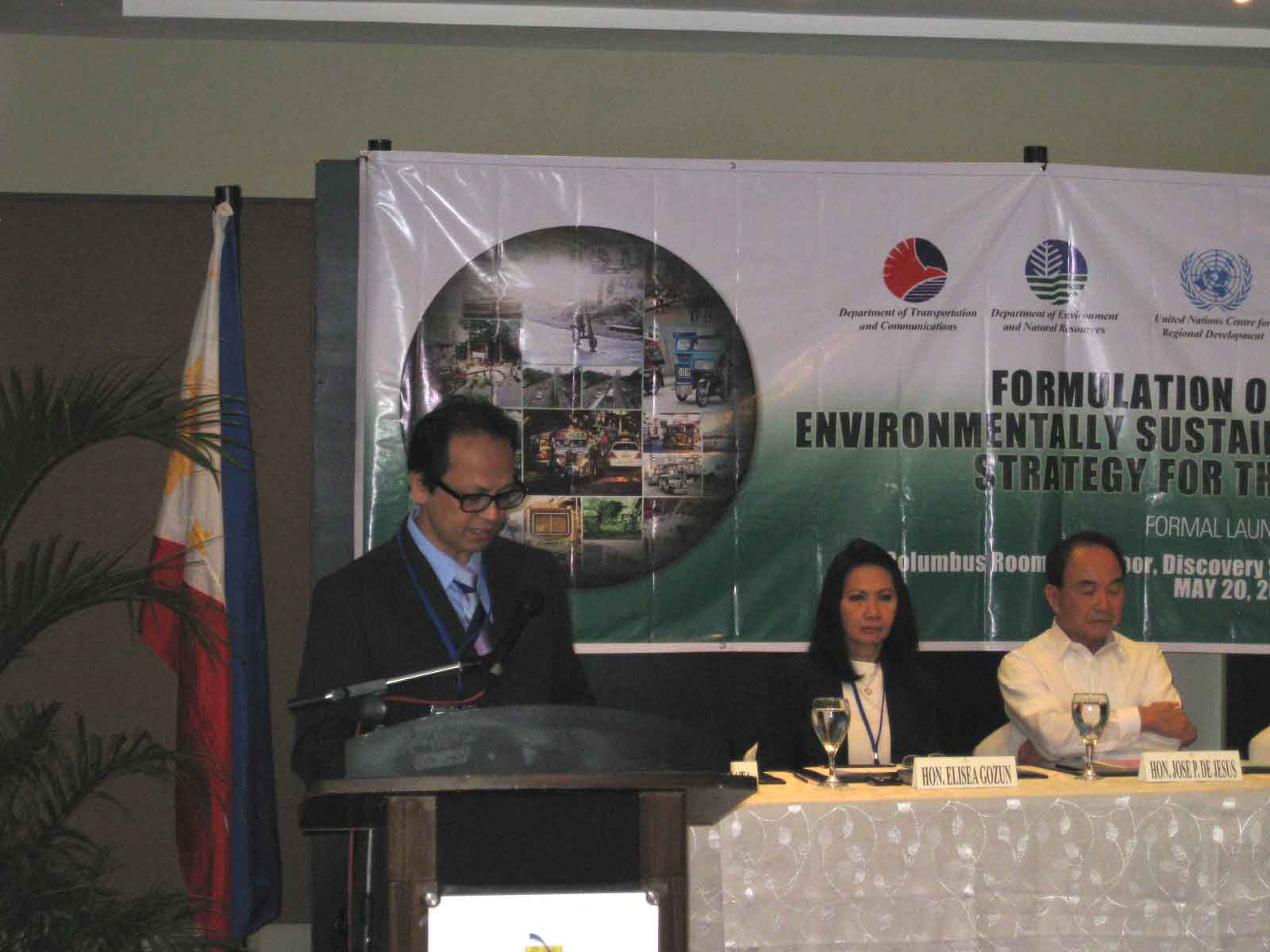 Mr. Mohanty of UNCRD delivering the Opening Remarks
 DOTC Sec. Ping De Jesus delivering a message from the Department
 NCTS Director Regidor presenting the highlights of the national EST strategy
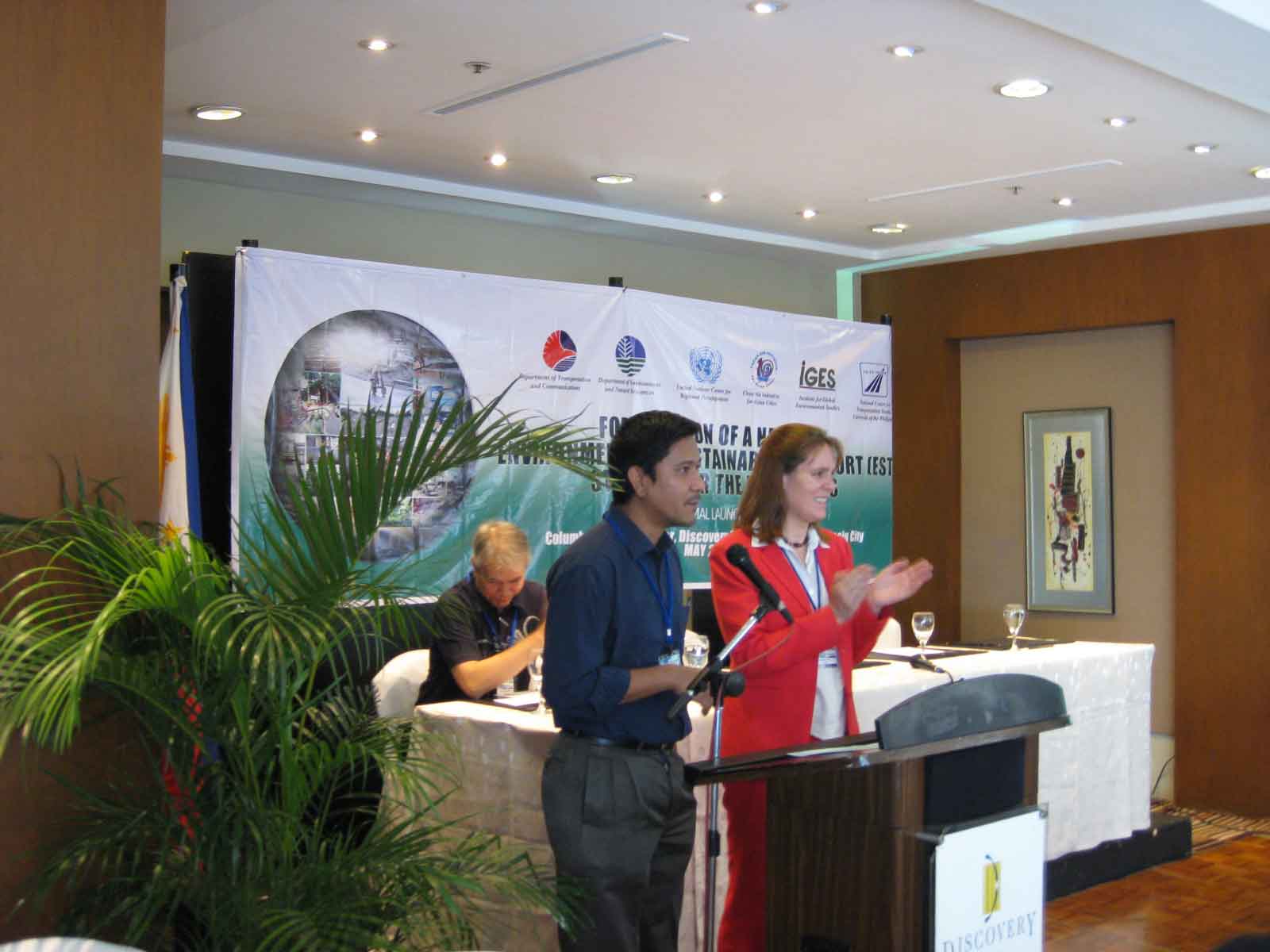 CAI-Asia’s Bert Fabian and Sophie Punte facilitated the panel discussion
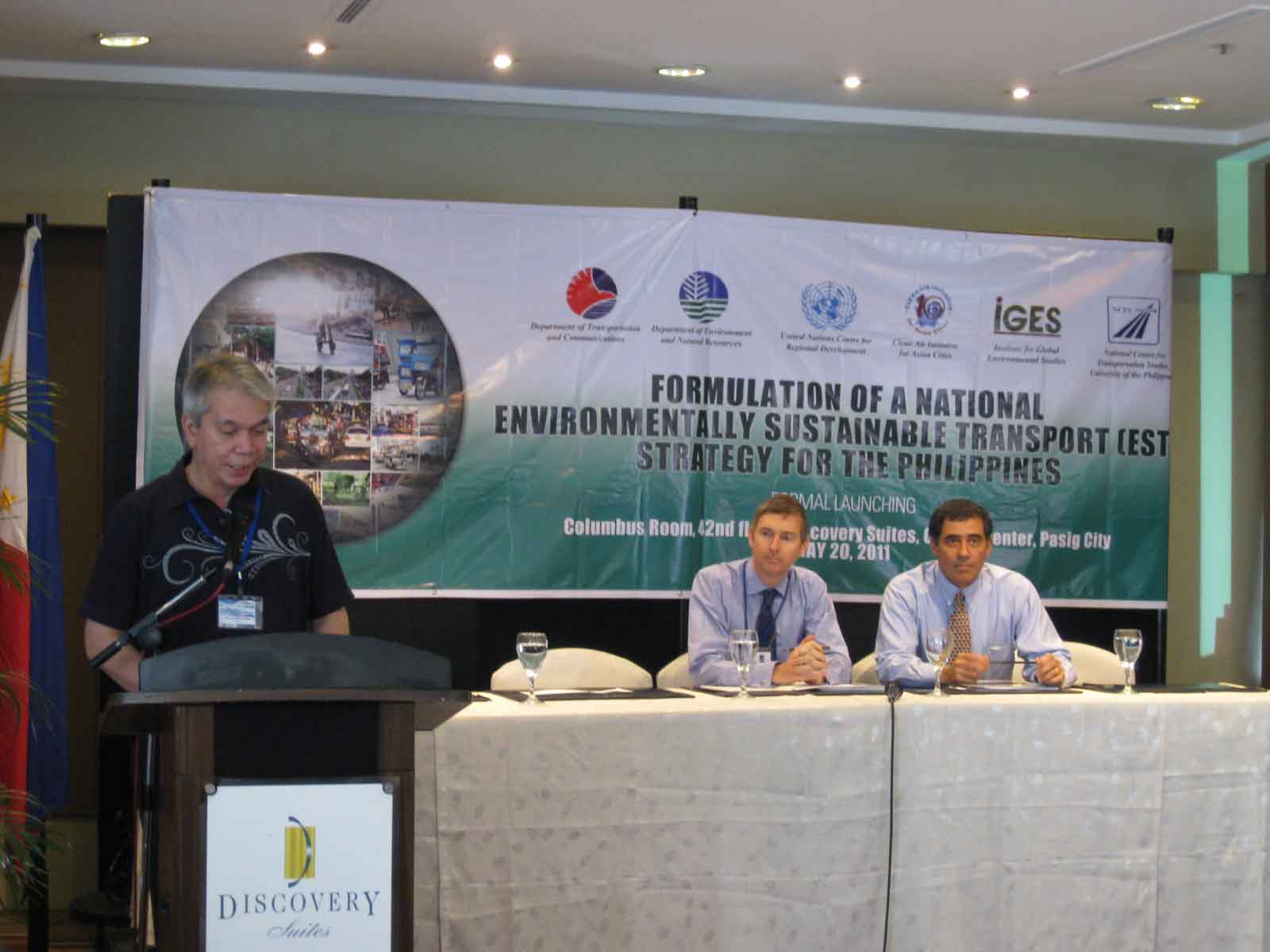 DOTC Asst. Sec. George D. Esguerra responding to the key questions during the panel discussion
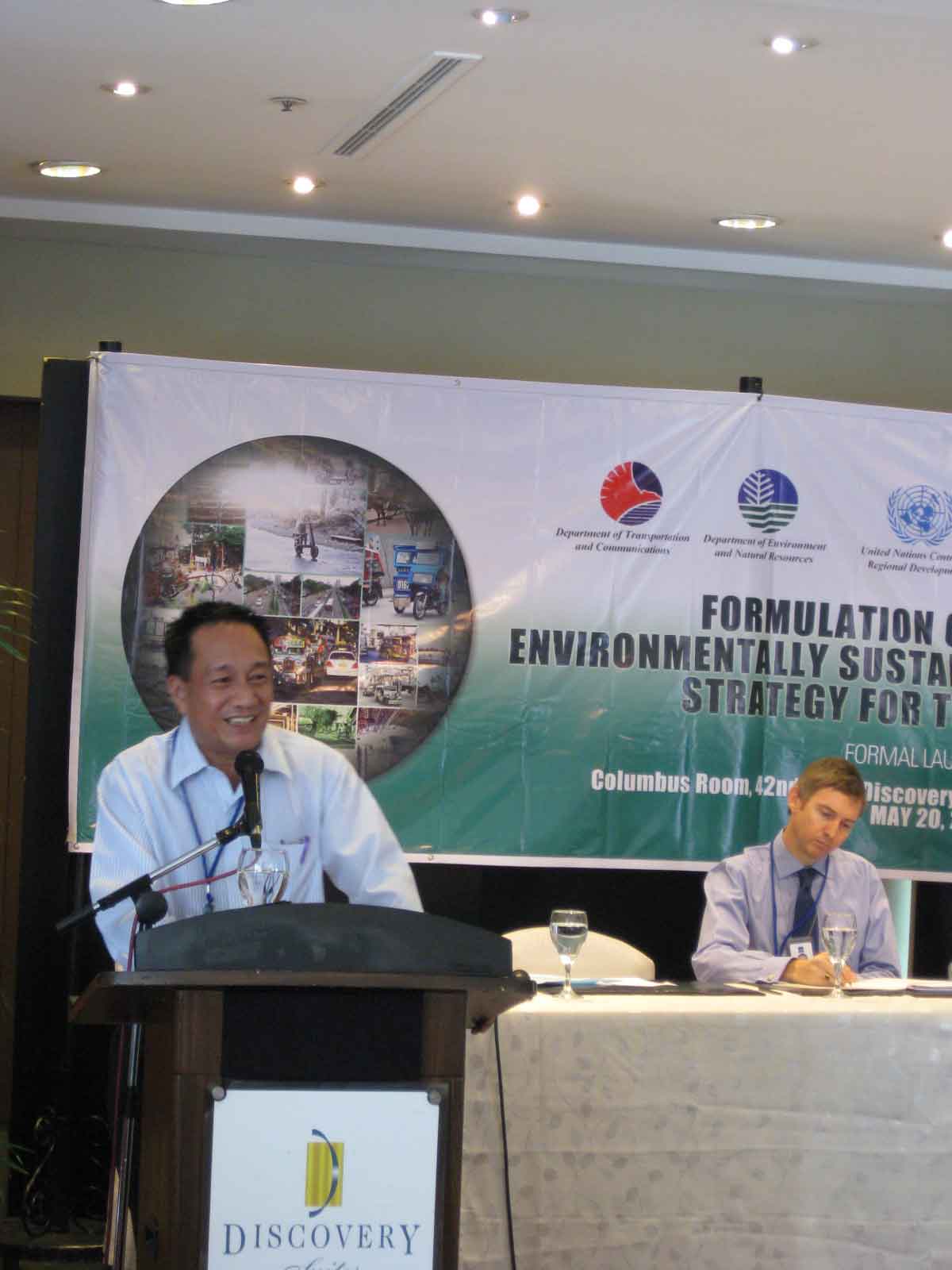 MCIAA’s Nigel Paul Villarete making his comments during the panel discussion
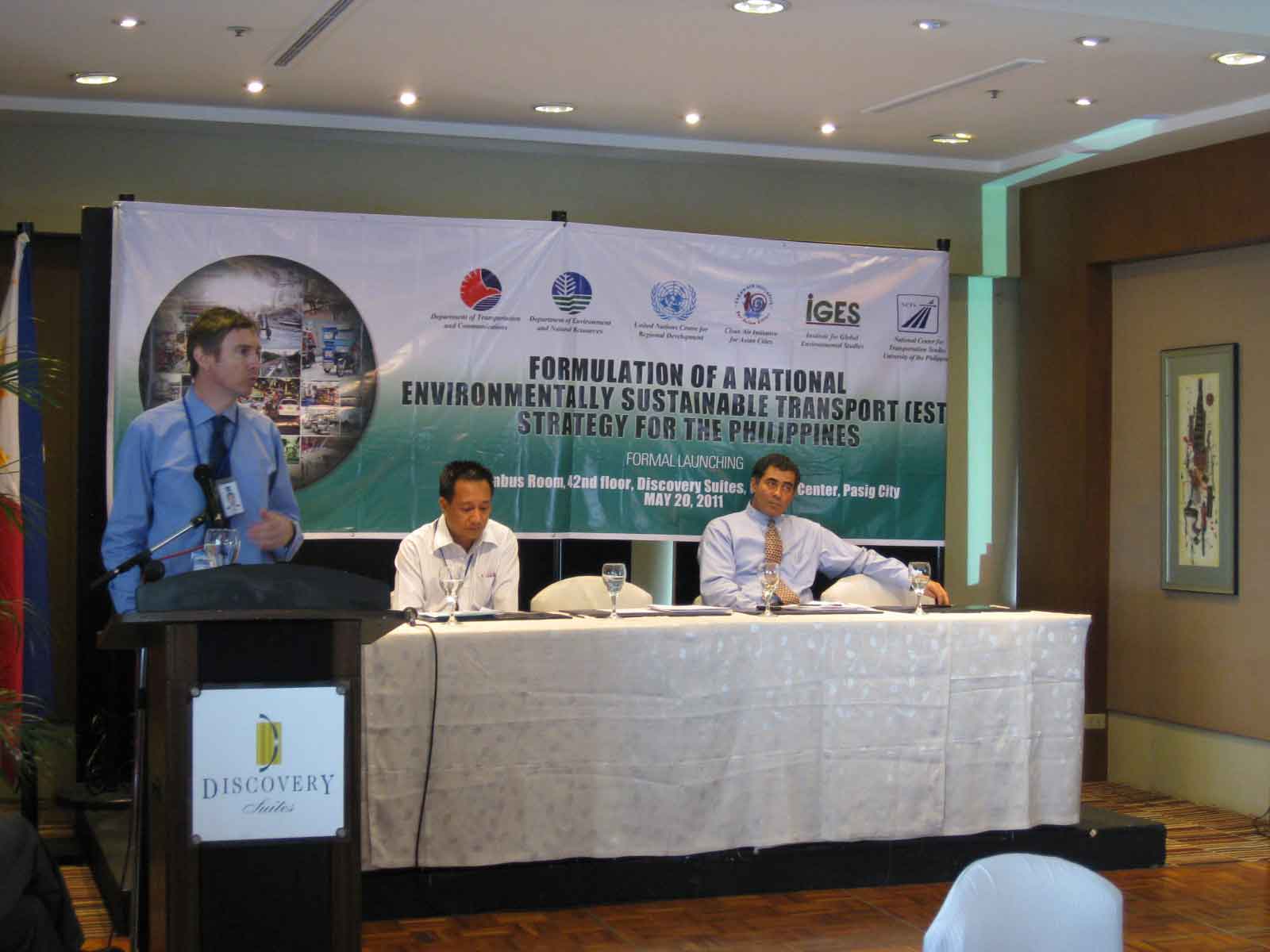 Bruce Dunn explaining about the ADB’s initiatives
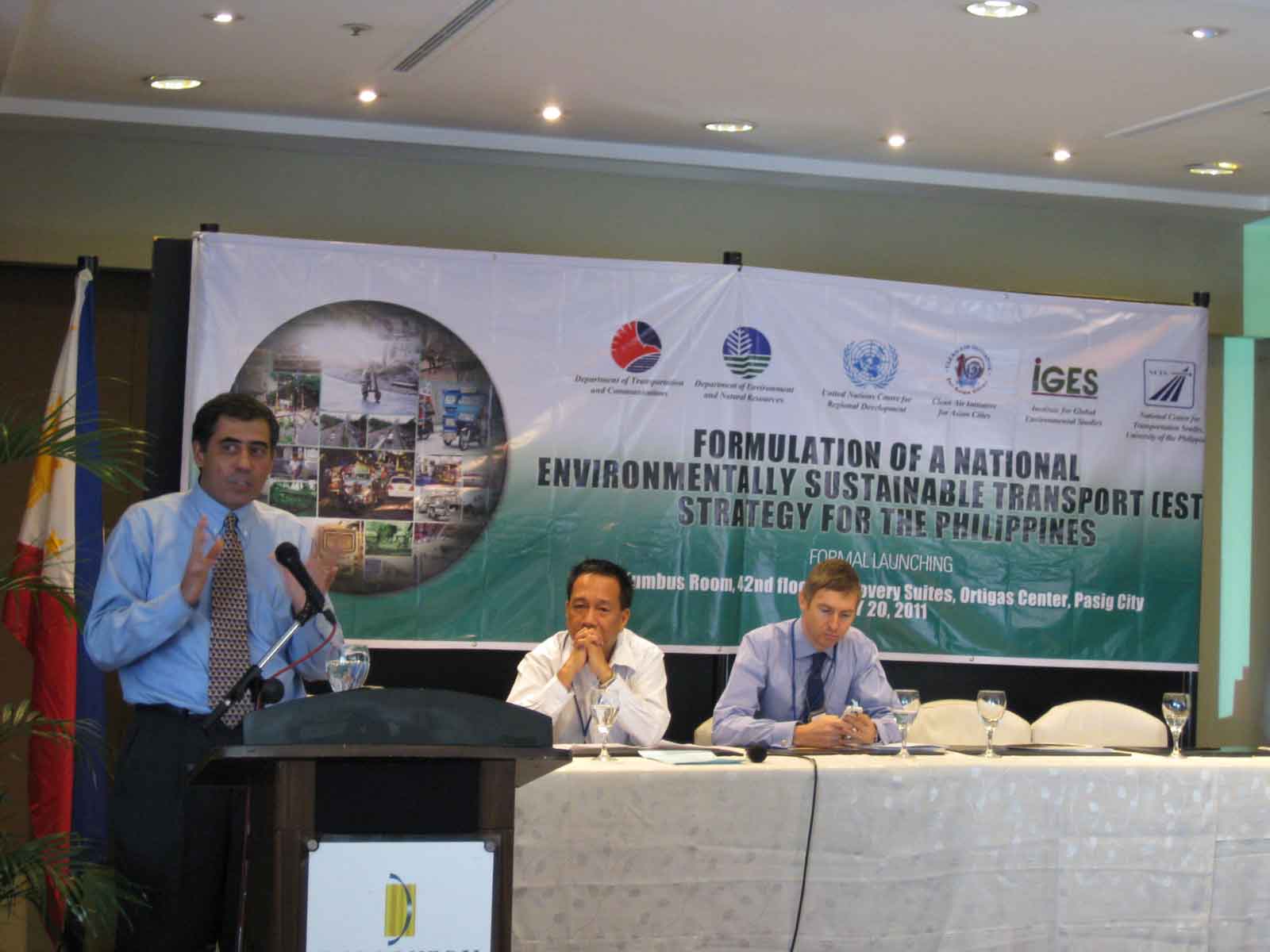 The WB’s Baher El-Hifnawi stressing a point during the panel discussion
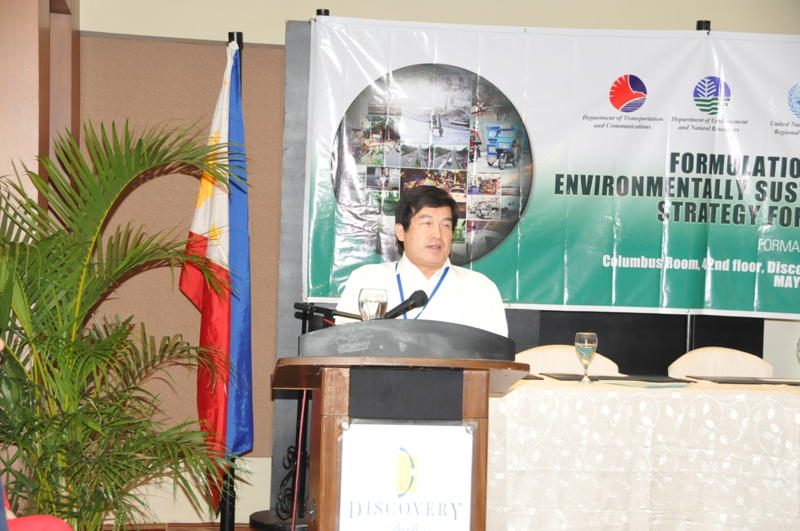 Embassy of Japan Minister Isomata delivering a congratulatory message from the GOJ
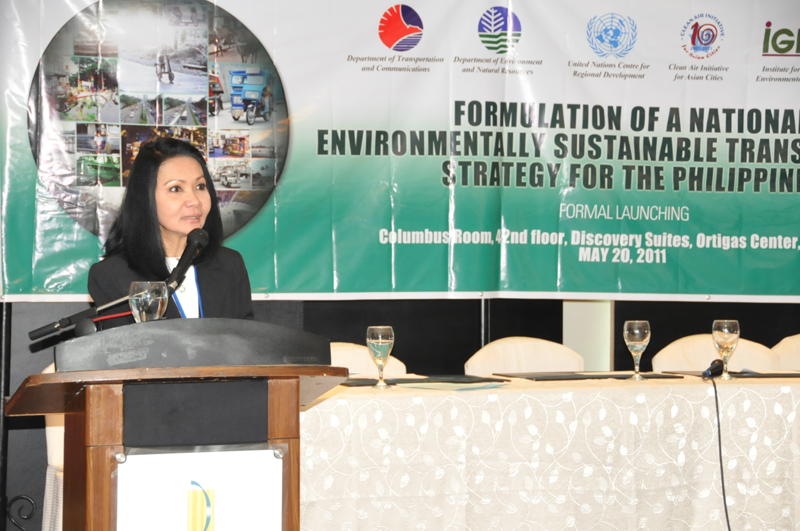 Presidential Asst. on Climate Change Bebet Gozun delivering the concluding message
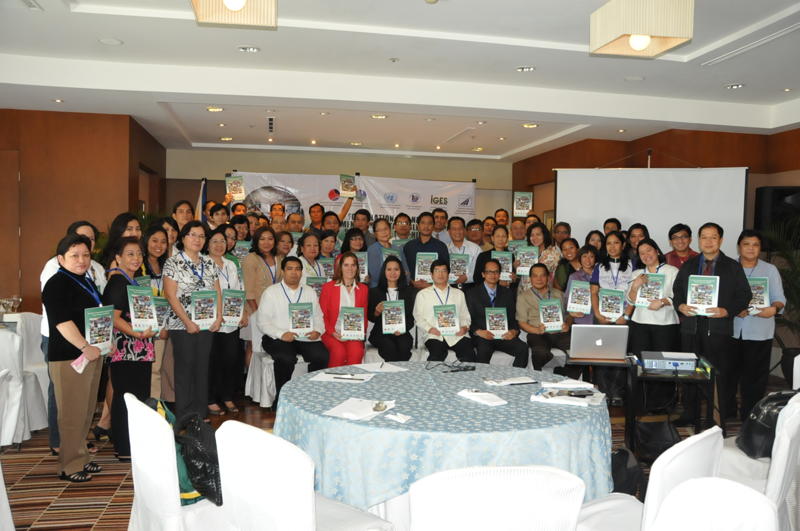 Group photo showing participants to the national EST strategy formal launch
The messages and the panel discussion were one in conveying a challenge to all stakeholders to use the framework provided by the national strategy to come up with action plans and implement these in order to realize sustainable transport in the country. It was also clear from the proceedings of the event that there should be a strong, collaborative effort among national agencies, local government units, NGOs, and development agencies if EST is to be operationalized and for programs and projects to succeed. Significant impacts would then be realized and perhaps lead to the alleviation of transport and traffic problems and their derivatives. It was emphasized that everyone should carefully consider the co-benefits that may be reaped from the implementation of EST.
For more on the national strategy including the reports and other resources, all these are available from the NESTS Web Portal hosted by the NCTS.
Told ya so! And more irony
I was watching the news on TV after having dinner at home and caught one segment where the report featured an assessment of traffic schemes along Commonwealth Avenue. Prominently shown was an interview of the DPWH secretary where he is quoted relating the assessment of Australian and Korean experts about their assessment of safety along Commonwealth Avenue. What struck me about the assessment by foreign experts was that they were practically the same things pointed out by local experts from the NCTS and TSSP back in the day when Bayani Fernando was Chair of the MMDA. At the time, that agency was embarking on what the Chairman called the “Grand Rotunda Scheme” more popularly known as the U-turn Scheme that was to replace most of Metro Manila’s traffic signals with U-turn slots that were supposed to function much the same as roundabouts. This obsession with the U-turn as the ultimate solution to Metro Manila traffic culminated with the construction of the twin U-turn flyovers along C5-Kalayaan that was the subject of a protracted argument between the MMDA and the DPWH. From what I gathered in the news report, the DPWH and MMDA are currently discussing how to come up with an effective scheme for Commonwealth, showing that the two agencies are now quite receptive to alternatives and are keeping their options open, a flexibility that was absent in the past decade.
The Australian and Korean experts mentioned in the report are consultants for the International Road Assessment Program (iRAP) that is to be implemented through the DPWH and is supported by the road safety program of the World Bank. I have mixed feelings about the reception of their assessment particularly because I have seen the same thing happen where the so-called neutral or objective assessment of foreign experts seem to weigh more than those of local experts.
Don’t get me wrong about this feeling as I am also truly happy that their assessment is the same as those made by local experts early last decade and repeated to whomever had the time to listen or pay attention to their assessments. In fact, I am on the Steering Committee of this iRAP project and would be eager to see how the souped-up van that will run through more than 3,000 kilometers of Philippine roads will assess these infrastructure according to the star rating system iRAP has developed and calibrated to become an international standard for road safety assessment. Perhaps the outcomes of this project will allow us to compare with other countries’ roads including those in Malaysia, which the DPWH secretary mentioned earlier this year would be the benchmark for the Philippines. I am hopeful that the outcomes of iRAP Philippines will allow the DPWH and other agencies concerned including the tollway operators to improve the safety features of our highways. After all, the bottomline is not really who made the assessments or the recommendations but whether these would be implemented at all, and if we are able to save lives in the end.
Some opinions on safety and public transport
I’m re-posting below some opinions I’ve stated on Facebook reflecting things coming to mind since Friday’s tragic incident along Commonwealth. A lot of the ideas I posted and the comments made by friends are actually old ones that have yet to be realized given the apprehensions of those who have the power or authority to once and for all bring order to traffic along our highways and streets.
– Perhaps we should cap bus and jeepney speeds along Commonwealth to 40kph. These should also be limited along the 2 outermost lanes and not allowed to race or overtake each other. The MMDA and HPG /QCPD should work 24 hours to ensure speed limits and other rules are strictly enforced and violators should be penalized immediately. PUV drivers involved in crashes should have their professional licenses revoked. They are engaged in a public service, and safety is non-negotiable!
– I think it’s time to hit where it hurts to send a clear message that authorities are serious about the matter of public safety. Revoke the franchise when an operator’s unit is involved in a fatal crash 3 times. Suspensions seem to be only a slap on the wrist.
– Simplify is a word that needs to be appreciated in as far as public transport in the Philippines is concerned. The routes are too complex and the service sucks. It seems that while there are calls for fare increases all the time, there are no calls from people to have safe efficient service in return.
Tragedy and mockery
Friday the 13th turned out to be tragic to a faculty member of the College of Mass Communications of the University of the Philippines Diliman. Prof. Lourdes Estella-Simbulan was killed when a bus hit the taxi she was riding along Commonwealth Avenue in Quezon City at around 6:00 PM yesterday. By the looks of the crumpled taxi cab shown in photos and videos taken by the media, it would have been a miracle if she survived such a crash.
Adding insult to injury were reports that the bus driver fled after the incident. The name of the bus company is not familiar to me despite our Center currently immersed in a project developing a planning support system for public transportation that included a database component that required us collecting data on companies and operators of public transport in Metro Manila. I suspect that the bus is one of those fly-by-night units taking advantage of the night in operating illegally or maybe one that is part of the kabit system that would be difficult to take to task by the HPG or the LTFRB. It is indeed a mockery of traffic rules and regulations that drivers can get away with murder when they are involved in crashes such as this. It is even more frustrating that the most common reason mentioned by drivers when asked why they drive recklessly is that they are just “naghahanap buhay” or earning a living. Such is unacceptable and those charged to bring order to traffic should be decisive and assertive on acting to prevent such crashes from happening again.
To me there is some irony in what had transpired considering that a couple of days ago, the Philippine joined other countries around the world in launching a program geared towards the reduction of road crashes and victims in the next ten years. Forget about the decade – there is a need to reduce crashes and victims NOW. This is because people are getting killed (or dare I say murdered) now, and there are terrible costs even as I write this post.
The College of Mass Communications is a partner in our advocacy for road traffic safety. In fact, that college produced a video for driver education that was supported by resources extended by the private sector led by the Automobile Association Philippines and Toyota Motor Philippines. I am sure that their faculty are now wondering if their efforts have been to naught considering the proliferation of drivers disregarding traffic rules and regulations, throwing caution to the air when they drive their vehicles.
On my part as head of a Center providing training to public utility vehicle drivers, I feel responsible and frustrated at the same time as I question myself if indeed our efforts are even having the slightest influence to improve PUV drivers’ behaviors. In fact, I have been admonishing participants in our training courses about how they sit in and pretend to learn, and then go out and drive like hell. I just hope that the driver involved in the crash that killed Prof. Simbulan is not among those whom we trained at the Center. It would be a shame and one that makes a mockery out of our efforts in promoting road safety. It is our failure as educators that our students and trainees do not practice what they are taught in terms of road safety. We just take it with a grain of salt, so to speak, that responsibility for such PUV drivers’ behavior can also be linked to a flawed licensing system as well as shortcomings in the regulations of public transport services. Indeed, we have our work cut out for us and we can only hope that our persistent efforts would eventually prevail and lead to a significant improvement to safety along our roads.
Launch of the Decade of Action for Road Safety
The Decade of Action for Road Safety 2011-2020 had a worldwide launch last May 11, 2011. It was a “rolling” launch as different countries held their own events as they greeted May 11 . The Decade of Action seeks to reduce the incidence of road crashes both in terms of crash rates, and fatalities and injuries by half. This would be impossible if people, organizations and institutions will not collaborate or cooperate with one another. The Decade of Action calls for all to combine efforts in addressing what is now considered as a killer disease and among the Top Ten causes of death. If we do nothing, it is expected that road crashes will be ahead of such diseases as tuberculosis and congenital heart disease as a cause of death within a decade or so. It is already the leading cause of death for people aged 15-25 years according to the World Health Organization (WHO).
In the Philippines, the formal launching was hosted by the Asian Development Bank (ADB) at 8:00 AM. The other activities marking the event were held at the Quezon City Memorial Circle later in the afternoon. The morning affair was well attended considering that invitations were limited to selected road safety advocates (it was not open to the public). Among those at the presidential table last Wednesday morning were DOTC Secretary Jose De Jesus, DPWH Secretary Rogelio Singson, Rep. Roger Mercado (who is Chair of the House Committee on Transportation), Philippine Global Road Safety Partnership Chair Augusto Lagman (who is also Automobile Association Philippines President and a newly appointed COMELEC Commissioner), WHO Country Representative Dr. Soe-Nyunt-U, ADB Vice President Bindu Lohani, and ADB Practice Leader for Transport Tyrell Duncan. A placecard with the name of MMDA Chair Francis Tolentino was at the table but he was not able to make it to the event.
The program included remarks and messages from the ADB, the WHO, the Philippine House of Representatives, the Philippine Senate (read by Gus Lagman), and presentations of the ADB Action Plan and revised and improved Philippine Road Safety Action Plan (PRSAP 2011-2020). The final part of the program featured a keynote speech delivered by Sec. Singson where he also read the Presidential Proclamation 159 declaring 2011 as the launching year of the Decade of Action in the Philippines and calling for all to participate and support in efforts to promote road traffic safety. The month of May is already being observed as Safety Month throughout the country.
In his Keynote, Sec. Singson also talked about the DPWH’s commitment to ensure that national highways in the country will be designed for safety and informed the audience about the another launch held the previous week at the DPWH Region IV office in Quezon City. This was a project launch for the International Road Assessment Program (iRAP), which will be assessing about 3,000 kilometers of roads, mostly expressways and national roads in Luzon and Visayas. For security reasons, and particularly because the project involves road trips on-board a vehicle fitted with sophisticated equipment as well as foreign consultants, Mindanao roads were passed up for the current assessment. The assessment will allow for the rating of road sections according to a “star” rating system developed and standardized by iRAP. This would lead to recommendations to address safety issues for motorists, pedestrians and cyclists. Sec. Singson ended his speech with a reiteration of the DPWH’s and the country’s commitment to making roads safe for all.
Going electric in the Philippines
The Asian Development Bank (ADB) hosted and co-organized a forum on electric vehicles with the Department of Energy (DOE) today. The forum was divided into two parts where the first part included remarks from the DOE Secretary and two presentations from invited speakers. The second part included mainly presentations of experiences in the deployment of electric vehicle technology around the country and a presentation by the ADB on their program to support electric vehicle deployment in the Philippines.
In the first part, the DOE Secretary was very clear in his message in support of electric vehicles. He emphasized the importance of addressing concerns pertaining to the use of fossil fuels, mentioning the need for fuel efficiency and our transport system’s (over)dependence on fossil fuels. He also expressed concern over environmental aspects, recognizing the direct association between emissions and fuel consumption. His remarks was followed by two presentations on experiences on electric vehicle applications abroad. One presentation was mainly on the infrastructure for charging e-vehicles and included material on the experiences in China. Another was on battery technology but included also the different e-cars that are currently available in the market (e.g., Volt, Leaf, Tesla, etc.).
I must admit, modesty aside, that I was disappointed with the presentations as they were both mainly on private vehicle applications including electric motorcycles and electric cars. I was unimpressed, as were others, with the presentations that had material one could easily pick out of the internet. Even information on battery technology did not provide any new knowledge to most participants that included proponents/advocates of electric vehicles in the Philippines. The comment of one participant said it all when he mentioned that in the Philippines the focus was on public transport applications of e-vehicles.
The second part was more interesting, although two presenters tended to stray away from the topic of electric vehicles. The first presentation of the second part of the forum was delivered by the Congressman representing Taguig City. He did not use any slides but chose to make a rambling speech on Taguig’s experience during his time as mayor of the city. He explained his administration’s push for the e-trikes in Bonifacio Global City and made it appear as if his administration was progressive in its push and that the private sector (i.e., Ayala Land, which had a say on transport at BGC) did not have foresight. In truth, the question that needed to be answered at the time of their push was if the e-trike was the appropriate transport mode at the Fort. Ayala knew it was not but it was clear that Taguig insisted on the deployment of e-trikes at BGC rather than take the more progressive (radically) yet risky push of replacing conventional tricycles in the old Taguig east of C5. His speech was really more a conscious delivery of soundbites and I must say, was quite pretentious and self-serving. It was, for me, simply lip service and a waste of time. In fact, one person near us was already snoring by the time the Congressman finished his speech.
The second presentation was delivered by a representative of the Puerto Princesa Mayor. It was straightforward and wasted no time in explaining PPC’s programs and clearly showed their efforts in deploying environment-friendly transport systems. He also mentioned the incentives that the city has so far offered and proceeded to ask those present to partner with them in promoting e-vehicle use.
The third presentation was on Makati’s experience on electric vehicles. The presenter was city’s traffic consultant and I was expecting him to focus on the electric jeepneys now operating along three routes in that city’s central business district. Instead, he took up much time presenting on Makati’s transport plan including the proposed Bus Rapid Transit (BRT) system and its extensive pedestrian facilities that included walkways connecting buildings and to the shopping district. Nevertheless, his presentation had its saving grace in that it mentioned how the e-jeepney could serve as feeders to the BRT and how the pedestrian facilities complemented public transport services.
The fourth presentation was by a representative of Mandaluyong City, which is the first recipient of the incentives being granted by the ADB in support of e-vehicles. This was another straightforward presentation and clearly covered the main points of the e-trike application in that city including the infrastructure they put up for charging. These charging stations represented an innovation that can be picked up by entrepreneurs in coming up with a business model for charging stations. It was not clear though if Mandaluyong has set out to replace conventional tricycles as my impression was that the e-trikes they acquired will be on top of the existing tricycles plying routes around the city.
The fifth presentation was from Ateneo De Manila University, and focused on that school’s efforts to pilot e-vehicles for the use of their students and staff. The presentation mentioned their rationale and the apparent marching orders from their newly installed president, who is an acknowledged expert on environment, to address air quality in the vicinity of the campus. I found their presentation awkward and at the very least hypocritical of the fact that the problem they have to face is the overwhelming number of private vehicles the school generates and their continuing coddling of tricycles whose phase out along Katipunan is long overdue. Perhaps I will expound on this and other issues when I write about Katipunan transport and traffic in the future.
The last presentation was a quick one from the ADB. It was mainly on the ADB’s program supporting e-vehicle promotion. It was also explained why ADB chose to focus on tricycles and was unapologetic in their argument that tended to generalize the problem on transport in the Philippines. There was no mention of rationalization considering that there is actually an oversupply of tricycles and this too needs to be addressed.
While it is commendable that the ADB has extended assistance in the form of grants incentives to promote e-vehicles, there are still questions on the sustainability of this effort given that they chose to focus on tricycles. Of course, the statistics on the number of tricycles and their environmental and energy impacts clearly argue for addressing this problem pertaining to conventional motor tricycles. However, the ADB must realize that local government units (LGUs) can be quite fickle-minded or hard-headed in their approaches to public transport regulations. This is a fact given that there are few LGUs that have been successful in regulating tricycles and particularly in restricting their numbers and their operations along routes or areas where they are suitable. If we take a look at many cities, we will find tricycles running on national roads and causing congestion in CBDs. We would also see that many of these cities, among them highly urbanized cities (HUCs), have a need to graduate from these low capacity modes into middle or even high capacity vehicles.
It was noticeable that there were no representatives from the Department of Transportation and Communications (DOTC) nor its attached agencies like the Land Transportation Office (LTO) and the Land Transport Franchising and Regulatory Board (LTFRB) at the forum. Despite pronouncements by the DOE Secretary that the DOTC and the Department of Science and Technology (DOST) were on-board in the former’s push for e-vehicles, experience has shown that DOTC and its attached agencies have been the bottlenecks in the forward movement of e-vehicles. This includes the absence of clear policies pertaining to e-vehicles including their registration as well as the lack of direction pertaining to their mainstreaming as public transport modes (i.e., franchises). Also, lest we forget, all the talk on e-vehicles while being spearheaded by the DOE, is very much the province of the DOTC since we are, after all, talking about transport. It is the main responsibility and the mandate of the DOTC to see the e-vehicles through and lead in the mainstreaming of these vehicles in the context of environmentally sustainable transport. It is a pitch for e-vehicles that would go a long way into ensuring that a critical mass can be realized and that the tipping point for the shift to electric would be reached in the near future.
Some issues on walkability in the Philippines
I have written about walking in the past (No Car? No Problem!), and it was mainly about a personal experience I had commuting home one evening. At the time, I had already made the observation that we are generally lacking for pedestrian facilities. We do have sidewalks but most are too narrow for the typically high volume of pedestrian traffic. In cases where there are sufficient width or space, sidewalks are often occupied by vendors. In commercial areas, establishments also have a tendency to encroach on pedestrian space thereby constricting the walkways. This is the predicament in most, if not all, Philippine cities and the result is often that pedestrians are forced to walk along the carriageway, using space that is supposed to be for motor vehicles and effectively causing congestion due to the reduced road capacity. Such are issues pertaining to walkability that touches mainly on the safety, mobility and accessibility aspects of walking.
In rural areas and particularly along national highways, there are practically no pedestrian facilities unless one considers highway shoulders as appropriate for walking. As such, one will most likely find people walking along the shoulders or, should it be the wet season and these shoulders happen to be muddy, along the carriageway. It is not uncommon also to see children walking along the highways since many schools are located along the roads. Such situations often put children at risk, thereby magnifying their vulnerability to becoming victims of road crashes.
Another vulnerable group are senior citizens, who, despite their age, can still be very active and are entitled to mobility just like any person. They, too, deserve facilities that will keep them safe from risks such as wayward public transportation or reckless drivers and riders. Then there are also those who are physically-challenged, people with disabilities who, despite their physical limitations, also have the right to move about. In fact, there are laws with provisions requiring public facilities to be designed according to the needs of persons with disabilities (PWDs). Sadly, pedestrian facilities in Philippine cities generally do not incorporate ramps, guides and other devices that would allow for efficient movement of PWDs.
Crossings are also a big issue considering the statistics of pedestrian involvement in road crashes. Of course, there are two sides of the coin here where, on one hand, hard-headed people still cross at inappropriate locations or say at street-level when there is an overpass or underpass nearby. Such incidences of jaywalking are quite prevalent in urban areas, betraying a lack of discipline that is often in combination with weak traffic enforcement. On the other hand, there are pedestrians crossing along designated locations like zebra crossings but are placed in harm’s way as motorists do not give way.
Heading to the airport last Maundy Thursday to fetch my wife, I took Marcos Highway and saw the many people walking to Antipolo Church, a popular pilgrimage site for Filipino Roman Catholics during the Holy Week as well as the month of May when the feast of Our Lady of Peace and Good Voyage is celebrated. They came from all over Metro Manila but mostly from Pasig, Cainta, Marikina and Quezon City. It was around 10:00 PM and due to the Holy Week, there were very few public transport (and vehicles in general) along the highway, which is a major corridor to the east. Most of them had to walk along the carriageway considering the ongoing construction work along Marcos Highway for a major drainage and pavement project. Considering the volume of people, they has practically occupied one lane (the outermost) of the highway. Fortunately, because there were few vehicles, the people didn’t have to worry much about being sideswiped as they walked.
I could imagine a similar case along Ortigas Avenue, which is along the original way to Antipolo Church. Perhaps there were even more people walking along that road considering that it passes through densely populated areas of Mandaluyong, Pasig, Cainta and Antipolo as well as the avenue being most accessible to people coming from Taguig, Makati, San Juan and Manila. The Way of the Cross along Ortigas Avenue has been enhanced with the construction of stations along the route that can be used as guides, especially by those who are unfamiliar with the pilgrimage. That way is also wanting for pedestrian facilities and often sidewalks are ill-designed and may even have electric posts impeding the flow of traffic.
To me, the solution to such issues on walkability is quite clear and does not require more than common sense. Obstacles along walkways, for example, need to be removed to ensure that there will be space for walking and ensuring smooth traffic flow. The MMDA deserves a lot of credit for waging an aggressive campaign during the time of Bayani Fernando, when he implemented a “sidewalk clearing” program that effectively returned space to pedestrians that were taken from them by vendors and establishments. The latter mostly did so in violation of the building code that is quite common in most downtown areas. Electric posts also need to be relocated and such may be coordinated with power/utility companies who are responsible for their installation.
On the technical side, there is a need to revisit design guidelines, if any, pertaining to pedestrian facilities. The National Building Code actually has provisions for designing sidewalks but there are none, to my knowledge, about designing overpasses and underpasses. There are no criteria currently being used to determine, for example, the suitable locations for overpasses and to estimate their capacities based on the principles of traffic flow. This, considering that there are actually level of service (LOS) criteria for walkways and other facilities catering to pedestrians. These design guidelines should clearly incorporate safety and accessibility so that the resulting facilities will be for the inclusive use of all.
On the enforcement side, there is nothing new and no surprises that the recommendation would be to have firm, consistent and aggressive enforcement of traffic rules and regulations. For this I may sound like a broken record but it only goes to show that we have not progressed much in this aspect of traffic management. The ningas cogon approach must go and programs should also be directed against those impeding pedestrian flow (e.g., vendors setting up on overpasses) as well as those whose behavior endanger pedestrians (e.g., reckless, undisciplined drivers).
I am optimistic, though, that with the combined efforts of many advocates for road safety, we may eventually be able to improve walkability in most cities in this country. For one, there are already several LGUs who have programs with a vision for them to be a walkable city. Among these are Marikina and Makati in Metro Manila, and San Fernando in La Union. More will hopefully follow the examples of these cities and, who knows, one day perhaps we can walk safely wherever and whenever we wish to do so.
All roads lead to Antipolo
The title of this post is based on a saying referring to the Shrine of Our Lady of Peace and Good Voyage that is located in what is now the City of Antipolo in the Province of Rizal, to the east of Metro Manila. The saying is based on observations during May when the feast of Our Lady is celebrated the entire month. While people flock to the shrine throughout the year often to pray for safe travel, many devotees go up the city in the Sierra Madre range during Lent to pray the novena to Our Lady, hear Mass, or simply to partake of the other attractions of this city.
Antipolo has been a popular pilgrimage site since the Spanish Period ever since the reports of miracles performed through the image of Our Lady of Peace and Good Voyage. These include her image being reportedly found among the Antipolo tree that is the basis for the name of the town that now is a highly urbanized city and capital to the Province of Rizal. Rizal, of course, is the name of the province that once was generally called Morong. One town of the province still bears that name and it, too, has a beautiful, picturesque church. The Shrine is often visited by those seeking safe travel, perhaps these days it has even become more popular due to the tremendous numbers of overseas foreign workers (OFWs) employed abroad. Antipolo is also allegedly the richest among the most popular shrines or churches in the Philippines, supposedly ahead of Quiapo (Black Nazarene), Cebu (Sto. Nino), Baclaran (Our Lady of Perpetual Help), Naga (Penafrancia) and Manaoag (Our Lady of Manaoag), though not necessarily in that order. I think I read about this in one of Ambeth Ocampos’ columns from the Inquirer.
The popularity of the Shrine is so much so that a road was built to directly connect it with Manila, particularly to Intramuros where the seat of government was at the time. This road is most probably along the corridor that is now Ortigas Avenue. Of course, in the Spanish Period, this would be a more general route that would have likely included many rough trails considering that the Ortigas we know now was only developed in the 1970’s. I witnessed this when we moved from Mandaluyong to Cainta in 1976, often seeing huge machines work their way along what is now Valle Verde to carve out a wider right of way for Ortigas Avenue.
During the American Period, the trams operated by the Manila Electric Rail and Light Company (MERaLCo) included a line that went up to Antipolo. Those trams were the state of the art and representative of high technology in public transportation in those years after the turn of the century and a line to Antipolo reinforced the shrine’s importance to many people and the government’s recognition of this. The tram network, which was probably the most developed in Southeast Asia if not in Asia at the time, was destroyed during World War 2 and was never rebuilt for some reason. It is something that Metro Manila now continues to regret if only to postulate what might have beens and what could have beens if the network was revived after the war. Of course, this bit of history is related to the eventual rise of the jeepneys but that is another story for another post. Nevertheless, there still exists in Antipolo some remnants of the tram’s glory days and it is remembered as a road which is still called “daang bakal,” as the railways were fondly called then and now.
There are now many ways from Metro Manila and its neighboring provinces to Antipolo, although several of these eventually merge into three main roads en route to the Shrine. One is via the old route along Ortigas Avenue, a second is the route via Sumulong Highway, and the third is through a “back door” via the Antipolo-Teresa Road. Routes from the general areas of Manila, Makati, Pasig, Mandaluyong, Taguig and the southern cities of Metro Manila and towns from Laguna, Batangas and Cavite will most likely merge to Ortigas Avenue. Meanwhile, people coming from Quezon City, Caloocan, Marikina, Bulacan, Pampanga and the northern Rizal towns of San Mateo and Rodriguez (Montalban) will likely converge along Sumulong Highway. Meanwhile, those coming from the east including the Rizal towns like Tanay, Teresa, Morong, and Jala-jala, the Laguna towns like Paete, Pakil, Pangil, the Quezon towns of Luisiana, Lucban, Infanta and General Nakar, and others will most likely take the Antipolo-Teresa Road that climbs from the east of Antipolo. People from Marikina, Cainta and Pasig generally may take either the Ortigas or the Marcos Highway/Sumulong Highway route.
Public transport to Antipolo these days include mostly jeepneys as the city is the end point of many routes – a testament to its importance even as a reference point for public transportation. One can easily spot the Antipolo-Cubao jeepneys in the Araneta Center in the Cubao business district in Quezon City. There are two lines, one via Cainta Junction (where jeepneys eventually turn to Ortigas Avenue) and another via Marcos Highway, turning at the Masinag Junction towards Sumulong Highway). Another terminal is at the EDSA Central near the Ortigas Center in Mandaluyong where Antipolo-Crossing jeepneys are queued. And still there is another, albeit somewhat informal terminal near Jose Rizal University (JRU, which was formerly a college and hence the old JRC endpoint), which passes through Shaw Boulevard, Meralco Avenue and eventually turns towards Ortigas Avenue. Other jeepneys from the Rizal towns all have routes ending in Antipolo simbahan, referring to the shrine.
There are now also Filcabs or AUV Express, shuttles offering express trips between Antipolo and the same end points of Cubao or Crossing. Others go all the way to Makati in the Ayala financial district. These evolved out of the Tamaraw FX taxis that started charging fixed fares during the 1990’s and competed directly with the jeepneys. These are popular, however, with office employees and students during weekdays and the nature of their ownerships and operations do not make them serious competitors to the jeepneys during the merry month of May and the Lenten Holy Week.
There was an Antpolo Bus Line before. These were the red buses that plied routes between Antipolo and Divisoria in Manila. These died out sometime between the late 80’s and the early 90’s probably due to decreasing profitability and likely because of its competition with the jeepneys. That bus company, along with the green-colored G-Liners, the red EMBCs (Eastern Metropolitan Bus Co.) and CERTs, and the blue Metro Manila Transit Corp. buses used to form a formidable mass transport system for Rizal and the eastern towns of Metro Manila. There were even mini-buses (one I recall were the Antipolo “baby” buses and those that plied routes betwen Binangonan and Recto). Most of these, except the G-Liners eventually succumbed to the jeepneys.
In the future, perhaps the jeepneys should give way to buses as the latter will provide a higher level and quality of service along Ortigas Avenue and Marcos and Sumulong Highways. Already in the drawing boards is a plan to ultimately extend LRT Line 2, which currently terminates at Santolan, Pasig, to Masinag Junction and then have a branch climb along Sumulong Highway and terminate near the shrine. This will bring back the trains to Antipolo and would surely make the church and the city very accessible to people. I look forward to these developments both in my capacity as a transportation researcher-engineer and a Catholic who also visits the Shrine to pray for safe travel for loved ones and myself.
National EST Strategy Update
The Third Draft (Draft Final Report) of the National Environmentally Sustainable Transport (EST) Strategy (NESTS) formulation study for the Philippines has just been completed. The report is available online via the NESTS Web Portal on the NCTS website. The project is concluding in May 2011 after more than 2 years of developing strategies covering twelve (12) thematic areas as defined by the Aichi Statement of 2005.
The report articulating strategies, indicators and key result activities is written in general terms to allow for flexibility in the further development of strategies and action plans to realize EST. The document is envisioned to be a guide for both national agencies and local government units, as well as for other stakeholders such as non-government organizations (NGOs) and private entities seeking to take on EST as an advocacy.
The National EST Strategy will be formally launched on May 20, 2011.
 Caught (up) in traffic