Home » 2011 (Page 6)
Yearly Archives: 2011
Roads to Naga City – via Rizal Province
A little more than two years ago before the onslaught of Ondoy (Ketsana), I had the opportunity of going to Naga City, Camarines Sur to talk before students of Civil Engineering in a regional conference. I took that opportunity for a road trip that allowed me to take photos of roads along a route that took us from Quezon City to Naga via Antipolo, Tanay, and other towns of Rizal. We proceeded through Pakil, Paete, Lumban and other towns of Laguna, as well as Luisiana, Lucban, Tayabas, Lucena and other towns of Quezon. We also took the zigzag roads of Quezon and Camarines Norte including the “Tatlong M” and “Bitukang Manok.”
Following are photos I took on the way to Naga City starting with a few along roads in the Province of Rizal.
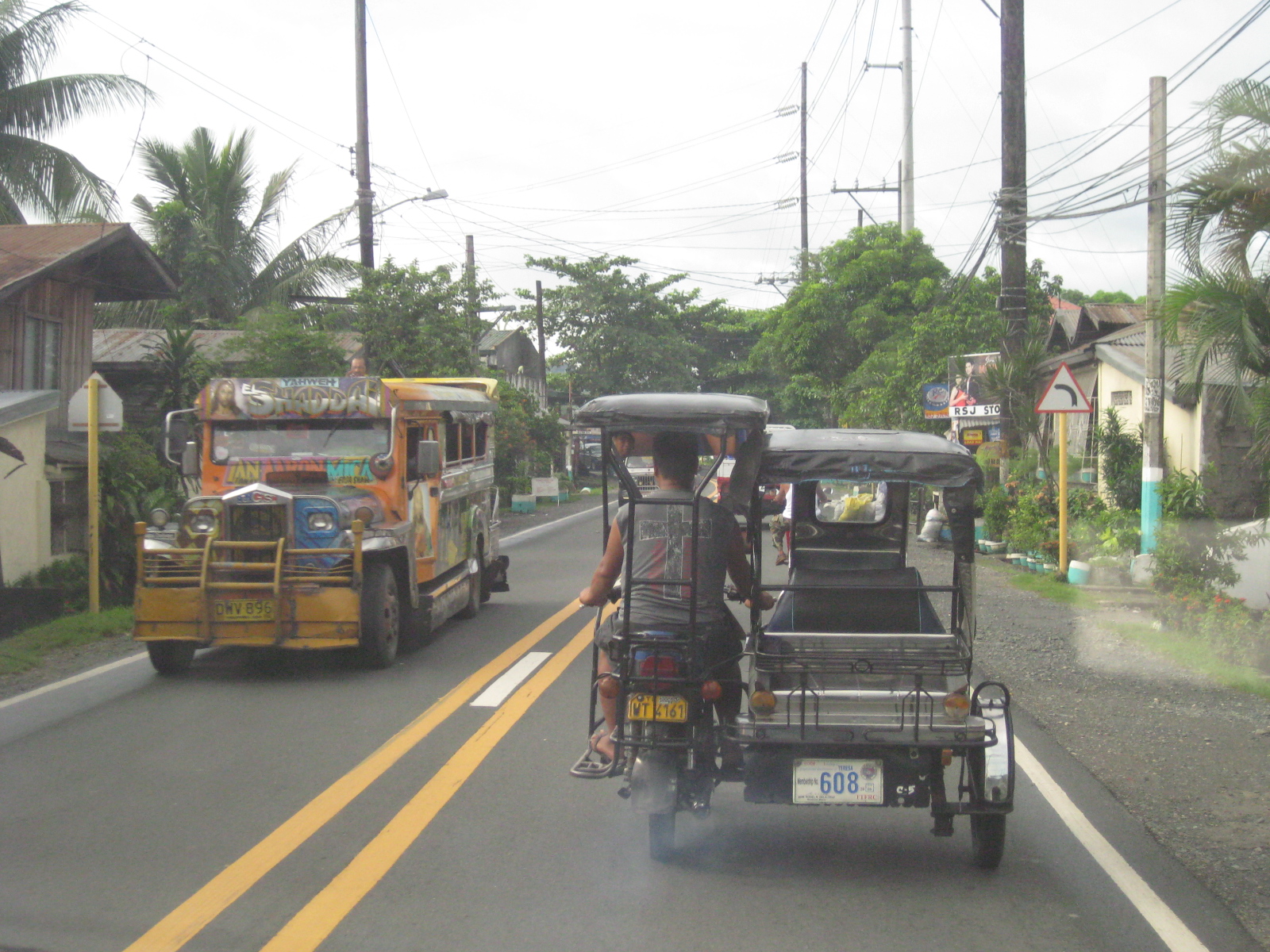
Jeepneys and tricycles remain the most common modes of transport along highways although the latter are supposed to be banned from using national roads. Most national roads pass through towns so it is somewhat inevitable for tricycles to used them. Adding to the problem is the fact that most national roads do not have shoulders or space where tricycles or pedicabs (non-motorized version of tricycles) can pull off from the road to let traffic through.
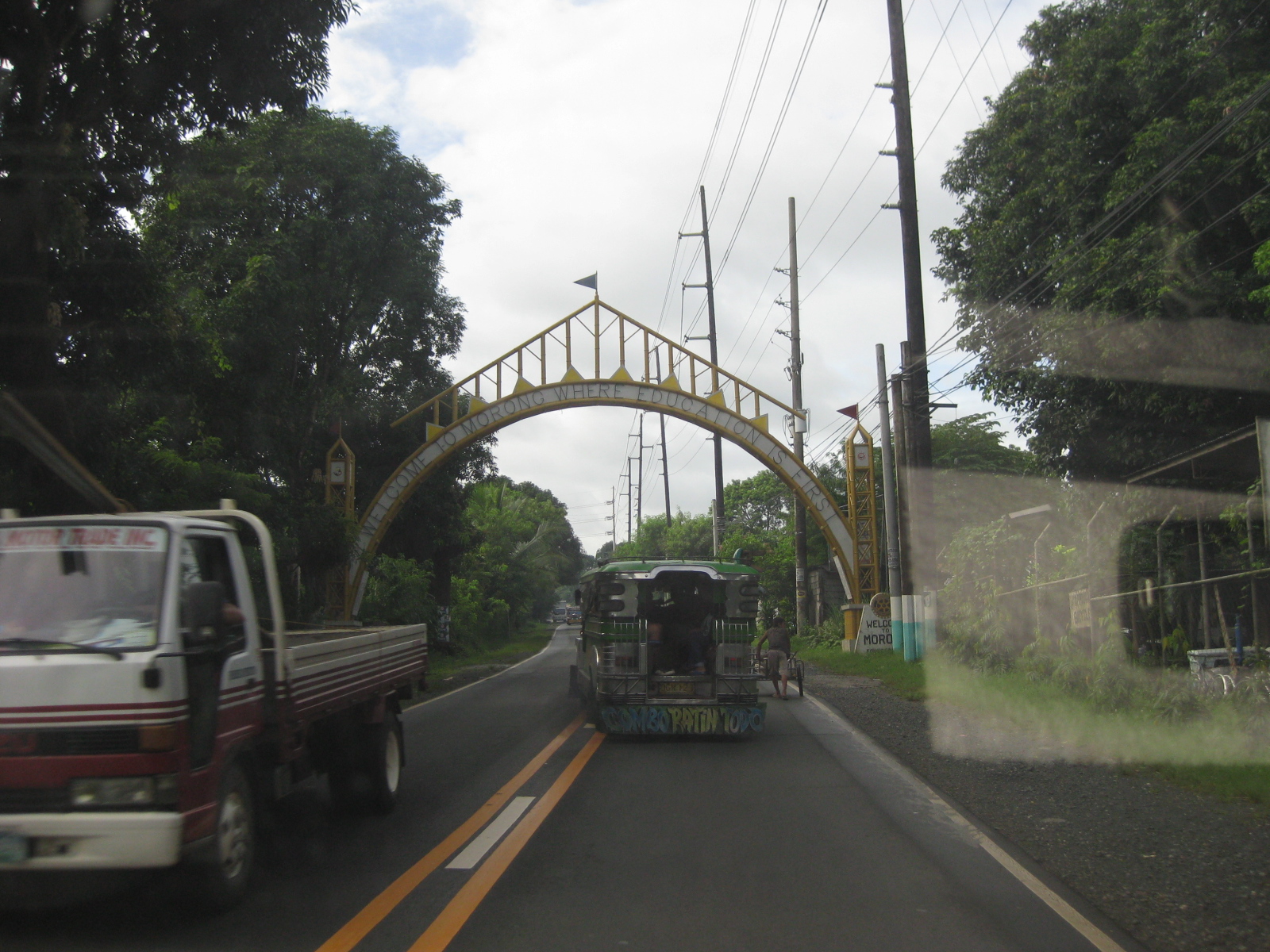
Like most highways in the Philippines, arches greet and say farewell to travelers as they cross town boundaries. Above is a simple arch at Morong, Rizal.
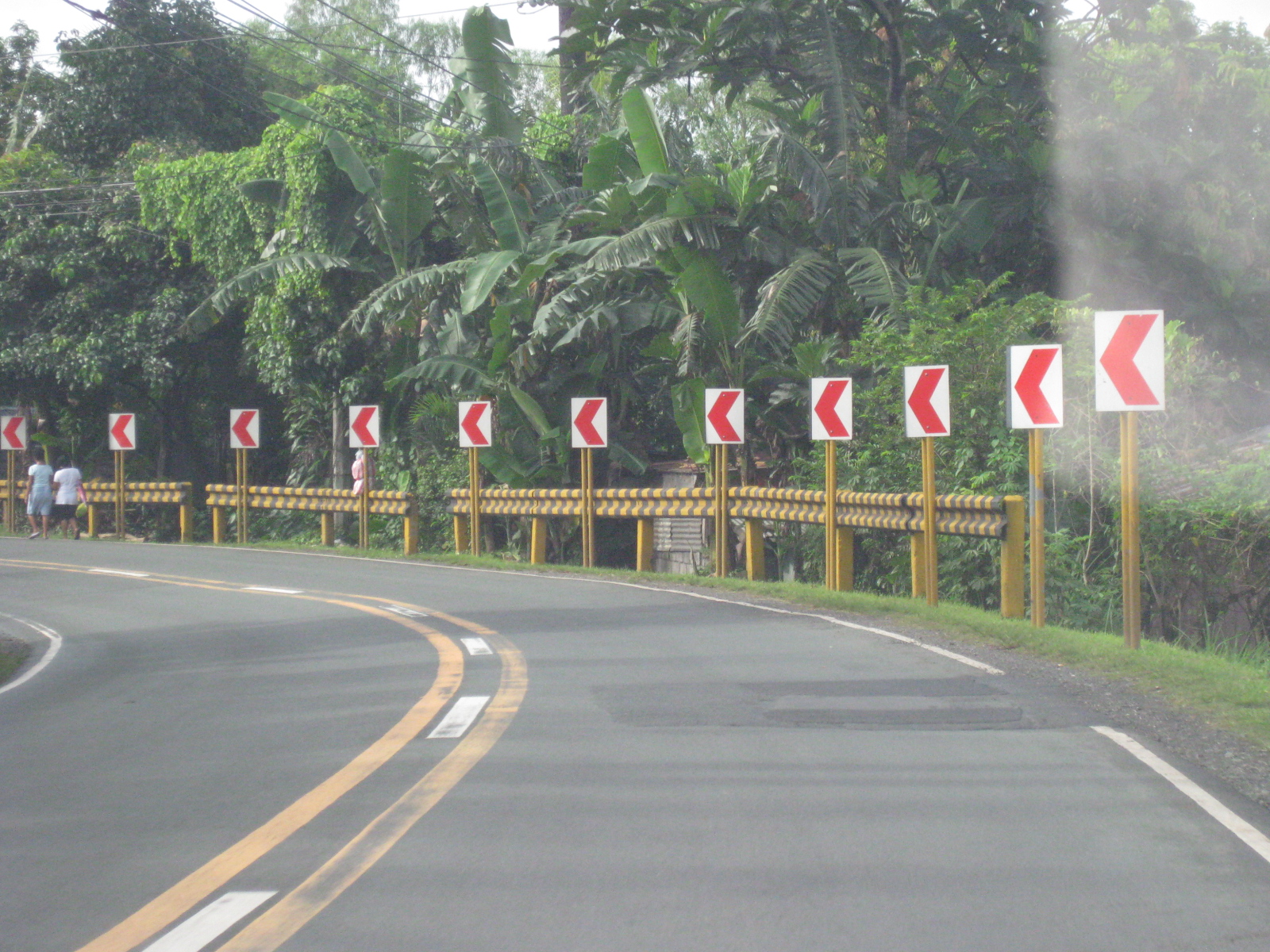
Chevrons along curve section – most Rizal roads have standard signs and road markings. As far as I could remember, these were adequate rather than excessive. The DPWH only needs to maintain these and make sure signs are not vandalized or stolen (Yes, there are cases where they are taken as trophies!), or obstructed by flora.

Most road sections have good quality pavement complete with markings signs and barriers where applicable. This tree lined section is somewhere along the road from Tanay to Baras.
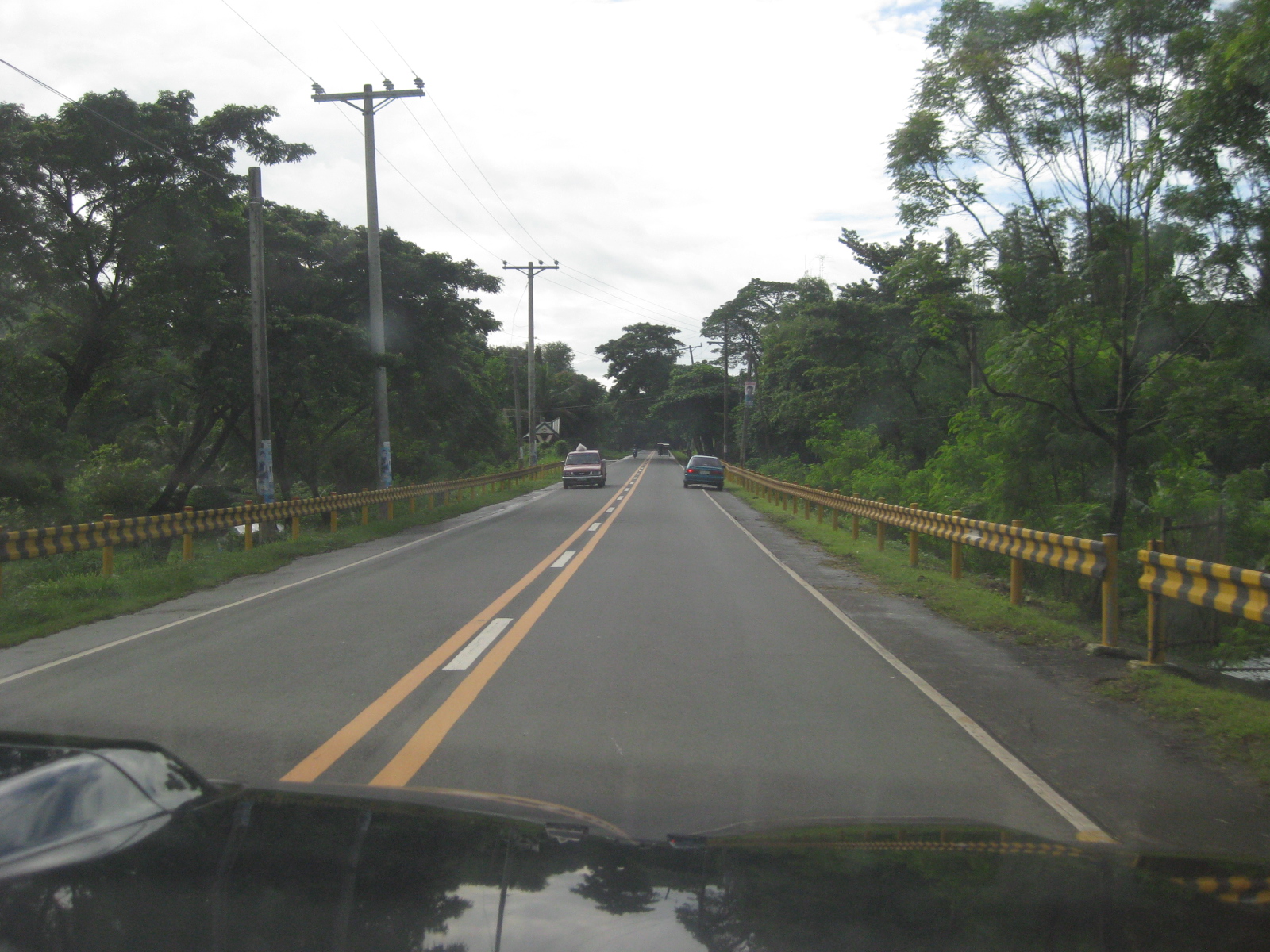
These roads often provide good sight distance allowing for drivers to ascertain whether they can successfully pass a slower moving vehicle. Despite the straight, level section in the photo above, however, pavement markings indicate a restriction for overtaking or passing. This is perhaps the result of road crash experience in the area. Note that such straight, level sections may have a negative effect on drivers as they may actually encourage speeding. The problem, of course, is how to enforce such regulations as indicated by pavement markings. Double yellows are strictly enforced in other countries where highway patrol are deployed strategically to enforce the rule and help curb the potential and actual crashes.
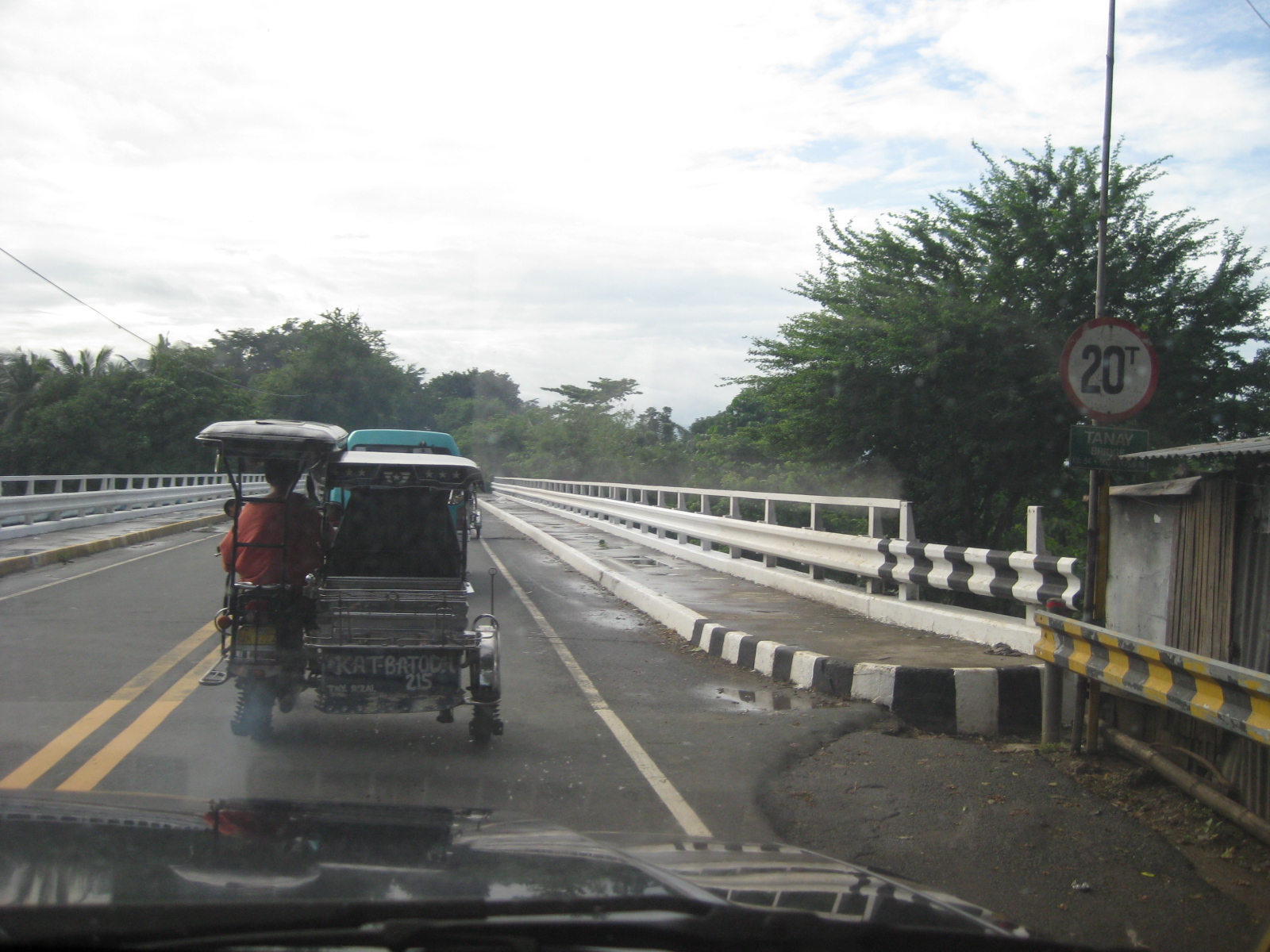
Bridges also have standard signs and markings. This one taken at the approach to a bridge in Tanay.
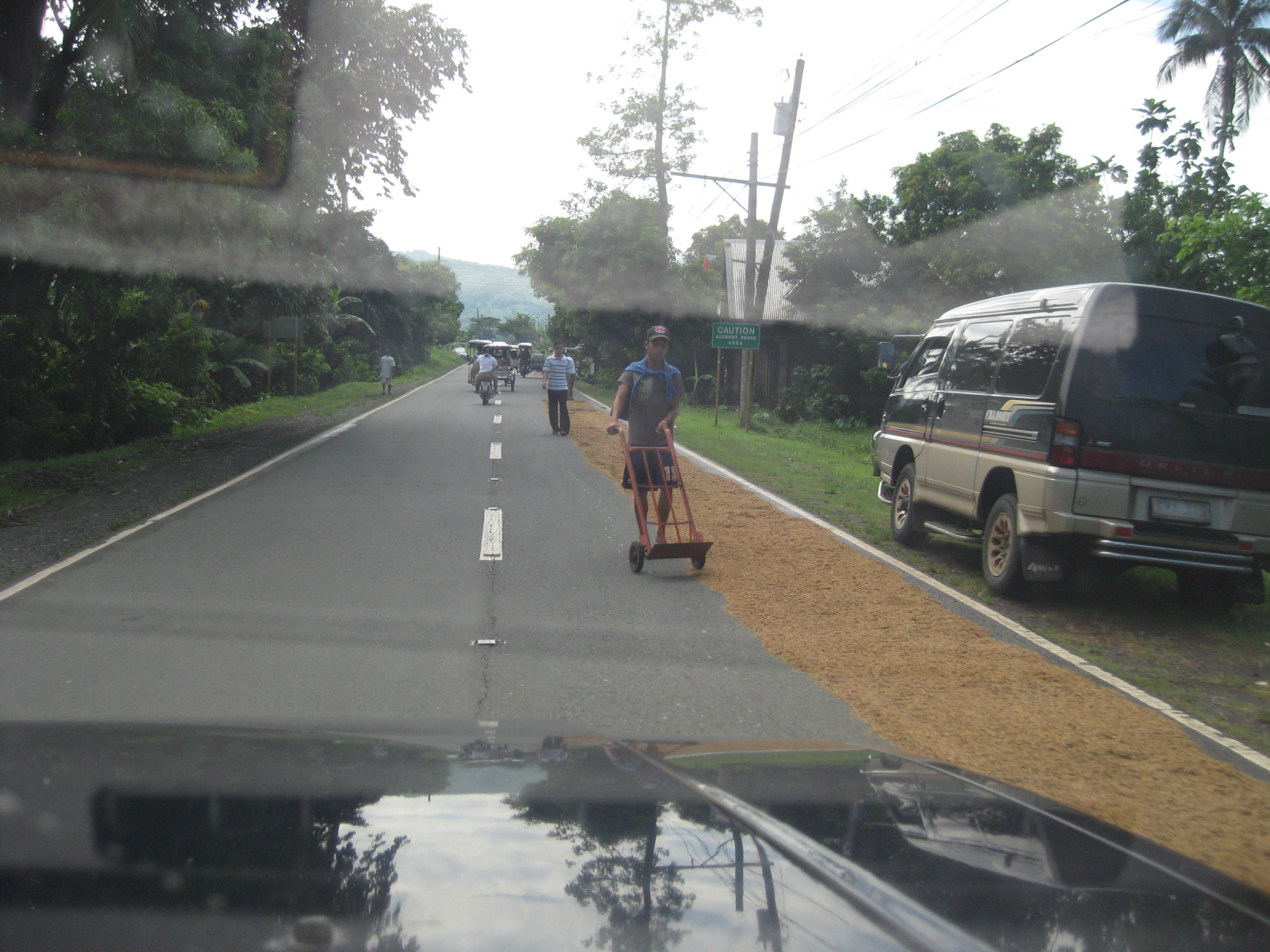
Many roads are used as solar dryers for products such as rice (palay not bigas), fish, and sticks (for barbecue, fishballs, etc.). While tolerated for highways with very low traffic, these are always hazards and often take up significant road space like what is shown in the photo above. A better set-up is found in other areas where shoulders are also paved and these are where farmers or fishermen lay out their products to dry rather than along the carriageway.
Next: Roads in Laguna
Bus involvement in road crashes
The LTFRB recently release lists of bus companies that are in the top ten . Versions of the list may be found in this article from the Philippine Daily Inquirer, The Manila Times, and The Philippine Star.
From the Inquirer:
“…The list is broken down into three categories—number of deaths, injuries and property damage—and is based on accident reports submitted by all public utility buses to the LTFRB. The lists published by the LTFRB cover the whole of 2010 and the first half of 2011.
Lists of the 10 most dangerous bus operators in Metro Manila:
Based on the number of deaths (passengers and bus personnel)
1. Admiral Transport
2. Nova Auto Transport
3. JAM Liner
4. Gassat Express
5. Joyselle Express
6. Philippine Corinthian Liner
7. Rainbow Express Inc.
8. Alberto Garating
9. Alps the Bus
10. EM Transit ServiceBased on the number of injured (passengers and bus personnel)
1. Admiral Transport
2. Nova Auto Transport
3. AM Liner
4. Gassat Express
5. Joyselle Express
6. Miami Transport
7. Pascual Liner
8. Philippine Corinthian Liner
9. Rainbow Express Inc.
10. CEM Transit ServiceBased on damage to property
1. Don Mariano Transit
2. Nova Auto Transport
3. Gassat Express
4. Miami Transport
5. Pascual Liner
6. Rainbow Express Inc.
7. Ropal Transport
8. A&B Liner
9. GELL Transport
10. CEM Transit Service”
The above are generally companies plying routes in Metro Manila. Meanwhile, the list mentioned in another article, this time from the Manila Times, identifies provincial bus companies that frequently got involved in road crashes:
“…Topping the LTFRB list is the Victory Liner, Inc. plying routes from Manila to Isabela, Bataan, Zambales and Benguet with 31 accidents from 2009 to 2011; 15 drivers died from these accidents.
Second-placing Vallacar Transit Corporation had 26 accidents resulting in the death of six of its drivers. Silver Shuttle and Tours, Inc. is third with 24 accidents and 5 driver deaths
Fourth in the list, United Land Transit and Bus Company has routes from Quezon, Leyte and Samar with 18 cases of accidents killing four of its drivers.
Philtranco came in fifth with routes from Luzon and Visayas with 15 accidents and three driver deaths followed by the Five Star Bus Company Inc. and Valisno Express that has 14 road accidents each…”
While the reports above mention few statistics, there are actually more detailed information with the LTFRB. Such data have been demanded from them by Congressional committees “investigating” public transport franchising. In one meeting the LTFRB mentioned that it is coordinating with the MMDA in compiling the number of traffic violations for each bus company based on the MMDA’s records. Their preliminary results have shown that bus companies have been involved in thousands of violations! Perhaps these should be proof of the aggressiveness or recklessness of drivers in general? And I dare ask if these can be used to weed out public transport drivers who should have no right conveying the general public?
I just wonder what would be the statistics for PUJs, tricycles, trucks and private vehicles. These would be interesting to analyze in order for us to formulate better strategies and tactics for curbing road crash incidence, fatalities and injuries.
UP’s official pronouncement on the proposed AGT
I wrote about the proposal for a transit system at UP Diliman in a couple of posts where in one I included a figure of what was being put forward as a possible route for a loop at the Diliman campus. In another post, I included photos of the test track that was constructed at the DOST compound in Bicutan and featured a prototype vehicle that was more of a “confidence builder” than a viable transit vehicle. In the posts, I already articulated that a transit system such as an AGT or a monorail would most likely be not viable for an area like UP Diliman considering the limited demand and the prospect of having high maintenance costs. These are aside from the issues pertaining to social acceptability and other impacts of such a system on the campus. Perhaps an AGT or a monorail would be feasible elsewhere like how they are currently being used in CBDs or airports, where the demand would be enough to at least allow for decent revenues.
I’ve read a few articles including one that appeared a few days ago where it seemed to me that the writers were not really knowledgeable of what was going to be the collaboration between UP and DOST in as far as the transit prototype was concerned. Articles have even gone to the extent of saying farewell to the Ikot jeepneys as the primary mode of public transport when going around the campus. All these are mostly theoretical at best considering that perhaps road-based transport is still the best option for UP Diliman. We only need to ensure that such transport will be of the environmentally sustainable kind.
Meanwhile, UP’s official statement regarding what will really be constructed at the Diliman campus may be found at the university’s website. It is clear from the statement that a test track will be built and that a prototype will be tested to determine whether local designs actually work. This perhaps will be the basis for determining whether the system can be replicated elsewhere, even considering the prospects of scaling up where such transit may be applicable. Studies will also be able to validate the costs of a system since it is being touted as something that should be less costly than other systems that are already in operation elsewhere (i.e., other countries). For what its worth, a locally developed, cost-effective system will be a welcome option for many Philippine cities that badly need a modern public transport system.
Katipunan parking predicament
Developments along Katipunan Avenue in Quezon City are good examples of fragmented land use and transport planning in Philippine cities. The developments, particularly the high rise condominiums have been the subject of much opposition from residents of subdivisions in the area as well as two major institutions of higher learning that have defined the stretch of Katipunan that has been developed in the 15 years. I mention 15 years because this is the period during which most of the high density developments along Katipunan have been constructed, apparently with the blessings of city hall. It is also in the last decade that schemes such as road widening and the U-turns were implemented.
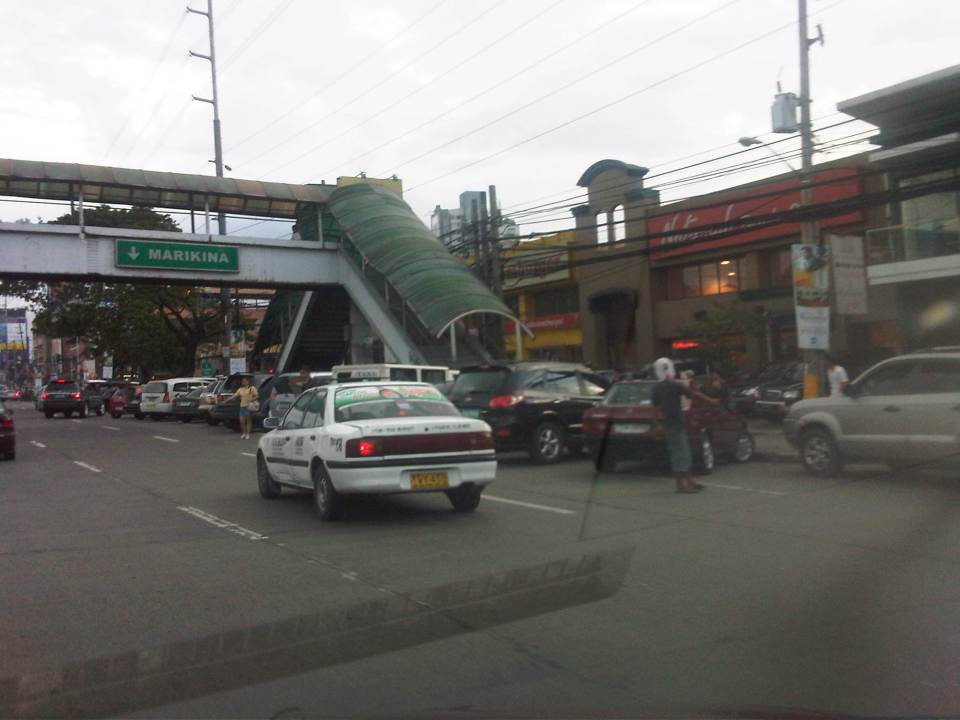
On-street parking along Katipunan at lanes that used to be part of what was a west service road. In many cases, onstreet parking has been the result of a violation of a very basic provision of the National Building Code, which prescribes the minimum number of parking slots for establishments such as restaurants, shops, banks and offices. Despite being quite outdated and disconnected with more progressive parking generation principles, the NBC should have been a basis for the local government to assess whether minimum guidelines are satisfied, and perhaps impose penalties on those who are not able to comply such provisions. This is a fundamental case where individuals (owners of parked vehicles) impose external costs (e.g., congestion and crash risk) upon the general public.
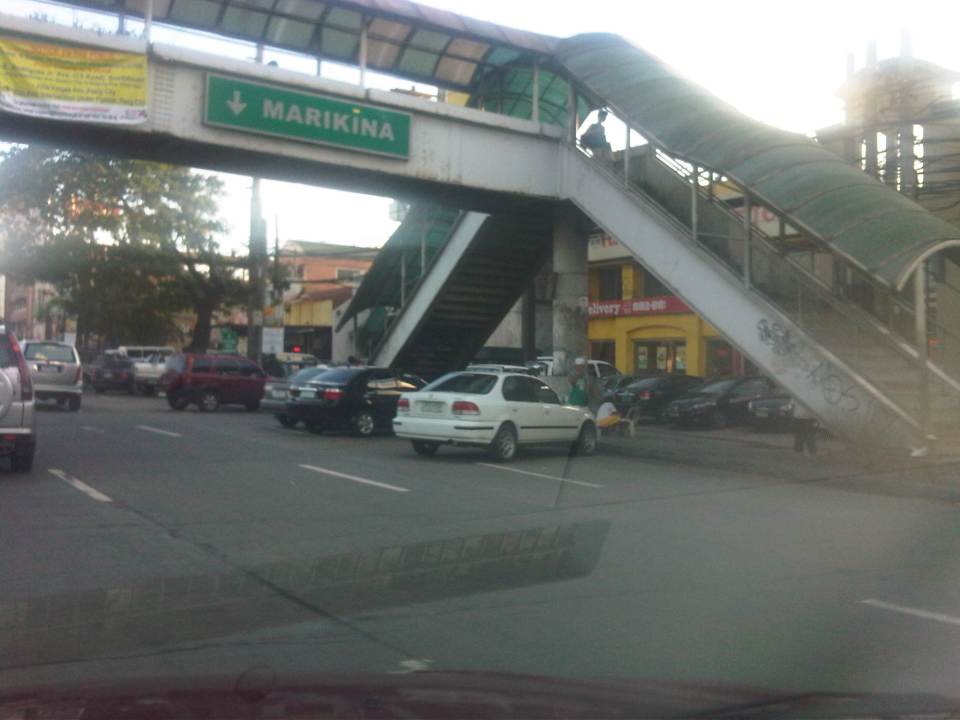
Another look at onstreet parking just beneath the pedestrian overpass across from Ateneo’s Gate 2 – restaurants along Katipunan are major traffic generators and despite the presence of public transport (jeepneys and tricycles) a significant number of trips generated by these establishments use private vehicles including cars, vans and SUVs. Katipunan’s pedestrian facilities are inadequate as there are practically no sidewalks, thereby forcing people to walk along the road. This exposes many and particulrly students to risks like getting sideswiped by vehicles driven by reckless drivers.
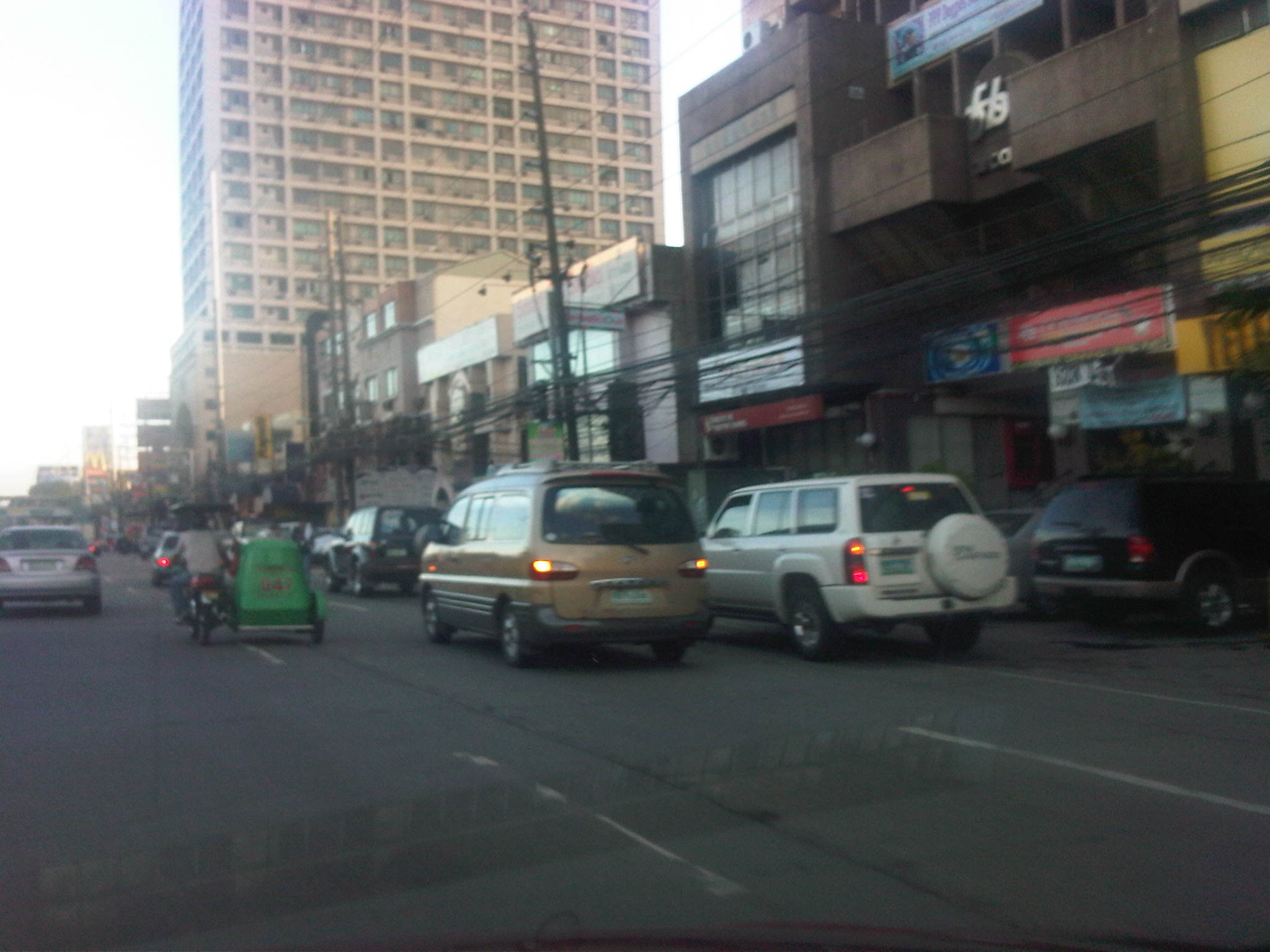
Waiting vehicles effectively occupying 2 lanes of Katipunan – many employ drivers who can stay with the vehicles while the occupants eat, shop or transact at establishments. In most cases, standing vehicles are practically parked vehicles as they occupy road space. High-rise residential condominiums along Katipunan may have complied with minimum parking requirements stipulated in the NBC but their trip generation characteristics considering the commercial establishments located at the same buildings surely require many more parking spaces than what are available.

Congestion along Katipunan’s southbound side – may be caused by onstreet parking, standing (waiting), or vehicle maneuvers with respect to the limited parking slots fronting most establishments along the road. One tutorial center located near a U-turn slot, for example, generates significant vehicle traffic that it affects both U-turn and through traffic. Meanwhile, traffic enforcers seem either ineffective or helpless in their efforts to manage traffic, including preventing vehicles from taking 2 lanes of Katipunan.

Standing/waiting vehicles in front of a new development along Katipunan – the new building hosts several establishments including a major bank, a book shop, a popular gym, and several restaurants or cafes. Despite the potential for vehicle attraction, only a few parking spaces were provided, leaving all other vehicles and their drivers on their own to find parking spaces or just occupy road space in front of the building. The footbridge across Ateneo’s Gate 3 has been extended to the building but this obviously has marginal impact in reducing vehicle generation and parking demand.

Another photo showing the parking situation in front of the new building – while traffic is generally a manifestation of economic activity, one opinion is that many developers are irresponsible by designing buildings that have inadequate parking and resulting in the general public bearing the burden of traffic externalities. Add to this local governments that turn a blind eye on such discrepancies in design (who reviewed the design that obviously violated the building code?) only to be on the receiving end of complaints. In some cases, LGUs probably will be forced to shoulder costs of providing solutions that developers should have covered in the first place if they were responsible enough or made responsible for mitigating negative impacts of their projects.
In the end, it is inevitable that we need to address the root of the problem, which pertains to land use planning and the zoning policies LGUs are implementing. Consistency is one thing and being circumspect about established guidelines is another. Sustainable development, after all, does not pertain to continuous transformation from low to high density development but more about balancing elements that would preserve the character of neighborhoods and communities, particularly and most importantly to ensure that quality of life is not compromised.
Congestion along Ortigas Ave. Extension
The severe traffic congestion experienced along Ortigas Avenue Extension these days are due partly to civil works related to a water project. This is similar to works that were implemented along Marcos Highway that coincided with the road widening and drainage project along that Highway. Ortigas Ext. traffic is always bad during the weekdays due to the limited capacity of the road combined with the sheer volume of traffic it has to carry. The highway still serves as the primary artery connecting the populous and progressive towns of Rizal Province to Metro Manila. These include Antipolo City and the towns of Cainta, Taytay, Binangonan and Angono. I’ve written a piece about traffic along Ortigas Ext. as well as the management schemes that have been employed to address peak period congestion including allowing counterflow traffic on weekday mornings. Following are a few more observations and assessments

Civil works in the middle of Ortigas Ave. Ext. in the De Castro Subdivision area – road capacity is substantially reduced along significant sections of the road due to waterworks project. Both eastbound and westbound traffic are affected as one lane each are taken up by the project. Traffic flow will surely improve once the project is completed, automatically adding two lanes (one for either direction) to increase capacity.

Sunday jam – I can only imagine how bad traffic congestion can be during the weekdays. The photo above is one I took on a Sunday afternoon showing congestion along the westbound direction typically associated with peak period traffic on weekdays. Meanwhile, traffic is practically free flowing on the eastbound side once you get past the work area across De Castro. I was a little surprised about the discipline of drivers considering only few (mostly motorcycles) dared to counterflow.

More diggings – this time 2 lanes are taken away from the wide section of Ortigas stretching from across the former Riverside Mills to the BF Metal Corp. This is where vehicles usually make U-turns because of the space available for vehicles making such maneuvers that are no longer allowed during most periods past the vicinity of Cainta Junction.

Approach to Cainta Junction – this is probably one of the most congestion or saturated intersections outside Metro Manila. Most traffic though can be attributed to Metro Manila as most vehicles are either bound for MM or are coming from it. At this Junction, Ortigas Ext. meets Imelda Ave. (formerly known also as Francisco Felix Ave.), which continues as A. Bonifacio Ave. as it extends to towards Cainta town proper. Ortigas Ext. from the eastbound approach has only 2 lanes (another 2 on the opposing direction) widening to 5 (additional lane for right turning traffic to Cainta) at the entry. Meanwhile the westbound approach from Antipolo/Taytay also has 3 lanes with one dedicated to right turning traffic, which is significant due to left turns being disallowed from the eastbound approach towards Imelda Ave. Vehicles now go through Ortigas and take a U-turn after the junction and then turn right to Imelda. At the median opening, Ortigas has been widened to allow for such maneuvers.
Cainta traffic and the MMDA has been experimenting on a number of schemes for the signalized junction. One proposal that has been on the shelf for quite some time now is for an overpass to be constructed along Ortigas to allow for continuous traffic flow along the highway. So far, there just seems to be not enough space for an overpass to be constructed and some quarters are saying that the only way to improve traffic really is to widen Ortigas to something like Marcos Highway on the other end of Imelda Ave. Such propositions could have been averted if a mass transit system was constructed along this corridor when congestion was just starting to set-in. Actually, history tells us that there was a mass transit system before with trains running regularly between Manila and Antipolo. But that is a topic we’ll reserve for another post. Abangan!
Pedestrian overpasses along Ortigas Extension
This post is a continuation of recent ones featuring pedestrian overpasses along major roads. These past posts include facilities along Commonwealth Avenue and Espana Boulevard. This time we take a look at similar facilities along Ortigas Avenue Extension, which stretches from C5 to Kaytikling Junction in Taytay, Rizal. Following is a photo journal of overpasses from Rosario until Cainta Junction.
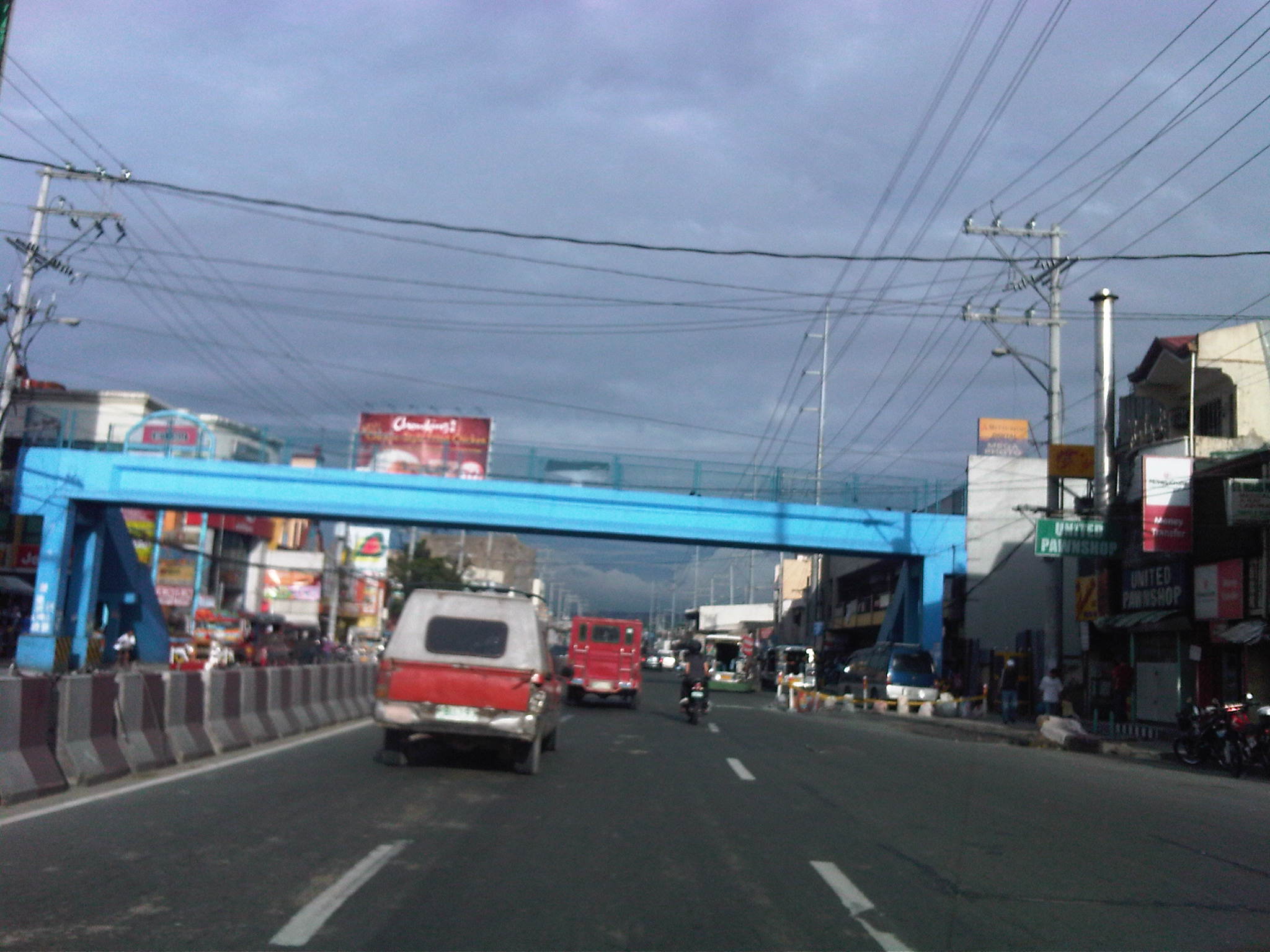 Concrete overpass at Rosario as viewed along Ortigas Ave. eastbound – it appears to be newly repainted but the design suggests it is an older structure of the more traditional design. There used to be no overpass here despite the volume of pedestrians crossing the street due in part to the Sto. Rosario Church on the left side of the road. At-grade crossings are still common with many jaywalkers hurdling/jumping over the concrete barriers.
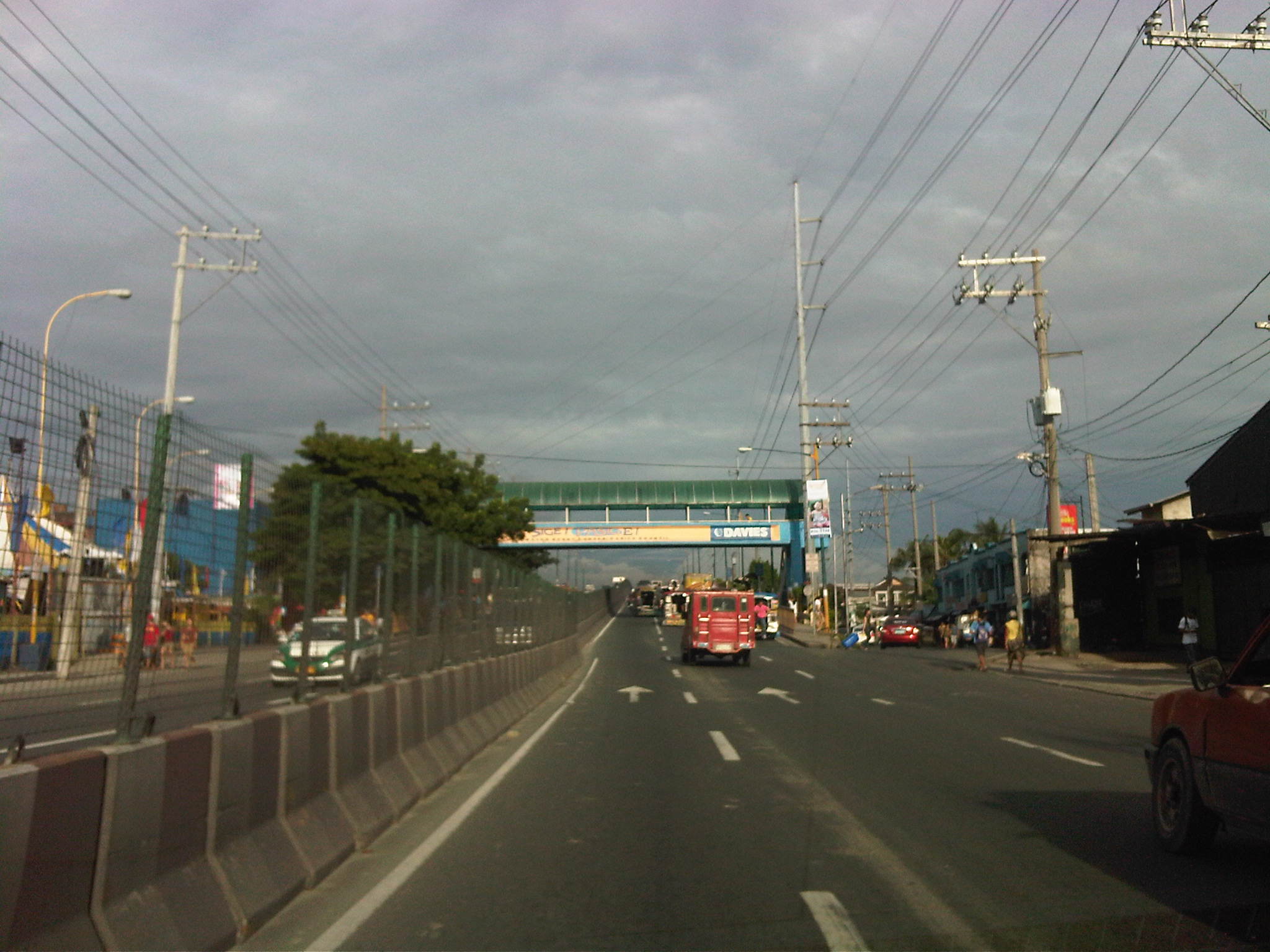 Overpass at the approach ramp to the Manggahan Bridge – seen from Ortigas eastbound, this is one of two overpasses found at either ends of the bridge crossing the Manggahan Floodway. There is a service road on either side Ortigas just beside the overpass that serves as access to the the West Service Road along the floodway.
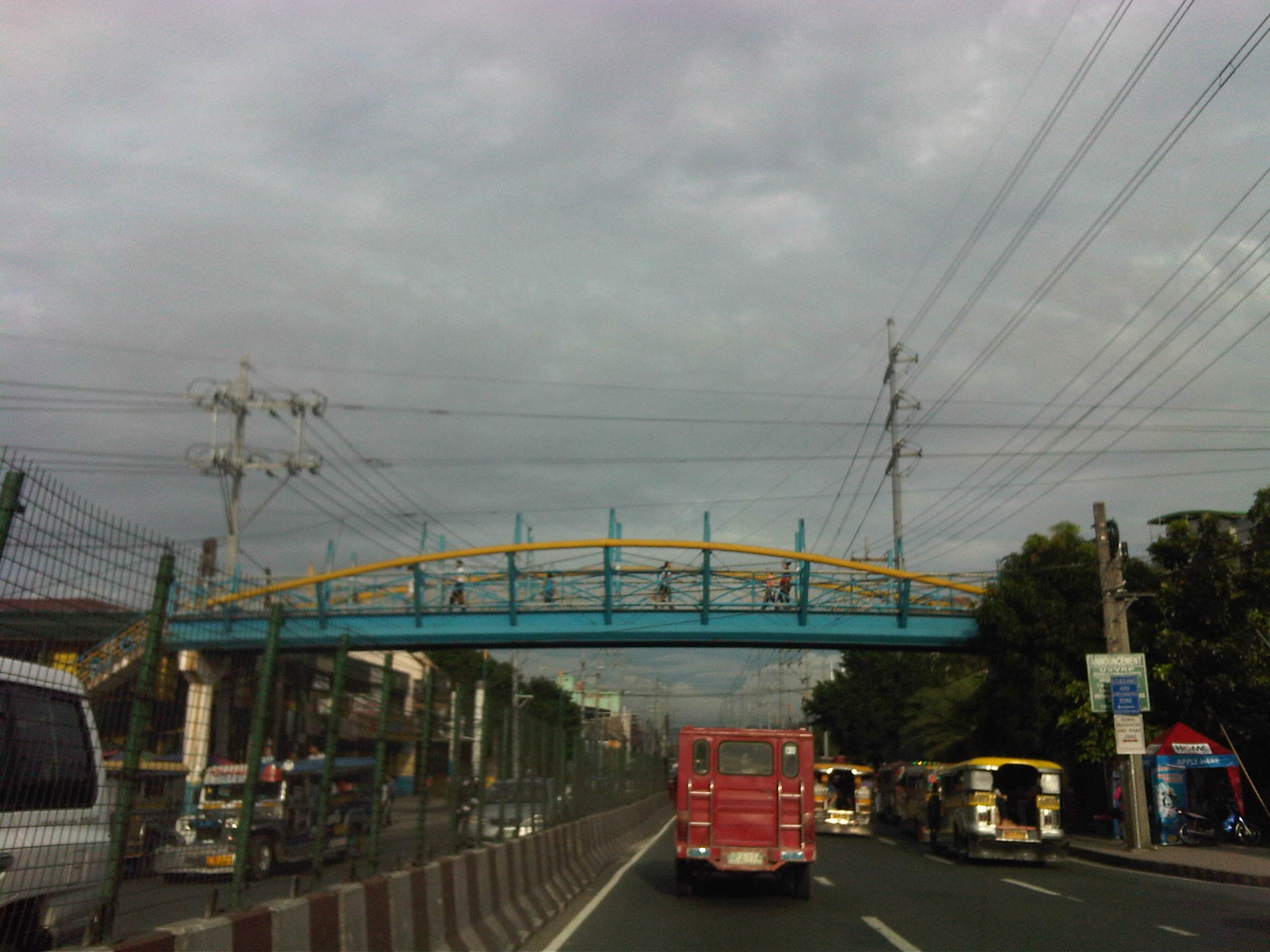 Second overpass at the exit ramp right after the Manggahan bridge – as viewed from Ortigas eastbound, the facility is similar to one found along C5. The steel structure comes across as a rather odd design that I’m sure my architect friends would have their own opinions about. As far as I am concerned, I think there’s just too much steel and is unnecessary though it can be claimed for aesthetics by the designer. Perhaps I am too concerned with functionality and safety rather than beauty?
 Overpass across Ever mall – the covered section of the overpass is concrete and similar to the Rosario overpass. The extension of the overpass is visible from this photo at the right side just above the minivan, and has the distinctive mark of the MMDA (the double M seen in the photo). The extension is a steel structure like most of the newer facilities constructed during the time of BF that allows pedestrians to walk overhead and straight to the mall. This section of Ortigas is quite unusual as outbound (MM-bound) traffic occupy all lanes of Ortigas at this area. Inbound (Rizal-bound) traffic are diverted towards a stretch fronting the mall that appears like a bypass road. Traffic eventually re-enters Ortigas right after the mall.
 Overpass across Cainta Public Market and Robinsons Cainta – this is a concrete structure that is covered and, surprisingly, is clear of vendors thanks to the efforts of Cainta enforcers and the mall security. The public market side (left side of the photo) is too crowded with the pedestrian immediately encountering informal vendors’ stalls upon descending the stairs. While there are no vendors atop the overpass, there are many tambays loitering about and the usual beggar sitting anywhere about the structure (usually at stairs along the public market side). The facility extends all the way towards the mall, which can be accessed via its second level.
Risky behavior at intersections
I saw these three vehicles, two motorcycles and a car, slowly encroaching towards the center of the intersection of Katipunan and C.P. Garcia Avenues last night. The red light was clearly displayed along with the number of seconds remaining that was indicated in the countdown timer installed along the southbound approach of the junction. They seemed to be unaware of the significant amount of time remaining before the green light. Worrisome was their being unmindful of the trucks turning left to C.P. Garcia from the northbound approach of Katipunan. Many of these trucks were the big trailer types that could easily wreck the car or crush the motorcycles should they mistakenly cross their paths. Requiring more space for their turning movements, many trucks encroach upon the second and third lanes from the median and would probably have hit one of the vehicles that were already past the nose of the median island on our side of the road.

There was no yellow box or markings clearly indicating the clear area for the intersection. However, it was quite clear where vehicles should stop considering there was a pedestrian crossing (incorrectly painted as zebra despite the traffic signals) at the approach of the intersection and vehicles should stop before these markings. The driver of the vehicle to our left obviously wanted to follow the example of the black car and already positioned his car over the pedestrian crossing. Is this a manifestation of being swapang or maybe the thinking that you want to be ahead of the rest?
Such behavior and others similar to this are risky and may lead to crashes that could have been prevented if the drivers and riders followed basic traffic rules and regulations. In fact, aside from the potential for road crashes, congestion due to clogged intersections are often due to many drivers and riders not following the rule of keeping an intersection open. Such a rule applies even when the green light is given to a particular movement considering that the intersection exit ahead is already full and further movement and the resulting queue will only block other movements once the lights change. The yellow box is supposed to define “no-man’s land” in as far as designating exactly which space should be clear of vehicles to facilitate traffic flow and as a matter of courtesy among drivers and riders. These are very basic principles in driving and among those consistently and constantly being violated. Meanwhile, traffic enforcers are either ignorant of these rules and prefer to just stick to catching violators of the number coding scheme or playing blind as they may have practically given up trying to enforce the rule while managing traffic. Perhaps they should try harder and be persistent in order to influence behavior change? After all, the last time I checked there are so many other rules and penalties other than swerving or violating number coding.
Road and drainage improvements along Marcos Highway – Part 2
Previous posts on Marcos Highway road works and the resulting congestion did not include photos and discussions on a significant section of the highway. This is the stretch that runs from P. Tuazon/Imelda Ave. to Masinag Junction, where Marcos Highway intersects with Sumulong Highway. Some friends have pointed out the bottlenecks that include Masinag Junction itself and the uncompleted work in the vicinity of the newly opened SM City Masinag. Following are a few photos I took on a Saturday morning while traveling along that stretch of road and a few observations pertaining to some causes of congestion.
 Unfinished drainage and roadworks along eastbound direction of Marcos Highway approaching Golden Meadows gate – note that materials occupy practically 2 lanes of the highway.
 Construction along Marcos Highway eastbound in front of AMA Computer College just after Filinvest East Gate – only 3 lanes available to traffic, sometimes 2 due to heavy equipment maneuvers.
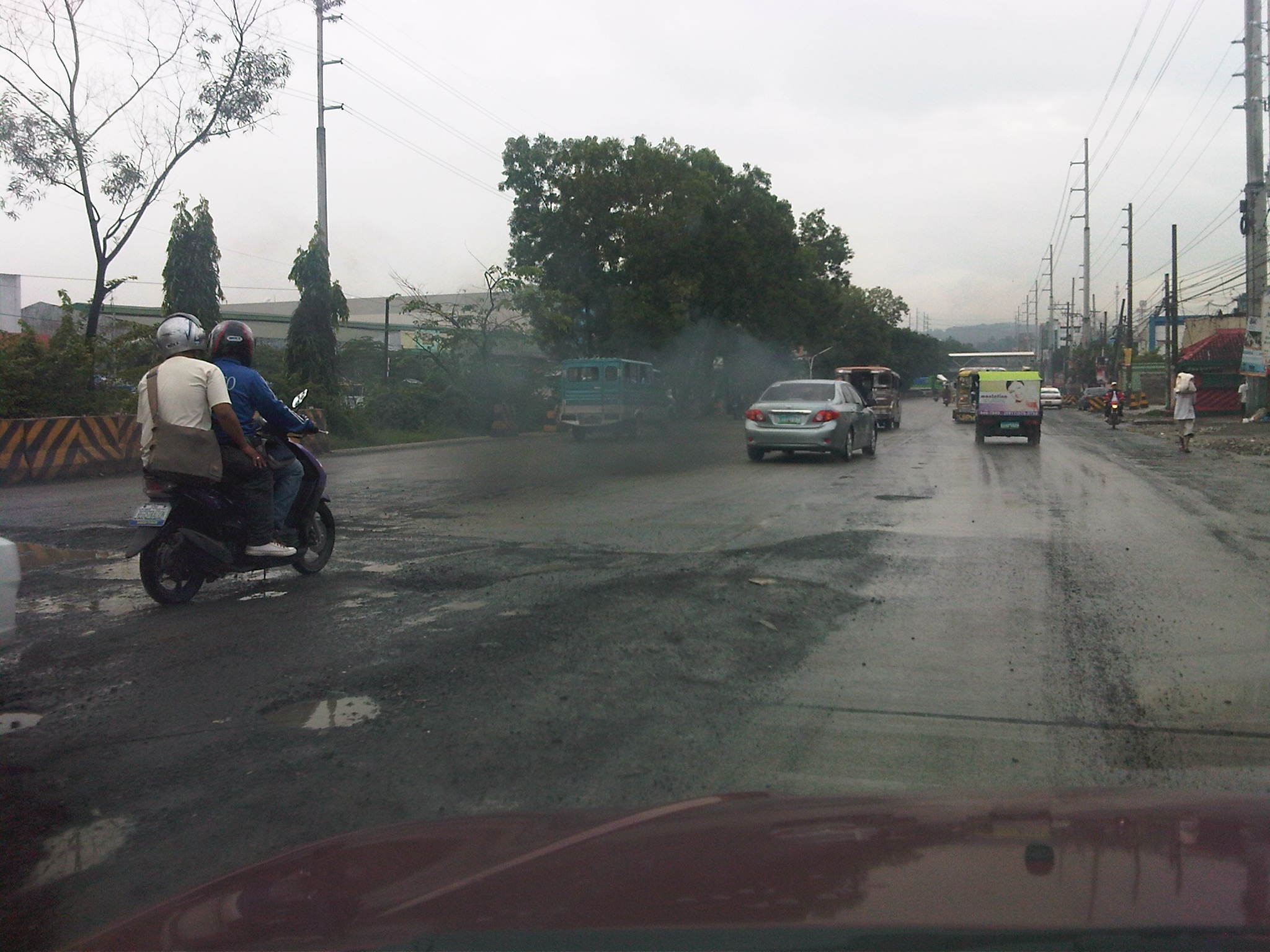 Unfinished road works near Kingsville Gate along Marcos Highway eastbound – bad road conditions lead to congestion as vehicles are forced to slow down due to the potholes and uneven pavement surface.
 Completed PCC pavement sections along Marcos Highway eastbound approaching SM City Masinag area – note that standard signs and pavement markings are still lacking along completed sections. Perhaps there is also a plan to have asphalt overlay as a protective or weathering layer for the concrete slabs?
 Completed section and newly constructed pedestrian overpass across SM Masinag – despite the overpass, many people still brave crossing the wide highway and risk getting run over by speeding vehicles.
 Jaywalking and risky crossing at Masinag Junction – I think traffic enforcers usually fail in managing pedestrians and cyclists crossing at the intersection resulting in the decrease in the throughput of the intersection. In any case, poor control may just lead to a road crash involving pedestrians and/or cyclists.
 More pedestrians crossing at Masinag junction – in this case, the only conflict is with vehicles turning right from Sumulong Highway.
 Another look at the new pedestrian overpass across SM Masinag along Marcos Highway westbound – this was a necessary facility for the safety of people (likely shoppers) crossing the 8-lane highway. The overpass would probably have to be modified later should LRT Line 2 be extended towards Antipolo City.
 Concrete barriers delineating lanes intended for vehicles making a U-turn along Marcos Highway just after SM Masinag – the barriers are also meant to reduce weaving caused by vehicles generated by the mall and intending to make the U-turn. These barriers, however, are also hazards as vehicles accelerating after Masinag will suddenly encounter these without adequate warnings. At present the lane is blocked right after the median opening due to uncompleted roadworks. Thus, erroneously entering the leftmost lanes will require a U-turn. Such barriers would have to be removed so traffic can still opt to pass through the section.
 Unfinished section along Marcos Highway westbound – the number of lanes are reduced from 5 to 2, drastically reducing capacity and causing serious queuing due to the shockwave resulting from the bottleneck.
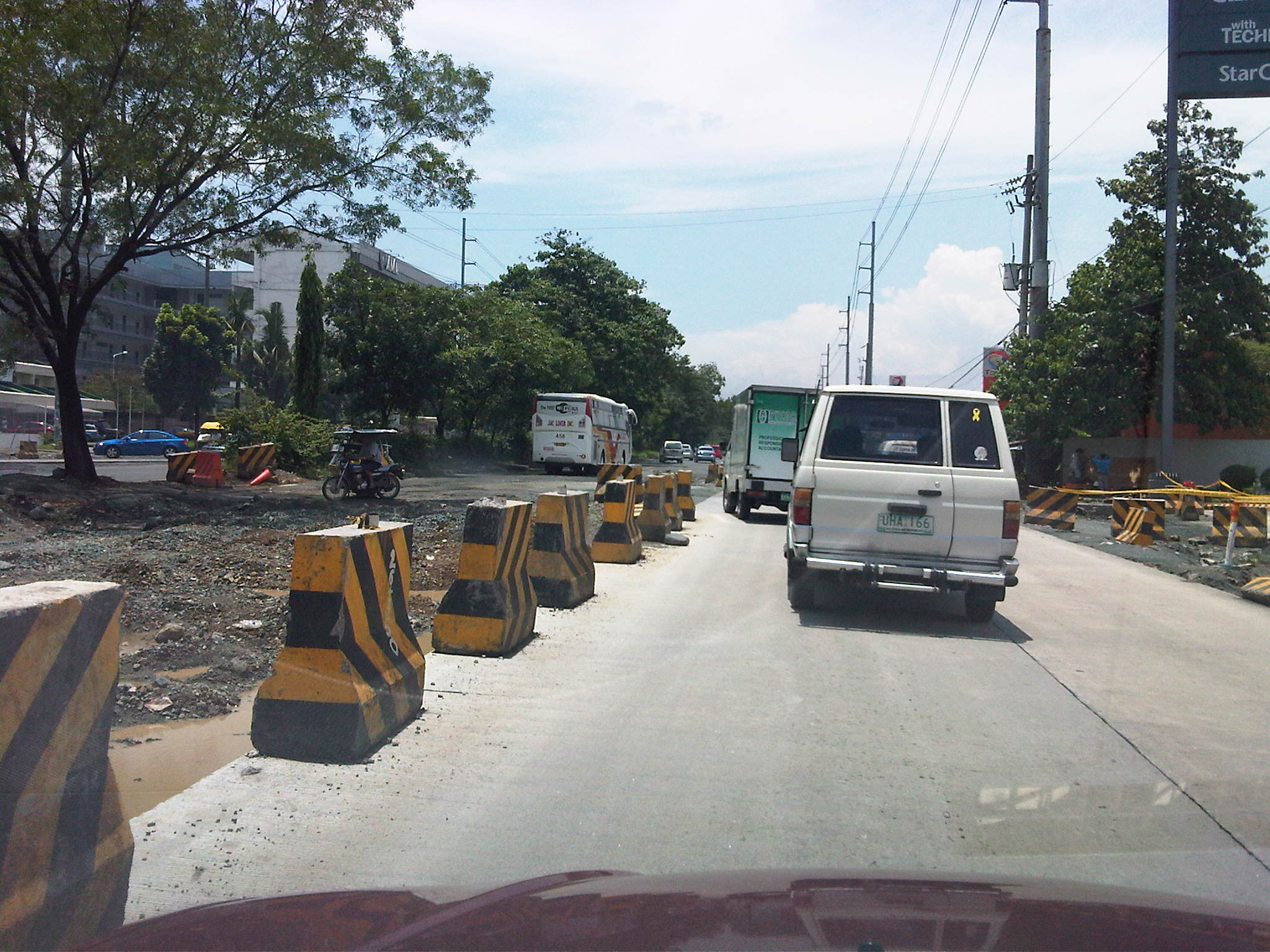 Unfinished drainage and roadworks along Marcos Highway westbound across the Caltex service station approaching the Filinvest East and Vermont Park gates – the section widens just before the subdivision gates and median opening but the inner lanes have not been paved at the time the photo was taken.
 Median opening (U-turn slot) for westbound traffic coming from Imelda Avenue – the old median opening across Burger King was closed and traffic was diverted to this slot located between the Shell and Phoenix service stations right after the Town & Country gate and CVC grocery. The result was less congestion due to weaving traffic between Imelda and this slot. This, however, came with a price – a longer trip for vehicles coming from Imelda Avenue.
With the completion of road and drainage works along Marcos Highway, it is expected that congestion will eventually be eased and the inherent costs will be reduced. Perhaps there will also be an opportunity to revisit traffic management and traffic control at critical junctions including Masinag, Imelda Ave./A. Tuazon, and A. Rodriguez/J.P. Rizal. So far, the perception of continuous movement due to the U-turn schemes along Marcos Highway have resulted in many adjustments to the locations of the slots while only producing congestion and perhaps encouraging aggressive driving behavior. Traffic signals should again be considered though traffic and travel behavior will surely be affected by a proposed extension of LRT Line 2.
Yurikamome – AGT in Tokyo
I lost a lot of photos and negatives to Ketsana. These included many about transportation systems in Japan during my 3 years while taking my doctorate. We loved to take pictures at railway platforms and I had a collection of photos of various trains approaching the platform including those taken by friends where I was in the picture as the train was approaching in the background. Fortunately, I have photos taken from more recent trips to Japan when I already had the benefit of having a digital camera for my shots. As I was browsing old photos, I came upon a set taken from a trip to Tokyo back in 2005. Following are a few photos I took when we went around the Odaiba district and used its popular Automated Guideway Transit (AGT) system called the Yurikamome or Seagull.
 Station platform – notice the doors that automatically open and close along with the AGT doors
 Another view of the station platform – notice the markings on the floor to designate queuing areas as well as standard guides for blind commuters (these are the yellow, dimpled tiles)
 Passengers’ waiting area with simple benches. The information boards for train arrivals are visible from this photo.
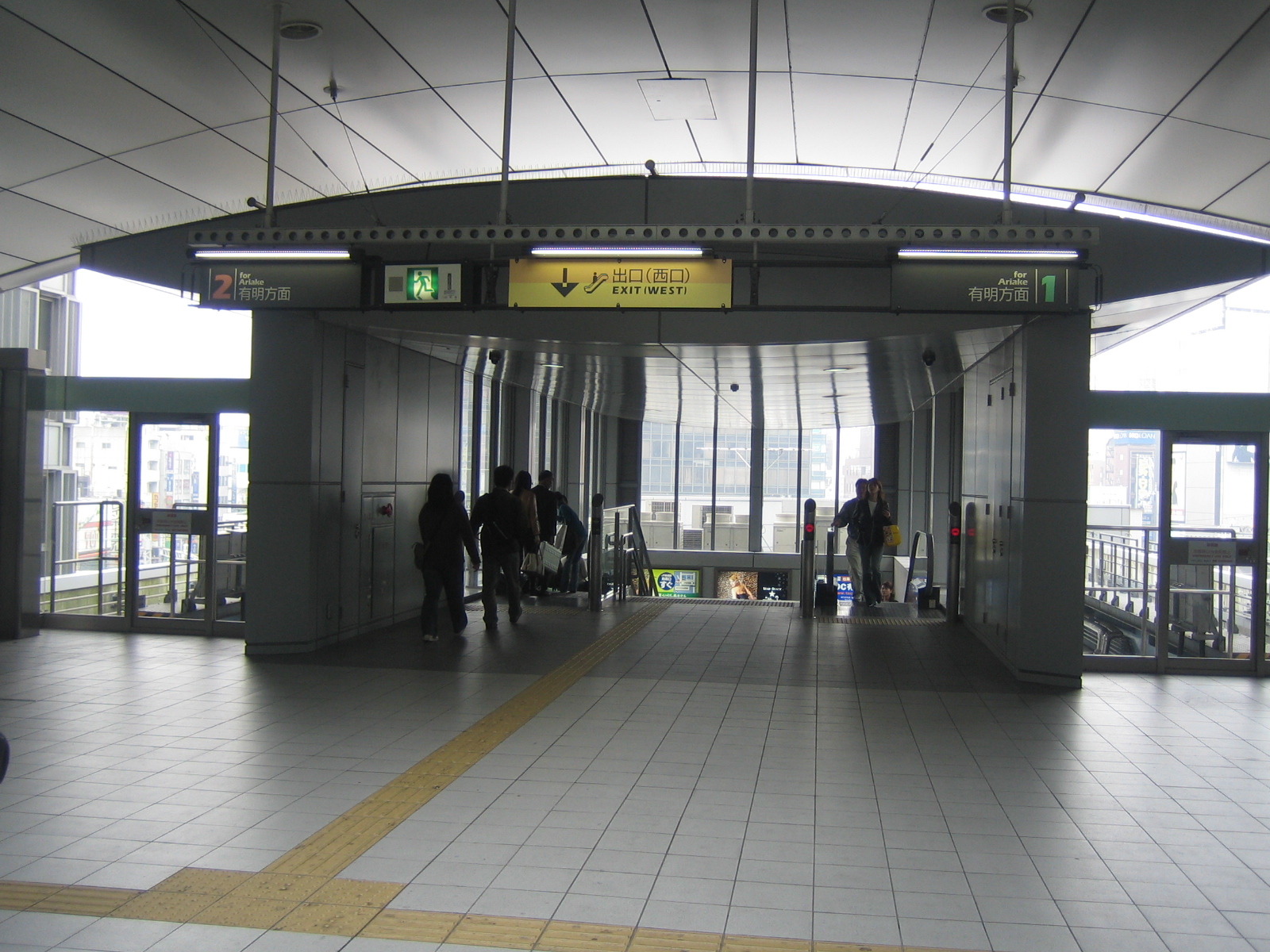 Entrance and exit to the station platform – both stairs and escalators are available to passengers.
 The Yurikamome’s guideway, which looks like a road. The AGT uses rubber tires much like road vehicles and employs a suspension system that ensures a smooth, comfortable ride.
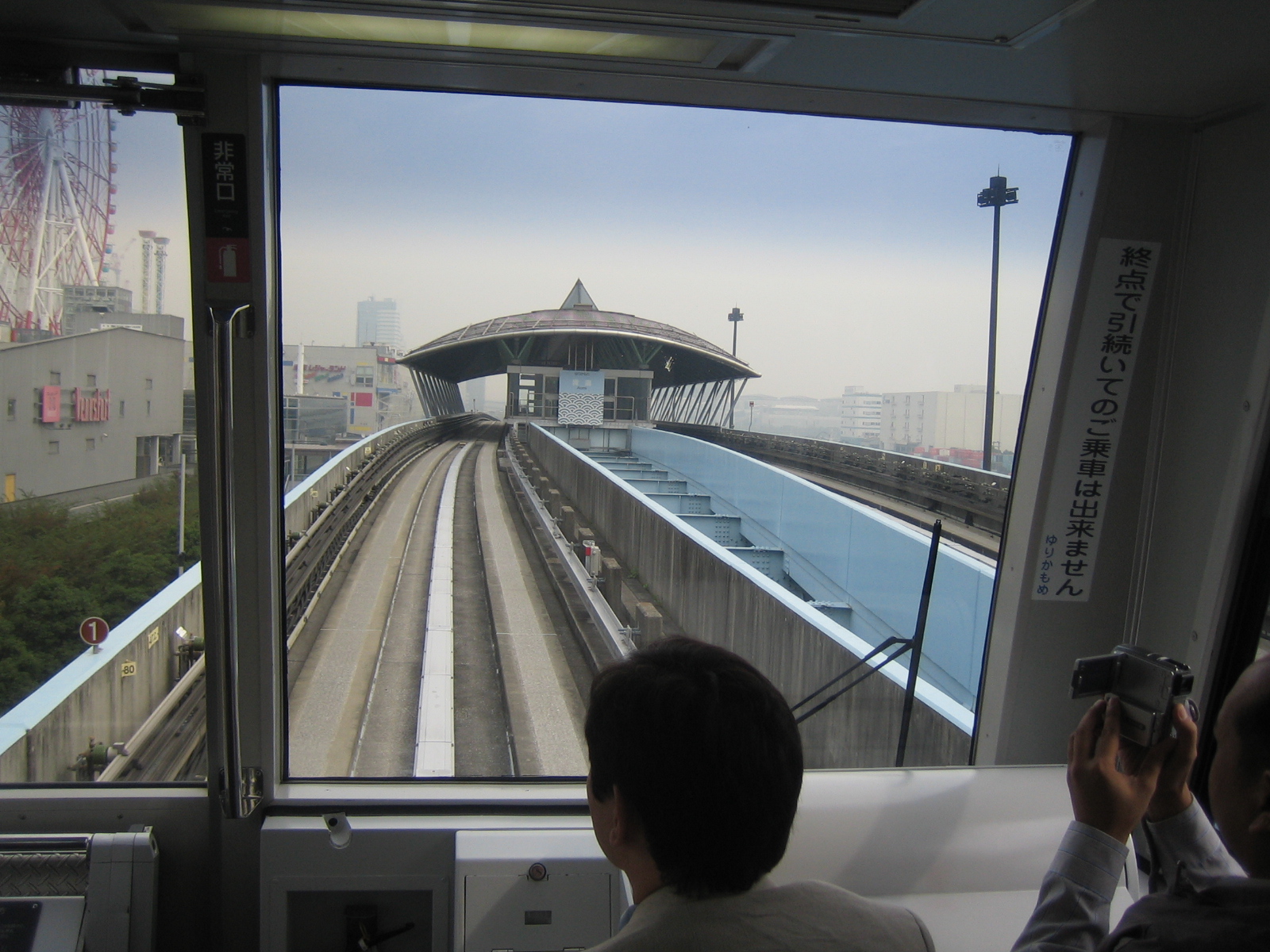 The Yurikamome is driverless (thus, automated). This is the view from the most coveted seats on the transit as the AGT approaches a station.
Dim your lights
I took the photo below in Cebu during one visit in 2010. The signs were posted along the coastal highway in the South Road Properties (SRP). Our friend explained that the signs were supposed to have been posted there as a spiteful message by a former mayor of the city to a political rival whose entourage commonly used the highway going to the city. Apparently, the vehicles on the politician’s convoy have the habit of using their lights even during the day to announce their presence in traffic. It seems their headlights are always on high beam (i.e., bright), which can be distracting for opposing traffic even if there is a median island along the highway. I can also imagine that in the past, vehicles on the convoy would probably use sirens or wangwang.

Many Philippine roads, especially in the rural areas, do not have lighting or are poorly lit, and it would be a lucky night when the moonlight is sufficient to provide illumination. Thus, it is understandable if we use the high beam or bright mode of our headlights when we are driving along dark roads and if there are no traffic on the opposing lanes. However, I think it is a matter of road courtesy that we dim lights when we encounter other vehicles on the road at night. Maybe it’s okay if the opposing lanes are divided by a median (like the island with plants in the photo) or barrier such that the lights are dissipated somehow. But most Philippine highways are undivided and thus, bright lights may become a hazard for motorists and lead to road crashes. If only for this, then there is actually a sound basis for reminding drivers to dim their headlights, especially in the city where there is significant vehicular traffic.
 Caught (up) in traffic