
Home » 2011 (Page 9)
Yearly Archives: 2011
An AGT at UP
The signing of a Memorandum of Agreement (MOA) and groundbreaking for a proposed prototype transit system at the University of the Philippines Diliman campus is scheduled for the morning of July 18, 2011, Monday. The site will be at the open lot near the corner of Lakandula and Jacinto Streets just across from the College of Fine Arts and near UP Diliman’s Campus Maintenance Office (CMO). The prototype system is a pet project of the DOST Secretary and was originally billed as the system to replace the IKOT jeepneys of UP Diliman. It will be a major undertaking for the university considering that its expertise (i.e., faculty, staff and students) will be tapped to undertake the studies and designs for the system. It will be a multi-disciplinary project that would involve architects, engineers and planners as well as social scientists who will be assigned with the unenviable task of securing social acceptability of the project.
The prototype system will have several phases in order to complete a loop. It is to be designed as a one-track, and therefore likely a one-way system. The “rolling stock” of modified buses each with a capacity of 60 passengers are supposed to have already been finished and are being tested at the DOST compound in Bicutan. It is still not known what the capacity of the system will be since there have been no studies to support demand (i.e., ridership), which will be affected by factors such as the route, direction and headways. among others. The project is one that is technology-driven rather than demand-driven. It is going to be an experimental system and one that will probably have to be tweaked from time to time given that it will be “home-grown” and attempting to reduce costs commonly associated with existing systems in other countries. Below is one of the proposed alignments for the system showing the initial phase from Philcoa (in yellow). The circles indicate the 2-minute walking distance radius although this is a crude concept considering people will be walking along the roads or sidewalks and not necessarily along a straight line leading to the proposed stations.

Whether it will eventually replace the jeepneys is still up in the air but the stakes are high considering that a locally made AGT may be transferable or feasible in other settings. Perhaps areas such as Bonifacio Global City, the reclamation areas along Macapagal Boulevard and even the Batasan can have their own AGTs in the future. My only hesitation for the prototype at UP Diliman is that it is still unclear who will be shouldering the operations and maintenance costs of a system that is sure to have revenues that won’t be able to cover such. Then there is the issue of aesthetics that cannot really be addressed now considering most plans are still in the minds of the proponents and have not been transferred unto the drawing boards or computers. We hope to be able to answer these questions and answer them correctly and appropriately. Otherwise, our legacy for the campus would be a white elephant that nobody would have wanted in the first place.
Enforceable?
Whenever laws and regulations are crafted, one basic question that needs to be considered pertains to whether there is capacity to enforce such laws or regulations. This is quite logical and appeals to common sense since laws and regulations are practically prints on paper that will not have any impacts if not enforced properly and fairly. I mention “fairly” here because laws and regulation may also be the subject of abusive enforcement. That is, there have been cases where motorists are flagged down and charged with violations that are taken out of the context given the traffic conditions, and where the number of apprehensions are related to quotas set by authorities.
Take the case of the unwarranted or illegal use of sirens (wangwang) in the past. There were laws and regulations for its use but for a long time these laws and regulations were not enforced properly, leading to the wangwang’s abuse by many unscrupulous people. Almost everyone have practically given up on this abuse of the siren when a newly elected President expressed his dismay and ordered the eradication of illegal sirens. Almost overnight, “wangwangs” were confiscated by authorities inspired by the Commander-in-Chief’s orders or removed by owners themselves for fear of the law bearing down on them. This was enforcement at its best. Unfortunately, it was not replicated for other traffic laws and regulations, wasting valuable momentum and the opportunity to make things right along our streets and highways.
Quezon City’s Green Building Ordinance is quite good and well-meaning. It is very timely and relevant, and even includes provisions for upgrading transport in that city. Among others, it requires that tricycles be transformed into cleaner vehicles by stipulating the replacement of 2-stroke and even 4-stroke motorcycles with LPG or electric models. To date, nothing significant has been achieved to address issues pertaining to the tens of thousands of tricycles in Quezon City. The construction of green buildings in Quezon City cannot be mainly attributed to the ordinance but rather to owners and designers who are now much more aware of climate change and its impacts, and are progressive enough to design buildings that are environment-friendly. Of course, there are those who take to the “green” bandwagon but do nothing towards this end. Are these subject to evaluations and inspections that are the equivalent of enforcement?
Now comes a bicycle ordinance from Pasig City that is formally the “Bicycle Transportation Promotion Ordinance of 2011.” It is also good and well-meaning but the jury will definitely be out there if this initiative will be a successful and sustainable one. I am quite hopeful that it would be and not just end up as an example of coming up with laws because anything about the environment is in these days. The provision in the ordinance designating bicycle lanes and requiring establishments to provide bicycle racks for parking are all good but we have seen this before in an even bigger scale in the City of Marikina. There they constructed bikeways practically connecting all parts of the city and they were quite aggressive even after foreign support had ended. Politics and shortcomings (I wouldn’t say failure.) in encouraging people to cycle have made much of the on-street bicycle lanes practically taken over by motorized transport. Bicycle racks there are also being used by motorcycles and scooters. Pasig should learn from these experiences and it is hoped that the city succeed and become another example of EST to be replicated in other Philippine cities.
Transport topics in the 2011 Professorial Chair Colloquium
The 2011 Professorial Chair Colloquium of the College of Engineering of the University of the Philippines on July 4 will feature a number of lectures with transportation themes. These are the following:
– Development of a Diesel Hybrid Vehicle Prototype [Gerald Jo. C. Denoga, Emerson Professorial Chair in Mechanical Engineering]
– Survival Versus Sustainability: Challenges to Environmentally Sustainable Transport [Hilario Sean O. Palmiano, Transport Training Center Professorial Chair]
– LPG in Dual-Fuel SI and CI Engine Applications – Effects on Maximum Power and Fuel Consumption [Edwin N. Quiros, Emerson Professorial Chair in Mechanical Engineering]
– Traffic Congestion in Metro Manila: Is the UVVRP Still Effective? [Jose Regin F. Regidor, Pozzolanic Philippines Inc. Professorial Chair]
– Design and Production of a Vehicle Run by Cordless Drills [Joseph Gerard T. Reyes, Emerson Professorial Chair in Mechanical Engineering]
– Towards a Safer Intersection Design [Ricardo G. Sigua, Prof. Emeritus Norbert S. Vila Professorial Chair]
– Estimation of Emissions and Fuel Consumption of Sustainable Transport Measures in Metro Manila [Karl B.N. Vergel, Maynilad Professorial Chair]
The lectures are to be delivered mainly by Civil Engineering and Mechanical Engineering faculty and it is quite obvious from the titles that the ME’s have focused on vehicle technologies while the CEs are into sustainable transport and design. These topics also reflect on the researches currently being implemented at the college although it is also known that IEs and EEs are doing transport-related researches including those on Intelligent Transport Systems (ITS) and logistics. Hopefully, the outputs of these researches will be beneficial to the country considering their applications to local problems.
Philippine participation in EASTS 2011
The 9th International Conference of the Eastern Asia Society for Transportation Studies (EASTS) was recently held in Jeju, Korea. The conference was well attended with over 700 participants from at least 12 countries including those from member societies in eastern Asia. The Philippines was represented by academics and researchers coming mainly from the UP Diliman, Mapua Institute of Technology and St. Louis University (Baguio City).
Following is a photo taken during the Welcome Dinner last June 20, 2011 held at the Jeju International Convention Center.
 Seated [L-R]: Grace Padayhag (ITPS), Regin Regidor (UP); Standing [L-R]: Mark De Guzman (SLU, partially obscured), Riches Bacero, Aldrine Uy (Mapua), Francis Villareal, Dr Shigeru Morichi (ITPS), Jun Castro (UP), Ric Sigua (UP) and Ernie Abaya (UP)
The next photo shows Philippine participants taking a break at a cafeteria at the Jeju ICC:
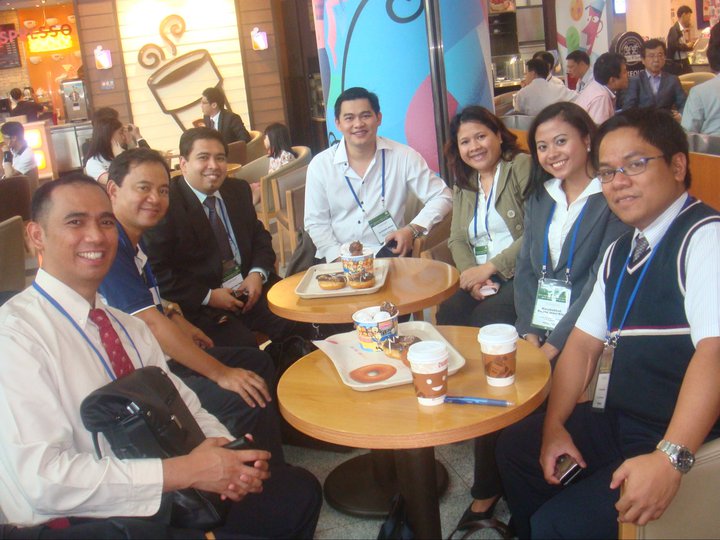 [L-R]: Riches Bacero, Ric Sigua, Regin Regidor, Aldrine Uy, Grace Padayhag, Reigna Macabbabad, and Mark De Guzman
School traffic generation – Part 1
One thing I will miss about summers is the relatively light traffic along Katipunan Avenue, which is where I pass through almost everyday between my home and workplace. There is still some congestion during the mid-day and the afternoons but these are typically due to truck traffic as Circumferential Road 5 (C5) is a truck route. During the rest of the year, however, with the exception of most weekends and holidays, severe congestion is experienced along Katipunan during the peak periods, particularly in the mornings between 6:30 AM and 7:30 AM. This is due primarily to the traffic generated by schools along Katipunan Avenue, most notably the Ateneo De Manila University and Miriam College. The following photos show typical traffic conditions along C5 during the peak periods.
 Slow-moving vehicles along the northbound side of Katipunan Avenue
 Congestion along the northbound direction of Katipunan atop the Aurora Blvd. overpass
 Congestion along the Katipunan southbound service road leading to the U-turn slot underneath the Aurora Blvd. overpass
Traffic along the southbound service road leads to a U-turn slot under the overpass where many vehicles turn, heading in the general direction of Ateneo. Most turn here in order to enter the university via its Gate 1, which is the main access to the Grade School. On most times, congestion is caused by these vehicles turning right at Gate 1 as they effectively occupy the two lanes of the northbound service road and block all other traffic. This is shown in the following photo where it is clear that vehicles bound for Ateneo and turning at Gate 1 are the main cause of congestion. Beyond Gate 1, the traffic lanes are practically free of congestion.
 Vehicles turning right to Ateneo’s Gate 1 blocking traffic along the Katipunan northbound service road
The afternoon peak is exacerbated by traffic generated by these schools that lead to longer periods of congestion as the number of private vehicle traffic dramatically increases when there are classes between June and April. Meanwhile, there is a noticeable decrease in traffic during the weekends and holidays. Such phenomenon is mostly attributable to the trip generation characteristics of schools, and especially those that tend towards the generation of much private vehicles. Ateneo and Miriam along Katipunan are just two examples. The traffic they generate and the consequential congestion is replicated in other places as well, giving headaches to motorists and commuters passing along major roads affected by these schools. Ortigas Avenue, for example, is usually congested during the weekdays because of traffic generated by LaSalle Greenhills, and ADB Avenue at the Ortigas Center is usually congested due to traffic attributed to Poveda.
Vehicle development and safety
As I drove to work this morning, I chanced upon a new model Korean-brand SUV along the highway. I couldn’t help but notice the sleek exteriors and was again impressed by what seemed to me, at least from where I was sitting, was a nicely performing vehicle along a road that was already starting to congest with morning traffic and with pavements still under rehabilitation. As I pulled ahead of the vehicle, I was able to appreciate its front design (the snout in particular) and noticed its lights that were very much similar to those already being used by late model German cars. Of course, the initial reaction would be that perhaps the Korean vehicle was a copy of the original European one. However, I was also aware that Korea already had strong partnerships with leading German automakers and routinely benchmarked their vehicles with their German counterparts. In fact, there are models of German vehicles that were and are developed and tested in Korea, which
I believe that much of the Korean vehicle manufacturers’ success in the design and development of vehicles that are at par if not better than its European counterparts may be attributed to Korea’s testing and research facilities. At the head of the effort for vehicle development and testing is the Korea Transportation Safety Authority or TS, and they work closely with other institutions including the very influential Korea Transport Institute (KOTI). It is a good example of a successful working relationship between government, the private sector and the academe.
I was fortunate to have been able to visit the Korean testing and research facilities back in 2009. At that time, I was part of a small party from the Philippines attending the Regional Environmentally Sustainable Transport (EST) Forum in Seoul, and was among those invited by Korean Transportation Safety Authority (TS) to visit the Korea Automobile Testing & Research Institute. We were very impressed with their facilities and perhaps could only dream of having a similar one in the Philippines. We were toured around the different areas where various tests were being conducted and I was particularly interested in the proving grounds where new models were being tested for various operating conditions. I have some photos taken of the research and testing facilities but I defer from posting these here as there might be some restrictions applicable. Also, I’m afraid my photos won’t do justice to the impressive facilities at KATRI. Nevertheless, I have provided the links to the websites of the institutions I mentioned above for easy reference for anyone interested in their activities. The details may be found there and there are many photos and illustrations that would allow anyone who would at least browse their website to have an idea of just how far Korea has made progress in vehicle development and how much effort they put in to ensure safety on the part of the vehicle.
Traffic Congestion in Metro Manila: Is the UVVRP Still Effective? -Conclusion
The MMDA always reports what it claims as improvements of travel speeds along EDSA that past years. They have pointed to this as evidence that traffic congestion is being addressed and that programs like the UVVRP are effective in curbing congestion. However, many traffic experts have cautioned against making sweeping generalizations pertaining to the effectiveness of schemes especially if the evidence put forward is limited and where data seems to have been collected under undesirable (read: unscientific) circumstances.
The MMDA also has been using and to some extent overextending its use of a micro-simulation software that is employs to demonstrate the potential effectiveness of its proposed traffic schemes. The software has an excellent animation feature that can make the untrained eye believe in what is being shown as The problem here is when one realizes that computer software will only show what the programmer/operator wants, and is perhaps an example where the term “garbage in, garbage out” is very much applicable. And this is especially true should the computer model be uncalibrated and unvalidated according to guidelines that are well established, and extensively discussed and deliberated in a wealth of academic references. The fallacy of employing advanced tools to demonstrate how one’s proposal is better than another was highlighted when the DPWH acquired the same tool and came up with an entirely different result for an analysis being made for the same project by that agency and the MMDA. Surely this resulted in confusion as the outcomes of the simulation efforts of both agencies practically negated each other.
It should be pointed out that such micro-simulation software is unsuitable for the task of determining whether metro-wide schemes such as the UVVRP is still effective given the actions of those affected by the scheme. What is required is a macroscopic model that would take into account the travel characteristics of populations in Metro Manila and its surrounding areas (cities and towns in the provinces of Rizal, Bulacan, Cavite, Laguna). There are quite a few of these models available but most if not all were derived from the one developed under the Metro Manila Urban Transport Integration Study (MMUTIS) that was completed in 1999. The main beneficiary from the outcomes of MMUTIS happens to be the MMDA but for some reason, that agency failed to build capacity for maintaining and updating/upgrading the model. As such, the agency missed a great opportunity to invest in something that they could have used to develop and evaluate traffic schemes to address congestion and other traffic issues in Metro Manila, as well as to assess the impacts of new developments.
Metro Manila has come to a point where its options for alleviating congestion are becoming more and more limited. The combination of a still increasing rate of motorization and private vehicle use have definitely contributed to congestion while there are also perceptions of a decline in public transport use in the metropolis. The share of public transport users in most Philippine cities and municipalities range from 80 – 90 %, while in many highly urbanized cities the tendency seems to be a decline for this share as more people are choosing to purchase motorcycles to enhance their mobility and as a substitute to cars. This trend towards motorcycle use cannot be denied based on the steep increase in ownership and the sheer number of motorcycles we observe in traffic everyday.
Metro Manila needs to retain the substantial public transport share while accepting that motorcycle ownership will continue to chip off commuters. The latter phenomenon can be slowed down should authorities strictly enforce traffic rules and regulations on motorcyclists, effectively erasing the notion that the latter group is “exempted” from such. The bigger and more urgent issue is how to put up long overdue mass transport infrastructure that is direly needed in order to create another opportunity for rationalization transport services. We seem to like that word “rationalization” without really understanding and acting on what is required to once and for all address transport problems in the metropolis. We are not lacking for examples of good practices that are both effective and sustainable including those in the capital cities of our ASEAN neighbors. However, we seem to be unable to deliver on the infrastructure part that we have tended to over-rely on a TDM scheme that has long lost much of its effectiveness. The evidence is quite strong for this conclusion and perhaps we should stop being in denial in as far as the UVVRP’s effectiveness is concerned. Efforts should be turned towards building the necessary infrastructure and making public transport attractive so that private car and motorcycle users will be left with no excuse to shift to public transport use. It is inevitable that at some time they will understand the cost of congestion and that they will have to pay for their part in congestion like what is being done along tollways or, in the more sophisticated and mature example, Singapore. But this cannot be realized if we continue to fail in putting up the infrastructure Metro Manila so direly requires.
Is it “Commonwealth” or “Commondeath” Avenue?
There is an excellent article appearing today in the Philippine Star written by Arch. Paulo Alcazaren aptly titled “‘Commondeath’ Avenue.” I stumbled on when it was shared by a friend, Dr. Dayo Montalbo, who is a faculty member of the UP School of Urban and Regional Planning. It provides a rare insight into the history of our highways and streets in Metro Manila. It is required reading for planners and engineers with backgrounds in civil engineering, architecture, urban planning, etc., and, I must say, for anyone who can appreciate history and how we seem to not have learned (or refused to learn) from it. It certainly should be required reading for students who want to become future planners and engineers.
When the MMDA “discovered” plans where it was indicated how wide the RROW for Commonwealth should be and started acquiring land left and right from those who were supposed to have been encroaching on the avenue, including UP Diliman, it apparently didn’t study the old plans and the context by which the capitol, Commonwealth, UP and other institutions where laid out back in the day. That interpretation translated into what we see now as probably the widest highway in the country.
I see the article as something that can be used by the DPWH and the MMDA as an input to whatever planning or engineering they plan along Commonwealth. The avenue is just too wide and definitely not friendly to people. Perhaps it should be transformed into the parkway it was meant to be in the first place.
Traffic congestion in Metro Manila: Is the UVVRP still effective? – Part 2
In the past decade, there has been a sharp rise in the motorcycle ownership around the country and especially in Metro Manila. From about 1 million motorcycles registered in 2000, the number has increased to 3.2 million in 2009, a 320% increase over a period of 10 years. Motorcycles have become associated with mobility, in this case the motorized kind, and have become the mode of choice for many who choose to have their own vehicles but cannot afford a four-wheeler. These people also choose not to take public transport for a variety of reasons but mainly as they perceive their mobility to be limited should they use public transport services that are available to them. This rise of the motorcycle is also a response to the restrictions brought about by UVVRP with the scheme not covering motorcycles. In fact, should motorcycles be included in the UVVRP, it would be a nightmare for traffic enforcers to apprehend riders considering how they maneuver in traffic. Add to this the perception and attitude of riders that motorcycles are practically exempt from traffic rules and regulations (and traffic schemes!). One only needs to observe their behavior to validate the argument.
To understand UVVRP, it must also be assessed in the context of its original implementation when Metro Manila had to contend with congestion due to infrastructure projects being constructed everywhere during the 1990’s. EDSA MRT was being constructed, interchanges were also being put up, and a number of bridges were being widened to accommodate the increasing travel demand. Road widening projects generally benefit private vehicle users more than public transport users. In the case of Metro Manila, many areas are already built-up and acquisition of right of way for widening is quite difficult for existing roads. As such, it is very difficult to increase road capacities to accommodate the steady increase in the number of vehicles.
In transportation engineering, when traffic/transport systems management (TEM) techniques are no longer effective or yield marginal improvements we turn to travel demand management (TDM) schemes to alleviate congestion. In the former, we try to address congestion by tweaking the system (i.e., infrastructure) through road widening, adjustment of traffic signal settings, etc. while in the latter, we go to the root of the problem and try to manage the trips emanating from the trip generation characteristics of various land uses interacting with each other. By addressing the trip generation characteristics through restrictions, we influence travel demand and hopefully lessen traffic during the peak periods while distributing these to others.
This is the essence of UVVRP where the coding scheme targets particular groups of private cars (according to the end number on the license plate) each weekday. Meanwhile, the scheme is not implemented during weekends due to the perception that, perhaps, travel demand is less or more spread out during Saturdays and Sundays. However, there is a problem with this approach as the traffic taken away from the peak hours are transferred to other times of the day, thereby causing in some cases the extension of what was originally a peak hour unto a longer period. What was before a morning peak of say 7:30 – 8:30 AM becomes spread out into a peak period of 7:00 – 9:00 AM. The problem here is when you have major traffic generators like central business districts (e.g., Makati and Ortigas) where congestion is experience for more than 2 hours (e.g., 7:00 – 10:00 AM or 4:00 – 7:00 PM).
The UVVRP is not implemented in all of Metro Manila. Several LGUs, particularly those in the outer areas like Marikina City and Pateros. This is simply due to the information and observations of these cities that their roads are not affected by the build-up of traffic since most traffic is bound for the CBDs located in Makati, Pasig, Mandaluyong, Quezon City and Manila. This is the case also for LGUs in the periphery of Metro Manila like the towns in the province of Rizal, which is to the east of the metropolis, where the typical behavior of traffic is outbound in the morning and inbound in the afternoon. The great disparity between inbound and outbound traffic is evident in the traffic along Ortigas Avenue where authorities have even implemented a counterflow scheme to increase westbound road capacity.
There have also been observations of traffic easing up during the mid-day. As such, the MMDA introduced a window from 10:00 AM to 3:00 PM to allow all vehicles to travel during that period while retaining the restrictions of the number coding scheme from 7:00 – 10:00 AM and 3:00 – 7:00 PM. However, while many LGUs applied the window, some and particularly those found in central part of the Metropolis like Makati, retained the 7:00 AM – 7:00 PM ban. This stems from their perspective that traffic does not ease up at all (e.g., try driving along Gil Puyat Ave. during lunchtime) along their streets during the window period.
Nowadays, there seems to be the general perception that one can no longer distinguish between traffic during the coding period and the window. Traffic congestion is everywhere and there are few opportunities for road widening. Traffic signal control adjustments are limited to those intersections where signals have been retained (mostly in Makati) since the MMDA replaced signalized intersections with U-turn slots during a past administration where the U-turn was hailed as the solution to the traffic mess.
Regular salary or commission?
Still related to the topic of the road crash that claimed the life of a UP Professor last week are current discussions on the compensation of public utility vehicle drivers – particularly drivers of buses. The boundary system is the one that is predominantly employed by many operators or companies with their drivers. It is quite a simple system where the driver practically rents the vehicle from the operator for a certain amount that is related to the characteristics of the route that he or she will be plying. Thus, the longer routes with the higher passenger demands typically pay more than shorter ones or those with less demand.
What a driver would earn during his shift (in a day) would include the amount he would be spending for fuel and maintenance costs. This means that the driver would have to earn significantly more than what he plans to take home because from the gross income for a day’s work he would have to subtract the boundary (vehicle rental) fee, fuel costs and maintenance costs. Should he be apprehended for any traffic violation, he may also have to shell out more money for fines or, in certain cases, bribes to crooked traffic enforcers. Theoretically, however, if a driver is able to cover more round trips in a day he has the potential earn more in terms of net income. Thus, it can be inferred that traffic congestion would be among his main problems if he is to reach his goal of a decent take home pay. As such, the objective for any driver is to maximize his passengers for every trip that he makes and maximize the number of trips that he makes in order to maximize his income.
Meanwhile, the salary type of compensation involves a fixed payment for services rendered by a driver regardless of the number of passengers he is able to pick up or of even maybe the number of round trips per day that he is able to make. The latter parts of that last sentence is probably the most significant difference in the characteristics of the two compensation schemes that we are now attempting to compare. These are the characteristics that are often mentioned whenever inefficiencies and inconveniences in road public transport services are discussed since it is argued that scheduled services and behavior change, ergo better public transport services, will be possible if drivers won’t have to compete against each other for passengers or recklessly speed up in order to cut travel and turnaround times.
But can a fixed salary or a system much like those in most conventional or regular companies be acceptable in the first place to both driver and operator? What are the views from the drivers and operators themselves? What would be the implications and impacts of having salaried drivers much like employees of a conventional company?
The theoretical answer to the first question, and one that would most likely be provided by proponents of regular salaries, is a resounding yes. However, the response to the second question would be problematic once one realizes that the answers to number three seem to be unfavorable to both driver and operator while appearing to be beneficial for commuters. For the first question, a fixed salary may not necessarily be acceptable to drivers since it is not necessarily advantageous to them. A fixed salary means they will lose the potential of earning more income that is possible from the current practices of driving aggressively and pursuing as many passengers as possible.
The idea of putting a cap on their income is one thing, the prospect of having a paper trail for a regular salary is another. If, as proposed, drivers would have regular salaries like most employees working in offices, then companies may have to employ a system similar to that in other business where they will now be withholding taxes and other dues for benefits like social security and healthcare. While the BIR might end up happier with this set-up, surely the drivers who until now perhaps do not even pay their taxes at all will oppose a system where they will end up with potentially less net income.
On the part of the operator or company, having drivers with fixed salaries would also mean less potential income at the end of the day as revenues may be reduced. The reduction would be mainly due to less passengers as drivers are no longer pressured to take as many passengers as they can. They are, after all, assured of a fixed salary and do not have to stay longer at stops just to maximize the number of passengers they could pick up. Such result would definitely be welcome to passengers who would benefit from shorter dwell times (delays) and faster travel speeds. But from the perspective of operators or companies, it is bad business and they may end up being exposed for their financial incapacity.
This perspective of the operators and drivers is validated by the recent interviews by news crews of the former group where they practically opposed regular salaries for drivers. Operators reasoned that drivers would be on the losing end of the deal while not discussing how it would affect them and how the prospect of salaried drivers may lead to increased efficiencies of public transport services and even alleviate traffic congestion. On the part of the drivers, there are basically mixed views on regular salaries with one group saying it is acceptable to them and another saying it is disadvantageous in their cases. The impression for both groups, however, is that they are basically ill-informed and do not fully understand the implications of having regular wages. Perhaps their understanding is limited also by the fact that many of these drivers might feel beholden if not loyal to their operators/companies.
While the jury is still out on salary vs. commission, it should be noted further that salaries may only be applicable to companies or operators with several units of PUVs (perhaps something that resembles a fleet). As such, the preceding discussions and arguments may not be applicable to drivers of jeepneys or AUVs and perhaps even tricycles and pedicabs, most of which are individually owned. This becomes a weakness of the proposal for regular salaries as it becomes clear that only buses will be affected and their operations influences. In Metro Manila, perhaps the impacts would be marginal since jeepneys comprise much of the public transport supply and would pose more unique problems pertaining to driver compensation.
 Caught (up) in traffic