
Home » 2020 (Page 12)
Yearly Archives: 2020
Whatever happened or is happening to the Metro Manila Subway?
There is an article that came out today stating issues and concerns about the Metro Manila Subway Project. I will not summarize the article here but leave it to the reader to click on the link and read the article himself/herself. The writer has been attacked for his sharp criticisms of this administration and has had his share of being branded a liar. What is lost in the attacks vs him (many if not most by organized trolls) is that he is usually on target and factual despite the denials by those who are the subject of his exposes and criticisms. Also, note that he has been a consistent and persistent critique of any administration. This is important as he is being objective rather than protective of vested interests. He represents the interests of a lot of people who are considered the silent majority.
Bondoc, J. (2020) Subway works at standstill since realigned to fault line, The Philippine Star, https://www.philstar.com/opinion/2020/02/14/1992947/subway-works-standstill-realigned-fault-line?fbclid=IwAR2yN_qpwTJ9AHfJaws_3VXztVu6etZsxOBkSj-Zw2KS7v7Tv9hcnJc1K-s&utm_medium=Social&utm_source=Facebook&utm_term=Autofeed [Last accessed: 2/14/2020]
While I am still hopeful about this project, I already feel some disappointment for something that I have supported from Day 1. The delays and escalation of costs are serious matters. It can only get worse during construction.
–
On the safety of e-scooters
There’s recent news about the Department of Science and Technology (DOST) launching a smart scooter system in Cauayan City, Isabela. This should be considered a positive thing in light of the scooter’s sudden popularity as a mode of transport. There are, however, much to be determined in terms of this vehicle being a safe mode of transport. Singapore, for example, has released guidelines for its use in its streets while there have been mixed reactions among American cities on how these vehicles should share spaces with other modes including walking and cycling. Here is a nice article about scooter safety that should point the way towards how we should go about in assessing safety:
Chang, A.Y.J. (2020) Demistifying e-scooter safety one step at a time, https://medium.com/@annieyjchang/demystifying-e-scooter-safety-one-step-at-a-time-956afcf12d75 [Last accessed: February 3, 2020]
As a parting shot in other cases, I have always asked: Would this have been an issue or a popular mode if we had good public transportation as well as decent pedestrian and cycling infrastructure? The answer could be a simple ‘no’ for our case in the Philippines where much is to be desired in terms of PT, pedestrian and cycling infra. But e-scooters seem to have attractive quite a few in developed cities including those with good PT, pedestrian and cycling infra. The jury is still out there if this was just a fad or perhaps, as some claim, part of the evolution for improved mobility.
–
Limited – Inflight meals on Cebu Pacific
My friends and I were just talking about inflight meals prior to boarding our Cebu Pacific flights last week. En route to Zamboanga, we didn’t have to get some refreshments for the typically 1.5-hour flight. There were many choices to eat from at NAIA Terminal 3. However, heading back to Manila on a lunchtime flight, we joked about what could be available on the plane. We all had our experiences of ordering items on their menu for flights scheduled at different times of the day (e.g., red eye, last flight) and it always seems as if the airline didn’t have many if not most of what appears on their menu.
 Lucky Me cup noodles and pretzels for lunch
To be fair, the airline offers pre-ordered meals that they do deliver inflight. We got pre-ordered meals for our flights to and from Singapore last year. But not everyone would usually avail of this option and there is real demand for inflight meals even if there were just pastries or quickly prepared (i.e., instant) meals. I don’t remember the last time we were able to avail a meal more decent than the cup noodles shown in the photo. In fact, we were curious about the new items they had in the menu that included champorado (chocolate porridge). That was supposed to be available last December 2019 but so far we haven’t had the chance to have it inflight.
–
Aerial photo: Zamboanga City’s fish canning and bottling factories
As we approached Zamboanga City’s airport last week, my colleague and I surveyed the landscape trying to identify landmarks. He was quite good at this being a geographer/transport planner. We took a few photos from the plane and one is this shot of the fish port and factories in Barangay Recodo along the national highway.
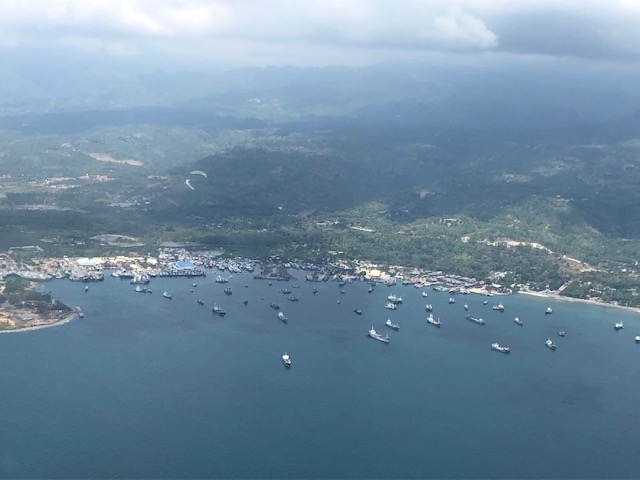 Canning and bottling factories lined along the Zamboanga City coast with are mostly fishing vessels anchored off-shore.
There is still an abundance of aquatic resources in the Sulu Sea where these vessels go for fishing. These should be more than enough for domestic as well as typical international demand. Unfortunately, there are alleged foreign trawlers or vessels poaching our resources. These should be seriously looked into by our coast guard and navy.
–
Motorcycle taxis in Cebu
The recent controversies, and issues raised vs. motorcycle taxis (habal-habal) have captured the attention of a lot of people including those who don’t use this mode of transport. I will be writing about this and more of my opinion on motorcycle taxis in another article. For now, I am sharing these photos of habal-habal in Cebu.
 Off-street motorcycle taxi terminal at SM City Consolacion
 The terminal is located on the sidewalk at the corner of the SM lot. I assume it is tolerated by SM though it blocks the pedestrian way to the mall.
 Another herbal-habal terminal near SM Consolacion but serving a different set of barangays from the previous terminal of habal-habal I mentioned.
 Fair matrix? Habal-habal minimum fares to specific destinations
Motorcycle taxis are a popular mode of transport in many Philippine cities and are generally tolerated by local government units. I guess the treatment they get from LGUs show the role they play as a mode of public transport. It is unfortunate and disappointing that the TWG that’s supposedly evaluating motorcycle taxis in Metro Manila cannot give a favorable assessment when it is clear that these habal-habal provide people with another choice for their commutes.
–
Statement of the Philippine Competition Commission on Motorcycles as Public Transport
Here is the link to the press statement of the Philippine Competition Commission on Motorcycles as Public Transport:
I will just leave this here as it stands on its own with the details and discussions provided by the PCC. I will comment on this in another post but in essence I agree with the statement, which I think is a better document in terms of provisions and clarity compared to what the TWG has released so far.
–
National Transport Policy is out!
The National Transport Policy is out and there’s a lot of buzz about the wording of the policy. NEDA released the following infographics on their official Facebook page:
 Definition of what the policy is about
 Hierarchy of transport modes (note the emphasis on walking and cycling)
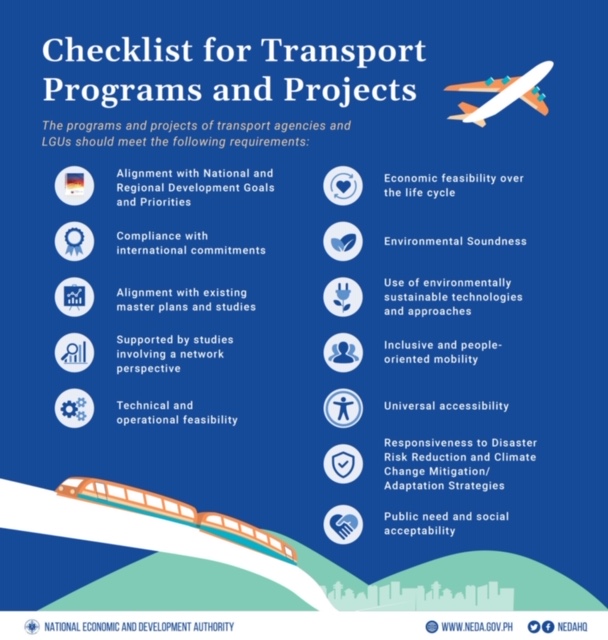 Checklist for programs and projects: I am already anticipating what proponents will be writing to justify projects according to this checklist.
I will reserve my commentaries for future blogs. There is really a lot to discuss about this policy and how it will implemented (properly or improperly), There are lots of different ideas, advocacies, interests and agendas on transportation that come into play here. And we can only hope that the policy and its implementing rules and regulations will be clear enough (not vague as to have so many loopholes) for this policy to effect transformation and inclusive and sustainable development.
–
On Taal and Tagaytay
We were frequent visitors to Tagaytay the years prior to the rapid commercialization and (over)development of the city. While we still go there occasionally, We have not been able to enjoy the city and its environs as much as we did before. Nevertheless, we genuinely feel for the people (the real residents but not necessarily for the carpetbaggers) of Tagaytay and other cities and towns affected by the eruption of the volcano. They deserve better and yet they should also heed the advice of science over those of politicians who have taken advantage of them and now claim innocence over what is perceived as a lack of preparedness for such a calamity.
 Dawn over Taal – I took this photo from the balcony of what was our favorite bed & breakfast hotel in Tagaytay. I thought this showed a rather peaceful scene complete with the background of roosters giving everyone a wake-up call.
I had wanted to post an aerial shot of Taal volcano. I have one or more somewhere in an old folder when the planes (not sure our origin) I were on flew over the volcano. Unfortunately, these are probably in my older computers or portable drives. I will for these and post them soon.
Comments on current transport issues – Part 3: On the obstacles to the PNR trains
2) On the obstacles to the PNR operations
We have done studies before when studies on the PNR were not considered fashionable. People who did research on rail transport were more interested in Lines 1, 2 and 3, and dismissed the PNR as a lost cause. There were many transportation experts who ridiculed it and even taunted PNR about their poor service. And yet we did our studies because we had an appreciation of the importance of this line and how it could play a major role in commuting if given the resources to improve their facilities. It was shown that the line could be more advantageous for commuters particularly those traveling between the southern parts of Metro Manila and Makati and Manila. These would be both workers and students who will benefit from the shorter travel times and less expensive fares. The downside then (and still at the present time) was the long headways between trains. That is, you can only catch a train every 30 minutes.
 This photo taken more than a decade ago show the typical conditions along many sections of the PNR. It is pretty much the same today and the agencies involved (DOTr and PNR) have done little to reduce the informal settlers along the line. No, they didn’t just appear now, and are throwing garbage, rocks and other debris on the trains. This was already happening years ago.
Fast forward to the present and they seem to be getting a lot more resources than the last 30+ years. A Philippine Railway Institute (PRI) has been created. New train sets have just been delivered and went into operation. Unfortunately, the new trains were met with rocks and other debris as they traveled along sections occupied by informal settlers. The incident damaging the new trains puts further emphasis on the need to the need to address the squatter problem along the PNR line. Should fences be built to protect the trains and passengers? Should people be relocated? I think both need to be done in order to secure the line and in preparation for service upgrades including more frequent train services (i.e., shorter intervals between trains). And we hope to see the DOTr and PNR working on this as they attempt to attract more passengers to use their trains.
–
Comments on current transport issues – Part 2: On motorcycle taxis
I continue with my comments on current and persistent transport issues. This time, I focus on one of two hot topics – motorcycle taxis or “habal-habal”.
1) On motorcycle taxis:
I am not a member of the Technical Working Group (TWG) that’s supposed to be evaluating the trial operations. I know one or two of the key members of the TWG and am surprised that they have not referred to the academe for studies that may have already been done about this mode of transport. I know there have been studies about it in UP and DLSU. Perhaps there are more from other universities in the country. Motorcycle taxis or “habal-habal”, after all, are practically everywhere and would be hard to ignore. Surely, researchers and particularly students would be at least curious about their operations? Such is the case elsewhere and many studies on motorcycle taxis have been made in the region particularly in Vietnam, Thailand and Indonesia, where these modes also proliferate.
The terms “trial”, “experimental” or “pilot” are actually misleading because motorcycle taxis have been operating across the country for so many years now. They are supposed to be illegal and yet they serve a purpose in the areas where they are popular. What is often referred to as an informal transport mode is ‘formal’ to many people who are not being served by so-called formal modes including the tricycle. Of course, one can argue that these terms (i.e., trial, experimental and pilot) refer to the app that are supposed to enhance the existing habal-habal operations.
I would strongly endorse motorcycle taxis but companies need to be held accountable should there be fatal crashes involving their riders. They are supposed to have trained and accredited them. The companies should also have insurance coverage for riders and passengers. LGUs tolerant of these should be watchful and do their part in enforcing traffic rules and regulations pertaining to motorcycle operations in favor of safe riding. This is to reduce if not minimize the incidence of road crashes involving motorcycle taxis.
I think one of the problems with motorcycle taxis is not really their being a mode of choice but the behavior of their drivers. While companies like Angkas and Joyride conduct training sessions with their riders, many revert to reckless on-road behavior including executing risky maneuvers in order to overtake other vehicles on the road. This is actually a given with many ‘informal’ motorcycle taxis (i.e., those not affiliated with the recognized app companies). But then this is also an enforcement issue because we do have traffic rules and regulations that are poorly enforced by authorities. Thus, there is practically no deterrent to reckless riding except perhaps the prospect of being involved in a crash.
I will refrain to include the politics involved in the issue of motorcycle taxis. I will just write about this in another article.
Coming up soon: hot topic #2 – Obstacles to the PNR operations
 Caught (up) in traffic