
On congestion due to school drop-offs
I found this rather interesting article about congestion at school drop-offs in the US:
Hurley, K. (September 16, 2024) “How School Drop-Off Became a Nightmare,” The Atlantic, https://www.theatlantic.com/family/archive/2024/09/school-drop-off-cars-chaos/679869/?utm_source=copy-link&utm_medium=social&utm_campaign=share [Last accessed: 9/26/2024]
To quote from the article:
“Today, more parents in the United States drive kids to school than ever, making up more than 10 percent of rush-hour traffic. The result is mayhem that draws ire from many groups. For families, the long waits are at best a stressful time suck and at worst a work disruptor. Some city planners take the car line as proof of our failure to create the kind of people-centered neighborhoods families thrive in. Climate scientists might consider it a nitrogen-oxide-drenched environmental disaster. Scolds might rail at what they see as helicopter parents chaperoning their kids everywhere. Some pediatricians might point out the health threats: sedentary children breathing fumes or at risk of being hit by a car.”
The situation described in the article is actually already happening for quite a long time now in the Philippines and mostly at private schools. You have the same issues with the traffic congestion and road safety risks faced by schoolchildren in schools like Ateneo and LaSalle. The more ‘elite’ public schools like the science high schools may also have similar concerns. Can these be really addressed at the local level or is there a deeper, more complicated problem that needs to be tackled here (just to clarify that my questions are for our case here in the Philippines and not in the US)?
–
On transportation and global health – article share
I was supposed to write about the keynote lecture delivered during the 30th Annual Conference of the Transportation Science Society of the Philippines (TSSP). I am sharing instead an article written by Dr. Renzo Guinto who is an Associate Professor at the SingHealth Duke-NUS Global Health Institute based at the National University of Singapore.
Here is the link to his article on the Philippine Daily Inquirer: Health at the center of transport and mobility
I will not quote from the article and leave it to my readers to read and appreciate the articles content.
–
30th Annual Conference of the Transportation Science Society of the Philippines (TSSP)
I was not able to post on the conference itself but it was definitely a success including the pre conference workshop (Workshop for Young Researchers or WYRe) held for the benefit of young researchers in transportation science.
Here is the link to the TSSP’s official page featuring the program for the Technical Sessions: https://ncts.upd.edu.ph/tssp/archives/2972
There were 6 sessions with papers on public transportation, active transport, traffic engineering and others including port operations and safety. A total of 27 papers were presented and in attendance were more than 150 people, mostly from the academe. The conference was conducted in cooperation with the University of the Philippines Visayas and the City Government of Iloilo. When available, I will also later share information about the very informative and enlightening keynote lecture delivered in the morning of the conference on the topic of Global Health.
–
Foggy roads – Part 2
This is supposed to be a follow-up to the post on foggy roads in Tagaytay last month. Unfortunately, I could other things came in the way of finishing this Part 2. Intersections can be quite dangerous if all approaching one have limited visibility. Add to that the flaws in intersection geometry that may contribute to it being risky to travelers. Following is an example along the Tagaytay-Calamba Road with an intersection with Belleview Drive, which is the main access road to Tagaytay Highlands.
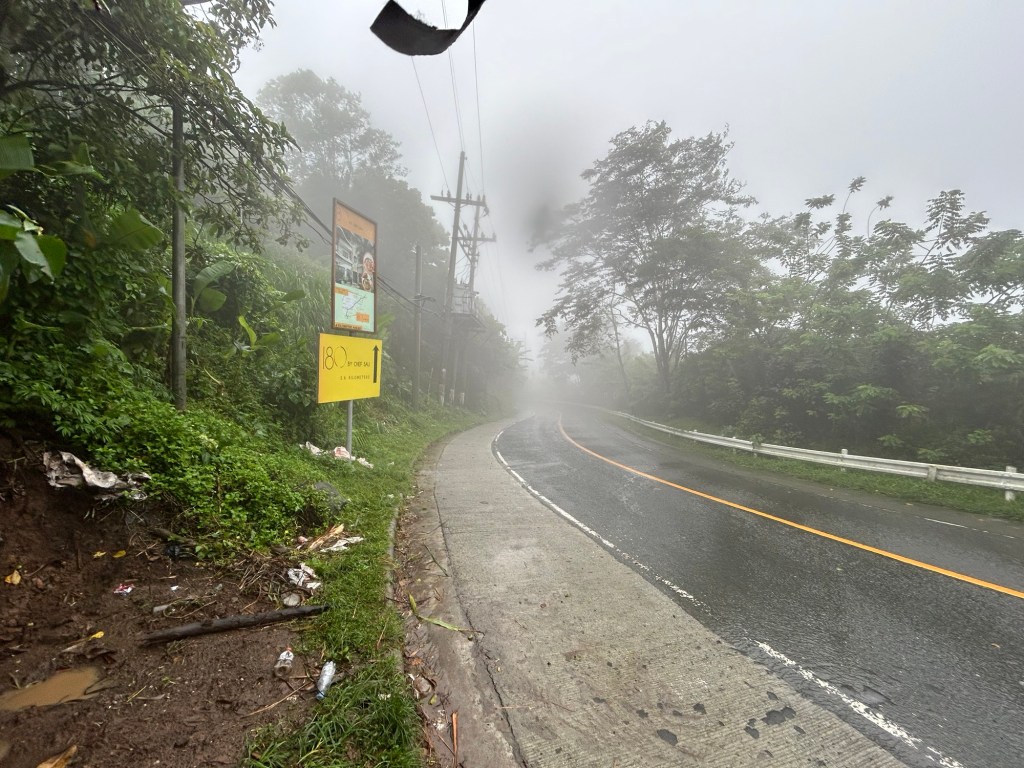 The approach from Tagaytay features a curve. I didn’t notice any streetlights along the road so I can imagine it must be poorly lit at night. What more if there is a thick fog in the area?
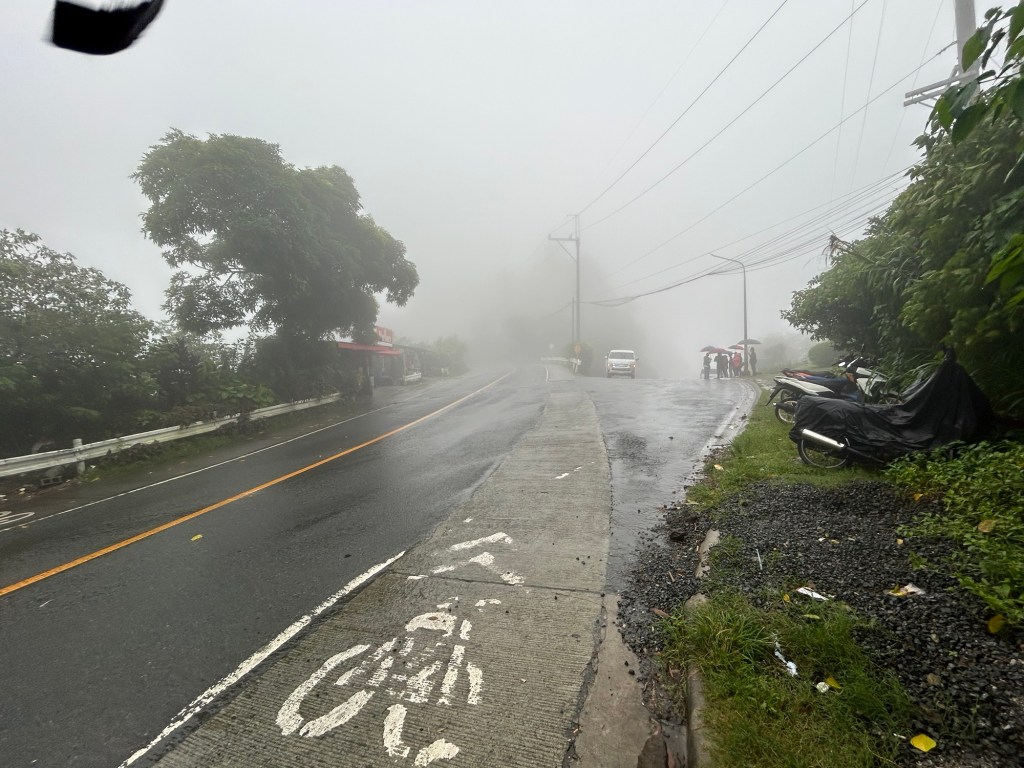 The bike lane is a product of the government’s efforts to come up with a bike lane network along national roads during the pandemic. This is actually the shoulder painted to become a bike lane. This is the view of the intersection approach if you’re coming from Tagaytay. The leg to the right with the people with umbrellas is Belleview Drive and towards Tagaytay Highlands. You can easily miss this if you were not familiar with the area and cruising along the highway. Note the thick fog obscuring your vision of the intersection. The curvature to the left also adds to the complex situation.
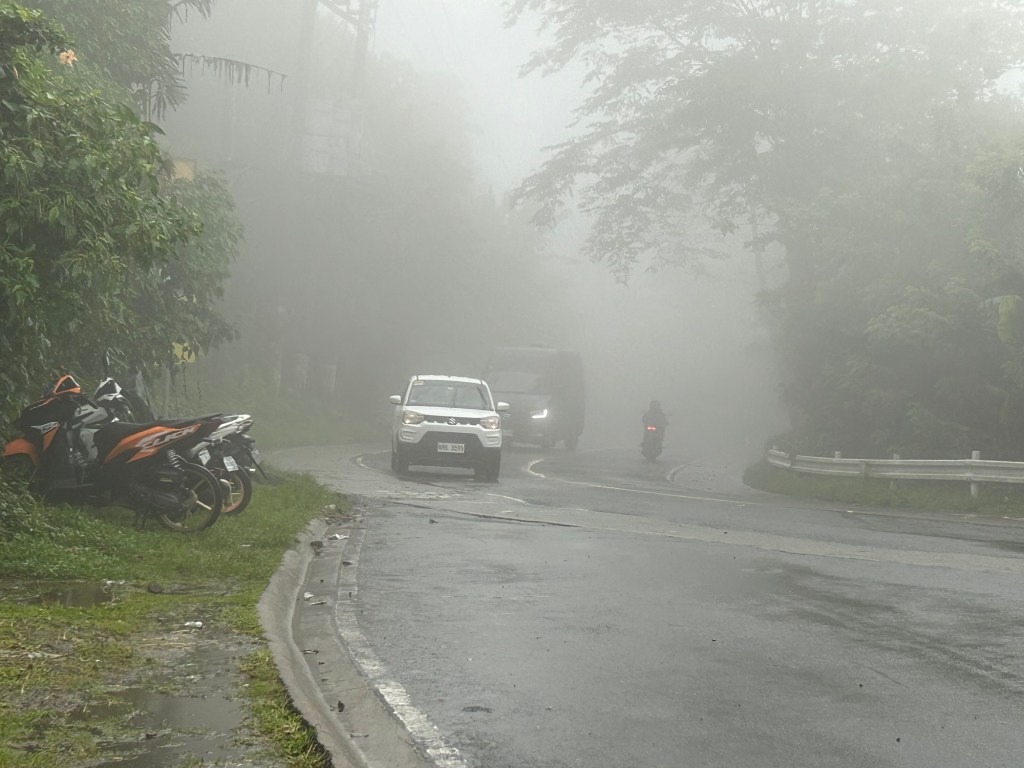 This is a closer look at the highway approach from Tagaytay taken a few minutes after I took the first photo in the article. Note the fog quickly setting in and the limited visibility. The motorcycle moving away from us would disappear into the fog. This is during the daytime and supposedly in broad daylight. Vehicles would need to turn on their lights so others may see them on the road.
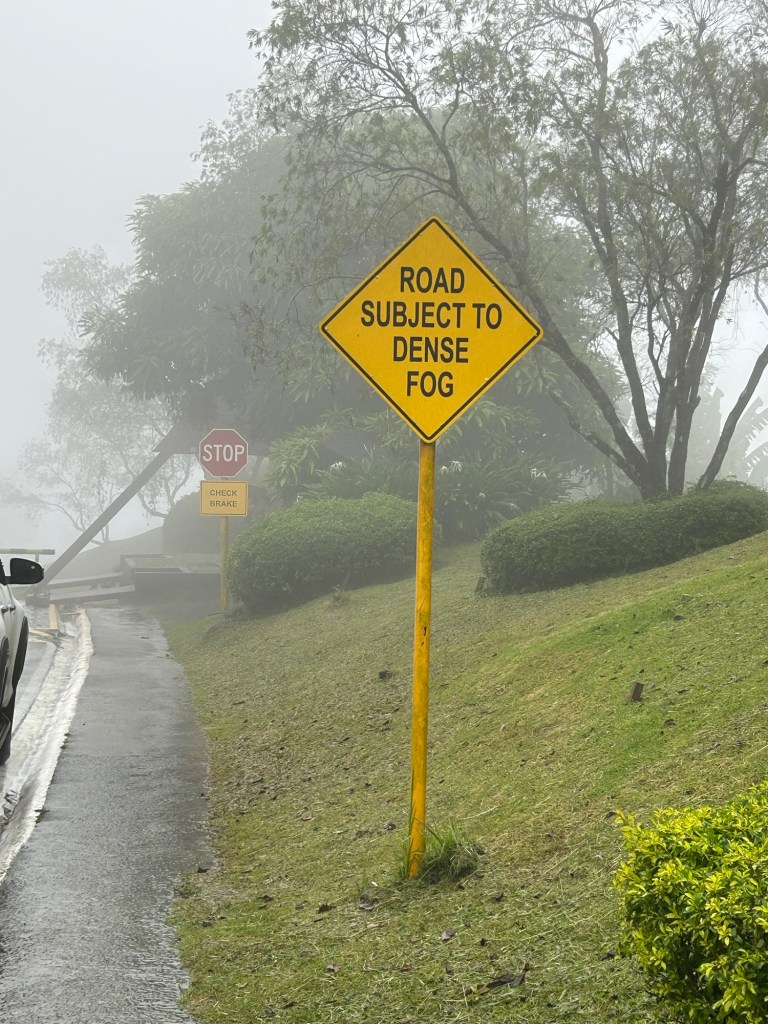 The sign along Belleview Drive states the obvious. There should be more signs like this located strategically along the Tagaytay – Calamba Road and others usually cloaked in the fog we experienced in Tagaytay recently.
I assume there would be similar situations elsewhere including in Baguio City. We also experienced fog (not smog) in Antipolo but these were quick to dissipate unlike the ones in Tagaytay and Baguio.
–
On the impact of more frequent lightning strikes on airports
We were waiting for our plane to arrive at the airport yesterday and can’t help but observe the heavy rains falling while a strong wind blows and causes the rains to fall at an angle. This renders umbrellas to be ineffective in keeping you dry if you’re outdoors. Such weather requires a long coat or even overalls to keep one dry on a very wet day. The rains and wind were brought about by a storm affecting the area. Though distant, the storm was able to influence the weather. Fortunately, there wasn’t any lightning and we wondered if lightning strikes have affected ground crew working in an open area that makes them vulnerable to lightning strikes. Here is an interesting article that describes the threat of lightning strikes particularly to people on the ground at airports.
King, R.E. (September 11, 2024) “Increasing Lightning Strikes from Stronger Storms Could Cripple Airports and Airbases,” Jalopnik, https://jalopnik.com/increasing-lightning-strikes-from-stronger-storms-could-1851645799 [Last accessed: 9/16/2024]
Quoting from the article:
“While flying planes are hardened to withstand lightning strikes, airports are typically a cluster of free-standing structures on a flat, open plot of land. The ongoing increase in lightning strikes caused by climate change is a direct danger to facilities and people on the ground.”
I wonder about similar data or statistics in the Philippines considering the long wet season we have that includes not just threats from typhoons but from seemingly small weather systems that may involve lightning strikes. I recall operations at NAIA were halted a few times when there were lightning storms. Is this phenomena. I wonder how many incidents at our airports have been reported and recorded pertaining to lightning.
–
Back in Iloilo (again) and a note on landmarks
One landmark that I have been familiar with since I was a child is the Jaro Cathedral belfry. The building is located at the plaza across from the church. The area has been neglected for a long time and I am glad to see the city developing the area to become more attractive and useful as a park for the benefit of its citizens and visitors.
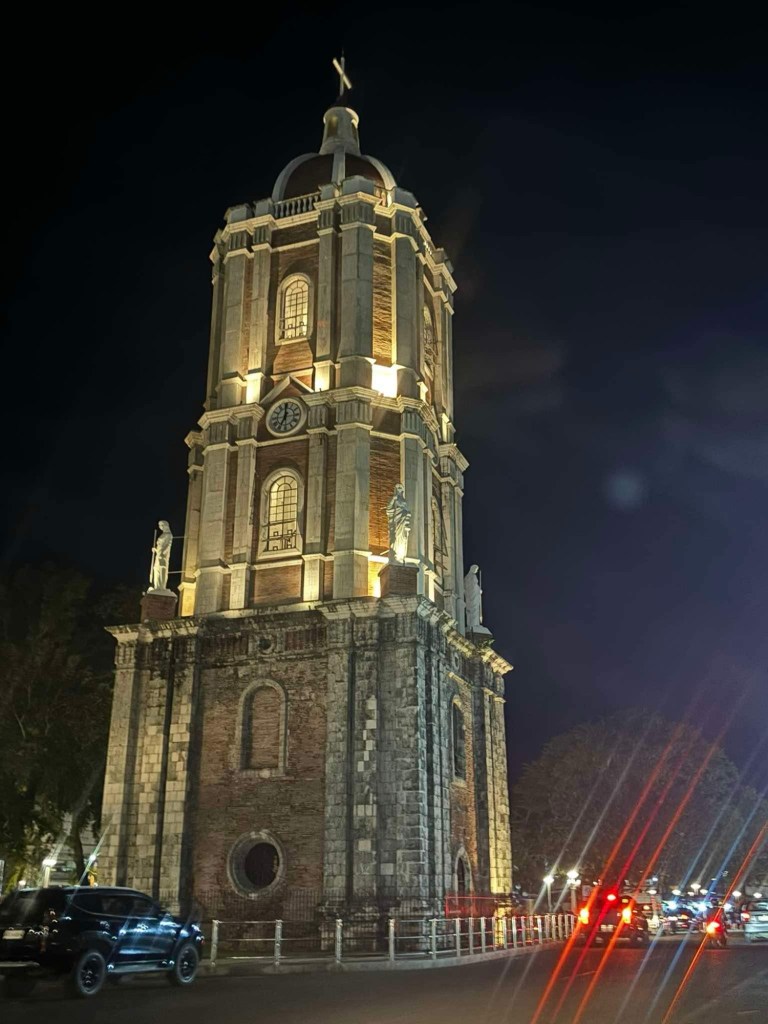
The area, I’ve been told, is being developed as part of a program towards coming up with more open spaces like parks particularly where there are already plazas around the city. I have memories of getting a ride back to my father’s hometown whenever we went to the city usually to eat or shop. The informal jeepney terminals used be around the plaza. Other jeepneys rounded the streets for their return trips instead of stopping at a terminal. Now you have to travel to the provincial jeepney terminals at the outskirts of the city to get a ride to the other towns.
–
On ride hailing replacing more sustainable options for transport
We’ve long suspected that ride hailing or ride sharing is not as sustainable as their proponents and companies would project them to be. Here is more evidence showing how ride hailing has diminished other more sustainable transport options.
Kerlin, K. (August 28, 2024) “Half of Uber, Lyft Trips Replace More Sustainable Options,” UC Davis News, https://www.ucdavis.edu/news/half-uber-lyft-trips-replace-more-sustainable-options [Last accessed: 9/8/2024]
Quoting from the article:
“About 47% of the trips replaced a public transit, carpool, walking or cycling trip. An additional 5.8% of trips represented “induced travel,” meaning the person would not have made the trip were an Uber or Lyft unavailable. This suggests ride-hailing often tends to replace most sustainable transportation modes and leads to additional vehicle miles traveled. “
The article and the study by UC Davis is limited to their experiences with Uber and Lyft and perhaps others that employ cars. In our case, we have in addition motorcycle taxis or habal-habal that further takes away passengers from public and active transportation. Motorcycle taxis provide a very attractive alternative to conventional public transport modes as these are perceived to reduce travel times among other advantages they provide to users.
I will share some information later about the current mode shares in Metro Manila and how drastically public transport mode shares have been eroded post pandemic.
–
Designing a “Runnable” City
I’m sure you’ve read or heard about walkable cities. But have you read or heard about “runnable” ones? Here’s a quick share of an article about cities where you can run, jog or walk.
Source: Designing a “Runnable” City
To quote from the article:
“Several urban design principles can enhance the runnability of a city:
Connectivity and accessibility: This means developing a network of interconnected running paths and trails that are easily accessed from various parts of the city (especially neighborhoods). Even better if can be green corridors that connect to other parks and open spaces, and support continuous movement.
Safety and security: Ensuring running paths are well-lit and separated from vehicle traffic is crucial. Traffic calming measures such as vehicle lane narrowing, wider footpaths, and appropriate landscaping enhance runner safety. Street trees also help reduce car speeds, as they alter our perception of how wide the road is and provide a psychological cue that we’re in a residential area. Redesigning urban infrastructure to include dedicated running paths alongside walking paths and bicycle lanes, is a great idea.
Inclusive design: City design should encourage active mobility, which means including benches, water fountains, and restrooms along running routes. It means building footpaths that enables running, and avoiding uneven, slippery or unfavorable surfaces such as cobblestones. It also means making it easy to find your way around — even in unfamiliar environments.”
–
Technical sessions at the TSSP 2024 Conference
I am sharing here the latest draft of the technical sessions for the 30th Annual Conference of the Transportation Science Society of the Philippines (TSSP). The conference will be held in Iloilo City this coming September 13, 2024.
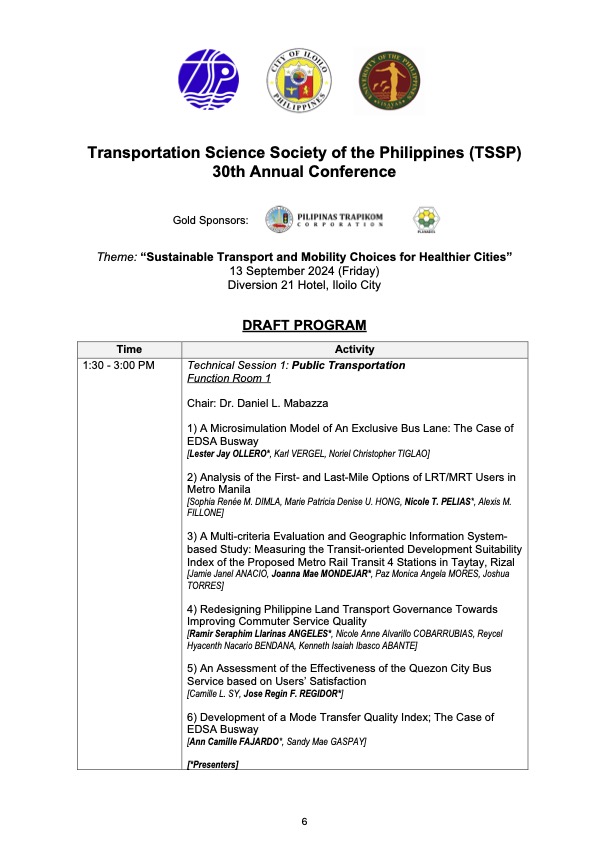
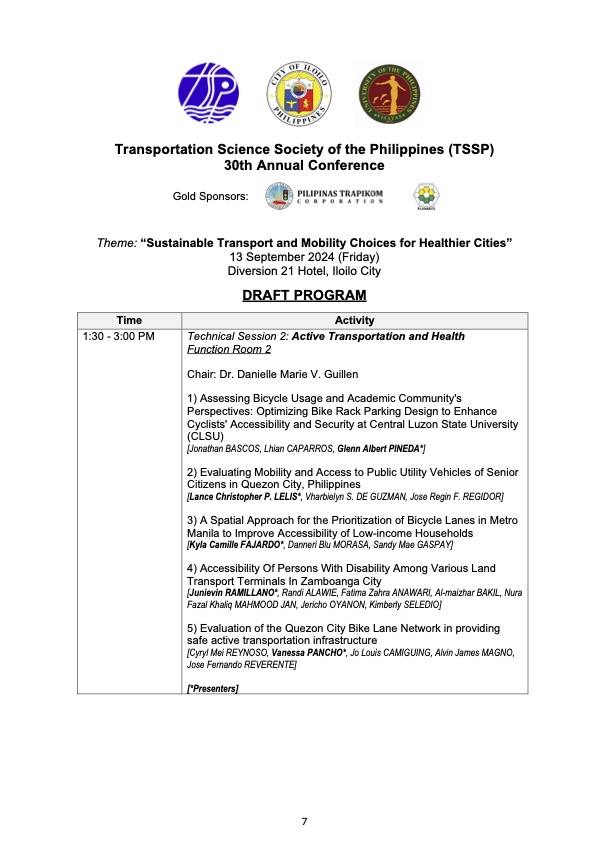
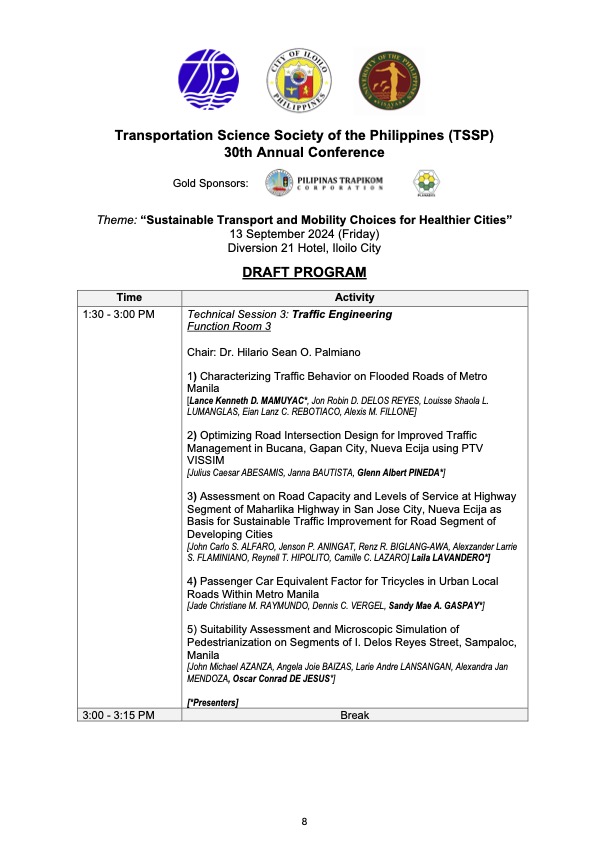
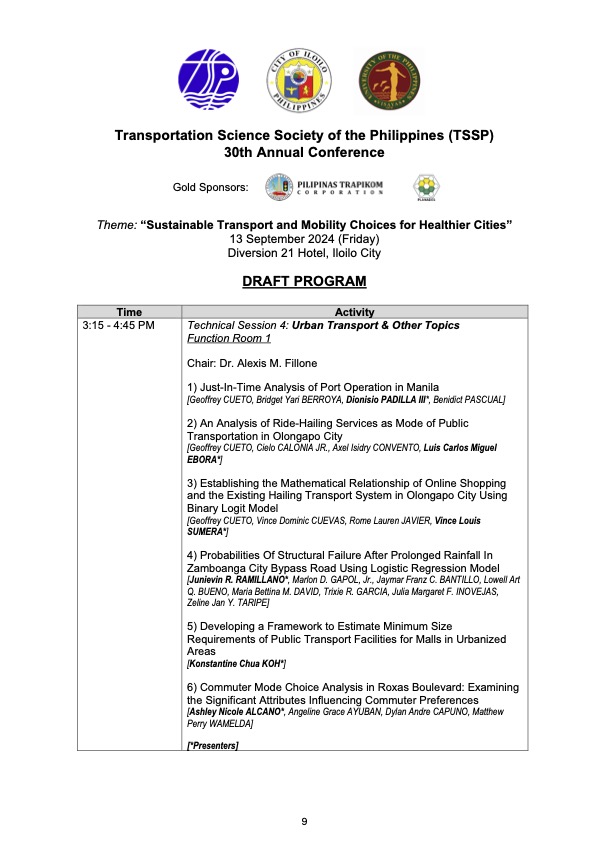
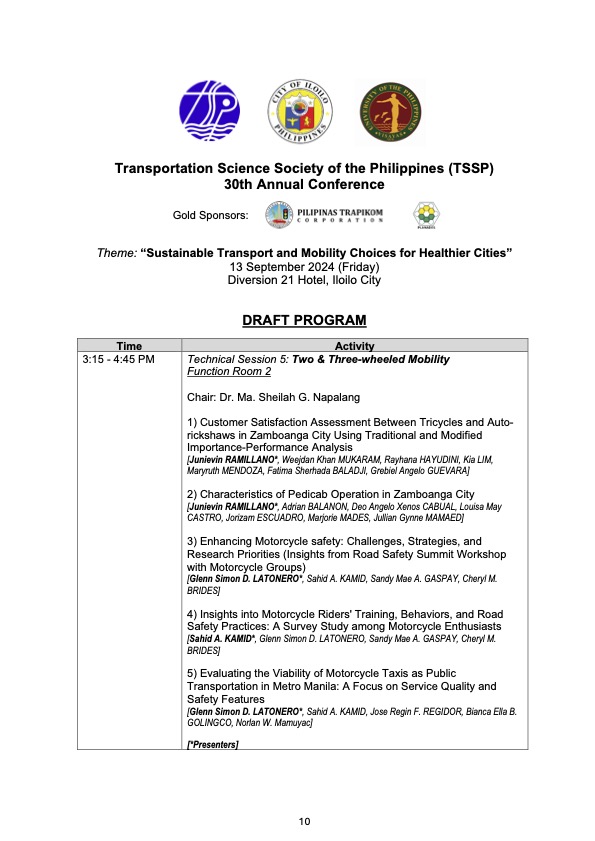
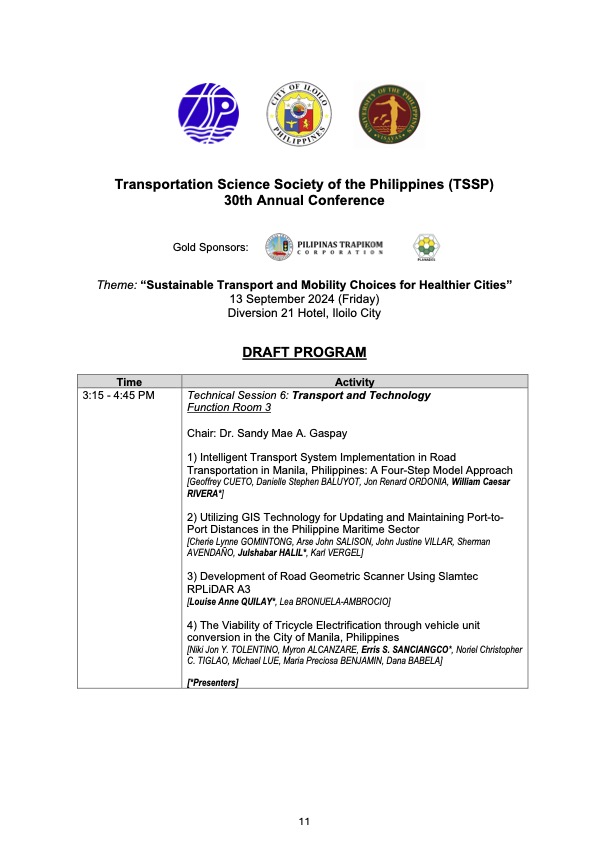
I will share the draft program for the morning plenary session in the next post.
–
 Caught (up) in traffic