
Transport options between Naga and Legazpi
I wrote about the PNR still operating between Naga and Legazpi cities. However, there is only one roundtrip per day and that is the Legazpi-Naga-Legazpi trip. If you want to do the Naga-Legazpi-Naga trip, you have to spend at least the night in Legazpi. But the latter schedule is not so good for the return to Naga as the train leaves Legazpi at 4:30 AM! Aside from the rail option, most people will use road-based transport. That is, most people will probably take a bus or van. There are many bus companies and UV Express vans operating along the corridor (Pan Philippine Highway) connecting the major cities and municipalities of the Bicol Region.
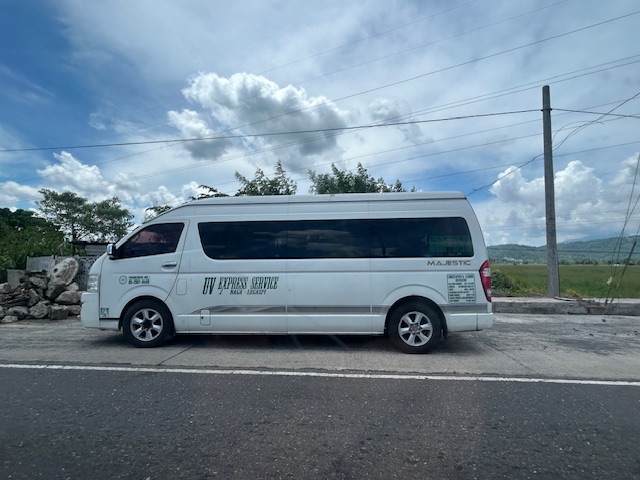 We saw this van parked along the roadside as we were waiting for our turn to proceed along a section under construction employing a alternating one way traffic scheme.
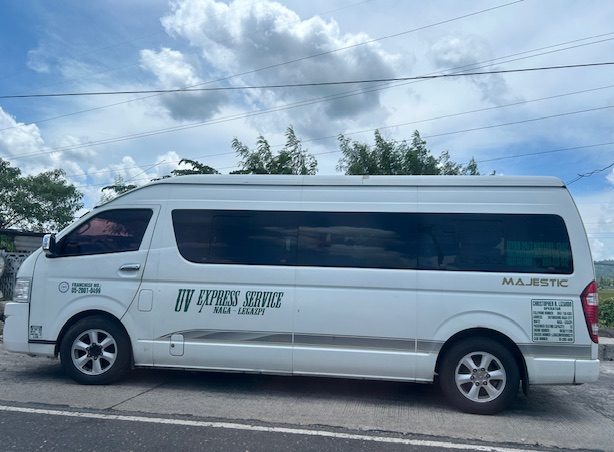 A close-up showing the UV Express van’s end points to be Naga and Legazpi. The declared passenger capacity is 23. Though this appears to be a long or stretched van, I can only imagine how comfortable or uncomfortable it is to ride these for 3 plus hours one way.
More on Bicol transportation in my posts this coming July!
–
PNR services from Naga City
I have yet to share the photos I took at the PNR Station in Naga City. Instead, I am sharing here the current train schedule and fares.
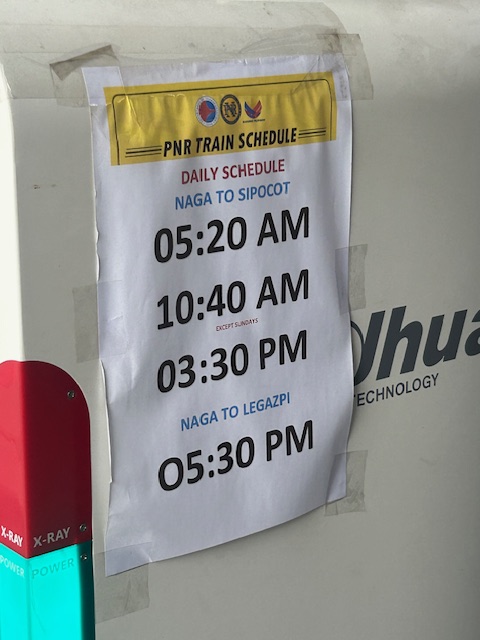 There are only three trips from Naga to Sipocot – two in the morning and one in the afternoon. Meanwhile, there is only one trip to Legazpi. Sipocot is in the same province, Camarines Sur, while Legazpi is the capital of Albay.
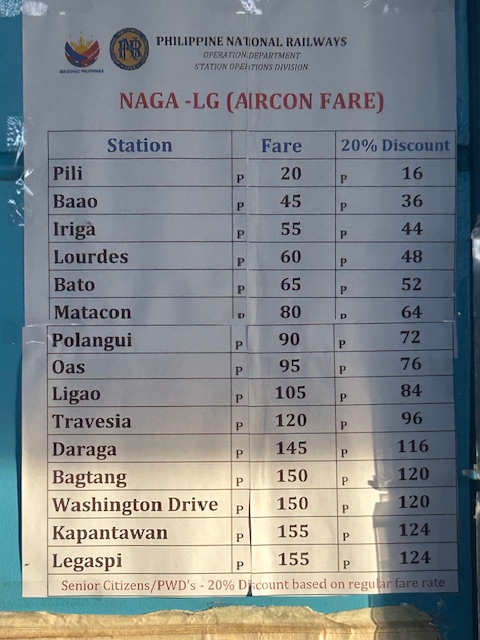 Fare rates between Naga City and Legazpi City. There are 15 stops along this route.
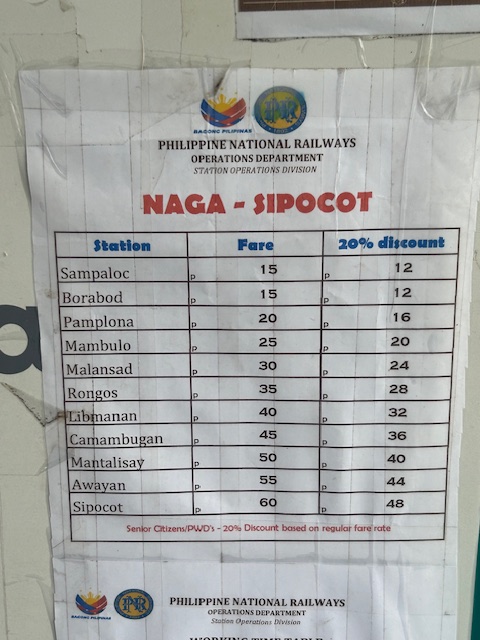 Fares for destinations between Naga and Sipocot
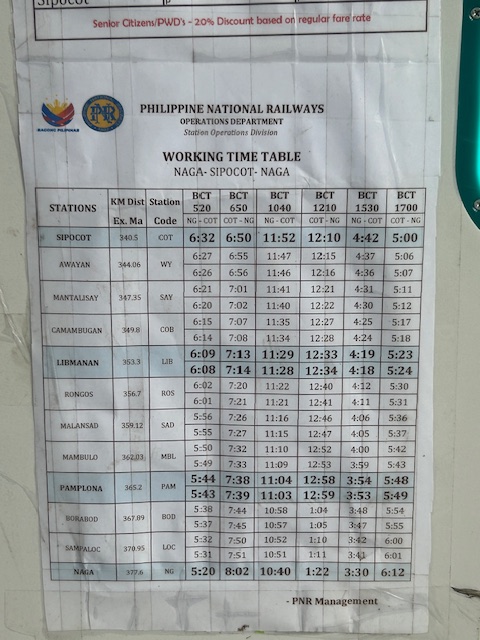 Timetable between Naga and Sipocot. It takes 1 hour and 12 minutes one way. It seems I wasn’t able to take a photo of the Naga-Legazpi timetable but the staff told us it takes 3 hours to get to Legazpi.
The station staff also told us that the train from Legazpi leaves at 4:30 AM. If it also takes 3 hours, then it arrives in Naga at 7:30AM. This can be okay for a super-commuter even at this travel time and speed (about 33 km/h). The frequency of trips between Naga and Legazpi should increase and will probably do once the PNR completes rehabilitation of what was termed as the Main Line South.
–
Electric taxis anyone?
Finally saw one of the taxis operated by Green GSM, which is a Vietnamese company. This is supposed to be the first all-electric taxi service in the Philippines.
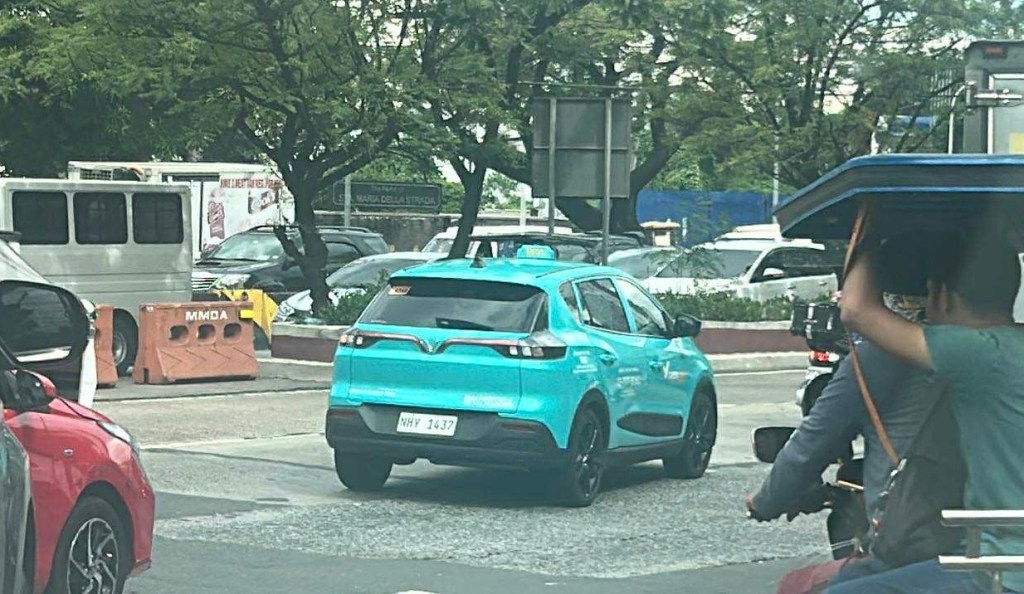
My colleagues and I were talking about this. Among other topics is whether these taxis will not encounter problems once the rains pour and many streets are flooded. We also wondered whether these vehicles will add to the congestion; slugging it out with the established competitors.
Another, more deeper and serious topic is whether these are really clean. While these are emission free as far as the proverbial tailpipe is concerned, the sources of power are not necessarily so.
While we do have renewables in the mix including hydro, geothermal, solar and wind, much of our power used to produce electricity uses fossil fuels.
–
Aerial photos – reclamation projects in Manila Bay
Last week’s travel allowed me to take aerial photos of the reclamation projects in Manila Bay. Here are the photos:
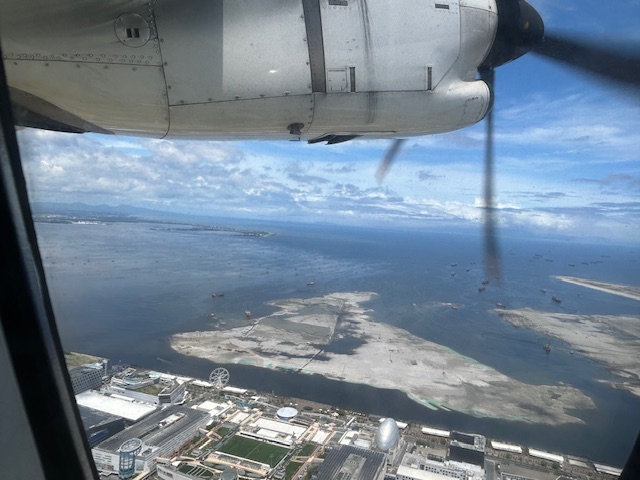 The view as we lifted off from NAIA shows SM’s reclamation project across from the MOA complex.
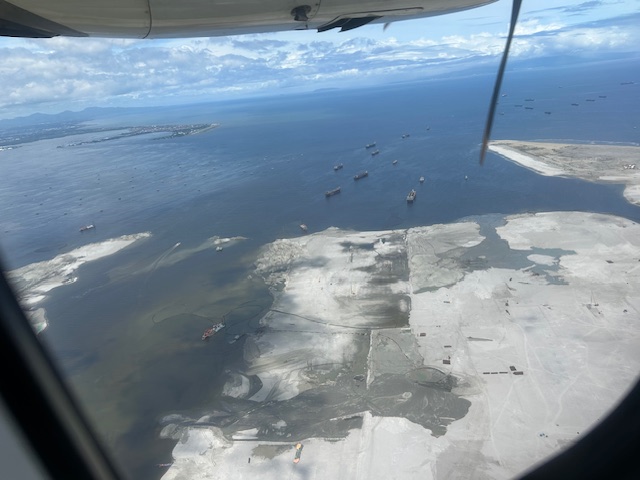 Our plane then climbed and afforded this close-up of sorts of the reclamation across from the now closed Sofitel Hotel.
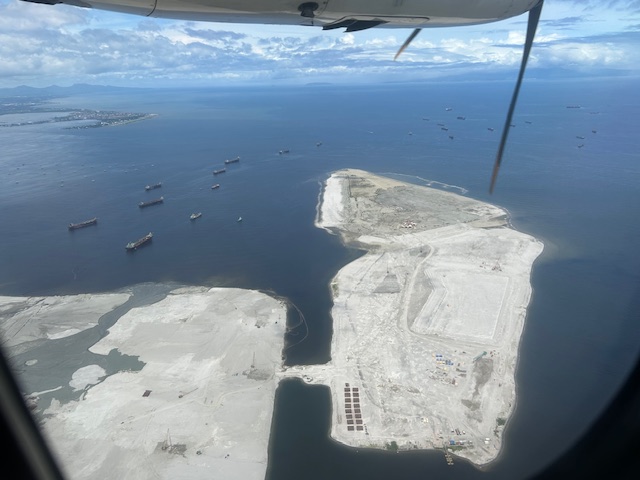 Past the largest of the three reclaimed lands is another man-made island.
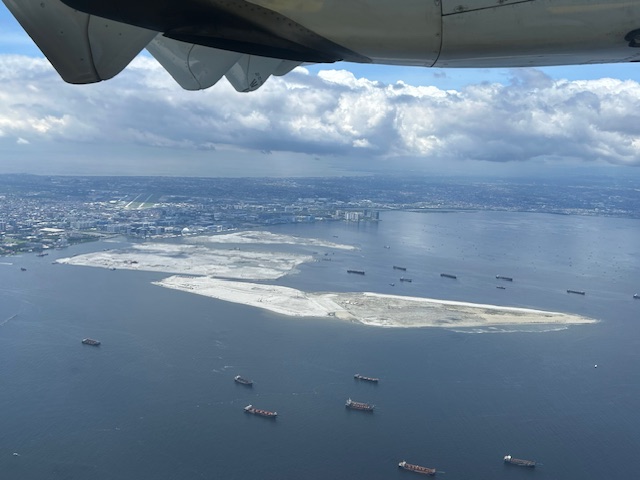 As our plane turned left, we were able to see all three reclamation projects
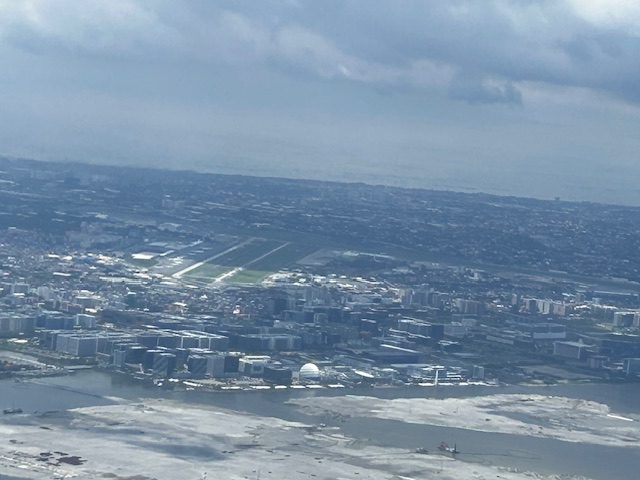 A close-up of the reclamation across the MOA complex. Also in the photo is NAIA.
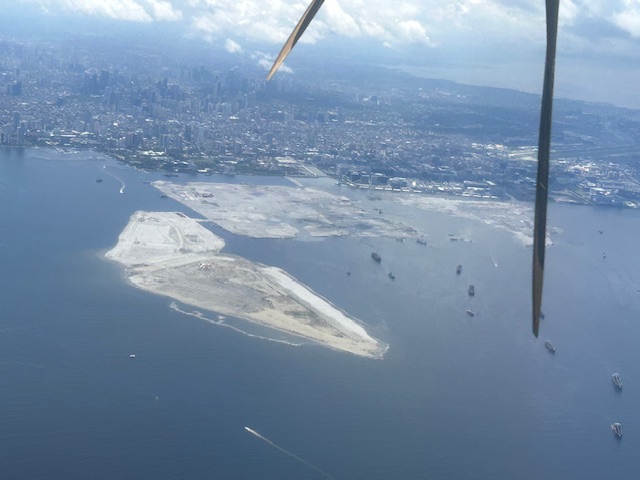 All three reclamations in one photo as we continued to turn towards the south and southeast (towards Bicol).
More aerial photos soon!
–
Robot barista at NAIA Terminal 2
In the previous post, I mentioned something about a robot barista at NAIA Terminal 2. Unfortunately, it wasn’t functioning at the time so I wasn’t able to try it out.

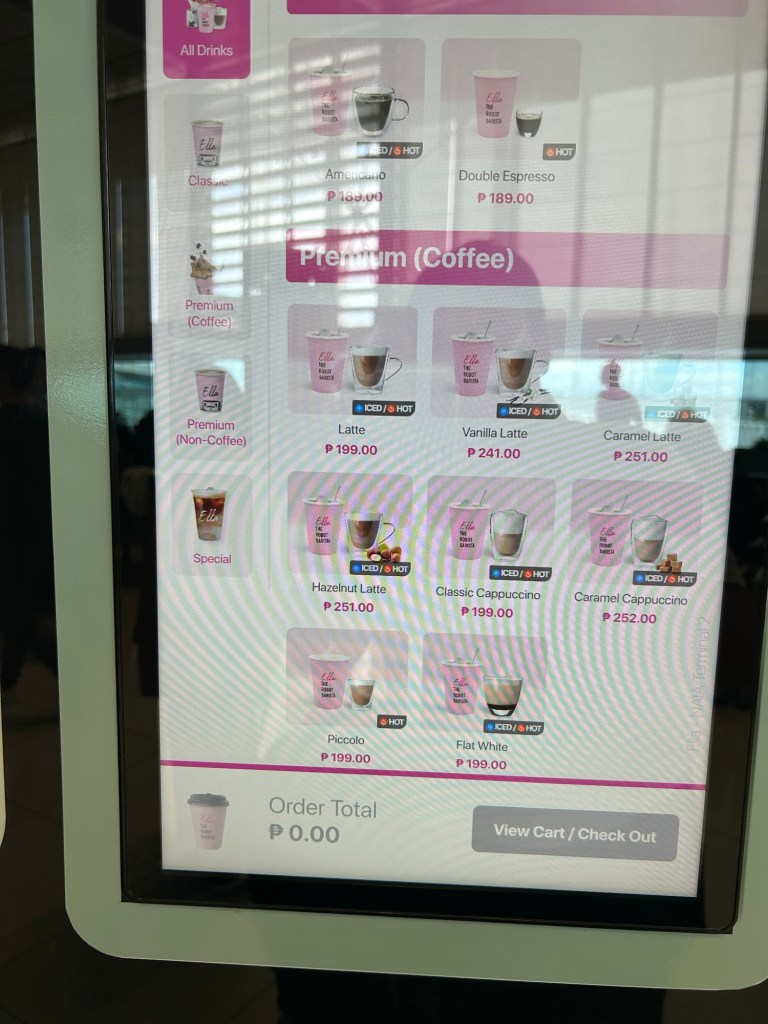
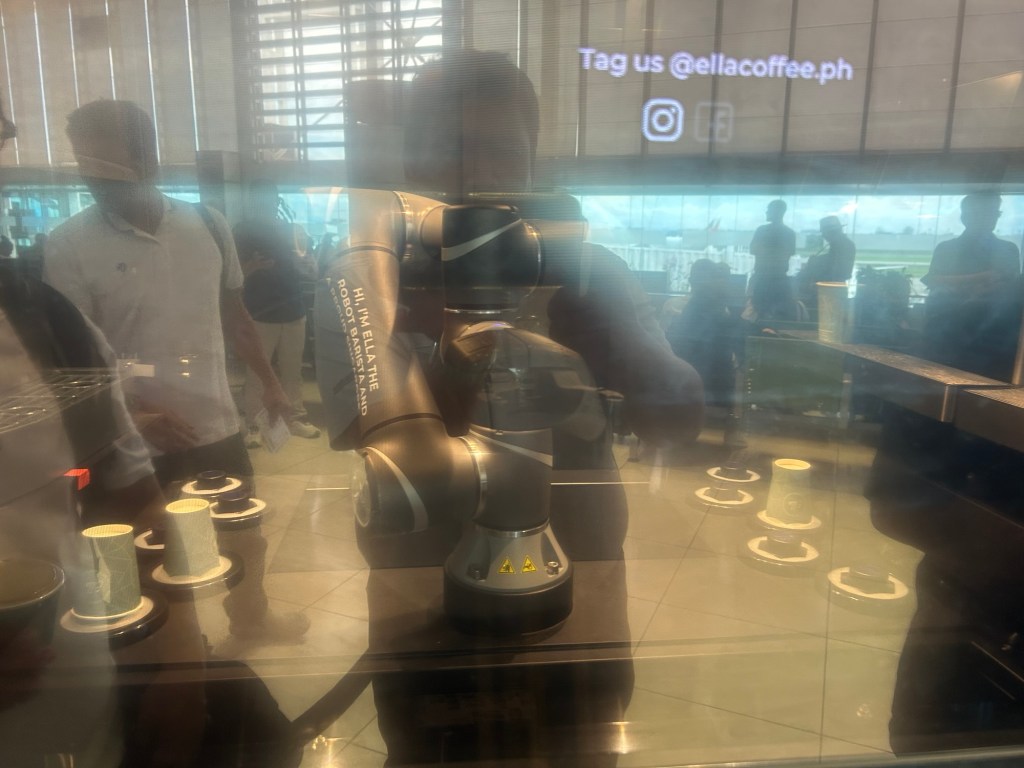
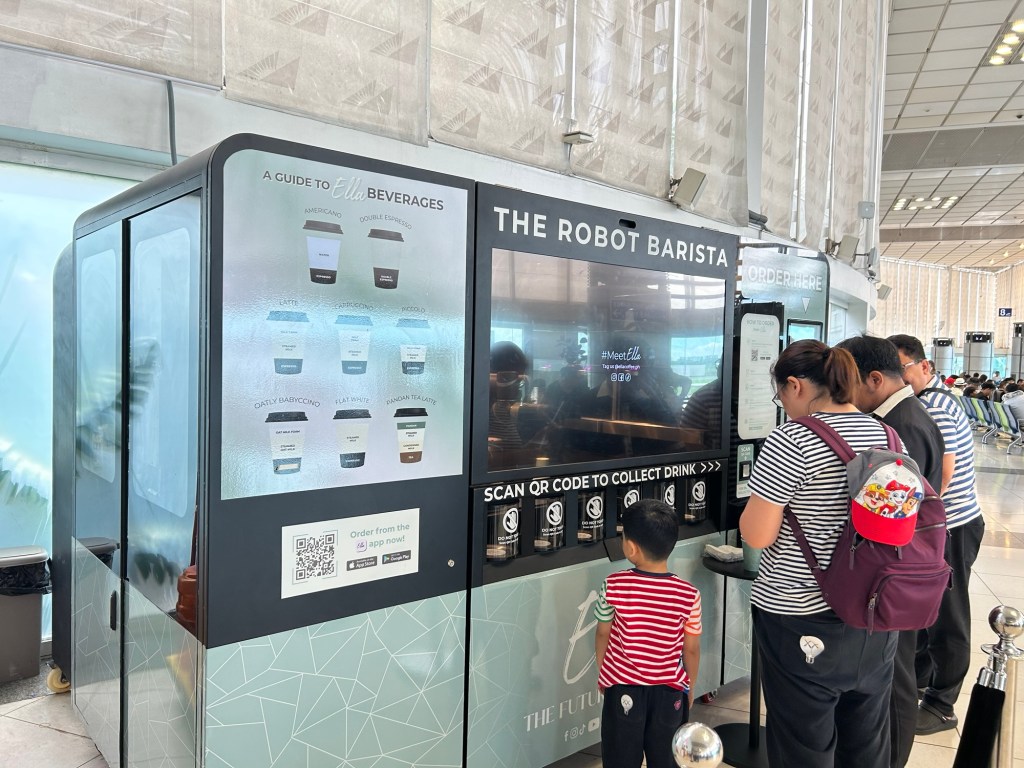
Another group purchasing coffee at the Robot Barista.
Perhaps there will be more of these in the future and replacing the manned shops at airport terminals. I imagine there might be these and vending machines providing food and drink at airports and other transport terminals.
–
Vending machines at NAIA Terminal 2
There’s nothing really new at NAIA’s Terminal except maybe this time I noticed the vending machines at one end of the terminal and the robo coffee stand. I took some photos of these machines and share the following:

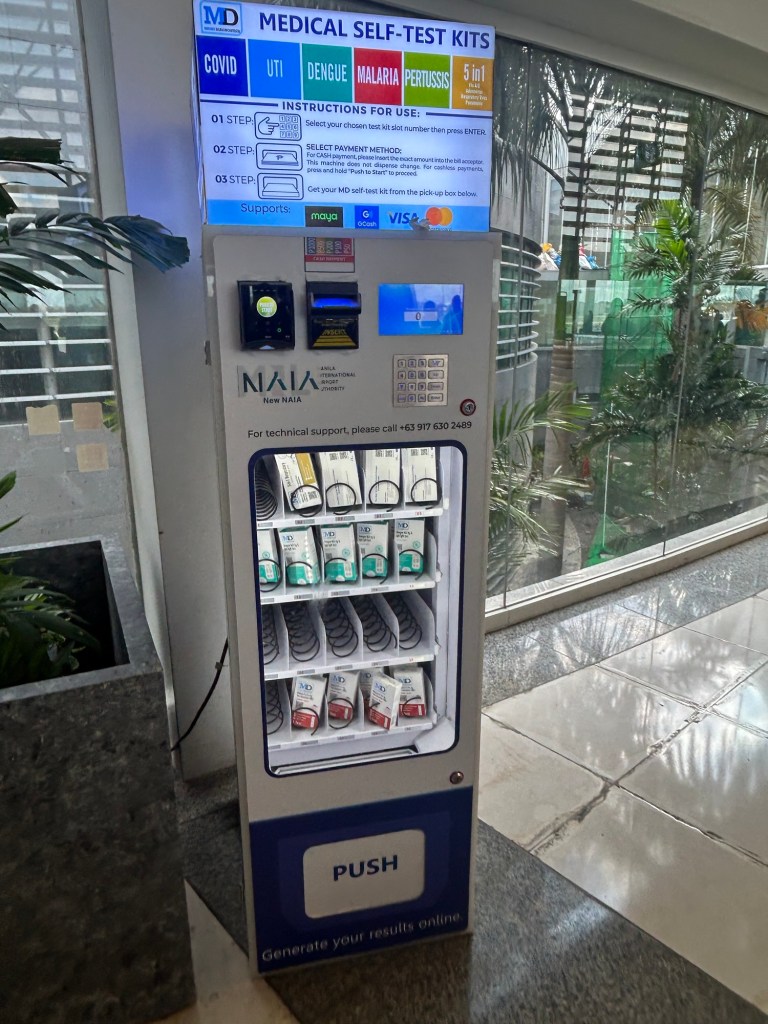
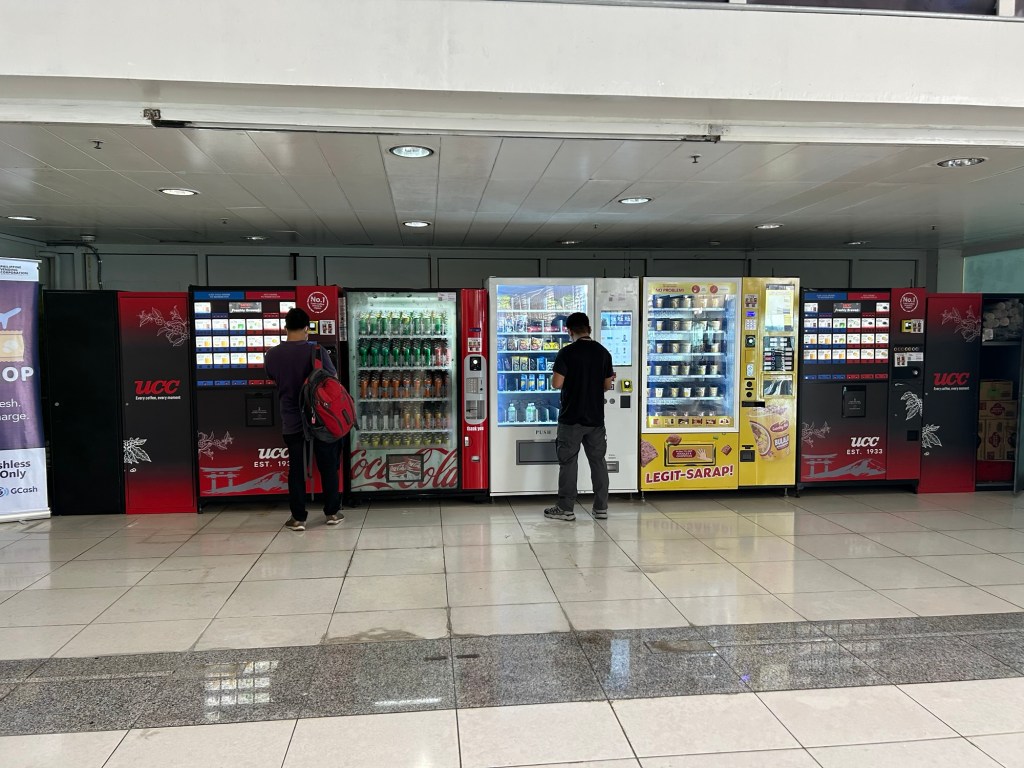
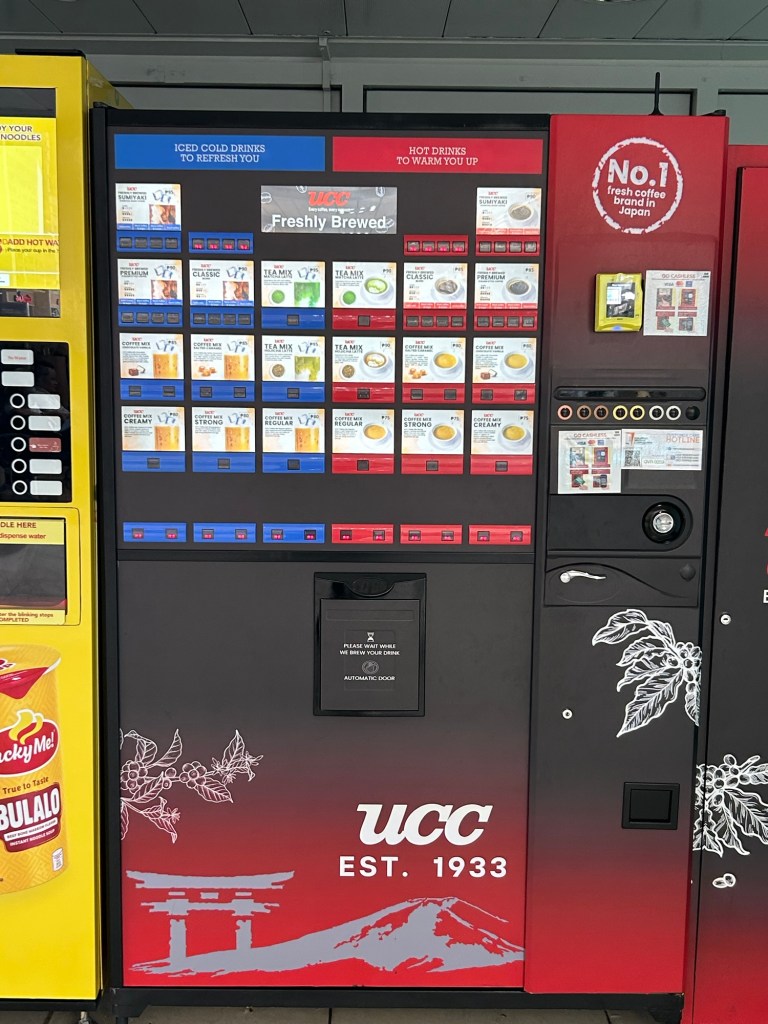
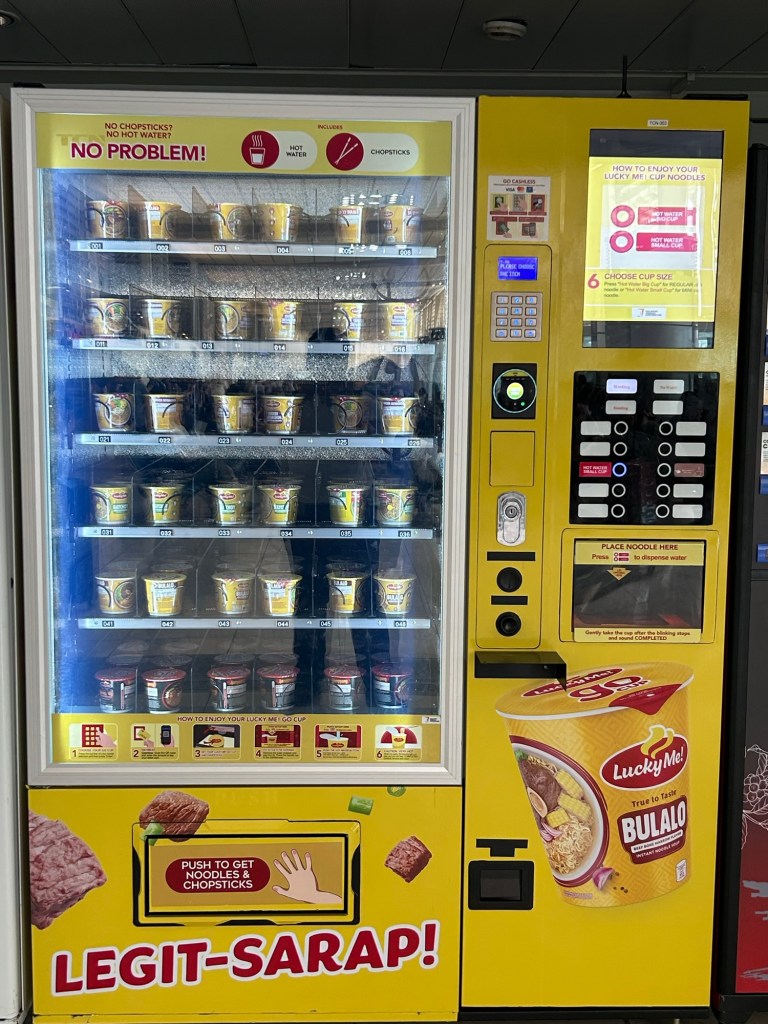
There are no new stores or eating options at T2. The two restaurants at the middle of the terminal wings are already closed so there are less eating options at the pre departure areas.
–
Naga Airport arrival
Since I’ve written about Naga Airport in the previous post, I might as well follow-up with a short write-up on our arrival. I’m sharing the following photos I took on our arrival at the airport, which is actually located in the town of Pili, which is to the south of Naga City.
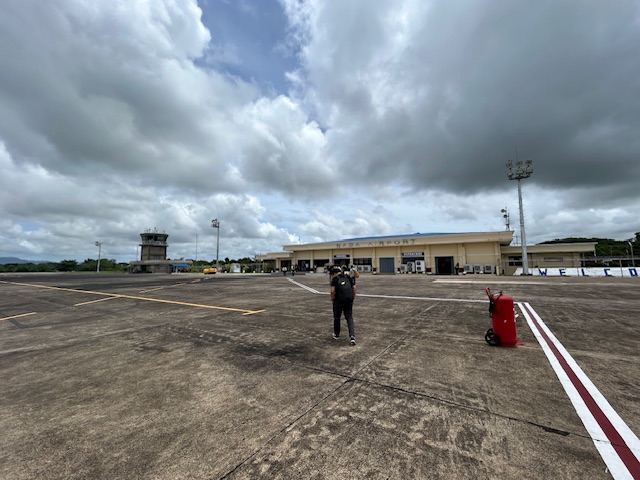 The airport terminal and control tower as viewed upon our deplaning
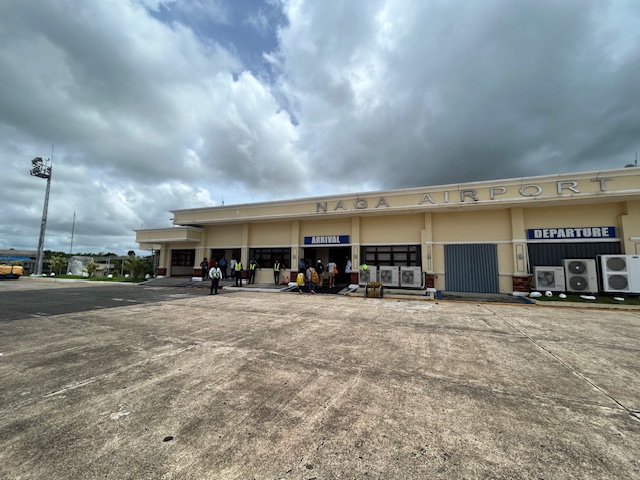 Walking towards the arrival area
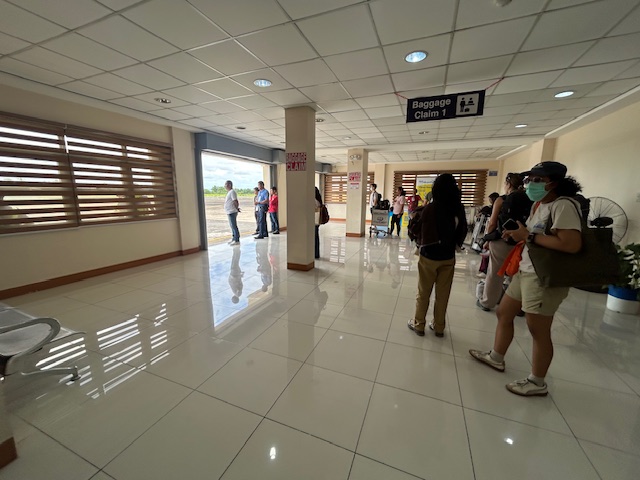 The baggage claim area was the simplest I’ve seen with no conveyor belt or carousel.
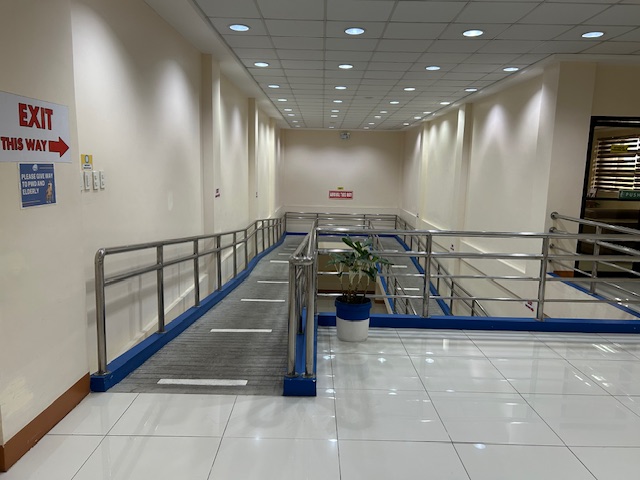 We had to travel through these ramps towards the terminal building exit.
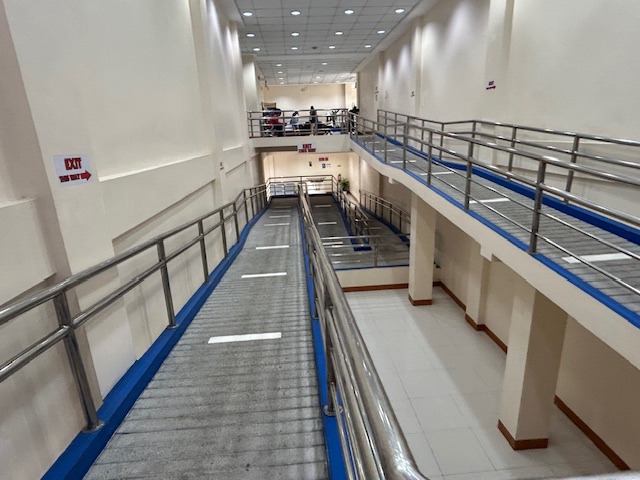 The final ramp descending towards the exit – this is another rather unusual design feature of the airport.
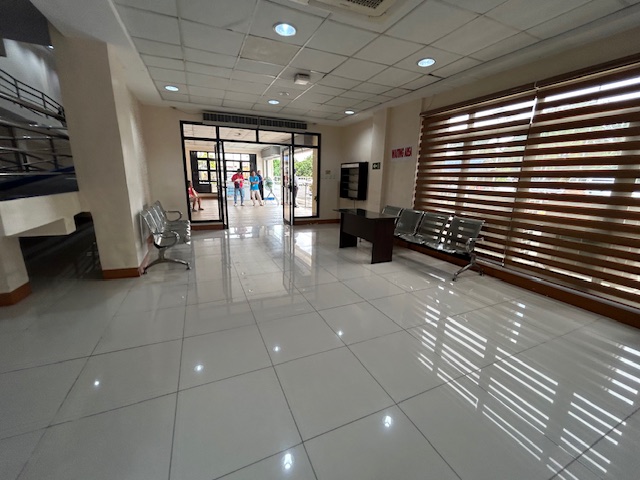 Terminal building exit for arriving passengers.
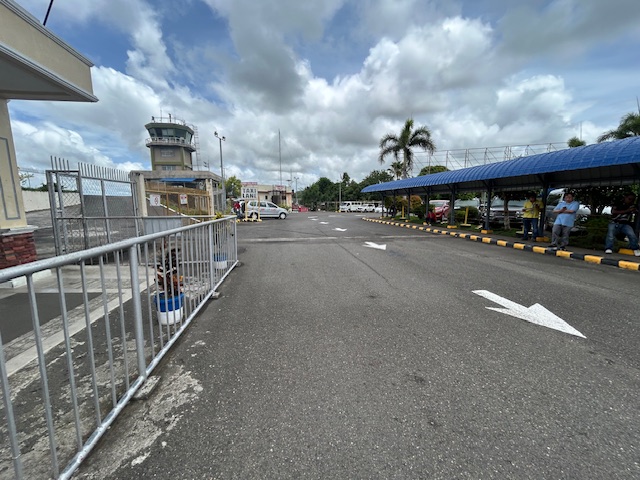 Airport terminal driveway with a view of the air traffic control tower
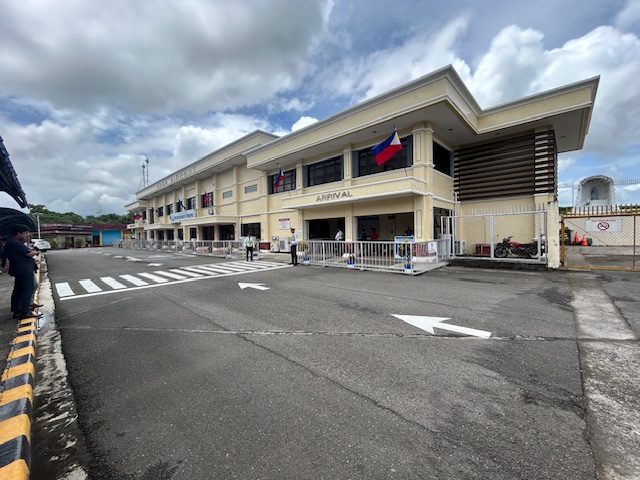 A view of the terminal building from the waiting shed across from the terminal
–
Back in Bicol – arrival at Naga Airport
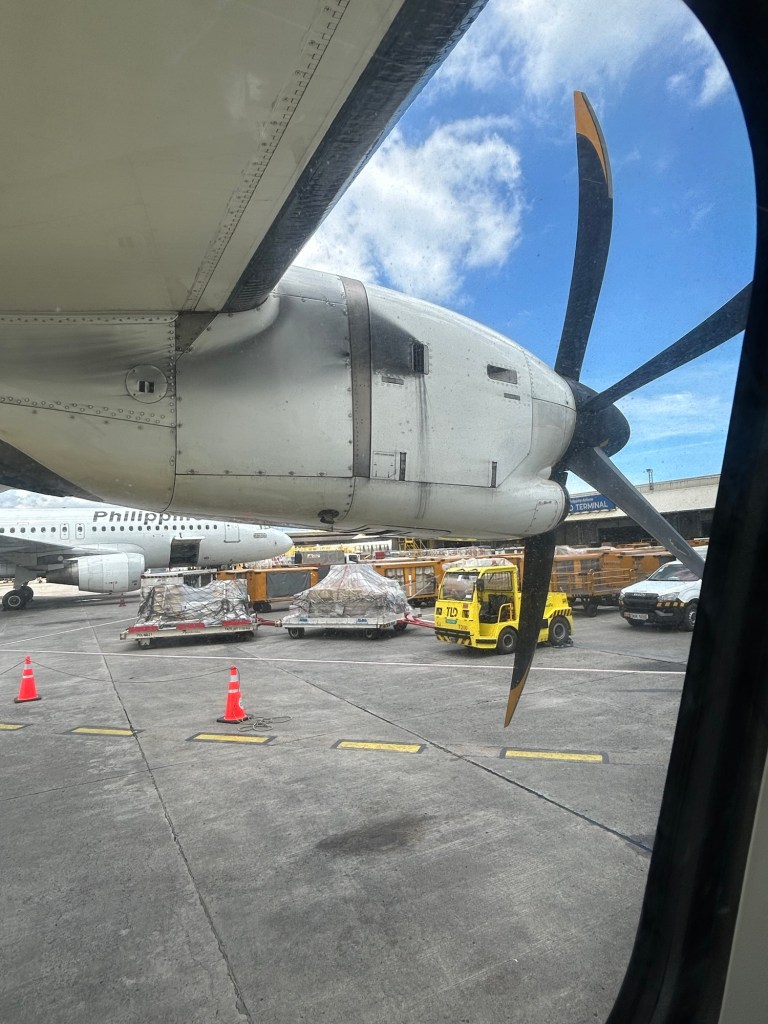
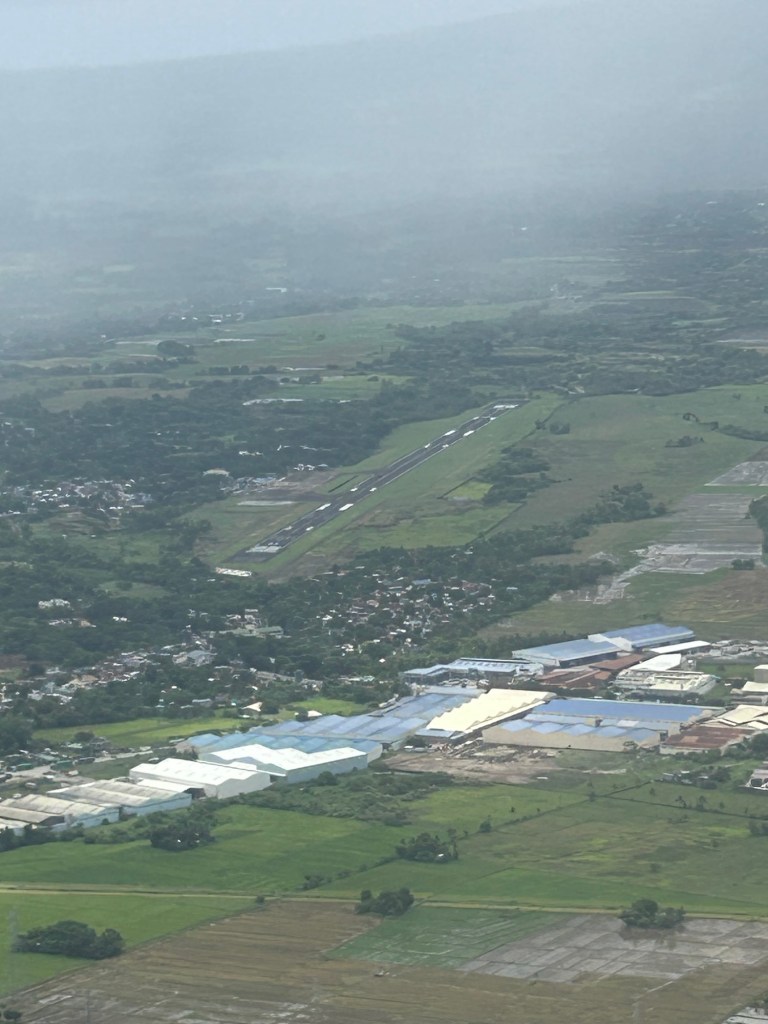
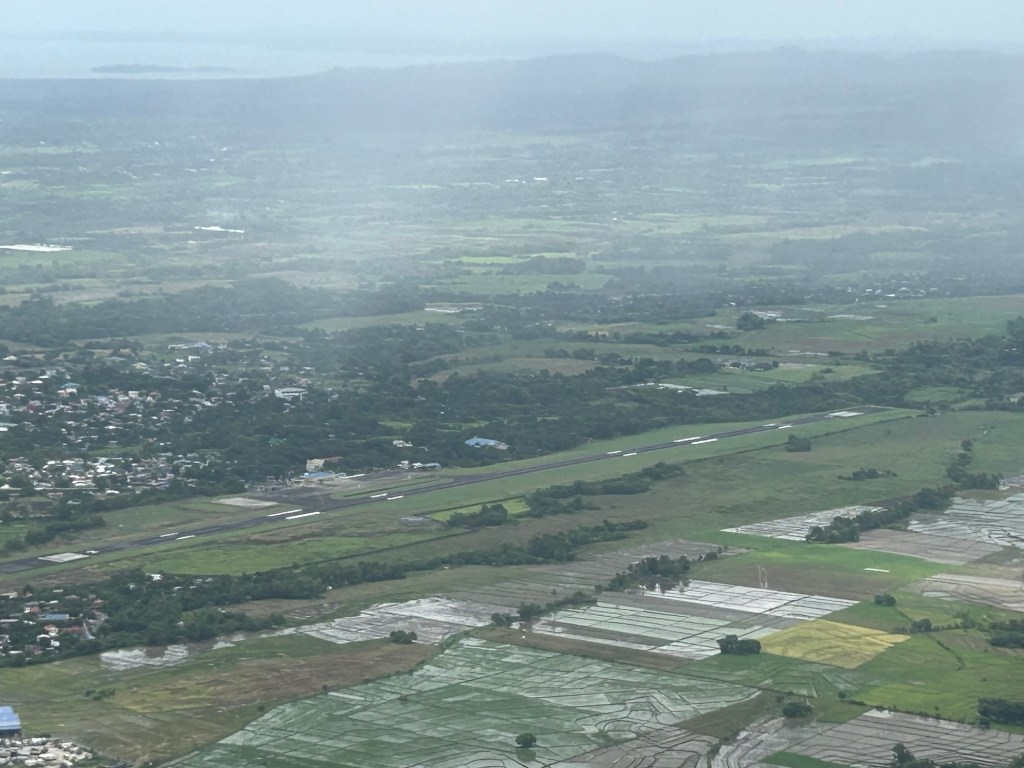
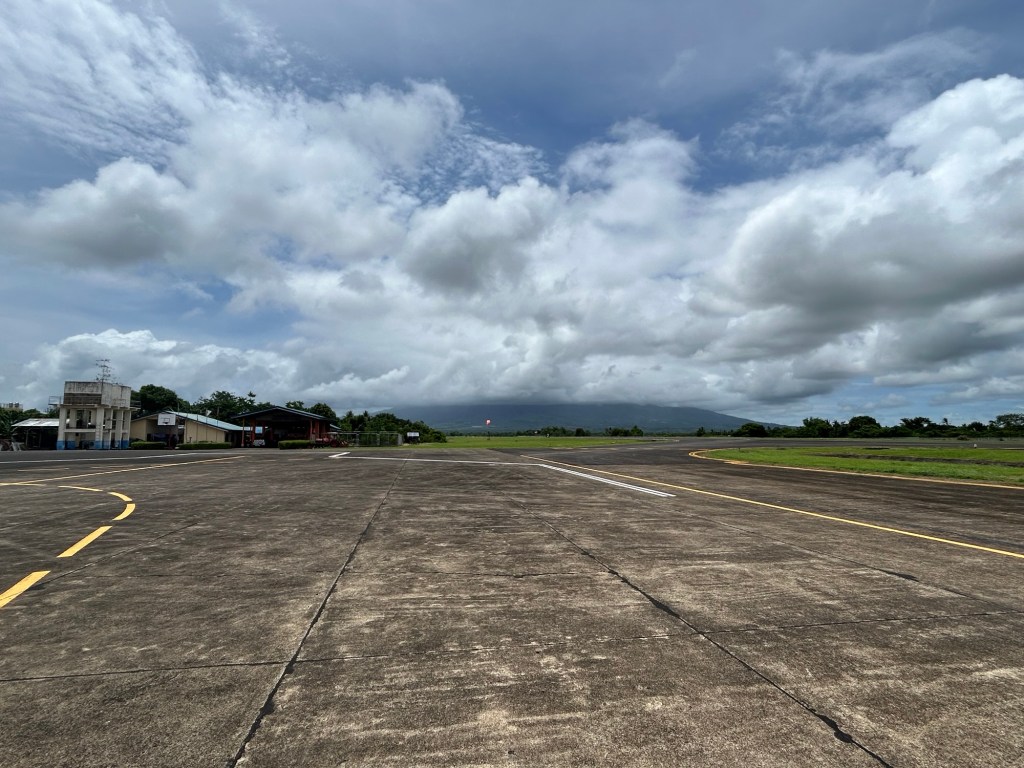
I posted about the airports in Daraga/Legazpi City and Davao City as I knew I would be traveling to Naga City and likely by air. That likelihood became certainty as horror stories of 14-16 hour travel by bus became unacceptable for short trips where the travel times by road exceeded our actual stay in the city.
More on Naga City in the next posts!
–
Here comes the rain again…
And just like that, Habagat is here and dumping rains upon us again. Yesterday’s downpour during the early afternoon resulted in flash floods including a few along our route home.
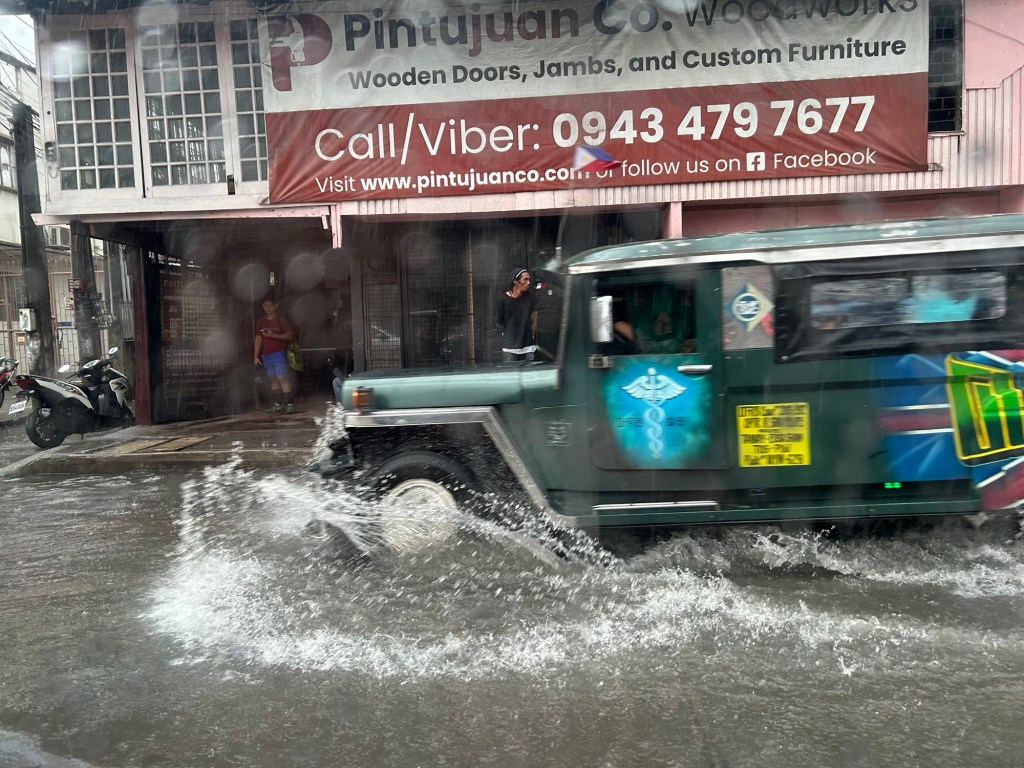
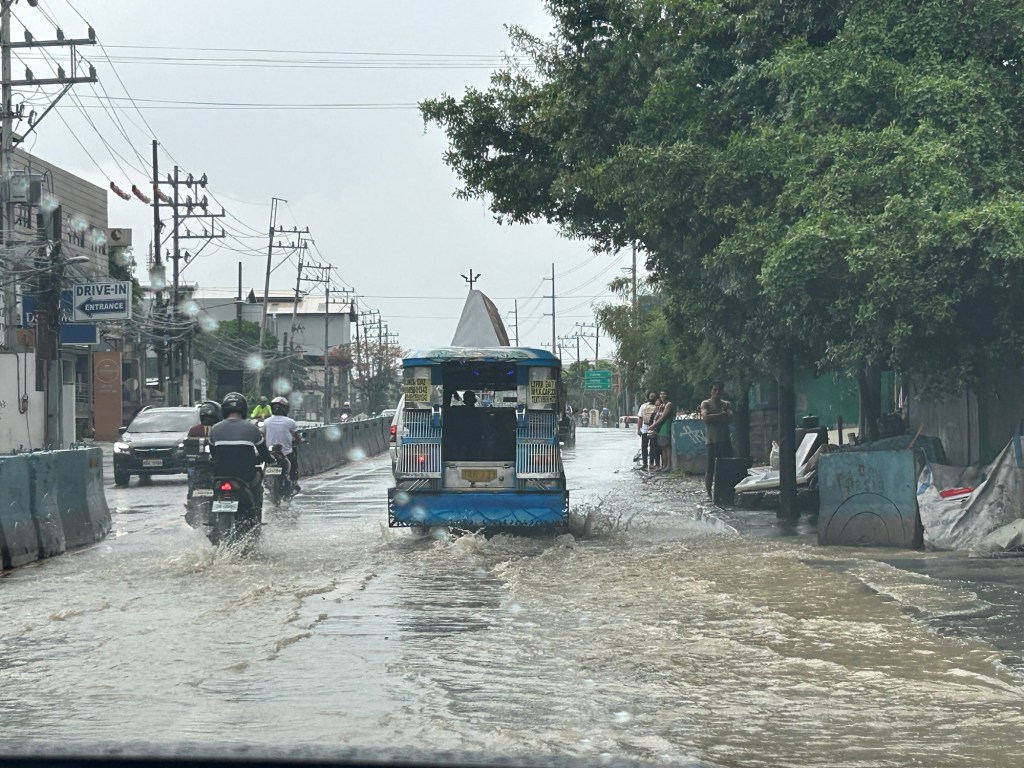
The combination of heavy rains and floods have significant impacts on transportation as traffic slows down or even stops as roads become impassable. As most commuters are dependent on road based transport, this means a tremendous inconvenience to a lot of people.
I’ve also written about this topic before. Despite the implementation of various flood control and drainage improvement projects, we seem to be back to square one once the rains come. There is certainly something wrong that the floods are still here after spending so much to mitigate them.
–
NAIA Terminal 1’s departure level driveway and drop-off
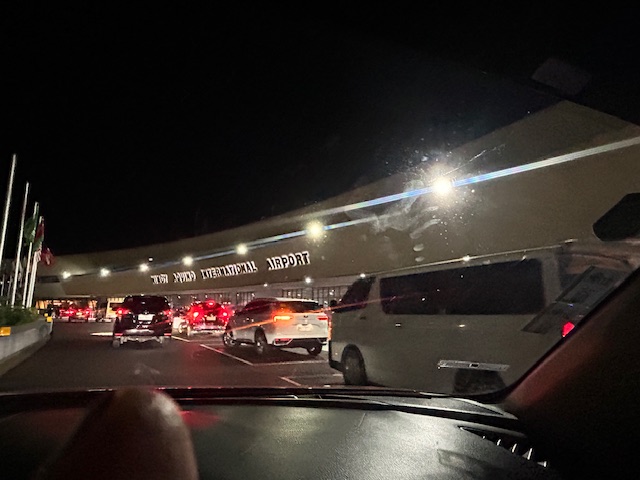
Weeks ago there was a fatal incident involving a motorist who plowed into well-wishers and passengers at NAIA Terminal 1. It was revealed. I finally had the chance to see the area for myself. I had not gone to Terminal 1 in a long while and especially after San Miguel Corporation had taken over the airport. The photos shared below were taken by my wife as we eased into the departure driveway of NAIA T1 one early morning last week.
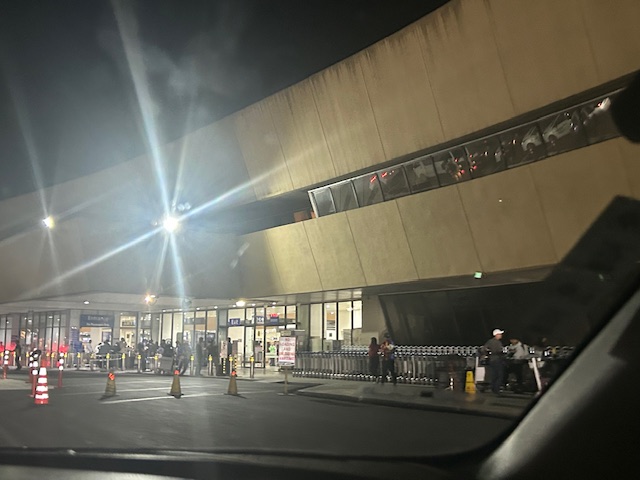 Arriving at the west wing of the departure level of Terminal 1. Those are luggage carts lined up along the sidewalk. There are cones for the restricted area but these turned out to be to block vehicles from using the inner lane adjacent to the terminal.
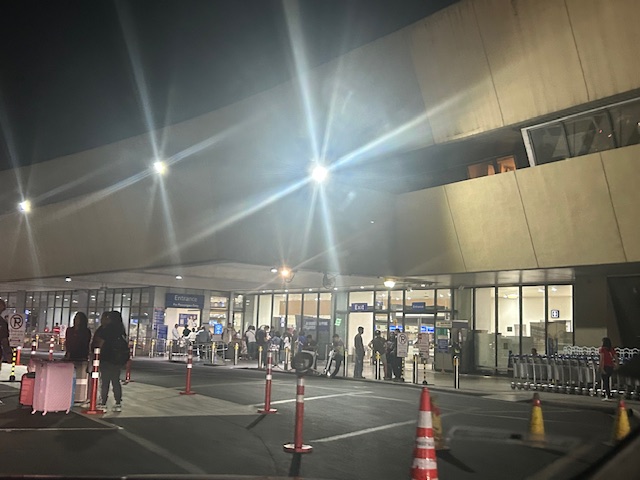 West wing entrance of Terminal 1 – unlike Terminals 2 and 3, there is really no area for well-wishers. Note the bollards that are supposed to protect people from errant vehicles. We now know these were not built or installed to the required specifications for protection.
 Vehicles are now parked parallel along the center of the driveway. Previously they were angled facing the terminal.
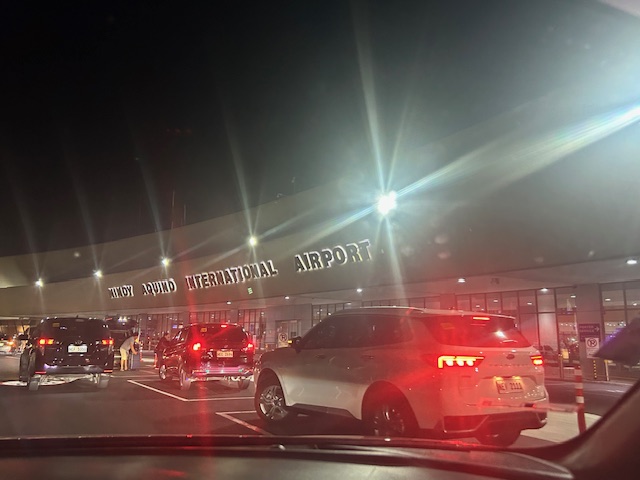 In terms of the space available, this significantly reduces the number of vehicles that can park to drop off passengers at the departure driveway.
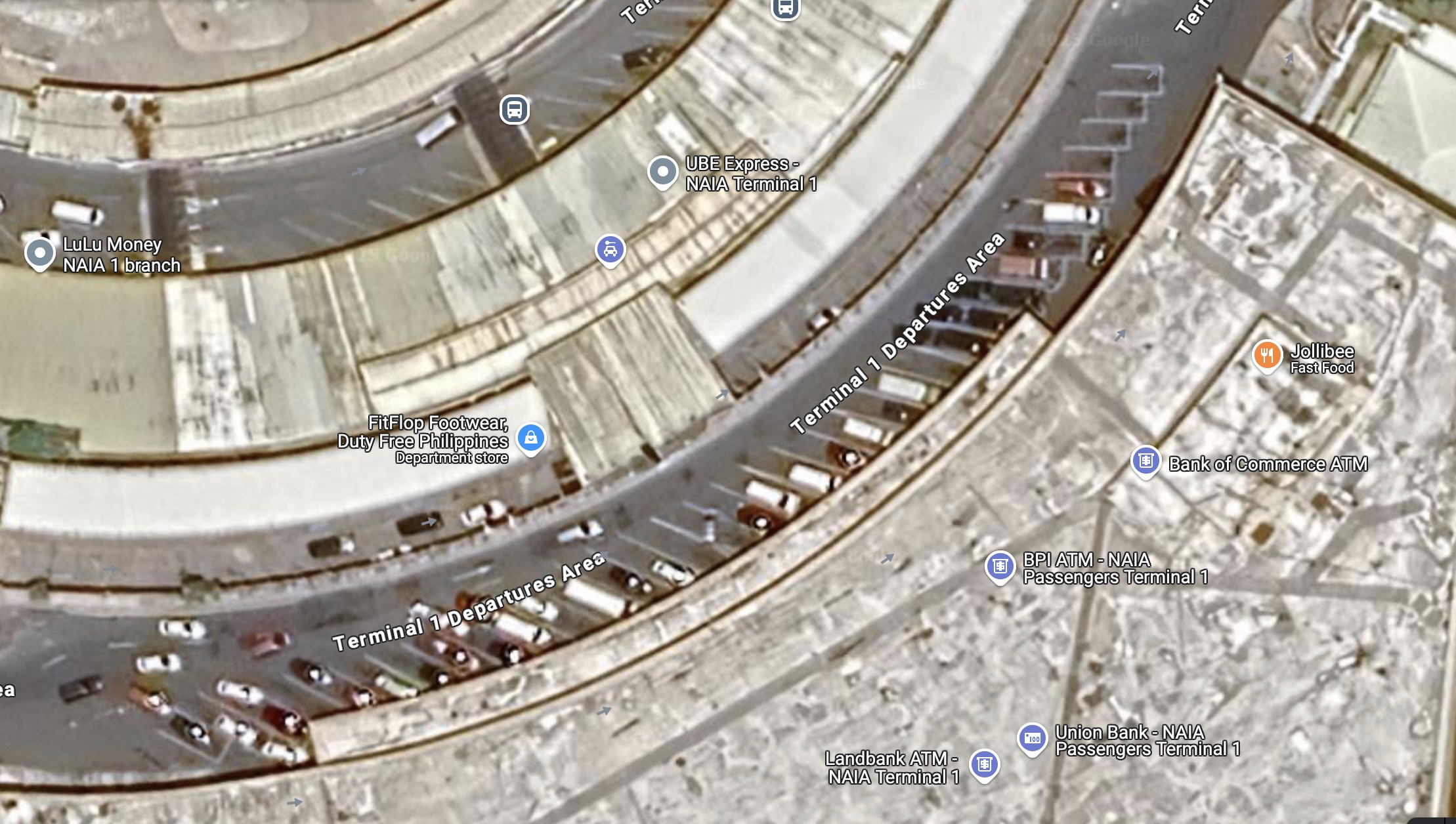
Screenshot from Google Maps showing the previous layout of the drop-off parking. Note the vehicles pointing towards the terminal.
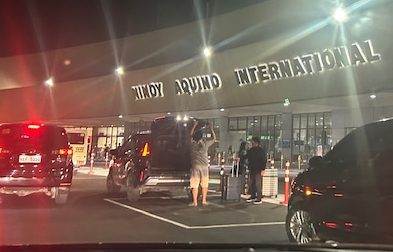
Passengers unloading their luggage behind the vehicles. There are markings for the vehicle slot but most just park parallel where space is available at the center of the driveway.
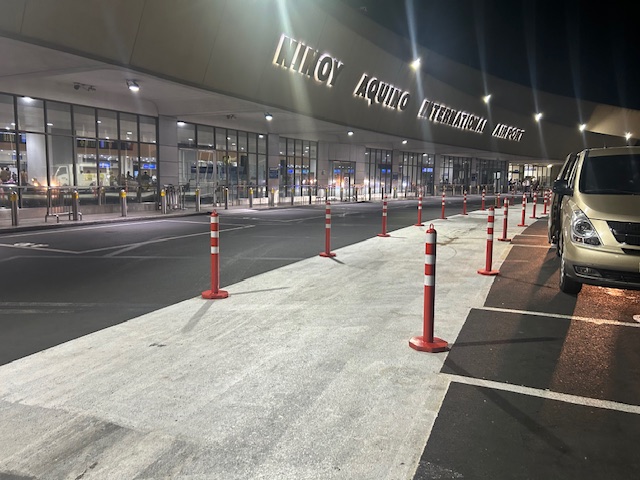 There is a buffer zone between the inner driveway lane and the drop-off lane. There were no vehicles using the inner lane but you can see in the photo that there are also curbside slots. Perhaps these are used during the busier times at the terminal?
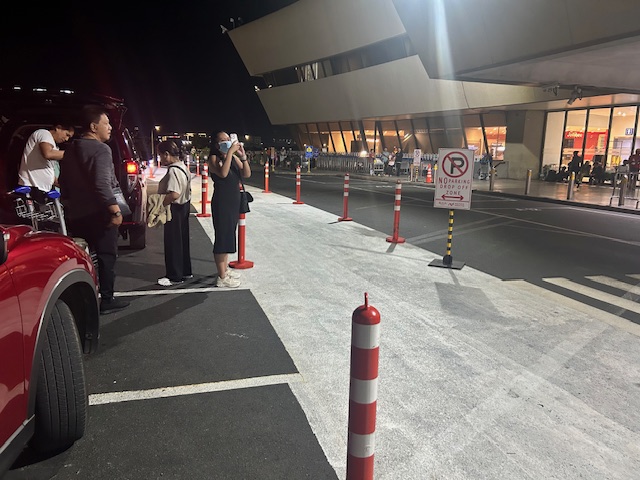 Other passengers were also taking photos as their luggage were being unloaded from their vehicles.
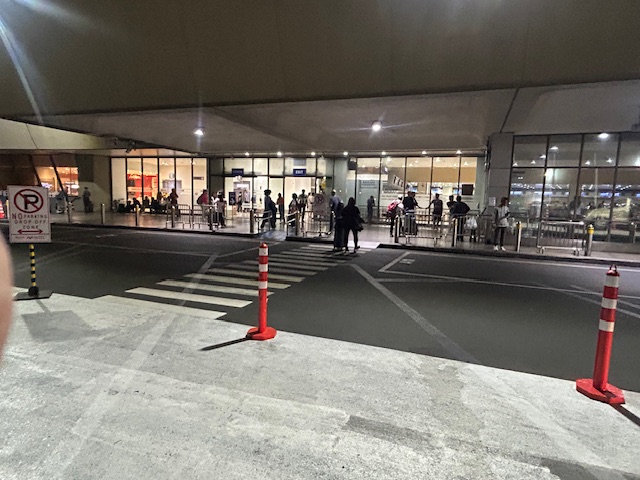 This is where the fatal crash occurred. It seems the damage has been repaired and quickly and its business as usual at the airport.
NAIA authorities should already start retrofitting or reinstalling the bollards at the terminal. This would ensure the safety of passengers vs. vehicles that may or may not be under the control of their drivers. The effort to quickly address the concern is much appreciated but a long term solution needs to be implemented to prevent future crashes from occurring here and at other terminals.
–
 Caught (up) in traffic