
Public transport in Iloilo
I took some snapshots of public transportation on my recent travel to Iloilo. These are typical PUVs you would find in most towns across the country. Iloilo’s have some distinct features that they also share with other towns in other provinces.
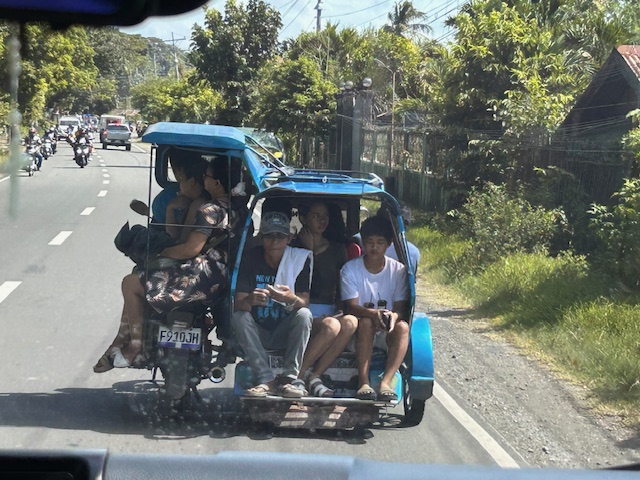 A typical tricycle along the Iloilo-Antique road seats 8 to 9 passengers. Sometimes passengers even sit on top of the sidecar. Sidecars here and other provinces often have roofs designed to carry heavy loads including agricultural products. Usual trike sidecar seating have passengers facing front. This one has them “talikuran” or “back to back” with some passengers facing back – not really a nice view when traveling along a highway and vehicles tailing or bearing down on the trike.
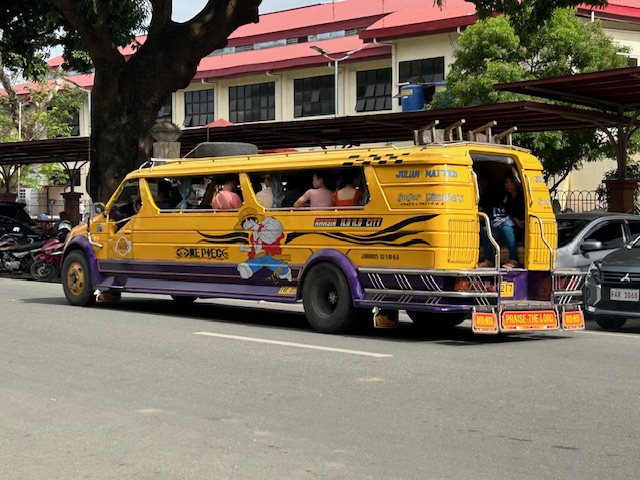 The typical jeepney in Iloilo is stretched whether it’s for inter-town or city operations. Instead of having the ‘face’ of the jeep (from which jeepneys evolved from), they use the front of the Toyota Fortuner or Mitsubishi Montero. These seat 20 to 24 passengers not counting those who are seated on the bench along the aisle. I wonder what engines they now use for these vehicles.
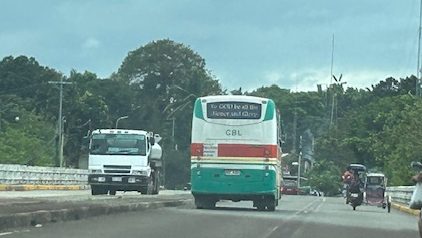 I took this fleeting photo of a bus. For me it wasn’t just a regular bus like the Ceres buses that now dominate the inter-provincial routes. This was a Calinog Bus Line (CBL) bus. We used to take their buses whenever we traveled from Cabatuan town proper to Tigbauan Road. One of my aunts also rode on these buses going to work as a teacher in another town along its route.
–
Traffic calming devices in the vicinity of schools – speed tables
Traffic calming devices are an effective means to reduce speeds especially where there are many pedestrians crossing the streets. These are usually applied near schools where there are significant numbers of pedestrians, particularly schoolchildren. Following are examples of raised crossings or speed tables located at the approaches and exits of an intersection in Naga City. These are located at the intersection of J. Hernandez Avenue and P. Burgos Street. Burgos leads straight to the main gate of the University of Nueva Caceres. However, there is no raised crossing for Burgos. There are only those for both legs of Hernandez.
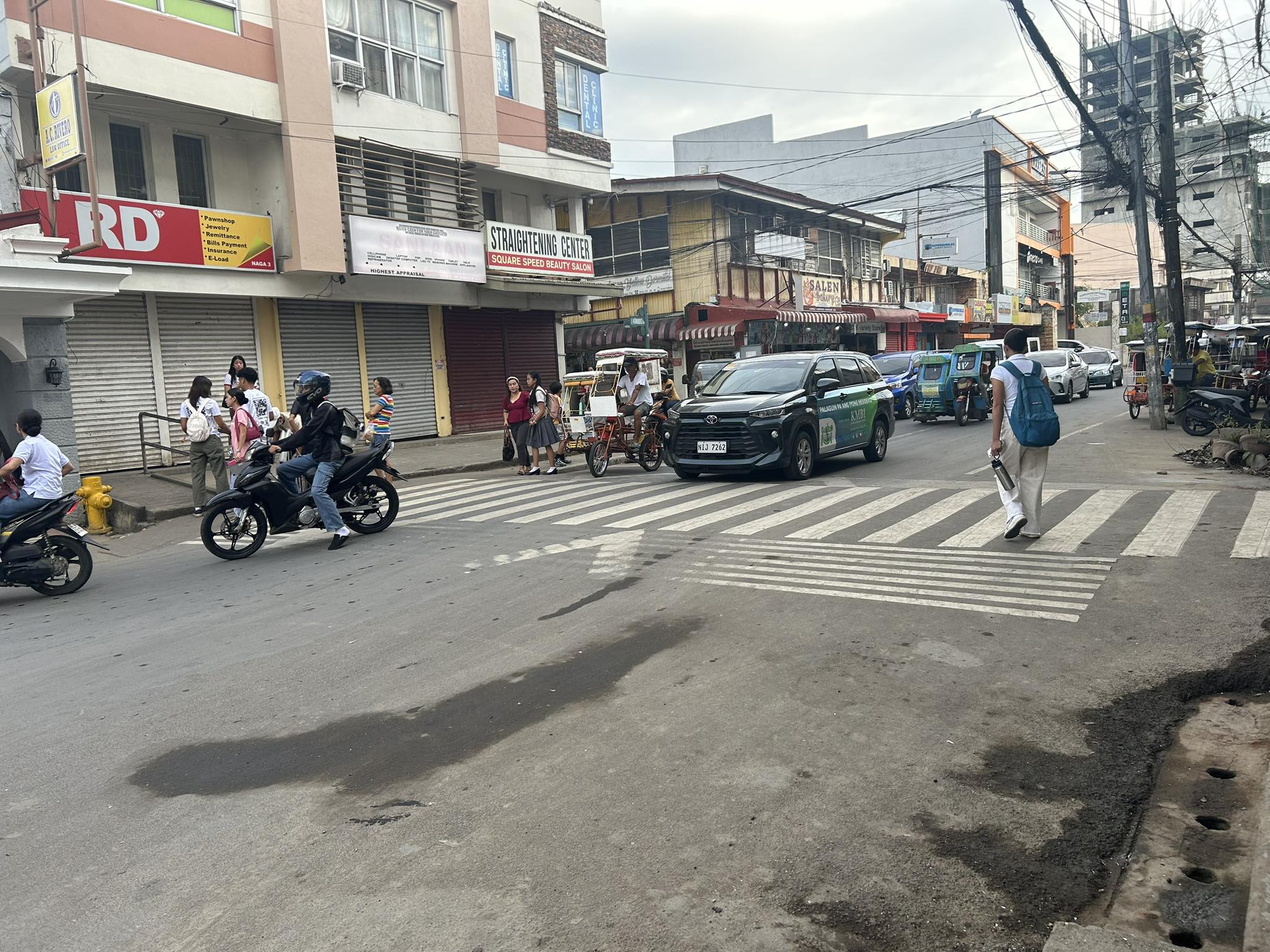 Speed table along north approach of J. Hernandez Avenue
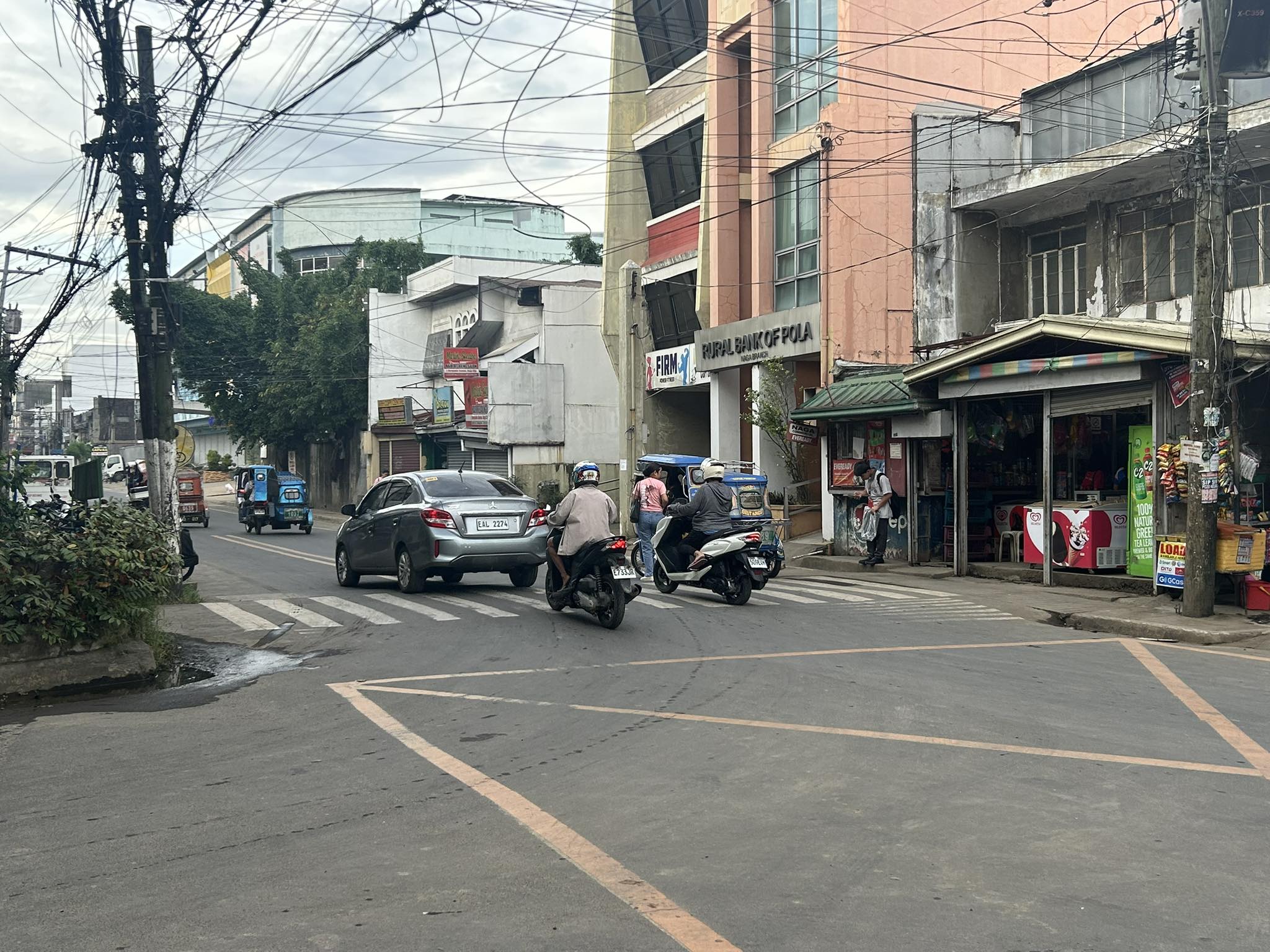 On the other side, there is another raised crossing along J. Hernandez Avenue.
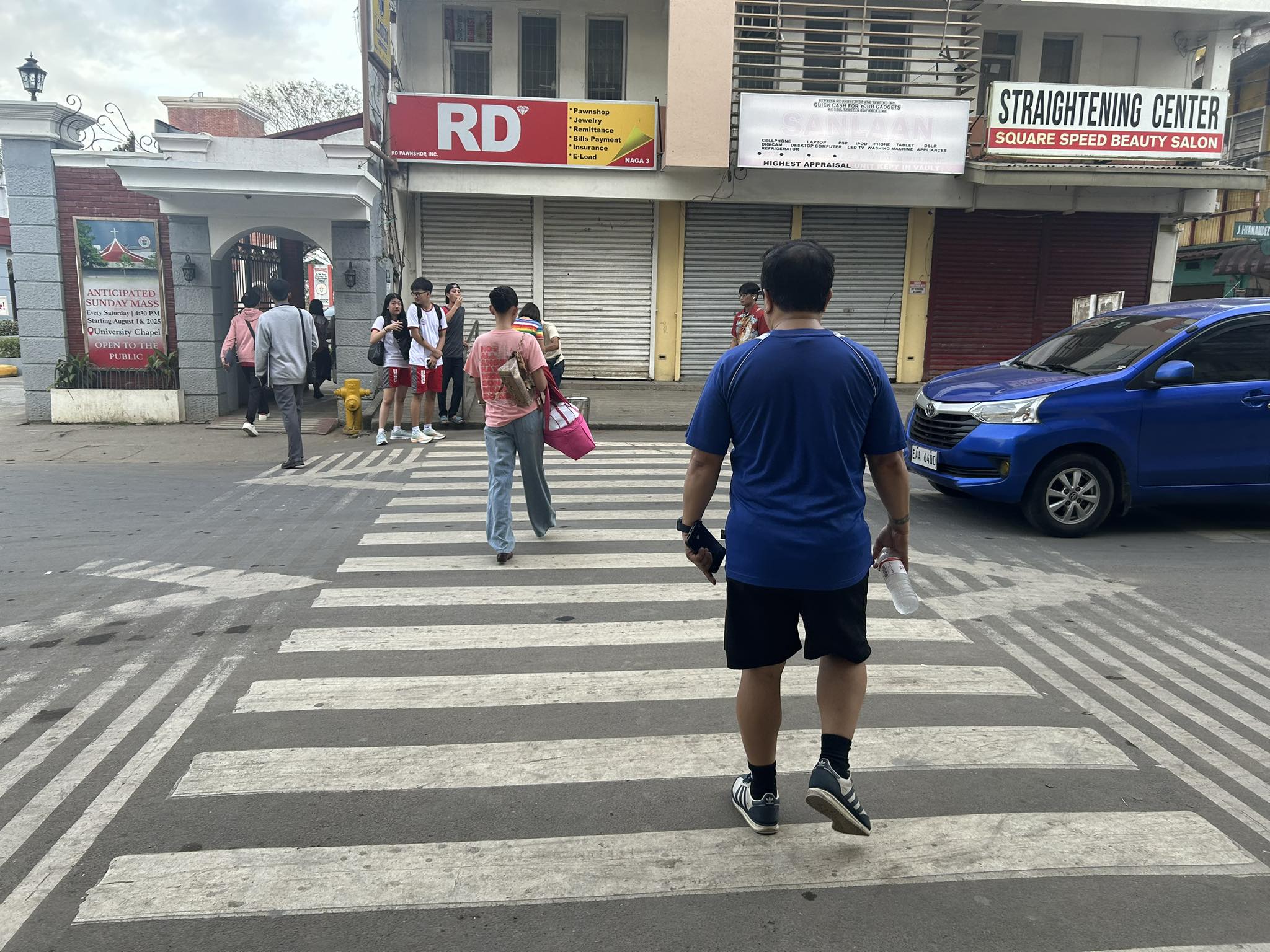 POV of a pedestrian crossing at the speed table towards the UNC main gate (to the left in the photo).
There is a need to have these traffic calming devices in other locations across the city and particularly near schools where crossings are located and vehicle speeds need to be reduced. There should be no exceptions for the application of traffic calming. That includes national roads along which certain agencies like the DPWH like to maintain higher speeds despite the obvious risks posed on pedestrians. Many schools are located along national highways and raised crossings can be designed to reduce speeds while offering safe crossings to schoolchildren. We just have to change mindsets pertaining to safety and priorities.
–
More Buses, Fewer Riders? Thoughts on the Ridership vs Coverage Tradeoff
Here is a quick share of an article on ridership vs. coverage:
Source: More Buses, Fewer Riders? Thoughts on the Ridership vs Coverage Tradeoff
Basically, there is that question of whether planners or decision makers should prioritize ridership over coverage? Or should it be the other way around? The article provides a detailed discussion of the trade-offs. Perhaps this is again a case of determining which is more suitable for your city?
–
PNR Naga – Lupi Timetable
We went to the PNR Naga Station last Friday morning and got an updated timetable for the PNR trains. We also were informed that the Naga-Legazpi train service is currently suspended due to damages along the line sustained during the recent typhoon. Hopefully, that section will be repaired immediately and the service resumed.
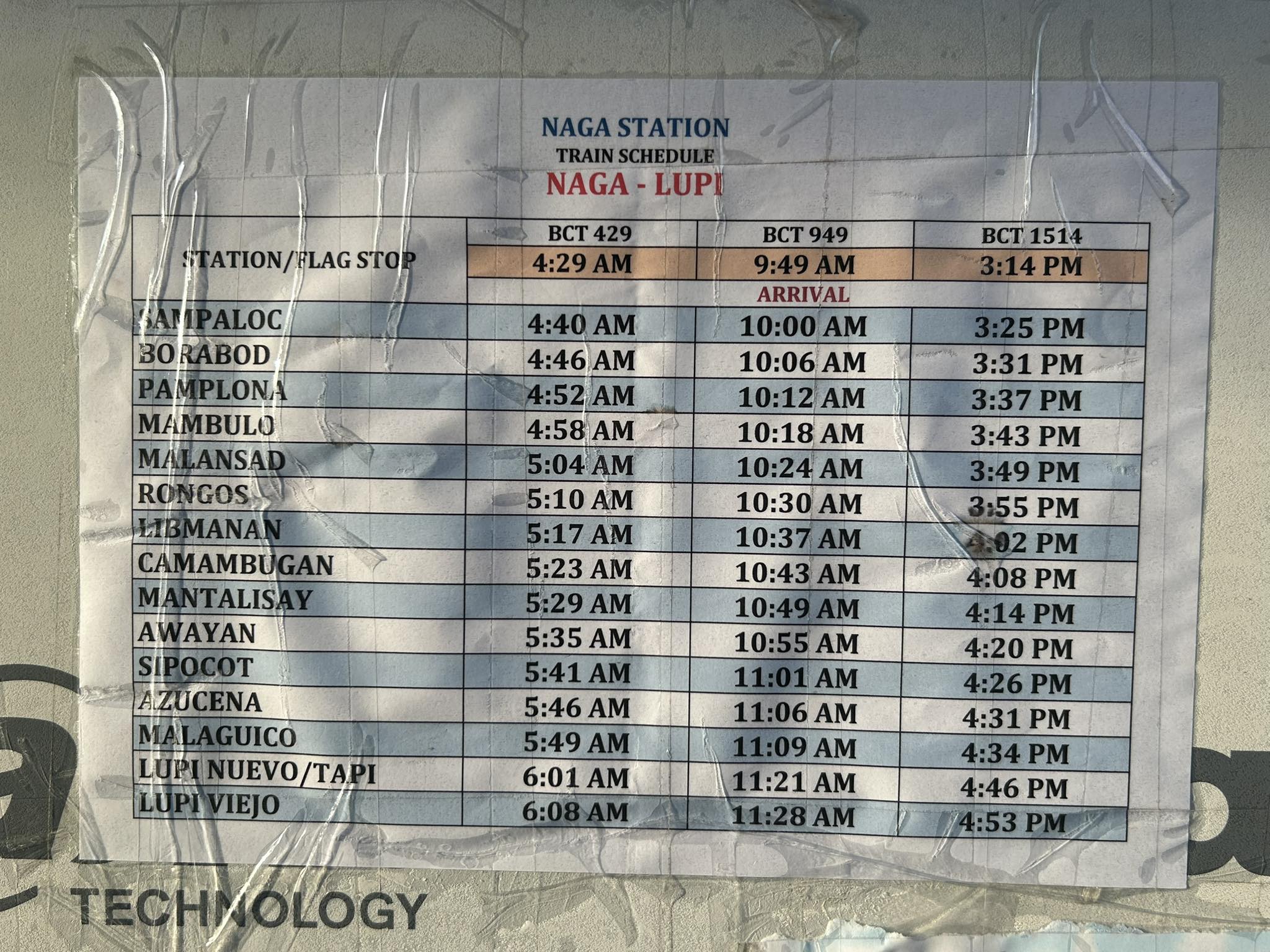 Naga to Lupi timetable showing the first train leaving Naga at 4:29 AM and the last at 3:14 PM. There are only 3 trips.
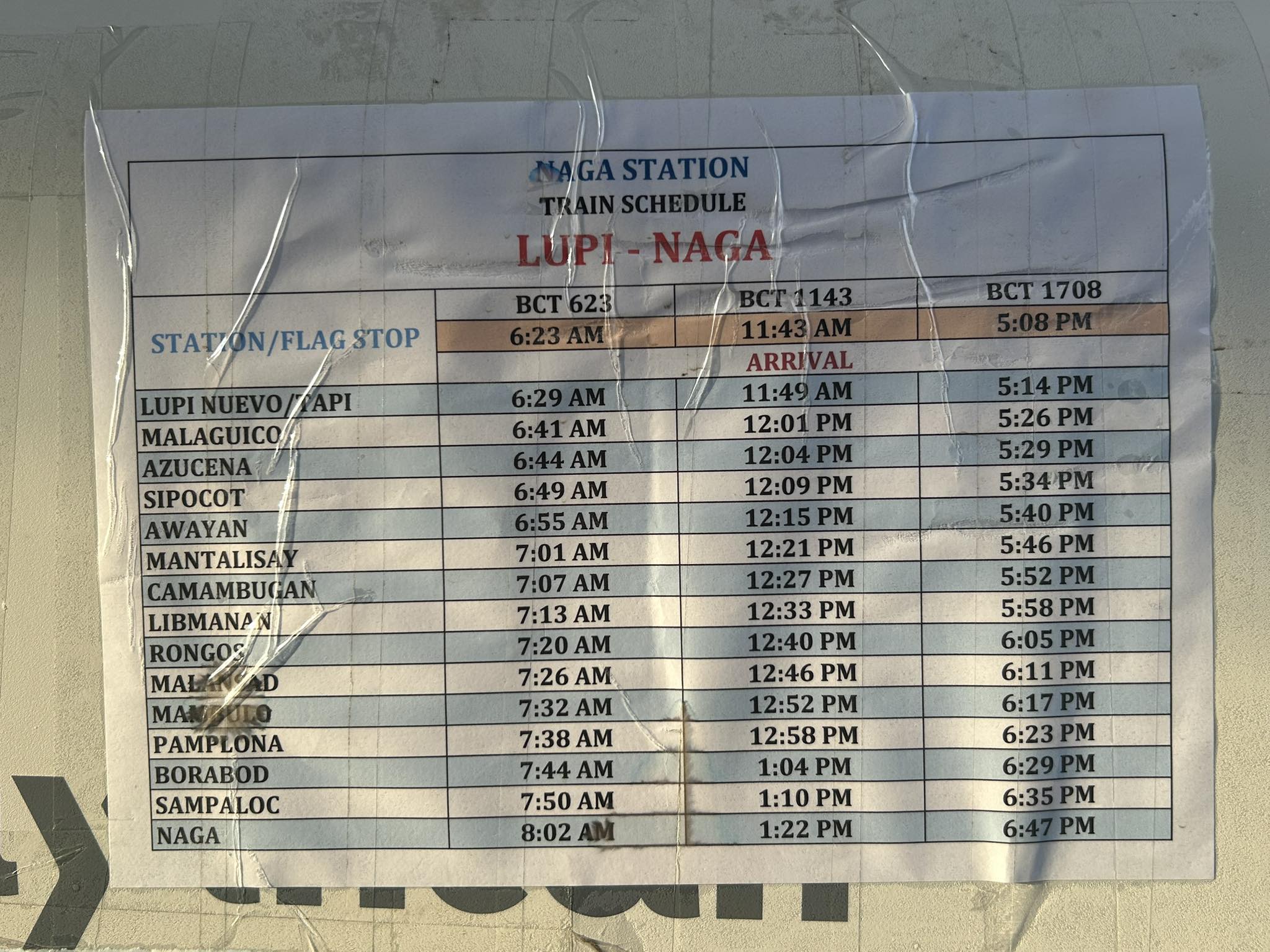 Lupi-Naga timetable showing the first train leaving Lupi at 6:23 AM and the last one at 5:08 PM. Again, there are only 3 trips from Lupi to Naga. The first train arrives in Naga at 8:02AM. This is actually attractive to commuters as the LGU reports the train to be full. Unfortunately, the return trip in the afternoon doesn’t have a favorable schedule for those heading home from work or school.
There is potential here for people to shift to rail for the major part of their commutes. Unfortunately, the frequencies of service is too low at present. People will shift to rail if the service is frequent and more reliable. Cost-wise, there is a significant difference between road-based and rail-based transport especially over long distances. Fares via express vans between Naga and Legazpi cost 300 to 400 pesos while private vehicle may cost between 3,000 to 5,000 pesos depending on the model and arrangements. Compare those with the 155 peso fare for the PNR train.
We are also hopeful that the rehabilitation and upgrading of train services will eventually be realized. The NSCR project is currently underway with the northern line connecting Metro Manila to Pampanga and the southern line currently until Laguna. The work needs to be accelerated and that entails much resources (i.e., funding) for railways to make comeback and perhaps experience another “Golden Age.”
–
On how delivery culture is influencing policy and urban design
While discussing on-street parking policies and schemes with Naga City LGU officials, one comment was on providing parking space for delivery riders. Truly, delivery riders have become a significant consideration especially where they have no parking spaces to wait or sort their items. The following articles expounds on how the rise of delivery culture is influencing policy and urban design:
Franco, A. (November 14, 2025) “From edge to epicenter: How the curb became a key piece in modern cities,” Public Square, https://www.cnu.org/publicsquare/2025/11/05/edge-epicenter [Last accessed: 11/14/2025]
To quote from the article:
“Urban designers need to recognize that while our streets were once built exclusively for car movement and storage, they are inherently adaptable. The opportunity now is to make these spaces more equitable, accessible, and efficient for everyone, not just car owners with parking privileges. After all, the street and the curb are public spaces and should serve the diverse needs of all citizens.”
On parking for typhoons
The Metro Manila Development Authority (MMDA) recently issued a memo to shopping mall operators in Metro Manila in relation to the anticipated arrival and onslaught of a super typhoon. I reproduce the memo below:
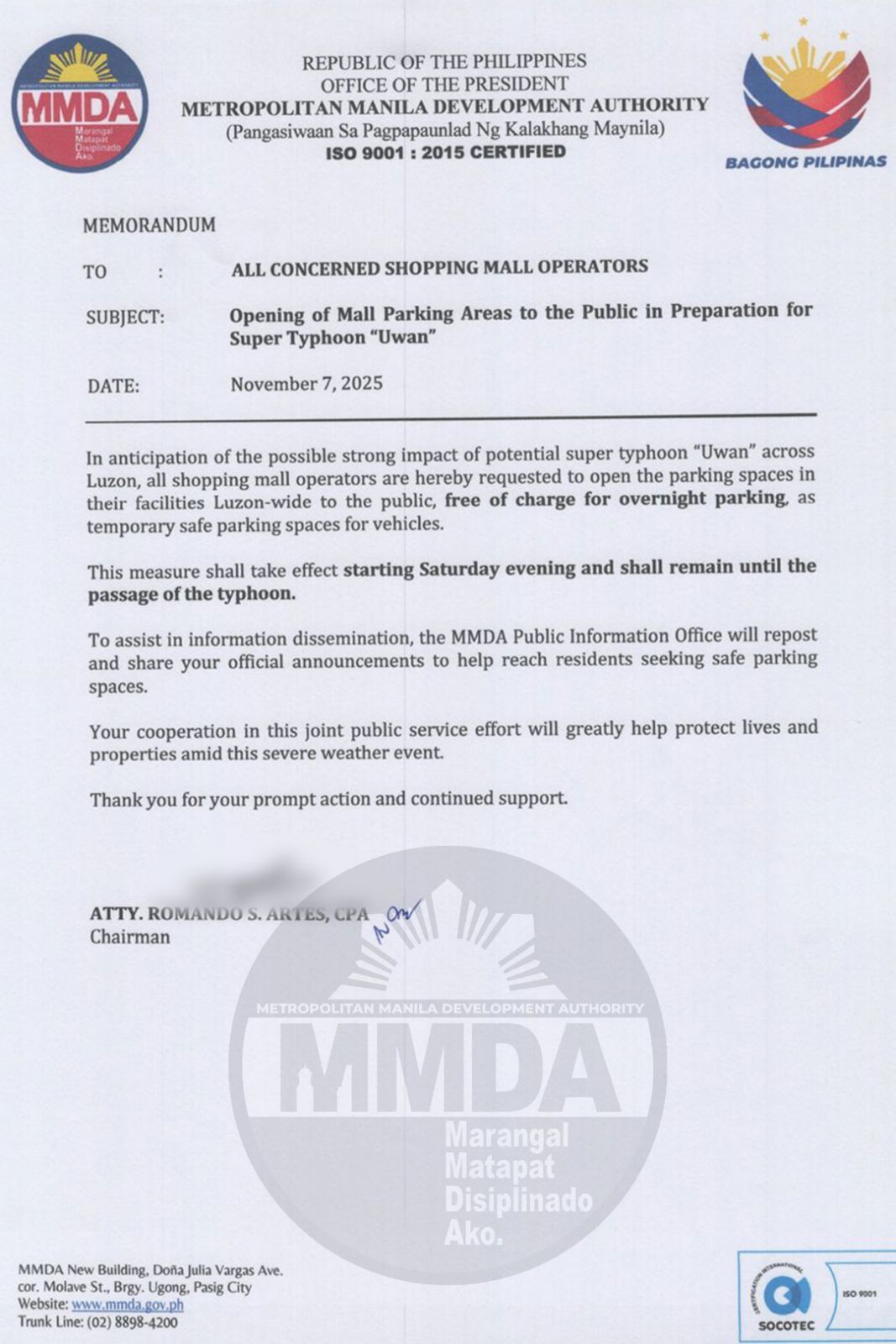
As of this morning, most if not all mall operators (at least all of the major ones – SM, Robinsons, Ayala and Megaworld) have responded positively. Some observations this morning though shows a lot of people already lining up their vehicles at the malls to take advantage of the free parking. It seems a lot of people have misunderstood the memo and responses (from the malls) to mean there’s free parking from today til Monday. Let’s assume that most of these people live in flood prone areas and that many of them probably don’t have garages in their homes. This somewhat shows us another angle of vehicle ownership and the lack of parking for many. It also somehow tells us something about our dependency on cars and how we really need to have a better transportation system.
–
Is there a future for the Philippine made AGT?
I am writing this after reading posts on social media about how they are hopeful about the Philippine-made Automated Guideway Transit (AGT) being finally operational. For one, both AGT models (60 passenger capacity train and 120-passenger capacity train) have not been technically certified. And then there are really no plans for lines to be constructed anywhere.
The closest to plans that we have are the feasibility studies conducted many years ago that did not materialize into an operating line. One of those were supposed to be along Gen. Santos Avenue in Taguig, which could have extended to C6. Another is a line that could have run along C.P. Garcia Avenue and Katipunan Avenue, connecting Line 7 at Commonwealth Ave. with Line 2 at Aurora Blvd.
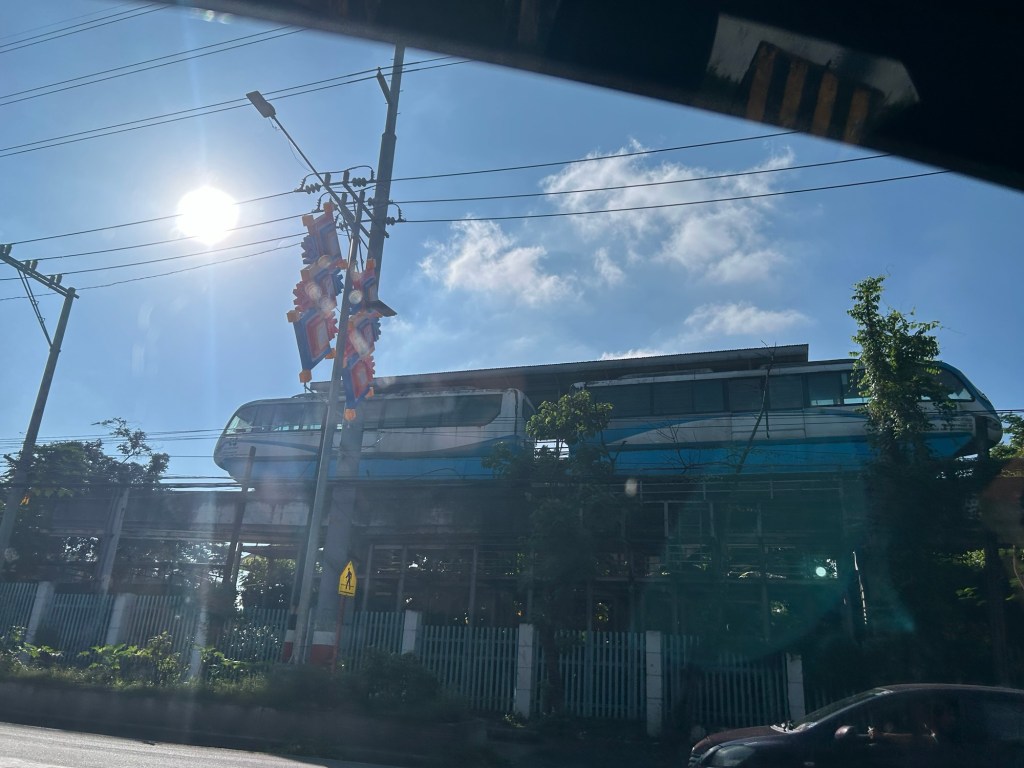
There’s still something worth studying and refining here as the AGT is a product of local R&D. However, there must be a commitment among researchers and the DOST on the way forward. There should also be some kind of buy-in from government agencies especially DOTr to support this development.
–
More electric vehicle taxis
I wrote about the new player in town, Green GSM Taxi, which has an all EV fleet. But while this is a relatively big company, there are smaller players who are also operating EV taxis. Here are a couple of them.
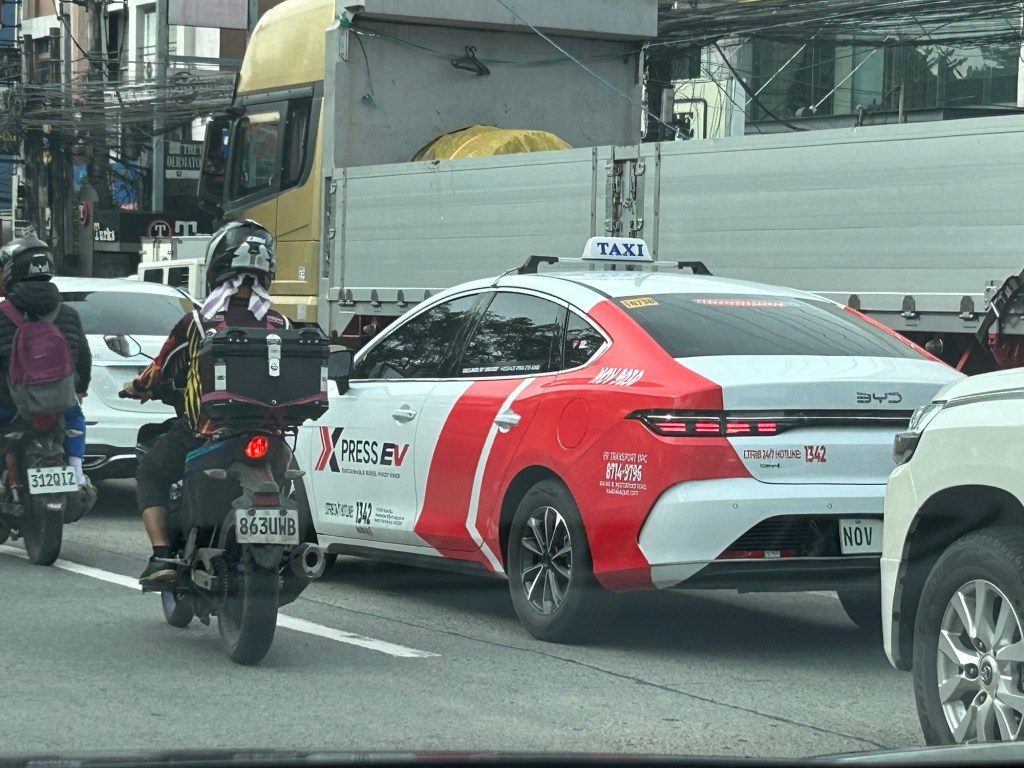
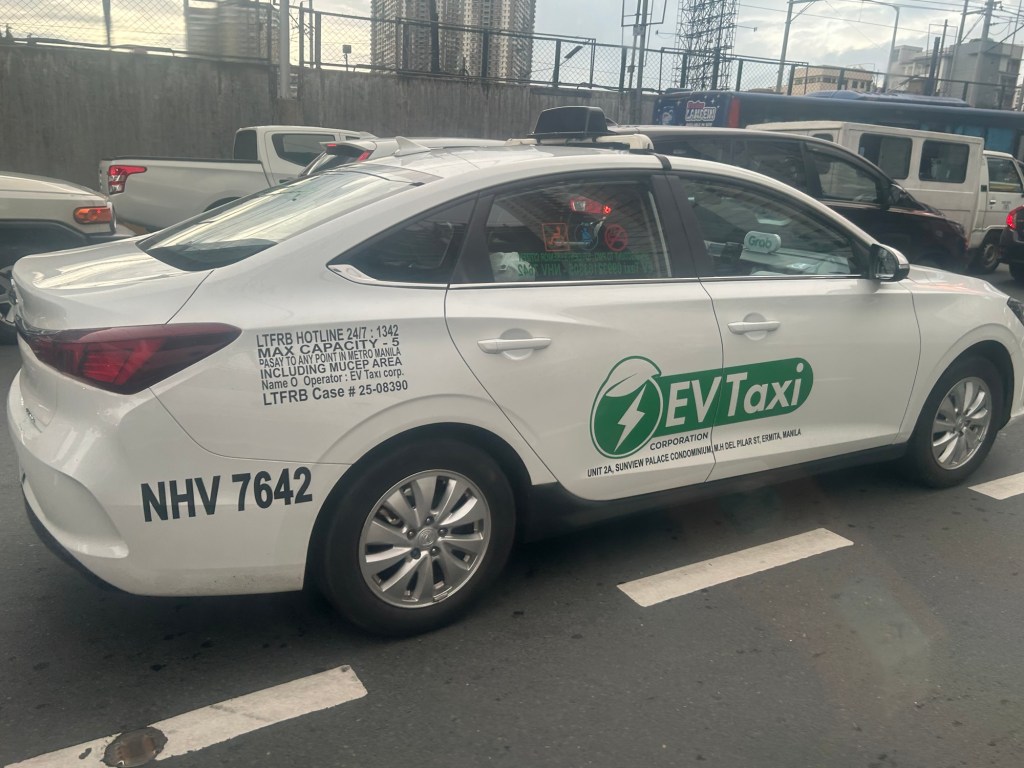
The last one, EV Taxi, is affiliated with Grab. The former doesn’t have sticker or anything identifying it with any of the app-based services. I haven’t seen many of both Xpress EV and EV Taxi so I assume there are fewer vehicles under the operator. This is much the same as previous conventional taxi operators and a consolidation of sorts is via one of the app-based companies like Grab. Is this (small operator) a sustainable venture? Is there anything new about these taxis aside from the vehicles being electric? Maybe the drivers are the same as before (for better or worse)?
–
The need to be alert while walking, jogging or running in campus
With the recent bad weather, I noticed a big decrease in the number of visitors to the UP Diliman campus. Most of these walk, jog or run for health or recreation. Many of these are often lost in their conversations or too focused on their activity that they become unaware of the dangers of moving under large trees whose branches might fall on them anytime. It is especially true during the wet season and when there are typhoons or storms. The water and wind often bring down the older branches and one can get serious injuries perhaps even die should a large branch fall upon them.
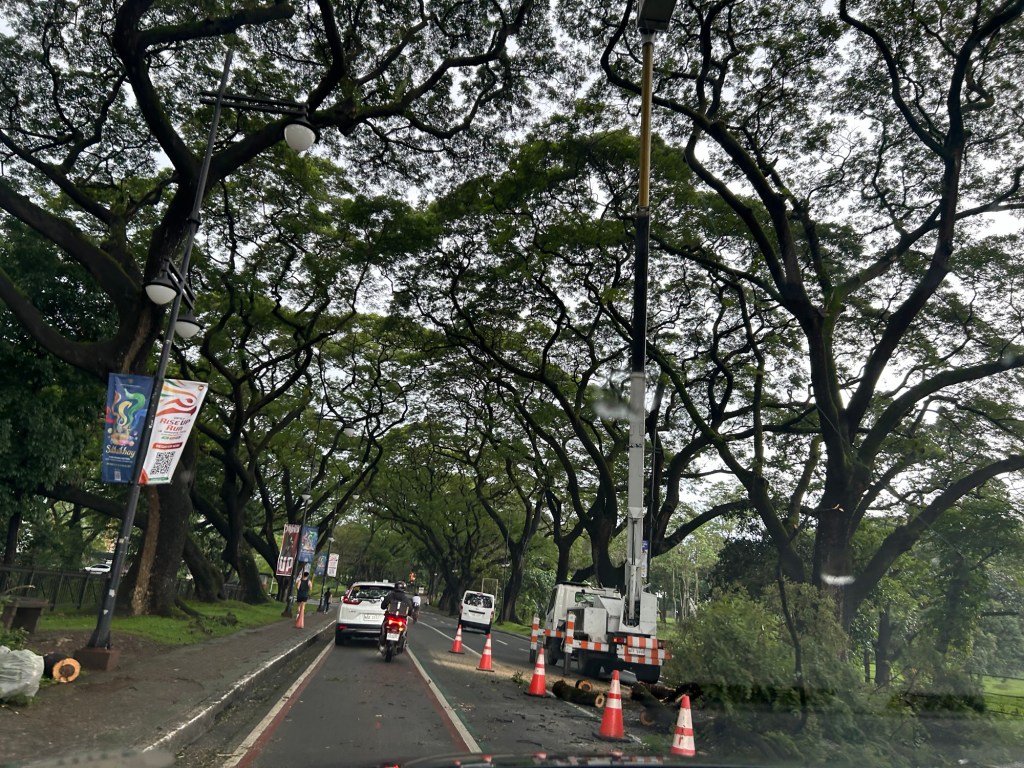
Walkers, joggers and runners (let’s also include cyclists/bikers) need to be aware of these dangers. I myself had a few near misses in the past while walking around the Academic Oval. I know people who have been injured by falling branches while they went around.
–
The need to be alert while walking, jogging or running in campus
With the recent bad weather, I noticed a big decrease in the number of visitors to the UP Diliman campus. Most of these walk, jog or run for health or recreation. Many of these are often lost in their conversations or too focused on their activity that they become unaware of the dangers of moving under large trees whose branches might fall on them anytime. It is especially true during the wet season and when there are typhoons or storms. The water and wind often bring down the older branches and one can get serious injuries perhaps even die should a large branch fall upon them.
Walkers, joggers and runners (let’s also include cyclists/bikers) need to be aware of these dangers. I myself had a few near misses in the past while walking around the Academic Oval. I know people who have been injured by falling branches while they went around.
–
 Caught (up) in traffic