
Article share – My provocative proposal: Want a roadway safety movement? Ditch the engineers.
Here’s a quick share of an article on who should be involved in road safety:
Source: My provocative proposal: Want a roadway safety movement? Ditch the engineers.
The future of taxis in the Philippines?
In recent weeks, the energy crisis has brought to the forefront the use of electric and hybrid vehicles among private car users. You see a lot of new electric and hybrid vehicles as I assume sales have risen. “Sana all!” as they say as not everyone have the resources to purchase a new vehicle. There is an option, however, for those who might prefer their own transport (private) or are regular users of Transportation Network Vehicle Service (TNVS) as rideshares have been termed for some time now. Take the taxi. While there are still the conventional taxis, there are now also electric vehicle taxis. Leading the way for the electrification of taxis is the upstart Green GSM, which is a Vietnamese company using Vinfast electric cars that are also manufactured in Vietnam.
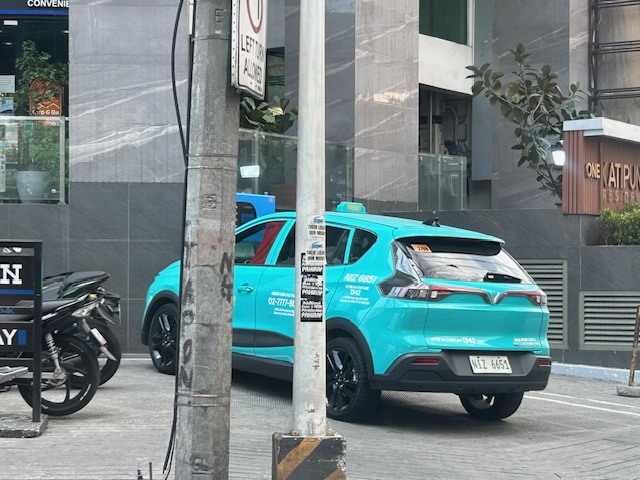 Electric taxi charging at a station at a residential building along Katipunan Avenue in Quezon City
Here are some preliminary data from an ongoing study at UP Diliman, comparing fares of Grab and Green GSM. The values shown are averages based on several simulated bookings for either for the same origin-destination. The peaks for Grab probably indicate the times when there are surge pricing for trips (i.e., peak periods).
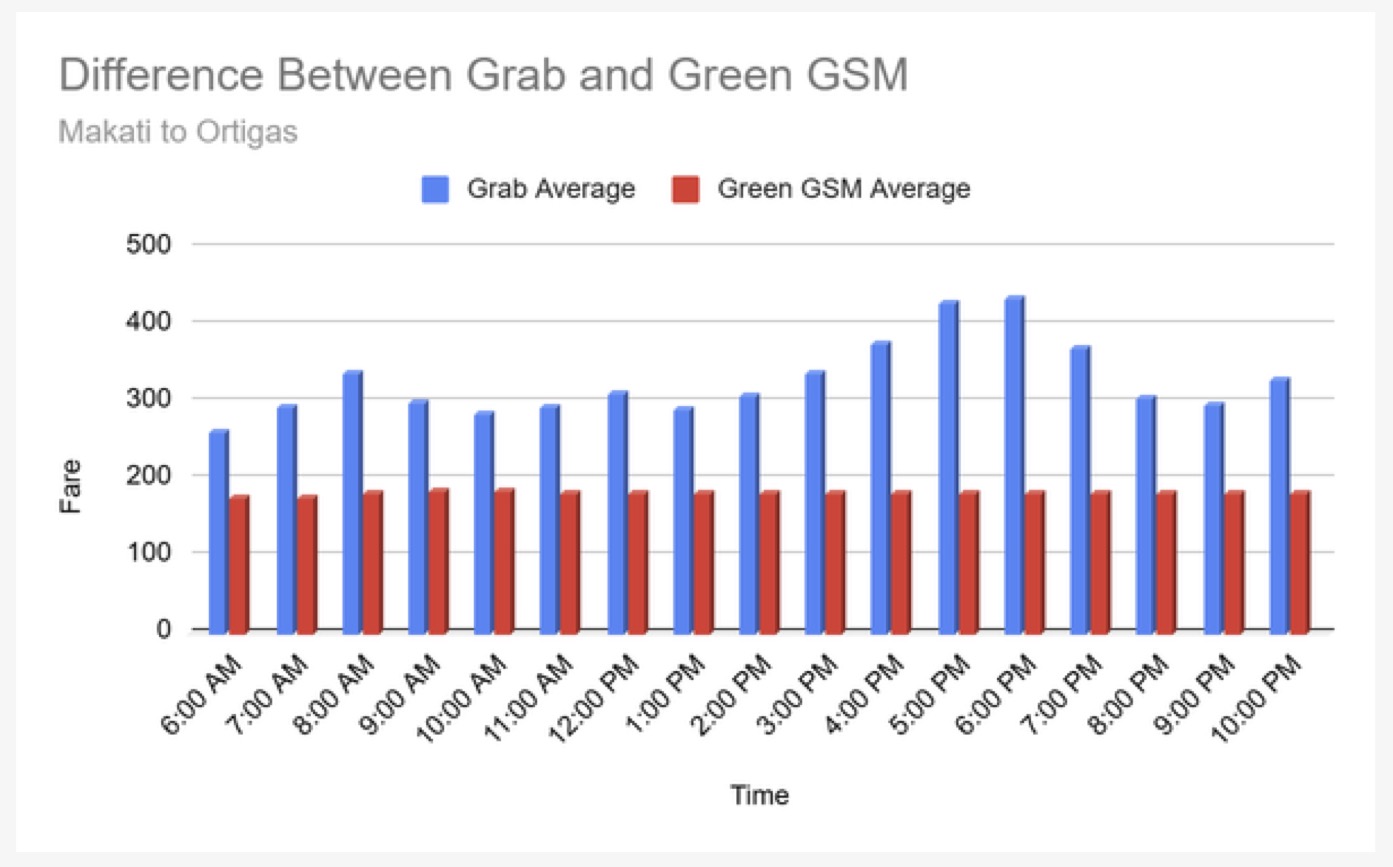 Comparison of average fares of Grab Cars and Green GSM Taxis between 6:00AM and 10:00PM from Makati CBD to Ortigas CBD. (Source: ongoing research at UP, unpublished)
 Comparison of average fares of Grab Cars and Green GSM Taxis between 6:00AM and 10:00PM from Makati CBD to Bonifacio Global City (BGC). (Source: ongoing research at UP, unpublished)
My colleague and I were on one of these taxis recently and we interviewed the driver. We learned that the company covers their charging expenses so they basically don’t worry about that cost. They also can take home their vehicles so that probably reduces garage concerns. But what caught our attention is that they also receive a regular salary and benefits due employees. On top of this are incentives based on how much they earn per day. I am curious about the business model for this company and if it is replicable for both electric and conventional taxis.
More on these electric taxis in future posts!
–
Some thoughts on PUV modernization in the context of the energy crisis
One can help but recall a lot of things past during slow days like those on Holy Week. I was able to write about memories of spending the Holy Week in Iloilo during my younger days. I myself spent most of my Holy Weeks there until after College. My annual “recharging” was only interrupted when I was abroad for three years in the late 1990s. I don’t recall now the last time I was there for Holy Week but perhaps it was after I got married more than 20 years ago. The recollection this week was not only about the sentimental stuff of my childhood and teen days. I couldn’t help but recall some of the work we did many years ago on trying to modernize public utility vehicles, particularly jeepneys.
I was involved in some DOTC (what the DOTr was then) programs and projects about 15 years ago where we sought to replace the old conventional jeepney engines with newer models. This was to reduce emissions and improve fuel efficiency. Electric jeepneys then were still crude in terms of motors and batteries though the body designs were patterned after the conventional jeepneys. They were not as viable as the current models available now. There were also few designs of modern jitneys or minibuses at the time. And jeepney operators and drivers groups indicated their receptiveness to engine replacement. So it was logical to consider engine replacement at the time. Unfortunately, some groups strongly opposed this leaving nothing accomplished from the time.
Fast forward to the present and now, it seems it was correct to at least propose engine replacement at the time. Jeepney engines could have been more fuel efficient aside from having less emissions. Of course, it is now moot and academic and the current crisis might just result in jeepney operators and drivers giving up on their pasada. There is the opinion that jeepneys have been coddled and romanticized for quite some time now (since the 1970s?). It is perhaps time to phase out old vehicles in favor of modern ones. A message to progressive groups though: let’s learn from the lessons of this energy crisis and help with pushing for modernization of road-based public transport. If its the prices of the new models that pose as barriers then lets find ways for more acceptable and affordable financing schemes. Should there be a variant of service contracting by national and/or local government? Find solutions rather than find ways to inhibit or prevent modernization. Throwing obstacles has cost commuters a lot in terms of time and money. Commuters deserve a more modern and efficient transportation system.
 Modern jitney in Cebu
–
 Caught (up) in traffic