
On affordable and inclusive mobility in the Philippines
Here’s a quick share of an article from the Institute for Climate and Sustainable Cities (ICSC) about affordable and inclusive mobility. The observations and conclusions are actually familiar because these have been articulated before when the topics were brought up in the context of environmentally sustainable transport (EST).
–
E-vehicles? Sana all!
The current energy crisis was brought about by the US waging a war against Iran, resulting in the closure of the Strait of Hormuz. Since much of the Philippines fuels come from the region and given the country’s dependence on oil from the Middle East, the limited supply led to steep increases in the price of fuels. One reaction to this was people suddenly purchasing hybrid and electric vehicles to replace their fossil fuel-powered vehicles, or as another vehicle in their garages. Sales of hybrid and electric vehicles surged the past weeks. However, this reaction among private vehicle owners only showed the disparity among people who struggled to find ways to commute mainly via public transportation or their only vehicle and those who can afford to own several vehicles.
One colleague joked that if you want to see what electric and hybrid models are available across various vehicle types (e.g., cars, SUVs, vans, etc.), you only need to travel along Katipunan. There you will see all types of hybrid and electric vehicles including the most popular ones to the more recent models. Many are SUVs and then there are the luxury brands somewhat being paraded by those who opt for them instead of the Chinese brands. Should we be happy for them? Maybe. Should we be envious? Maybe not. The standard defense for these purchases usually runs along the lines of the owners spending their hard-earned money. So let’s leave it at that. Let those who can afford to buy new vehicles do so if that’s their way of coping with the crisis. Meanwhile, we should lobby for better public transportation services and active transport facilities so the majority of people who need to travel can do so without having to buy their own vehicles.
–
Another ‘a bridge too far’?
Earlier this month, I was reminiscing about a trip I made before the pandemic. I was in the Netherlands during one Holy Week to participate in the final defense of a PhD dissertation. I was the external panelist and was invited to be there in person. This was prior to the pandemic and the preference for online participation. I took advantage of the travel to make a side trip to a few locations I previously only watched onscreen. Several bridges there were subject of a World War II film, “A Bridge Too Far.” This was about the bridges the allies attempted to capture during Operation Market Garden. The term “a bridge too far” is now used to refer to the folly of going beyond what can really be achieved. It can also be used to refer to something (including bridges) that one sought to build or create but is just not called for or required.
I wrote in the past about projects that are nice to have but are not necessary or priority. These included bridge projects that are supposed to connect major islands in the Philippines. Given the limited resources we have and the long list of infrastructure projects that need to be prioritized, these shouldn’t be on top of a city’s or province’s list over projects like transit systems, affordable housing closer to workplaces and schools, and schools. And even if we did commit to bridges, it doesn’t make sense to build them where they are likely to cause more damage than benefits. One such bridge that is now in the pipeline and currently making the rounds of social media pages is the proposed bridge connecting Boracay Island to Panay Island. It simply doesn’t make sense to make a tourist attraction like Boracay more accessible to even more people. The island already exceeded its environmental carrying capacity many years ago and more people via this bridge will definitely be disastrous to its ecosystem aside from the social and economic impacts of the bridge.
I googled the land areas of three islands where bridges are proposed for construction. Here are the results:
“Guimaras is the largest of the three at roughly 611.87 square kilometers, followed by the Garden City of Samal at 301.35 square kilometers and Boracay, which is the smallest at only around 10.32 square kilometers. Guimaras is a province, Samal is a component city, and Boracay is a tiny tourism-focused island.”
While it might make sense for such bridges to be built to connect Iloilo with Guimaras and Davao with Samal Island, it doesn’t make sense for Boracay’s case. Guimaras and Samal will be better served by the bridges across many aspects of their being local government units and not just a tourist attraction. Guimaras’ mangoes, for example, can be transported more efficiently to Iloilo where a world class port can transport the fruits in bulk to destinations where they are in demand. The bridge will also ultimately link the island province to Iloilo’s airport. Both Guimaras and Samal have nice beaches and resorts but they are not the only attractions or activities of these islands. Granted that boatmen and maritime transport between the islands will be affected by the bridges, the impacts can probably be alleviated by a shift in their livelihoods (of course, with the assistance of government and partners). The perception is that Guimaras and Samal stand to gain more in terms of benefits while Boracay will deteriorate should it become so easily accessible.
–
Article share: Why Complete Streets Design Benefits Everyone
Here is another quick share of an article; this time on Complete Streets. I guess many are aware of the AI-generated street transformations that are now being shared across many social media platforms. These show street transformations of many sections and intersections.
Source: Why Complete Streets Design Benefits Everyone
Again, it is important to have context sensitive solutions. This extends to street transformations. Some may look cool (AI tools have enabled non-architects, non-engineers, etc. to produce nice renderings) but should be tempered for the street or highway functions as well as the actual volume of people and vehicles running along these.
–
Article share – My provocative proposal: Want a roadway safety movement? Ditch the engineers.
Here’s a quick share of an article on who should be involved in road safety:
Source: My provocative proposal: Want a roadway safety movement? Ditch the engineers.
The future of taxis in the Philippines?
In recent weeks, the energy crisis has brought to the forefront the use of electric and hybrid vehicles among private car users. You see a lot of new electric and hybrid vehicles as I assume sales have risen. “Sana all!” as they say as not everyone have the resources to purchase a new vehicle. There is an option, however, for those who might prefer their own transport (private) or are regular users of Transportation Network Vehicle Service (TNVS) as rideshares have been termed for some time now. Take the taxi. While there are still the conventional taxis, there are now also electric vehicle taxis. Leading the way for the electrification of taxis is the upstart Green GSM, which is a Vietnamese company using Vinfast electric cars that are also manufactured in Vietnam.
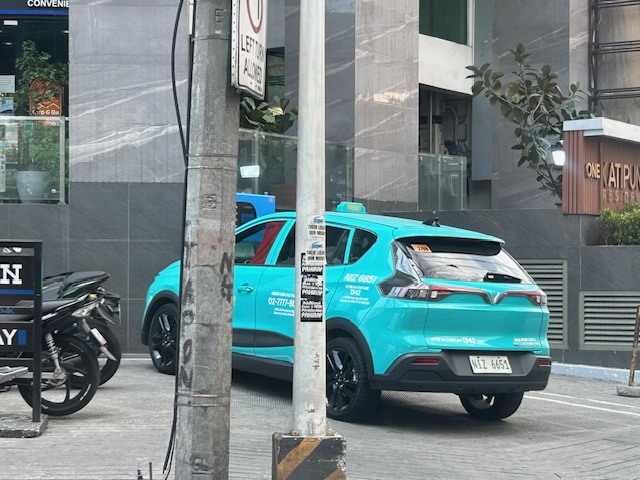 Electric taxi charging at a station at a residential building along Katipunan Avenue in Quezon City
Here are some preliminary data from an ongoing study at UP Diliman, comparing fares of Grab and Green GSM. The values shown are averages based on several simulated bookings for either for the same origin-destination. The peaks for Grab probably indicate the times when there are surge pricing for trips (i.e., peak periods).
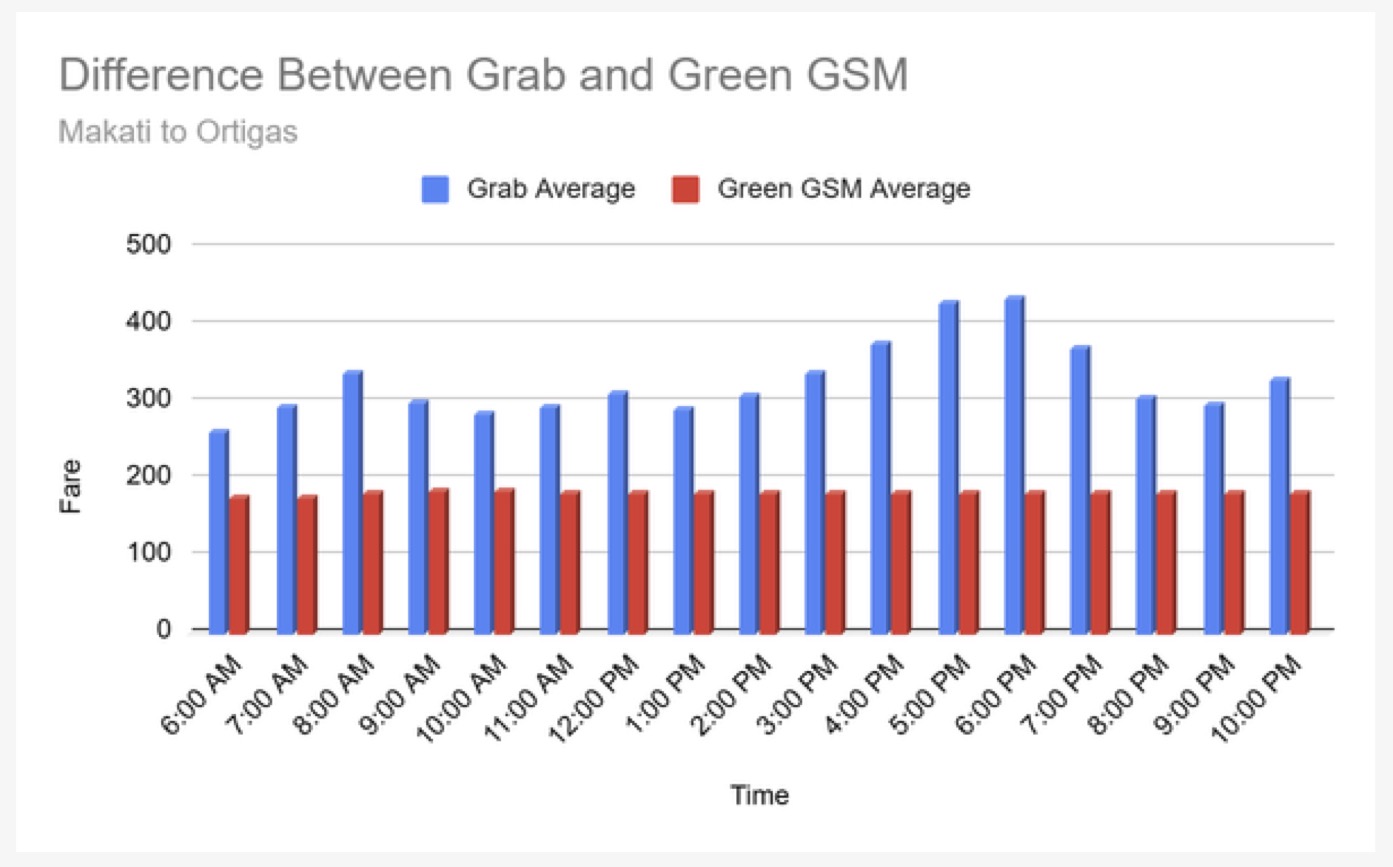 Comparison of average fares of Grab Cars and Green GSM Taxis between 6:00AM and 10:00PM from Makati CBD to Ortigas CBD. (Source: ongoing research at UP, unpublished)
 Comparison of average fares of Grab Cars and Green GSM Taxis between 6:00AM and 10:00PM from Makati CBD to Bonifacio Global City (BGC). (Source: ongoing research at UP, unpublished)
My colleague and I were on one of these taxis recently and we interviewed the driver. We learned that the company covers their charging expenses so they basically don’t worry about that cost. They also can take home their vehicles so that probably reduces garage concerns. But what caught our attention is that they also receive a regular salary and benefits due employees. On top of this are incentives based on how much they earn per day. I am curious about the business model for this company and if it is replicable for both electric and conventional taxis.
More on these electric taxis in future posts!
–
Some thoughts on PUV modernization in the context of the energy crisis
One can help but recall a lot of things past during slow days like those on Holy Week. I was able to write about memories of spending the Holy Week in Iloilo during my younger days. I myself spent most of my Holy Weeks there until after College. My annual “recharging” was only interrupted when I was abroad for three years in the late 1990s. I don’t recall now the last time I was there for Holy Week but perhaps it was after I got married more than 20 years ago. The recollection this week was not only about the sentimental stuff of my childhood and teen days. I couldn’t help but recall some of the work we did many years ago on trying to modernize public utility vehicles, particularly jeepneys.
I was involved in some DOTC (what the DOTr was then) programs and projects about 15 years ago where we sought to replace the old conventional jeepney engines with newer models. This was to reduce emissions and improve fuel efficiency. Electric jeepneys then were still crude in terms of motors and batteries though the body designs were patterned after the conventional jeepneys. They were not as viable as the current models available now. There were also few designs of modern jitneys or minibuses at the time. And jeepney operators and drivers groups indicated their receptiveness to engine replacement. So it was logical to consider engine replacement at the time. Unfortunately, some groups strongly opposed this leaving nothing accomplished from the time.
Fast forward to the present and now, it seems it was correct to at least propose engine replacement at the time. Jeepney engines could have been more fuel efficient aside from having less emissions. Of course, it is now moot and academic and the current crisis might just result in jeepney operators and drivers giving up on their pasada. There is the opinion that jeepneys have been coddled and romanticized for quite some time now (since the 1970s?). It is perhaps time to phase out old vehicles in favor of modern ones. A message to progressive groups though: let’s learn from the lessons of this energy crisis and help with pushing for modernization of road-based public transport. If its the prices of the new models that pose as barriers then lets find ways for more acceptable and affordable financing schemes. Should there be a variant of service contracting by national and/or local government? Find solutions rather than find ways to inhibit or prevent modernization. Throwing obstacles has cost commuters a lot in terms of time and money. Commuters deserve a more modern and efficient transportation system.
 Modern jitney in Cebu
–

