
Metro Manila public transport – addition is good but we need subtraction, too
The company providing the P2P bus services is very enthusiastic (aggressive?) in promoting their services especially via social media. Satisfied commuters have also shared their experiences and a lot of photos about the buses and their commutes through social and mainstream media. I have read some articles carried by the likes of Rappler and Inquirer as well as blogs relating about the buses features, what people liked about the service and their suggestions on how to further improve and expand services. These have provided commuters with a taste of how good public transport could be in terms of quality of service.
The operations and the operator seems to have the blessings of the Department of Transportation (DoTr) and not just the present administration but from the previous one when the P2P services started. The fact that they have expanded services further these past few months is a testament to their popularity and the demand for high quality public transport services in Metro Manila. I personally believe that the next step is to give these buses exclusive lanes along their routes. Such would allow for buses to travel faster and providing a significant decrease in the travel times of commuters. Current operations, despite having non-stop runs between origin and destination, run in mixed traffic so their impacts in terms of travel times are diminished. Also, with exclusive lanes, they can probably consider adding a few stops between the route ends and be able to simulate bus rapid transit (BRT) services of which there seems to be little appreciation so far in the Philippines.
While the new buses and routes are very welcome and provide attractive options for commuting, there is still a need to address what is perceived as an over-supply of buses, jeepneys and UV express vehicles in Metro Manila. The attractiveness and higher service quality of P2P buses can pave the way for reducing the numbers of buses, for example, along EDSA. A similar strategy of introducing high quality bus services along other corridors and then reducing bus, jeepney and UV express units there can be implemented but will require much in terms of political will. The latter is important when dealing with operators and drivers of displaced vehicles, who may oppose such transport reforms and probably throw in legal impediments including those pertaining to franchising. Whether such opposition can be addressed by emergency powers or not remains to be seen but hopefully, even without such powers, the government can engage the transport sector to effect reforms and improve public transport (and ultimately commuting in general) not just in Metro Manila but in other cities as well.
–
Oversupply of vehicles for ride-sharing/car-sharing – Part 1
My students recently concluded studies on popular ridesharing/carsharing services Uber and Grab. The studies details how, for example, people have come to prefer Grab Taxi, Grab Car and Uber over regular taxis. One important finding and conclusion in one study is that Uber and Grab in the Philippines cannot be considered as contributing to sustainable transport. Note that this conclusion is just for the Philippine case and perhaps can be further constrained to Metro Manila since all data collected was with the geographical bounds of the metropolis.
There is already a perception that there is an oversupply of vehicles being used for what is being claimed as ride-sharing or car-sharing. This is due to the surge in new vehicle purchases as people joined the Grab/Uber bandwagon. Who can resist the opportunity to earn good money from being a Grab or Uber driver? That is basically the question answered by a lot of people who decided to purchase cars and register these and themselves for Grab or Uber.
To see if there is some truth to this perception of oversupply, we use one ride-sharing app for the information it provides users. One can make a quick check of how many Grab vehicles are moving about and ‘looking’ or waiting for riders/passengers. Following are what’s displayed on my phone in three random instances last Tuesday for GrabCar. I leave it up to the reader to draw conclusions from these screenshots.

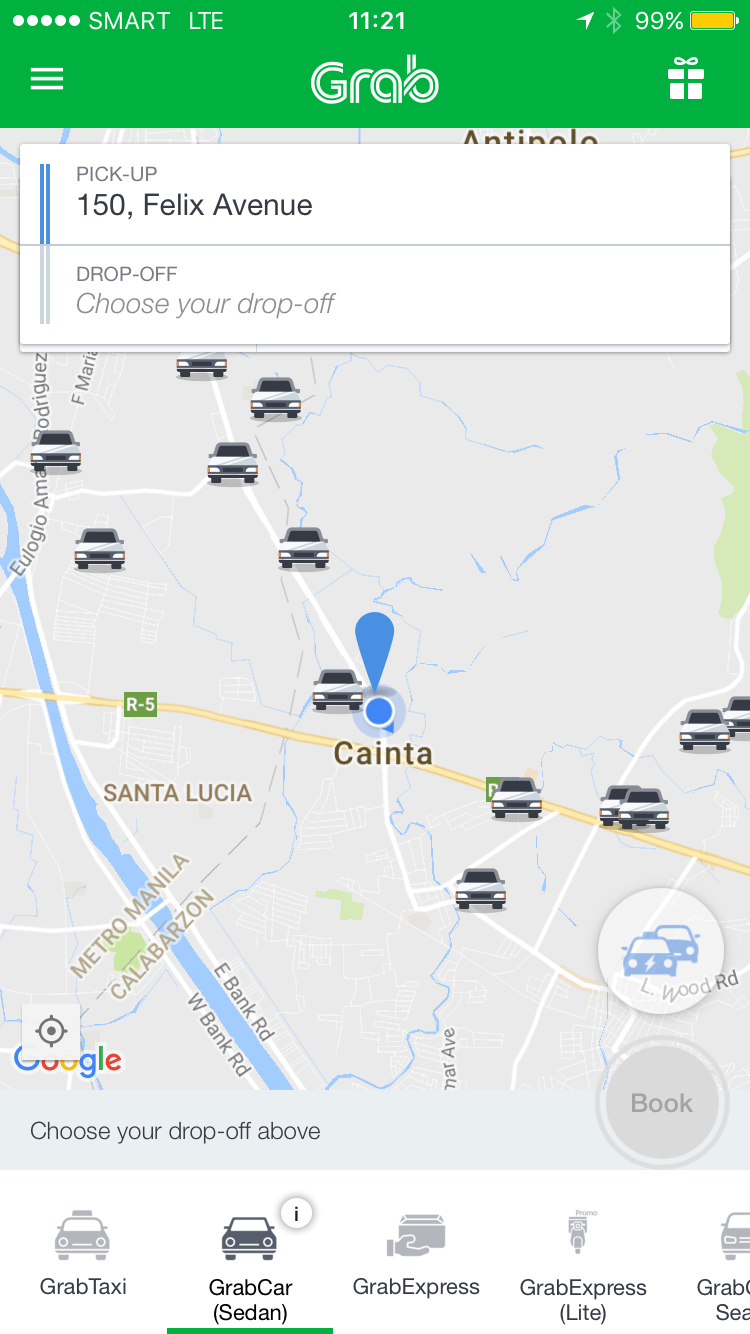
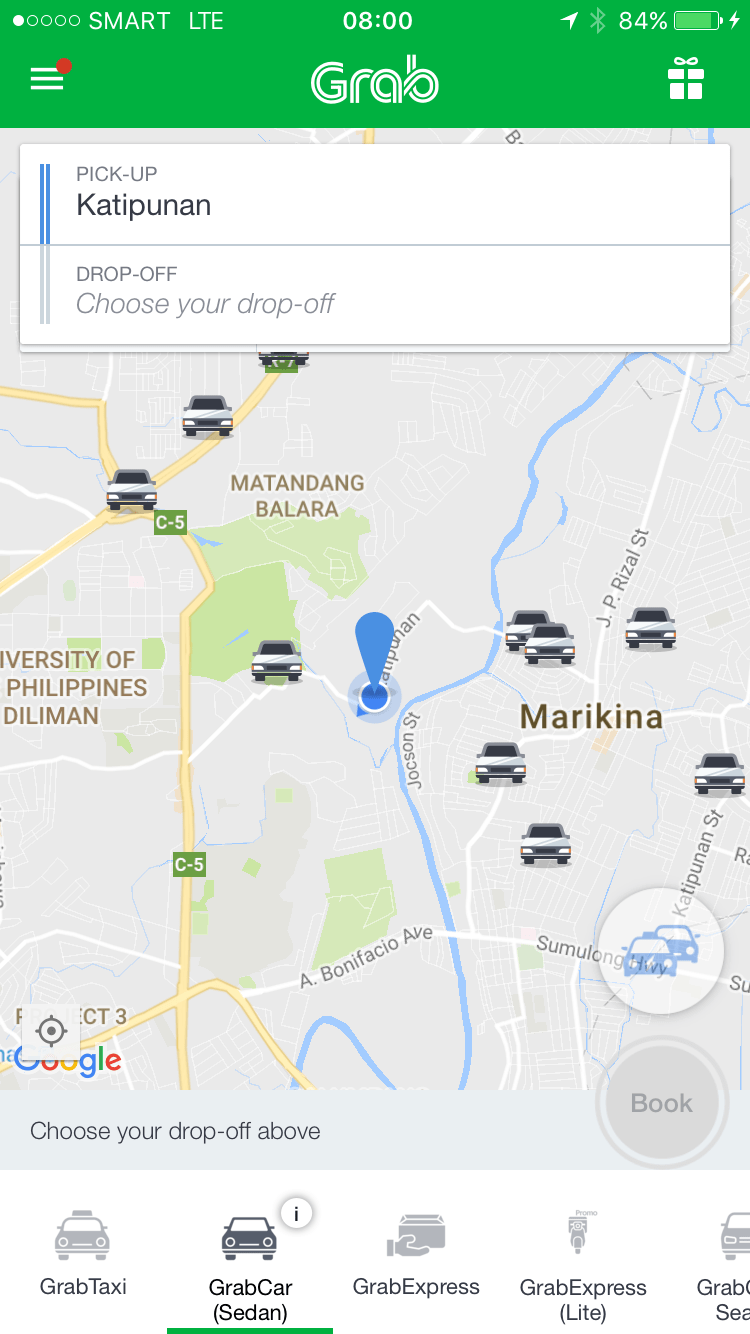
More in Part 2…
–
Of accomplishments and legacies in transport
My colleagues and I have been talking about accomplishments and legacies. In particular, we had a spirited discussion about what we have been doing in terms of transportation projects that we have been involved in. I think everyone wants to have something physical to remember them by. And these should be positive and constructive and not memories of controversies or anomalies like those in major projects that will be associated with corruption or abnormalities in the processes by which the projects were implemented.
The ‘problem’ with being involved in policy making and planning is that these often lead to outputs such as reports and maybe even laws. If one is lucky enough then perhaps its in the form of a legislation rather than a Department Order. But those legislations and memos often do not acknowledge the people who contributed to its drafting. They will be associated with the politicians (e.g., senators and congressmen) and officials (e.g., secretaries, undersecretaries) who sponsored, co-sponsored or issued them. It will be good to have some sort of evidence to show and prove that you were instrumental in planning, designing and/or implementing a project.
The appointment of a new Department of Transportation (DoTr) Secretary in Art Tugade had me recalling our meeting with him to present the outcomes of our study on a major commercial development at Clark Freeport. He was appreciative of our work and mentioned that Clark had implemented many of the recommendations of the Master Plan we had developed for the Freeport back in 2010. All the major recommendations were implemented during Tugade’s watch at Clark. Following are the most notable ones:
 The Mabalacat Gate and Public Transport Terminal of the Clark Free Port Zone
 McArthur Highway – M.A. Roxas Highway – First Street rotunda
 Clark Freeport main gate
The lead for these projects was Dr. Ricardo Sigua who is the one of the leading transportation engineers in the Philippines and currently the Director of the Institute of Civil Engineering of the University of the Philippines Diliman. He is also the head of the Road Safety Research Laboratory of the National Center for Transportation Studies where he is also a Research and Extension Fellow. Others involved in these projects were Dr. Karl Vergel, Dr. Noriel Christopher Tiglao and Dr. Jose Regin Regidor, all from UP Diliman and affiliated with the NCTS.
–
Sparing the trees
The Department of Public Works and Highways (DPWH) embarked on a major road widening project in the last administration. This continues today. One of the issues raised then was the cutting down of many trees along the roadside to give way to one additional lane along each direction of national roads. While conservationists and environmentalists were not successful in provinces like Tarlac where old camachile trees were cut down, the case in Pangasinan seems a bit more positive. Traffic along rural highways such as the Urdaneta-Calasiao-Dagupan Road can become heavy but not so much so that it requires two additional lanes to the original two. As such, while the shoulders can be paved as part of the lane widening program of the DPWH, the trees can actually be spared. I think the DPWH and the LGUs would just need to mark the trees to make them very visible at night time or when visibility is low along the highway.
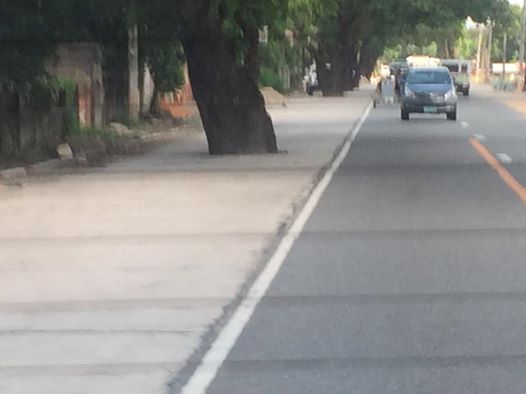 Big old trees, mostly mango trees line up the Urdaneta-Calasiao-Dagupan Highway along the newly paved lane that used to be a shoulder of this highway. These huge trees are fruit bearing and so one can imagine that part of the loss if these were to be cut down were the tons of mangoes that many people could benefit from.
 Sections of the additional lanes are generally not usable for general traffic and revert to their previous use as parking spaces. These paved sections now also are useful as ‘solar driers’. Shown in the photo above is an example where grains of rice (palay) are laid out direct on the concrete pavement for natural drying under the sun. People (staff of the owners) guard these against animals, wayward motorists and possibly thieves. These staff will gather the grains when there is impending rains or when the day’s almost over to dry another day.
I wanted to take more photos of the highway but was seated at the back of our van so I had to settle for a few select shots. The second photo above is care of a colleague who sat in front and took a few shots himself.
–
Data on local roads – digital maps
Here’s another quick reference to an article describing a current undertaking to map the 45,000+ kilometers Philippine road network:
PH undertaking $5M digital mapping of 45,000-km road network
What’s significant with this development is that soon the country will have excellent maps, including 3D and 360-degree views of most if not all local roads. While there are similar maps via Open Street Maps and Google Maps, the latter are not as comprehensive. These maps will be very useful for a lot of applications including transport planning, urban and regional planning, and disaster mitigation. A lot of people are surely looking forward to the completion of this project as well as when the maps can be accessed and used.
–
Extreme commutes on a jeepney
I chanced upon this overloaded jeepney along Sumulong Highway. I counted eight people hanging behind the vehicle including the conductor. This is actually illegal and not just at present but always. The practice of hanging behind a jeepney is obviously unsafe and there is a high risk of people falling off. It would be a miracle not to have major injuries if one falls from the vehicle, and there is a high likelihood of fatality especially of a falling passenger gets hit by another vehicle trailing the jeepney.

‘Sabit’ or hanging on for a jeepney ride is more a necessity and males usually do this in order to get a ride home or to work. On many occasions, you will see men or boys in their office or school uniforms in the morning, braving it just so they won’t be late for work of school. While it is illegal, authorities seem to apprehend overloaded jeepneys from time to time (or according to some, just for show). I guess they, too, understand how difficult it is to get a ride and how this somehow allows people to get to their destinations. Surprisingly and despite reckless behavior among drivers, there seem to be few untoward incidents reported. Hopefully, public transport will improve so that people will not have to do such extreme commuting.
–
10 principles for sustainable urban transport
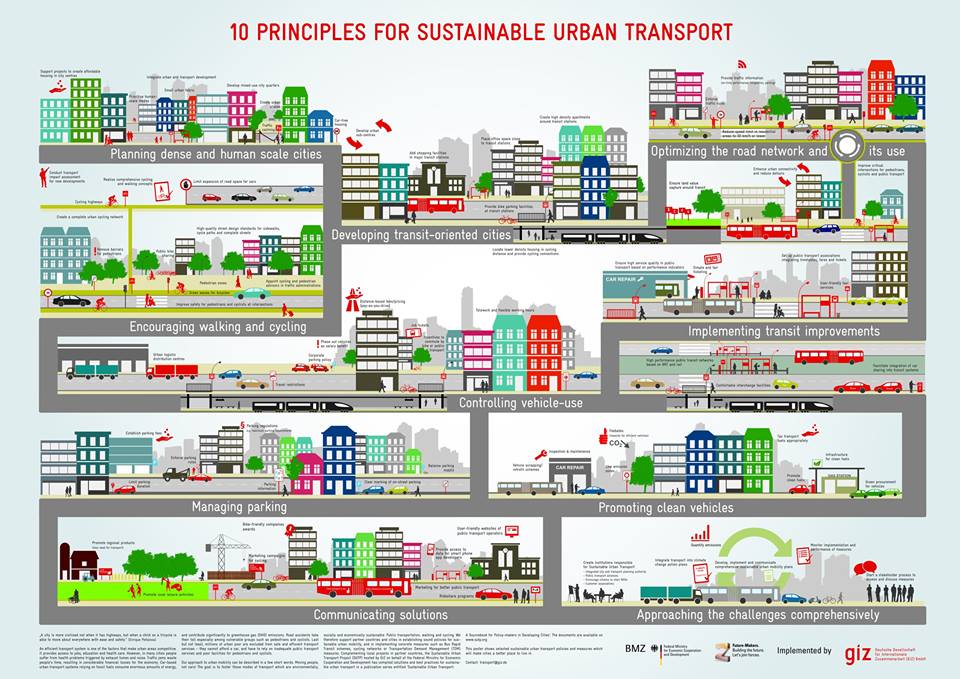
We start October with a graphic on sustainable transport. I first saw this shared on social media (FB) by the Clean Air Asia. The organizations behind it are on the graphic itself so I don’t have to list them down for the reader. This is a good material to share and learn from especially for those who don’t have a clear idea of what sustainable transport is and is all about. As they say, pictures paint a thousand words. And illustrations such as this convey so much about sustainable transport in the urban setting in layman’s terms.
–
Research topics for transportation engineering and planning for 2016-2017?
I observed from my site’s statistics that there have been a lot of interest on research topics in transportation engineering and planning. I regularly post on the undergraduate research topics our students have engaged in. At this point in the first semester of the current 2016-2017 academic year, topics have not yet been assigned and we have only learned how many students have been assigned to our research group. As such, we are still in the process of determining who takes on which topic. Following are topics we have identified in addition to those that had no takers the previous semesters:
Traffic engineering
- Anatomy of congestion along EDSA
- Anatomy of congestion along C-5
- Segregated lane for motorcycles
- Impacts of the MMDA’s truck lane policy along C-5
- Congestion study in the vicinity of UP Town Center
- Assessment of through traffic for the UP Diliman campus
Public transportation
- Connectivity study for UP AGT and MRT 7
- Feasibility of bus services beyond Masinag junction
- Characterization of Internal Public Transportation Operation in UP Diliman and Viability of Introduction of Electric Vehicles
- Modelling the Public Transport System of UP Diliman Campus Using CUBE Travel Demand Software
- Estimation of Passenger Demand for New Transit System for UP Diliman Using Discrete Choice Model
- Characteristics of motorcycle taxis in the Philippines [Habal-habal, skylab, etc.]
Road safety
- Severity of injuries of motorcycle riders (helmet and non-helmet users)
Pedestrian & non-motorised transport
- A study on walkability along Ortigas Avenue
- A study on the characteristics of bike share users in the UP Diliman campus
Transport & Environment
- Assessment of Roadside Air Quality along C.P. Garcia Avenue in the Vicinity of UP-ICE Compound
Other topics
- Study on the mobility of PWDs in Metro Manila
- Assessment of ridesharing in the context of sustainable transport
I’m sure there are other topics but I’m not aware of the specifics at present. Also, we welcome the ideas of our students should they already have topics in mind as long as these preferably fall under the research agenda of our Institute. The topics listed above may appear to be specific but these are still basically very general and can be refined after the students establish their scope and limitations. They can only do that once they have undertaken a decent enough literature review for them also to have a more firm appreciation of their chosen topics. I will post again on this later this year when students would have already put in substantial work on their research proposals (i.e., the objective for this semester).
–
Landslide in Antipolo
What’s been causing some traffic congestion along Ortigas Ave. Extension is the collapse of a side of the mountain at a section just before the Antipolo City arch (if you’re coming from Tikling Junction). The soil probably was already saturated after the past few days heavy rain and it didn’t help that the old wall holding the soil and consisting mainly of blocks was also already weakened (I am assuming that it was built following standards for such walls.).
 The area had been partially cleared of soil and rock, which initially blocked 2 lanes of the 4-lane road. Kudos to the DPWH for their work clearing part of the debris and easing traffic along this busy thoroughfare.
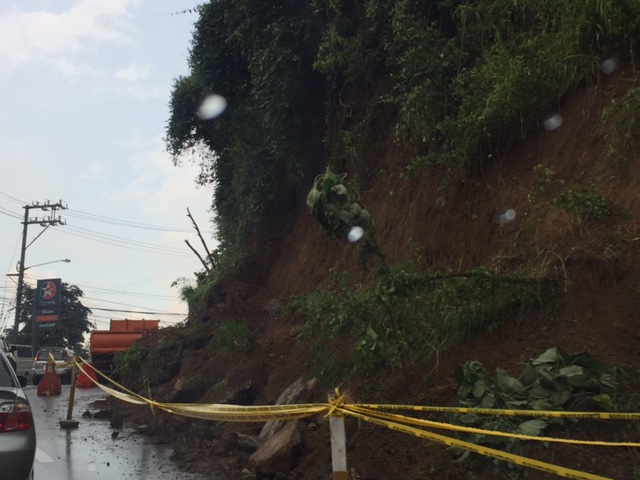 The wall at this section was completely obliterated revealing soil that appeared to be already unstable.
Hopefully, funds can be allocated very quickly in order to build the necessary slope protection. Perhaps the barrier should be designed to allow for more water to seep through without compromising the structure. Such weep holes are necessary especially given the saturated soils due to heavy rainfall experienced during this wet season and others in the future.
–
On BRT being a game changer for Philippine cities
There’s a nice interview about transport on ANC’s early morning program. The topic is bus rapid transit (BRT) and the interviewee is a colleague of mine at the University of the Philippines. Dr. Cresencio M. Montalbo, Jr. is actually a faculty member of the School of Urban and Regional Planning (SURP) and a Fellow at the National Center for Transportation Studies (NCTS). Here’s the link to the interview:
Will bus rapid transit (BRT) remove bias against public transport?
–
 Caught (up) in traffic