
Licensed to Drive?
One recommendation often made in light of the increasing frequency of road crashes is on the review of the licensing system of drivers in this country. It may sound like a broken record but there are again calls for a review and even overhaul of a licensing system that appears to be insufficient in ensuring that drivers have an orientation towards road safety. Any person observing traffic along Philippine roads will easily come to the conclusion that most drivers are undisciplined and are not knowledgeable of even basic traffic rules and regulations.
Public utility vehicle drivers, in particular, can be seen speeding and making risky maneuvers, their drivers not seeming to care at all that they are responsible for the safety of their passengers. Truck drivers change lanes as if they are using compact cars. Motorcyclists seem to be oblivious that they are also covered by the same traffic rules and regulations governing all other road users. This is not to say that private car drivers do not have the propensity for aggressive or risky driving. In fact, we have the tendency to put much of the blame on PUV and truck drivers for dangerous situations in traffic when private car drivers are also highly likely to cause road crashes. Truly, it is one thing to know how to operate a vehicle and another to know how to drive one.
In the Philippines, a lot of people learn to operate a vehicle but even after several years, still do not know how to drive. This is a result of how these people learned to operate vehicles; a method that is often referred to by its sole requirement – lakas ng loob. Learning to drive via established schools or academies, after all, is not required as a prerequisite to qualifying for a license. One can take the written examination Practical examinations are virtually inexistent and unlike the ones conducted in countries with strict licensing systems. When I took my examinations for my license, I was surprised to learn that the only distinction between the practical tests for non-professional and professional licenses was that you get to drive a dilapidated truck forward then backward for the professional license. That was more than 15 years ago and at the central office of the licensing agency. This experience has always reminded me of how easy it was for one to get a professional driver’s license.
Perhaps there is a need to revisit how we grant drivers’ licenses in this country. There are many examples of good practices in other countries that it begs the question why we haven’t followed their lead. The Singapore Safety Driving Center offers at least twelve courses for different types of drivers including those for heavy vehicles, buses, taxis, motorcycles and motor vehicles. Such is required since each type of vehicle would require different skills. People wanting to become bus drivers in that country must secure a vocational license. Prospective truck drivers have a stricter regimen for training and an even stricter set of requirements in terms of experience.
In Japan, one is required to learn driving through a formal school. Schools have their own driving facilities where skills are taught and students are able to practice various maneuvers before they are even allowed to drive in actual traffic. New drivers are even required to attach a sticker (0ne that looks like a leaf) to their cars so that other drivers may be made aware of the former’s presence.
In the US and Canada, theoretical tests are computerized and questions are selected in random by a computer. This ensures that the people taking the exams will be tested for their knowledge of traffic rules and regulations, including signs that are often regarded as mere suggestions in the Philippines if not neglected outright by many who claim to be drivers. Practical tests are also conducted in a strict manner and the exam is designed to challenge one’s skills given different situations including what to do when changing lanes, making a turn and approaching an intersection. There is also the dreaded parallel parking maneuver that is a required skill for anyone intending to use roadside parking spaces.
It is not difficult to see that a review of our licensing system is long past due. Examples in other countries may serve as models for coming up with a system that will encourage safe driving and weed out those who are not qualified to drive. True, these countries especially the US have their own problems concerning road safety. However, we must realize that these are countries with good licensing systems – systems that were designed to at least minimize the likelihood of having people not unsuitable for driving being granted licenses and the responsibility of having in their hands the lives of other people. Such systems are not perfect but what system is? Human and other factors are also in the mix but then these results in what can rightfully be called “accidents,” incidents that could not be prevented let alone be predicted. In the Philippines, we cannot even categorize crashes as accidents because most are preventable and predictable, the latter being a result of the way people drive their vehicle in our streets and highways.
A quick rundown of recommendations include (but are not limited to) the following:
- The professional driver’s license should have at least 4 categories in the Philippines: (a) Basic – for drivers of taxis, rental cars and companies (limited to light vehicles including vans); (b) Intermediate – for drivers of jeepneys, AUVs/FX; (c) Advanced – for drivers of mini-buses, buses (including company shuttles and tourist buses); and (d) Heavy vehicles – for drivers of trucks of different types (incidentally, there could be a stricter rule for those driving articulated vehicles). Intermediate drivers may handle taxis and company cars and Advanced drivers may handle vehicles covered by Basic and Intermediate licenses. However, Heavy vehicle licenses are specifically for truck drivers and do not include passenger utility vehicles. All licenses mentioned allows the driver to handle private cars such as their own.
- Current drivers of PUVs and trucks should be required to undergo theoretical and practical examinations within a grace period (say 2 years) set by the LTO. Practical examinations should be able to simulate actual situations on the road. Failure in any or both examinations will require re-training of the person as a prerequisite for a second and last chance to pass the examinations.
- Theoretical tests must be computerized and questions selected randomly in order to ensure that both examination and the examinees are honest, and results are reliable.
Needless to say, the LTO is required to build capacity for such upgrading of the licensing system. The agency may even want to consider the acquisition of state of the art driving simulators for the practical exams. That way, it may be possible to have a very objective test for persons wanting to acquire a specific license. Expensive? Yes it is, but if that is what it takes to make our roads safe and arrest the rapidly increasing death toll due to road crashes, then it is a necessity. The loss of a life and/or a limb cost much more than a simulator. What more if we are talking about lives and limbs. Investing in road safety through investing in a more rigid licensing system is a necessity that we need not delay in addressing. After all, there is also that observation that the traffic in our streets reflect what we are as a nation. Figure that out!
The pitch for electric public transport
Electric vehicles have been in operation as public transport modes in the Philippines since 2007 when electric three-wheelers were introduced at the Bonifacio Global City in Taguig City, Metro Manila. At the time, the City Government of Taguig bought the pitch by the proponents of the E-Trike and supported their trial operations that have since expanded but are yet to be legitimized due to the vehicles not being registered with the Land Transport Office. These could not “legally” charge their passengers since they also did not have franchises with the Land Transport Franchising and Regulatory Board (LTFRB) nor with the local government (i.e., like conventional tricycles).
 E-trike in Fort Bonifacio
Meanwhile, around the same time, another electric vehicle was introduced in the Visayas. In this case the vehicle was in the form of a national icon – the jeepney. Electric jeepneys were first built out of China and directly imported as a “proof of concept.” What were initially launched in Bacolod and Silay Cities in Negros Occidental were examined by local partners based in Manila, and eventually a locally manufactured E-jeepney came out in 2009, care of the Motor Vehicle Parts Manufacturers Association of the Philippines (MVPMAP) and Motolite with assistance from the Dutch Stichting Doen. The project quickly gained proponents including two very influential mayors and their cities – Binay of Makati and Hagedorn of Puerto Princesa. It is to the credit of the cooperation between the Institute for Climate and Sustainable Cities (iCSC, the original proponents of the E-jeepney) and Makati City that there are currently two E-jeepney lines in that city. But while the vehicles have been registered with the LTO (using the conspicuous orange plates), they have yet to be granted franchises by the LTFRB. The vehicle gained more attention when the newly elected Vice President Binay rode the vehicle to the inauguration. Currently, the E-jeepney is subject to studies at the National Center for Transportation Studies of the University of the Philippines and has gained interest from private firms as well as other researchers. Together, the E-jeepney and the E-trike represent the strongest cases for electric vehicle applications in public transport.
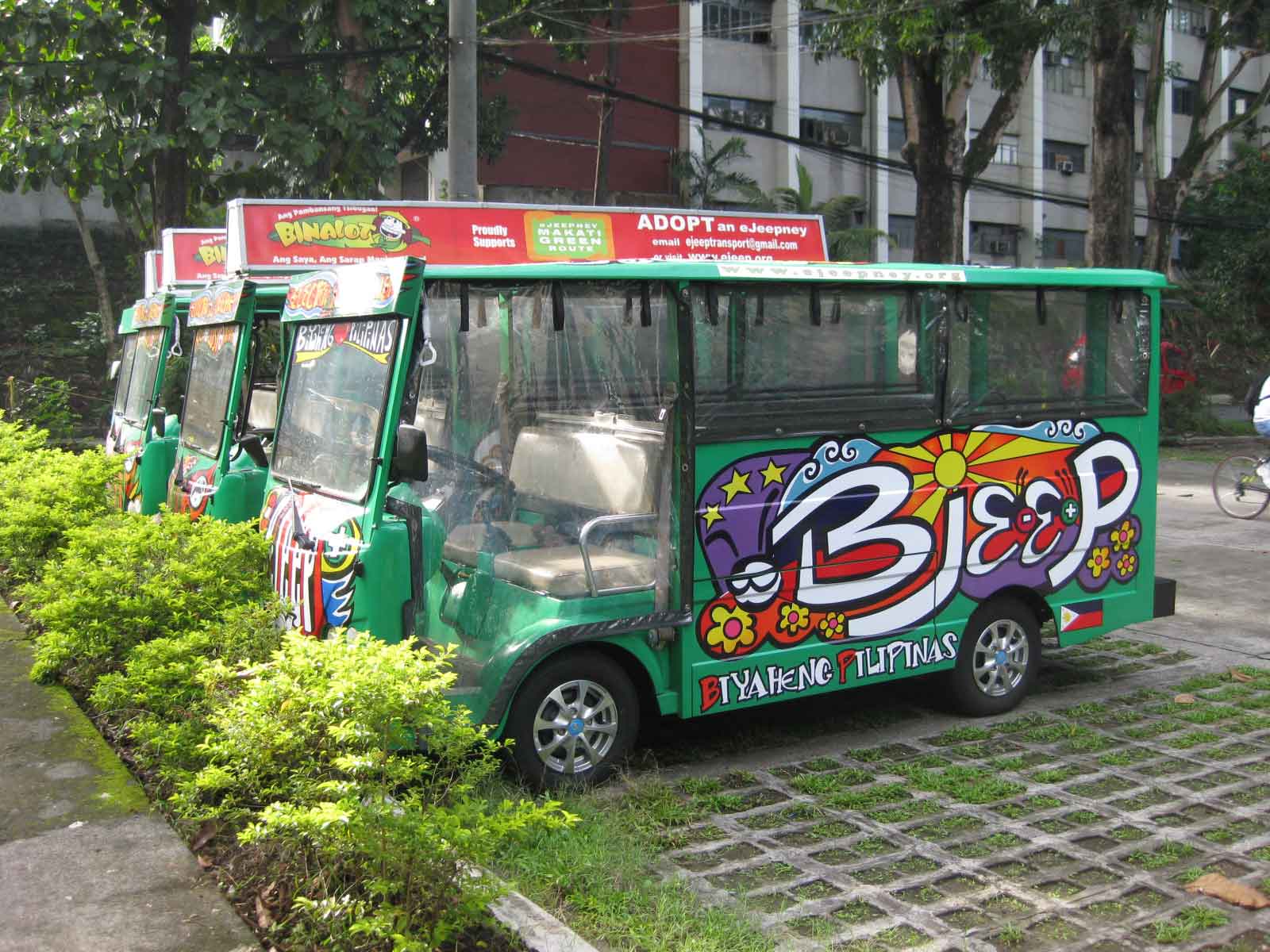 Electric jeepneys parked at UP Diliman – the Bjeep is the one used by Vice President Binay during the inaugurations
I reproduce below a news item from the GMA News website that features an initiative from the ADB that may finally push electric vehicles to gain a significant share of trips across the country:
The Asian Development Bank is offering as much as $280 million in loans for the Philippine government to finance a proposed re-fleeting program for tricycle drivers and operators shifting to electric motorbikes or e-bikes.
“The loan will be coursed through ADB conduit banks like Land Bank of the Philippines for re-lending to tricycle drivers who may want to shift into using e-bikes,” Environment Secretary Ramon Jesus Paje told reporters in a briefing Tuesday.
He said ADB will give 30 e-bikes as donation to city governments in the Metropolis.
“ADB wants to us to sample the bikes to see for ourselves that these machines are totally pollution-free. No emissions, less pollution,” he said.
If all Philippine tricycles are e-bikes, the country can save much as 20 million metric tons of carbon footprints a year.
“We could go into carbon trading. That will earn us dollar equivalent which we can use to offset a portion of the loan,” said Paje.
Tricycle drivers can save up to P300 in daily fuel costs with the use of e-bikes.
“Four hours of charging would only cost P40 compared to P340 for fossil-based fuels. The acquisition cost is about 20 to 30 percent higher than fuel-fired motorcycles but the overhead cost is certainly lower,” Paje said.
Of the total 5 million tricycles in the country, 2.8 million are in Manila.
The department said that the shift to e-bikes would reduce pollution 25 percent to 30 percent in the country’s urban centers by 2011.
As of 2009, the country’s total suspended particulates – a concentration of micro pollutants in the air – in all cities and urban centers is 134 micrograms per normal cubic meters, which is 48 percent beyond the normal standard of 90 micrograms per normal cubic meters.
The major sources of these particulates are diesel vehicles and coal-burning power plants. Dust from unpaved roads and construction activities contribute to the rise in particulates especially during summer months.
Vehicles contribute as much as 80 percent to air pollution, while the remaining 20 percent are from industries.
Department monitoring shows that more than 50 percent of vehicles are registered without prior actual testing by accredited Private Emission Testing Centers.
“If all vehicles are tested for emission prior to registration, the 30 percent reduction in particulates will be easily realized,” Paje said. —With MR Gavin/VS, GMANews.TV
The ADB initiative comes at a critical time when the national government is still finding its way with regards to local public transport modes, particularly how the tricycle has established itself as the primary (sometimes, the only) public transport option in cities and municipalities across the country. It is inevitable that the issue of proliferation and regulation of tricycles will have to be addressed. National and local government would have to discuss the nuances of the Local Government Code in as far as public transport operations, franchising and fare setting are concerned. On top of this, the time is critical also because there is a strong call for environmental sustainability; one that is anchored on the increasing awareness for climate change and its impacts. The long-standing perception is that the conventional tricycles contribute to the continuing degradation of our environment as the collective emissions from these vehicles effectively suffocate our cities, and the key is for local governments to realize this and be a major player in transforming local transport into the environment-friendly kind. It is, after all, in the best interests of their constituents that clean air be pursued to ensure that there will be a bright future for their cities and this country.
Through Traffic – Part 1
As I was reviewing a paper concerning a study on vehicles utilizing residential streets as alternate routes to congested arterials, I couldn’t help but compare the circumstances described by the authors to the current situation at the University of the Philippines Diliman campus. It is a classic case of motorists who, having free access to roads regardless of the nature of the land use, will choose to take this roads in order to bypass what they perceive to be congested roads. The objective is simple, take the route where travel time is significantly less, thereby getting to your destination faster. Such traffic is often termed as through traffic mainly since they do not have any other purpose along the street.
While the paper I was reviewing focused on a single street in a residential district somewhere in Tokyo, the problem in UP Diliman is much more complicated. The UP Diliman campus occupies 493 hectares of prime land in Quezon City, the largest component of Metropolitan Manila. The campus is located between two major thoroughfares – Commonwealth Avenue and C.P. Garcia Avenue (more popularly known by its former name, Katipunan Avenue as well as its designation in the basic circumferential and radial network for Metro Manila, C5). It used to be that campus roads were fair game to general traffic bypassing the traditional connection of Commonwealth and Katipunan at Tandang Sora (where the intersect). The latter being a narrow 2-lane, undivided street often congested because of truck traffic and the operations of tricycles serving the dense residential areas at either side of the road. Many vehicles, particularly private cars because trucks were not allowed to use campus roads, came through the campus via its Main Gate along University Avenue and its other gate along Ylanan Road (along Commonwealth) and exit via gates along Magsaysay Avenue (Asian Center), Schuster Street (Narra Residence Hall), or Velasquez Street (NIGS), and vice versa.
Due to the increasing volume of through traffic, the University agreed to grant right-of-way to what was to become C.P. Garcia Avenue (later downgraded by the MMDA to C.P. Garcia Street), which practically separated the academic areas from the residential areas located in the south portion of the property. Traffic has since shifted significantly from campus roads to C.P. Garcia but there has been a resurgence of through traffic in the past 3 years mainly due to C.P. Garcia being congested during peak periods. Most through traffic in the morning are vehicles bound for private schools along Katipunan Avenue and these are clearly indicated in the stickers on the windshields of the vehicles as well as the characteristic uniforms of students on-board. There are also significant traffic from motorists bound for the Pasig/Mandaluyong (e.g., Ortigas CBD) and Makati/Taguig (Bonifacio and Makati CBDs) via C5. Such traffic have significantly and detrimentally imposed themselves on the University, affecting the community and more specifically its academic constituents.
No Car? No Problem!
It’s been months now since I’ve had a car. Lost old reliable to Ondoy last year and decided to commute part-time (I still drive when I’m with the wife.) to work. Sometimes, I am able to get a ride from officemates to our subdivision’s gate but that doesn’t happen often considering my work hours.
One night, I decided to walk home from SM Marikina partly out of necessity and partly out of choice. Of course, it can be argued that I made the choice out of necessity or that it was a necessary choice given the circumstances but these are just semantics. The choice to walk and the choice to commute is something that was essential to re-establish a routine I came to know and appreciate when I was still a student both here and in Japan – but mostly in Japan where I lived for some time.
I used to walk a lot during my stays in Japan. It’s always a delight to take long walks as long as the environment is conducive. I started walking when I stayed in the University dormitory that was a kilometer away from my laboratory. I also walked when I got off the train station to get to the church. This was no easy task considering that Sacred Heart in Yamate was located atop a hill. I could tell then that I was healthy as I didn’t have to make stops as I negotiated the steps to the cathedral.
When I transferred to an apartment (or mansion as the Japanese called it), I walked more from the nearest train station to my laboratory. Again, since the university was essentially on top of a mountain, the walk to school was a workout of sorts. I usually covered the distance without any stops but aided apparently by a piece or two of candy that I consumed while trekking. At times, the candies would be replaced by cold drinks during the summer and hot chocolate during the winter. I remember the hot can turning cold even before I reached the comfortable warmth of my laboratory. Of course, the walks back to my homes away from home was always the easier, mainly downhill and usually with the company of friends who were similarly heading home and using the same train station.
I enjoyed my walks in Japan mainly because the environment was conducive to walking (and commuting). The design of the steps, the pedestrian crossing facilities and the sidewalks, not to mention the driver discipline and courtesy in that country allowed for safe walks. Proof of this, I believe, is seeing a lot of children and elderly people walking (and commuting).
In contrast, it was both smoggy and noisy along Marcos Highway. I always had to watch out for vehicles that might sideswipe me as I walked near the carriageway when I ran out of sidewalk or foot path. I was lucky that it didn’t rain that night. I can only imagine walking in the rain and most parts of the foot paths transformed into mud. If so, I could also imagine that people would have to walk on the carriageway, risking life and limb to speeding jeepneys and reckless trucks. And in Philippine streets, I know for a fact that private cars aren’t that good either. You just assume that they won’t be joyriding and looking for people to splash water from the puddles forming on the road.
People who are supposed to find solutions to our traffic problems should try walking and commuting to see how bad traffic and our transport systems are. People who walk would always be able to notice what facilities are needed to enhance the experience and to ensure that walking would be a safe, enjoyable and healthy activity. Road safety audits, after all, are not performed while riding a vehicle but while traversing the length of the road and making detailed observations of its features. Such details will allow the auditor(s) to recommend specific measures based on well-grounded assessment. It is a lesson I know from first-hand experience both as a pedestrian and a road auditor. Perhaps it is a lesson a lot of people would be better of learning and applying. It is a lesson that will probably make our lives better and our cities a nicer place to live in.
Wang wang!
In the inaugural speech of Philippine President Noynoy Aquino, I and my colleagues were pleasantly surprised hearing him start with an item considered to be a pet peeve among multitudes of Filipinos – the use of sirens and blinkers. In fact, the reference to sirens as “wang-wang” puts it in the proper context where use is actually abuse. The “wang-wang” has been a symbol of how many of our government officials as well as those who perceive themselves as entitled have abused our traffic systems to get their way at the expense of others that they seem to believe have much lesser values of time compared to theirs.
Many who have been forced to surrender their sirens and blinkers state various reasons for doing so, including being professionals who needed to be in certain places at certain times. Among these are medical doctors and lawyers who have always claimed to be in a hurry, in the process of addressing emergencies of both the real and the imagined kind. While there are other opposing views on this, I firmly believe that the same people totally missed the point regarding the new president’s stand against “wang-wang” and his current personal crusade against beating the red light, counter-flowing, and the use of sirens by his own presidential convoy.
The statement should be pretty clear that only emergency vehicles may use sirens especially because they are responding to matters of life and death. These include ambulances, fire trucks and official police vehicles that should have distinct sounds according to international standards. The distinction is important for people to be able to recognize what type of vehicle is attempting to come through. But more importantly, the statement is also to show everyone, whatever his place in society may be, that the days of abuse are past and that this administration will do its part to bring back decency in our roads starting with the drive against “wang-wangs.” It is also actually an excellent case for leading by example, and one that hopefully can be sustained by P-Noy and adopted by his officials. For our part, we should make our own contributions and practice more discipline when we drive, commute or even walk along the street. It is not an exercise in futility but rather an exercise in humility and productivity – a demonstration of our commitment to change and help this country become great again.
Transitions in government and in transportation in the Philippines
“It’s the end of an era.” Perhaps that is one of the most quotable expressions every time change occurs, most especially when that change pertains to prevailing states or conditions and that includes governments. I have had the pleasure of working with many people under the current administration. And I can say that we in the academe have been fortunate that current officials of the Department of Transportation and Communications (DOTC) have been very receptive to collaborations. Such cooperative work is not at all new but something more like very good friends touching base once again and finding out that there’s so much more they could do together.
The reunion actually started sometime in 2003-2004 when the then DOTC Director of Planning Service and a bunch of faculty members affiliated with UP’s National Center for Transportation Studies (NCTS) got together in a meeting and over small talk extended each other’s ideas on how to improve transport in this country. More meetings, small talks and a few beers later saw the formalization of this collaboration when DOTC and NCTS held a Visioning seminar in 2006 to begin the charting of a road map for Philippine transport. There were no politics nor personal interests (other than the interest in improving transport) involved in this re-forging of old alliances.
Zoom to the present and I can only say now that the journey has been very productive; and if there is one thing I regret its that it is only now that we are reaping the fruits of our hard work put in the last 6 years. We can only hope that credit goes to those to worked so hard and dedicated their time, effort and resources to make things work. There were just too many challenges, obstacles to hurdle that today, one can look back and probably breathe a sigh of relief that we were able to accomplish much. Hopefully, the next administration will look at these achievements and see the good it has brought to the people. Hopefully, the next administration decides for continuity, even perhaps retaining people who worked so hard and honestly, who kept in their minds that the only things that are recalled as legacies are actually good things. And we can only hope that whoever we will be working with from July 1 would recognize the value of collaborative work between government and what was often referred to as an ivory tower.
Our warmest thanks to Acting Secretary and concurrent Undersecretary for Road Transport Anneli Lontoc – a true visionary and champion of Environmentally Sustainable Transport in the Philippines, Assistant Secretary Alberto Suansing – champion/advocate of road safety and reform both in his stints at the Land Transportation Office (LTO) and the Land Transport Franchising and Regulatory Board (LTFRB), Undersecretary Thompson Lantion – who in his capacity as LTFRB Chair engaged UP in providing training for public transport drivers, and of course, Executive Secretary Leandro Mendoza – who despite all the negatives pertaining to persistent criticisms from various parties in UP , committed the Department to collaborate with the University in worthwhile and unprecedented endeavors. One name is not mentioned here and that is the hardest working person of all – you know who you are and you know how much we appreciate your commitment and look forward to continuing our work together in the next administration and era.
Teaching transportation engineering
I’ve taught Transportation Engineering courses since I joined the faculty of the then Department of Civil Engineering at the University of the Philippines Diliman in 1995. This year marks my 15th year with UP counting my 3-year study leave in the late 90’s.
Since 1995, I have taught most of the transportation courses offered by the Department (now Institute) of Civil Engineering. These include the two undergraduate offerings ubiquitously titled Transportation Engineering I and II (CE 141 and CE 142) that are considered major courses, and part of a balanced curriculum leading to a Bachelor of Science in Civil Engineering degree. Being major courses, these are required subjects and all students must take these courses one after the other with TE I being the prerequisite of TE II.
Both subjects are not difficult ones to teach and it is easy to come up with examples that the students can visualize and understand. In fact, experiences from driving and commuting are common examples that allow me and my students to discuss actual manifestations of concepts we discuss in the classroom.
I don’t really have a favorite among the two undergrad courses though I must say that I like teaching CE 141 over CE 142. I like the content of CE 141 with topics on Traffic Flow Theory and Transport Planning, which allow me to use my imagination in conjuring new examples (and exams) each semester that I handle the course. I feel that CE 142 is more deliberate because it is partly a design course, and in the undergraduate level it is important to instill fundamentals in the minds of future Civil Engineers – future Transportation Engineers. Nevertheless, teaching CE 142 is not at all boring and lacking for challenge.
I always pray that I can share my knowledge and experience to my students. I assume that while I am not the best teacher in the subject, I do give it my best shot every time I give a lecture. I am hopeful that I am able to contribute in the molding of the next generation of Civil Engineers produced by UP – more so the next generation of Transportation Engineers who can continue the advocacy for better transportation systems and infra that this country of ours deserve.
Transport Forum
It’s that time of year again when the ADB holds and hosts a Transport Forum at their office in Manila. This forum is expected to attract more people than usual as the ADB will be presenting its new Sustainable Transport Initiative. Its new because it was formulated after Copenhagen and attempts to link transport with climate change. Thus, climate change mitigation and adaptation are among the general topics in the forum.
As usual, there will also be the sessions on urban transport, road traffic safety, rural transport, etc. Of particular interest to me will be the presentations by iRAP and GRSP on road safety on Wednesday aside, of course, to the Keynote Speech on road safety to be delivered by the International Ambassador for Road Safety who happens to be the actress Michelle Yeoh. I will have my chance to meet her sometime in the afternoon as she leads the laying of a time capsule for the proposed Road Safety Park at the UP Diliman campus.
I was actually at the ADB today and joined a meeting by the Partnership on Sustainable Low Carbon Transport (SLoCaT). Unfortunately, I couldn’t join the afternoon session as I had to rush back to the University for another engagement. The National Engineering Center held a forum on Public Service where I presented on NCTS activities including training, research and extension work in the last 5 years. At the end of my presentation, I showed a sneak preview of projects already in the pipeline including shamelessly plugging Michelle Yeoh’s visit to UP for the Road Safety Park.
For a more detailed schedule of the ADB Transport Forum, you can google the same and this will lead you to the ADB website and links to pdfs containing the schedule from May 25-27.
Transport Planning in Quezon City
I got a letter today from the Chief of Staff of the Mayor-elect of Quezon City. I was invited to deliver a presentation on transportation planning in Quezon City before the City Council where the Mayor-elect will be the presiding officer as outgoing Vice Mayor of the city. I still haven’t come up with a draft presentation but am already conceptualizing what I’d want to say before the council.
I will talk about environmentally sustainable transport (EST). I will speak about road traffic safety and the dangerous, killer roads in Quezon City. I will talk about land use planning and its interaction with transport (and vice versa). And though I am tempted to talk about parking, I will definitely talk about traffic impact assessment.
It is important to articulate at the simplest and most understandable terms what transport planning is all about. It is essential that sustainable transport is defined and promoted. Hopefully, the Mayor-elect will respond. Hopefully, the Councilors who will remain will take notice and appreciate the importance of having a well-planned city. Hopefully, they will champion sustainable transport and help spread the word on this through their actions.
I will be joined by colleagues when I go to present my case before the council. We will come in full force and maybe, at least, by our numbers we can show how serious and how important EST will be in solving transport and traffic problems in this part of Metro Manila. Hopefully, we can convince this large and progressive city to become an example that other cities may emulate.
Good luck to us all!
 Caught (up) in traffic