
On step counts
Here’s a nice read about whether we need to reach 10,000 steps/day. We often hear or read about people asking how many steps you’re taking on average each day or lamenting or bragging about how many they’re taking each day. Perhaps we don’t really have to take so many? And maybe the key is really about our diets.
Apparently, there is really no need to reach that so-called magic number that is 10,000 steps.
Here is another article:
Landsverk, G. (July 9, 2021) “Forget 10,000 steps — here’s how much you should actually walk per day, according to science,” Insider, https://medium.com/insider/forget-10-000-steps-heres-how-much-you-should-actually-walk-every-day-db6699848f9c [Last accessed: 7/14/2021]
–
On car ownership and car use vs. public transport use
Here is another quick share of an article regarding car ownership and car use vs. public transport use. It is written in the first person as a the author relates her experience and what contradictory feelings she’s had with the decision to acquire and use a car.
Noor, D (June 21, 2021) “Buying a Car Improved My Life. It Shouldn’t Have.” Gizmodo, https://gizmodo.com/buying-a-car-improved-my-life-it-shouldnt-have-1847106068 [Last accessed: 7/10/2021]
I think many people in the Philippines (not just Metro Manila or other highly urbanized cities in the country) have similar experiences. They really don’t want to get a car or a motorcycle but their circumstances and the conveniences have outweighed their initial stand. Why do we need to have our own private vehicle anyway? Is it because its difficult to get a ride using public transport? Is it because of the quality of the ride? Is it due to health or safety-related reasons? In that last question, perhaps the fears of getting infected by Covid-19 present a overwhelming justification for car use and not just car ownership.
We also have to distinguish between vehicle ownership, car ownership and car use. ‘Vehicle ownership’ is a more general term that should include both motorized and non-motorized vehicles. Thus, if you have don’t have a car but instead have a bicycle, you are still a vehicle owner. Of course the term is more widely applied to motor vehicle owners but we need to expand this and distinguish between motor and non-motor vehicle ownership. Otherwise, let’s just be specific about the vehicle. ‘Car ownership’ is not equal to or does not correspond with car use. It is possible that one owns one or more cars or vehicles but does not use them at least for his/her regular commute. People in Singapore, for example, have cars. The same for people in Japan. However, most of these car owners choose to take public transportation most days. In their case, owning a car may not have improved their lives considering the excellent public transport services they have and requirements for people wanting to own cars in those places. Elsewhere, such as the Philippines, owning and using a car may provide better transport options depending not the circumstances of the person(s), even considering the costs of ownership and operations.
–
A night’s catch
I like going out early and taking a walk along the beach. Aside from the glorious sunrises and the views and sound of the waves, there are always other scenes and experiences that you only get to observe seaside. Among those is witnessing the arrival of fishing boats laden with the night’s catch. The boats are met by the families of the fishermen who help bring in and sort the fish. Here are a few photos from Laiya, Batangas.




–
Modernized jeepneys in Marikina
Passing through Marikina City on the way home, I chanced upon these versions of the so-called modernized jeepneys plying routes in the city. Marikina has some of the oldest routes I’ve known including those originating from Parang and SSS Village. These were at the edges of the city and back in the day were bordering on rural as compared to the urbanized areas what was then still a municipality. The opportunity presented itself so I took a few photos of the mini-buses posing as jitneys or modern jeepneys.
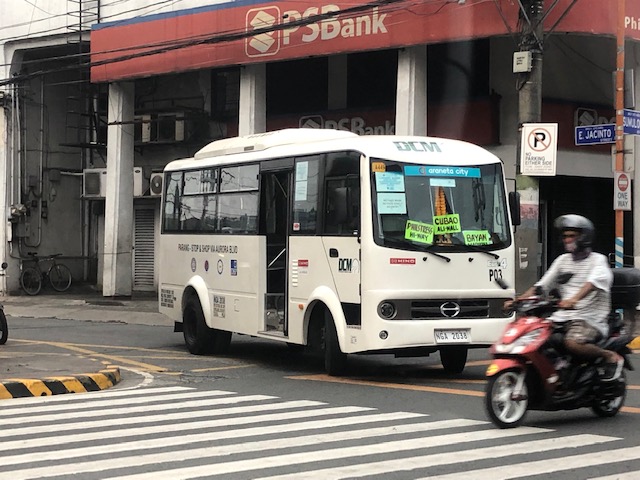
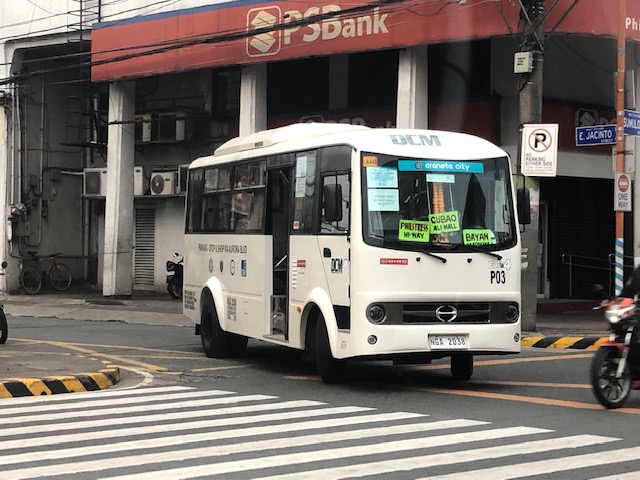
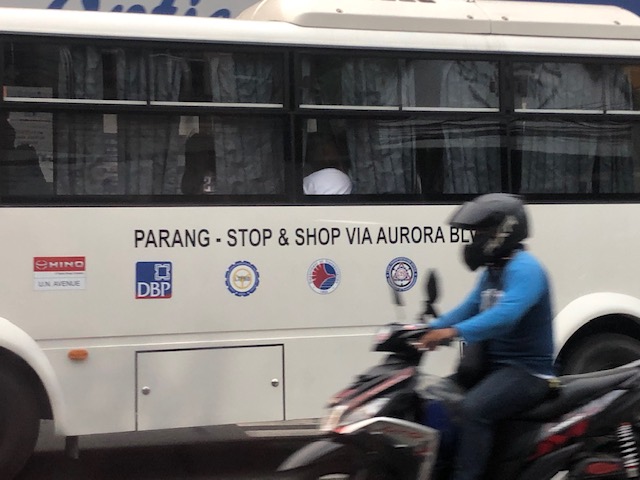
Unlike the old, conventional jeepneys, these are closed, air-conditioned vehicles. While there exists concerns about virus spread in such configurations, one cannot argue vs. the improved comfortability of these vehicles over the old ones especially when the Covid threat is already addressed. The vehicles seat 20+ passengers on average with more room for standees, if required and allowed in the future.
These vehicles are operated by transport cooperatives, which are encourage by the government in their PUV modernization program. Cooperatives have many advantages compared to the old set-up of individual operators. These include the personality or modality to engage financing institutions for acquiring fleets of PUVs. As such, modernization (or the replacement of old PUVs) is expedited. Note the logos along the side of the vehicle? These are DOTr, LTFRB, LTO and DBP. DBP is, of course, the Development Bank of the Philippines, which is one of the underwriters of the modernization program.
More on these vehicles, modernization and rationalization in future posts.
–
Article on the new mobilities
Here’s a quick share of an article on what is described as the new mobilities:
Litman, T. [June 30, 2021] “Planning for New Mobilities: Preparing for Innovative Transportation Technologies and Services,” Planetizen.com, https://bit.ly/2U99Hlw [Last accessed: 7/3/2021]
What exactly are these new mobilities? To quote from the article:
“New Mobilities
- Active Travel and Micromobilities. Walking, bicycling, and variations, including small, lower-speed motorized vehicles such as electric scooters, bikes, and cargo bikes.
- Vehicle Sharing. Convenient and affordable bicycle, scooter, and automobile rental services.
- Ridehailing and Microtransit. Mobility services that transport individuals and small groups.
- Electric Vehicles. Battery-powered scooters, bikes, cars, trucks, and buses.
- Autonomous Vehicles. Vehicles that can operate without a human driver.
- Public Transport Innovations. Innovations that improve transit travel convenience, comfort, safety, and speed.
- Mobility as a Service (MaaS). Navigation and transport payment apps that integrate multiple modes.
- Telework. Telecommunications that substitutes for physical travel.
- Tunnel Roads and Pneumatic Tube Transport. New high-speed transport networks.
- Aviation Innovation. Air taxis, drones, and supersonic jets.
- Mobility Prioritization. Pricing systems and incentives that favor higher-value trips and more efficient modes.
- Logistics Management. Integrated freight delivery services.”

–
What if MUCEP was wrong?
I am not a stranger to the perils of bad data and the analysis, conclusions and recommendations based on it. Last week and the next couple, our students will be presenting and defending their research proposals (one group) and research outcomes (another group), respectively. Many of these students conducted secondary data collection and/or depended on online surveys for their primary data needs including interviews for their respective topics. Much of the secondary data are from past studies including the MMUTIS Update and Capacity Enhancement Project (MUCEP), which was the most recent comprehensive transport planning study for what we basically refer to now as NCR Plus (MUCEP covers Mega Manila, which includes parts of Bataan, Pampanga, Batangas and Quezon provinces aside from Bulacan, Cavite, Laguna and Rizal).
I share the following quote from one who is in the know or has inside information about what went about during the data collection for a major project that sought to update the Metro Manila Urban Transportation Integration Study (MMUTIS):
“The MUCEP data can not be trusted. A major part of the survey was done by DoTr (via a contracted group) – not by JICA-supervised surveys. Its results revealed a large portion of walking per day, because the surveyor filled up the forms and/or disregarded sampling design as most car-owning HH were not available (working or declined to participate) during the survey.
However, citing it is for convenience (aura of credibility). Its (mis)use is another matter.”
The stories are not at all new and I have heard this from various sources including surveyors and survey supervisors themselves whom we also engage for our own data collection (it’s a small world after all – transportation practice in the Philippines). Whether these are factual or not, should be obvious from the data and whether it is consistent with past studies or presents an abrupt change in matters such as mode share and vehicle ownership.
Of course both the DOTr and JICA will deny there was any error in data collection at the time and the weights of their statements will definitely make these the more accepted even if there are reasonable doubts about the assumptions and the survey implementation. But infallibility claims aside, what if the assertion in the quote was correct? What are the implications to activities such as forecasting, policymaking or master planning? Are we not surprised or dumbfounded that despite what is being reported as lower vehicle ownership for Mega Manila, it seems that people do have the motor vehicles and are opting to use them as public transport reliability and safety perceptions are still at low points. Mode choice after all is not as simple as some people want to make it appear to be. And if the assumptions including vehicle ownership are off then any modeling or analysis will end up with erroneous results.
–
On how animals can safely cross highways
Here is a quick share of an article regarding animal crossings and roads/highways:
I thought the article was interesting not just because it featured animal crossings but because the very same ideas and design interventions may be adopted for humans as well. Indeed, there will be cost implications but that is only because we have been accustomed to designs that favor car use more than the movement of people. Perhaps we should rethink how we design infrastructure such as our roadways for them to be favoring active transport and employing more nature or environment-friendly features.
Updated fares for LRT Line 2
After so many years, the Line 2 extension to Masinag Junction is finally complete and operations covering the additional 2 stations. The 2 stations will be fully operational on June 23, 2021 (Wednesday) though there will be a ‘soft opening’ on June 22, 2021, following ceremonies for the extension. Here’s the new fare matrix showing how much passengers would have to pay traveling between certain stations including the two new stations of the extension – Marikina Station (formerly Emerald Station) and Antipolo Station (formerly Masinag Station):

What’s next for Line 2? Will there be another extension? Will there be a branch line? Also, it would be nice to see in the next few months if people will indeed be taking Line 2 instead of their current or usual road transport mode. Of particular interest would be if people will be shifting from private vehicle use. This is important because one main objective of the line is to reduce car dependence. That is expected to lead to a reduction in road traffic condition along the corridor (Marcos Highway and Aurora Boulevard). This could also provide lessons for Line 7, which is still under construction.
–
So what’s the role of academe in transport development again?
I was in a meeting that started off well enough but was accentuated and concluded on sour notes. It was where 2 governmentt officials basically berated and ridiculed us representing academe. Dinaan lang kunyari sa mapalamuting pananalita nila. Well, no matter how you twist your words, we could still decode their meaning. I guess that goes with years of experience listening to all kinds of talk from government officials, politicians, people in private sector, consultants, faculty members, researchers and yes, students. You know bullshit even if its hiding behind a bunch of flowers.
I think the idea of certain government officials about the role of academe in development is to essentially be rubber stamps of the administration. Those who offer criticisms or disagree with plans, policies or parts of these are often branded as “bad apples”. Bawal kumontra. I guess that comes from people who are basically insecure with their work or outputs? Or perhaps they are just worried about their standing and image considering the very political environment they are working in. I could not use the word ‘validate’ to describe the expectation from academe from the government officials in that meeting since the process of validation may end up either positive or negative (thereby invalidating something such as a plan or a policy).
There will always be newer tools and newer models. I remember the times when JICA STRADA was supposed to be the state-of-the-art travel demand forecasting software. It was easily overtaken by the like of CUBE and Vissum. Even its simulator was not at par with VISSIM, Dynasim and a host of other micro-simulation software packages that were more user friendly. Better tools allow for better models, but also only if you do your part in collecting the data required for calibration and validation and formulate sound assumptions. As they say, garbage in, garbage out. No matter how sophisticated your computer models seem to be, they are nothing if your assumptions and data are rubbish. As Howard Stark states in his recorded message to Tony, “I am limited by the technology of my time. But one day, you’ll figure this out.” And not only will there be newer tools and models, there will also be newer methods including those that allow for more sophisticated data collection.
Plan formulation and acceptance are not as simple as 1+1 as one official used as an example. It’s actually more complicated than that. Plans don’t and should not be described in absolutes but should be dynamic or evolving since the future is also uncertain and there are so many factors in play that cannot be all represented or modeled. And no, we’re not going to toe the line nor will we tell other academics to do so. In fact we will continue to be outspoken because that is part of how it is to be objective, and to be encouraging of critical thinking. It is the latter that needs to be instilled in many government agencies where people tend to forget about it likely for convenience as well as to conform with the political atmosphere.
The presence of respected Japanese professors in the meeting and their likely role in convincing JICA to convene an experts’ panel meeting. The meeting was with certain academics representing schools that were not initially engaged by government. JICA’s nod is recognition enough of the accomplishments and reputation of those of us who were invited to the meeting. Unfortunately, their expertise are not appreciated by their own government but that seems to be the consistent policy for the current administration that rewards those who toe the line while shunning those who are more objective and critical.
Culturally though, I am not surprised of the proceedings because we don’t have the same reverence for academe as they have in Japan or other countries where academics are regularly called upon to provide insights to address problems such as those pertaining to transportation. That is why they have strong advisory councils in those countries. And in the case of the US, for example, their National Academies have contributed much to transport development. I have experienced something similar from a top government official before regarding traffic management and policies in Metro Manila. Whether that set-up in the US and Japan can be realized here remains to be seen.
–
On the arguments vs. free transit
Here is a quick share of an article discussing about the idea of free public transport (no fare or minimal fares):
Grabar, H. (June 1, 2021) “The Problem with Free Transit,” Slate, https://slate.com/business/2021/06/free-transit-is-not-a-great-idea.html [Last accessed: 6/16/2021]
Apparently, “better transit, not cheaper transit” should be the mantra for both providers (operators including government) and users (commuters). It is a very sensitive topic for regulatory bodies though since higher fares are generally unpopular to the commuting public. One transport official recently stated that fare setting is a political issue. I tend to agree with this but only because the riding public is currently still largely ignorant or unappreciative of the benefits of efficient public transportation. Perhaps this is also because we’ve really had no efficient public transportation such as the ones we see in other countries including Singapore and Hong Kong? In Singapore, for example, the road pricing policies have educated people about the true costs of transport and that convinces most to take public transportation over private cars.
–
 Caught (up) in traffic