
On a different view of the ’15-minute city’ concept
Here is an article discussing the downside(s) of the 15-minute city; particularly its adoption without understanding first and setting the context for the concept:
O’Sullivan, F. (March 3, 2021) “The Downside of a 15-Minute City,” Bloomber CityLab, https://www.bloomberg.com/news/articles/2021-03-02/the-downsides-of-a-15-minute-city [Last accessed: 3/20/21]
Some people are pushing very much the same concept for quick adoption in the Philippines without again contextualizing it. I feel these people are detached or choose to be so perhaps as they seek shortcuts to achieve what they believe should be the way cities and municipalities are laid out in the country. But wait…don’t we already have 15-minute cities in the Philippines? I will be writing about that soon…
–
Nostalgia: On old photos of transport in the Philippines
I like browsing old photos on the Philippines. Of particular interest are photos showing transportation during the Spanish and American periods. I came upon this photo of a tranvia station at Plaza Goiti in front of Sta. Cruz Church. The church is still there though it looks very different from the structure in the photo below. This is probably due to the reconstruction and renovations done over the years (it was seriously damaged during World War 2).

The source of the photo is a collection I found on the internet. Note that if you clicked the photo, you will be taken to another site where you can view other photos as well. Meanwhile, here is a screen capture of the area from Google Street View:
 Plaza Lacson with Sta. Cruz Church in the background to the left of the statue of former Manila Mayor Arsenio Lacson
Plaza Goiti is now Plaza Lacson with a statue of the former Mayor of Manila standing in the open space. Of course, the tranvia is no longer there but there are buses and jeepneys as well as tricycles providing public transportation in the area. The population is also higher and denser than when the first photo was taken (ca. 1910) but it seems the Sta. Cruz district is still a walkable area. We hope it will remain to be so and more initiatives are taken to have more improvements or enhancements to encourage active transport as well as public transport use over private motor vehicles.
–
On planning communities for children
I am currently involved in a project concerning child road traffic injury prevention (CRTIP). The topic of road safety is also close to my heart since a beloved aunt died due to injuries sustained after being hit by a jeepney. She was in great health and walked almost daily between our home in Iloilo and the church to hear Mass. Children and senior citizens are among the most vulnerable road users and so I believe we must address their needs more than able-bodied adults. That would probably make our communities safer and friendlier to most people. Here is an article that tackles planning for communities from the perspective of children and families:
Litman, T. (March 9, 2021) “Planning communities for children and families,” Planetizen.com, https://www.planetizen.com/node/112498?utm_source=newswire&utm_medium=email&utm_campaign=news-03112021&mc_cid=5a75b816a6&mc_eid=9ccfe464b1 [Last accessed: 3/14/2021]
To quote from the article:
“Here is a summary of child-oriented urban design features:
-
Children need opportunities to join a loose social group of other children without a formal—or prearranged—invitation to play.
-
Children need access to safe, uninhibited outdoor play to support their physical and mental health. Outdoor play should include opportunities to interact with the natural environment—finding bugs, smelling flowers, playing in puddles, or collecting objects—without the need for excessive rules, oversight, or segregation.
-
Children need environments that are safe from traffic, pollution, and undue physical or social hazards, including safe routes to and from school and local playgrounds, allowing them to travel throughout their neighbourhoods safely in order to develop confidence, resilience, and independence.
-
Children need private spaces for themselves and their friends, including tree houses, forts, or clubhouses that are close to home yet away from public view. 5.
-
Children need stable, appropriate, and affordable housing that provides them with private space to rest, study, and play.
-
Children need local access to appropriate early childhood education, child care, and community schools.
-
Children benefit from the opportunity for their parents to work locally.
-
Children benefit from walkable communities, with infrastructure for safe walking, cycling, and recreation.
-
Children benefit from diverse, multi-generational communities, where they can interact with—and learn from—children, adults, and seniors of all races, religions, cultures, and incomes.
-
Children should be given an opportunity to effectively and productively participate in decision-making processes.”
–
If you became the DOTr Secretary, what will be the first things you do?
I saw this article posted on Planetizen about what the new US DOT Secretary would be and should be doing upon his appointment:
Fischer, R. (February 8, 2021) “You’re in Charge of the US DOT; Where Do You Start?” Planetizen, https://www.planetizen.com/node/112170?utm_source=newswire&utm_medium=email&utm_campaign=news-02152021&mc_cid=f4502363c4&mc_eid=9ccfe464b1
While, the US needs to implement a lot of projects for their needs and perhaps some catching-up here and there across the country, the term “catching-up” cannot really describe the backlog of programs and projects we need to implement in the Philippines. And so I posted the same article on social media to solicit some reactions. There were some good responses but many I though were on the cliche side. Some even posted about personalities in various transport agencies rather than the reforms needed or the infrastructure required to address transport problems.
How about you? If you were appointed Secretary of the Department of Transportation; where do you start?
–
Vaccine passports anyone?
As the Philippines, relaxes protocols to contain the Covid-19 pandemic, it is interesting to note that other countries have not let down their guard. And the latter includes nations that have been quite successful in dealing with the pandemic. Many countries have also received the vaccines and have started inoculating their populations. These received the doses ahead of the Philippines and have now vaccinated a significant % of their population according to their respective prioritization schemes.
But even as countries have started vaccinations, the question remains whether a vaccinated individual can now move around or travel as if it were pre-pandemic conditions (the old normal). Here’s a nice article to read as the topic of unrestricted (or restricted, depending on your take) comes up in discussions including those leading to certain policies to be formulated by governments:
Fisher, M. (March 2, 2021) “Vaccine passports, Covid’s next political flashpoint,” The New York Times, https://www.nytimes.com/2021/03/02/world/europe/passports-covid-vaccine.html [Last accessed: 3/4/2021]
–
On the Boeing 747
We deviate from our usual topics that are mostly about land transportation to something about air transportation:
Waldek, S. (February 10, 2021) “How the Boeing 747 Changed the Way Airplanes are Designed,” Architectural Digest, https://www.architecturaldigest.com/story/how-boeing-747-changed-way-airplanes-designed?utm_source=nl&utm_brand=spotlight-nl&utm_campaign=aud-dev&utm_mailing=thematic_spotlight_021021_2&utm_medium=email&bxid=5bd6761b3f92a41245dde413&cndid=37243643&hasha=cf6c402001bc473063a8744033fe9be3&hashb=ec2bb753c2e6299f5107823241955221da67bd1f&hashc=09f65c608bfb62050199733de500e3cd82827631b36d537ce8386d41a3bd1ff7&esrc=FYL_SEG_APR18&sourcecode=thematic_spotlight&utm_term=Thematic_Spotlight [Last accessed: 2/14/2021]
My first flight on the Boeing 747 was back in 1996 when I first traveled overseas to Tokyo. I was booked on a Northwest Airlines (NWA) flight and the airline used B747’s on the regular flights between Manila and Narita. Later, I was on another Northwest Airways, JAL and Korean Air B747’s for homecoming trips and a trip to Seoul. While in Japan, I usually took the Shinkansen for long distance domestic trips. I even had the chance to ride Pakistan Air’s B747 that was a half passenger, half freighter plane. The flight between Narita and Karachi in the 1990s had a stopover in Manila that meant cheap tickets between Manila and Narita (also because passenger demand for the airline was not as high since PAL, JAL and NWA were the airlines of choice between MNL and NRT. I was even upgraded to Business Class en route to Narita the only time I flew on PIA in 1998.
Here’s a model of a Delta B747-400 we got from one of our trips. Delta acquired Northwest and its flights to Asia.

–
On cultivating a culture of public transportation
There’s this recent article about cultivating a culture of transit (i.e., public transportation). We probably take this for granted despite most of us taking public transportation for our commutes. I would like to think such cultures exist with variations and uniqueness for various towns, cities, even countries. There is a uniqueness about the different paratransit modes that you might find around Southeast Asia, for example. These include Thailand’s Tuktuk and Songthaew, Indonesia’s Bajaj and Angkot, and the Philippines’ jeepney and tricycle.
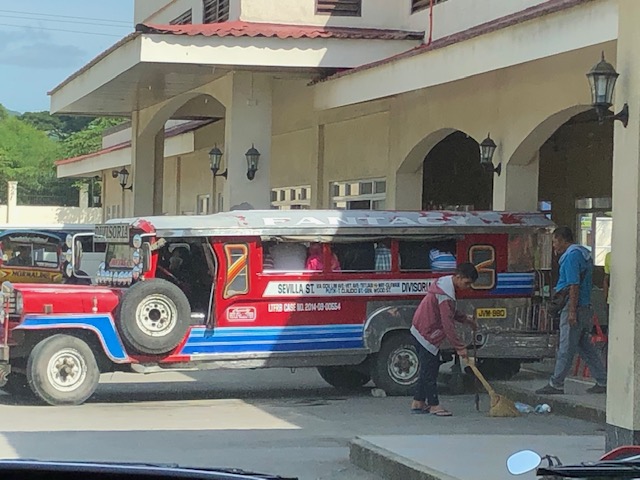 A Philippine jeepney waiting for passengers at a terminal
Here is the article via Planetizen:
Gifford, D. (February 23, 2021) “Cultivating a Culture of Transit,” Planetizen, https://www.planetizen.com/node/112361?utm_source=newswire&utm_medium=email&utm_campaign=news-02252021&mc_cid=c3b203ffe6&mc_eid=9ccfe464b1 [Last accessed: 2/26/2021]
Some takeaways from the article:
“What are the common factors for great transit? Well funded, frequent transit is one key to a successful transit system, and funding goes a long way to support transit culture. When a system is well funded, it is more frequent, more useful, more people use it, and it becomes part of the culture. Many of these systems are so popular they even have their own stores where riders and transit fans can purchase merchandise.”
and
“Improved service would cultivate a diverse culture of transit as more people rode. Just imagine a far reaching system with dedicated lanes that would not only be beneficial for commuters, when in office work resumes, but one that will improve life for daily riders who depend on it most.”
What is culture anyway? It refers to society, a way of life; including lifestyles, customs and traditions. Perhaps its worth mentioning that the jeepney and the tricycle (the conventional/older ones) are considered cultural icons. This did not happen overnight and probably involved romanticized concepts of anything about jeepneys and tricycles; including stories, true or fictional, about the people involved.
Questions: Can we develop and nurture a similar culture about bicycles? And can it happen immediately?
–
On leaders and decision-makers taking public transport or bikes to commute
There has been clamor for our leaders and decision-makers, especially those in the transport and highway agencies, to take public transportation. This is for them to experience how most commuters fare for their daily grinds. And no, having an entourage including bodyguards or reserving your own train car does not count. Dapat pumila o maghintay sa kalye. Makipagsisikan o makipag-habulan sa bus, jeepney o van para makasakay. Many if not most of these officials have their own vehicles or are even driven (may tsuper o driver) to and from work. One even had the gall to transfer his department to where he comfortably resides so he won’t commute but that’s another story.
You see articles and posts about Dutch politicians and even royalty riding the bicycle to work.
 The Dutch Prime Minister bikes to work
Then there are politicians regularly taking public transport while in office. Here is an article about the newly inaugurated POTUS, Joe Biden, who took the train for his regular commutes:
Igoe, K.J. (May 4,2020) “Where Did “Amtrak Joe,” Joe Biden’s Nickname, Come From?”, Marie Claire, https://www.marieclaire.com/politics/a32363173/joe-biden-amtrak-joe-meaning/ [Last accessed 2/14/2021]
Do we have someone close to such an example? Commuting by private plane between your home in the Southern Philippines and your office in Manila surely won’t let one have an appreciation of the commuting experiences of typical Filipinos.
–
It’s not that simple: the math on vehicle sales and registration
I read the statement of a government official about vehicle sales, and the subsequent responses it got. He cited math and seemingly joked about not being good at it while trying to make sense of the numbers. It is not as easy as he supposes. And I think that is partly why we fail to address the transport problems. For one, we think it is just about road capacities. For another, it may be about public transport supply. These are not mutually exclusive but rather intertwined along with so many other factors.
Housing, for one, (i.e., its availability, affordability and location) is among the most important factors that affect or influence how we commute. I have been asking the question about housing affordability in CBDs such as Makati, Ortigas and BGC. Lucky for those who already reside at or near those places but most people working there have to contend with expensive mortgages, leases or rents. How much is a condo unit in BGC, for example? If you have a family of 4, you certainly can’t and won’t opt for a studio unit just because its near your workplace. It’s obvious here that you also would have to consider where your children will be going to school as well as the workplace location of your partner if he or she is also working. No schools for now but imagine how it was and would be once our children go back to physical school. Such facts of life seem lost to many pundits commenting or offering opinions about transportation.
I think to be fair this should also be framed from various perspectives. For example, those vehicle purchases don’t necessarily mean additional vehicles on certain roads. like what one MMDA official claims. These will be distributed across the network of roads, and these will be operating during certain times of the day. Some of these vehicles were purchased by new car owners. Others as replacements to older or unserviceable units (e.g., upgrades). It would be nice to see, for example, the stats from 2008, 2009 & 2010. Thousands of vehicles were doomed by Ondoy in the greater Metro Manila in 2009 resulting in their replacements late that year until 2010. Then there was the boom in sales in the following years as people ventured into TNCs (Uber and Grab). The recent surge in private car use and what seems to be strong sales of these vehicles in the wake of the Covid-19 pandemic is more out of necessity (why do you think people aren’t taking to cycling for their commutes as much as is desired?)
The question why people still prefer to purchase and use their own vehicles has not been answered in the most honest way because different people with their own agenda tend to paint different pictures of the car owner. In some cases, car owners are being portrayed as ‘evil’ while those taking the more environment-friendly modes as ‘good’. Again, it should be obvious that this is not a ‘good’ vs. ‘evil’ discussion nor is it something that is black and white. We should pay (a lot of) attention to the grays, which can have so many different shades when it comes to transportation. No one really wins a “holier than thou” exercise where people on opposite sides tend to take hard line stances and close their minds to constructive ideas from either side.
–
Lessons on housing we need to talk about
There’s this recent article on housing that presents and discusses lessons from Singapore housing that
Fischer, R. (February 2, 2021) “Singapore Housing Lessons for the Biden Administration,” Planetizen, https://www.planetizen.com/node/112077?utm_source=newswire&utm_medium=email&utm_campaign=news-02082021&mc_cid=4fac9821d0&mc_eid=9ccfe464b1 [Last accessed: 2/15/2021]
 I’m not an expert on housing but I’ve experienced living in Singapore. Here’s a photo of the wife as she walked ahead of me on our way to the MRT station near our place back in 2012. One of the factors we considered when we chose this place for our residence was its proximity to the orange line station that meant only one ride (no transfers) between our home station and the station closest to the wife’s office. We could also take the train to the nearest mall if we didn’t feel like walking 15 minutes.
To quote from the article:
“…the secret to Singapore’s success is that their housing projects are carefully designed to support mixed-incomes, beautiful green spaces, and access to high-quality public transportation that conveniently links residents to education and community centers. And last but not least, couple all that with the famous Singapore hawker centers (food courts) where all income classes and ethnicities meet, socialize, and dine on Singapore’s famously delicious and affordable cuisine.”
–
 Caught (up) in traffic