
On arches as border references or landmarks
Many people take it for granted when you talk about locations or places and the cities or towns where they are located. When ask where a certain place is, people may reply in the general though sometimes in the specific. When you ask where Robinsons Galeria is, the usual reply may be Ortigas Center or, more specifically, “sa kanto ng EDSA at Ortigas Ave.” The mall is actually
Where does Antipolo start and Taytay end? To many, the Tikling Junction might be the easy reference or landmark for this. It is usually assumed that you’re already in Antipolo as you start climbing from Tikling. The stretch from Tikling to the boundary with Antipolo is actually still part of Bgy. Dolores, Taytay. Here is Antipolo’s welcome arch along Ortigas Avenue Extension:
 “Tayo na sa Antipolo” is the city’s old tagline that you can find in a song relating its attractions
It may be somewhat unimportant or trivial for many but political delineations are subjects of many disputes among local government units. Cainta, Taytay and Pasig, for example, continue to dispute areas along the Manggahan floodway. Pasig, Marikina and Cainta are also wrestling about areas along Marcos Highway (e.g., Robinsons Metro East is Pasig but Sta. Lucia Mall is Cainta. Across from the two is Marikina territory. And the three lobbied to get the Line 2 Station to be associated with either of them (as of this writing, it seems Marikina’s got it and the station may have the alternate name “Marikina Station” to the original “Emerald Station”). The Feliz Mall is technically in Pasig though people seem to associate it with Marikina. Line 2 Santolan Station is Pasig’s. And do you know that along Sumulong Highway, Antipolo and Marikina are split by a barangay of Cainta? There are many other cases across the country that have these issues that have not been resolved or needs to be resolved especially as there are implications to elections in those areas, particularly at the local level.
–
On teaching children how to ride a bicycle
After some hesitation, we finally decided it was time to remove the training wheels from our daughter’s bicycle. She’s enjoyed biking whether we walked alongside or were on our bikes, and she was already tall enough to stick out her legs to regain balance if the bike tilted to one side or the other. So we thought it was probably time to remove the training wheels so she will learn to bike on 2 wheels.
She’s a fast learner and after I pushed her a few times, she could already pedal ahead and straight. The turns took some time as she immediately stuck out a leg when she thought she would fall upon making a turn. The confidence grew and the following day she was already turning while keeping her balance. She now cycles every afternoon but we still forbid her to go by herself and beyond our eyesights. So we usually have one adult or our high-schooler to bike with her. Sometimes, her grandfather, who cycles at 78, also shadows her and gives her pointers.
 The view as I followed her along one street in our neighborhood.
I always tell her to take the lane and not wander to the middle of the road or the edge of it. Our main worry is always the motor vehicles that tend to speed as if no one else is using the road. Some motorcycle riders are reckless and so are many car drivers. It is as if they were not driving/riding in a residential area. So we always remind our little one to position herself where she can maneuver to avoid these vehicles. And we always remind her to be aware of her surroundings as being alert will help keep her away from danger.
I think we should teach our children to bike at an early age. It is a very useful skill to learn and nurture, whether its for recreation, exercise or transport. She already knows how to swim, which was and still her preference over cycling. Our daughter was already biking (with training wheels) at 4 but it took some time for her to grow (she was really small for her age then) and gain strength. She just turned 7, and we think she can now out-pedal us if we didn’t ask her to slow down. 🙂 I think its time to get another bike, too, as the wife’s also returned to cycling in order to shadow our daughter. I’m usually left to run after them…
–
On the need for more public spaces
Here’s a quick share of an article discussing the pandemic’s exposing the need for more public spaces:
Ionescu, D. (February 5, 2021) “The Pandemic Revealed Public Space as ‘Essential Infrastructure'”, Planetizen.com, https://www.planetizen.com/node/112044?utm_source=newswire&utm_medium=email&utm_campaign=news-02082021&mc_cid=4fac9821d0&mc_eid=9ccfe464b1 [Last accessed: 2/9/2021]
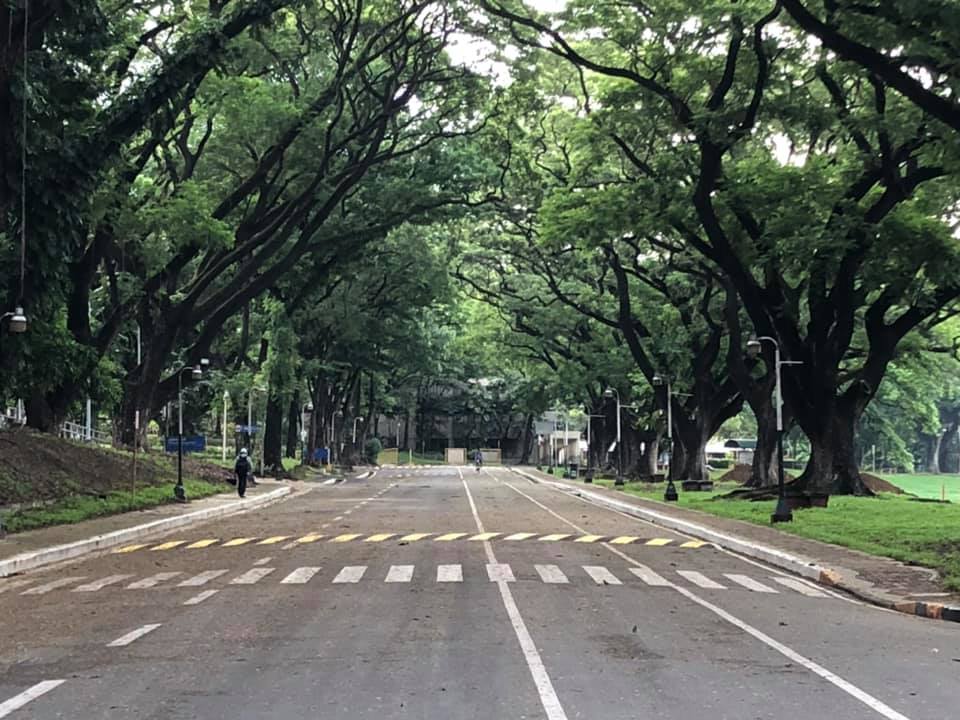 Quezon City is lucky to have the Quezon Memorial Circle, Parks and Wildlife and the University of the Philippines Diliman campus but it needs more public spaces given its size. UP should not technically be regarded as a public space as it is a school first and just happens to be blessed with a spacious campus. Pictured above is its academic oval with the Sunken Garden to the right.
Public spaces include parks and other open spaces that serve as breathing spaces or lungs for our cities and municipalities. A lot of people complained about being cramped up during the lockdowns and are now going out (others quite recklessly) even with the specter of Covid-19 still about us. In many old towns around the country, there are plazas and of course fields where people can go to while maintaining safe physical distancing. We certainly lack for these especially in highly urbanized cities. Rizal Park and its surrounding areas including Intramuros are not sufficient for dense Manila. In Taguig, you see a lot of people taking walks or exercising along the C5 service road. Its good that they actually have a linear park in Lower Bicutan and maybe parts of BGC where people can “decompress” from their cramped conditions where they reside but again, these may not be enough. Cities and municipalities need to allocate or build more public spaces. These should be deliberate developments to create such spaces (even small playgrounds scattered around a city would be a good start) for everyone’s well-being.
–
Afterthoughts on ridesharing
Ridesharing/ride-hailing companies like to claim that they are helping solve transport problems. However, their disruptions seem too good to be true in a growing number of cases including those in London and California where studies have shown anomalous practices of companies particularly Uber. Grab is now the dominant company in the Philippines after Uber sold its business to Grab. Other upstarts have had little impact on Grab’s market share. The only ones perhaps that have had some success taking business from Grab are the motorcycle taxi app companies like Angkas and Joyride. Motorcycle taxis are actually quite popular though they have been informal (and illegal). Habal-habal operations though have been tolerated in many cities and towns with authorities usually turning a blind eye to their operations.
They have thrived in large cities and have practically displaced taxi companies in these cities. I would not go deep into the social impacts but there are already a lot of negatives including the growing evidence that they are taking people away from public transport in general. Their operations seem promising at the start as the original concept was to use underutilized vehicles that otherwise would have been parked for most of the day, and offering work and income opportunities to people who had the free time (e.g., home-based people who may have a few hours to spare to drive/transport other people to their destinations). The latter were assumed to be part-timers with their vehicles available for providing transport services on demand. The vehicle used might be a spare one. And I use the word ‘spare’ here as it is assumed there might be another ‘main’ vehicle that is used by another person in the family who is a full-time job who drives to work. I don’t buy that romanticized claim that one main objective of these rideshare companies is to break the monopoly of taxi companies. They ended up being the taxis with all those cars now roaming city streets for passengers (and fares).
I mention here a very recent article citing an MIT study:
Green Car Congress (February 2021) “MIT study finds Uber & Lyft increase congestion, decrease transit ridership and don’t affect vehicle ownership,” Green Car Congress, https://www.greencarcongress.com/2021/02/20210204-tncs.html [Last accessed: 2/5/2021]
There is also a published paper in 2019 that is from the perspective of TNVS drivers in Metro Manila:
Mirandilla, C.S. and Regidor, J.R.F. (2019) “Assessment of Transportation Network Vehicle Services from the Drivers’ Perspective,” Journal of the Eastern Asia Society for Transportation Studies, Volume 13, Pages 2369-2389, https://doi.org/10.11175/easts.13.2369
In the paper, their findings include the following:
“It was found that TNVS have greater impact in traffic flow compared to other modes of transportation while delivering inferior productivity. The study also found that full-time driver-operators have very high risks of financial losses, and they have lower than minimum wage income when depreciation costs and maintenance costs are considered.”
–
What type of seat is appropriate for your child?
I wrote yesterday about the new law requiring child seats for children 12 and under or under 4’11” in height in the Philippines. The implementation has been postponed after government received a lot of flak about it. To be fair, the info campaign started months ago but it seemed to be limited to social media and not really disseminated as widely as is ideal. The material while catchy at first glance, is not as clear in the info or message as already evidenced from the flak about the law and its provisions.
Here is a graphic from the US National Highway Traffic Safety Administration (NHTSA) that is quite easy to understand:
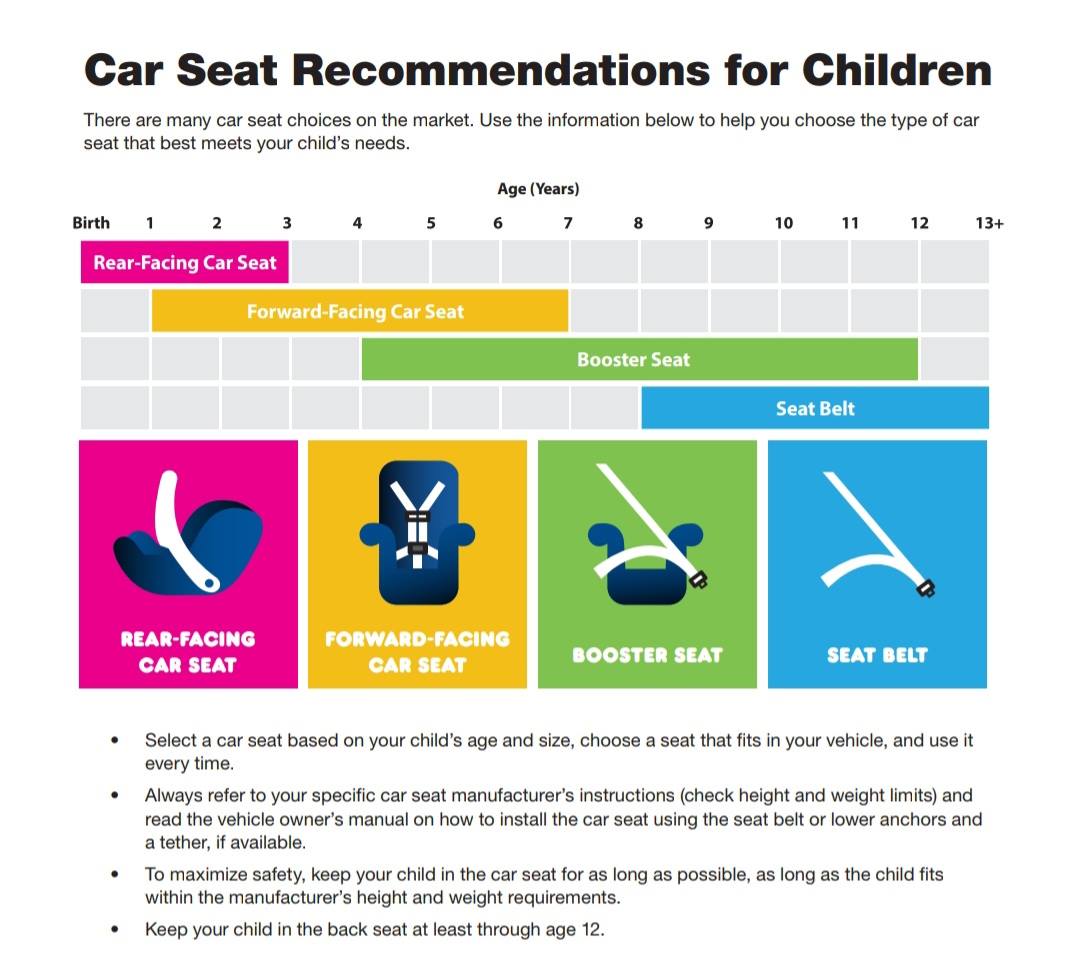
Based on the information from the NHTSA, the CDC came up with the following graphic:

It would have been clearer and more effective in communications if the agencies-in-charge came up with similar material rather than the one I shared in yesterday’s post. There are also many designs for child seats and so far there are no specifics about these that people could refer to. Ultimately, I believe there should be a list of what are allowed or not allowed including brands. Perhaps its better to have a list of what are not allowed with the reasons for these, and then let the manufacturers challenge these. Having a list of allowed products might come off as advertising or favoring certain manufacturers. Of course, it will be up to the Bureau of Product Standards (BPS) of the Department of Trade and Industry (DTI) to determine which seats will be allowed based on their specs and the standards they conform to. European and US standards are among the most stringent so perhaps these can be reviewed and determine whether they can be adopted in the Philippines.
–
On R.A. 11229 and the requirement of Child Seats
There seems to be a lot of feedback (mostly negative) on the new law and its implementing rules. RA 11229 is the “Child Safety in Motor Vehicles Act” that requires the use of child car seats. There seems to be a confusion about who are supposed to be using child seats particularly about the age and height limits mentioned. In one “controversial” interview, a government transport official was recorded replying to a question about tall children that the parents would have to get a bigger vehicle. That was obviously uncalled for but also probably what can be considered as a “snappy answer to a stupid question[see note below]” type of situation. What is clear now is that a lot of people are not aware of the provisions and implications of the new law (for various reasons including their choosing to ignore it) and there needs to be a more comprehensive and effective info campaign on this topic. Not yet mentioned in discussions are the models of car seats that are approved or certified for use.
 Screenshot of a graphic explaining who are required to use child car seats
Here are examples of the opinions and comments in one of the group discussions I am part of [I will just leave these without specific attribution or anonymous.]:
- “RA#11229 was badly written. Authored by Sen JV Ejercito, trying to copy laws in the USA. In California, the Child Safety Seat is only required for child 2 years old and below, 4 years old in NY, and 3 years old in Europe. Additional parameters: height limit of 40″ (101 cm) and weight limit of 40lbs. They differentiate rules for children up to 8 years in NY & CA.”
- “The Philippine version lumps all kids into one group below 12 years old, requiring child restraint system. Additional parameter is 150 cm height, none on weight. Two wrong premises of our law: 1) that Filipinos children are taller than Europeans and Americans of same age, and 2) Filipino children mature later at 12.”
- “They lumped it into one class because its the simplest and easiest thing to do, without going into a lot of uncertainty. Na controversial na nga yung 12 yr. old catch-all, ano pa kaya kung they broke it down into numerous classifications.”
[Note: To those who are not familiar with the term “snappy answers to stupid questions”, google it together with Mad Magazine.]
–
On using a car for transport in the time of COVID-19
We start the month of February with a very informative articles from the New York Times about car use and the spread of Covid-19. There have been a lot of discussions or discourse, even arguments, about private car use or shared vehicles (e.g., Grab) as people have apparently chosen these over public transport in many parts of the Philippines. For one, there is still a limited supply of public transport as government tries to take advantage of the situation to implement their rationalization and modernization programs.
The following article is from the US but the principles presented particularly about air flow and the potential spread of the virus inside a car are factual and apply in a general manner to other situations including ours. It is important to have an appreciation of the science behind air circulation and how it relates to the potential infections.
Anthes, E. (January 16, 2021) “How to (Literally) Drive the Coronavirus Away,” New York Times, https://www.nytimes.com/2021/01/16/health/coronavirus-transmission-cars.html [Last accessed: 2/2/2021]
The common misconception appears to be that using private vehicles automatically helps spread the coronavirus. The science tells us it is not as simple as that (i.e., using your own vehicle will lead to your and your family being infected). While private vehicles are not the proverbial suit of armor vs. Covid-19, their proper use might give better chances compared to crowded and/or poorly ventilated public utility vehicles. Walking and bicycles, of course, are most preferred but that’s a topic for another article.
–
Infanta, Quezon Arch
I was just writing about the arches you typically came across as you traveled by road around the Philippines. A former student of mine posted a photo of the arch welcoming travelers to Infanta, Quezon from Rizal province, and I asked to have a copy of the photo. He is an avid cyclist who goes on long rides. The arch bears the seal of the town but few other symbols (that I am familiar with) that could have represented the municipality. Here is a typical low-traffic highway with two lanes and dirt shoulders along either side of the road leading to something mysterious (see that fog/mist at the end of the road?).
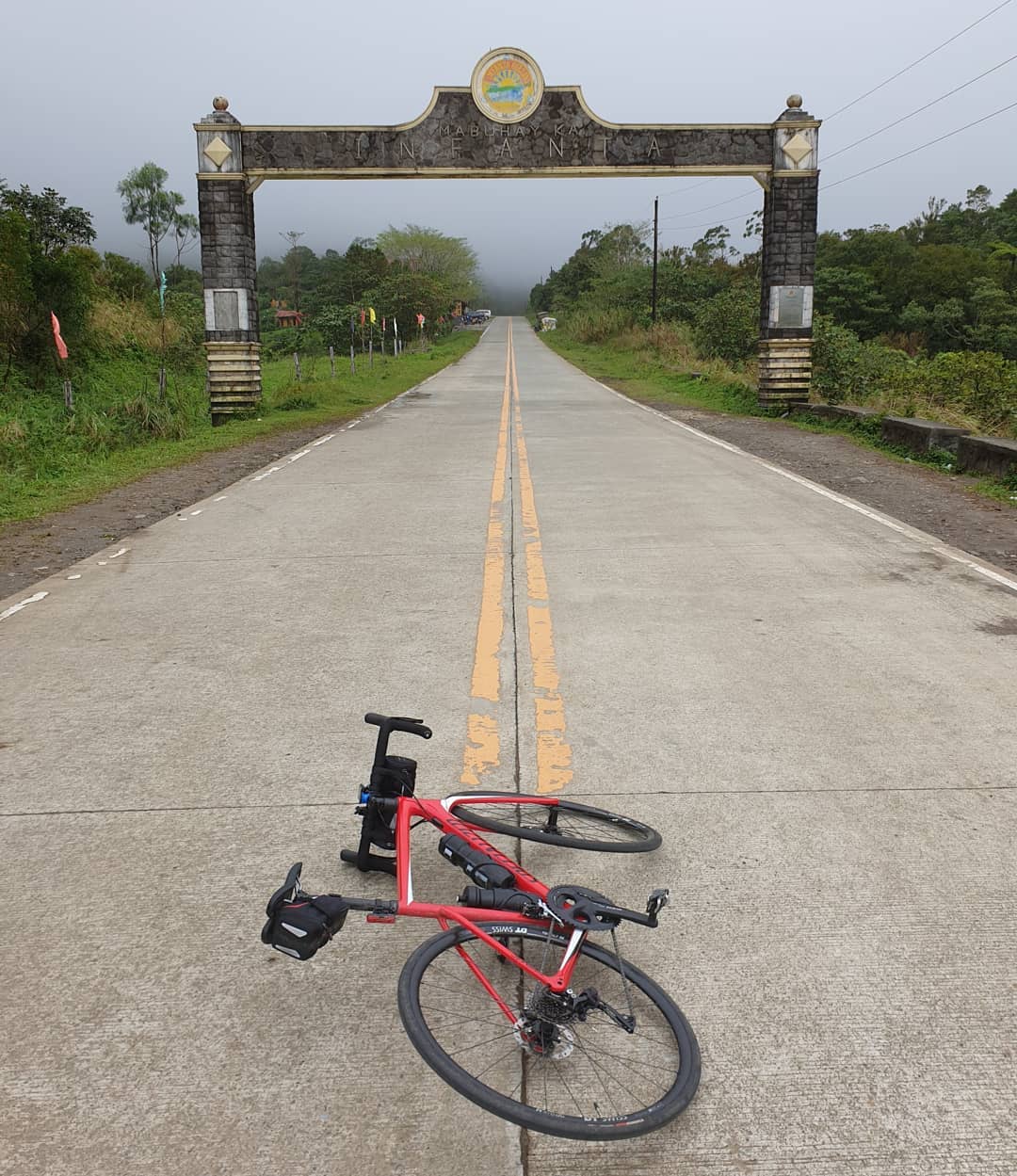 Road to Infanta, Quezon [Photo credit: Dexter Cuizon]
–
On airline travel in the time of Covid-19
I haven’t been on a plane since February 2020. That is almost one year next month. I have friends though who have traveled by air recently. They had to follow certain protocols before departing and upon arrival at their destination. These include testing for the virus and observing quarantine especially upon their return to Metro Manila and prior to returning to their respective homes. Fortunately, all have been testing negative for Covid-19 and were able to come home safely.
Here is an interesting article on air travel, particularly how airlines and airports are handling passengers during this time when processes need to consider the prospects of getting infected by Covid-19:
Marshall, A. (January 21, 2021) “The Art and Science of Boarding an Airplane in a Pandemic,” Wired, https://www.wired.com/story/art-science-boarding-airplane-pandemic/ [Last accessed: 1/26/2021]
I am anxious about being required to travel for a project we are currently doing for a major city in Mindanao. While our clients have been very understanding about our health concerns, it might be inevitable for some of us in the project team to travel by March 2021 to present the findings and recommendations of our study. I will continue to update myself about travel guidelines in preparation for that likely travel.
–
On the road again
A couple of weekends ago, I found myself doing my first long drive in months. I wasn’t a passenger but the driver when the wife and I went on an excursion with neighbors-friends, one of whom arranged for our lunch at Ugu Bigyan’s Potter’s Garden in Tiaong, Quezon. We had two options to get there – one via the scenic route through Rizal’s backdoor that takes one to Teresa, Tanay, Baras and Pililla in Rizal, Pakil, Pangil, Paete, Lumban, Pagsanjan, Sta. Cruz and San Pablo in Laguna, the other via C-6, SLEX and STAR Tollways taking us through southern Metro Manila, Laguna, and Batangas. We took the latter route as it was faster (shorter travel time by an hour) and it allowed us to test our newly installed Autosweep RFID’s for the two tollways we used along the way.
The photo below was taken by the wife upon my prodding. I had not seen an arch as we traversed Sto. Tomas (Batangas), and Alaminos and San Pablo (Laguna). These were all along Asian Highway 26 (AH 26) or the Pan Philippine Highway system. The arch marks entry/exit to/from (boundary) the Province of Quezon from the Province of Laguna. Laguna doesn’t have its own arch.
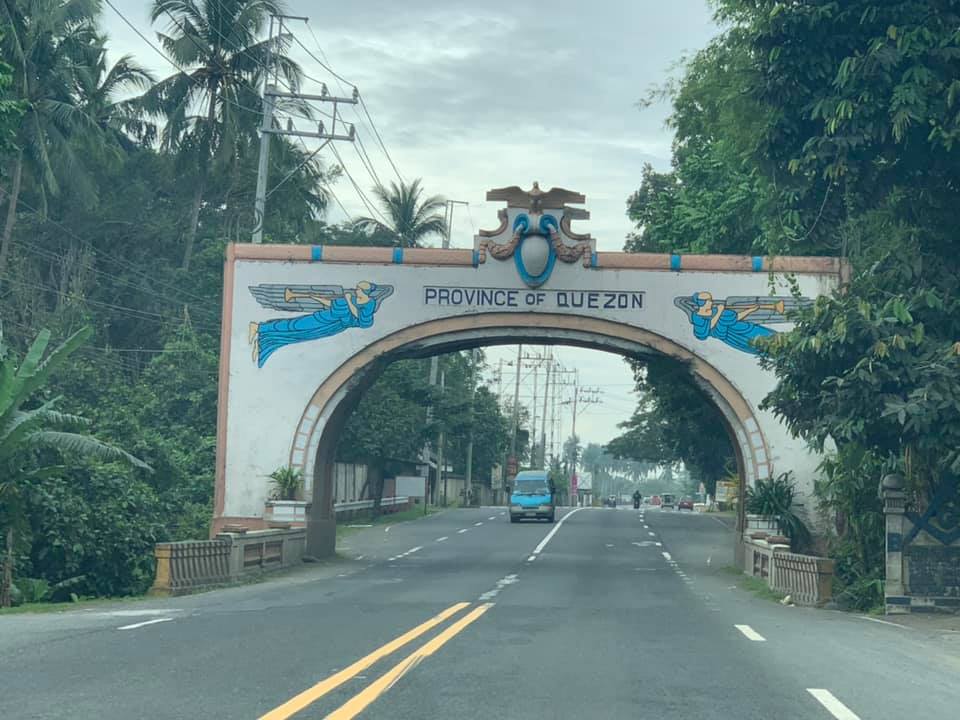
Arches like the one in the photo used to be the landmarks between towns and provinces. I wrote about these many years ago:
https://d0ctrine.com/2013/02/18/arches-in-la-union-and-ilocos-sur/
https://d0ctrine.com/2019/04/25/arko-along-the-highways/
I have other photos somewhere but have not scanned/digitized them. Others I think that I left at my parents’ home perished with the floods of Ondoy.
With DPWH’s road widening program, many of these arches around the country may have been demolished. Those that remain tend to constrict traffic as they have space for two lanes and perhaps narrow shoulders at either side like what is shown in the photo. Perhaps others will be reconstructed and even enhanced to reflect a town’s or province’s attractions or attributes?
–
 Caught (up) in traffic