
On interviews and propaganda
A colleague once mentioned that he didn’t want to grant interviews to the media because of a then recent experience of one channel splicing up his interview and making it appear as if he were arguing with a government official. True enough, these productions can be made like that in order to generate more interest on the subject. People watching that channel’s programs on news are hooked to the latter because of their sensationalised style of reporting.
When I was Director of our transport center at the University of the Philippines, I maintained a generally media-friendly policy but was selective of those I would grant interviews to or whom I would refer to colleagues whom I had to assure about the interviews not becoming similar to those a former colleague referred to. After all, we knew which programs tended to be on the sensational side. For one, you can base the “media filter” on the personalities behind these programs. At the very least, you’ve done some damage control by pre-empting
Fast forward to the present and a close friend pointed to what first appeared as propaganda material made by online supporters of the current administration (i.e., the troll army). However, upon closer review we determined to be an official production of the government. It included a lengthy part of an interview one of our former directors granted to the government station a while back when the government was embarking on its “Build, Build, Build” program. To be fair, if taken without the tags and labels attached by what people would call fanatics or die-hard supporters of the current administration, then the production is simply a information material. Sure, it can be used as propaganda material but then taken as is, it is certainly not “information, especially of a biased or misleading nature, used to promote or publicize a particular political cause or point of view” as the term “propaganda” is defined in dictionaries. In fact, a major part of the interview specifically mentioned failures of an authoritarian regime in building transport infrastructure that could have averted a lot of the problems we now experience. Context is very important and I thought that the labels attached to the video that made it look like it was something being peddled by the troll army definitely made it look bad.
I think this should be another lesson with our dealings with mainstream media and perhaps with social media, too. You cannot be too careful or meticulous about these interviews but then it is still a responsibility that should be taken on. Otherwise, we commit a sin of omission by not engaging in such activities. While we should not let our guard down in selecting which interviews to grant, there will be times when we just have to assume good faith and trust that the end product will not be fake news.
–
A quick update on the Line 2 Emerald Station construction
Here are a couple of photos of Line 2’s Emerald Station, which is under construction. There’s significant progress in the construction but this will definitely take months to complete along with the Masinag Station, which is in a similar state of progress in construction.
 Here is what the Emerald Station, which is just across from Robinsons Metro East and Sta. Lucia Mall, looks like. It’s still far from being completed but you can already see what seems to be an area underneath the tracks where people can cross from one side to the other. Stairs have been constructed to connect what could be a station concourse to the street level. The building under construction to the right in the photo is Sta. Lucia’s. From the looks of it, this will be an office building, likely to host a BPO office. We hope that the station will have direct connections with the two malls as well as this office.
 Right after the station is the intersection of Marcos Highway with Felix Avenue and Gil Fernando Avenue where there is still pedestrian overpass that allows people to cross the wide roads safely. There are only rare instances when people attempt to cross at street level here but there were some security concerns as there was a spate of snatching incidents on the overpass. Cainta authorities seem to have addressed this despite some border issues with Marikina and the former has posted policemen to deter crime on the overpass.
The last image connects to the first one in the sense that there should be a connectivity for the existing pedestrian infrastructure (i.e., overpass and sidewalks) with the future Emerald Station. This connectivity would be in the form of suitably designed walkways that can and should include provisions for cyclists, too. Perhaps the two malls can pitch in to make these designs a reality and not just be content with token steel structures like what are usually constructed elsewhere and at the junction near the station. There is a good opportunity here to come up with good design that can become a good example for replication.
–
On the need for more facilities for cycling and ensuring they will be used for cycling
I read and hear a lot of comments about two particular items: pedestrian overpasses and bike lanes. Most of the comments call for pedestrians and cyclists to have priority over cars and for the latter to give way to pedestrians and cyclists every time. The hardline stance for some is for the pedestrians to be allowed to cross anywhere and for cyclists to be able to bike on any lane they choose to. Of course, the concerns about these are quite obvious and safety still calls for people, no matter what mode they choose, to use the appropriate spaces. What few actually discuss and delve into are design solutions to these problems. Many cite good practices elsewhere but stop at sharing these and not really going into in-depth and constructive discussions on how to implement these good designs here. Most of the time its just “the government must do this” and “the government must do like what (insert city or country) is doing”. Worse are those who tend to simplify it as an “architect vs. civil engineer vs. planner” kind of conflict. Playing the blame game doesn’t get us anywhere if we wanted the planning and design of transportation infrastructure improved.
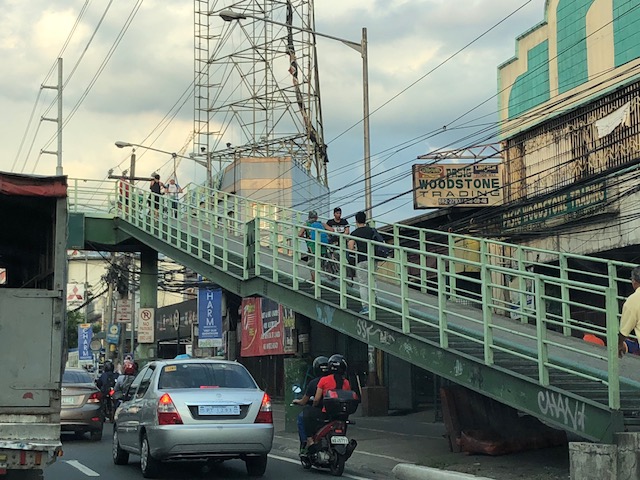 Cyclists use the overpasses to cross the wide Marcos Highway between Pasig and Marikina. There are only 2 ramps, one each on either side of the highway and it partly occupies the sidewalk beneath. Could there be a better design for such overpasses?
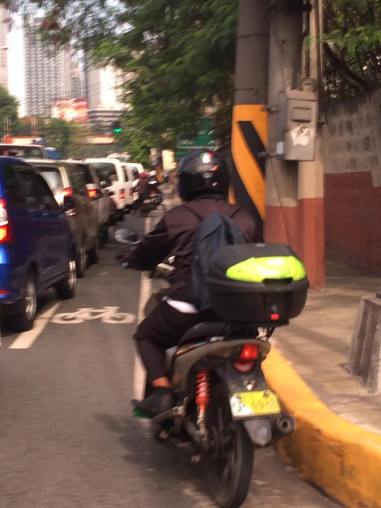 Motorcycles using the bike lanes along Ortigas Avenue. How do we make sure that spaces are utilised according to their intended users? How do we design these spaces to include elements that will deter such incursions?
There are many references out there showing us what good design should be from the technical and social perspectives. Surely these can be taken up not only at the workplace for architects, engineers and planners but in schools where such principles are supposed to be learned and inculcated into the minds of future architects, engineers and planners.
–
Another look at NAIA Terminal 4 departure
Here’s another set of photos care of a good friend who recently went through NAIA’s Terminal 4 en route to Palawan. Terminal 4 was what many people used to call the Manila Domestic Terminal. This was because it used to be the terminal for all domestic flights via Manila.
 The concierge’s desk greets travelers as they enter the terminal.
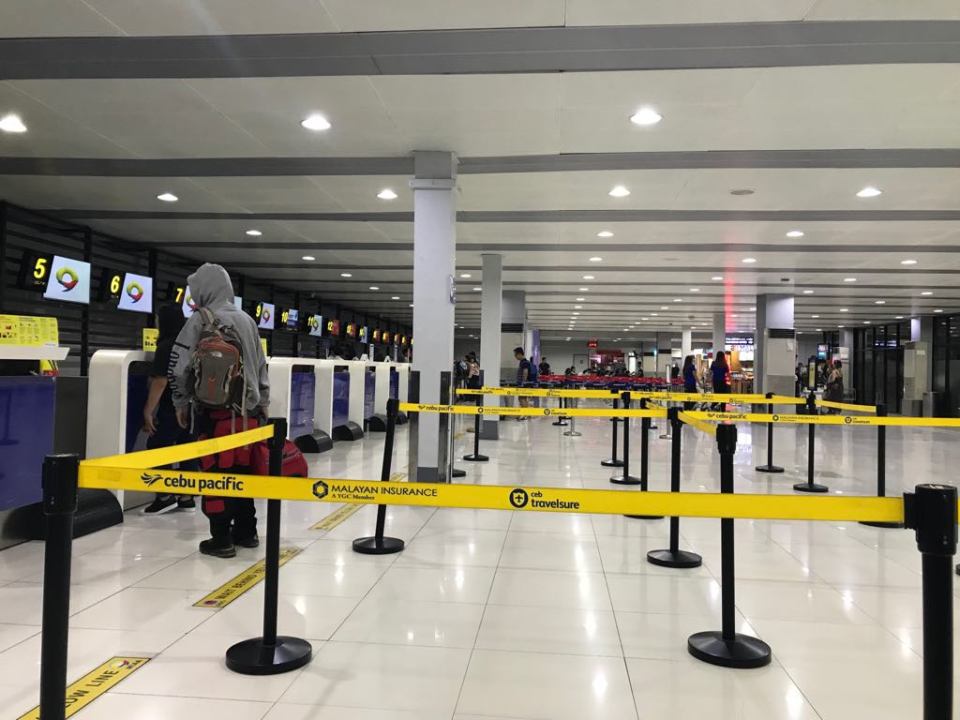 The terminal’s airline check-in area appears to be very spacious.
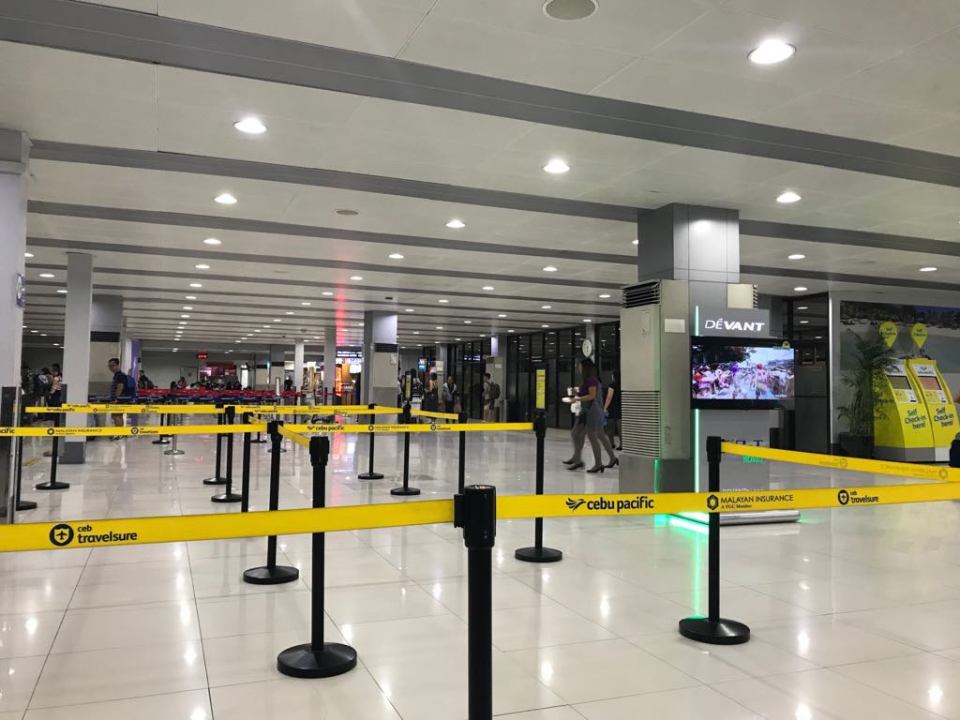 It was an early morning flight for my friend and that’s probably why, she says, it was much less crowded at the time she checked-in for her flight.
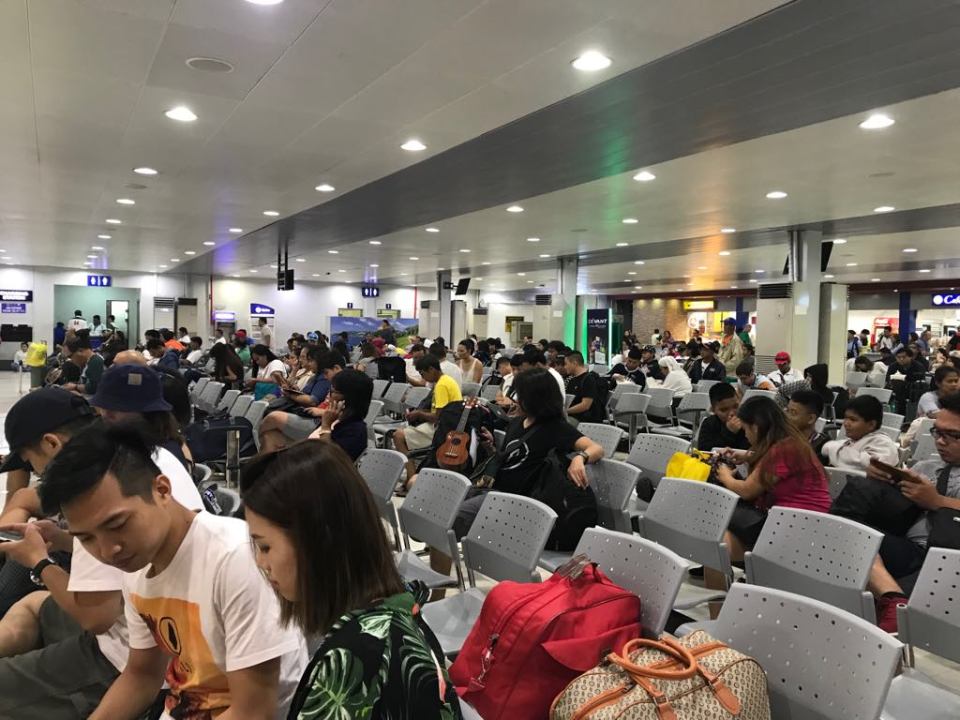 Passengers waiting for their boarding calls – the concessionaires are visible to the back in the photo.
–
What the DPWH says about the installation of ads including those masquerading as signs
So what does the DPWH say about signs and their installation? The DPWH in their Highway Safety Design Standards (Part 2: Road Signs and Pavement Markings Manual) states the following:


It’s plain and simple and yet we find a proliferation of ads masquerading as signs and entities such as the MMDA and LGUs not properly (or strictly) implementing the provisions of the DPWH manual. It is also sad to see practitioners actively trying (and succeeding) to circumvent this provision in the DPWH manual.
–
More on ads masquerading as signs
I recently wrote about what I thought were ads masquerading as signs. It turns out a friend also took notice of similar signs along Katipunan and decided to make this a topic of his vlog. I learned that he has corresponded with the MMDA regarding this matter and even contacted the company behind these ads (I would prefer to call them what they really are.) to get their take on the matter. It turns out that the company is quite aware that what they are doing are basically not according to DPWH guidelines pertaining to signage. I wouldn’t and couldn’t say it is illegal since the MMDA and LGUs gave their approvals for these ads to be installed.
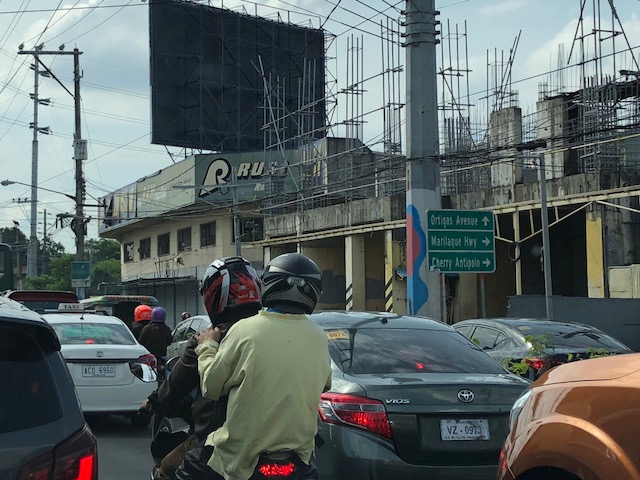 Approaching Cainta Junction from Antipolo, there is a sign that advertises Cherry Antipolo, which is all the way back and past Masinag Junction along Marcos Highway.
 Less than a kilometre away from Masinag Junction along Sumulong Highway, there’s another ad posing as a road sign and from a certain angle it covers a more important traffic advisory concerning the construction of the Line 2 Extension.
 This ad doesn’t even pretend anymore since all directions point to an Ayala Mall!
Following are examples of what may be tolerated and what must be disapproved and therefore removed. Guidelines are important so that the criteria for signs including ads masquerading as such will be clearly spelled out and approval/disapproval will not be
Logical: The photo below shows a sign installed by the DPWH showing the general directions for towns (Cainta, Taytay, Antipolo) or major thoroughfares (EDSA). The smaller sign is actually an ad for a mall but is located near a major junction (Cainta Junction – intersection of Ortigas Avenue Extension and Felix Avenue/A. Bonifacio Avenue) and may perhaps be tolerated as the mall is close by. Such a sign can be justified to assure or validate the direction to be taken by a traveler headed for this mall.

Not logical: The sign below is meters away from Masinag Junction in Antipol but advertises the same mall as the previous sign. It is not logical and should not have been approved since it is far from the destination mall and does not offer a validation or assurance for direction like the previous sign. In fact, the same mall chain has a branch nearby in the Masinag area and another one further on along the Marikina River. This sign should be removed as it adds to the clutter, the visual noise that makes people blind or numb to the actual road signs that require their attention.

[Disclaimer: For purposes of transparency, my colleagues and I also have worked as consultants for projects such as malls but never have we recommended for signs like these.]
–
A quick look at the Puerto Princesa airport terminal – departure
I asked a good friend to take a few photos of the airports she used in her recent trip to Palawan. Here is the first batch consisting of pictures of the pre-departure area of Puerto Princesa airport. It’s been a while since my last travel to Palawan and that was through its old airport terminal.
 Here’s a look at the pre-departure area of the terminal. It is obviously a significant upgrade from the old terminal.
 Here’s another look at the spacious are for passengers as they await their boarding calls.
 Here are some of the food concessionaires at the terminal.
 Passengers have a lot of choices for food and drinks as they wait for their flights.
I hope to be back in Palawan in the near future for some R&R and perhaps take more photos of this terminal for another article.
–
About the weather and other thoughts this weekend
We interrupt our regular posts with an article on the current state of the weather and some thoughts while a super typhoon (Mangkut) was devastating the northern and central Philippines. First the article from Wired:
Rogers, A. (2018) An Equator Full of Hurricanes Shows a Preview of End Times, http://www.wired.com, https://www.wired.com/story/an-equator-full-of-hurricanes-shows-a-preview-of-end-times/?CNDID=37243643&mbid=nl_091418_daily_list1_p4 [Last accessed: 9/15/2018]
I am not into doomsday articles and thinking but am always fascinated by it if has foundations in science and fact rather than of religion or the “prepper” type of thinking. This one is based on fact and should not be dismissed as “fake new” – an excuse many use if the information presented to them offers an inconvenient truth about our state of affairs or, in this case, state of the earth.
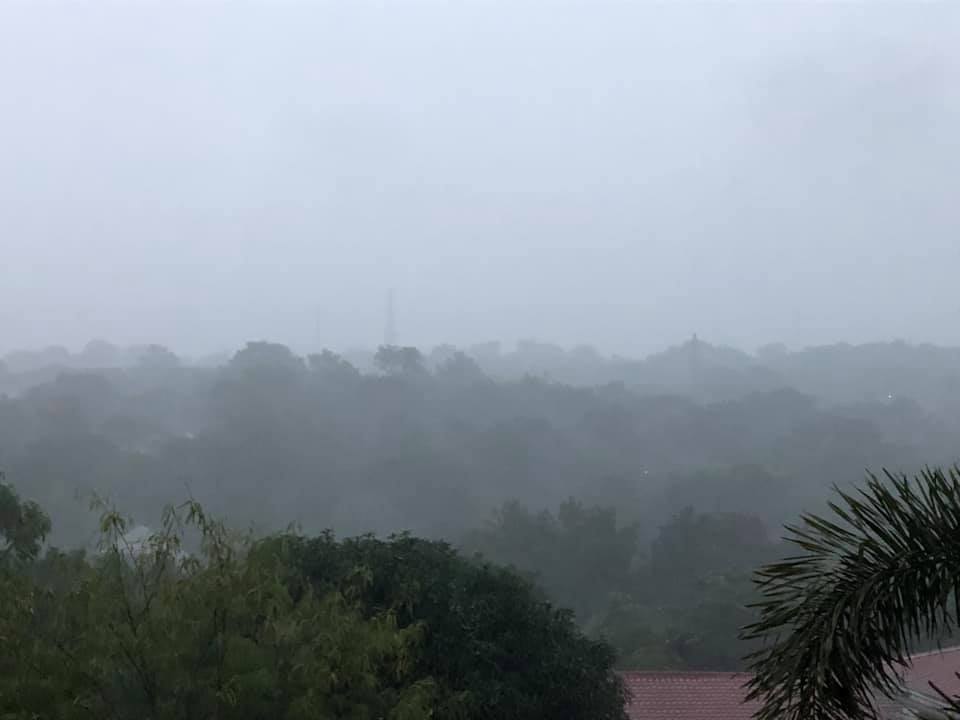 Gloomy weather brought about by Typhoon Mangkut
I was thinking about the bad weather and what previous strong typhoons have brought about early this morning as I was awaken by the sound of the strong winds and the heavy rains that followed. I easily come awake and cannot sleep whenever we have inclement weather. Its been like this since my childhood as our home was in a flood prone area.
The last times there were typhoons comparable in perceived and actual physical impacts, the socio-political impacts also eventually manifested. Typhoon Ketsana (Ondoy) in 2009 dumped record rainfall across a wide area that included Metro Manila, Central Luzon (Region 3) and Southern Luzon (Region 4A). The government’s response then and the issues that came about afterwards essentially contributed much to the doom for many of the administration’s candidates in the 2010 elections including its standard bearer who was Defense Secretary at the time. The follies of many politicians and government agencies were also exposed and most people judged them for that in the elections.
Come 2013, another typhoon, Haiyan (Yolanda), laid waste to much of the central Philippines. It was a super typhoon that again caught most, especially government, unprepared for the devastation that was its outcome. It spelled disaster, too, to many political aspirations with the then Interior Secretary becoming the poster boy somewhat for the government’s failures. Apparently, many of the lessons of Ondoy were not heeded despite gains here and there in weather forecasting and disaster preparedness. But then these were perceived to be more on the side of politicians. There were no lack in politicking, self promotion and grandstanding. And there was even more drama among rival sides in Philippine politics. There was enough material for fodder come 2016.
The current administration is much aware of the issues and the dangers of playing into the same script. After all, they created much of the political storm that led to an almost complete defeat of the previous admin’s ticket (the current VP survived that and hopefully gets to finish her term instead of being replaced by the ambitious son of a former dictator). But the present set of leaders and wannabees are not lacking for distasteful maneuvers as relief goods are being prepared by government agencies and local government units bearing the name (and sometimes even face) of aspirants for electoral posts in the 2019 elections. Among these are a Presidential “alalay” who is somewhat desperate for a senate post if only to protect himself from charges once his sponsor(s) bow down from power.
Will Mangkut/Ompong effect positive change in the country? Perhaps so and we can only hope it will be for the better. And that we, as a people, learn from mistakes we have made including electing certain people who are not fit or qualified to lead us.
–
On the need to increase NMT and public transport use
A recent report reinforces what many of us already probably know or are aware of – that we need to shift away from dependence on car use to more sustainable modes of transport in the form of non-motorised transport (NMT) and public transportation. Here is the article from the AASHTO Journal:
Global Climate Report Calls For Expansion Of ‘Non-Motorized’ Transport And Public Transit (2018)
There is a link to the report in the journal article. The report is conveniently available in PDF form and is very readable (i.e., not overly technical).
Incidentally, I was involved some time ago in a project led by the group Clean Air Asia (CAA), which involved several experts from across ASEAN as well as Japan that attempted to determine the necessary transport programs and projects in the region to stave off the projected increase in global temperatures. In all the scenarios evaluated, non-motorised transport (NMT) and a rationalised public transportation system By the term ‘rationalised’ I am referring to the use of higher capacity vehicles as against the taxis and tricycles that typically carry few if not one passenger. Here is a link to the final symposium for that study that has links to the materials presented:
The Final Symposium on the “Study on Long Term Transport Action Plan for ASEAN”
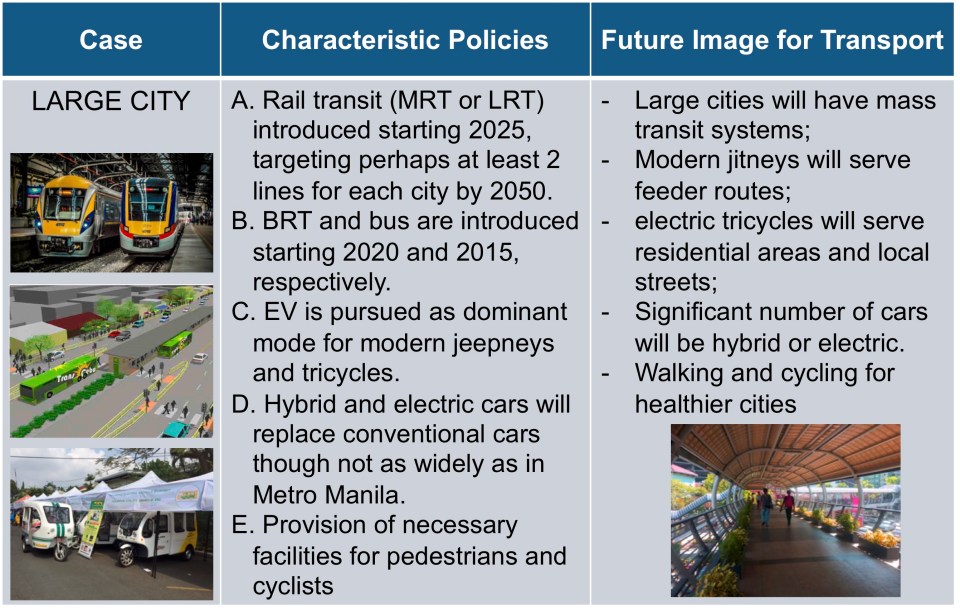
Here’s a slightly updated slide on the future image for a large city in the Philippines:
–
On the relationship between public transport use and enhanced traffic safety
I found this article while browsing the AASHTO Journal:
APTA Study Says Higher Transit Use Results In Fewer Traffic Deaths, https://aashtojournal.org/2018/08/31/apta-study-says-higher-transit-use-results-in-fewer-traffic-deaths/ [Last accessed: 9/5/2018]
The article contains a link to the report, which would be a good reference for those who want to show proof for the argument for public transportation development and use vs. dependence on cars. I think its possible to come up with our own version of the graphs shown in the report especially those that show less traffic fatalities per 10,000 residents vs. annual trips using transit per capita. However, this will require data collection and analysis for at least the highly urbanised cities (HUCs) in the country. I say at least because these cities would be the ones likely to have the resources to determine the stats necessary for such an assessment.
–
 Caught (up) in traffic