
Home » Academe (Page 8)
Category Archives: Academe
TSSP 23rd Annual Conference Proceedings
The 23rd Annual Conference of the Transportation Science Society of the Philippines (TSSP) was held at the University of the Philippines (UP) Diliman last August 8, 2016. It was hosted by the National Center for Transportation Studies (NCTS), which for some time was practically inactive in its dealings with the society. The conference was a very successful one with more than 170 participants, mostly students from the undergraduate programs of Mapua Institute of Technology (MIT), De La Salle University (DLSU) and UP Diliman.
The Proceedings of the 23rd Annual Conference contains 22 technical papers, which I have already listed in a previous post showing the technical program for the conference. The link is to the current website of the TSSP hosted by NCTS. Those wishing to have copies of the papers may download them directly from the link. Meanwhile, those interested in the presentations should contact the authors. Their contact information are stated in the paper and it is ethical to get the nod of the authors for their presentation file as these still fall under what can be defined as their intellectual property. I am aware of people who tend to get presentation slides and then pass them of as their work when they use the slides or the data/information therein. There are proper ways for citations of references and sources but sadly such ways are not observed by many.
–
TSSP 2016 Conference Program
I am sharing the banner and final program for the Transportation Science Society of the Philippines 23rd Annual Conference to be held on Monday, August 8, 2016. The final program features a Keynote Speech by the Undersecretary for Road Transport and Infrastructure Anneli R. Lontoc, a Panel Discussion on Road Safety, and technical sessions in the afternoon.


 –
–
TSSP 2016 Conference: Tentative Program
I am sharing below the tentative program for the 23rd Annual Conference of the Transportation Science Society of the Philippines (TSSP):

Soon, I will post on the list of papers to be presented for the Technical Sessions to be held in the afternoon part of the one-day conference.
–
TSSP 2016 Conference – August 8, 2016
I start August with an announcement, promoting the 23rd Annual Conference of the Transportation Science Society of the Philippines (TSSP). The theme of this year’s conference is “What Gets Measured, Gets Managed: Transportation, Data and Statistics.” The conference will have a panel discussion in the morning and parallel technical sessions in the afternoon.

The topic for the panel discussion is “Road Safety Data: Issues, Challenges and Opportunities”. Confirmed are resource persons from the Department of Transportation, the Department of Public Works and Highways, and the Global Road Safety Partnership Philippines. The session will feature presentations and reactions on agency or organization initiatives on road safety with emphasis on road safety data. An open forum will immediately follow for the audience to be able to participate in the discussions.
The afternoon will feature 4 parallel technical sessions where selected papers will be presented. These would be the output of researches from leading universities including the University of the Philippines, De La Salle University and Mapua Institute of Technology. I will post on the paper titles as soon as I get a copy of the program.
The one-day conference will be held at the National Center for Transportation Studies at the University of the Philippines in Diliman, Quezon City.
–
Introducing the New Director of the National Center for Transportation Studies
The National Center for Transportation Studies (NCTS) of the University of the Philippines Diliman has a new Director. Dr Ma. Sheilah G. Napalang of the School of Urban and Regional Planning (SURP) succeeds Dr Hilario Sean O. Palmiano of the College of Engineering. Dr Napalang becomes the 5th Director of the NCTS since the latter’s transformation from the Transport Training Center (TTC) in the early 1990s, not counting the two OICs over that period.
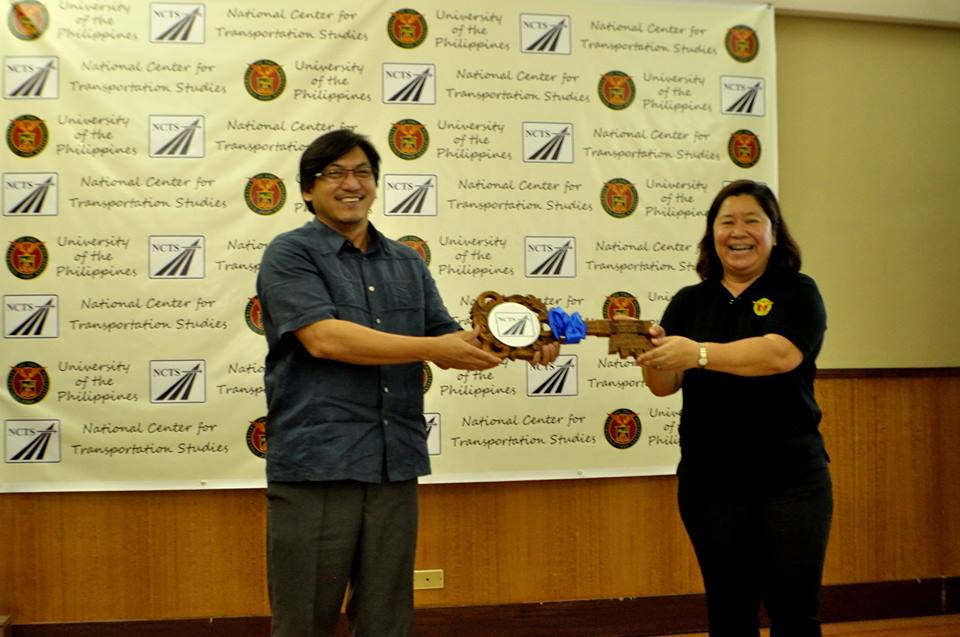 Dr. Napalang receives the symbolic key from Dr Palmiano
Dr Napalang was a former top senior technical staff of the NCTS before she joined the faculty of SURP after a short stint at the Asian Institute of Tourism (AIT) of the same university. Prior to joining UP, she was a faculty member and former Chair of the Department of Civil Engineering of Xavier University in Cagayan De Oro City in Mindanao. Dr Napalang obtained her B.S. Civil Engineering degree at Xavier University, her master’s at Virginia Tech in the US, and her doctorate at Tokyo Tech in Japan. She has done work on sustainable transport and the viability of transport systems. She has also contributed to the Cebu Bus Rapid Transit (BRT) project and the formulation of the National Environmentally Sustainable Transport (EST) Strategy. Her most recent publications are:
- Challenges of Urban Transport Development in Metro Manila: A look back at the last 40 years (lead author)
- State of Pavement Engineering in the Philippines and Implications on the Economic Life of National Roads (lead author)
These papers were presented at the recent 11th International Conference of the Eastern Asia Society for Transportation Studies (EASTS) held in Cebu City last September 2015.
Congratulations to Dr. Napalang for her new appointment, and thank you to Dr. Palmiano for his contributions as NCTS Director!
–
A new Director of the National Center for Transportation Studies
I learned a couple of days ago that there will be a new Director at the National Center for Transportation Studies (NCTS) at the University of the Philippines in Diliman soon. The new Director will be Dr. Ma. Sheilah G. Napalang who is a tenured faculty member of the university’s School of Urban and Regional Planning. She is to be the first woman head of the center, which used to be called the Transport Training Center that was created in the 1970s as part of the Japanese Government’s technical assistance to the Government of the Philippines to increase capacity and capability in transportation planning, engineering and management. Dr. Napalang will be the first Director from SURP since 2001 (since that time, all Directors were from the College of Engineering). She was a former senior technical staff of the NCTS before she joined the SURP and obtained her advanced degrees from the US (masters’ at Virginia Tech) and Japan (Dr. Eng. at Tokyo Tech).
More on this development and perhaps the turnover once everything is final and formalized.
–
Kids stuff for urban planning?
It’s been a busy latter part of the week and I haven’t had much time to finish a new article so I will just be sharing another interesting article, this time on urban planning. I spotted the article in my mailbox as part of a bulletin that I am subscribed to. Here’s a link to the article:
Teaching urban planning to pre-schoolers
It’s interesting to me as I am a teacher and I thought as I read this that we should probably be teaching transport planning or transport engineering to pre-schoolers as well. We are doing something like that for grade schoolers already in the form of road safety lessons. I am already curious about what topics to cover for pre-schoolers and how to teach them. Older children probably could go with SimCity and other computer games but pre-schoolers can be more of a challenge in terms of the tools you would need for them to learn. Using Lego is a brilliant idea and the same can be applied to transport as well in addition to maybe Matchbox and Tomica.
–
Readings for the new year
I wrote late last year about how the Christmas and New Year holidays allow me to catch up on some readings. These are mostly contemporary articles on transport and other topics rather than whole books (though I just finished one by George RR Martin during the semester). That post with three articles may be found in this link:
Some interesting readings on traffic engineering
I open the year with another post with a couple of interesting articles. One article reports on the newly opened bicycle ‘autobahns’ in Germany. ‘Autobahns’ basically refer to expressways or freeways. The new facilities for cycling represents what many will term as a paradigm shift for a country well known for its excellent automobiles. The concept of an expressway for bicycles actually makes sense in terms of safety and as a way to eliminate many if not all the factors that tend to discourage people from using bicycles for longer distance commutes. These do have the potential to reduce car usage (and traffic congestion) and ultimately also reduce pollution and fuel consumption. I am interested about the designs of these structures as the designs are also key to the development of similar infrastructure elsewhere including, hopefully, the Philippines.
Germany opens first stretch of bicycle ‘autobahn’
Another article is more thought provoking in the sense that it delves into labor and legal issues surrounding Uber and other ride sharing companies. These issues are valid and need to be discussed thoroughly not just in the US but elsewhere where ride sharing services have proliferated and profited. Many of the points pertaining to labor and compensation are valid, and I would like to think that these extend to the franchising issues that have been raised against ride sharing, which ultimately have implications on their business model. The legalese may be a turn-off to many who would argue that companies like Uber and Grab provide them with a good quality of service. But then that begs the question of whether they would have the same view if taxis were better than what they are now.
Road warrior: Is Uber ripping off its drivers?
Happy New Year and happy readings!
–
Some interesting (and required) readings on traffic engineering
Christmas breaks allow me to catch up on a lot of reading. The previous months comprising our university’s semester were spent preparing for lectures though I had to do some readings related to researches I am involved in. Browsing the net and social media, I came across 2 articles shared by an acquaintance. He is a very progressive planner who has extensively studied and written about the most relevant issues in urban planning, focusing on transport. A third article I found while reading one of the two. These were very interesting for me in part because they are thought provoking in as far as traffic engineering is concerned.
- What traffic engineers can learn from doctors
- As traffic deaths rise, blame engineering dogma
- The new science of traffic engineering
The author seems to call out traffic engineers in general but these articles should also be contextualized properly. The situations mentioned in the articles are to be found in cities in the United States and may not be applicable in other cities in other countries. Traffic engineers in Europe, for example, have been working on exactly the solutions being mentioned in the articles that would make streets inclusive and safe especially for pedestrians and cyclists. The same with Asian cities like Singapore and Tokyo.
In the Philippines, however, there is so much that we can learn from the articles. The mere mention of the design guidelines being used in the US betrays the flaws of highway and traffic engineering in the Philippines. The Philippines’ highway planning manual and other guidelines used by the Department of Public Works and Highways (DPWH) are heavily drawn from US references. Most highway and traffic engineers in the country are educated using curricula that use US textbooks and references. There are even civil engineering programs that use licensure exam review materials as their references! These exam materials are also known to be based on DPWH guidelines and manuals aside from problems “outsourced” or patterned after the Professional Engineer (PE) exams in the US. Few schools have progressive curricula that look to best practices that take into account the complexities of roads especially in the urban setting. Such ‘copying’ of American standards and practices in many cases do not consider Philippine (local) conditions and blind applications to our roads instead of proper adaptation often have lead to unsafe and inequitable roads.
–
Undergraduate research topics on transportation for Academic Year 2015-2016
Our students at the University of the Philippines Diliman are currently making their final presentations for the research topic proposals to be implemented in the next second semester (January to May 2016). The first semester (August to December 2015) focused on research topic formulation including problem identification and formulation, review of related literature, and development of methodologies for data collection and analysis. Here are the topics of our students in transportation engineering and planning (not in any order):
- Economic Feasibility of Electric Tricycles as Shuttle-Type Transport Service in Medium Density Residential Areas with Linear-Type Local Road
- A Study on Road Public Transport Policies and Planning in Metropolitan Manila: 1970s to the Present
- Comparative Study of GrabTaxi and Regular Taxi within Metro Manila
- Comparative Study of Uber and Regular Taxi
- An Analysis of Road User Behavior Influence on Unsignalized Intersection Performance
- An Assessment of Cycling and Bicycle Lanes along Marcos Highway
- Energy Efficiency of Electric Jeepneys
- Application of Discrete Choice Modeling in UP Diliman
- Development of Vissim Traffic Simulation Model of UP Diliman (Focus on Vehicle Characteristics)
- Evaluation of Runway Design and Capacity of Ninoy Aquino International Airport (MNL)
- Determination of Satellite Parking Locations and Capacities in the University of the Philippines Diliman Campus
- Critical Review of Practices Abroad Towards Identifying Pavement Performance Indicators in the Philippines
- A Study on the Suitability of Tricycles as an Urban Transport Mode in the Philippines
- Benefit Monitoring and Evaluation of the South Metro Manila Skyway Project (Stages 1 and 2)
- Predicting Student Trip Patterns Using Enrolment Data within UP Diliman
- Video Image Processing for Parking Management
- Analysis of Occupancy and Dwell Time of Buses in EDSA
- Development of Public Transport Information System in UP-Diliman
- Philippine Air Transport Safety: Analysis of Incidents over the Last Two Decades
- Evaluation of Transfer Facilities for Public Transportation in Metro Manila
- Survey of Maintenance Practices for Concrete Structures in Transportation Facilities
- Road Safety Audit Evaluation of Expressways
- Calibrating MOBIL Lane Changing Model for Local Traffic Micro- Simulators
- Development of VISSIM Traffic Simulation Model of UP Diliman
Again, note that there are many topics here that have as a study area the UP Diliman campus. These are part of the studies the Institute of Civil Engineering and the National Center for Transportation Studies are conducting to address transportation issues in the campus, which is an open campus with public roads.

