
Home » Air travel (Page 9)
Category Archives: Air travel
Surabaya’s Juanda International Airport
Traveling to Surabaya, Indonesia for a conference in 2009, we made the trip via Hong Kong rather than via Jakarta. It was the call of our sponsor rather than ours to fly via HK. I understood the logic of the arrangement as both legs of the trip (Manila to HK and HK to Surabaya) were international flights. If we flew via Jakarta, the second leg would a domestic flight. Cost-wise, the latter option could have been cheaper but comfort-wise, the first option was definitely better. Our sponsor booked us on Cathay Pacific Airways, which flew directly between HK and Surabaya. From what I’ve learned from other more experienced travelers, given the option they would always take Cathay over Garuda, which is Indonesia’s national carrier. Another option, which another friend took, was to fly via Singapore using Singapore Airlines between Manila and Changi, and then Silk Air (SIA’s regional spin-off) from Changi to Surabaya. I can imagine that to be also a good option considering the usually excellent service of SIA.
The following photos show just a glimpse of Juanda Airport as I didn’t get a chance to take photos during our check-in and stroll within the airport. I wasn’t that conscious about taking a few photos here and there as I was not blogging about transport and traffic back then. But based on what I remember, arrivals at the airport was no different from domestic operations in many of the larger Philippines airports. And for departures, the Juanda Airport offered only the basic conveniences to travelers and had few shops for last minute purchases or recognizable restaurants for quick meals. On our way back, it wasn’t really an issue as we were passing through HK and had a few hours to burn at HKIA prior to the Manila leg of our return trip.
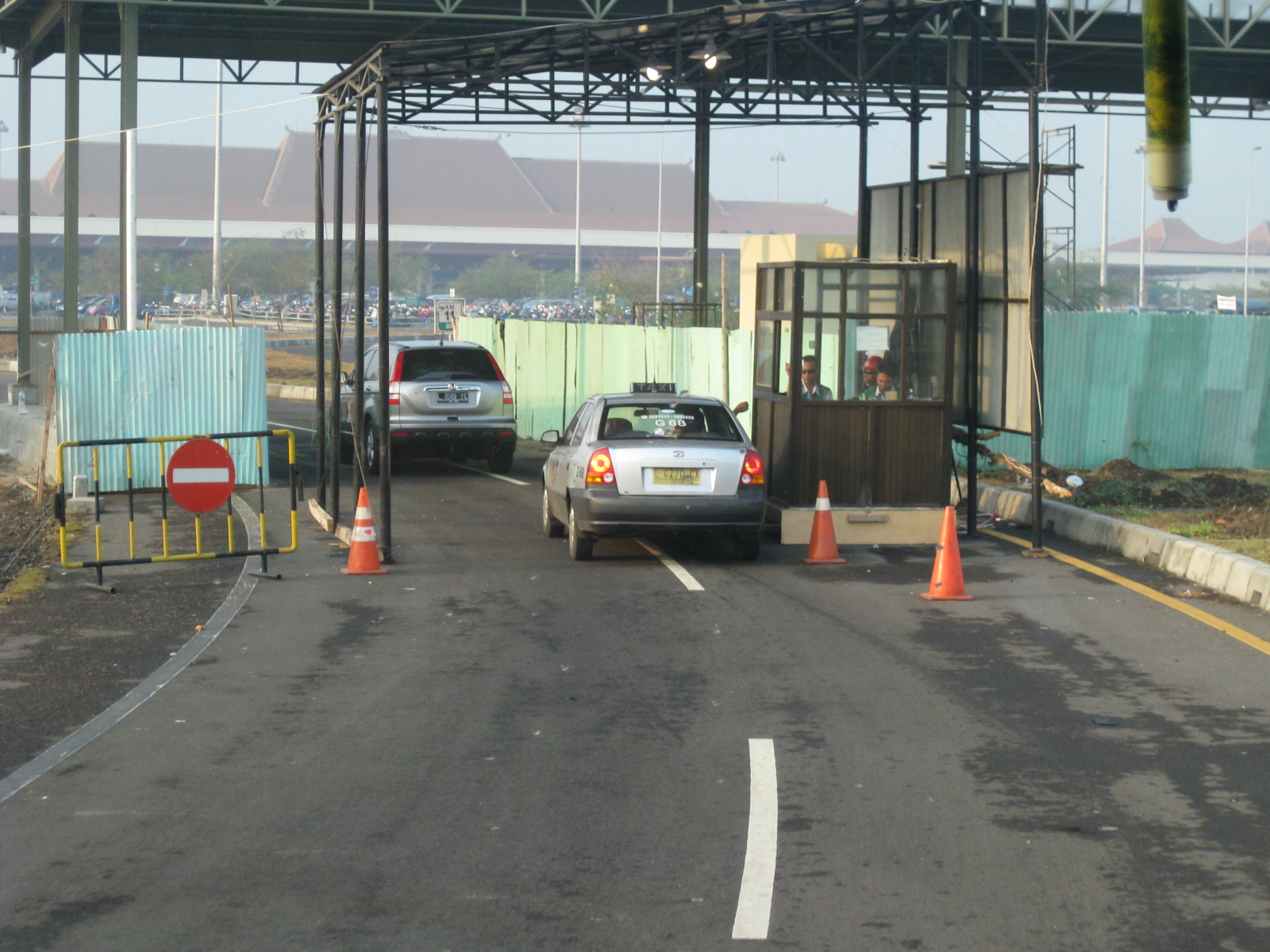 Security check for vehicles bound for the airport
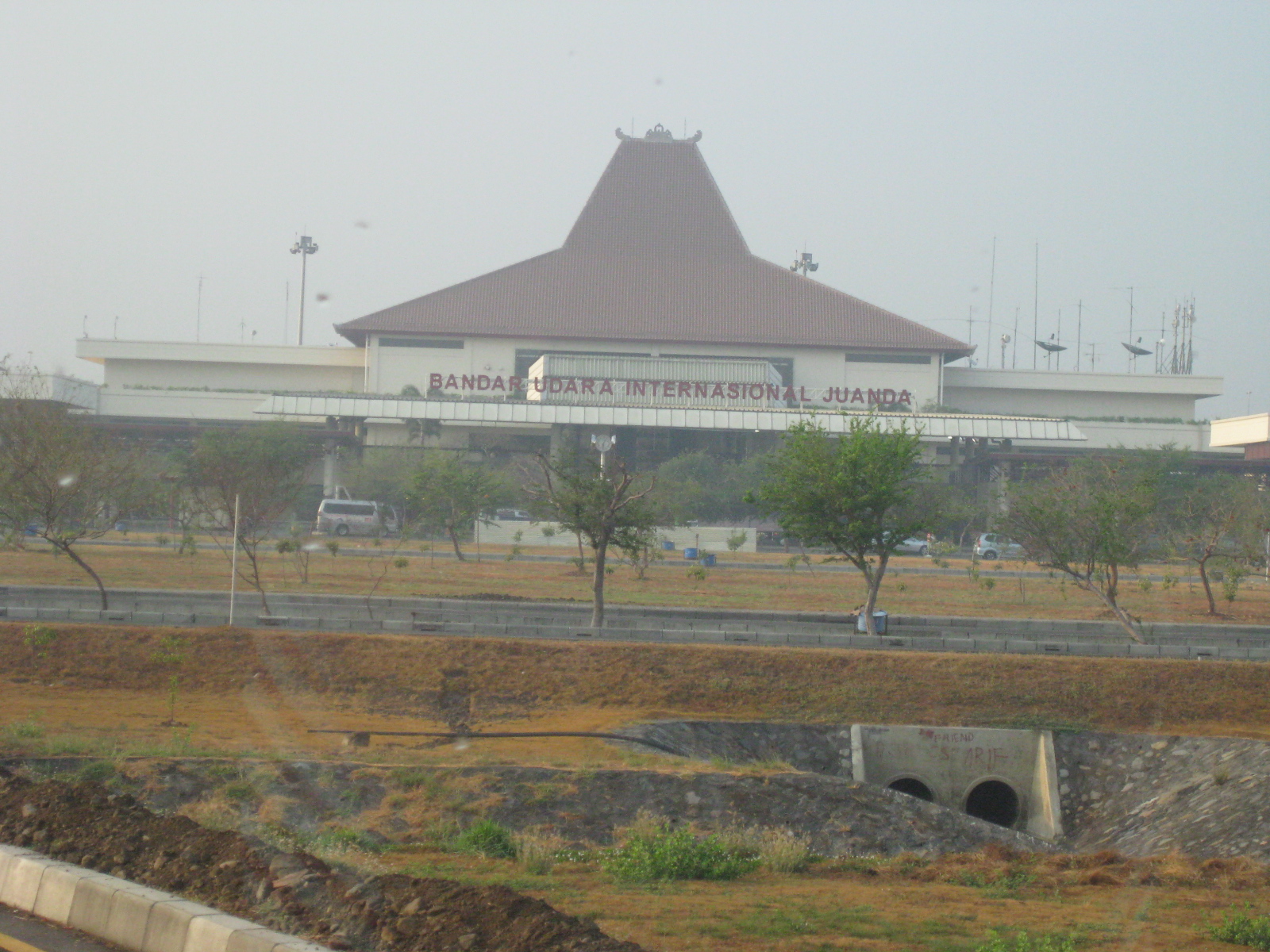 The Juanda International Airport terminal as seen from the highway
 Taxis lined up for passengers at the airport
 Approaching the terminal, we were surprised with the pedestrians crossing the wide road
 Private cars and public transport (e.g., taxis, buses) carrying common passengers stop along the terminal building
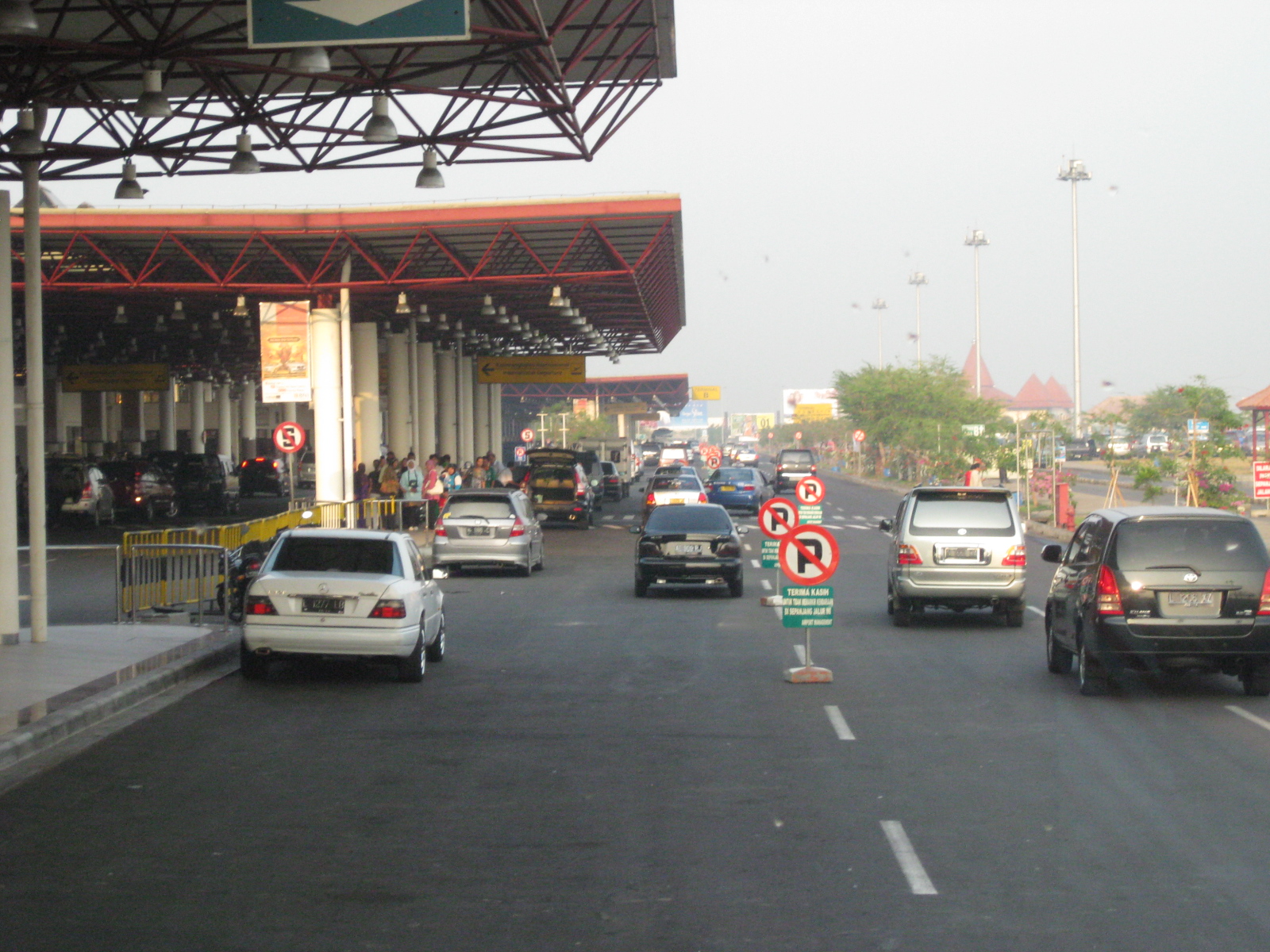 VIPs and others get to use the road closer to the terminal shown on the left in the photo
 Departure lounge at the Juanda International Airport
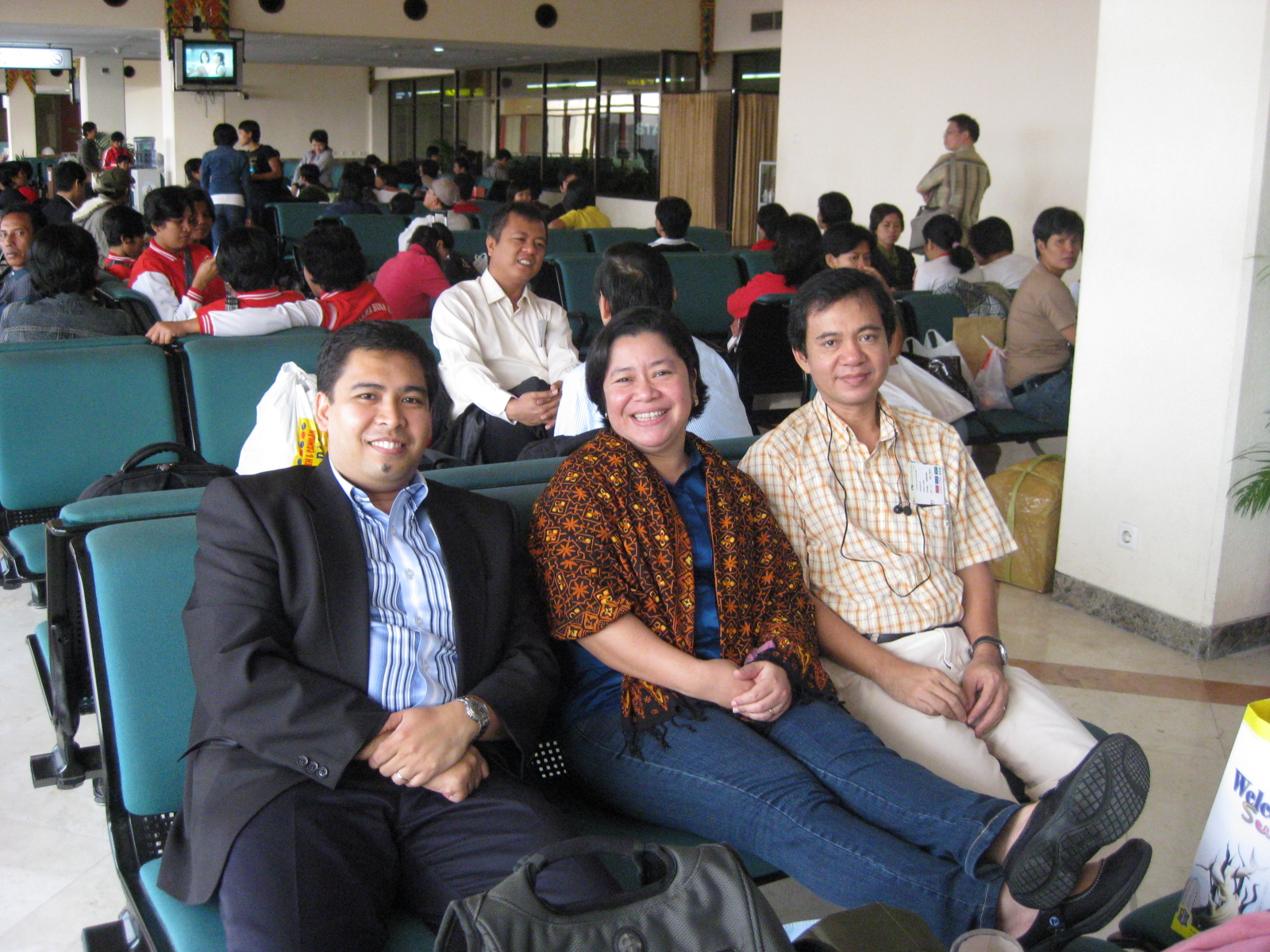 Our group posing for a souvenir photo at the airport
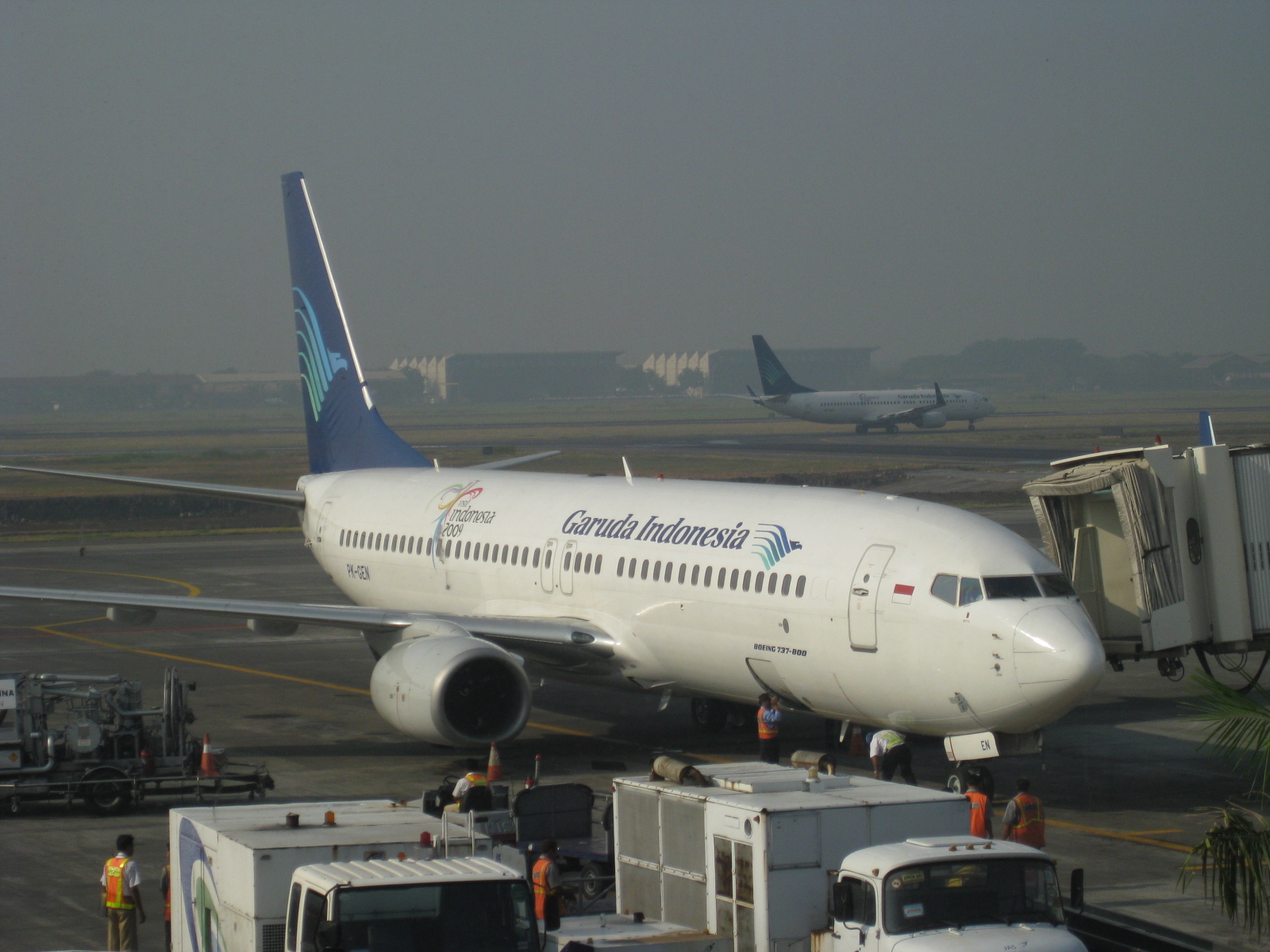 Garuda Airbus A320 docking at the air terminal, Garuda is Indonesia’s national flag carrier
I was not impressed with Juanda Airport at the time we visited Surabaya in 2009. It was my first time in Indonesia so it would be unfair to judge Indonesian airports by what I saw in Surabaya. Bali/Denpasar was much better and a more recent experience, and with a new terminal being constructed there to accommodate the millions of passengers traveling to Bali, I guess those facilities will be built to impress visitors and residents alike.
–
Changi’s Budget Terminal
Singapore has the best airport in the world, a distinction it has maintained despite challenges from similar world-class airports like the ones in Hongkong and Incheon. It currently has 3 huge terminals for mainly full service airlines including the very impressive Terminal 3. Singapore also has a Budget Terminal, which I have observed as serving only 2 airlines, both budget – Tiger Airways and Cebu Pacific. The Budget Terminal has most of the amenities of the three other main terminals and is also excellently maintained with its sparkling clean floors and toilets. In fact, when one arrives at the airport for an early flight, you will notice that there are people (mostly caucasians) lying on the floor somewhere taking a nap while waiting for their counters to open. I guess it beats renting a room at a hotel considering you can burn time at the airport with all its facilities available, 24 hours. Following are a few photos I was able to take while waiting for the airline counter for my flight to open and also while waiting for my boarding call.
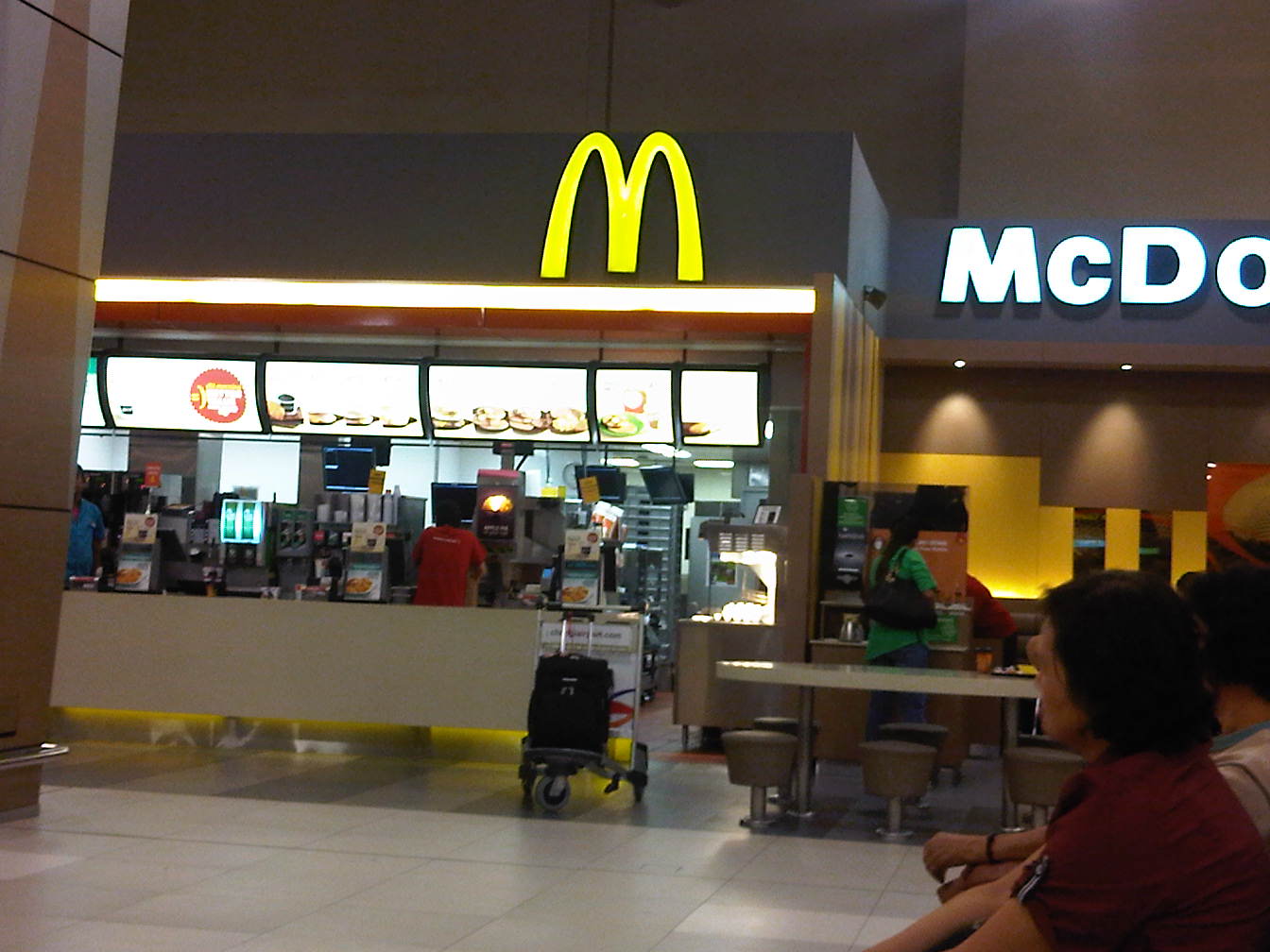 A McDonald’s outlet at the Budget Terminal
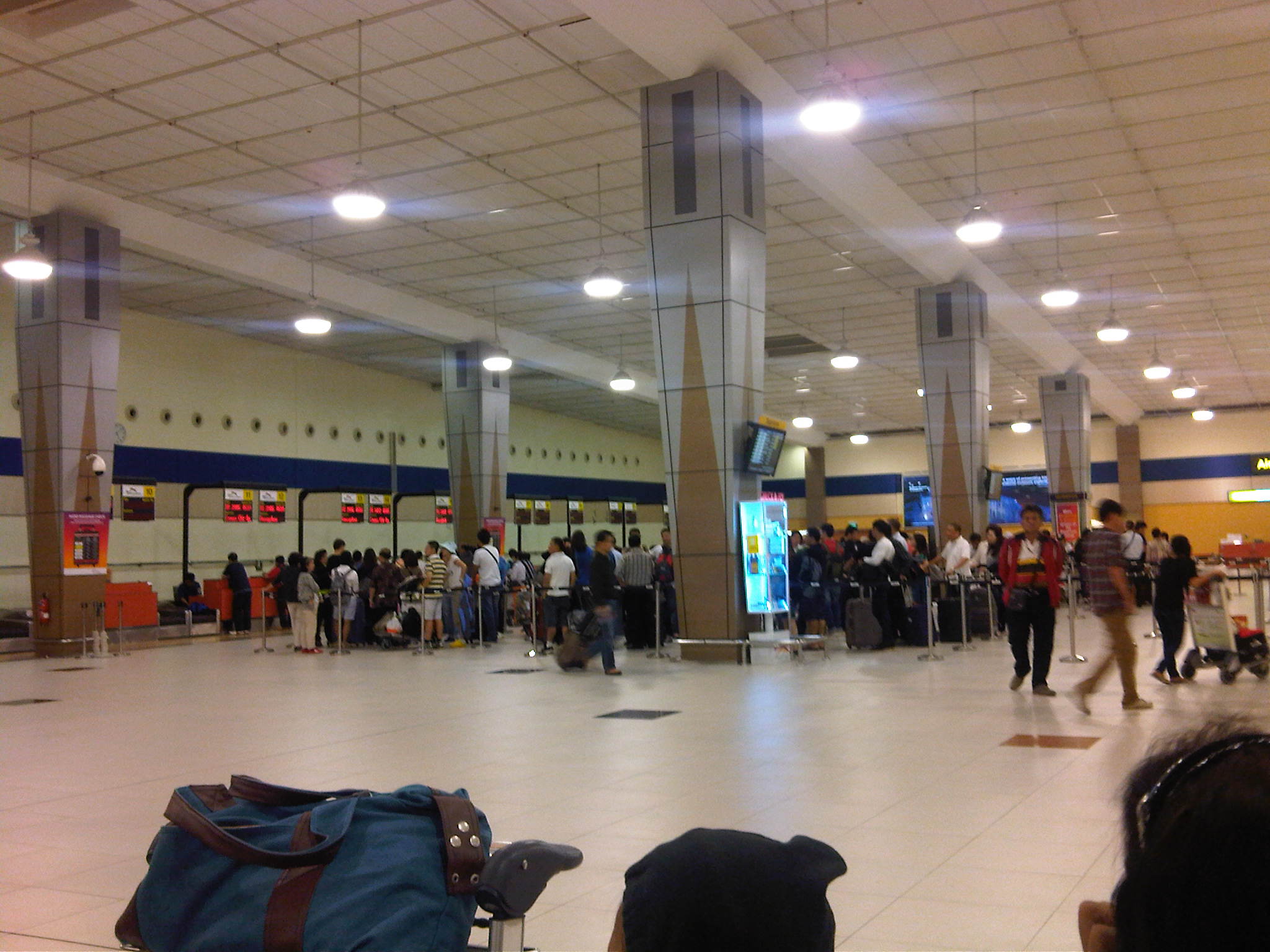 Queues at the Tiger Airways check-in counters
 Airport staff pushing carts toward the gates
 Passengers queued before the Departure gate prior to the immigration counters
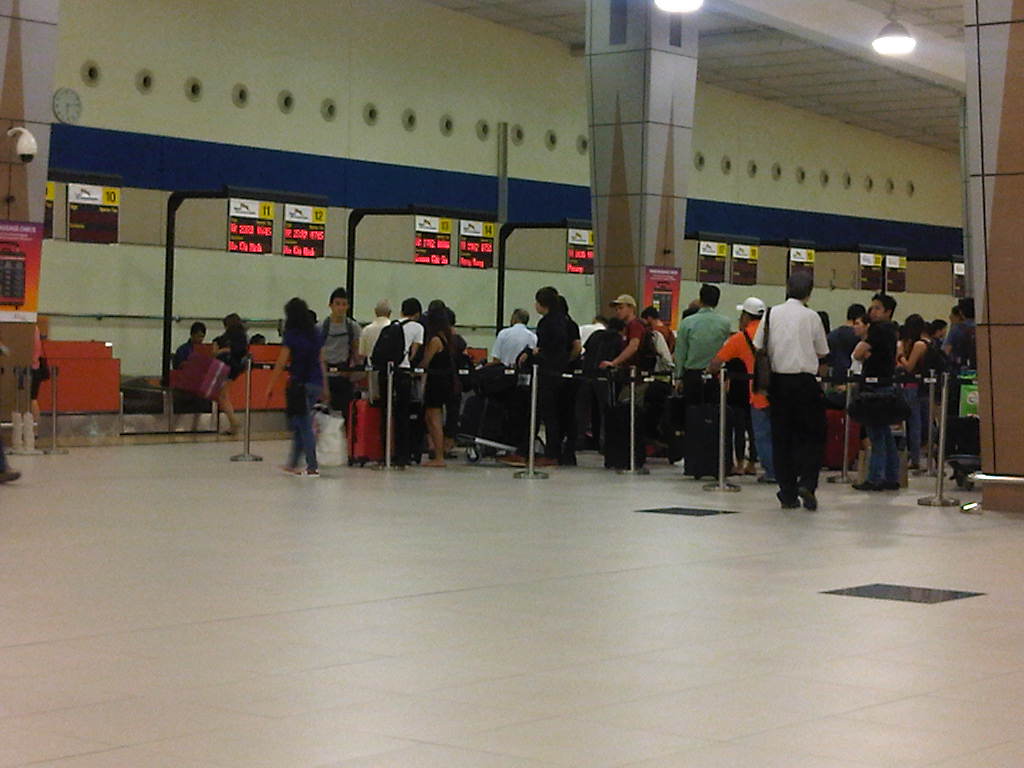 Tiger Airways is one of the more successful budget airlines in the region, a distinction in shares with AirAsia and Cebu Pacific
 You see a lot of passengers with large boxes or luggage including what are obviously electronics (giant LED or LCD TVs are quite the bargain in Singapore).
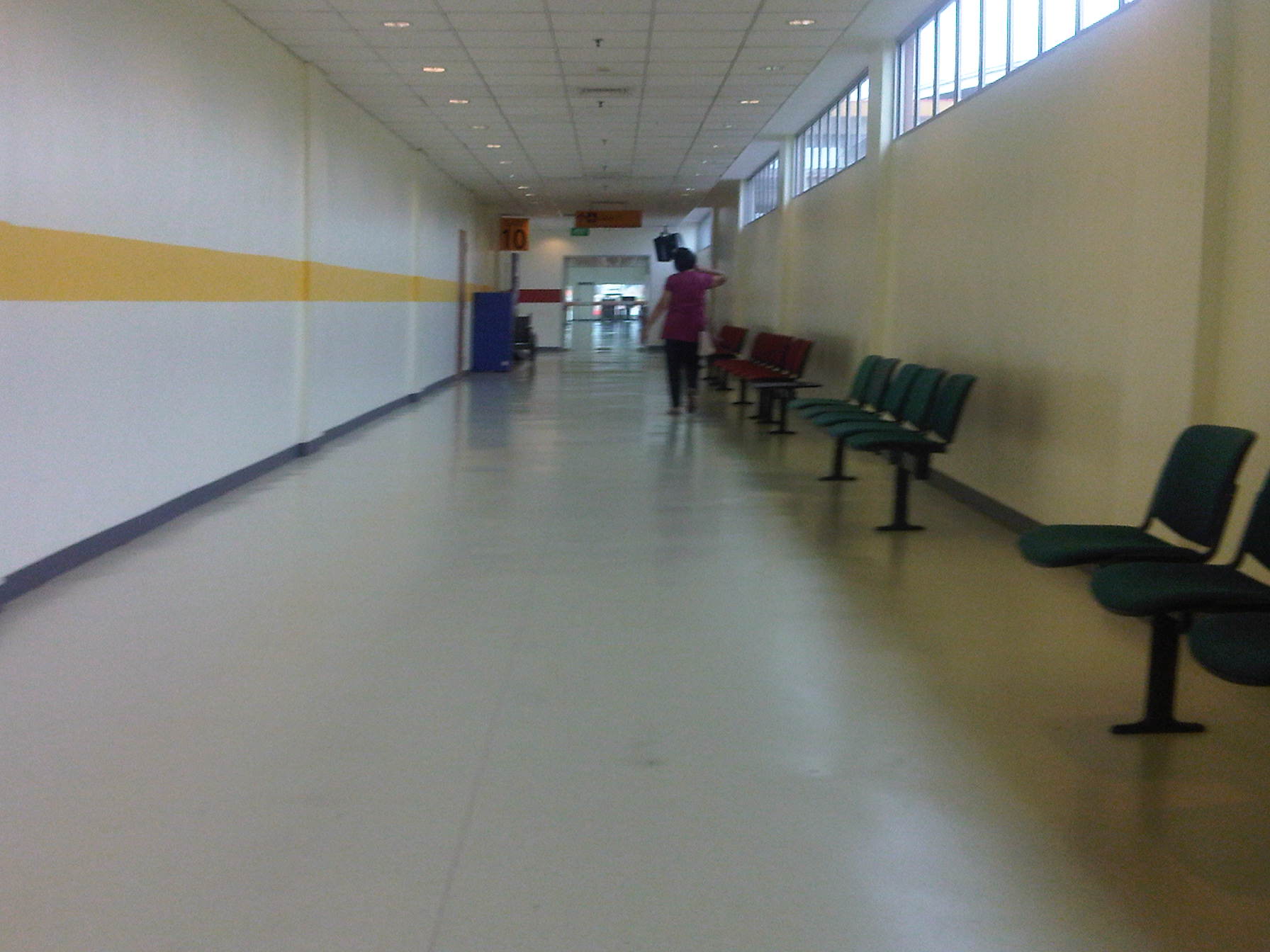 Corridor to the gate
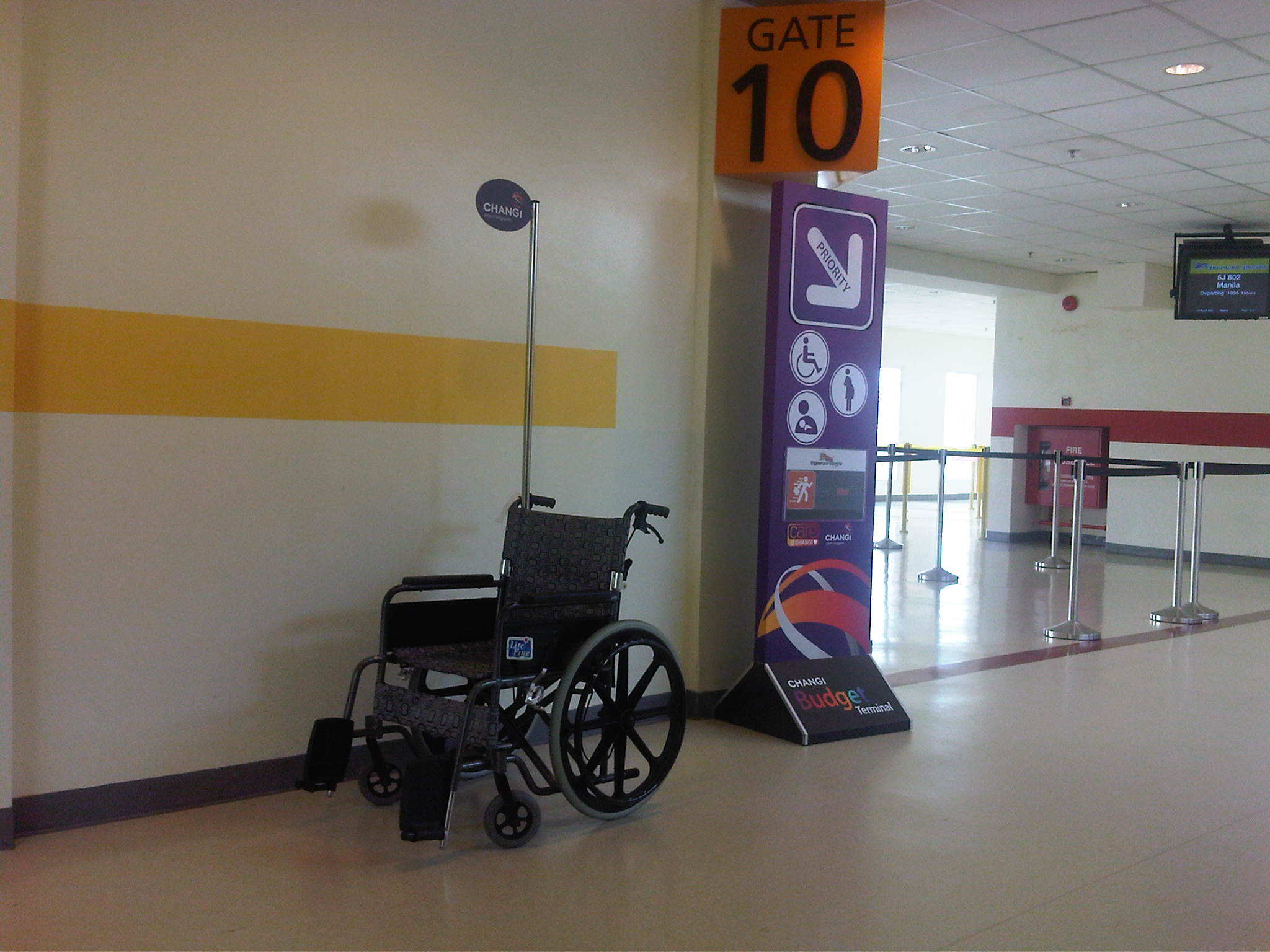 Wheelchair for passengers requiring it and sign stating priority for boarding (PWDs, pregnant women, those with small children)
 The waiting area at the end of the linear budget terminal
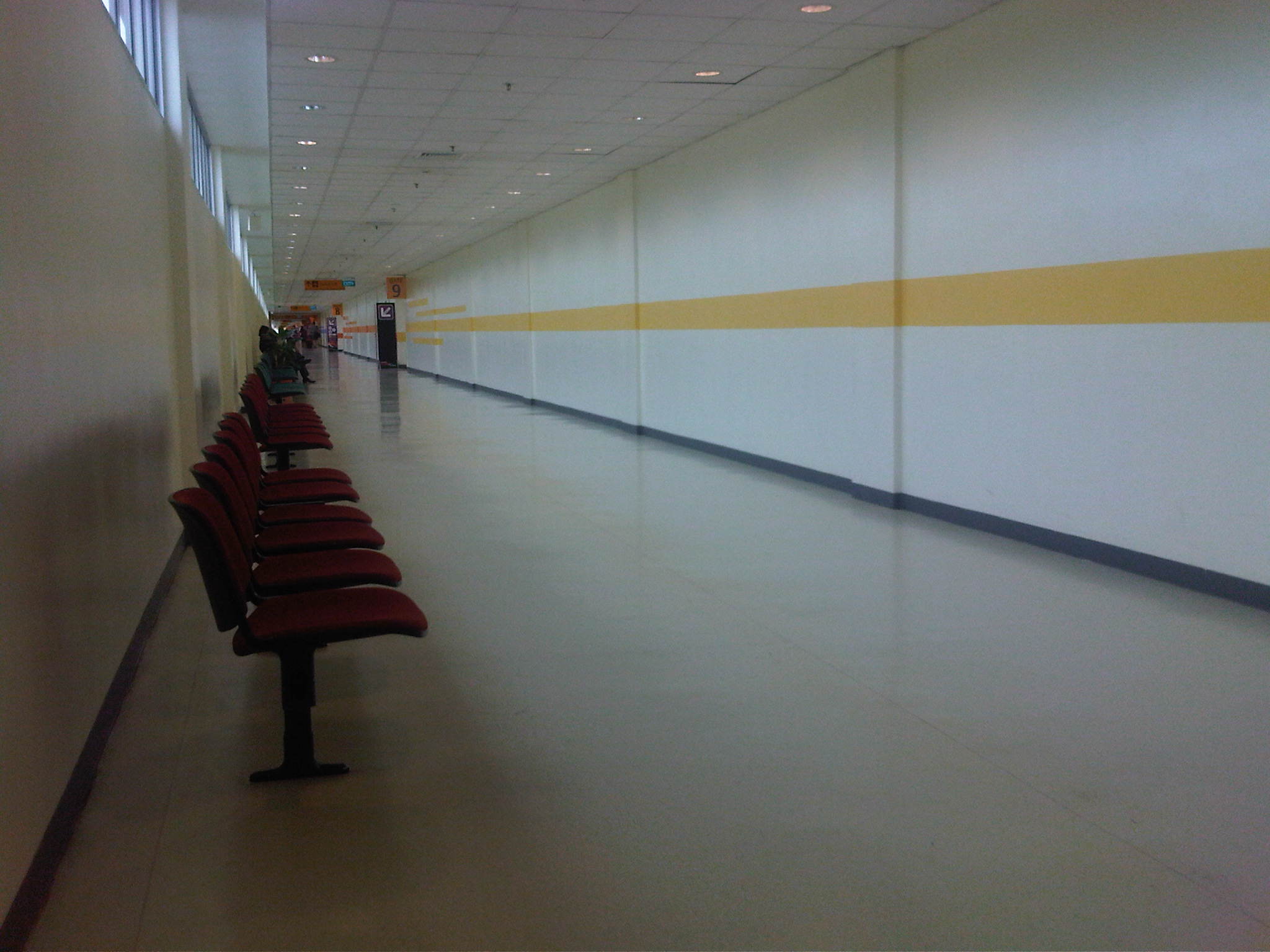 Seats at the waiting area – view from the end of the corridor
I have learned from friends and acquaintances that there are plans to scrap the Budget Terminal. In its place, a Terminal 4 will be built and all budget airlines will be served by the collective of four terminals at Changi. There has been mention of a 5th terminal but I guess that will be further in the future. One can’t be certain though since air traffic at Changi is still steadily increasing along with the travelers handled by the airport. Singapore knows it has to maintain its advantage as a hub connecting Asian destinations with the rest of the world and Changi is at the forefront of the city-state’s efforts to also maintain its leverage and status as a global center for business in the region.
–
NAIA T3 Departures
This is one of the peak periods for air travel in the Philippines so the airports are pretty full with people departing and arriving from different places here and abroad. It was early morning yesterday and as I approached at the airport, I could see lots of vehicles driving off from the departure level of the terminal including taxis that have ferried passengers mainly for morning flights. It was about 4:30 AM when I arrived so the terminal was not as busy as it would be a few hours later.
I had some time to burn yesterday as I waited for the arrival of my wife at NAIA’s Terminal 3. And so I decided to take a walk around the terminal to check out the restaurants and coffee shops on the 3rd level. It turned out my favorite place was still closed and I didn’t think pizza, burgers or fried chicken would be a good idea at the time. I ended up walking around the terminal to get some exercise early in the morning and taking a few photos here and there of the queues at the check-in counters.
 Cebu Pacific handles a lot of flights nowadays as the top airline in the Philippines though it is a budget airline. At 4:30 AM, there were a lot of people lined up in front of their counters assigned to domestic flights. There were a lot more outside the cordoned off area and also outside the airport queued before the first security check for the terminal.
 There were even more people on the other side as Ceb Pac handled quite a number of flights to favorite destinations such as Caticlan (gateway to Boracay), Tagbilaran (gateway to Panglao) and Puerto Princesa (Palawan). Of course, there were the frequent flights to hubs like Cebu, Davao and Iloilo.
 AirPhil Express (formerly Air Philippines) also operates out of Terminal 3 but has less flights compared to CebPac. Its mother company, Philippine Airlines (PAL), is a full service airline with domestic and international flights to and from Terminal 2, which is also called the Centennial Terminal after being opened during the Philippines’ Independence Centennial in 1998. PAL Express, another one of PAL’s budget spin-offs, used to operate out of T3 but ceased operations in 2010 and was integrated into AirPhil Express.
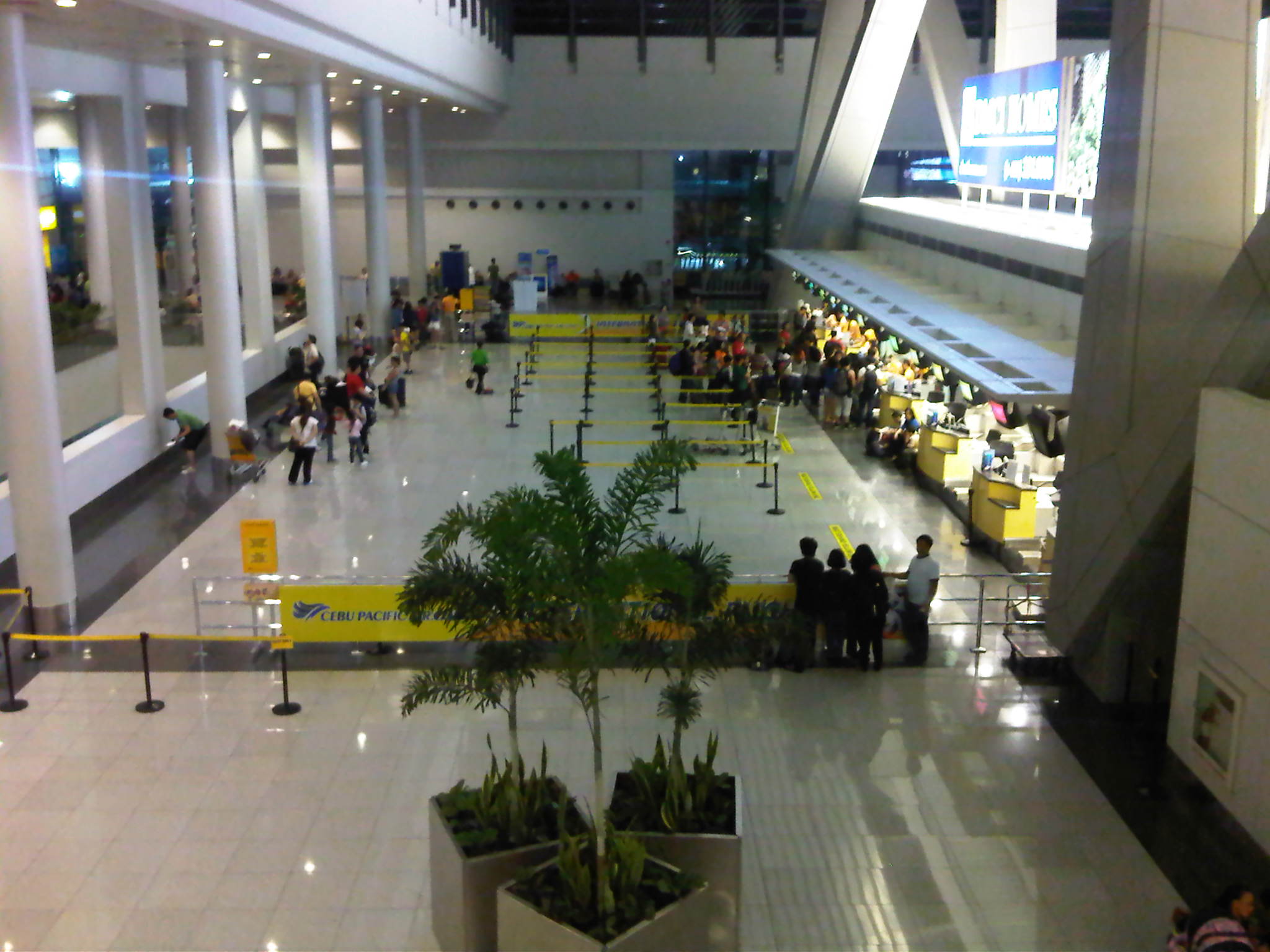 The queues for CebPac’s international flights were still short. I think they have few flights during the late night to early morning periods. These counters, however, will be busy later in the day considering the frequencies of service to destinations like Singapore, Hongkong and Bangkok. CebPac also flies to Korea, China and Japan and has recently opened direct flights to Cambodia (Siem Reap) and Vietnam (Hanoi and Ho Chi Minh).
I was not able to take a photo of the counters assigned to All Nippon Airways (ANA). I guess there might be no people there yet as ANA operates only two flights daily between Manila and Narita (from where it connects with a lot of flights to many other destinations including major cities in the US and Europe). Terminal 3 will be busier in the coming months and years as international flights increase and the Philippines tries to have its status upgraded in order for airlines such as CebPac to expand operations. Already in the sights of the airline are destinations in the Middle East, Australia and the US where there is a demand for a low cost Philippine carrier even counting only Filipinos living abroad. And with the country pitching its tourist destinations abroad, T3 will be expected to handle much of the traffic in this gateway in Manila.
–
The air that we breathe – afternoon smog in Metro Manila
I like to take aerial photos of islands and distinguishing formations or features on the land below. Among those I’ve been able to catch on photo on clear days are Mayon Volcano, Taal Volcano, the Chocolate Hills, Cagayancillo, and Corregidor Island. I took some snapshots while our plane was approaching Metro Manila around 5PM. This time, what caught my attention was not the any land feature but something above it – the smog that covered Metro Manila and its surrounding areas.
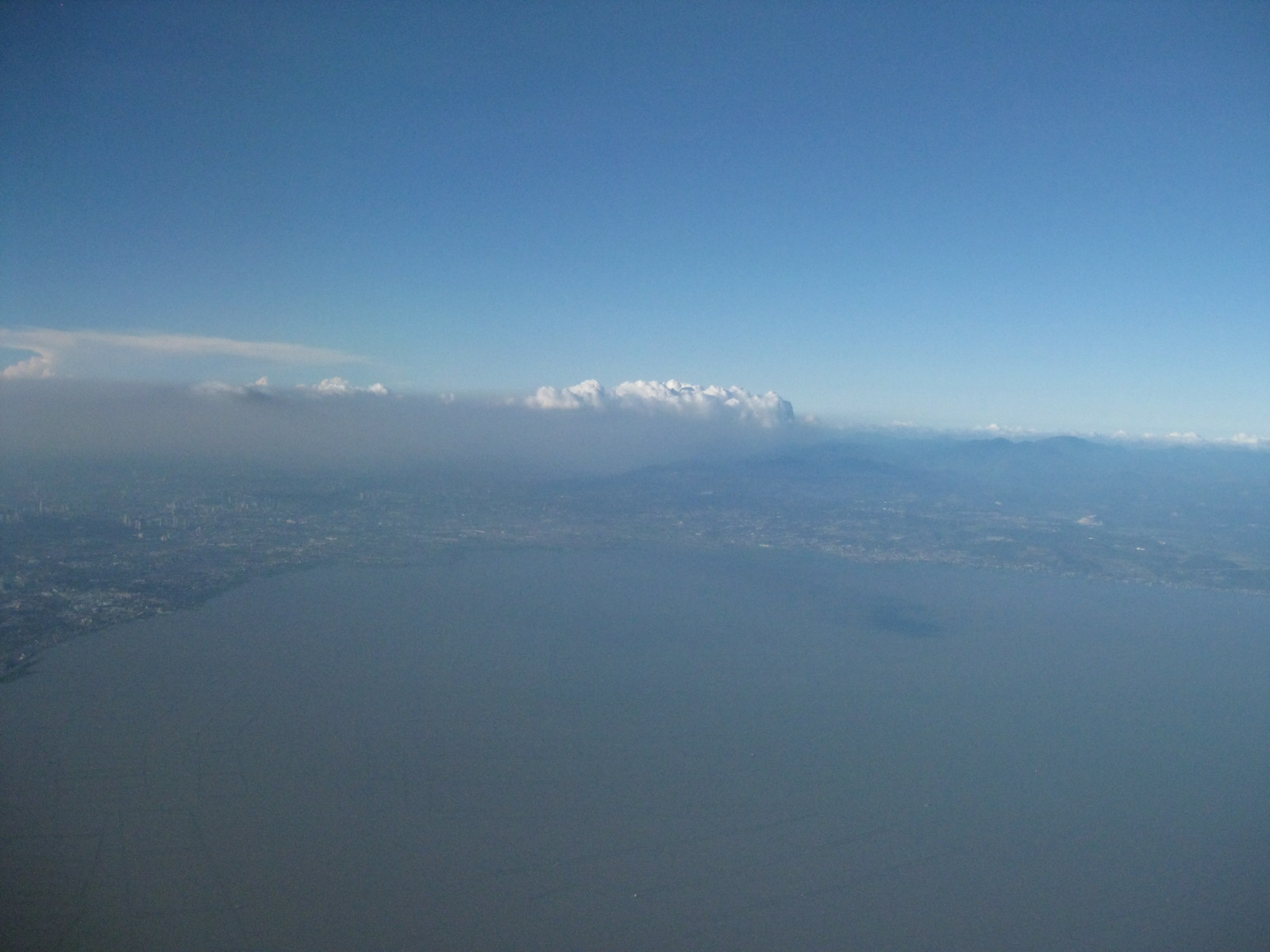 Approaching Metro Manila from Laguna de Bay, one can already sense there was something ominous in the air.
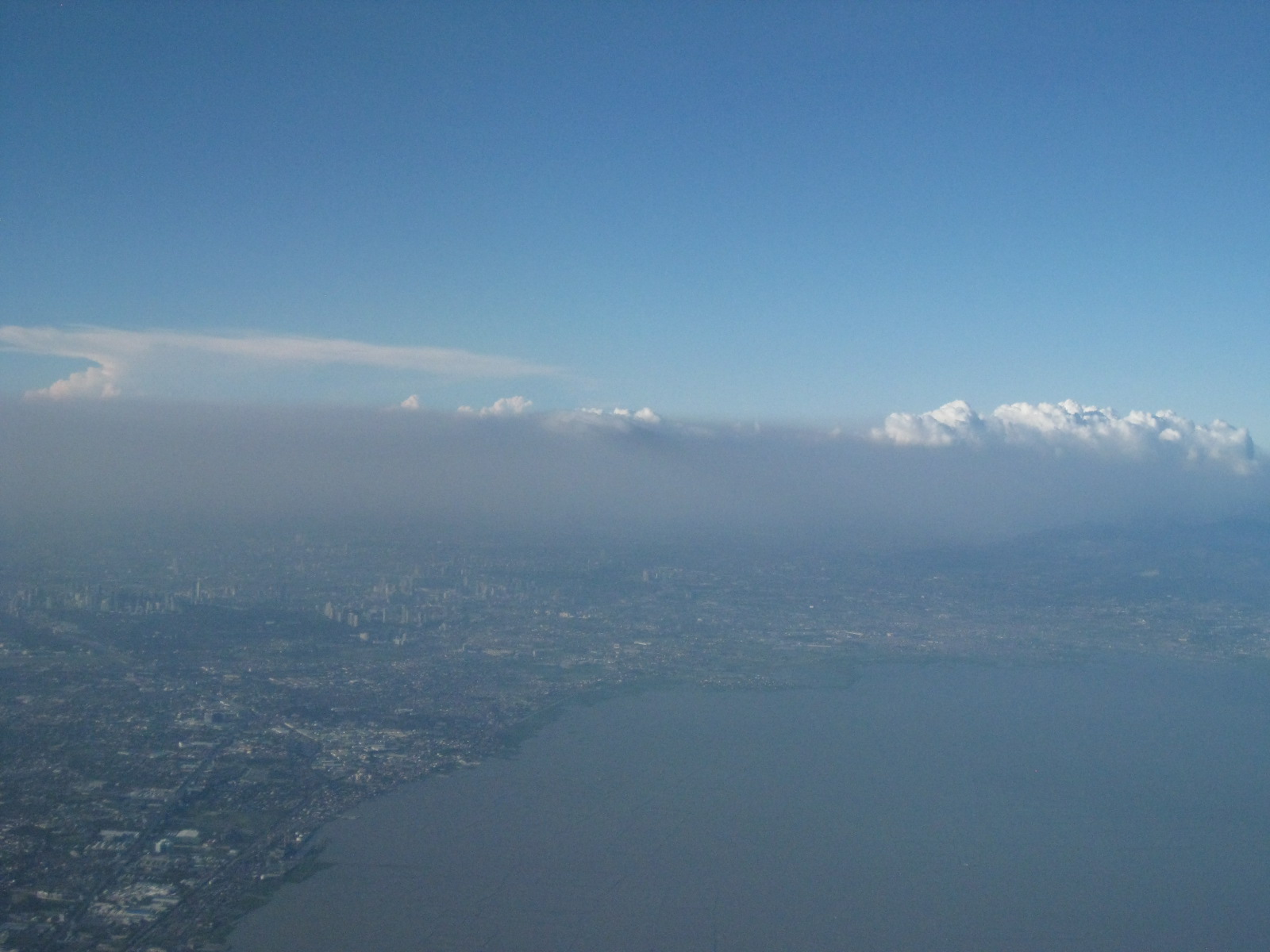 The smog over Metro Manila and parts of Rizal was not totally unexpected but I didn’t expect it to be this bad.
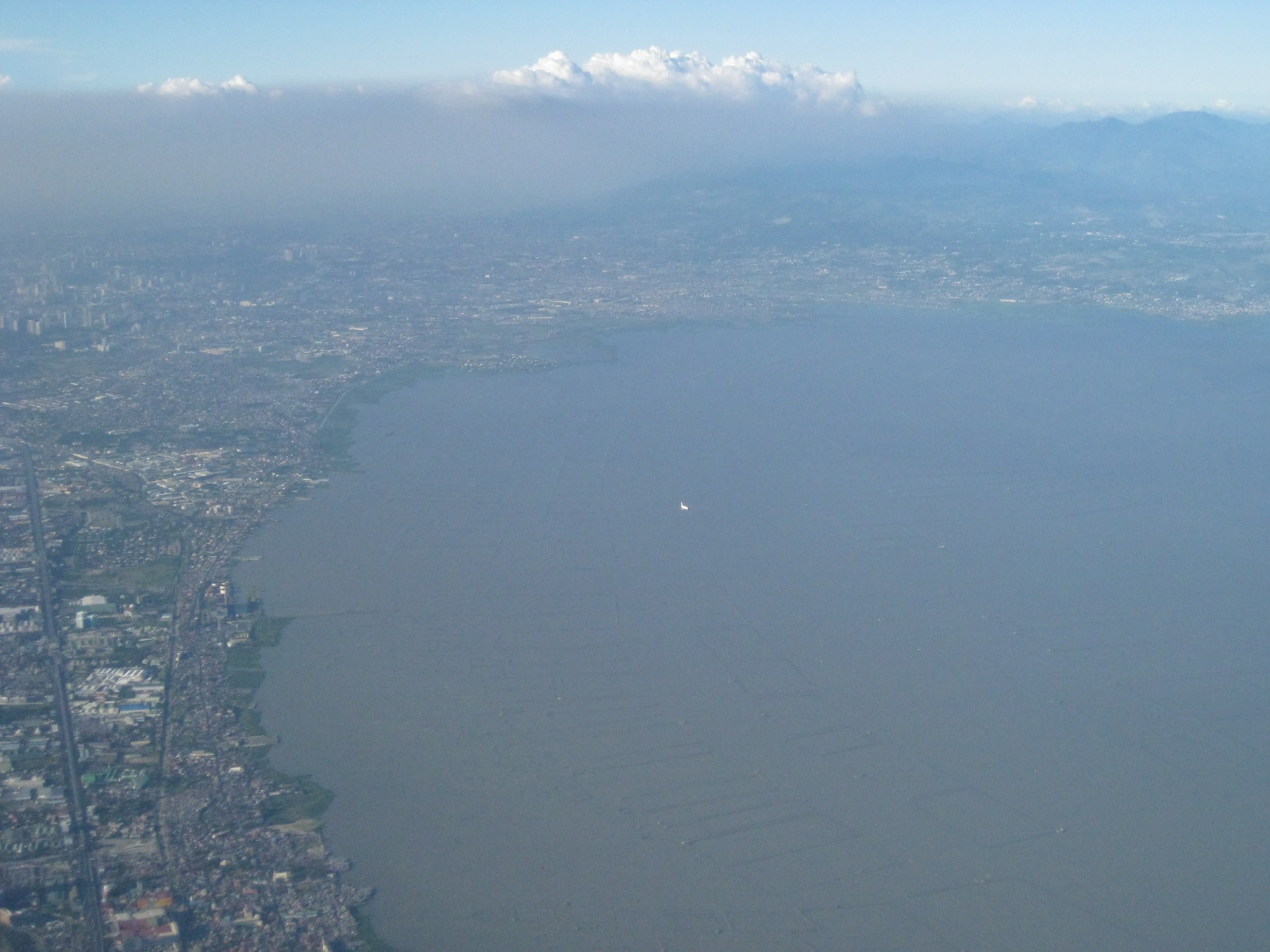 That’s the SLEX on the left side of the photo, to give the viewer a sense of location. The thick haze make it seem as if the clouds in the horizon are the tops of some snow-capped mountain range.
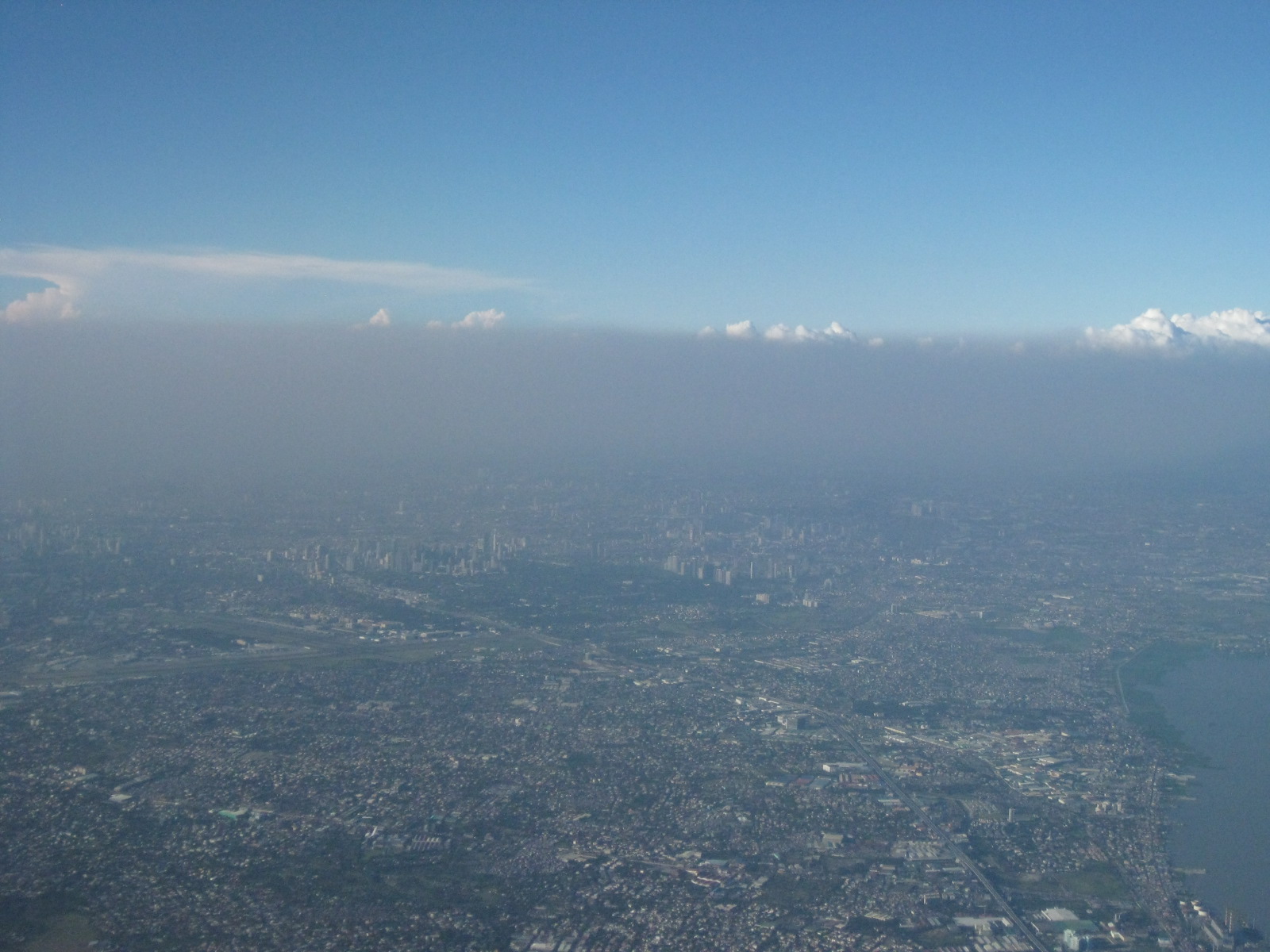 Smog over Makati and Ortigas – the main sources of this manifestation of air pollution are the emissions from road transport tailpipes.
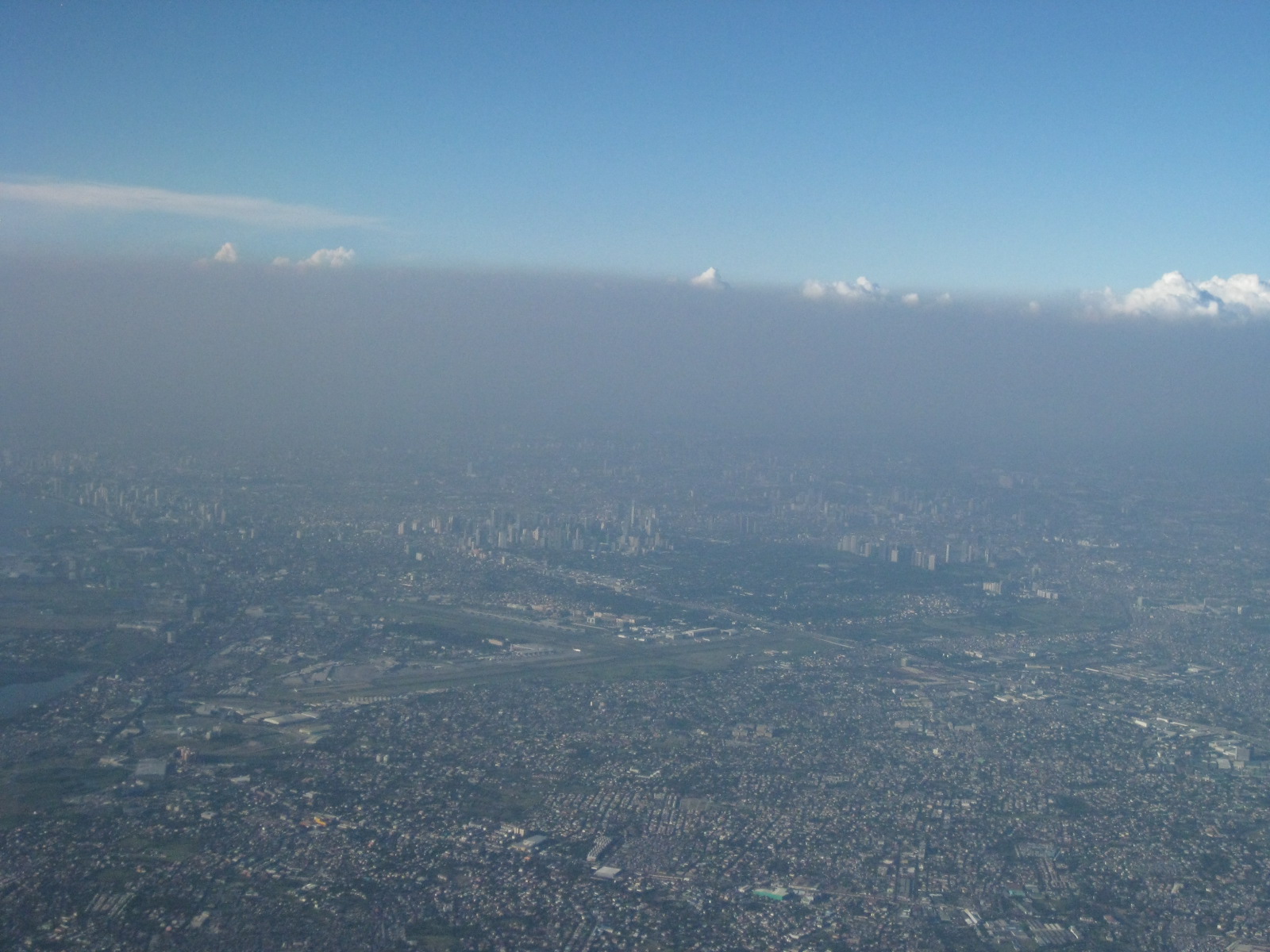 Smog over the airport – that’s the NAIA at the center of the photo
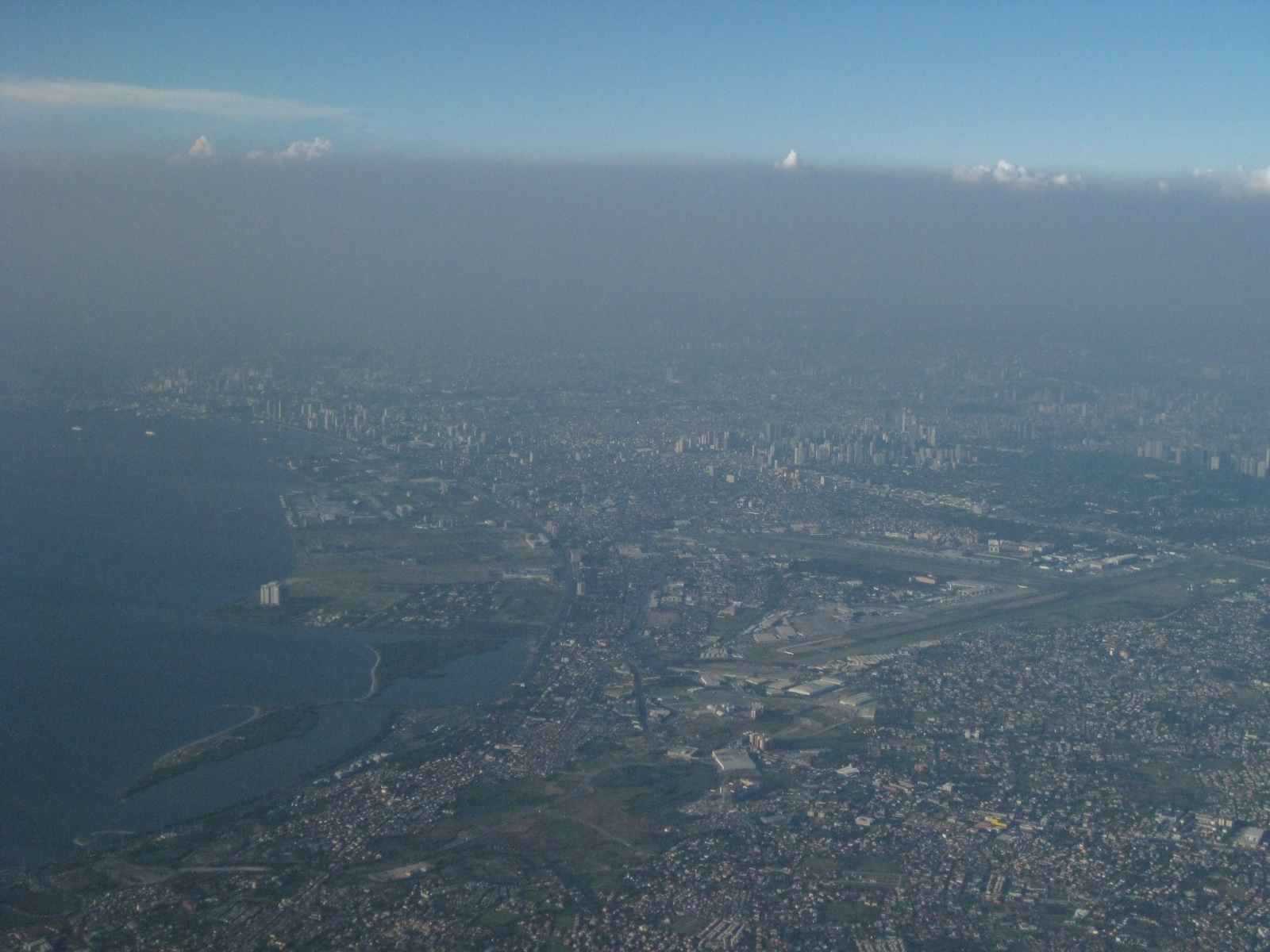 Yes Manila, that’s the air we breathe! This is what we inhale everyday and is the result of years of neglect and irresponsibility for those who cheated on the emission tests prior to vehicle registration, and continue to fail in the proper maintenance of vehicles.
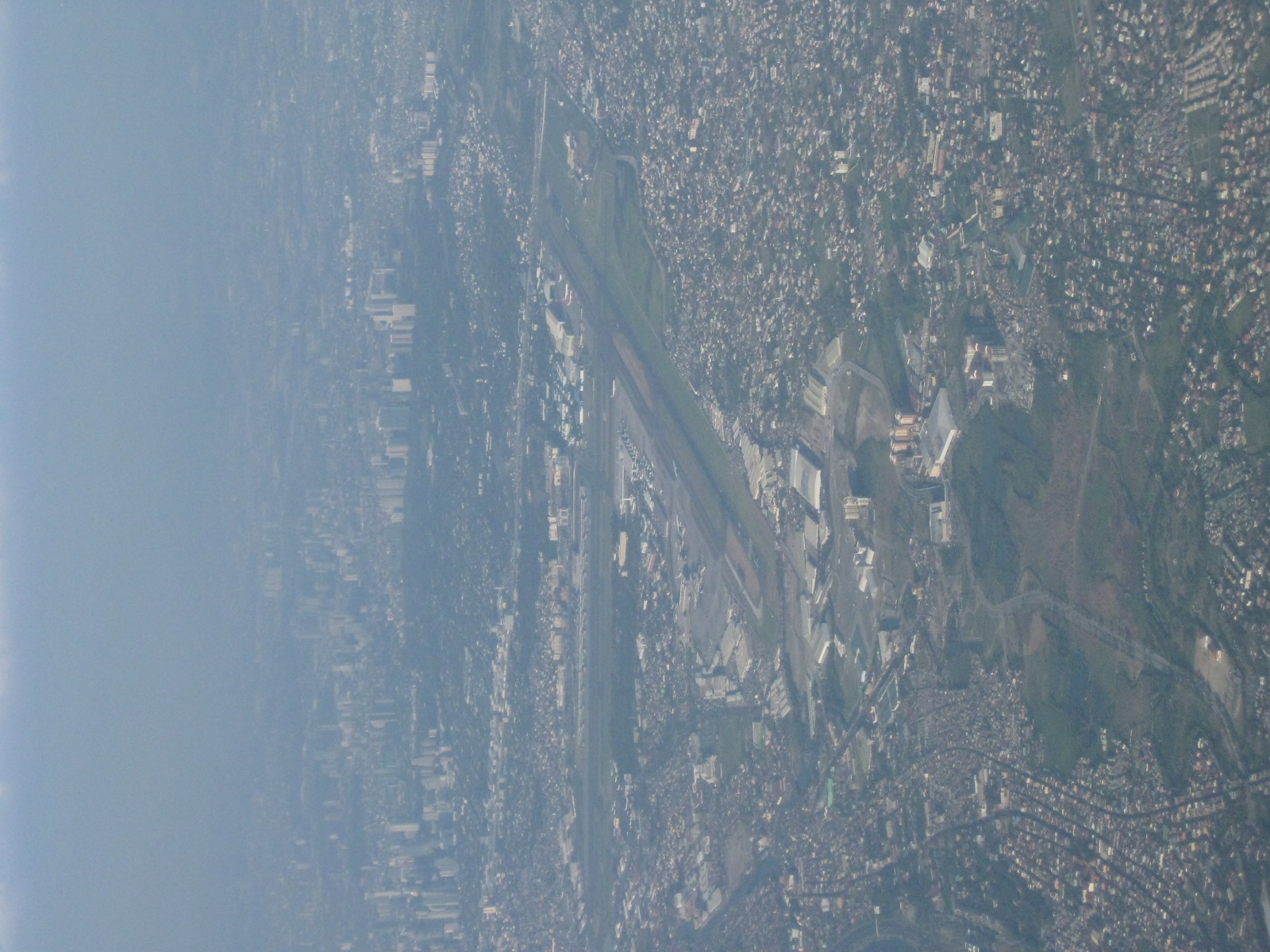 Nope, its not an out of focus photo or the effect of dirt on the aircraft windows. The blur in the photo is caused by the haze above and all around the airspace of Metro Manila.
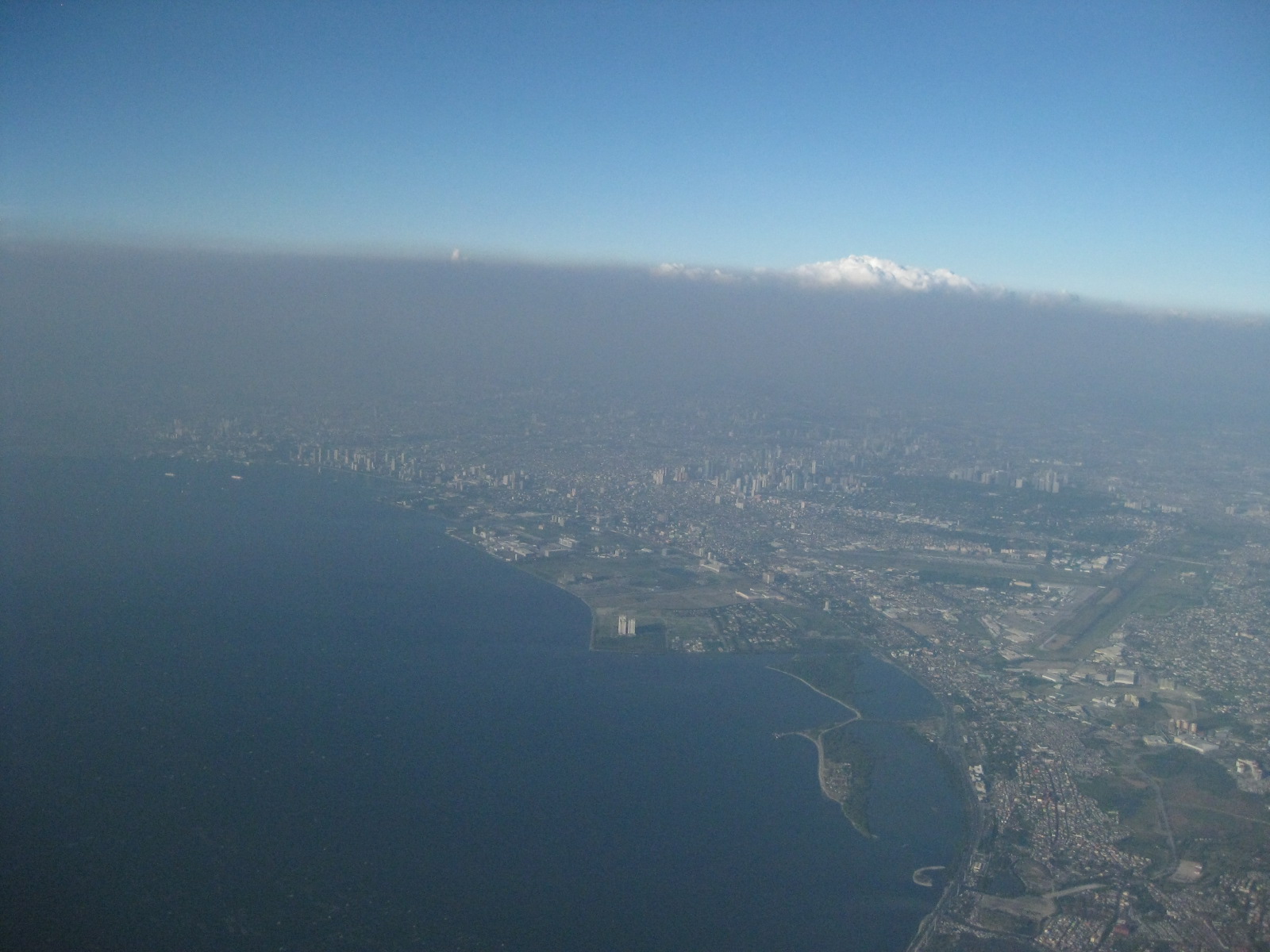 Manila with a thick band of air pollution above it. Pilots and tourists arriving by aircraft see this everyday and I’m quite sure that they have a bad impression about Metro Manila from this scene of the smog alone.
 Another shot of the airport runways with the haze above. At the lower part of the photo and along the approach to NAIA’s main runway is a bird sanctuary being threatened by plans to reclaim and develop the area.
The presence and persistence of smog over Metropolitan Manila should be a cause for concern if not outright panic considering the impacts of such pollution on our health. Unfortunately, people on the ground do not see this haze and would even likely interpret this as just cloud formations. Perhaps we tend to forget that one reason sunsets at Manila Bay are so colorful is because our air is already too polluted. It is sad that such realizations have not led to more urgent action from the government, often depending on NGOs to do much of the work. There is no other time than the present to be aggressive in such efforts as to clean our air. This is why we are pushing for sustainable transport…this is why we work!
–
Deplaning…it’s more fun in the Philippines
I was thinking about things that are more fun in the Philippines when I suddenly remembered I was able to take a couple of photos of fellow passengers descending from our aircraft via stairs, walking along the tarmac, and then ascending the stairs to the air bridge/tube. This, because there was no tube operator available for our plane at NAIA Terminal 3. I could still remember various remarks from passengers ranging from the unkind to those that come across as jokes to those made in jest including the by-line “It’s more fun in the Philippines!” that was adopted by the Department of Tourism as their slogan.
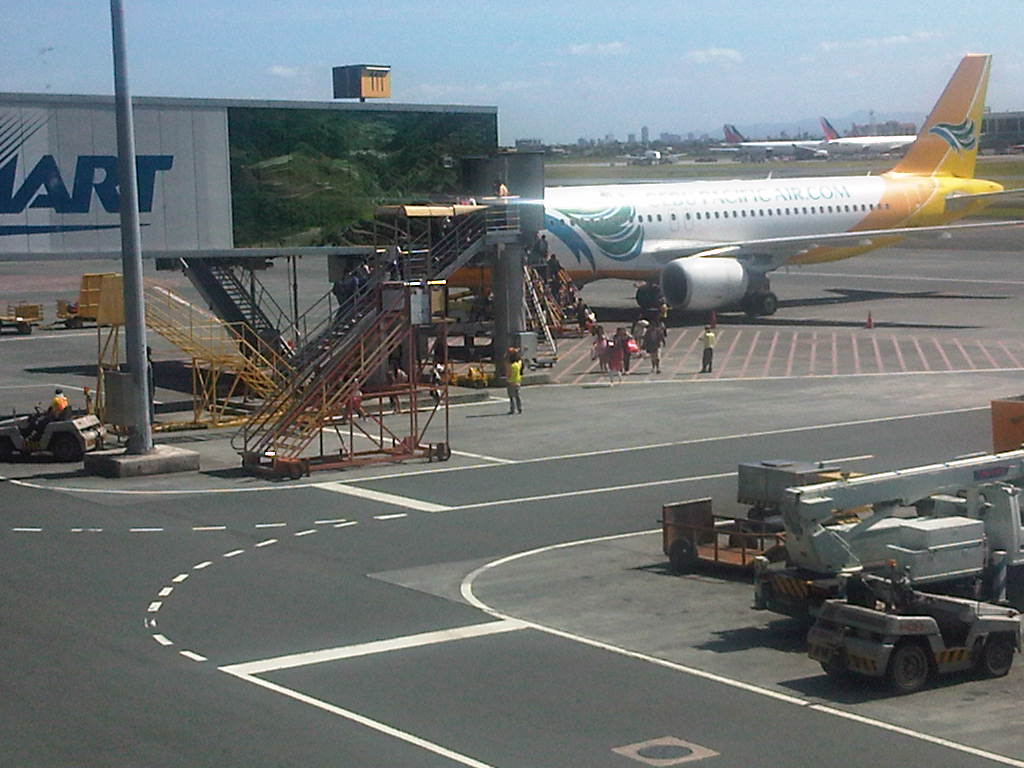 Passengers deplaning from the Cebu Pacific A320 aircraft – the plane was already docked for it to be served by the air bridge but it tool about 20 minutes before the flight attendant informed passengers that the aircraft had to be re-positioned to allow for the stairs to be brought alongside the aircraft. It was also announced that the reason for this was because there was no operator available for the air bridge.
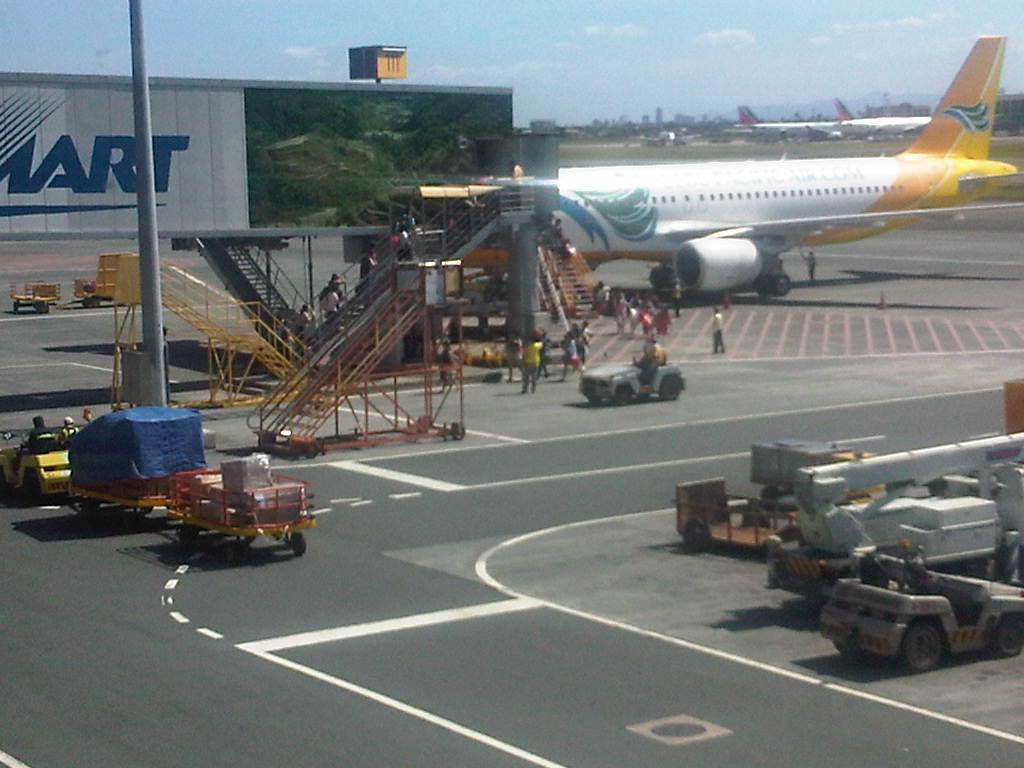 Passengers ascending the stairs to the air bridge – after walking the distance from the plane, passengers were instructed to climb to the air bridge, which connected to the corridor leading to the immigration area. This was at 2:30 PM in the afternoon when passengers are exposed to the scorching heat and elderly passengers had to negotiate two stairs with minimal assistance from ground personnel. For domestic flights, I remember that passengers could proceed to the baggage claim area that was practically at the same level as the tarmac since they didn’t require processing through immigration.
–
Flying budget vs full service
I have read and heard a lot about the discussions regarding flying budget vs. full service. Obviously, there are cost implications, as budget fares are considerably lower than regular fares with budget fares as low as perhaps 25% of full service airlines. For example, you can get very cheap fares for Cebu Pacific especially if you happen to be watchful of their frequent promos like their Piso (One Philippine Peso) and Zero promos, where they practically charge passengers taxes, insurance and fees on baggage only! That means a round trip fare can easily range between 5,000 PhP to 8,000 PhP for a flight between Manila and Singapore with 15 kilograms allowance for each way. Meanwhile, “regular” budget fares can reach a high of 11,000 PhP for the same baggage allowance. This compares favorably against fares from full service airlines like Philippine Airlines (PAL), whose promos still result in higher fares (around 12,000 PhP based on their online ticketing) while regular fares are in the range of 18,000 PhP (Fiesta Class or Economy) to perhaps 30,000 PhP (Mabuhay Class or Business). That’s easily 3 budget flights for the price of 1 full service flight! And other full service airlines flying MNL-SIN direct are surely more expensive with Singapore Airlines (SIA) charging even higher fares than PAL.
I have been able to take advantage of such promos that significantly reduced costs for my flights between Manila and Singapore (where I have a second home). Though I can afford to fly full service, I don’t think its practical for a 3.5-hour flight that I have come to be accustomed with considering the frequency of my travels. A flight that long is quite bearable and one has a lot of options to while away the time including bringing a good book to read during the flight, working on your computer or enjoying music on your portable player. I have seen a lot of people sleeping through the flight and waking up quite refreshed prior to arrival.
It makes even more sense to fly budget for domestic trips considering the furthest destinations are roughly 2 hours from Manila (e.g., Davao and Gen. Santos in Mindanao island). For most flights, it is just 45 to 60 minutes of flying time and travelers would usually have their own food and drinks (baon) with them anyway. Why purchase an expensive ticket for food that you would probably be criticizing? Service? There’s really not much of a difference for domestic flights as Ceb Pac and PAL staffs provide similar quality of service. To some, maybe the recent labor problems of PAL would suggest that their current staff would be less experienced except perhaps for international flights where they should have the slight advantage over Ceb Pac. In other airlines, however, the quality of service and experience would be the same though I can say that SIA, Thai Airways and Cathay Pacific provide better service than PAL nowadays. In fact, many full service airlines of other countries have their budget counterparts, with SIA competing with Tiger Airways, Garuda with Lion Air, and Malaysian Airlines with Air Asia, and their staffs would probably have the same experiences and service qualities.
Long haul flights are a different case since these flights can really be quite tiring and stressful, and there are things like in-flight meals, which though much maligned in many cases, are actually a necessity for long flights. Flying Singapore Airlines for a recent trip between Manila and Bali, for example, that consisted of two legs (3.5 hours MNL-SIN and 2.5 hours SIN-DNP) each way will definitely be more comfortable even with a stopover at Changi. Flying non-stop between Manila and Los Angeles is another example of a trip where full service airlines will have an advantage over budget, even after factoring in the additional costs attributed to fare differences. For such flights, one needs to be taken cared of and it would be such a hassle to prepare meals to bring with you on those flights but as they say and based on experience, there are always exceptions.
So as far as flights coming in and out of the Philippines (international) are concerned, the rule of thumb would probably be to take full service airlines for long flights (i.e., longer than 3 or 3.5 hours continuous or cumulative) and take budget airlines otherwise. For domestic flights, budget should definitely be chosen over full service. Of course, such preferences may be irrelevant if someone else is paying for your fares and your travel budget allows for the more expensive options. Still, with “value for money” being one of the original slogans of budget airlines, such is still very much the case here. And who wouldn’t want to be able to save on airfare and use such savings for food and shopping at their destinations?
–
 Caught (up) in traffic