
Home » Behavior (Page 14)
Category Archives: Behavior
On the “safe system” approach in road safety
We kick-off the UN Global Road Safety Week with a road safety feature. Here is an excellent read from Johns Hopkins University’s Hub:
(May 13, 2021) “Safe system” approach could dramatically reduce road deaths while improving equity, Hub, https://hub.jhu.edu/2021/05/13/safe-system-roads-could-reduce-road-accidents-deaths/ [Last accessed: 5/14/2021]
To quote from the article:
“The Safe System approach engineers road systems so that they are safe when used intuitively, the way people tend to use them. A Safe System minimizes the chances for mistakes by drivers, pedestrians, and bicyclists, and reduces the intensity of crashes when they do occur.”
There are so many situations and locations around the country that could be improved using this approach. The safe system approach is actually embedded in the country’s current Road Safety Action Plan (RSAP).
 Road and traffic environment in front of the main gate of a high school in Zamboanga City
–
On predicting how new developments will affect pedestrians
I’ve been involved in a number of traffic or transport impact assessment (TIA) projects in the past. In these assessments, not much is usually written about the impacts to pedestrians though we make sure that there is a section discussing their needs (e.g., sidewalks, crossings, footbridges). Unfortunately, even with specific recommendations, there is no assurance that the proponent will revise their designs. The typical TIA in the Philippines is undertaken after there have been architectural plans already prepared if not completed. By completed here, I mean they are practically final from the perspective of the client or proponent. The exception it seems is a big mall chain that seems to constantly revise their plans and for which our recommendations are almost always considered and incorporated in design.
I am sharing this recent article on the development of a new traffic model to predict the impacts of new developments on walkers.
Wilson, K. (April 26, 2021) “New Traffic Model Predicts How New Developments Will Affect Walkers,” StreetsBlog USA, https://usa.streetsblog.org/2021/04/26/new-traffic-model-predicts-how-changes-affect-walkers/ [Last accessed: 5/12/2021]
From the perspective of doing TIAs, I think that there should be a conscious effort of including the needs of pedestrians (walkers) and cyclists in impact assessments. Too often, (and I too am guilty here), there is but a minor mention of their needs and recommendations can be disregarded by both proponents (e.g., little or no change in designs to accommodate pedestrian requirements) and the local government (i.e., no push to make sure pedestrian needs are addressed).
On the tech side, there is a local development that can be used for counting pedestrians and cyclists. The TITAN project funded by the DOST-PCIEERD developed a tool that can count pedestrians and cyclists in aid of studies involving them. Such tools can be useful for data collection regardless of whether there is a new project or a TIA being undertaken.
–
Do we miss commuting?
That’s the question asked in a recent article about commuting via public transport in the US. The pandemic has altered much of our lives including our typical daily travels between our homes and workplaces. Of course, the experiences vary in many countries and different towns and cities. However, we cannot deny that with the still developing information about the Covid-19 virus (i.e., how it is spread), many of us have had doubts about taking public transportation. For those who didn’t have much options for their commutes, they just had to do their part in observing health protocols and trust that the operators and drivers of public utility vehicles also do their part to sanitize vehicles.
Barry, D. (May 10, 2021) “No Scrum for Seats. No Quiet-Car Brawls. Is This Really My Commute?” The New York Times, https://www.nytimes.com/2021/05/10/nyregion/new-jersey-transit-commute.html?smid=url-share [Last accessed: 5/11/2021]
How did your commutes change from what it was before the pandemic? Are you back to using public transport? Have you shifted to active modes like bike commuting? Did you go back to driving a car? Or are you still basically working from home most of the time? And did you miss how you were commuting before?
–
On building the ideal city from a transportation perspective
There’s a not so old article that popped in my timeline of articles I’ve read the past years. I thought I would make a quick share of it here. It is a good read and something that will never be irrelevant for as long as we have not redeveloped our cities and municipalities for transport equity and sustainability. Here’s a takeaway from the article:
“The ideal city is a place where lots of different kinds of people with lots of different amounts of money can live and work. It has to be easy to get around without a car, even for people whose bodies can’t ride bikes or hop over potholes, and for people who have kids to drop off on the way to work and groceries to buy on the way home, and maybe flowers to buy next door to the dry cleaner’s. These are places where people want to live, because it’s nice there. The fact that those places also adapt to and mitigate climate change instead of causing it is a bonus.”
Here’s the article from last year:
Rogers, A. (April 1, 2020) “Build Cities for Bikes, Buses, and Feet—Not Cars,” Wired, https://www.wired.com/story/cities-without-cars-san-francisco-jeff-tumlin/?bxid=5bd6761b3f92a41245dde413&cndid=37243643&esrc=AUTO_OTHER&source=EDT_WIR_NEWSLETTER_0_ENGAGEMENT_ZZ&utm_brand=wired&utm_campaign=aud-dev&utm_mailing=WIR_Classics_042921&utm_medium=email&utm_source=nl&utm_term=WIR_Daily_TopClickers [Last accessed: 4/30/2021]
–
On when to use masks when outdoors
Here is a useful graphic from the US Centers for Disease Control and Prevention. The graphic described situations for when masks are required. I don’t want to use preferred because it means people may opt out of using masks. It is a useful reference even for those in other countries that do not have enough clear information from their governments about wearing masks and how it helps protect vs. getting infected by Covid-19. It is applicable to people searching for a legit reference to mask-wearing in outdoor situations.

This information becomes more relevant as people start getting vaccinated and at the same time look forward to getting together with family and friends in social events such as eating out or having picnics. Of course, this also applies to exercise as well as commuting via active transport modes (i.e., walking or cycling).
–
On what local governments can do to improve road safety
Here is a very interesting article on how a small city in the US was able to reduce traffic deaths by investing in people-oriented transport programs and projects:
Kessler, E. (April 6, 2021) “EYES ON THE STREET: How Hoboken Has Eliminated Traffic Deaths,” StreetsBlog NYC, https://nyc.streetsblog.org/2021/04/06/eyes-on-the-street-how-hoboken-has-eliminated-traffic-deaths/ [Last accessed: 4/14/2021]
The article is pretty much self-explanatory. I won’t be commenting more about this except that many of the items mentioned can be taken on by many cities and municipalities in the Philippines. You don’t have to be a highly urbanized city with a big population and so much resources to come up with a plan and perhaps improvise in order to reduce costs of implementation. The most important thing is leadership since leaders like the mayor will be responsible for and making the critical decisions for the town. That is why he was elected in the first place, and the same goes for the other elected officials who are supposed to represent the interests of all their constituents and not just those who own cars.
–
If you build the bike lanes, will people use them?
The obvious answer to this question is yes. It is not so clear, however, how many will really be using these bike lanes over time. That needs data. That requires counting. And such data will be useful in order to understand, among other things, why people choose to bike or why they don’t. The latter is important to determine what factors are being considered by people who can switch to cycling particularly for commuting. Of course, there are many references for this from other cities and countries but these still need to be contextualized from our (Philippine) perspective. Case in point is Marikina, which has the most comprehensive network of bike lanes in the country. What are the numbers and what are the constraints and misconceptions? Did the city do its part to promote and sustain cycling?
Here is an article discussing the experience in the US:
Penney, V. (April 1, 2021) “If You Build It, They Will Bike: Pop-Up Lanes Increased Cycling During Pandemic,” The New York Times, https://www.nytimes.com/2021/04/01/climate/bikes-climate-change.html?smid=url-share [Last accessed: 4/9/2021]
 Bike lane along Katipunan Avenue (C5) in Quezon City
Here is the link to the paper mentioned in the article:
https://www.pnas.org/content/118/15/e2024399118
–
Vaccine passports anyone?
As the Philippines, relaxes protocols to contain the Covid-19 pandemic, it is interesting to note that other countries have not let down their guard. And the latter includes nations that have been quite successful in dealing with the pandemic. Many countries have also received the vaccines and have started inoculating their populations. These received the doses ahead of the Philippines and have now vaccinated a significant % of their population according to their respective prioritization schemes.
But even as countries have started vaccinations, the question remains whether a vaccinated individual can now move around or travel as if it were pre-pandemic conditions (the old normal). Here’s a nice article to read as the topic of unrestricted (or restricted, depending on your take) comes up in discussions including those leading to certain policies to be formulated by governments:
Fisher, M. (March 2, 2021) “Vaccine passports, Covid’s next political flashpoint,” The New York Times, https://www.nytimes.com/2021/03/02/world/europe/passports-covid-vaccine.html [Last accessed: 3/4/2021]
–
On the need for more public spaces
Here’s a quick share of an article discussing the pandemic’s exposing the need for more public spaces:
Ionescu, D. (February 5, 2021) “The Pandemic Revealed Public Space as ‘Essential Infrastructure'”, Planetizen.com, https://www.planetizen.com/node/112044?utm_source=newswire&utm_medium=email&utm_campaign=news-02082021&mc_cid=4fac9821d0&mc_eid=9ccfe464b1 [Last accessed: 2/9/2021]
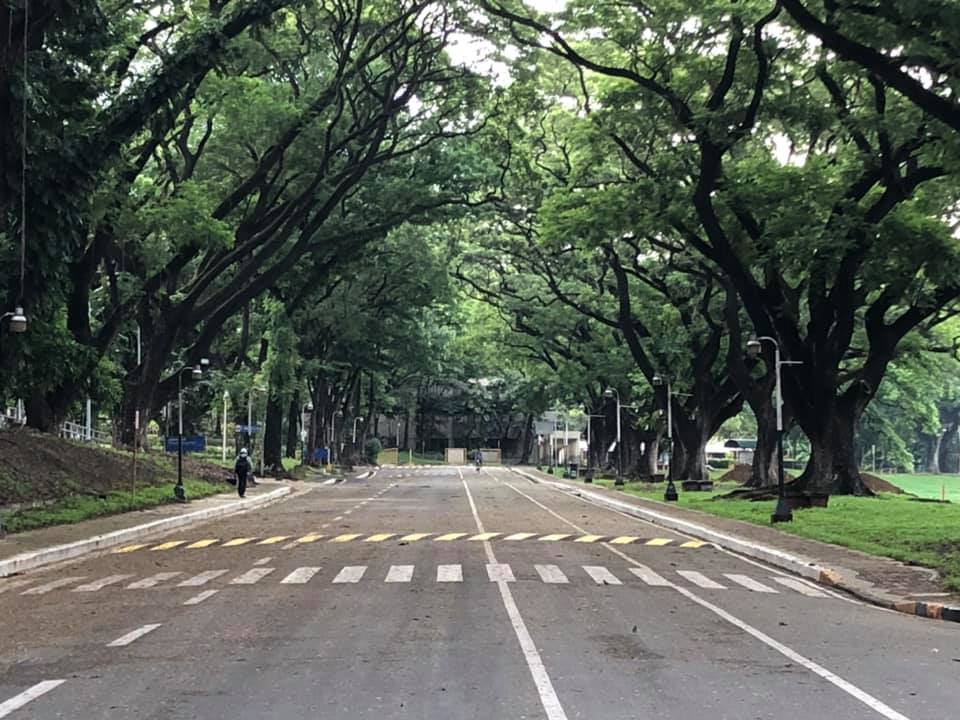 Quezon City is lucky to have the Quezon Memorial Circle, Parks and Wildlife and the University of the Philippines Diliman campus but it needs more public spaces given its size. UP should not technically be regarded as a public space as it is a school first and just happens to be blessed with a spacious campus. Pictured above is its academic oval with the Sunken Garden to the right.
Public spaces include parks and other open spaces that serve as breathing spaces or lungs for our cities and municipalities. A lot of people complained about being cramped up during the lockdowns and are now going out (others quite recklessly) even with the specter of Covid-19 still about us. In many old towns around the country, there are plazas and of course fields where people can go to while maintaining safe physical distancing. We certainly lack for these especially in highly urbanized cities. Rizal Park and its surrounding areas including Intramuros are not sufficient for dense Manila. In Taguig, you see a lot of people taking walks or exercising along the C5 service road. Its good that they actually have a linear park in Lower Bicutan and maybe parts of BGC where people can “decompress” from their cramped conditions where they reside but again, these may not be enough. Cities and municipalities need to allocate or build more public spaces. These should be deliberate developments to create such spaces (even small playgrounds scattered around a city would be a good start) for everyone’s well-being.
–
On R.A. 11229 and the requirement of Child Seats
There seems to be a lot of feedback (mostly negative) on the new law and its implementing rules. RA 11229 is the “Child Safety in Motor Vehicles Act” that requires the use of child car seats. There seems to be a confusion about who are supposed to be using child seats particularly about the age and height limits mentioned. In one “controversial” interview, a government transport official was recorded replying to a question about tall children that the parents would have to get a bigger vehicle. That was obviously uncalled for but also probably what can be considered as a “snappy answer to a stupid question[see note below]” type of situation. What is clear now is that a lot of people are not aware of the provisions and implications of the new law (for various reasons including their choosing to ignore it) and there needs to be a more comprehensive and effective info campaign on this topic. Not yet mentioned in discussions are the models of car seats that are approved or certified for use.
 Screenshot of a graphic explaining who are required to use child car seats
Here are examples of the opinions and comments in one of the group discussions I am part of [I will just leave these without specific attribution or anonymous.]:
- “RA#11229 was badly written. Authored by Sen JV Ejercito, trying to copy laws in the USA. In California, the Child Safety Seat is only required for child 2 years old and below, 4 years old in NY, and 3 years old in Europe. Additional parameters: height limit of 40″ (101 cm) and weight limit of 40lbs. They differentiate rules for children up to 8 years in NY & CA.”
- “The Philippine version lumps all kids into one group below 12 years old, requiring child restraint system. Additional parameter is 150 cm height, none on weight. Two wrong premises of our law: 1) that Filipinos children are taller than Europeans and Americans of same age, and 2) Filipino children mature later at 12.”
- “They lumped it into one class because its the simplest and easiest thing to do, without going into a lot of uncertainty. Na controversial na nga yung 12 yr. old catch-all, ano pa kaya kung they broke it down into numerous classifications.”
[Note: To those who are not familiar with the term “snappy answers to stupid questions”, google it together with Mad Magazine.]
–
 Caught (up) in traffic