
Home » Behavior (Page 31)
Category Archives: Behavior
Tutok – tailgating
A common practice of motorists along Philippine roads is tailgating. This is not only common in congested traffic, when vehicles are practically “bumper-to-bumper,” but also in free flowing traffic where drivers or riders tailgate for a number of reasons (e.g., to put pressure on the one ahead of them, to display skills in following closely behind another vehicle, etc.), all of which are dumb. There is always the risk that the driver or rider of the vehicle in front will brake to slow down or stop and the driver/rider of the vehicle behind will not be able to brake in time to hit (rear-end) the one ahead. Both time (reaction, headway) and space (distance between vehicles) are factors here as driver or rider reaction times vary and will affect the outcome of the chain of events should the leading vehicles suddenly slow down for any reason.
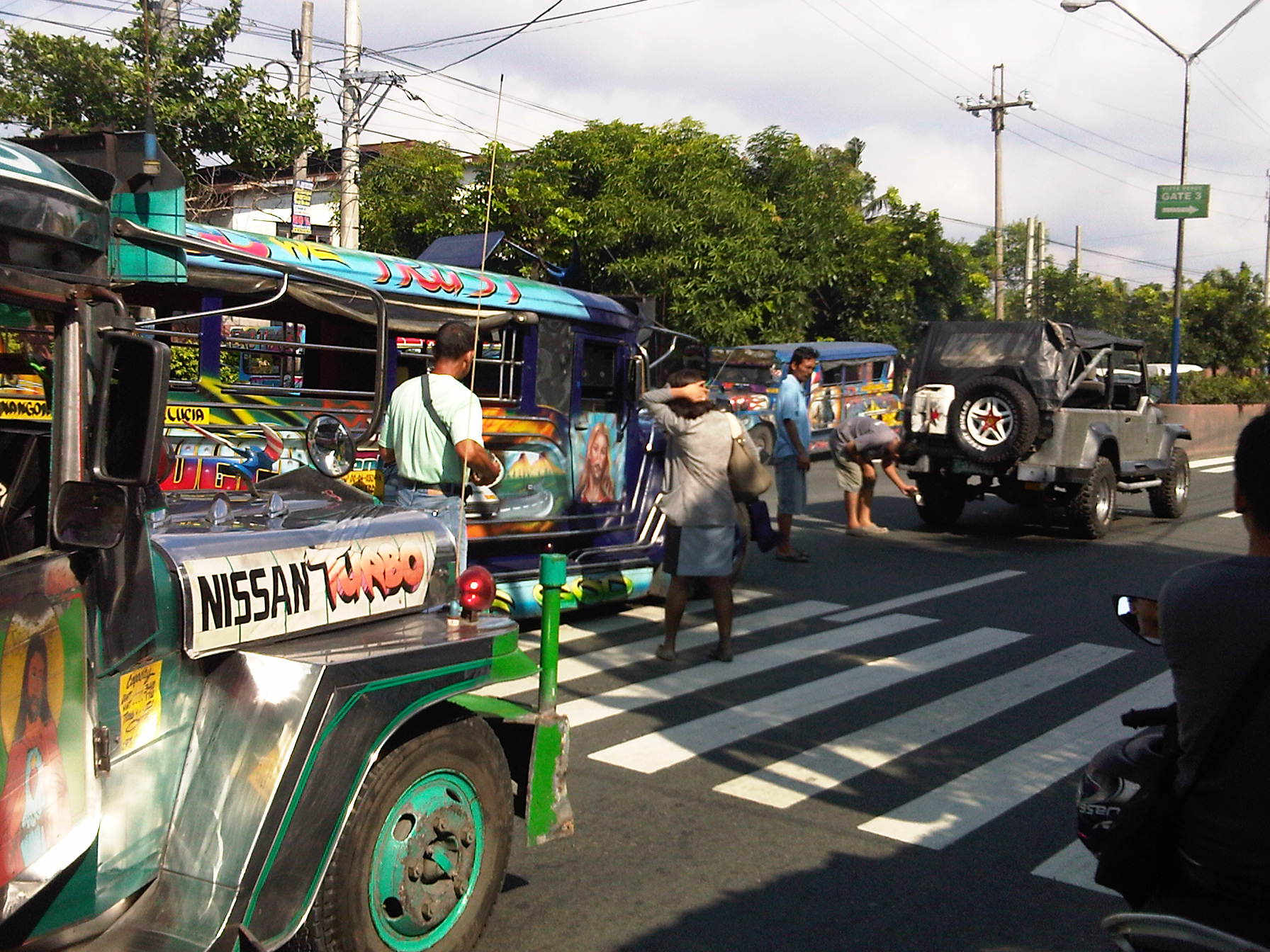 A passenger can only scratch her head as she tries to get back her fare from the conductor after alighting from a jeepney involved in a collision with another vehicle. Meanwhile, the driver of an owner-type jeepney inspects the damage to his vehicle as the driver of the jeepney that hit him looks on.
I was just explaining about Stopping Sight Distance (SSD) to a class of senior students and SSD very much applies to tailgating. Given varying traffic conditions along the roads, tailgating compromises the safe distance between vehicles and therefore too often leads to situations that lead to road crashes. Rear-end collisions in turn often lead to traffic congestion and raise the costs brought about by such incidents. In most cases, this happens because authorities are unable or incapable of managing the aftermath of the incidents where parties involved often argue in the middle of the road without regard for other road users plights. These cases need to be resolved quickly and efficiently in order to remove these obstacles from the road.
–
EDSA: Taft to Tramo
The EDSA-Taft Ave. intersection was in the news a few weeks ago due to the MRT3 train that derailed and overshot the end of the line along EDSA. Being a major intersection for roads as well as for rail (MRT3 and LRT1), it is a very crowded area. Nearby, too, is the Redemptorist church in Baclaran that attracts a lot of people especially during Wednesdays. Following are a few photos of the area showing the conditions on the pedestrian overpasses and at street level.
 The pedestrian overpass at EDSA-Taft is also a mall of sorts given the merchandise being sold at informal shops at the overpass.
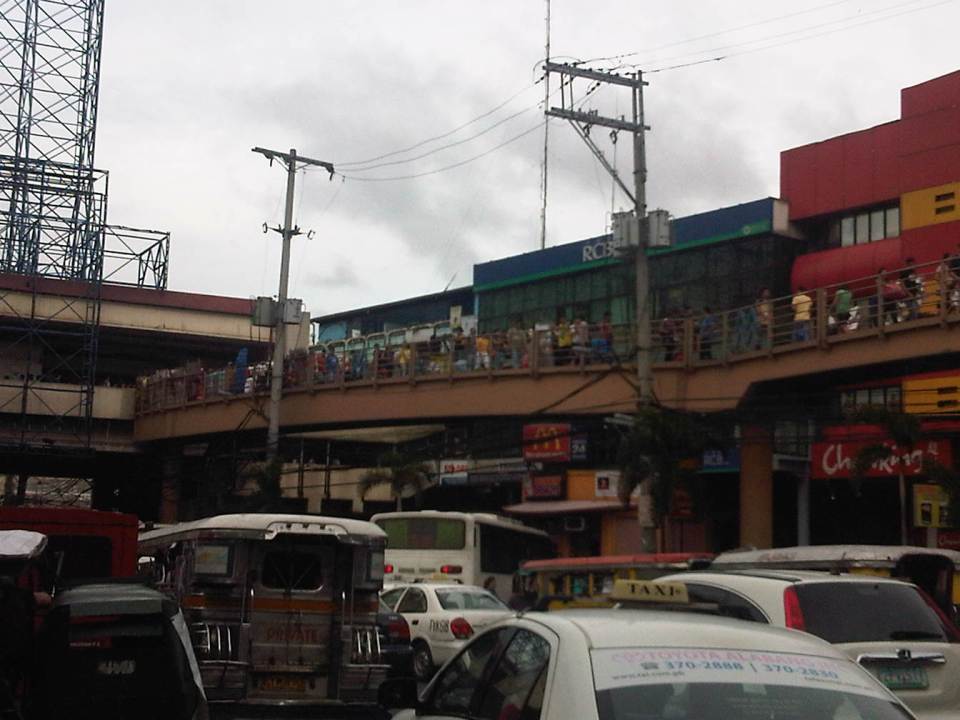 The overpass connects to the EDSA-MRT 3 Taft Ave. Station. This is the MRT 3’s end station and the overpass system connects the MRT 3 Taft Ave. Station with the LRT Line 1 EDSA Station. The connection was not and is still not a smooth one, which has been the subject of criticism from a lot of people.
 The overpass allows people to walk around this large intersection
 Pedicabs freely travel along this stretch of EDSA between Taft and Tramo on lanes designated for public utility buses and clearly violating regulations regarding what vehicles are allowed on EDSA. You can also see in the photo a cart full of merchandise being pushed along the curbside lane.
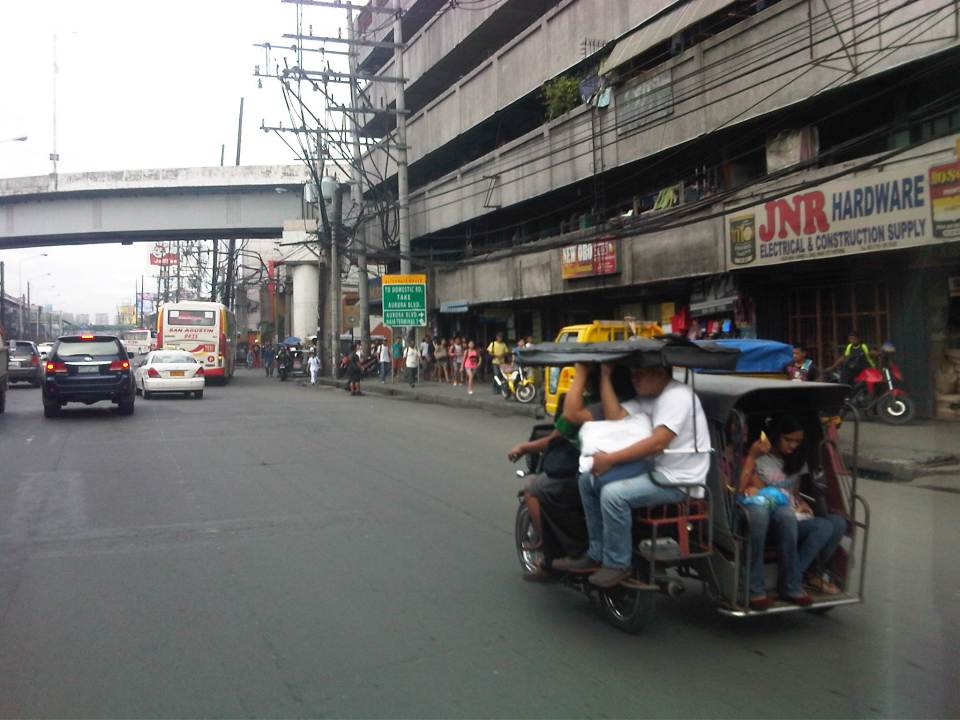 A motor tricycle ferrying passengers along EDSA just before Tramo (that’s the street above which is an overpass from EDSA southbound).
–
Practicable road sharing in Antipolo
As there are increased calls for more bikeways, we try to look at some good examples of what I’d call “practicable” road sharing. I term it “practicable” because it is something doable or is already being done or practiced. I tried to find a few good examples of practicable road sharing to show that it can be done and usually if all road users respect each others’ right to use the road. This respect can be developed over time and requires some familiarity for each users behaviors. Of course, there will always be abusive or disrespectful people on the road including drivers of different types of vehicles. Reckless or unsafe driving is not limited to public transport or truck drivers. There are also many unruly private vehicle drivers who endanger the lives of others whenever they are on the road. Then there are the motorcyclists, cyclists and pedestrians – all road users and also with bad apples or “pasaway” among them.
Road sharing happens everyday in Antipolo City in the Province of Rizal. Along Ortigas Avenue and Sumulong Highway – the two main routes to and from Antipolo, you will see motor vehicles, bicycles and pedestrians sharing what are mostly 4 lane, undivided sections of the two major roads. Antipolo is a very popular destination for cyclists so even during weekdays you will find a lot of people cycling up and down the mountain roads even during the night time and very early mornings. While many are recreational riders, many, too, are doing this for health. I would bet that a good percentage might be biking to work or school but there are no hard statistics to show this (topic for research?).
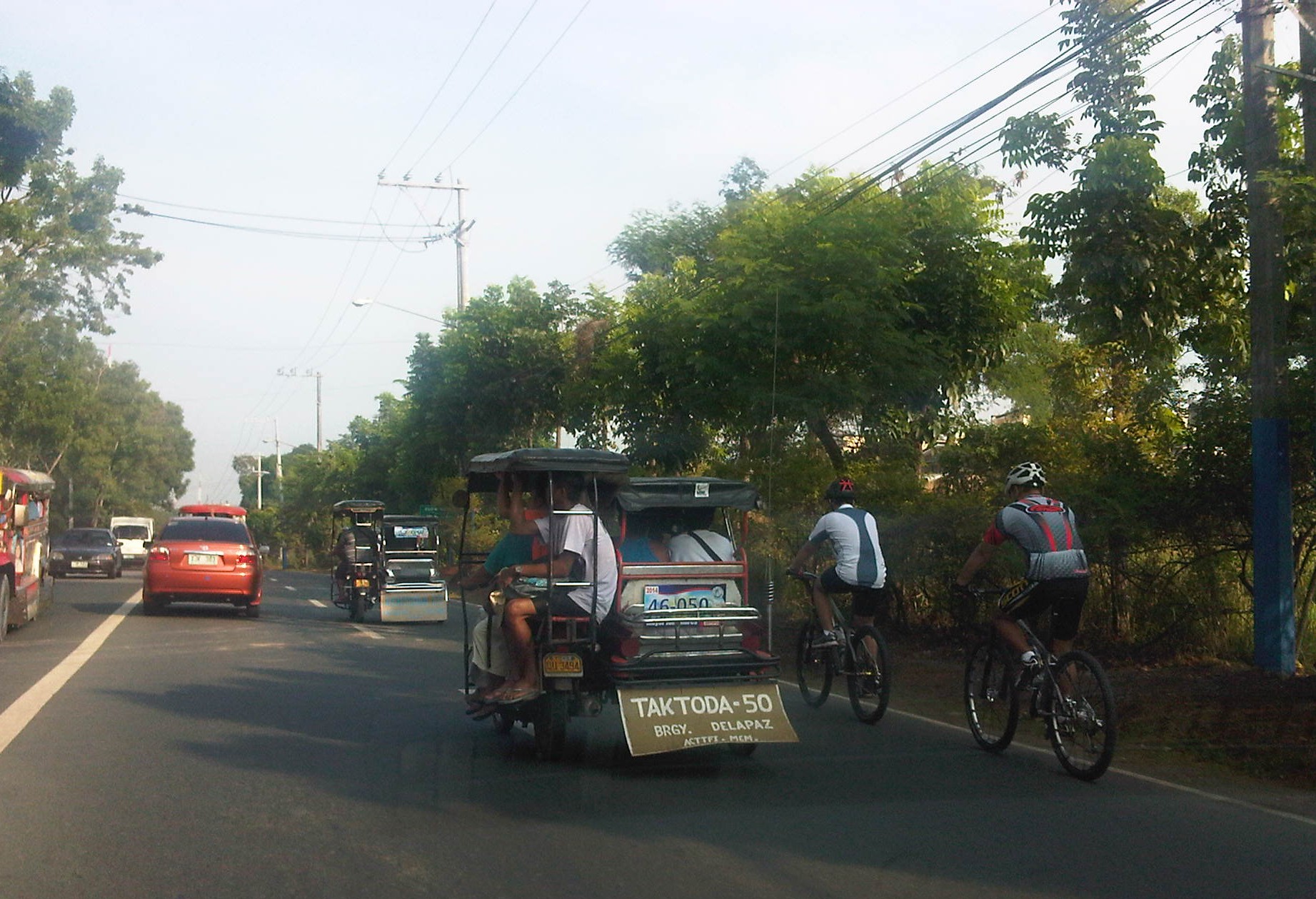 Motorists and cyclists “sharing the road” along Sumulong Highway
Sharing the road shouldn’t be too difficult. However, road users need to have respect for each other’s right to use the road. I have observed many instances where one or more road user types are guilty of “disrespect” and tend to hog the road as if making a statement that “i am king of the road” rather than “i have the right to use the road.” Here are among my pet peeves:
1. Slow moving trucks or jeepneys hogging two lanes and not giving way to other vehicles to pass them.
2. Jeepneys and private vehicles racing up or down the mountain roads and overtaking even in perilous sections (i.e., those already identified as prone to crashes).
3. Tricycles taking up the middle lanes and maneuvering anywhere.
4. Cyclists taking up the middle lanes or sometimes the entire two lanes of any direction preventing other road users to pass them.
5. People crossing anywhere along the road especially at blind sections (curves) where sight distance is limited.
There are practically no pedestrian sidewalks along most of Ortigas Extension and Sumulong Highway so pedestrians would have use the carriageway. As there are a significant number of people walking (e.g., students, workers, and even joggers or walkers), motorists and cyclists need to be careful not to hit these people. The same people, however, need to be aware of these vehicles and should exercise caution, always being alert as they use the road properly. Ultimately though, I would like to see walkways built along Ortigas and Sumulong especially since there is already an increasing demand for walking especially during the summer months when Antipolo holds its fiesta and a lot of people go on pilgrimages on foot to the Shrine of Our Lady of Peace and Good Voyage.
There is practicable road sharing in Antipolo because most road users are already familiar with each others’ behavior and accept each others’ presence and rights on the road. These road users are likely residents of Antipolo or nearby towns or regular visitors to the city. They are “nagbibigayan sa daan.” The “pasaway” people are likely the newer ones who seem to think that the way they drive or ride (i.e., unsafe) elsewhere is the norm. Of course, that goes without saying that familiarity with the roads and its users also breed risk takers who think they already know the road and have the skill and experience to drive like crazy. Here is where effective enforcement (e.g., timely apprehensions and reminders) and engineering (e.g., traffic signs and pavement markings) comes in to address the gaps in safety in order to reduce if not totally eliminate crash incidence along these roads.
–
Tales from a jeepney ride
Jeepneys get a lot of flak these days for the poor services they provide including many cases of reckless driving that could cause (if not already have caused) road crashes. Many of these crashes do not involve serious injuries or fatalities. Often, these are sideswipes or rear-end collisions, the latter being the result of aggressive drivers not being able to brake in time partly as they like to tail-gate (tutok) other vehicles. The social side of a jeepney ride is often the subject of many tales that illustrate typical human behaviour. There are the body language involved in passing fares between passengers and the driver or conductor. There are the scents and smell of different passengers. There’s music and there’s talk among people riding the jeepney (e.g., friends or colleagues commuting together). There are even cases of PDA or public displays of affection, including among students who go home together. I think it is still common for males to show their affection by taking their partners home (to make sure they get home safely).
One time during a ride home, I was fortunate to get a jeepney whose driver wasn’t reckless and whose conductor was a jolly fellow who engaged passengers in small talk while we were on our way to Antipolo from Katipunan. One passenger asked him how come it was more expensive to go to Antipolo Simbahan via Sumulong compared to the older route via Junction. He answered correctly that the former was a longer route (Google maps will tell you that the route via Sumulong Highway is 16.1 km while the one via Cainta Junction is 15.0 km.) but quickly added that the route via Junction usually took more time to travel along due to the congestion along Felix Avenue, Junction and Ortigas Extension. The other passengers agreed and joined the conversation, commenting on how many Antipolo-Sumulong jeepney drivers and conductors often try to choose passengers or attempt to cheat passengers on their fares (e.g., not giving back the right change or in some cases not even returning change). The good conductor offered his own observations in an accent that seemed to me as one for a native of Rizal. I wanted to join the candid discussion but decided to just listen in and be a spectator in this exchange.
 This jeepney conductor was honest and engaged passengers in conversation. The driver was not reckless unlike many others of jeepneys I have rode on. (He was at least middle-aged but nearing senior status based on his looks.) I thought this was quite rare given the many “patok” jeepneys operating these days and the younger drivers and conductors who don’t care about safety or passengers’ rights like senior citizens’ and students’ discounts.
I think it wouldn’t have been like this where conductor and passengers were interacting the way they did if this were a “patok” jeepney. “Patok” or “popular” jeepneys often feature loud music (though many people will regard this as noise and no longer music) and passengers can hardly hear themselves talk. Often the loud music is an excuse for the driver or conductor not giving back the right change or any change at all to passengers despite the latter shouting at the driver/conductor. We were also lucky that our driver drove safer than your average driver. That meant a somewhat longer trip but I guess the interaction among passengers and conductor allowed for us not to notice the time. I guess these types of trips and interactions are what distinguished jeepneys from other transport. This is very much how commuting can be romanticised and is certainly something we will perhaps miss should the jeepney be phased out. Will it be phased out and is it necessary to remove jeepneys from our roads? I don’t think it will be phased out completely, and I believe that there is a need for the jeepney to be modernised but at the same time operate within a sustainable framework and hierarchy. And we need more of this conductor and his driver to be part of this system while purging out the reckless, abusive and disrespectful kind who make commuting unsafe and uncomfortable for many.
–
More nuts on the road and a simple solution for traffic congestion
I have written recently about reckless drivers including one that drove as he was “busy” with his girlfriend in the car. The latter, however, is more an exceptional case rather than one you’d commonly find in our roads. Perhaps the most annoying behaviour by what I term as “nuts” on the road, is counter-flowing. Counter-flowing often happens along undivided roads (no median islands or barriers to split opposing traffic). Traveling home one afternoon, we took the bridge from C5 and the Marikina Riverbanks Road to Santolan, Pasig.
 I think we all thought that the driver of this Honda Civic was bold enough to have been able to cover a long distance before opposing traffic collectively forced the driver to back off.
While counter-flowing is dangerous and obviously a traffic violation, there seems to be few if any apprehensions regarding this behaviour. Such non-enforcement of traffic rules and regulations lead to more drivers and riders to be encouraged to counter-flow just so they could get ahead of all the others before them who did follow traffic rules by queuing properly. For one, there are issues of police or enforcer visibility in many areas, and when they are visible they are usually busy managing traffic at intersections and or watching out for number coding violations rather than enforcing all the other traffic rules and regulations that can be more or equally important than number coding violations in terms of their impacts on traffic. One such violation is counter-flowing that often leads to severe traffic congestion as counter-flowing vehicle block opposing traffic and force their way in front of queued vehicles. I think this has caused a lot more problems, congestion and safety-wise than number coding violations, and deserve to get more attention from traffic enforcers and managers looking for solutions to the traffic mess we encounter everyday.
–
Some thoughts on transport safety and security
There is an Office of Transport Security (OTS) under the Department of Transportation and Communications (DOTC). Under its mandate is coming up with plans and programs in order to ensure safe and secure travel for all. Security here is most often associated with the prevention of crime and the control of criminal elements in how they could affect transport (i.e., terrorists, robbers, etc.). I believe that this interpretation extends to safe driving as well since reckless driving is practically a criminal act especially when we realize the potential for fatal crashes due to these behaviors by drivers and riders. Unfortunately, the OTS like many agencies under the DOTC have a lack of personnel to be truly effective in carrying out their mandate.
I think passengers should be more proactive in ensuring their rides will be safe and secure. They should be in a position to pressure the driver to be more careful and responsible with the operation of the vehicle. However, there will always be apprehensions on the part of any passenger who might be thinking about the backlash or negative reactions they would get from the driver, conductor or even fellow passengers. Ironically, its the reactions from the latter that could turn something proactive to an embarrassing or humiliating experience. I recall one time a friend was conducting a survey on bus operations and one driver commented that passengers get angry with them when they slow down, saying the reason they rode buses of this particular company was because they drove very fast. Such thinking betrays their ignorance and disregard for safety – until, of course, they happen to be involved in a crash!
And so perhaps the OTS and other responsible agencies could enlist the help of other government personnel who would have the training required for authority figures on security and safety. For example, there are many of our servicemen in the armed forces and the police who take public transportation or who provide transport services by being operators or drivers (to augment their incomes with the AFP or PNP). Those who are passengers should assert themselves in the service of other passengers by accosting reckless drivers and reminding the latter of their responsibilities as service providers and the penalties for irresponsible driving. Servicemen can be formally (and legally) granted this authority by the LTO and/or LTFRB, which do not have the personnel to police the thousands of public utility vehicles around the country.
–
Walking vs. cycling?
I remember an episode in an old series, The West Wing, where White House staff had to meet with various proponents of renewable energy. The very same proponents advocated for the RE they thought should get the most attention, and therefore funding support from the government. They ended up criticising each other’s advocacies, even pointing to the flaws of each and basically putting each other’s proposals down. The POTUS (ably played by Martin Sheen) had to intervene and scolded these people for working against each other rather than working together to push a common RE agenda.
This is pretty much where we are now with many proponents of sustainable transport initiatives. People and certain groups would advocate for walking, cycling, BRT, rail transit, etc. as if these are exclusive from one another. The results have often been haphazard facilities such as entire pedestrian facilities being painted and designated as bikeways and regular bus services being mislabeled as BRT. I have some friends who insist that cycling is the way to go simply because they cycle between their homes and workplaces, not fully understanding that this mode is not for everyone especially with the various issues in urban sprawl affecting our choices of residence. Clearly, what is good for one person is not necessarily applicable to everyone else, and that is why we should have options for travel or commuting. These options would have to be integrated, complementary, affordable and people and environment-friendly.
 The MMDA fenced off entire stretches of sidewalks and painted the pavement red to designate them as bikeways. This basically alienates pedestrians and while the wire mesh fence has its benefits from the perspective of safety, it also effectively constricts the space that cyclists and pedestrians have to share. Note also the trees and poles that pedestrians and cyclists would have to evade or risk injury.
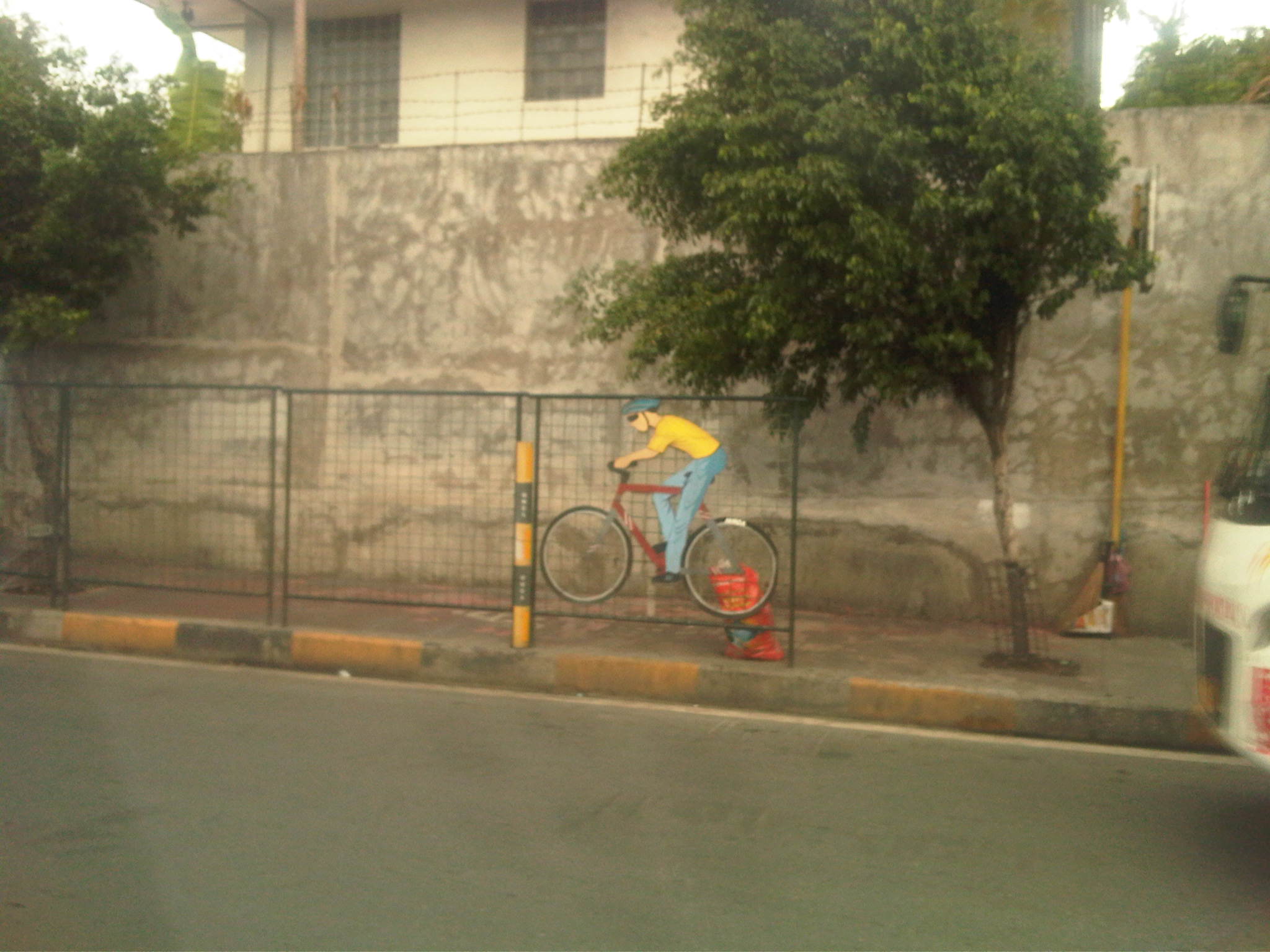 Along EDSA, the same treatment of fences and coloured pavements was applied ahead of Temple Drive/Corinthian Gardens. The space is just too constrained for sharing given the trees and poles and then you have the smoke belching buses adding to the misery of people using these facilities.
While there have been some quick wins for pedestrians and cyclists, it seems to me that many if not all do not seem to be as sustainable as we want them to be. Many cases are classic for their being “pwede na yan.” There is no innovation in design or no design involved at all much like what we typically see as best or good practices abroad. Marikina still has the best examples so far for integrated bikeway and walkway design though there are many examples of good pedestrian facilities around including those in Makati and Bonifacio Global City (I tend to resist saying Taguig because that city practically has no say in how BGC is developed.). Quezon City (along Commonwealth) had a little promise and the UP Diliman campus but perhaps that can be realised with the rise of a new CBD in the North Triangle area. Of course, we look forward to developments in Iloilo City what with the bikeways being constructed along the long Diversion Road. Still, I believe that there should be a conscious effort not just from the private sector but from government agencies, especially the DPWH, to come up with new designs and guidelines that LGUs could refer to. That agency so far has not measured up to the expectations of many for it to take a lead in revitalising our roads so that facilities can be truly inclusive and environment-friendly.
–
Nuts behind the wheel
Last night as we were on our way home, we noticed a vehicle in front of us swerving left and right as if the driver . We were in heavy traffic and vehicles from the adjacent lane were already falling back in order to avoid this vehicle. Even with the tint on the vehicle’s rear window, we could see the driver frequently leaning over the passenger side. At first, we would have dismissed this as the driver likely just taking care of the passenger (i.e., a parent perhaps checking on his/her child). However, closer inspection revealed what appeared to be a male driver leaning over to kiss what was likely a girl in the passenger seat. This went on for quite some time as we crossed the bridge along Marcos Highway and at full stop, we could see how busy the guy seemed to be with his display of affection. And so to get the driver back to focusing on his driving, we decided to give them a rap of the horn and flashed the high beam to their attention. The car swerved quickly to the right and sped off in what seemed to be a manoeuvre of embarrassment (We do hope he was embarrassed enough to focus on the road and driving, and not on “enjoying” his passenger. The road is not the place for such actions as they endanger other road users.
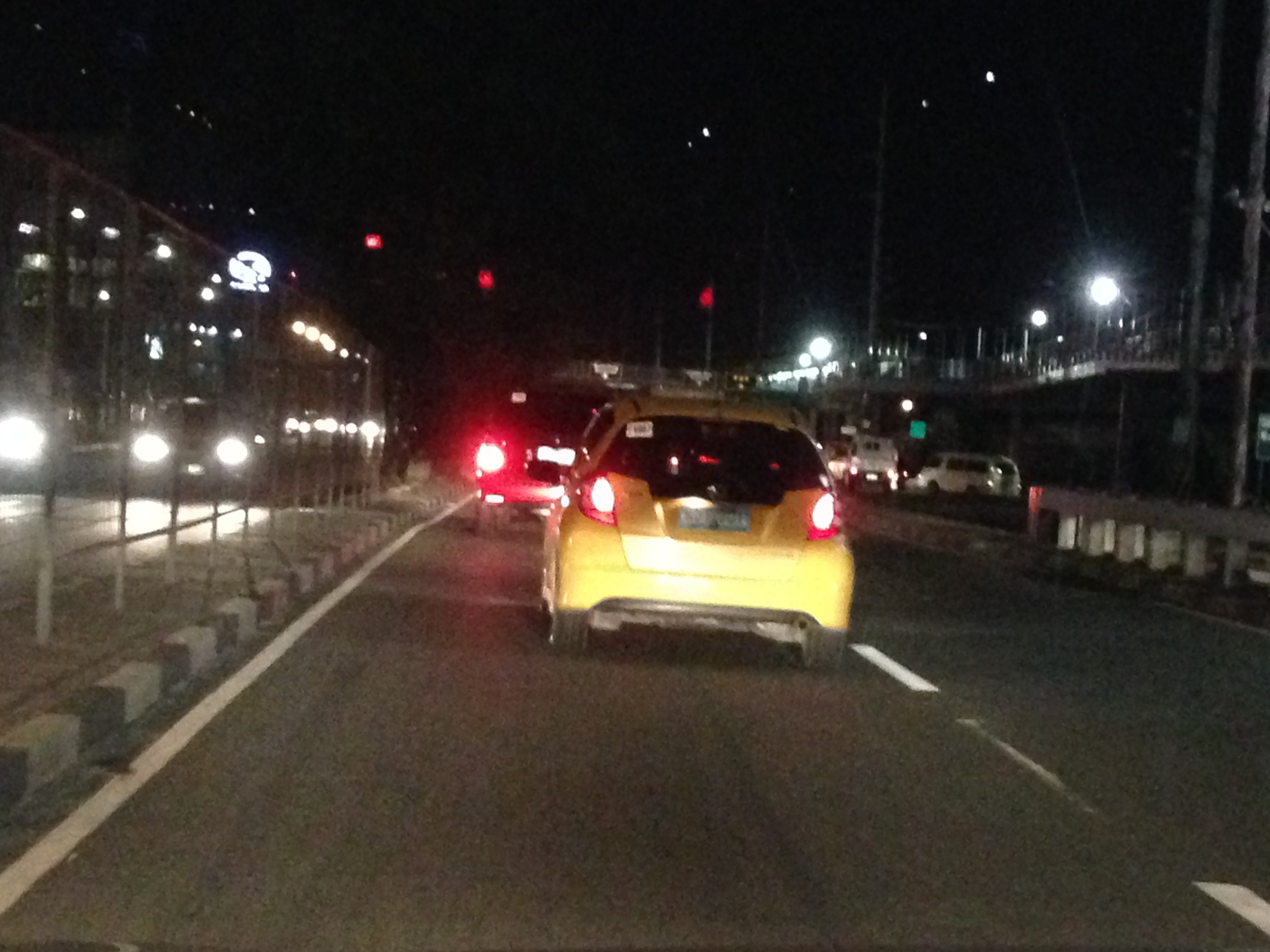 Yellow Honda Jazz with plate number NUT 801 was zigzagging along the road and there was no one to apprehend such drivers despite cameras supposedly installed along this road to monitor traffic.
This is a reminder to us that what’s wrong with a vehicle might be the one sitting behind the steering wheel – it’s driver. Drivers and other road users should always think about other people around them. Their behaviour and interactions along the road will determine how safe our roads would be for all users. This is practically the same principles regarding drunk driving or sleepy drivers whose behaviours under the influence or due to drowsiness could result in fatal crashes. These crashes and the resulting injuries and/or loss of lives are preventable with proper driving, riding and even pedestrian behaviour and is something each road user also has a responsibility to promote, even if it means simply getting the attention of another driver for him to drive more responsibly.
–
The Philippines’ National EST Strategy – Final Report
Friends and some acquaintances have been asking about whether there is a master plan for sustainable transport in Philippines. There is none, but there is a national strategy that should serve as the basis for the development and implementation of a master plan, whether at the national or local level. This strategy was formulated with assistance of the United Nations Council for Regional Development (UNCRD) through the Philippines’ Department of Transportation and Communication (DOTC) and Department of Environment and Natural Resources (DENR), which served as the focal agencies for this endeavour. The formulation was conducted by the National Center for Transportation Studies (NCTS) of the University of the Philippines Diliman. For reference, you can go to the NCTS website for an electronic copy of the National Environmentally Sustainable Transport Strategy Final Report.
 Cover page for the National EST Strategy Final Report
–
The need for mass transit to the east of Metro Manila
I wanted to use a title stating “the demand for mass transit to the east of Metro Manila” but the word “demand” for me seemed a bit technical (I associated it with the supply and demand concepts for transport.) and would need some numbers to support it. So I settled for the word “need” instead of “demand” so I could be flexible (i.e., more qualitative) with the way I wrote this article. “Need” is a more pedestrian term that can easily be understood and imagined, and there is no lack for images of this need for more efficient and higher capacity modes along the main corridors to the east of Metro Manila. The main corridors are Ortigas Avenue and Marcos Highway, which have the highest road capacities among other roads (i.e., higher capacities than A. Bonifacio Avenue in Marikina, the Batasan-San Mateo Road, or C-6/Highway 2000). These are also the corridors along which most public transport services may be found. Such connects the eastern towns (e.g., Cainta, Taytay, Antipolo, etc.) to the transport hubs of Cubao and Crossing, which are major transfer points for many people taking public transport. Of course, there are UV Express services from these eastern towns that go directly to CBDs like Makati and Ortigas.
You can observe the crowds at Katipunan and Santolan Stations of the LRT Line 2 as well as the people waiting for their ride home along Marcos Highway. I have observed that there are also lots of people along Ortigas Avenue from Tikling Junction to C-5 who religiously and patiently wait for their rides to school, office or home. This happens everyday and this regularity seems to be a never-ending sacrifice of time and patience. These people do not have much of a choice except taking whatever public transport is available to them. Many probably can afford to have a car or already have a vehicle in their household. Unfortunately, that vehicle is not usually enough for their commuting needs and so they are captive users of an inefficient public transport system (there are some who question if what we have can really be called a system).
 People waiting for a ride in front of Robinsons Metro East along Marcos Highway in Pasig City – these have occupied 3 lanes of the highway as they position themselves for the next available jeepney. There is a UV Express terminal at the mall and another at the nearby Sta. Lucia mall but these are not for the destinations these people are going to.
News that the LRT Line 2 Extension from Santolan to Masinag would finally be constructed was initially met with speculation. Such news have been circulating for so many years but no actual work could be seen along Marcos Highway to convince people that the project was underway. Now, that the soil test samplings have been completed, people are anxious about the actual construction of the extension. I think this is a project long overdue and the question that needs to be answered is if the line needs to be extended further, perhaps until Cogeo. I believe there is a tremendous market for this mass transit system along this corridor where a lot of residential subdivisions and relocation sites have sprouted over the years. The DPWH recognised this as a high capacity corridor and is already widening the road from Masinag to Cogeo.
Hopefully, the Ortigas Ave.-Manila East Road corridor can also have its own mass transit line. The regular bus services along this corridor is no longer sufficient and operations are not so efficient despite what appears as competition among 2 bus lines. There had been a Bus Rapid Transit (BRT) Line proposed for this corridor but there seems to be no progress towards the realisation of that project. Whichever of rail or BRT would be the option for the corridor though, it doesn’t take a genius or too many consultants to determine the need for a good mass transit line along this corridor. When that will be is a question with an answer that is still up in the air. Perhaps the local governments of Rizal, especially the province, should push for such transit systems. The governor and mayors should champion such systems that will definitely benefit their constituents and translate into real revenues for their LGUs from the certain business that will come along these corridors.
–
 Caught (up) in traffic