
Home » Behavior (Page 32)
Category Archives: Behavior
Habal-habal in Metro Manila?
Habal-habal is the term used for motorcycle taxis that proliferate in many rural areas but are steadily making their presence felt in urbanised areas as well. In Metro Manila, there are already some reports and spottings of habal-habal operations at Bonifacio Global City and in the White Plains area in Quezon City. I’m sure there are other areas where these informal services are being offered and the easiest way to spot these are by way of observing if there are motorcycle riders waiting in an area with extra helmets. The usual excuse if they are accosted is that they are just going to fetch someone (perhaps a relative or a friend) so they bring along that extra helmet for that person. When they do engage a passenger, I would like to think that they just ask the passenger to play along with them should they be apprehended and asked about their business.
Checkpoints around Metro Manila and many other cities and towns routinely stop motorcyclists to check on their registrations (i.e., there are many unregistered motorcycles around the country) and to pre-empt crime involving those “riding in tandem.” Motorcyclists with more than one passenger are risky and have a higher likelihood for severe crashes. The provision of services in exchange for monetary compensation (i.e., payment) puts these informal transport under the category of colorum services. These are not covered by insurance as required for formal public transport and so there are issues of liability should there be a crash involving these vehicles. No insurance means that passengers cannot claim for anything except compensation they can demand from the service provider (assuming he survives the crash) or the other parties involved (if it can be established that the other party is also at fault). You can always sue people but in this case, the pre-condition is that they shouldn’t have been riding a habal-habal in the first place.
 Alleged habal-habal waiting in front of an establishment along Katipunan Road. These typically cater to employees of establishments or staffs of households in the exclusive villages along this road, which has no formal public transport service due mainly to its being a private road that happens to tolerate through traffic. You can find other motorcycle riders offering such services at the corner of Katipunan with Boni Serrano Avenue.
–
Bottlenecks and other traffic issues in Antipolo
Commuting between our home in Antipolo and my work place in Quezon City, I have noted a lot of issues on transport and traffic that needs to be attended to by the local government in coordination with other entities like the DPWH and Meralco. Here are some photos with my notes and comments.
 Much of Sumulong Highway have been widened to 4 lanes but many electric posts remain in the middle of the additional lanes and pose hazards to motorists and cyclists. These posts seem to have been here for quite some time now and the paint on them gives the message that they will be here for the foreseeable future. Paint or no paint, they are road hazards and have the potential to kill people on vehicles crashing into the poles. I think this is supposed to be the responsibility of the power company (Meralco) but there needs to be a firm request and coordination coming from Antipolo City Government to finally relocate these poles.
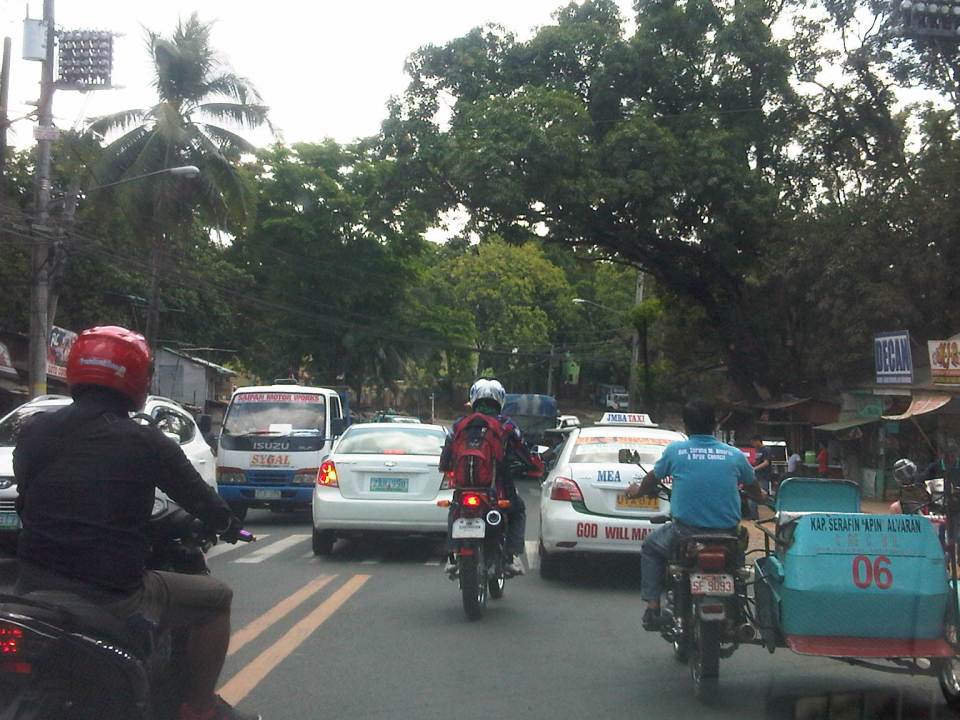 Congestion is often caused by counter-flowing vehicles forcing their way back into the right lane (like the car in the middle of the photo) upon encountering opposing traffic. It doesn’t help that there are motorcycles splitting the lanes to make for a very crowded road.
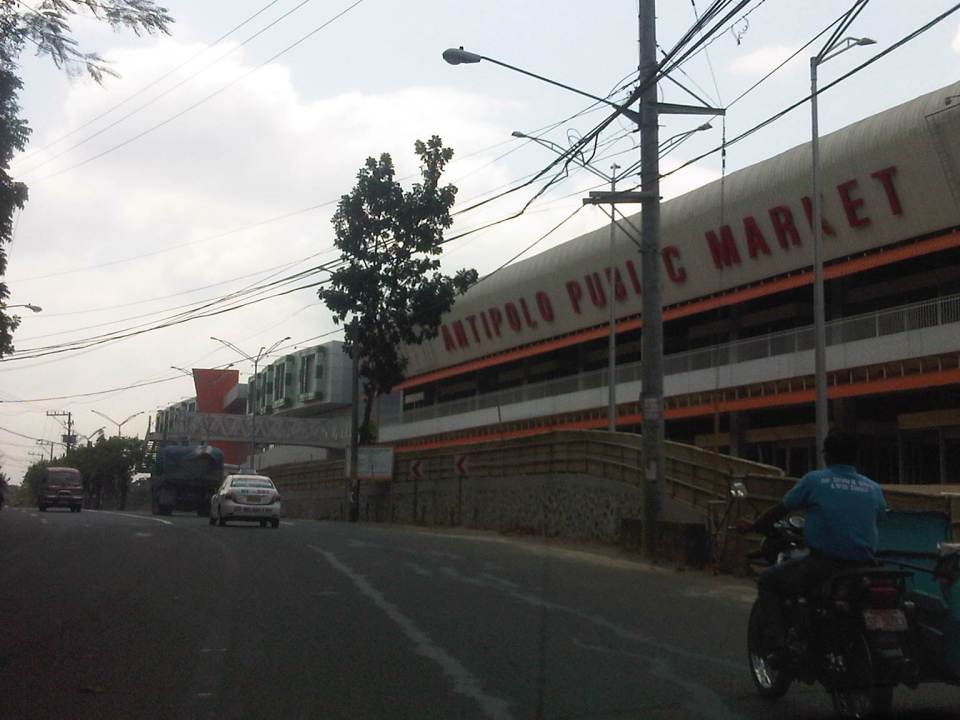 The new but still closed Antipolo Public Market along Sumulong Highway and near the intersection with Daang Bakal (the old railroad line that’s now a road). I wonder about the trip generation potential of this complex as it is not yet operational. Meanwhile, a huge Robinsons mall (looks larger than their Magnolia property) is currently under construction just across from it and will definitely be a major traffic generator in that area. The combined traffic to be attributed to these commercial complexes will surely have a tremendous impact on Sumulong Highway and other roads in the vicinity.
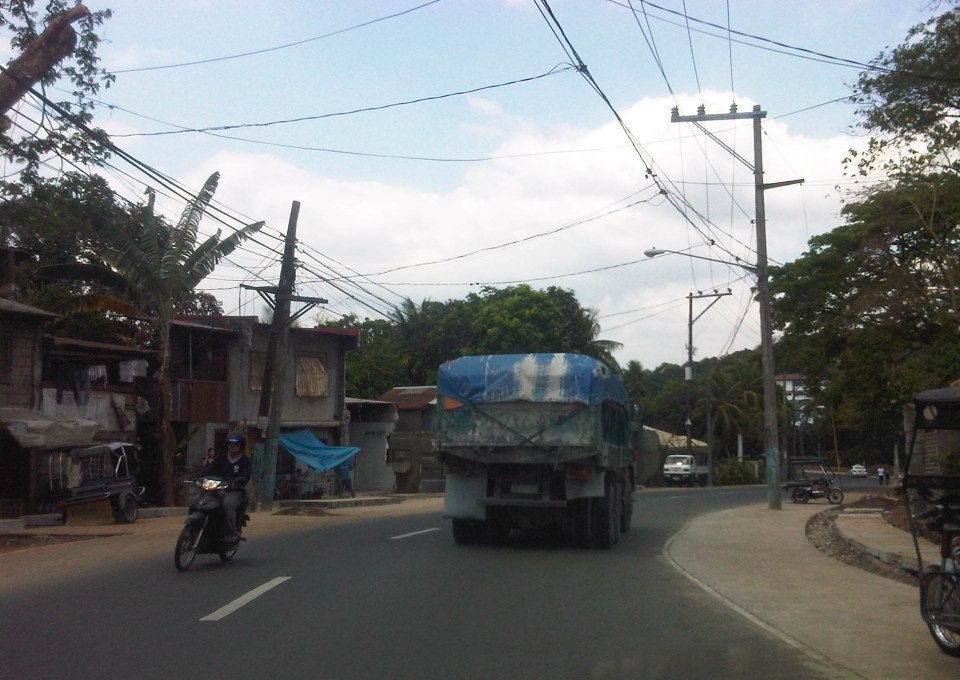 Both Sumulong Highway and Ortigas Avenue Extension carry significant truck traffic. These often cause congestion as they are slow going up to Antipolo and can block the entire road as Sumulong Highway and Ortigas Extension have some narrow sections where the shoulders could not provide enough space for other vehicles to pass the slower moving ones. In certain cases like the one in the photo above, there are electric posts in the middle of the shoulder lane.
 Tricycles occupy the outer lane of Ortigas Ave. Ext./Olivares Street. Such informal and on-street terminals are illegal along national roads and yet the city tolerates them. One explanation for this is that there are informal communities along the highway on shanties built along what is supposed to be a ledge along the mountainside (shown at right in the photo). These are where tricycle drivers and their families reside.
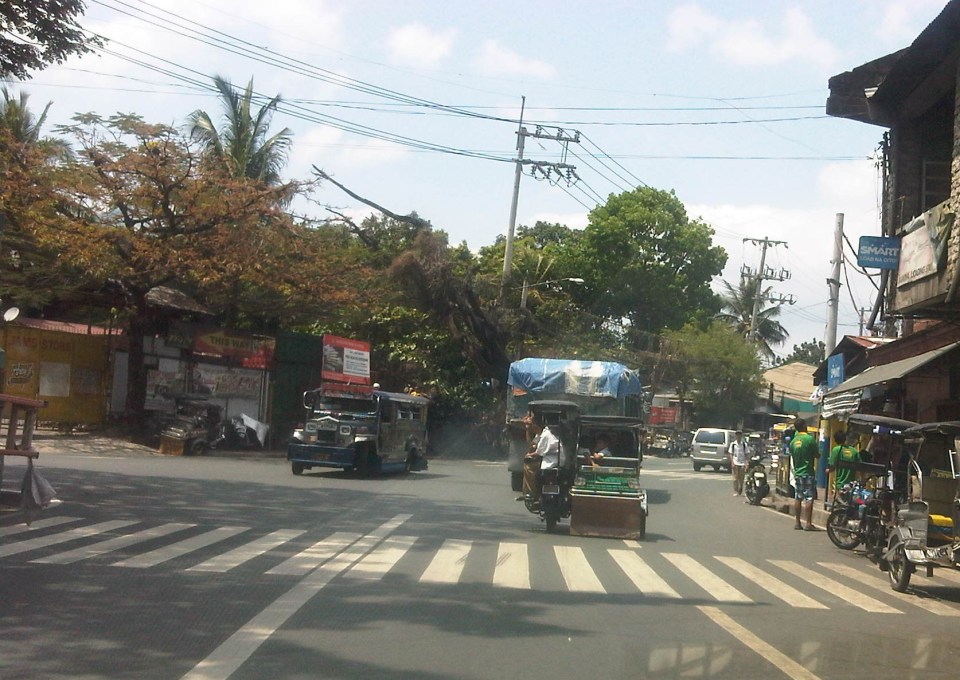 Tricycles from different tricycle operators and drivers associations (TODAs) seem to roam the entire city. This is contrary to the common practice in other cities and municipalities where tricycles are limited within a certain area or district that in many cases just overlap with others (e.g., UP Teachers Village-Philcoa-Krus na Ligas).
 Many tricycles serve as school service. However, the observation is that most tricycles tend to be overloaded with passengers. These are usually small children so the driver probably figured that they could cram more passengers than what is legally allowed.
 Sharing the road? Antipolo is very popular with cyclists and weekends bring a lot of them to the city as they come from all over via the main routes along Sumulong Highway and Ortigas Avenue (there should also be those coming from the east via the Antipolo-Teresa Road and Antipolo-Tanay Road). Most motorists are aware of these cyclists and give way to them. Most experienced cyclists are also aware of the ROW of other vehicles and so keep to the inner lanes. This mutual awareness and respect are vital to make roads safe for all. I think the only thing needed is to provide space for pedestrians as there are significant numbers of people walking, hiking or jogging along these roads.
–
Roads as solar dryers – Part 2
This is a continuation of an earlier post on roads being used as solar dryers. Our trip across Tarlac brought us to more of these facilities being used for agricultural purposes. The following photos are from San Jose and Mayantoc towns, which are obviously predominantly agricultural. The photos show lands devoted to agricultural as far as the eye could see and most are planted with rice.
A friend commented that something should be done to reduce if not eliminate such practices along roads. I replied that this is basically the responsibility of local government units including barangay officials who should be educated about the dangers posed to travellers as well as the deterioration in the quality of the rice as it gets compromised from the waste and grinding they get from vehicles. In terms of practicality and recognising the limitation in funds for solar dryers, roads seem to be the easier and versatile option. Basketball courts and other concreted spaces scattered around the countryside do not make sense where roads would have more use especially to address accessibility issues (e.g., farm to market roads).
Another friend commented on the earlier post that he almost had a collision with another motorcycle rider as the entire road was covered with rice being dried by farmers. I reasoned out that for rural roads with very low traffic, a single lane covered with rice could be tolerable but using the entire road width just is not right. Motorcycle can easily slip or skid along such rice-covered roads resulting in serious injuries if not fatalities. For most cases of what I’ve seen recently, the roads quality as having low traffic and rice is being dried only along one lane so we know at least that people are aware that one lane should at least be free of obstructions.
 1
1
 2
2
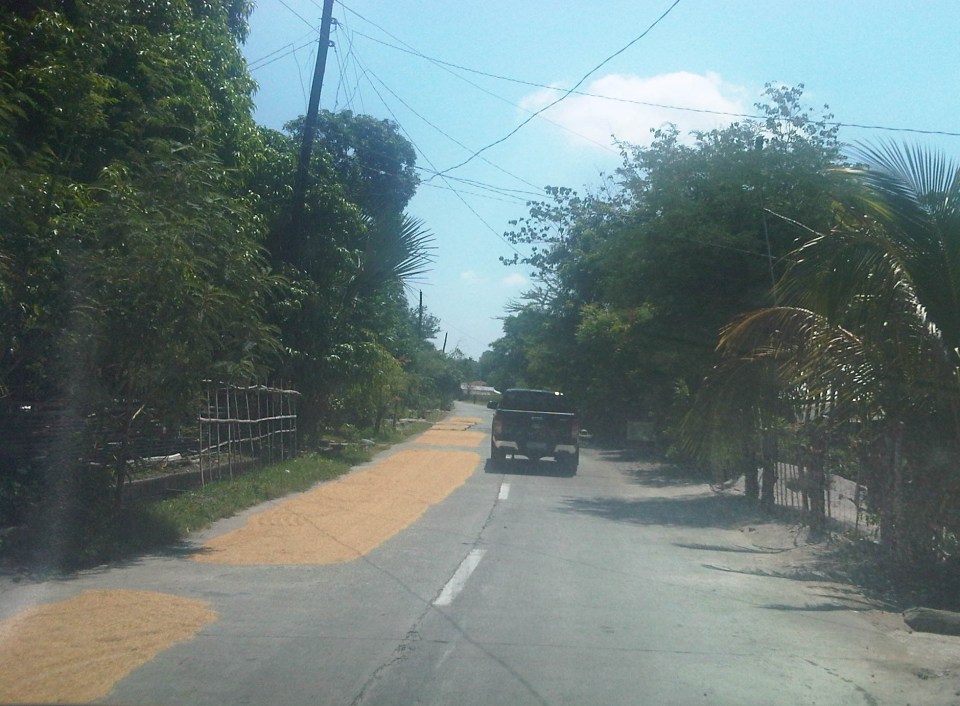 3
3
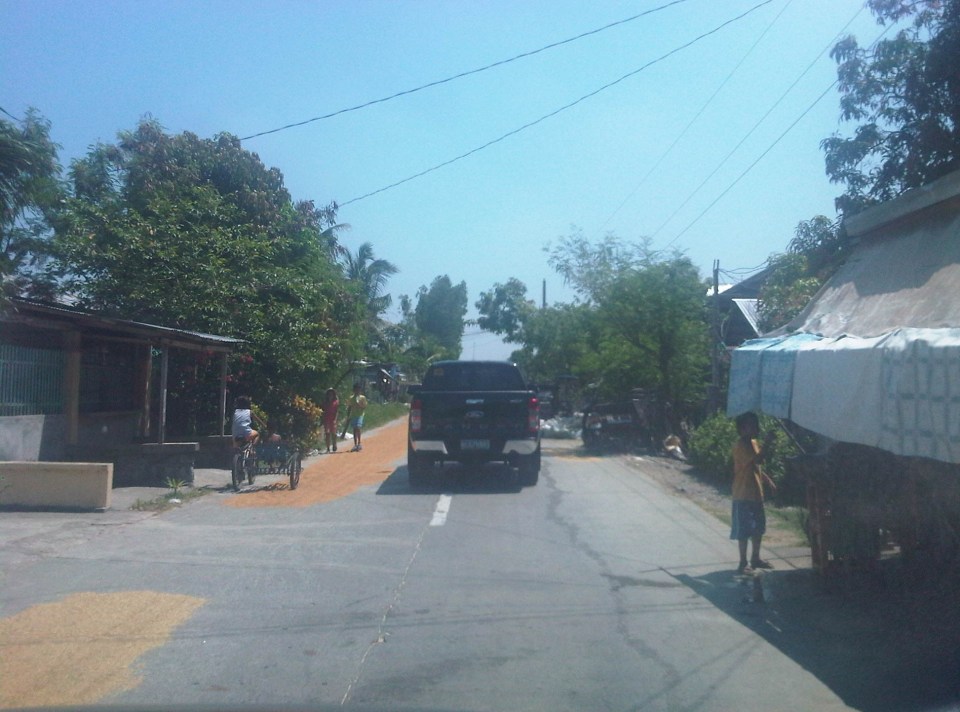 4 – That’s corn being dried just beside the pick-up truck in the photo.
 5
5
 6
6
 7
7
 8 – Bad practice of spreading the grains across the entire road carriageway
 9
9
The last photo is of corn kernels being dried on a basketball court. You can see the cobs piled near the stage, which shelters what looks like sacks of corn. As I mentioned earlier, it is possible to have such basketball courts or social facilities to be used as solar dryers. Even schools grounds can be used for this purpose but only for weekends or during the summer breaks. However, it would be impractical to have basketball courts and plazas scattered all over the countryside just for this purpose especially in places where there aren’t much people in the first place. Roads still offer the more flexible use (i.e., access/FMR and solar dryer) as long as traffic is not significant. Perhaps where traffic is significant (i.e., significantly populated areas) then such “off-road” facilities should be constructed. But again, the responsibility for making sure roads are clear of agricultural products would fall unto the LGUs.
–
Roads as solar dryers – Part 1
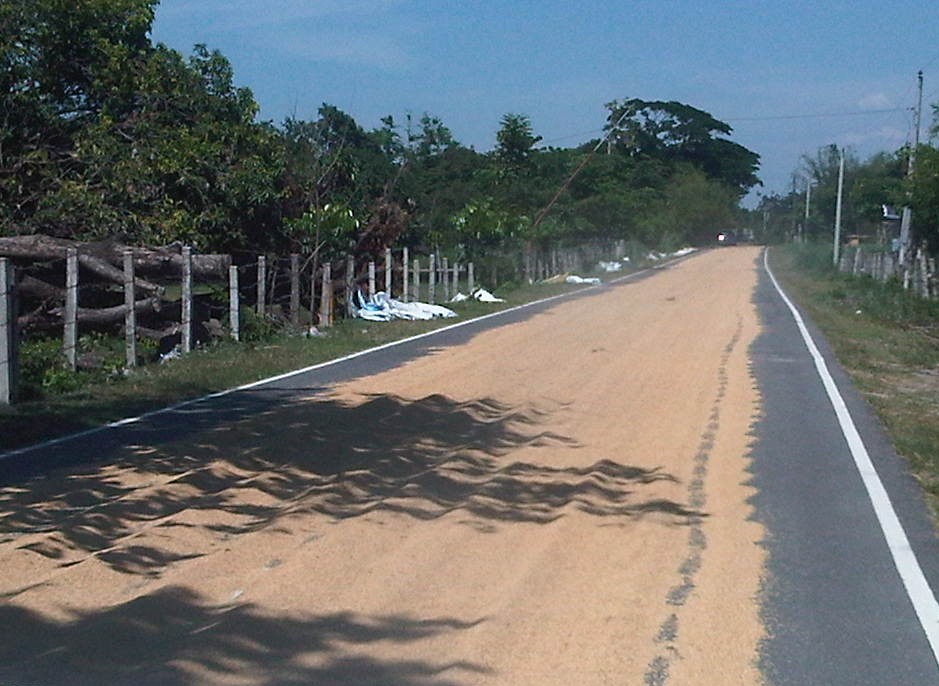
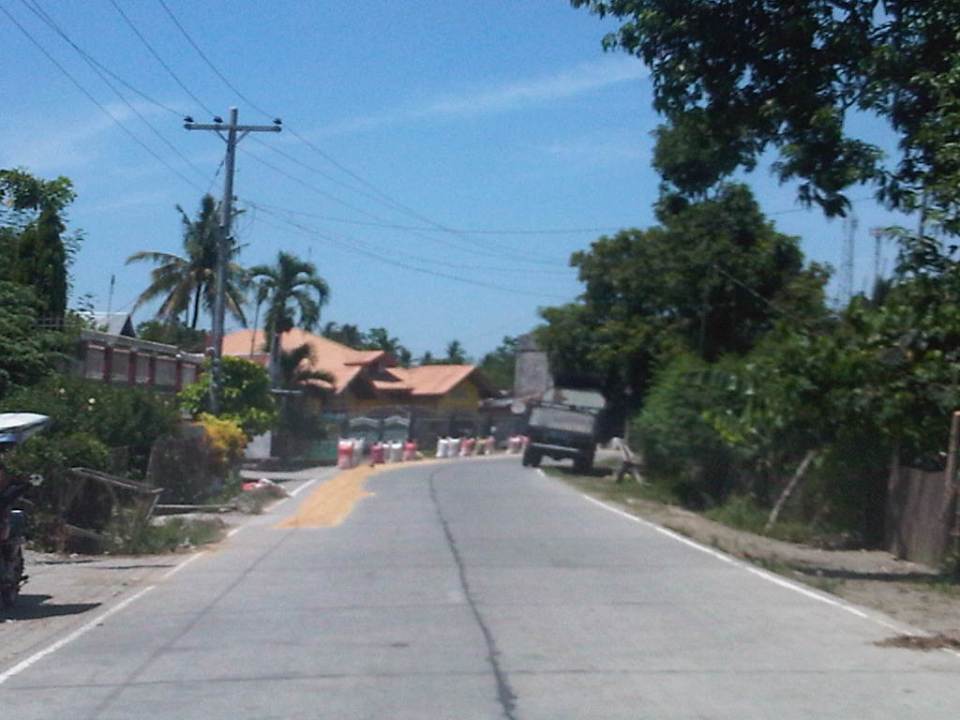
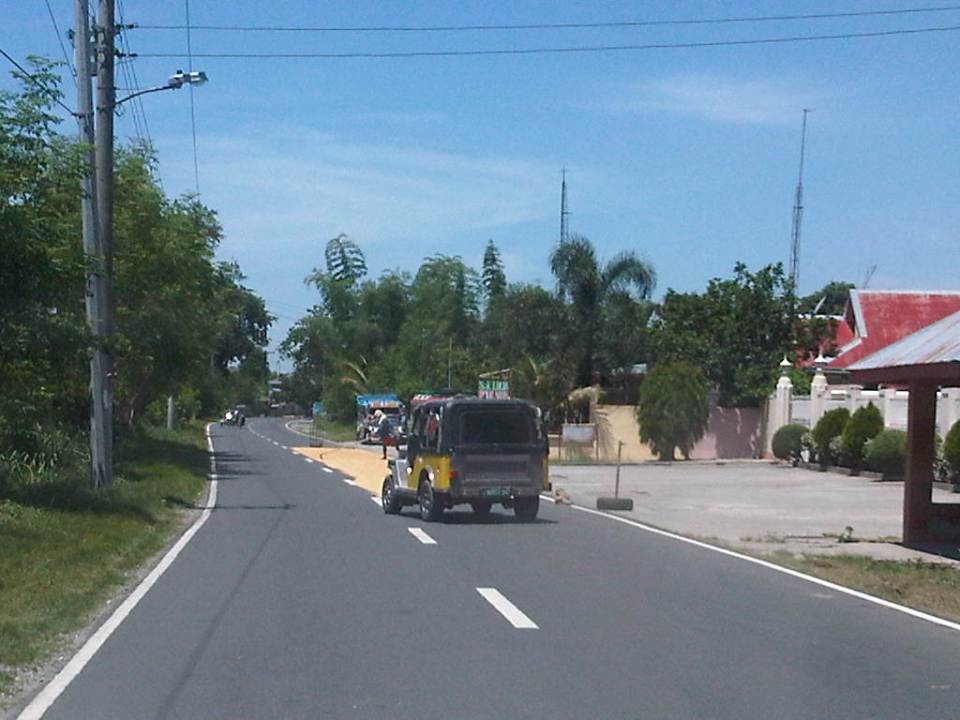
We are currently undertaking a project for the Province of Tarlac that looks into the safety along its rural roads (both national and provincial roads) including those providing access to tourism areas in the province. Along many rural roads are agricultural lands producing rice, corn, fruits, vegetables and other products. Often, travellers will encounter roads that serve another purpose other than transport – as solar dryers. Before rice is milled, it needs to be dried first so that it would be easier to remove the husk (i.e., separate the bigas from the ipa – together they are called palay). While it is possible to do this drying on mats (banig) spread over the land/soil this takes time. Meanwhile, portland cement concrete roads offer what seems to be the perfect surface for drying. As such, certain roads have been known to get justification for concreting despite low traffic volumes as they double as solar dryers. There are similar cases for basketball courts or village plazas receiving funding for concreting for the same reasons. Obviously, laying out rice on the roads have implications on the quality of the rice later on as vehicles will inevitably (even inadvertently) pass through the roads. I guess its even worse in cases when the road surface is of asphalt concrete. Following are photos I took along rural roads in Bamban, Capas and San Jose towns of Tarlac.
 1
1
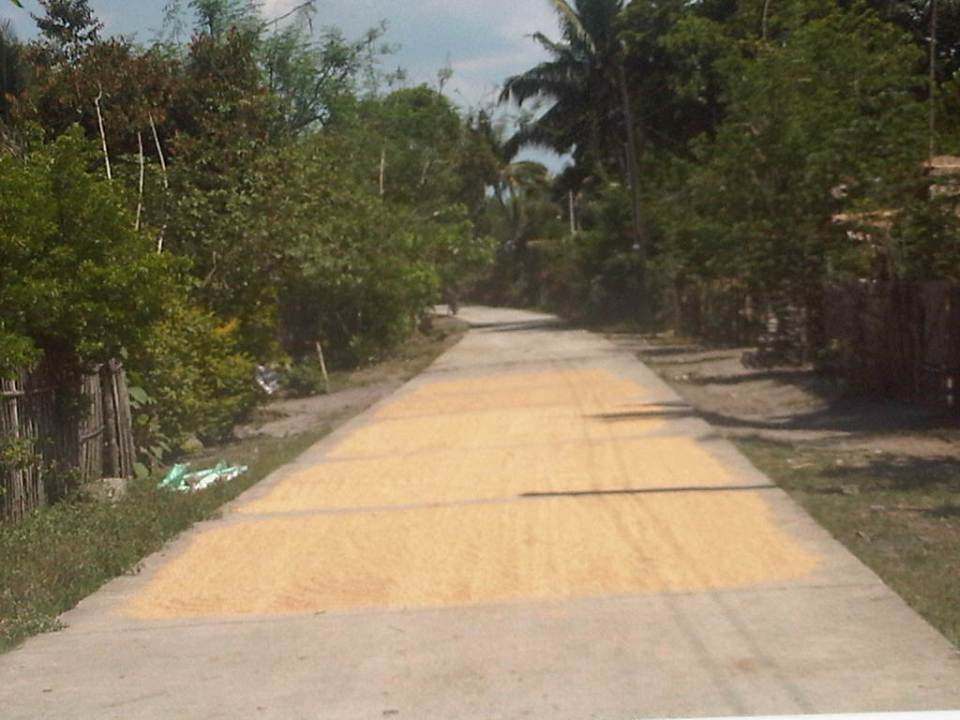 2
2
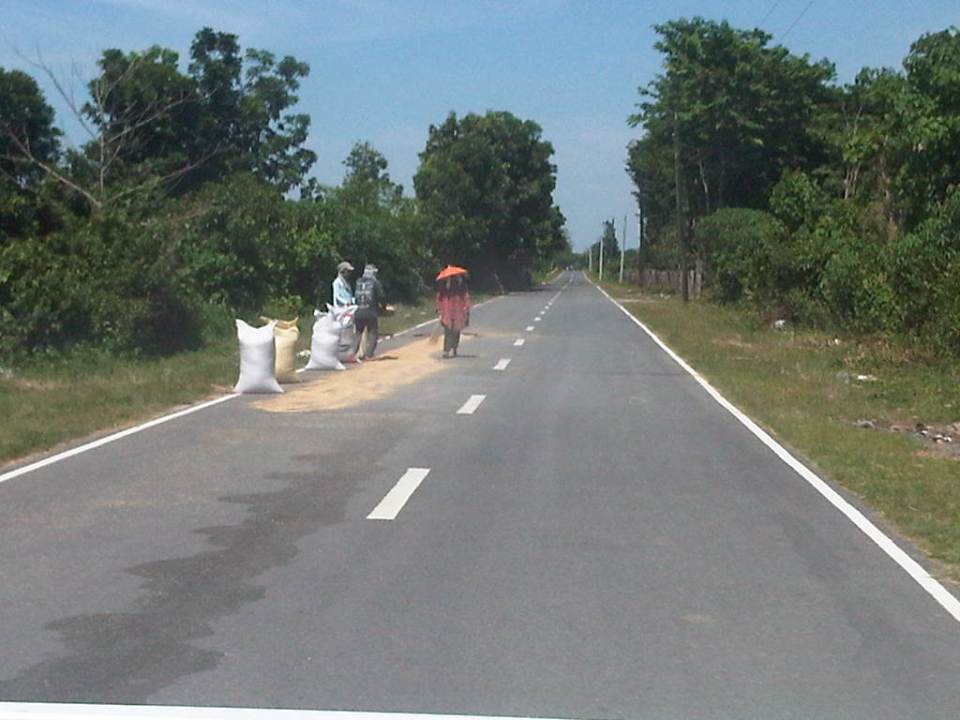 3
3
 4
4
 5
5
 6
6
 7
7
 8
8
 9
9
 10
10
Other items that are usually dried on the roads include tingting (the stems of coconut leaves that are used to make brooms – walis tingting) barbecue and fish ball sticks. I have also seen fish being dried on the road one time during a trip to Northern Luzon. Obviously, among the risks are the rice being grinded by the tires of vehicles (resulting in durog na bigas more suitable for porridge), fuel or oil compromising the rice, and the prospects of animals doing their thing on the road near or on the rice!
More on these solar dryers in the next post!
–
Hang time
Traveling to the office one morning, I spotted a jeepney overloaded with passengers. Many were already hanging on to the jeepney at the rear and I could count eight people including 6 who were practically dangling from the jeepney. Such behaviour is common among males who do this just so they could get a ride to their workplaces. But this is also common among students who, with their bags (usually backpacks) face even greater risks when they hang on at the rear of jeepneys. This is actually illegal but poor traffic enforcement combined with the inadequacies of public transport force a lot of people to make sabit (hang-on) to the jeepney. Granted that some of these people have no intention of paying their fares but there is a real danger of lost lives if not serious injuries if one falls off the vehicles.
 Eight passengers hanging on to a jeepney as it is stopped at an intersection. Note the ones with backpacks that add to the degree of difficulty for this practice just to get a ride to work or school.
 The same jeepney with all 8 passengers dangling as the vehicle speeds up along Marcos Highway in Antipolo. These sabit passengers are actually lucky that their driver is not so reckless (e.g., changing lanes so often, making abrupt movements).
This practice is among a host of seemingly small but important items that can easily be addressed with strict enforcement of traffic rules and regulations. Prompt and timely apprehension and penalties will go a long way into influencing behaviour change among both drivers and passengers. I think the basic idea going on in the minds of both parties is that despite the practice, there’s seldom an incident when a passenger falls off from the jeepney. Such should not be the case and an acceptable reason if we are to prevent untoward incidents from happening, and it starts with sending a strong message through proper enforcement. Are the authorities up to the challenge though? Or is the ningas cogon attitude going to prevail all the time for such situations?
–
On road safety and courtesy
I spotted what apparently was a father and daughter riding tandem on a foldable bicycle along Katipunan and heading to the University of the Philippines campus in Diliman. Both were dressed quite appropriately for the weather and for cycling. It was good to see that they both at least have their helmets on; though ideally it would have been better if they wore elbow and knee pads and “reflective” clothing for them to be easily seen on the road.
 Waiting for a chance to cross – the cyclist was waiting for a chance to cross Katipunan towards the University of the Philippines’ Magsaysay gate. True to form, motorists along Katipunan’s southbound directions do not slow down to allow for others to make a left turn to UP. Motorists bound for the university have to inch their way and create gaps for themselves to cross. Often, one has to rely on the Katipunan jeepneys whose drivers are braver than others in forcing their way to be able to cross the road. The father and daughter tandem were able to cross safely, taking advantage of a screen of motor vehicles (including ours) that made a left turn to enter UP.
I have observed that jeepney and truck drivers are more likely to stop and give way than private car drivers and motorcyclists. Motorists generally don’t give way to others even in heavy traffic, often blocking intersections just because the green light is still on for them. Many do not give way to pedestrians and do not know how to share road space with cyclists. Worse are motorcyclists who use sidewalks and bully pedestrians to give way to them! Meanwhile, you have pedestrians who throw all caution to the wind to cross anywhere and anytime along roads like Commonwealth, commuters occupying the carriageway as they wait for their rides, and cyclists hogging the middle of the road when there are actually lanes designated for them. These are manifestations of how poorly people are trained for road use and often an indictment of a failed licensing system as well as traffic education in general.
 Pedalling along – after successfully crossing Katipunan, the father and daughter tandem finally enters the more friendly roads of the UP campus. UP Diliman already has bicycle lanes along its academic oval and the community is generally aware of the rights of pedestrians and cyclists as road users. I would like to think that people who have a connection with the University and those who are also advocates of walking, cycling and road safety respect each other’s rights. But as always there will be those irresponsible people (e.g., pasaway, barumbado, etc.) who will disregard traffic rules and put lives in danger with their behaviour on the road.
In many cases these days, we just need a little common sense and perhaps more of courtesy to make travel safer and better for everyone. Everybody needs to learn and practice respect for each other’s rights on the road and courtesy extends to everyone so we can have order in our streets. It doesn’t take a genius (or experts, international or local) to point out things that are basically common sense and require common courtesy if not decency.
–
Risky business with motorcycling
I spotted what appeared to be a family of four riding the same motorcycle as I was traveling to work this morning. While they were traveling slowly, likely to be careful considering there were 4 riders, I could’t help but imagine (not really wonder) what was going on in the minds of the adults here. The children were obviously oblivious to the dangerous situation and I even saw one child smiling and apparently enjoying the ride. I am sure that the father is trying his best to be careful as he is surely aware that a mistake would likely doom his entire family.
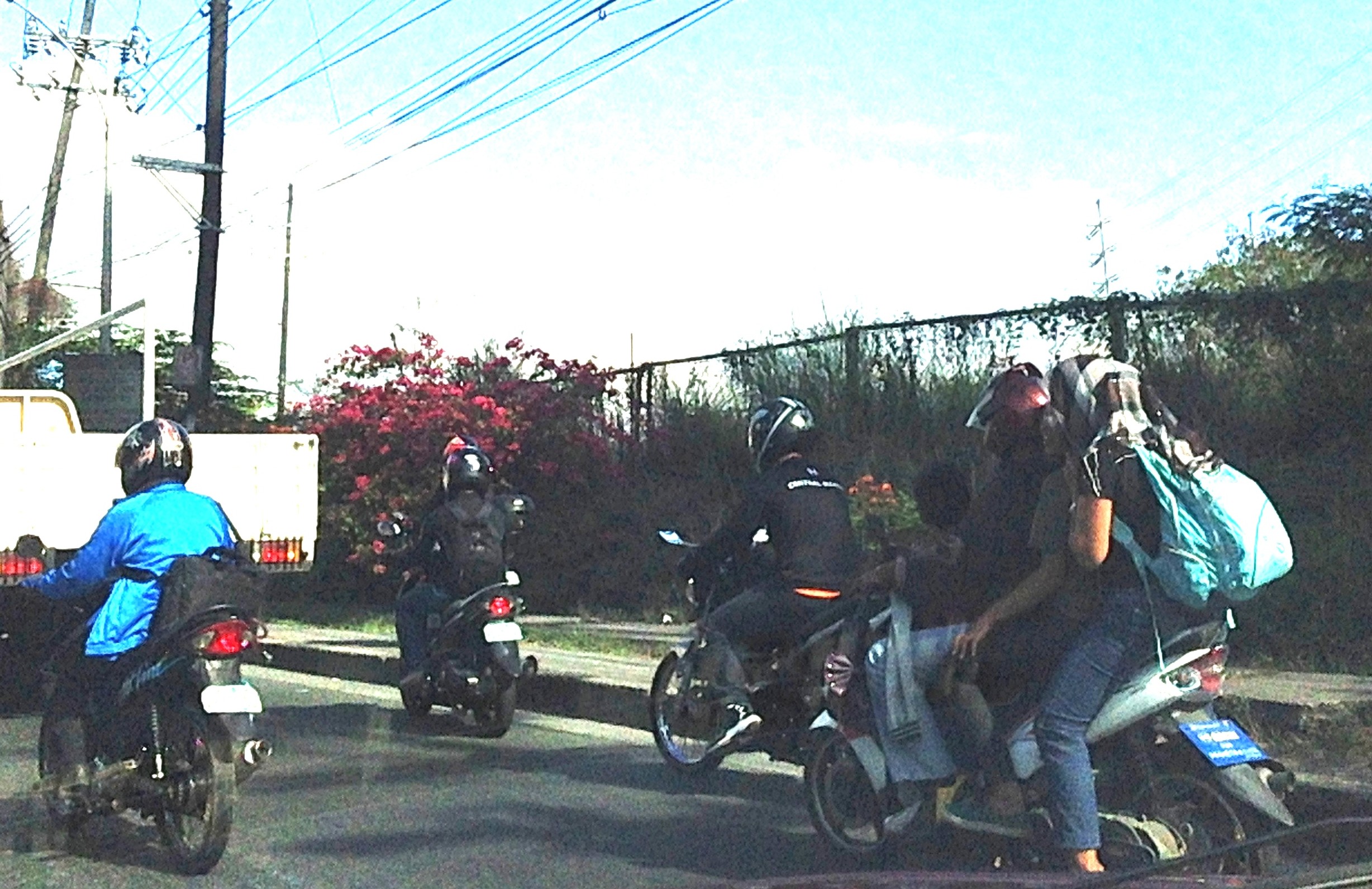 A family of 4 with one child (the younger one) in front and another child sandwiched between the adults riding a single motorcycle. The children didn’t even have helmets so if an untoward incident happens, there is a very high likelihood that the children will be killed in a crash.
These are common sights in Metro Manila and elsewhere in the country. Its worse in other places where there’s weak enforcement of road safety laws including the helmet law and the limitation in the number of passengers (yes, there is a law against passenger overloading for vehicles). I was actually wondering how these people in the photo were able to evade MMDA and LGU enforcers along major roads. And to think that there are many checkpoints to inspect those “riding in tandem.” Clearly, this is a violation of existing regulations and the only way to discourage such practices and effect behaviour change is for authorities to clamp down on such risky situations, even forcing them to discontinue travel in addition to issuing a ticket and fine for the violation. Are we really serious in promoting road safety and ensuring safety for everyone? If so, why the lax enforcement when it is perhaps, and arguably, the most important element in order to influence people’s mindsets regarding road safety.
–
Driver’s personal insurance?
A friend of my father-in-law approached me to ask if there have been studies on requiring Philippine drivers to get personal insurance before being issued a driver’s license. I replied that I am unaware of any study or studies on this topic. I told him, though, that there have been discussions to require bus and trucks drivers to get certification from the Technical Education and Skills Development Authority (TESDA) to drive these large vehicles. The certification is the same required in other countries for foreign drivers seeking working in those countries. And so, prospective OFW drivers would have to take up the certification course at TESDA in order to qualify as drivers in other countries. These discussions were made at DOTC together with the LTO and the TESDA prior to 2010. Since then, I have no knowledge if such discussions were continued or if someone or some group pursued this. Based on what we see now on our roads where buses and trucks have been involved in many road crashes, I can only conclude that the certification initiative was not pursued for one reason or another.
The reason I was asked whether there were studies on the topic of driver insurance is that the person is part of a group (he didn’t reveal it to me and I didn’t ask him about the name) seeking for a bill to be filed for this insurance to be required prior to being given a license to drive. He told me that this is based on the system in the US, where prospective drivers are required to get insurance as a prerequisite to being issued a license to drive. The premium for the insurance is dependent on the record of the driver and increases significantly with the person’s involvement in a road crash where he or she is proven as the guilty party. The premium also increases when drivers are found to have violated traffic rules and regulations, and the data based on citations or tickets issued by apprehending officers are transmitted to the Department of Motor Vehicles (DMV), which is the equivalent of our Land Transportation Office (LTO). The idea is for drivers involved in crashes or frequently violated traffic rules and regulations to be charged a higher premium until a point when there will be no legitimate companies willing to insure the driver because of his record. Alternatively, the driver might be forced to give up on driving because he or she could no longer afford the steep premium resulting from his/her own actions on the road.
This is actually a good idea and one that probably is worth looking into in more detail by our LTO if it is to use this as a way to reduce errant drivers on the road. I would propose that higher premiums should be required of public transport drivers who would be responsible for a lot of lives. Truck drivers can have their premiums dependent on what kind of trucks they drive. Perhaps higher premiums are for those driving tankers or lorries carrying sensitive or high value freight. The bottom line, of course, is how such a system can be operationalised or implemented. There is also that thing about enforcement and the sharing of information between apprehending entities (e.g., PNP, local police or local government staff) and the LTO for the data required to assess a driver’s record whenever he or she renews his or her license. There will always be loopholes and/or fixers somewhere but these should not deter the authorities from seeking a better system than what we have now where drivers can “get away with murder” sometimes quite literally.
–
“Sharing the road” – bandwagons and fads? Let’s hope not!
There seems to be a lot of talk about “sharing the road” and the initiatives to have more bikeways. I hope I am proven wrong but it seems to me as if these current programs and projects are more of a fad. A lot of people (and local governments) join the bandwagon with little understanding of what needs to be done. It’s usually because of the good PR they get out of these that they agree to coming up with the token carless street or the haphazardly implemented bicycle lanes. More than PR, some cities are aware of the opportunities that come with such initiatives as international agencies and groups are willing to spend money to support such programs and projects. The question really is on sustainability and doing the right thing not only on initiating things or coming up with programs but on the substance itself. And by substance I mean that programs should also go into the details of designs. Too often, the “pwede na yan” approach is taken and this just won’t do.
 The MMDA painted the sidewalks in White Plains and designated them as bikeways, in a way alienating pedestrians.
A vision for what people want to have is there but it is ultimately how the achieve the vision that needs a lot of work. For example, bills are being filed in congress to force the creation of bicycle lanes along major highways. (And mind you there are a lot of similar bills filed in congress that upon closer inspection actually have little substance.) The premise here seems to be that if you build them then people will start cycling. That was not the experience in Marikina, which boasts of the country’s only bikeways network that includes many off-street sections. These bikeways were built at a time when the perception and analysis pointed to a critical mass of cyclists in that city that was thought to be surely the tipping point in terms of non-motorised transport. Nowadays, the same bikeways are used by motorcycles and tricycles and most cyclists we see are not commuters (e.g., cycling between home and work/school) but recreational cyclists. It would take Marikina some effort to promote commuting by bicycles and much effort in enforcement to correct the misuse of the bikeways. The “new” bikeways in Quezon City appear to be poorly conceptualised as the MMDA decided to paint the sidewalks along EDSA northbound without addressing the obstacles like electric posts. Still, it is an effort to put NMT in the consciousness or awareness of the general public (thanks in part to media’s making these news worthy items).
Cities like Pasig and Taguig like to show-off Ortigas Center and Bonifacio Global City, respectively, as their faces when in fact the cities have not done much in their original cores. The running joke is that the real Taguig is not the areas to the west of C-5 but the old Taguig, which is to the east. This Taguig is the one plagued by narrow streets and the proliferation of tricycles. It was not so long ago that a former mayor imposed e-tricycles on BGC (where they were not suitable) while not doing much to lift a finger in the mayhem of tricycles in old Taguig (e.g., along Gen. Luna). As for Pasig, you just have go along the Pasig River and the Manggahan Floodway to see what it has accomplished so far in those areas.
There are no quick fixes to the transport and traffic problems our cities are facing. In the case of Metro Manila, much is at stake for the long-delayed mass transit projects. And the DOTC’s announcements of projects being formulated or proposed are no longer taken seriously as they have not delivered on any of these despite 4 years of this current administration. For other cities, it is important to learn the hard lessons from the experience of Metro Manila. There is also a need for a drastic change in transport and traffic policies in our cities. Iloilo, for example, has built an expensive bike lane along Ninoy Aquino Avenue (Diversion Road) and has marketed its Esplanade as a haven for pedestrians and cyclists. Yet the city has not acted on the clamour to revisit the overpasses along Gen. Luna (Infante and Jalandoni flyovers). The latest information I got from the city is that there are issues in the design of the bikeway along the Diversion Road as the surface (they used pavers) is not suitable for cycling. It seems, also, that the city and cyclists were not consulted by the DPWH when the bikeway was designed and constructed resulting in many cyclists using the Diversion Road itself for traveling. This last example is a lesson for our local governments and national agencies that they need to cooperate with each other and turfing has no place in transport and traffic if we are really serious about bringing solutions to problems we encounter everyday.
–
On sustainability and inclusiveness of pedicabs
“Sustainable transport is inclusive but inclusive transport is not necessarily sustainable.” Is this statement true? If yes, why and to what extent? This is not a philosophical take at transport. There seems to be some conflict in that statement but there should really be no confusion once you delve into the essence of sustainability and define the limits of inclusiveness. The statement is true to the extent that all sustainable forms of transport can be inclusive. These are transport modes that are friendly to all genders, all ages, all economic classes, and regardless of physical ability. However, there are transport modes that are inclusive in the same context stated but are unsustainable from the perspectives of suitability, efficiency and energy.
For example, non-motorized transport (NMT) in the form of pedicabs (also called trisikad or padyak) are sustainable from the perspective of energy. They are most suitable for operation along minor roads, especially those in residential areas. However, if the same pedicabs operate along national roads and mixed with motorized traffic, these become a nuisance and contribute to traffic congestion. Such operations also put passengers at risk, exposing to potential crashes as pedicab drivers tend to violate road traffic rules (e.g., moving against traffic).
 Pedicabs along the Quezon Avenue Service Road near Agham Road.
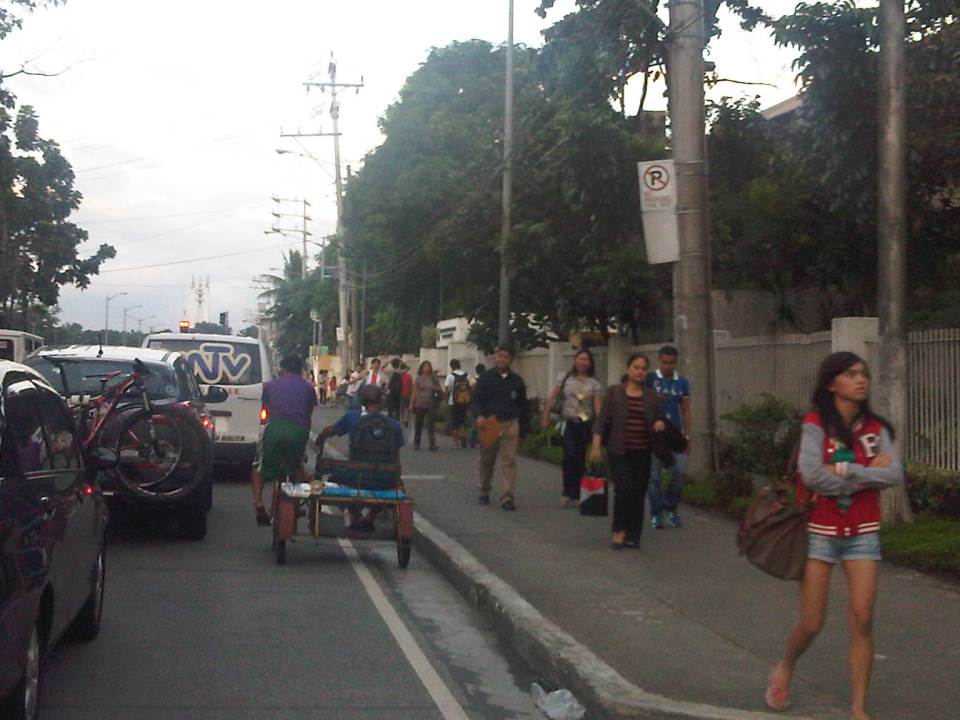 Pedicab ferrying passengers from the Quezon Ave. MRT-3 station to destinations along Agham Road.
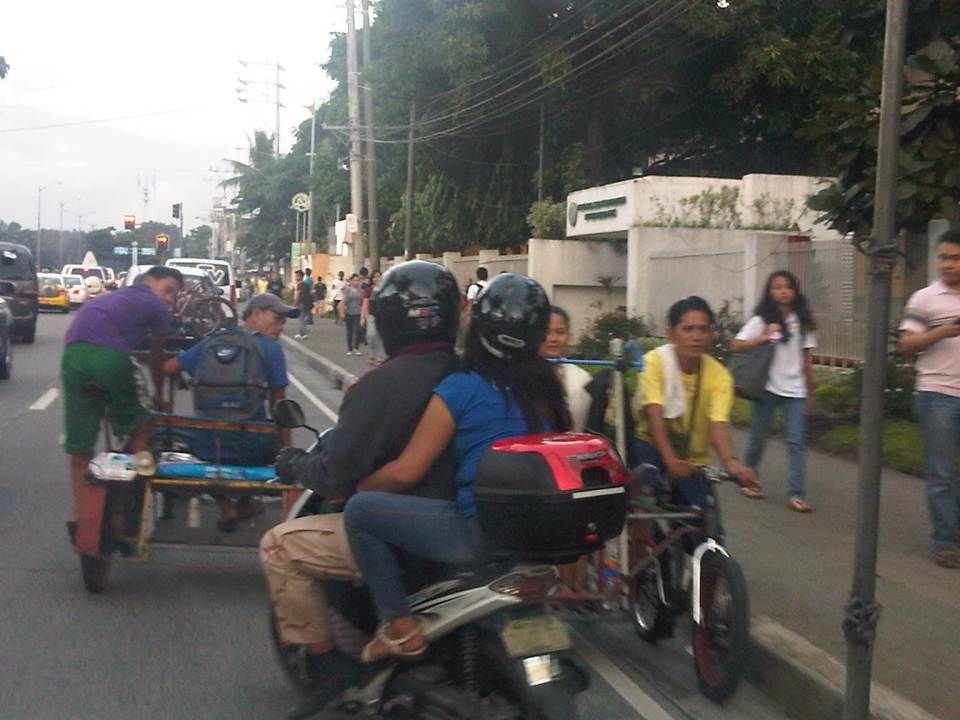 Counter-flowing pedicab along Quezon Ave. just outside the National Grid Corporation (formerly Napocor) office.
Pedicabs have another dimension, which is often cited as a reason for its very existence. It is a source of livelihood for many people. Whether this is something that needs to be encouraged is the subject of debates often involving discussions on poverty and governance. That is, pedicabs are often owned and/or operated by low income people and their numbers translate into votes for local officials who tolerate pedicabs and even encourage them as a form of livelihood. It is, after all, like the jeepneys and tricycles before it, supposed to be a simple investment that generates income for the owner/operator/driver. People have glorified or romanticized the pedicab as various designs have displayed the creativeness (or even artistry) of the Filipino. However, just like other modes of transport, the pedicab should function within a hierarchy based on its suitability with respect to other modes that are similarly appropriate for a certain range of conditions. Hopefully, such concepts are understood by stakeholders if only to effect the rationalization of transport services and correct certain notions pertaining to inclusiveness and sustainability for such modes.
–
 Caught (up) in traffic