
Home » Behavior (Page 33)
Category Archives: Behavior
Transport and traffic purgatory, paradise and inferno
A lot of people have been referring to the traffic congestion and other derivative issues that will be the result of the construction of several transport projects around Metro Manila as “traffic armageddon.” Some friend have appropriately (I think) referred to it more as “car-mageddon.” This seems to be the case since it is perceived to have the most impact on car users than public transport users, cyclists or pedestrians. This is far from the truth as there are more people taking public transport, cycling or walking than those driving their own cars. In fact, estimates for Metro Manila indicate that 70-80% of travelers take public transport while 20-30% take private vehicles. These mode splits do not include bicycles or walking, which obviously will further decrease private car shares.
I would rather refer to this period of construction as a sort of “purgatory” though it has nothing to do with the cleansing that’s associated with it. There is still the suffering involved while improvements are being implemented. But, most importantly, there is hope at the end of this process. This “hope” is not necessarily the “light at the end of a dark tunnel” kind of thing as surely population and the number of vehicles will surely increase over time even as the transport projects are being implemented. By the time these are completed, there are sure to be more people, more vehicles, as well as more of other developments that will put our transport system to a stress test. We can only hope that the designs of these infrastructure we are building now are based on honest to goodness trip or traffic forecasts. Otherwise, we’ll end up with congested or saturated systems by the time they start operating.
Unfortunately, most projects mentioned and those we know have the green light and would likely be proceeding with construction in the near future are basically road projects. It’s ironic considering that what Metro Manila urgently, and maybe desperately, needs now are public transport systems including the much delayed MRT 7, LRT 2 Extension and LRT 1 Extension. The proposals for Bus Rapid Transit (BRT) seem to be in a limbo, too, despite extensive studies and surveys to support BRT along corridors such as Ortigas Avenue and Circumferential Road 5. These are blamed on institutional and legal impediments including allegations of shortcomings among officials of agencies responsible for these infrastructure.
I am aware of an initiative led by an environmental lawyer seeking to effect the redistribution of road space in favor of public transport users, cyclists and pedestrians. I think such actions are useful from the perspective of getting the attention necessary to push government and private sector players to have a sense of urgency not just in words but also in actions in as far as transport infrastructure programs and projects are concerned. We are already lagging behind our ASEAN neighbors with regards to infrastructure and at this pace, it is likely that less developed countries like Cambodia and Myanmar might just overtake us in the foreseeable future. From another perspective, it is hard to push for sharing the road when people really don’t have better options for commuting. Walking and cycling are not for everyone and many people have turned to the motorcycle to solve their transport woes. In the latter case, motorcycles are perceived as a vehicle that’s fuel efficient and allows the users to zip through congested streets often at high risks of being involved in a crash or spill.
We can only achieve “paradise” in our highly urbanized cities if we build these mass transit systems along with the pedestrian and cycling facilities that will complement each other. Those for whom car travel is a necessity would also benefit from reduced road congestion so it will eventually (hopefully) play out well for most people. Meanwhile, we would have to endure transport and traffic hell (some more and longer than others) as the government and private sector embark on this round of infrastructure projects implementation. It helps to look back at our experiences with the last major batch of projects in the latter part of the 1990’s when the number coding scheme was first implemented. At the time, it was implemented as a temporary measure to alleviate congestion while projects where being implemented. What was a temporary measure is now still being implemented along with a truck ban that has also been evolving the past years with the latest being the one implemented by the City of Manila starting last February 24. Will these vehicle restraint schemes be modified to cope with the traffic congestion expected from projects like the Skyway connector? Will these be relaxed or removed after all these projects have been completed? Your guess is as good as mine.
–
Preventable tragedies
Last Friday, a provincial bus plunged into a ravine somewhere in the Mountain Province. The bus rolled several times before coming to a stop, instantly killing 14 people. Among the fatalities in this crash is a popular comedian/media personality who went by the name Tado and part of a group doing civic work in the area. Foreign visitors were also killed in the crash, leaving many to wonder if perhaps the Department of Tourism (DOT) should also get into the act as it is in the interest of the department to also establish that “It’s safer in the Philippines!” as part of its “It’s more fun in the Philippines!” tagline.
According to initial reports, the driver lost control due to defective brakes but later one report suggested that the driver had dozed off and awoke too late to bring the bus back in control. The slope of the road was downwards and there was significant curvature. This combination is definitely a challenging one for most drivers, even professionals who, like the bus driver, would probably have encountered such combinations of slope and curvature many times, even on a daily basis along mountain routes. One has to be awake and focused on maneuvering a vehicle for such sections. It didn’t help that probably, and I base this on photos of the section I’ve seen online, the road’s barriers were not up to standard in as far as stopping large vehicles like the bus from falling off and into the ravine.
These are preventable incidents, preventable tragedies that occur on a daily basis around the country. It is clear to many that the LTFRB needs to address these problems by taking steps to insure that public transport vehicles such as provincial buses are properly maintained and drivers are fit and in the best condition to drive these vehicles. To do that, they have to be proactive in evaluating bus, jeepney, UV express, and taxi and other franchises under them. These evaluations should delve into involvements in road crashes as well as the frequencies and types of traffic violations drivers have been involved in. Such records of crashes and violations should form part of a set of criteria to suspend and ultimately revoke franchises of public transport entities.
The LTO also has a responsibility here because they are the agency in-charge of licensing drivers. They should make sure that those applying for professional licenses are indeed qualified and not just to drive any vehicle. Therefore, perhaps there is a need to have different types of licenses for different types of professional drivers. Public utility vehicles differ in size and maneuverability so a different skill set and experience is required for buses compared with taxis. Another type of license should apply for those seeking to drive trucks as well as heavy equipment such as payloaders and bulldozers. The TESDA has certification programs for these that are sought out by people who want to drive professionally abroad. These should also be made as requirements for those seeking to drive professionally here. These would ensure that drivers will be qualified and competent as they are responsible for lives and property.
It is also clear that the DPWH and local authorities in-charge of road safety along roads should look into how to make travel safer by investing more into safety devices such as barriers. Crash or accident prone sections can be identified and sturdier barriers designed to keep vehicles on the road should be constructed/installed in order to prevent such types of fatal crashes (i.e., barriers would not prevent head-on collisions, etc.). That is why the DPWH and local governments need to have capacity and capability to assess road safety along national and local roads. These actions address vulnerabilities. These actions save lives.
What can you do to help in this effort? You don’t have to be part of an organized group or a lobbyist to be involved in promoting road safety. You can be involved in simple ways. Be aware of your rights on the road and your being among those vulnerable to road crashes. I am sure you don’t want to be involved in a crash nor would you like a loved one to get injured or, God forbid, perish in a crash. If your bus, jeepney, UV express or taxi driver drives recklessly, be firm in reminding him of his responsibility. You may enjoy a fast ride but are you sure your destination isn’t the afterlife? Think about it. Act on it. Save lives!
–
In-vehicle tools for road safety
I recently came across a provincial bus operator who is promoting a device for limiting the speeds of vehicles. He states that all their buses are fitted with the device and together with an on-board camera and GPS, they are able to monitor their buses and ensure the safety and security of their passengers. It’s always good to know there are responsible and progressive bus operators like him. Unfortunately, his kind is a minority among many who appear to be after the proverbial quick buck rather than ensuring a high quality of service for travelers.
Devices limiting the speeds of vehicles are not new. These have been installed in many public transport and commercial vehicles like buses and trucks in order to regulate their speeds along highways and streets. Trucks from Japan are fitted with these devices and those second hand trucks being sold in the Philippines have these but are allegedly disabled by their new owners. They are not violating any laws here as there are no regulations requiring such devices to be installed in vehicles.
Tracking devices that include GPS are more recent technologies being used mainly by logistics companies to track their vehicles. These are particularly important for trucks laden with high value cargo or for delivery vans who schedules and routes need to be managed to ensure timely delivery of packages consigned to them. Data from these devices would allow for the assessment of driving speeds and behavior such as lane changing that can be used to determine if drivers are, for example, reckless. The same data can also be used to evaluate fuel efficiency.
Such devices also have research applications because data can be used to determine real-time traffic conditions. In fact, there have been probe car studies conducted in other countries such as Japan, Thailand and Indonesia where taxis were employed to gather traffic information along urban road networks (e.g., Tokyo, Bangkok, Jakarta). Similar experiments can be implemented for Philippine cities to derive traffic information that can be used to guide travelers regarding travel times and route planning.
Perhaps the DOTC through the LTO and the LTFRB, should look into the mandatory installation and use of these devices to regulate vehicle speeds for public and freight transport and also monitor driver behavior. Mandatory speed regulation devices as well as tracking systems have a high potential for weeding out reckless, irresponsible drivers that will ultimately lead to a reduction in road crashes that have resulted in serious injuries and loss of lives. Definitely, there will be objections or opposition to such a requirement but these devices can be justified given the clamor for safer transport and safer roads. After all, everyone of us are vulnerable road users where even the safest driver can be involved in crashes. It takes only one reckless driver or rider to cause a crash.
–
Queuing at NAIA immigration
A lot of people get angry or feel aggravated when they arrive at Manila’s international airport and encounter the long, chaotic queues at the immigration section. This is particularly the cases at NAIA’s Terminals 1 and 2, which handle the most international arrivals among the 3 terminals. Terminal 3 has significantly less passengers despite it being the hub of Cebu Pacific, which currently enjoys higher passenger loads compared to rival Philippine Airlines but apparently serves less international passengers than PAL.
 Multiple queues seem to merge into one mass of people, all eager to get to a booth for their passports to be stamped. Early on, you will hear a lot of people already complaining about the queues and stating out loud how the system could be improved.
 Another photo showing multiple queues at the immigration section for arrivals at the NAIA Terminal 1.
The solution to this problem is quite simple and is actually already being implemented at the immigration section for departing passengers at Terminals 2 and 3. In both cases, there is only 1 queue for passengers that is served by several booths. This same approach to manage queues of arriving passengers is already being applied in many other airports elsewhere including Japan’s Narita and Thailand’s Suvarnabhumi where they have to handle even more passengers. Perhaps, also, a couple of booths and a separate line can be provided as courtesy to citizens of other ASEAN countries. There are such courtesy lanes in airports in other ASEAN countries, with whom we have existing agreements for visa free travels like Indonesia, Malaysia, Singapore, Thailand and Vietnam. An illustration of the system is shown in the following diagram:

I posted the figure above to be clear about the systems I’ve seen in other airports that worked quite well in being able to handle the large number of arriving passengers at the airports. It is more orderly and efficient, and to me at least, it is fair for all passengers who tend to shift to lines they think are moving faster but eventually are frustrated when the line turns out slower than their previous one. We’re hopeful that airport or immigration staff can improve the system and really soon as this will effectively cut down the times people spend at the airport terminals.
–
Cubao Aurora
Cubao is one of the busiest areas in Metro Manila where a lot of public transport routes converge. It is a major transfer point for road and rail transport particularly near the junction of three major roads – EDSA, Aurora Boulevard, and E. Rodriguez Avenue, which is only a few meters from EDSA. I took a few photos when I was in the area one time and here they are:
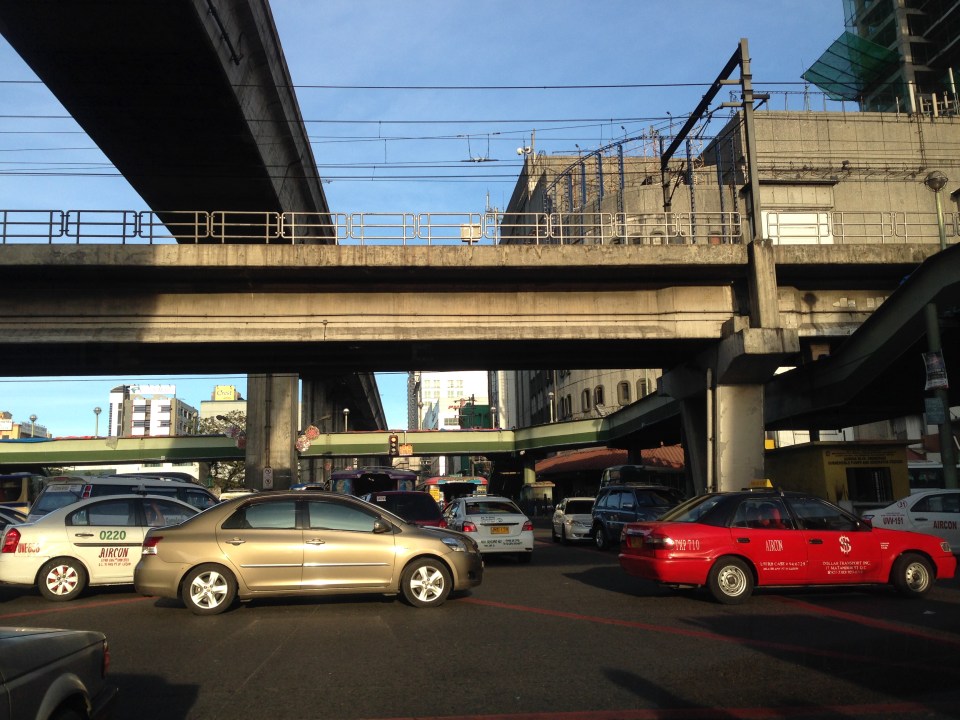 EDSA and Aurora Boulevard intersect at ground level. There is, however, an underpass along EDSA bypassing the at-grade intersection. Shown in the photo are the two rail transit lines passing through the area – EDSA MRT 3 at the 2nd level and LRT Line 2 at the 3rd level.
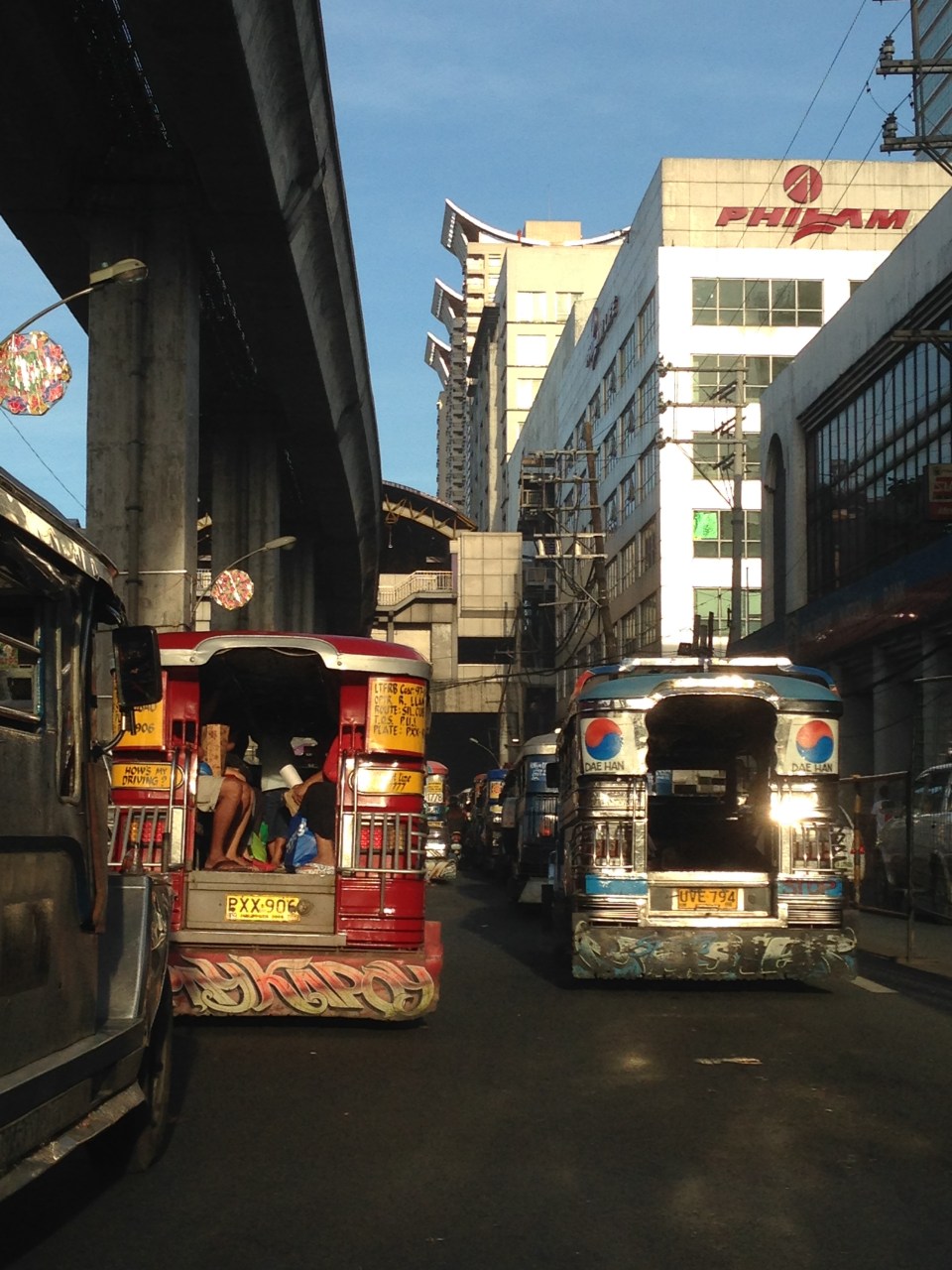 After crossing EDSA, eastbound jeepneys approach the LRT 2 Cubao Station, which is beside the Gateway Mall of the Araneta Center. Traffic along this section of Aurora Blvd. is typically slow as jeepneys bound for different destinations in the east congregate here. Meanwhile, on the other side of EDSA, the same situation is experienced as jeepneys line up along informal terminals on the street. This usually leads to congestion and low throughput along Aurora at the intersection.
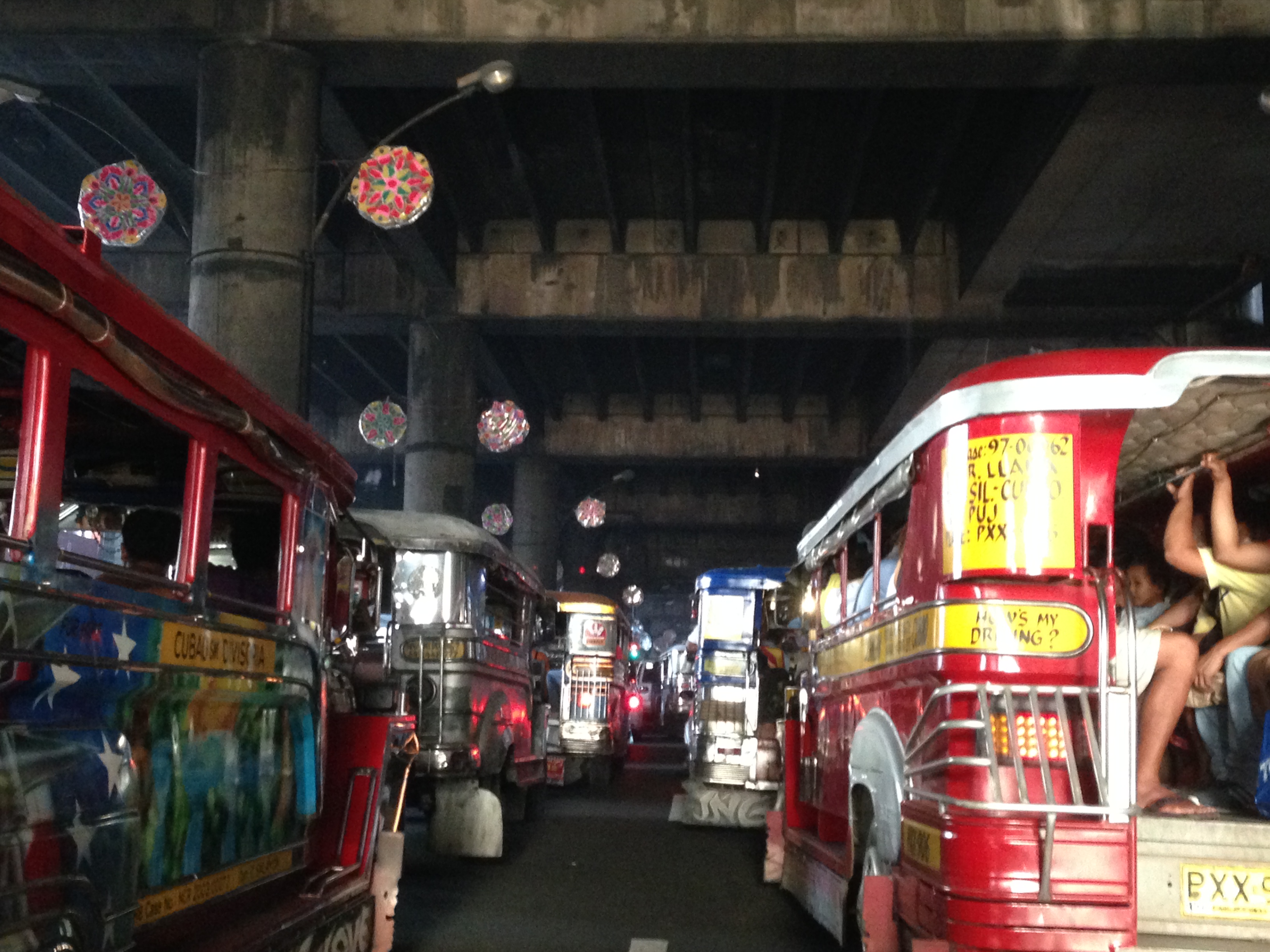 Jeepneys tend to linger under the LRT 2 station and occupy practically all the lanes with most jeepneys deliberately moving at snail’s pace as they try to get passengers. This is the case along both directions of Aurora Boulevard, which makes one wonder why many people don’t take the LRT instead. Of course, for eastbound passengers, the answer is simply that the LRT ends at Santolan Station in Pasig (along Marcos Highway and just after the Marikina River). Most passengers would rather take a single, direct jeepney ride from Cubao to their destinations rather than make the difficult transfer at Katipunan (for Marikina-bound passengers) or Santolan (for Rizal and Pasig-bound commuters).
I wanted to take some photos during the night time one time we were passing under LRT 2 along Aurora Boulevard near the Gateway Mall. The area wasn’t well lighted though so all the photos didn’t come out right. This blight is similar to the situation along the LRT Line 1 corridor stretching from Caloocan to Pasay, and affecting areas along Taft Avenue and Rizal Avenue. The areas including the rail superstructure are so dirty mainly because of the emissions from road vehicles, particularly jeepneys, buses and trucks with surplus and generally poorly maintained engines. Hopefully, the local governments and MMDA can address problems of bright with a campaign to install pocket and hanging gardens like the ones already along EDSA. The plants, if cared for properly, will surely help improve both air quality and aesthetics in these areas darkened by design and soot.
–
Swapang! or the perils of walking
Walking to the jeepney terminal for a ride to the university, I was irritated by the constant honking behind me as motorcycles rode up the sidewalk to avoid the weaving into congested traffic along Aurora Boulevard. And so I tried to stand my ground allowing only half the space of the sidewalk for these motorcycles to pass through. As far as I’m concerned, I was already too generous giving part of the space that is for pedestrians and not for motorized traffic. Still, there were a few motorcyclists who seem to think they had the right of way as they attempted to convince me give up more space so they could practically take over the sidewalk. I didn’t give way and assumed they were cursing me inside their helmets. Manigas sila! I thought that in the end, sila ang asar at talo in this situation, not me.
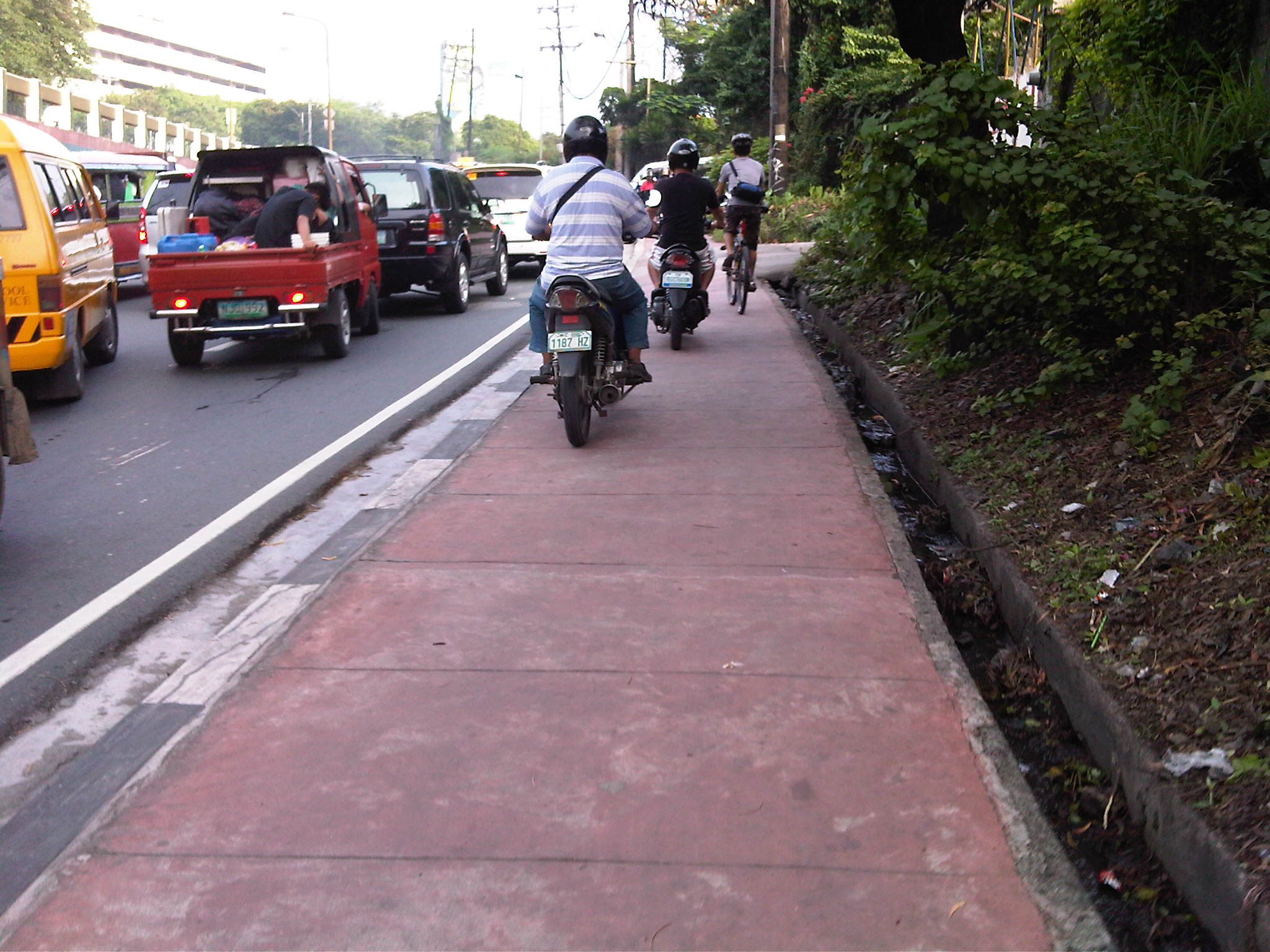 Motorcycles dominating space for pedestrians
At one point, I held my ground and didn’t give way to the motorcycles behind me [Advisory: This is not for everyone especially those who are “pikon” or who are looking for a fight.]. I knew my rights and I was walking on the pedestrian sidewalk. Unfortunately, a bicycle came along and I gave way only because I also appreciated cycling and understood that pedestrians and cyclists are sort of “kindred spirits” in a world dominated by motorized transport. The bicycle was immediately followed by two motorcycles including one that almost sideswiped the cyclist. I took the photo above to better show the situation.
The other day, I chanced upon a similar situation as I was driving in heavy traffic along Amang Rodriguez in Pasig City. What little space was available for pedestrians along a narrow sidewalk along this road connecting Marikina and Pasig cities.
 Motorcycles using a narrow pedestrian sidewalk to avoid traffic congestion along Amang Rodriguez
These cases are clear examples of swapang attitude or behavior that is prevalent among many road users. Unfortunately, these are not apprehended or accosted by traffic enforcers. The latter seem to be more engrossed with number coding and swerving violations, anyway, that they seem to have forgotten all the other traffic violations that included this brazen behavior of motorcyclists. Perhaps enforcers should go back to the basics and take more notice of all those other violations (e.g., speeding, counter flowing, beating the red light, beating the green light, etc.) to improve and promote discipline on our roads.
–
What Public Transit Data Teaches Us About How People Use a City
I’m sharing an interesting article featured on The Atlantic Cities, one of our favorite sites on the internet. Enjoy!
What Public Transit Data Teaches Us About How People Use a City.
Signaling
I recently read an article about signaling in the United States. It states that about 25% of turns are not signaled. That is, drivers do not signal prior to turning left or right at an intersection. This comes as somewhat a surprise for me as I thought this statistic should be lower in the US considering their stricter procedures for getting a license. I don’t really observe signaling behavior in the US when I am there also because maybe I assume that traffic enforcement is also stricter and errant behavior would usually be caught and the driver cited by the police.
In the Philippines, it’s a lot worse with many if not most drivers of all types of vehicles including motorcycles not indicating their intention to turn for other motorists. Drivers of public utility vehicles like buses, jeepneys and taxis are perceived to be the ones with the highest likelihood of not signaling prior to turning at an intersection or to change lanes. The results, of course, are chaotic driving conditions along Philippine roads and especially in urban streets where motorcycles add to the complexity as riders zip in and out of every conceivable space between vehicles.
I am not aware of any formal studies on signaling and related driver behavior in the Philippines. Perhaps there is one somewhere and not necessarily on traffic engineering but on psychology or other behavioral studies. Such researches, while appearing to be simple and somewhat trivial to some, can be quite helpful in understanding driver behavior and how these can influence the road environment. Abrupt or poor anticipation of turning or lane changing may lead to road crashes and motorists in the country are not the easiest to educate after getting their licenses. Of course, nothing can replace consistent, strict enforcement of traffic rules and regulations to encourage good behavior along our roads but this would just be a reinforcement of what was supposed to have been taught at driving school in the first place.
Here’s the link to the article appearing on the website Atlantic Cities:
DIY Urbanism of the Day: How Many Drivers in Your Nabe Aren’t Signaling?
–
Buses speeding along Commonwealth Avenue
Traveling along Commonwealth Avenue last Holy Thursday, we couldn’t help but notice the buses racing against each other along the wide highway. One bus speeding along the motorcycle lane almost hit a motorcycle along that lane. Traffic was free flowing and speed limits obviously were not being enforced or followed. Running at 60 kph, our vehicle was always passed by buses and cars alike, their drivers probably enjoying the wide space and the knowledge that there will be few if any traffic enforcers along Commonwealth. We saw a few underneath the Tandang Sora flyover but they were relaxed and seem to turn a blind eye over speeding violations along the highway. The video below was taken last Thursday and showed three buses speeding along Commonwealth, occupying lanes that they are not supposed to be using (Note: Public transport are supposed to run along the two outermost lanes of the highway marked with yellow lines.)
–
Air quality and road safety concerns for public transport
While traveling home one late afternoon, I couldn’t help but take a quick photo of a jeepney in front of me that was belching smoke while also carrying several people as sabit (hangers). Though a bit blurry, the photo still shows clearly the cloud of smoke coming out of jeepney’s tailpipe and the three people hanging behind the vehicle. Not obvious from the photo are the speed and lateral motion of the jeepney as it traversed this section of Marcos Highway.
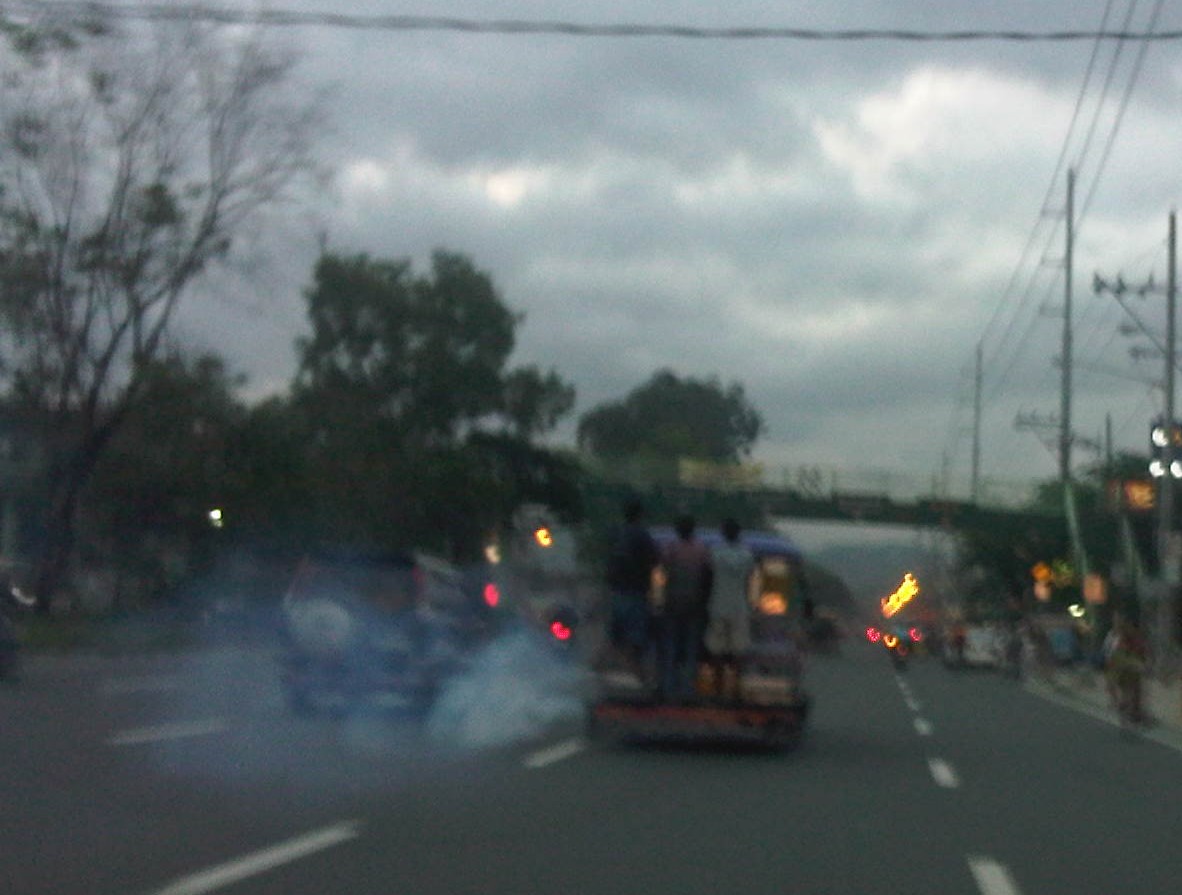
This is a scene we see everyday in our streets despite initiatives or efforts to address problems pertaining to vehicle emissions and safety. The Clean Air Act while enacted more than a decade ago has not been effectively implemented for vehicles. A lot of vehicles are able to register or renew their registrations without really going through a proper emissions test (or smog test for those in the US). “Non-appearance,” the term used for people going through the motions of a test but skipping the measurement itself while getting print-outs stating the vehicle “passed” the test is prevalent throughout the country.
The Land Transportation Office (LTO) has experimented with a lot of schemes to address the problem. These includes the requirement of a photograph showing the actual performance of the emission test on the vehicle. More recent was an initiative where RFID units were supposed to be installed/attached to vehicles and these would be used to ensure that emission tests really were conducted prior to registration. However, with very few Motor Vehicle Inspection Stations (MVIS), the LTO has no choice but to delegate emission testing to private emission testing centers (PETCs). The long standing suspicion, however, is that most of these PETCs collude with vehicle owners and fixers within the LTO to maintain a status quo in “non-appearances” and non-compliance with emission regulations.
Local governments have pitched in with their mobile anti-smoke belching units (ASBUs). In Metro Manila, many cities including Quezon City, Pasig City and Makati City have multiple ASBUs allowing them to set-up several stations along roads in their jurisdictions. These are usually seen along busy roads with policemen assisting them in flagging down vehicles (mostly trucks) observed to be smokebelchers. These vehicles are tested and penalties are imposed on emission regulations violators. The equipment of these ASBUs, however, are only for diesel engines and so are operations of these mobile units are limited in scope from the start. There have also been allegations that some ASBUs have been taking advantage of erring drivers resulting in bribery so as not to be issued violation tickets and penalties.
The bottom line for most cases of emission violations is that most violators are not properly educated about emission regulations including the requirement for them to pass emission tests at any time and not during the registration process only. This is a fact that most drivers or vehicle owners do not understand or choose not to understand, usually because of maintenance cost implications. Nevertheless, we will continue to be in the losing end of the war against air pollution if we cannot properly enforce provisions of the Clean Air Act, particularly for mobile sources that contribute most of the air pollution we experience in this country.
–
 Caught (up) in traffic