
Home » Cycling (Page 10)
Category Archives: Cycling
On the transformation from car-oriented to people-oriented streets
I saw this article shared by a friend on social media and share it here as an interesting piece providing ideas and the thinking or attitude required if we are to transform our streets:
Jaffe, E. (2020) “4 ways to go from “streets for traffic” to “streets for people”, Medium, https://medium.com/sidewalk-talk/4-ways-to-go-from-streets-for-traffic-to-streets-for-people-6b196db3aabe [Last accessed: 9/30/2020]
It is actually interesting to see how this plays out in Philippine cities. The ‘honeymoon’ or ‘grace’ period from the lockdown to the ‘normalization’ (read: going back to the old normal) of traffic might just have a window and this is closing for active transport. National and local officials, for example, who seemed enthusiastic and quickly put up facilities for active transport have slowed down efforts or even stopped or reneged on their supposed commitments. The next few weeks (even months) will show us where we are really headed even as there are private sector initiatives for active transport promotion and integration.
–
What if our government officials used bicycles for their commutes?
Here’s another quick share of an article about cycling:
Reid, C. (2019) ‘Cherish The Bicycle’ Says Dutch Government — Here’s That Love In Map Form, Forbes, https://www.forbes.com/sites/carltonreid/2019/01/08/cherish-the-bicycle-says-dutch-government-and-heres-that-love-in-map-form/#2951914e2726 [Last accessed: 9/29/2020]
The Dutch have perhaps the densest bikeway network in the world as shown in the article and the link below showing bike lane maps. They also have a government that is pro-bicycle. You wonder what transportation and infrastructure would look like if our government officials biked to work or used public transport on a regular basis. Perhaps these will affect how they make policies and decisions pertaining not just to transport but on housing and health as well? It would be nice to see a counterfactual discussion or paper on this and other scenarios that could help us improve transport and quality of life. This is a big “what if” that many people are actually clamoring for so government can be grounded in the way they make plans and decisions.
Here is the link to Open Cycle Map, which is affiliated with Open Street Map:
–
Do we still have to practice self restraint in travel?
I took this photo this morning as I was coming home from the market. Ever since Metro Manila, Antipolo and other areas around the NCR transitioned into General Community Quarantine (GCQ) and Modified General Community Quarantine (MGCQ), a lot of people have been going out and taking group rides on motorcycles and bicycles as if there was no pandemic hanging around. I understand that a lot of people have been holed in their homes for quite some time now but these trips seem excessive considering many are cross-town or even inter-provincial trips that are long in terms of distance and times traveled.
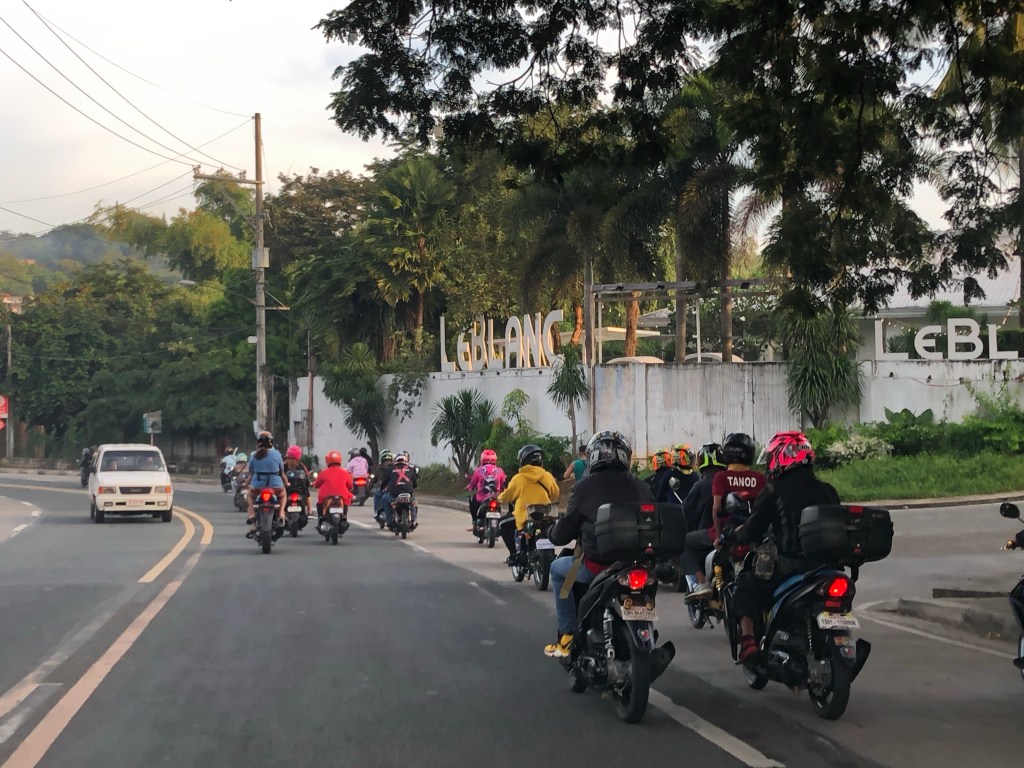
Motorcycle group traveling along Daang Bakal in Antipolo City
I posted the same photo on social media to solicit reactions or comments. I asked the question of whether these trips are necessary. So far, I only got a couple of sad face reactions and a couple of comments. The sad face reactions included one from a cycling advocate. I know the person to be very passionate about bicycle commuting but also advised vs. group rides during MECQ and GCQ. I guess the point here is that we seem to be lowering our guard against Covid-19 and to me these trips (i.e., long rides, group rides) are unnecessary trips. While there seems to be no spikes in infections due to these rides, we don’t know really as data is poorly collected and analyzed. For those who don’t give a damn, I give the analogy of road safety, many situations of reckless driving or riding do not necessarily lead to a crash but the high potential for one means it is something waiting to happen. The same applies to these rides where there might be one, just one, asymptomatic rider who can potentially spread Covid-19. Maybe those infected will be asymptomatic, too. However, others they are in contact with may not be and become seriously ill. So until we do have a vaccine vs. Covid-19 and many are vaccinated already, I would advise against these unnecessary trips.
–
Some takeaways from a UNICEF webinar
The UN together with its partners recently launch a Second Decade of Action for Road Safety (2021-2030). I will share the statement in a subsequent post. For now, I will share some slides from the recent webinar organized by UNICEF that focuses on safe and healthy journeys for children. Those of us who are working directly with UN agencies have been working on safe journeys for children particularly as they travel between their homes and schools. The recent launch and pledges or commitments of support from partner organizations will surely reinforce efforts to ensure the safety of children whether or not they return to school.

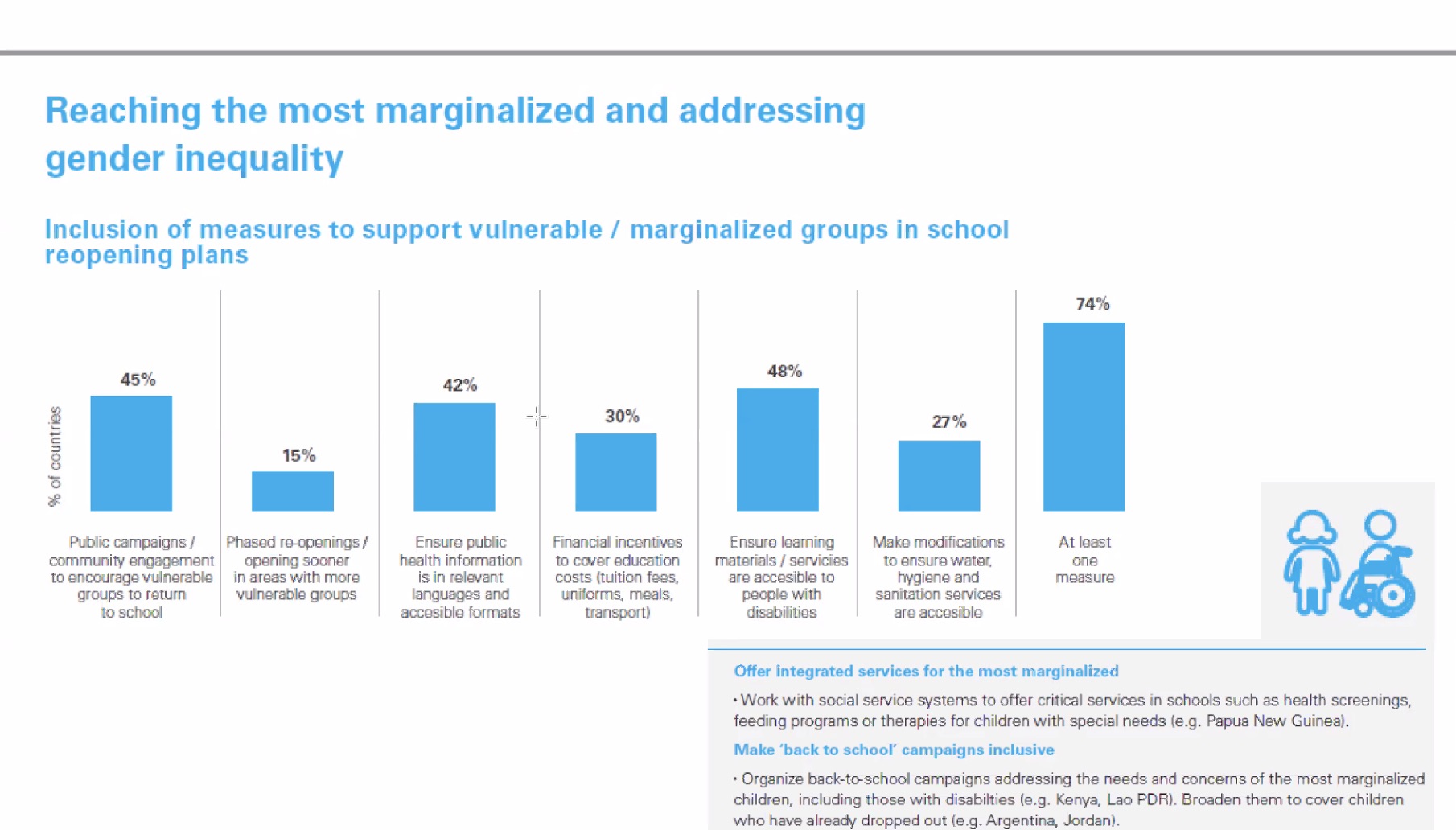 Context setting or rationale for UNICEF’s initiatives
 Key resources or references shared by the webinar host
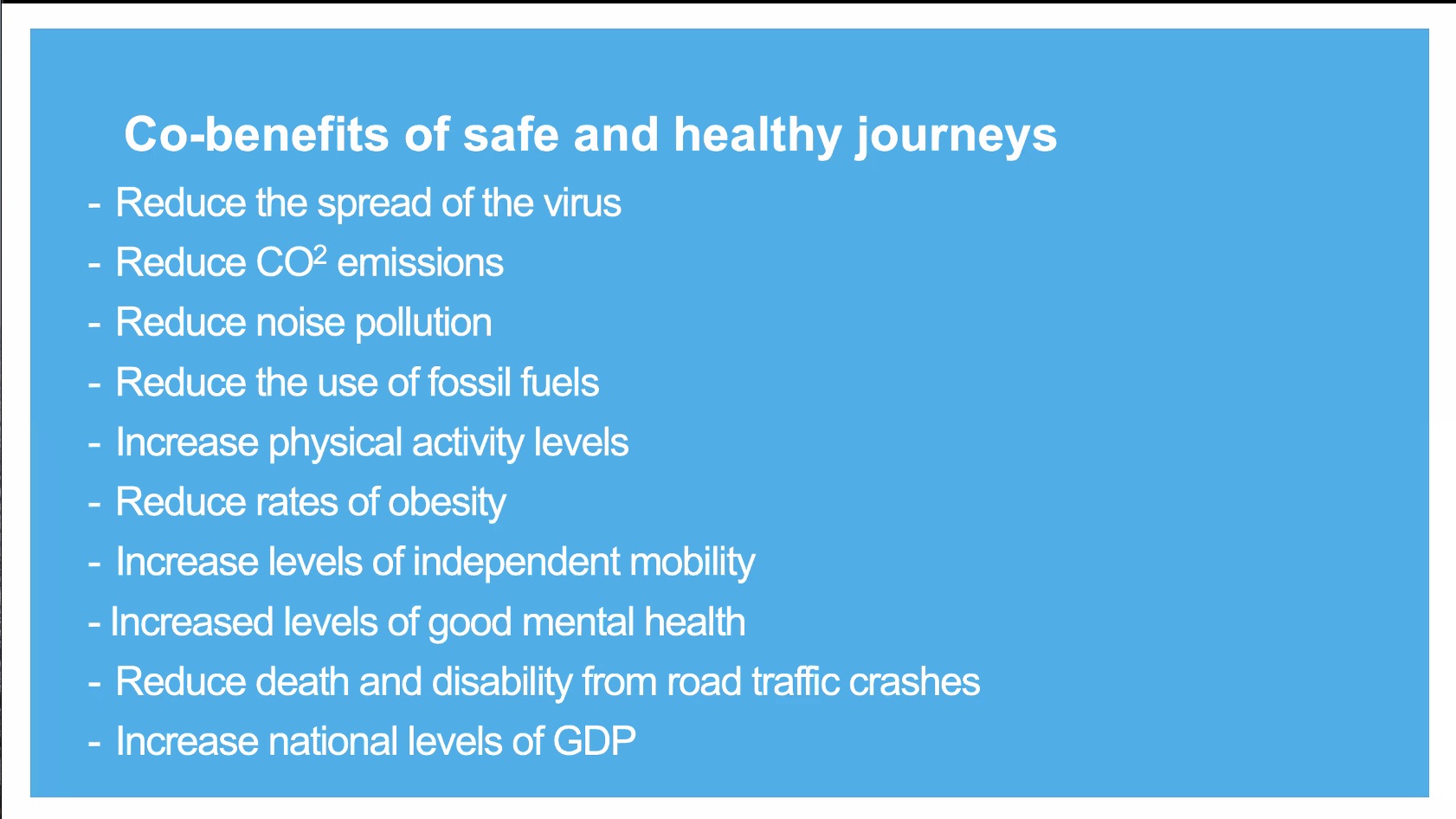 The term ‘co-benefits’ reminded me of a past project I worked on that was about low carbon transport. We also did assessment using co-benefits of low carbon transport. Among these were road safety.
 The slide and the table speaks for itself – examples of effective strategies
 There were several presentations during the webinar. However, the most interesting and informative for me was this one about the guidance for safe and healthy journeys to school.
 Ten (10) points to consider as guidance for safe and healthy journeys to school
 Database initiative in support of the guidance (I will get the link to this and share it in a future post.)
 An example from London’s experience
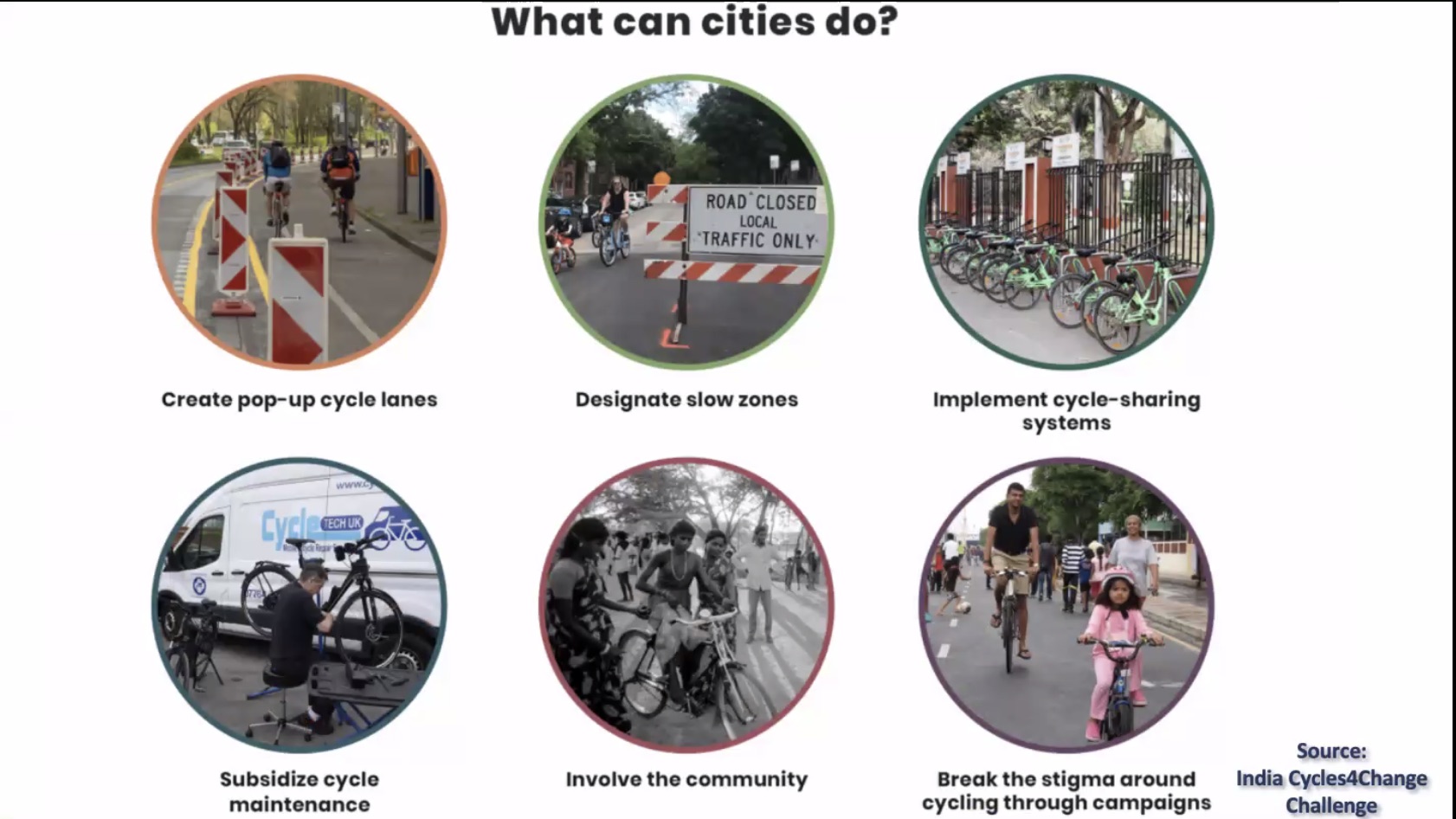 This is a slide on what cities can do to promote active transport among children.
 The photo shows what is termed as a “bicycle school bus”. This and “walking school bus” are real options for children and their guardians when traveling between their homes and schools. Such underlines the option of not using motor vehicles (i.e., reduction in motor vehicle trips).
I will try to elaborate on these in future posts, particularly on the 10-point guidance.
–
On bicycles and transit
Here is another quick share of an article on bicycles and transit (i.e., public transport):
Cox, W. (2020) “Bicycles: A Refuge for Transit Commuters?”, New Geography, https://www.newgeography.com/content/006753-bicycles-a-refuge-transit-commuters [Last accessed: 9/4/2020]
What do you think? Are we getting there in terms of the bicycle-transit relationship? MRT and LRT lines have allowed foldable bikes to be carried in their trains but buses and other road-based public transport may not allow you to bring your bike inside the vehicle. For the latter vehicles, there are usually racks installed in front of the vehicles that can accommodate 2-3 bikes. Train stations now should have bicycle parking facilities for the last mile trips of their passengers.
–
Painted lines are not enough for bike lanes
From the experiences of many biking or trying to bike in the Philippines, painted lines are not enough for bike lanes. Only recently, cyclists using bike lanes that did not have any physical barriers to deter motorists from encroaching have been involved in crashes, with at least a couple being reported as fatal for the cyclists. Here is an article on what cyclists need in order to ensure or at least improve the safety of their commutes.
UTC (2020) “White lines? Cyclists need more,” ITS International, https://www.itsinternational.com/its8/feature/white-lines-cyclists-need-more [Last accessed: 8/6/2020]
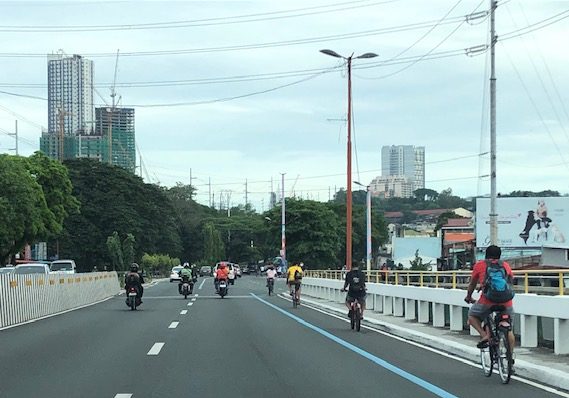 Commuters on bicycles along the Marcos Highway bridge bike lane
Are there differences regarding cycling in different countries? From a somewhat cultural-behavioral perspective, perhaps there are studies (though I am not aware of them yet) about how peoples from different countries or cities behave with respect to cyclists whether or not there are bike lanes designated for the latter’s use. I recall my experiences cycling in Japan and drivers are generally respectful of cyclists on the roads. Pedestrians, too, are very tolerant of cyclists on the sidewalks or designated areas for walking. Of course, the cyclist would have to do their share of respecting others’ spaces, too, and should behave and position themselves accordingly while traveling.
–
On bicycles slowing down cars
There is a perception that cyclists tend to slow down other vehicles, mainly motorized, along roads. Again, such can be the experience of some that have been generalized and accepted as fact in most cases. However, if we look closely at the evidence, the perception may not be true for most cases after all. This article comes out of Portland State University:
Schaefer, J., Figliozzi, M. and Unnikrishnan, A. (2020) “Do bicycles slow down cars on low speed, low traffic roads? Latest research says ‘no’,” EurekAlert!, https://eurekalert.org/pub_releases/2020-07/psu-dbs072320.php [Last accessed: 8/1/2020]
Check out the wealth of information through the links found throughout the article that includes references to published material in reputable journals. EurekAlert! is from the American Association for the Advancement of Science (AAAS).
–
On the benefits of shared roads during the pandemic
There is evidence, and they are increasing, for the benefits of shared roads. Here is another quick share of an article supporting that:
Brown, M (2020) “Shared-use roads improve physical distancing, research shows,” Medical Xpress, https://medicalxpress.com/news/2020-07-shared-use-roads-physical-distancing.html%5BLast accessed: 7/30/2020]
With the situation in the Philippines and particularly in Metro Manila appearing to be worsening rather than improving, national and local governments should take heed of the evidence for shared-use roads and the importance of active transport to ensure people’s mobility will not be hampered. This is particularly important for our frontliners and other essential workers if we are to survive this pandemic.
–
On bike shares and the pandemic
We begin August 2020 with another article I want to share. Here is another article on cycling, this time on bike share:
Kanik, A. (2020) “The decisions cities made about coronavirus had a big impact on bikeshare ridership,” citymetric.com, https://www.citymetric.com/transport/decisions-cities-made-about-coronavirus-had-big-impact-bike-share-ridership-5218[Last accessed: 7/29/2020]
Our university’s bike share program currently dedicated their bikes for the use of frontliners. Outside UP Diliman, only the City of Pasig has a bike share program. Is it somewhat surprising that these are the only bike shares we know in the country? It should be, considering the potential of bike shares and cycling as a mode of transport for mobility. In fact, two cities, Marikina and Iloilo, which pride themselves having formal bikeways (Marikina even has an extensive bikeway network that began 20 years ago.) have no bike share programs. Is the concept or perhaps the lack of facilities to encourage people to bike safely that is absent and therefore need to be provided? With the surge of bike users post-lockdown, there should be evidence that bike shares can work but only if cities work on it, too.
 File photo of Iloilo City’s bikeway along the Benigno Aquino Jr. Ave. (formerly Diversion Road) taken in 2015.
–
On designing street for bicycles
There have been a lot of discussion both online and offline about coming up with bike lanes for Metro Manila. Already, there are examples of pop-up bike lanes in some cities while others have had bike lanes and bikeways constructed years ago (e.g., Marikina and Iloilo). While agencies like the DPWH and MMDA have formed technical working groups (TWG) for bike facilities, the perception is that these are moving too slowly (dragging?) and have not produced any gains in so far as design recommendations or guidelines are concerned. Just how important are such guidelines and perhaps at the beginning, context setting, to come up with suitable designs incorporating cycling (and walking) rather than the usual car-centric set-ups? Here’s another article I am sharing that argues for these street designs:
Jaffe, E. (2020) “The most important bike technology is…street design”, medium.com, https://medium.com/sidewalk-talk/the-most-important-bike-technology-is-street-design-401c94065b5c [Last accessed: 7/26/2020]
People biking to work along the Marcos Highway bridge’s painted bike lane
–
 Caught (up) in traffic