
Home » Cycling (Page 14)
Category Archives: Cycling
Some recommended references for sustainable transportation design
We conclude the month of October with the following recommended readings:
- Designing Walkable Urban Thoroughfares: A Context Sensitive Approach, An ITE Recommended Practice, 2010
- Model Design Manual for Living Streets, 2011
- Smart Transportation Guidebook, Planning and Designing Highways and Streets that Support Sustainable and Livable Communities, 2008
While these are guidelines and manuals developed and published in the United States, the principles and much of the content and context are very much applicable here.
As an additional reference, here is the latest version of functional classifications for streets that is supposed to be context-sensitive:
- Stamatiadis, N., A. Kirk, D. Hartman, J. Jasper, S. Wright, M. King, and R. Chellman. 2017. An Expanded Functional Classification System for Highways and Streets. Pre- publication draft of NCHRP Research Report 855. Transportation Research Board, Washington, D.C.
–
Differences in opinions about safer roads?
I posted on a road safety-related page and suddenly there’s this guy who pounces on the post and delivers what he probably thought was an amusing commentary. From his posts, it was clear that he was one of those hard-core cyclists. I don’t want to use the word ‘fanatic’ but that is how many people would probably see him given his posts, comments and stand regarding cycling and safety. He also seems to revel in his claim to be a victim but the way he states this won’t really give him as much sympathy as he probably hopes to get. You have be more engaging and diplomatic if you want to be taken seriously whether as a stakeholder, a government official or an expert.
Everybody is certainly entitled to their own opinion (but not their own facts and that’s another story for another article that’s transport-related) about how roads can become safer for all. I say all because it is not only a concern of cyclists and motorists but pedestrians as well. Everyone, regardless of age, gender, economic status, etc. is vulnerable. And the only way we can succeed is if there is a collective effort that is fact/evidence-based and structured or organized. Cooperation is vital among various sectors and we must accept that there are many approaches, ways by which we can achieve the objective of safer roads and transport. Going hardline on one’s stand and trying to impose this on others will not get us anywhere.
–
TSSP 2017 Conference
The Transportation Science Society of the Philippines (TSSP) holds its 24th Annual Conference tomorrow, July 21, 2017. It will be held at the National Center for Transportation Studies at the University of the Philippines Diliman, Quezon City. More than a hundred participants are expected to attend this 1-day affair.
The final program for the conference may be found in the following link:
http://ncts.upd.edu.ph/tssp/index.php/2017/07/17/tssp-conference-program/
The theme for this year’s conference is “Improving Quality of Life in Urban and Rural Areas Through Inclusive Transportation.” This is also the theme for the panel discussion in the morning. The afternoon will feature four parallel technical sessions where 18 papers will be presented.
The keynote lecture will be delivered at the start of the conference by Prof. Tetsuo Yai of the Tokyo Institute of Technology, who is also the current President of the Eastern Asia Society for Transportation Studies (EASTS) under whose umbrella the TSSP is part of. TSSP is a founding member of EASTS and actually preceded EASTS by a year.
–
Some articles on walking, biking and transit for wellness
Here are a couple of recent articles on walking, biking and transit:
Walk, bike, and transit benefits boost people of all incomes [McAnaney, P. in Greater Greater Washington, June 13, 2017]
“Bikes are happiness machines.” Behind the Handlebars with cyclist extraordinaire Joe Flood [Maisler, R. in Greater Greater Washington, June 7, 2017]
I posted these partly for future reference but also to promote walking, biking and public transport. These are essential elements for mobility anywhere and governments should ensure that people have these as options for traveling about and not be dependent on automobiles for transport.
–
On low income cyclists
There are two articles that I want to share here. These are quite interesting for me as they tackle something not usually written about when it comes to cycling. The “invisible biker” referred to in one of the articles is the typical low-income cyclist. These are those who can be seen regularly using their bicycles to commute to and from their workplaces; likely to save hard-earned money for more important items such as food and shelter (rent?). They do not use fancy bicycles like those nice, branded mountain, road or fat bikes that you see being used by recreational bikers or weekend cyclists. They most likely use second-hand bikes like those surplus bicycles from Japan, or perhaps old BMX’s that have been modified to make it a bit more comfortable for the long commutes.
Quednau, R. (2017) The Invisible Bike Riders, Strong Towns, http://www.strongtowns.org, May 2.
Koeppel, D. (2015) How Low-Income Cyclists Go Unnoticed, Bicycling, http://www.bicycling.com, November 9.
I think these are the bike riders that we should be providing safe bikeways for. They are the ones who most often use bicycles for their trips and are at risk of being hit by motor vehicles.
–
First call for papers for the TSSP 2017 conference
The first call for papers for the 24th Annual Conference of the Transportation Science Society of the Philippines came out last Wednesday, Feb. 15:
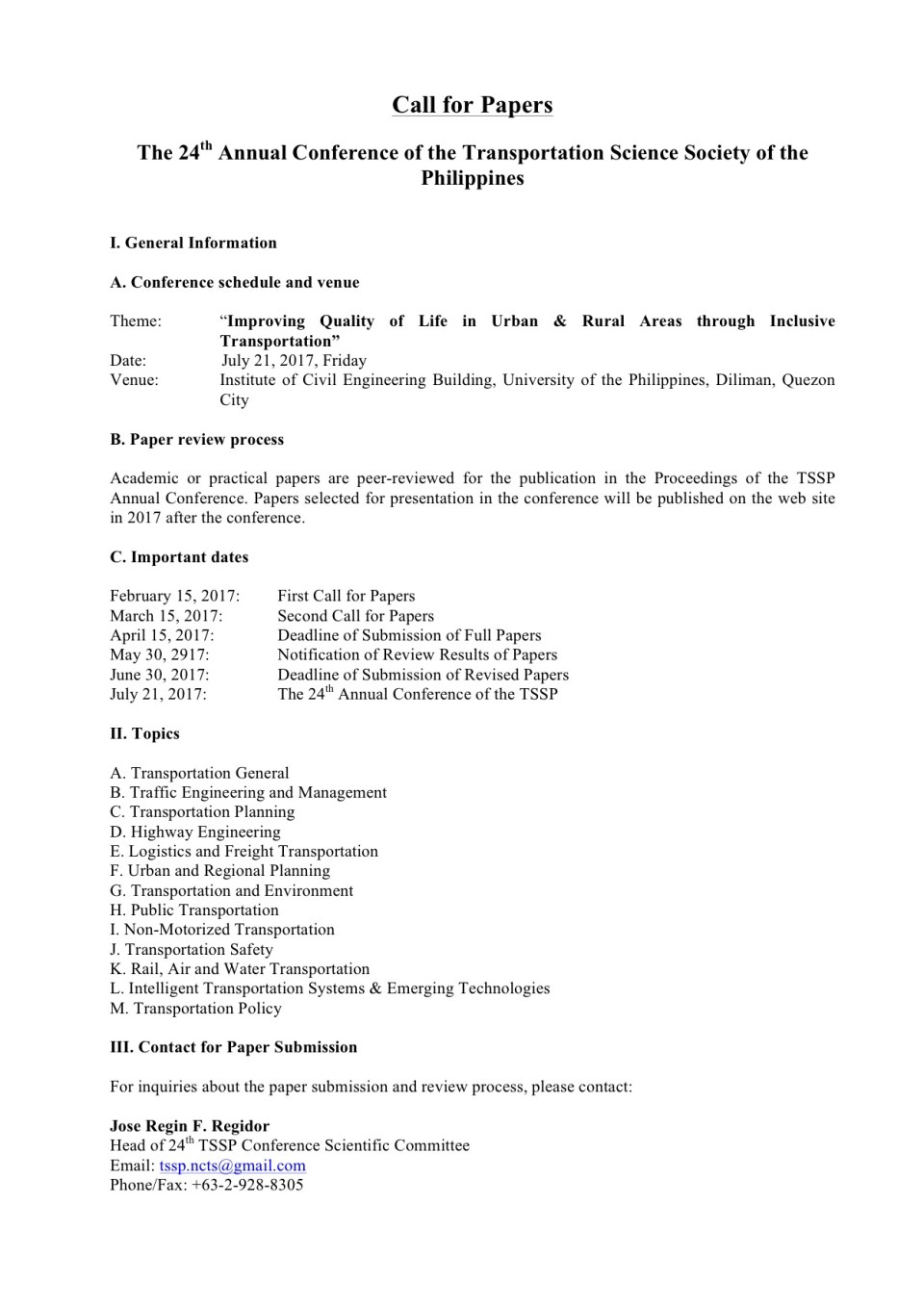
–
No more bike share at BGC?
Walking back to the parking lot near Seda Hotel after my meeting near Net One Center yesterday, I noticed that the bike share rack near Krispy Kreme was empty of bicycles. I was about to rejoice but then I noticed, too, that the portal by which you can borrow a bicycle was also missing. Was it temporarily removed because of all the activities (Christmas season) that were ongoing at Bonifacio High Street? Or were the proponents already in the process of removing them? I hope it was the first or perhaps the second but only to relocate the rack elsewhere where it is more strategic and perhaps attract more people to use it. Meanwhile, a nearby bike rack for cyclists to place and secure their bicycles was full. This meant a lot of people actually took their bicycles to High Street but these were their own and not part of the bike share system.
–
Bike share success?
There are two articles about bike sharing that got my attention today. These are both asked the question of weather bike sharing programs actually work or are successful. Following are links to the two articles available online:
Both articles draw upon the experiences in many cities in the United States where various bike share programs have sprouted. Many seem to have had some measure of success but most are not as successful when evaluated using criteria mentioned in the articles. I guess there’s much to be learned here but the experiences should not be limited to the US. There are better examples in Europe where bicycle use is quite popular compared to the US. Perhaps Asian examples, too, need to be assessed but then all need to be examined objectively and according to the unique situations and/or circumstances for how these bike shares came to be in the first place. In Metro Manila, the bike share program by the students at the sprawling University of the Philippines campus in Quezon City is a recent one but is very popular with students. Another, more endowed program in a more posh district in Taguig City is much less successful judging from the usually full racks of bicycles. There are also lessons to be learned here and perhaps things that can be shared with others looking to come up with their own bike share programs in their cities and towns.
–
Another look at Marcos Highway pedestrian overpasses – Part 2
I purposely didn’t include the overpasses at and near the Masinag Junction because I felt they deserved their own article. For one, the area will be the location of the future end station of the current LRT Line 2 Extension project. Here are a couple of photos of the overpasses in the area.
 Overpass at SM City Masinag – note the tall columns for the elevated tracks of Line 2. Will the Masinag Station be located that high or will it be at a lower level, perhaps closer to the SM City overpass?
The overpass at SM City Masinag is something that has been replicated in many other locations where an SM mall has been constructed. Note the similarity of the situation with the likes of SM City Iloilo, SM City Novaliches where SM built pedestrian facilities to allow for safe crossings between the mall and the area across from it along the highway. In many cases, it is the mall which provided the overpass in coordination with the local government unit and, I assume, the DPWH.
 Overpasses at Masinag Junction – there are actually 4 bridges here, each spanning one leg of the junction.
One of the intents for these is to eliminate at-grade pedestrian crossings at the junction. While crossing have been reduced significantly, there are still many “pasaway” who cross even when there is a green light for vehicular traffic along the leg they are crossing. Traffic enforcers here are quite lax about this and don’t seem to put in an effort to inform people about the overpass. There is no excuse for those who might claim they are too old or weak to climb the steps since the overpass has 4 working elevators for those unable to make the stairs. I noticed though that most of those using the elevators are able bodied people who probably are just too lay to take the stairs.
–
Another look at Marcos Highway pedestrian overpasses – Part 1
My daily commute allows me to have a look at the progress of the LRT Line 2 Extension construction. I also became curious about the situation of the pedestrian facilities along Marcos Highway particularly the crossings since many at first seemed to be affected by the elevated rail structure that was to be built. Now, we already have a good idea of the fates of these pedestrian overpasses. This article shows the conditions/situation of pedestrian overpasses (also called footbridges) along Marcos Highway. Most overpasses are not covered; exposing pedestrians to the elements. Most are also made of steel, which can be traced to the MMDA’s (and later the DPWH’s) preference for these structures.
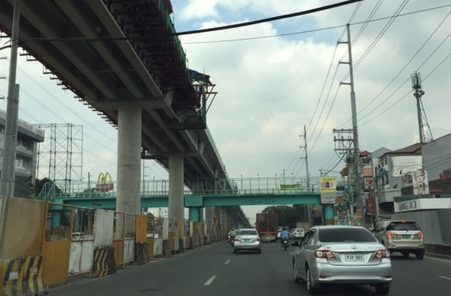 Overpass near Filinvest East-Vermont Park gates – the overpass actually is between a technical college and the commercial building across from it.
 The overpass across from Vermont Royale in front of a new Shell service station was actually among the newest facilities along Marcos Highway. Apparently though, it was built without considering the impending construction and design of the Line 2 extension. As such, the overpass needs to be modified or would have to be reconstructed elsewhere near the area.
 Overpass at Town & Country Executive Village that is also near the San Benildo School
 Overpass at Marcos Highway-Felix Avenue-Gil Fernando Avenue intersection – is probably the busiest among the pedestrian overpasses as it is at a busy junction where there are major commercial establishments (i.e., malls) and where many public transport routes converge.
 Robinsons Metro East overpass – this one also survived the clearance requirements with respect to the elevated superstructure for the Line 2 extension. However, since one of the two stations to be built will be nearby if not right across (part of the station at least) from the mall, then the station itself may function as an overpass.
 Overpass at De la Paz – note the ramp for bicycles and wheelchairs. This is one of the more bike- and PWD-friendly facilities along Marcos Highway. The slope is gentle enough for pedestrians, too, especially senior citizens who might have difficulty with steps.
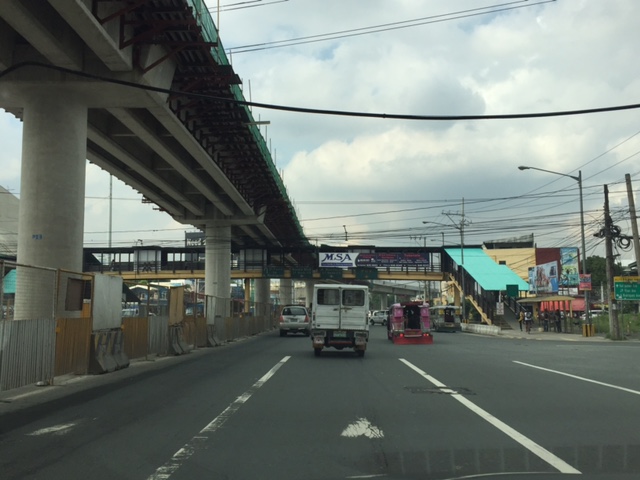 Overpass at Ligaya – this one also has ramps that make it easier for people to use to cross the busy highway. This will eventually be the closest overpass to the huge Ayala mall (Feliz) currently under construction at the Marikina side of Ligaya. I suspect that there might be a need for another overpass to be built with respect to the mall for one to directly serve the mall’s customers.
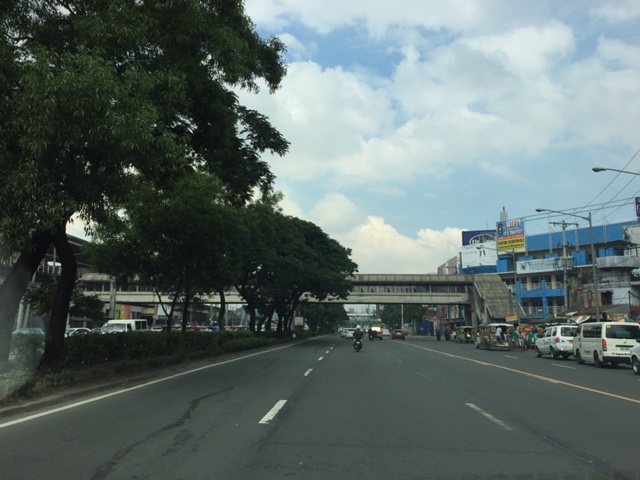 Line 2 Santolan Station overpass connects the Marcos Highway westbound public transport stop with the rail station along the eastbound side of the highway.
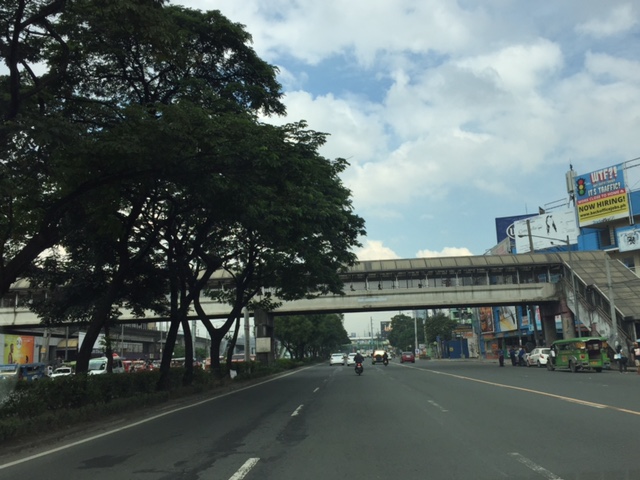 A closer look at the Santolan Station overpass, which is used by a lot of Line 2 passengers who cross the highway to continue on their journeys/commutes via train from their origins in Rizal, Marikina and Pasig. During the mornings, the observer will see a lot of jeepneys and UV Express vehicles emptying of passengers who cross the bridge to get to the station.
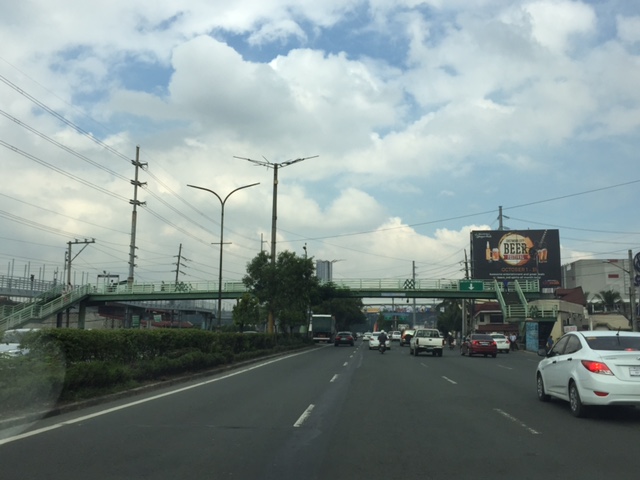 Santolan footbridge – this is actually more complicated than what is seems in the photo because the steel footbridge also connects to the SM City Marikina overpass (which is not included in this compilation but is visible in the photo). The footbridge branches to provide and almost direct connection between the mall and the Line 2 Santolan Station. That structure is shown at
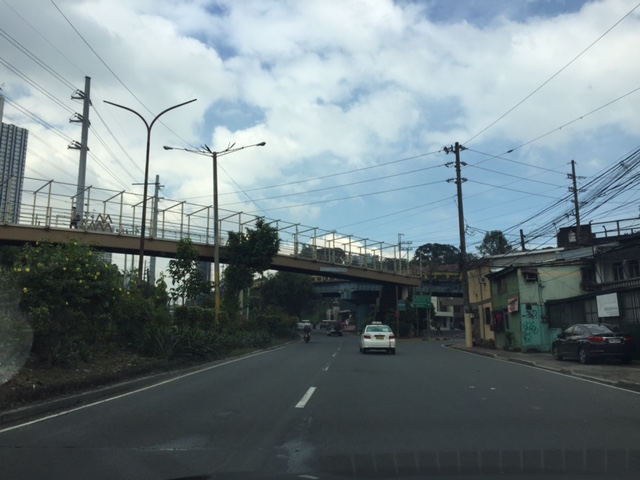 Monte Vista footbridge allows people to cross Marcos Highway (at its Marikina/Quezon City end) to and from A. Bonifacio Avenue, which is in Marikina City (Barangka)
More on pedestrian overpasses in the next post!
–
 Caught (up) in traffic