
Home » Cycling (Page 5)
Category Archives: Cycling
Examples of legislative actions in support of active transport
While the Philippine government and various local government units seem to be reneging on their commitments to support active transport, other countries have been building on their gains during the pandemic. Here are examples of legislations in New York State that will support active transport through funding of complete streets projects and institutional arrangements for representation of transit dependent individual:
The article is about two legislations:
Legislation (S.3897/A.8936-A) Provides Funding for “Complete Streets” Projects Inclusive of a Holistic Approach to Street Design
Legislation (S.3959-B/A.7822-C) Adds Board Seats to NFTA, RGRTA, CDTA, and Central New York Regional Airport Authority Dedicated to a Transit Dependent Individual
We hope to see something like these at least at the local level. Perhaps if LGUs are able to legislate and implement these, there will be more good practice examples that will compel national government to support active transport development. The latter is actually ironic considering that many plans are supposed to spell out the national government’s commitment to active transport. There are still live memorandum orders and department orders supporting and promoting active transport. Are these also being waylaid? That will be tragic for transportation if we didn’t learn or gain anything from the experiences during this pandemic.
–
On the future of bike lanes in Metro Manila and other cities and municipalities in the Philippines
My friends and I were talking about the current buzz about the bike lanes including statements made by certain personalities (influencers, advocates, government officials, etc.) about biking and bike lanes. There were many recent pronouncements of motorcycles being allowed to use bike lanes or the outright removal of bike lanes. We all agreed this was backward and the way forward is to build on the current network and facilities. What we have in our cities and municipalities are not perfect and far from ideal but they are a start and perhaps the foundation for a bikeway network that can eventually make a dent on the car-centric transportation we have.
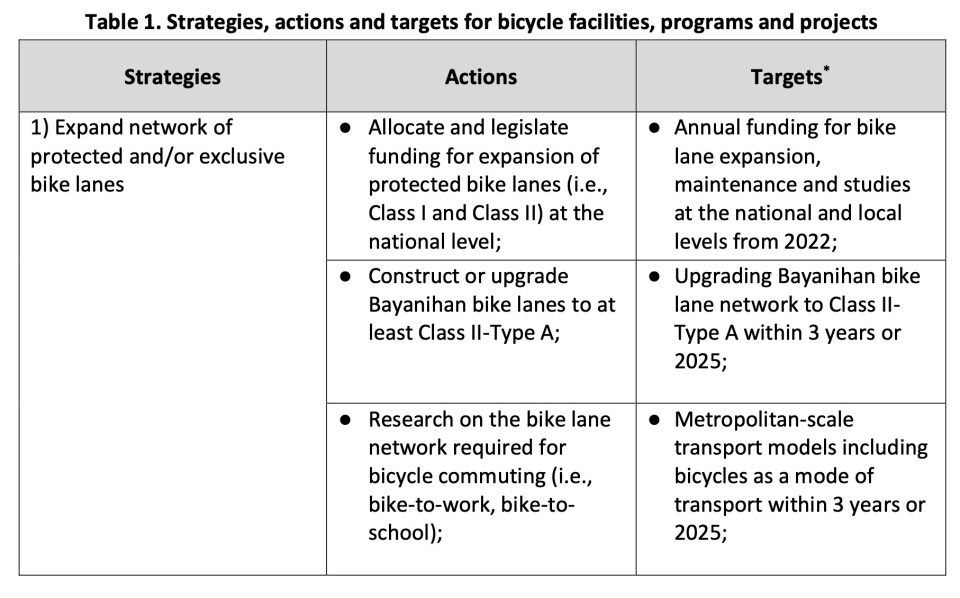
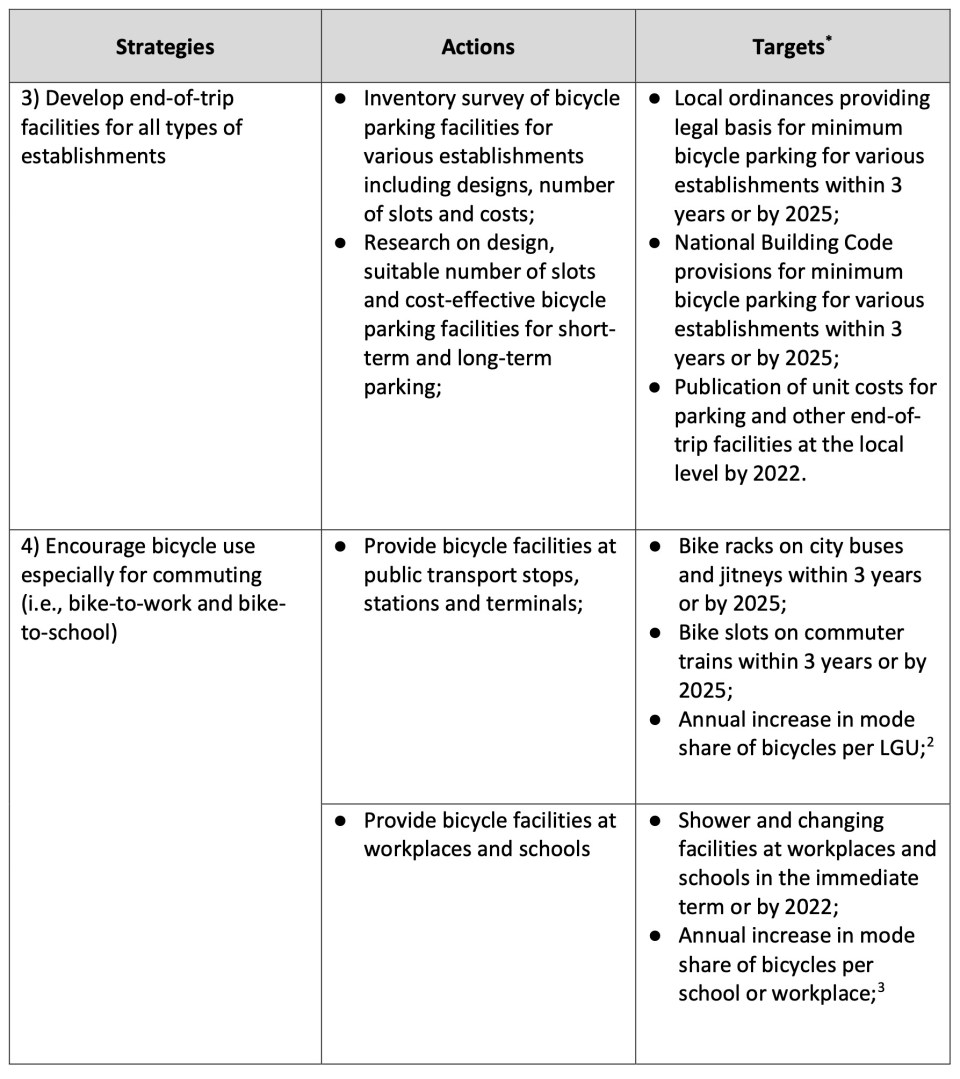
I share below the strategies, actions and targets for bicycle facilities, programs and projects from the Network Planning for the Establishment of Bike Lanes in Metro Manila, Metro Cebu and Metro Davao that was completed middle of 2022. The project is DOTr’s with support from the UNDP. The table is from the Final Report of the project.


A Happy Christmas to all!
–
Shared article: Active and Micro Mobility Modes Can Provide Cost-Effective Emission Reductions–If We Let Them
I’m sharing this article on active and micro mobility modes from Todd Litman, published in Planetizen.com:
Source: Active and Micro Mobility Modes Can Provide Cost-Effective Emission Reductions–If We Let Them
From the article:
“Common Active Transportation Leverage Effects:
–Shorter trips. Shorter active trips often substitutes for longer motorized trips, such as when people choose a local store rather than driving to more distant shops.
–Reduced chauffeuring. Better walking and bicycling conditions reduces the need to chauffeur non-drivers (special trips to transport a passenger). These often require empty backhauls (miles driven with no passenger). As a result, each mile of avoided chauffeuring often reduces two vehicle-miles.
-Increased public transit travel. Since most transit trips include walking and bicycling links, improving these modes supports public transit travel and transit-oriented development.
-Vehicle ownership reductions. Active mode improvements allow some households to reduce their vehicle ownership, which reduces vehicle trip generation, and therefore total vehicle-miles.
-Lower traffic speeds. Active travel improvements often involve traffic speed reductions. This makes non-auto travel more time-competitive with driving and reduces total automobile travel.
-More compact development. Walking and bicycling support more compact, multimodal communities by reducing the amount of land devoted to roadways and parking, and creating more attractive streets.
-Social norms. As active travel increases, these modes become more socially acceptable.
The article is a must read if we are to understand how important active transport and micro mobilities are in the context of today’s transport conundrum. Of course, part of the contextualization and perhaps ‘localization’ on these modes will be related to land use or development. The latter is a big challenge especially for the likes of Metro Manila and other rapidly developing cities in the Philippines where housing in the cities (related to compact development) has become quite expensive and has driven more and more people to live in the suburbs. As I’ve mentioned in previous posts, this has resulted in more pressure to develop transportation systems but infrastructure development cannot play the catch up game given the limited resources for their construction. Meanwhile, services are also behind in terms of quality and requires reforms and rationalizations.
–
On intersection treatments for bicycles
With the increasing popularity of bicycles as a mode of transport particularly for commuting (e.g., bike-to-work, bike-to-school), we should be redesigning our intersections to include elements essential for the safety of all users, whether on motorized or non-motorized modes. Here is a short but very informative article on how a simple intersection treatment can significantly improve safety for everyone especially cyclists and pedestrians:
Grief, N. (December 2, 2022) “How Green Paint Can Save Cyclists’ Lives,” Bicycling.com, https://www.bicycling.com/news/a42124210/bike-boxes-intersections/ [Last accessed: 12/3/2022]
To quote from the article:
“A bike box, on the other hand, seems to be the ideal middle ground and the option of the three that these researchers recommend. Cyclists feel more comfortable when compared to the free-for-all of a mixing zone because they have a designated area to be and they’re out ahead of vehicles, but according to the eye movement analysis, they remain alert and watchful for vehicles.”
Here are a couple of drawings showing bike boxes at intersections from the recent Bike Lanes Master Plan for Metro Manila, Metro Cebu and Metro Davao that was developed by DOTr with assistance from the UNDP:
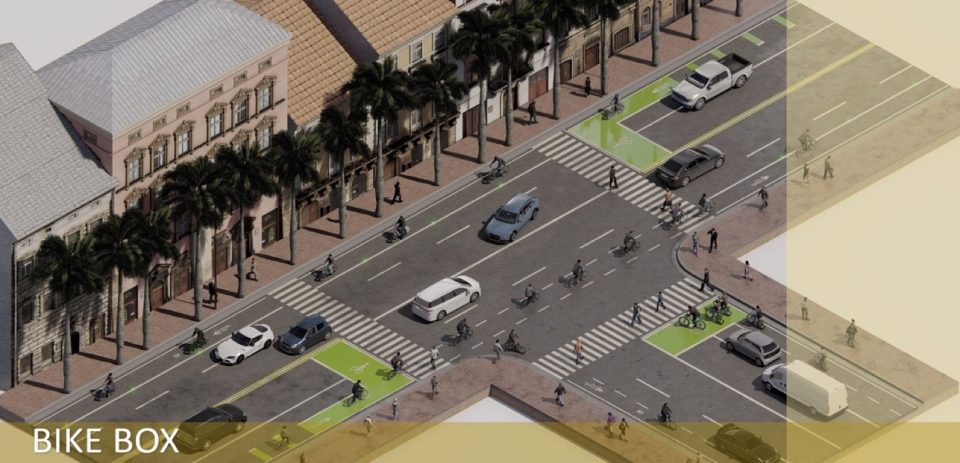 Bike boxes on a typical three-leg intersection (DOTr and UNDP, 2022)
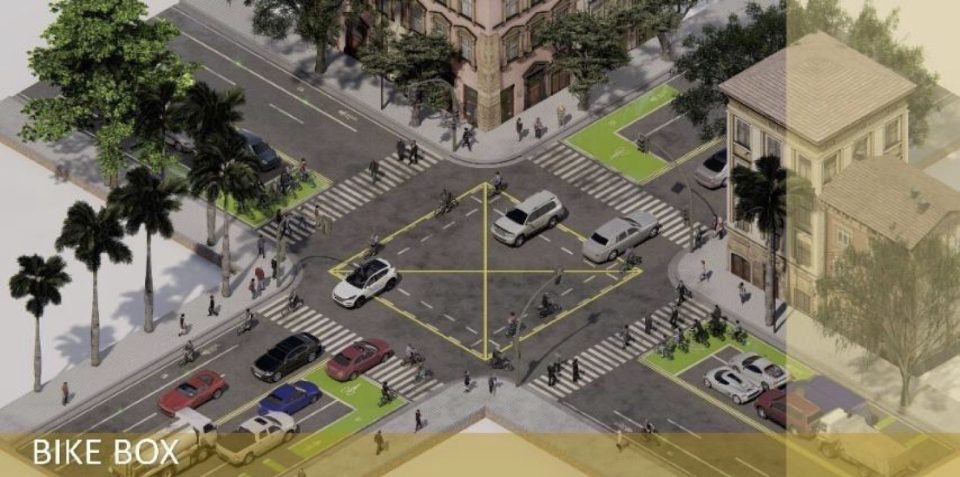 Bike boxes on a typical four-leg intersection (DOTr and UNDP, 2022)
The preceding drawings adhere to the DPWH design guidelines that mainly follow AASHTO Guidelines. Of course, there are other design references such as NACTO and the manuals of other countries (e.g., Netherlands, Australia, Singapore, etc.) were the best practice designs can be adopted for local applications.
–
Who can design bikeways?
I have read many comments about how bike lanes and other bike facilities are sub-standard or unacceptable because they were designed by non-cyclists. From an academic perspective and perhaps also from a point of view of someone who values empathy, the planning and design of bicycle facilities should not be so limited. The objective of education, and particularly for schools whose graduates become professionals like engineers, architects and planners, should be to have the latter be able to plan and design the most suitable infrastructure and facilities for all users. Suitability here should include equity considering the many elements involved for people of different gender, physical ability or disability, age, health conditions, etc. That said, it is the responsibility of agencies such as the Department of Public Works and Highways (DPWH) to revise and update their design manuals and guidelines to ensure that these are according to International standards and mindful of the best practices in various cities and countries that are now very well documented.
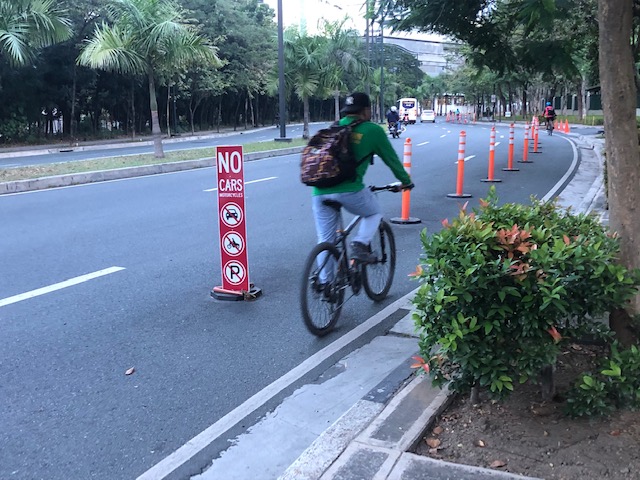 Bike lane in BGC,Taguig City
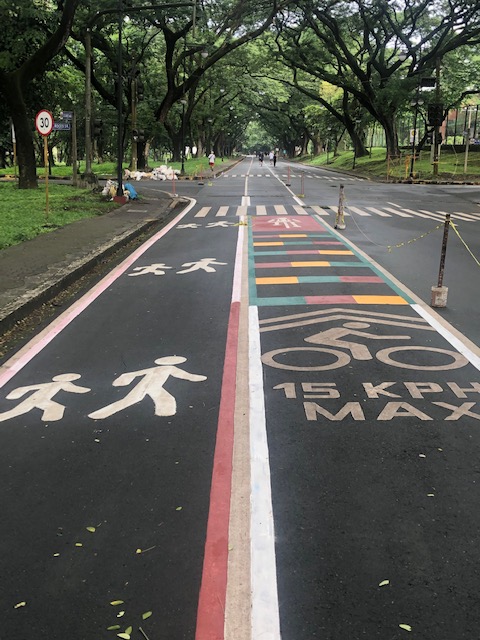 Bike lane and jogging/walking lane in UP Diliman
–
On making streets safer through woonerfs
One of the new things I learned when I was taking up transportation planning as an undergraduate student in the 1990s was about the woonerf. Our teacher then was a Visiting Professor from the Tokyo Institute of Technology. He introduced to us many concepts in that elective course that paved the way to a number of us proceeding to specialize in transportation. What is a woonerf? Well, here’s a nice article defining the woonerf and providing some examples:
Ionescu, D. (October 6, 2022) “What is a Woonerf?” Planetizen, https://www.planetizen.com/definition/woonerf?utm_source=newswire&utm_medium=email&utm_campaign=news-10062022&mc_cid=9d60b3d668&mc_eid=9ccfe464b1 [Last accessed: 10/10/2022]
To quote from the article:
“Translated as “living street,” a woonerf employs strategies like traffic calming devices and low speed limits to force drivers to slow down and safely share street space with pedestrians, cylists, and others, often without raised curbs separating cars and pedestrians. In the Netherlands, where the woonerf originated in the 1960s, motorized traffic within woonerf zones is limited to walking speed…
…A woonerf is not a pedestrianized street, but rather one where multiple users and vehicles co-exist. However, a woonerf can be converted to car-free uses using bollards or other barriers. The woonerf maintains utilitarian uses like loading docks and parking while making the roadway safer and more accessible to non-drivers.”
There should be many applications to the woonerf in the Philippines especially in areas where the dominant land use is residential and through traffic should be discouraged. This is goes well with the complete streets concept that is now being promoted and in fact pre-dates the concept and was well ahead of its time.
–
Bike parking at SM Masinag
With the increasing popularity of cycling, particularly the utilitarian kind (i.e., bike-to-work, bike-to-school, bike-to-shop, etc.), there is also the increasing need to provide facilities for cycling. Aside from the obvious (i.e., bike lanes), there are also what are termed as end-of-trip facilities, the most basic of which are parking. These may be spaces or slots allotted at workplaces, schools, markets, malls, government buildings, churches, etc. for cyclists or bikers to secure their vehicles. Bicycles may also be used as ‘last mile’ modes of transport so bike parking are necessary at transit or train stations. It is heartening to see the big malls like SM and Robinsons provide parking facilities for bicycles. Here are some photos of the bike station at SM City Masinag in Antipolo City.
 End of trip facilities in the Philippines is generally a work in progress. Hopefully, we get to benefit from their provision where they are needed – workplaces, schools, government buildings, commercial establishments, etc.
 The bike station at SM Masinag includes this bike repair stand with the basic tools for bike repairs and tire inflation.
 The bike station is just across from the Line 2 Antipolo Station (what was supposed to be called Masinag Station).
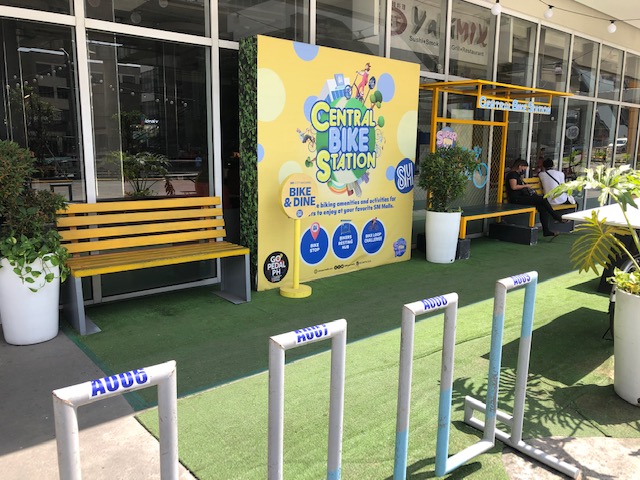 The central bike station also has benches for those who might want a rest and tables for those who want to “bike and dine”.
–
On bicycles vs. self driving cars
You’ve probably seen this graphic, the top part of which is attributed to the Cycling Promotion Fund. The last image is reproduced in the lower part of the image but labeled to emphasize what space is required to transport 48 people on electric cars and autonomous or self-driving cars.
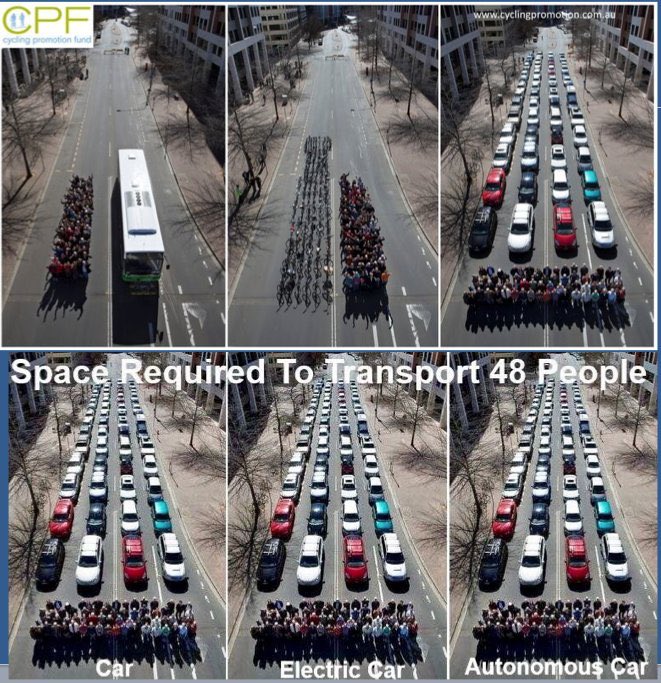
It is quite obvious that even if the current fleets of cars are replaced by electric and self-driving models, they will practically be the same problem in terms of road space occupied and the resulting congestion. So perhaps e-cars or autonomous cars are not really the solution we are looking for.
There is this nice article where the author articulates the how bikes (and active transport in general) should be the a more essential part of future transport and society than the automobile:
Collignon, N. (September 9, 2022) “Bikes, not self driving cars, are the technological gateway to urban progress,” Next City, https://nextcity.org/urbanist-news/bikes-not-self-driving-cars-are-the-technological-gateway-to-progress [Last accessed: 9/16/2022]
There are two quotable quotes from the article that I want to highlight here:
“Today the potential benefits from cycling on health, congestion, pollution and CO2 emissions are crystal clear and increasingly quantifiable, but the benefits of self-driving vehicles remain hazy. When ride-hailing companies like Uber and Lyft promised lower congestion and reduced car ownership, they instead increased congestion and led to a decline in transit ridership.”
and
“The concept of “jaywalking,” for example, is integral to the “car technology” of today. The crime of crossing a street without respecting the dominance of cars was invented by the car industry in the 1920s, who pushed hard to define streets as a place for cars, not people. Our car technology today is also defined by the restriction of movement it imposes on people.
When we begin to see technology through the lens of systems, it becomes clear that genuine technology-led progress will focus on dealing with the accelerating complexity of today’s world, not increasing the complexity of our tools.”
–
On micro transit and transportation gaps
I’ve written and shared articles before on how Paratransit, bicycles and micro transit helps alleviate the transport demand problems we are experiencing especially in highly urbanized cities. I think we should have as many options as possible for transport while also working towards the reduction of dependence on cars. Here’s an article that relates about experiences in the US:
Zukowski, D. (September 13, 2022) “Cities turn to microtransit to fill gaps in public transportation,” Smart Cities Dive, https://www.smartcitiesdive.com/news/microtransit-public-transportation-gaps-jersey-city-via/631592/ [Last accessed: 9/15/2022]
To quote from the article:
“Microtransit options are also helping to reduce the reliance on personal cars. “We’ve received feedback from people who say that because of Via they are now more consistently leaving their personal vehicle at home and using Via instead to travel within the city, which is exactly the kind of thing we want to see happen,” said Jersey City’s Patel.”
This final statement or paragraph in the article sums it up very well. Of course, we have to note that the experience in Asia is quite different especially in Southeast Asia where motorcycles are very popular and still on the rise in terms of their mode shares. While these may be considered micromobilities in western countries, they are definitely motorized private vehicles that, depending on how they are used and how the rider behaves, may be beneficial but at the same time also very dangerous for people.
–
On the impacts of bicycle use
I’ve probably read a lot of posts on social media advocating for bicycle use. Here is another article that provides us with evidence about the impacts of cycling on travel, emissions and health:
Timmer, J. (August 20, 2022) “Here’s What Happens When Countries Use Bikes to Fight Emissions,” Wired, https://www.wired.com/story/bike-more-curb-global-emissions/ [Last accessed: 8/24/2022]
To quote from the article:
“Globally, adopting a Danish level of bicycle use would reduce annual emissions of CO2 by 414 million metric tons, approximately equivalent to the UK’s emissions in 2015. Boosting that to a Dutch level would eliminate nearly 700 million metric tons, or most of the emissions from Germany in that year.
The researchers also noted that countries like the Netherlands and Denmark have much lower rates of obesity than their peer countries. Based on the known health risks there, they estimate that, globally, we’re already avoiding 170,000 deaths annually due to cycling. Expanding this globally, they found that Denmark-equivalent bicycle use would prevent 430,000 deaths per year. Dutch levels of cycling would prevent 780,000 deaths.
That said, the vulnerability of cyclists to cars poses its own lethal risks. But these aren’t anywhere close to outweighing the benefits from exercise and lower obesity. (They’d add about 90,000 and 160,000 additional deaths per year for the two levels of use.) And if fewer drivers are using cars, there’s a chance that those numbers would come in even lower.
It’s worth noting that these numbers almost certainly underestimate the benefits of shifting to bikes. Bicycles use far fewer resources to produce, and they last longer than most cars. Maintenance is likely to be far less resource-intensive as well. So simply focusing on the use of the bike omits a lot of things that would show up in a detailed life-cycle analysis.
The researchers are certainly correct that there are a lot of locations where weather makes cycling a less-than-ideal option—and the range of places where heat makes it a positively dangerous option is expanding in our changing climate.
But some of the other issues are less severe than they might appear at first. For example, the advent of bicycles with electric assist means that hilly locales aren’t necessarily the barrier they might have been a decade ago. And while a number of countries have large open spaces where cars will remain a necessity, the trend toward urbanization means that most people in those countries will live in places where cycling can be made an option.
So, the biggest barrier is likely to remain the social will to rethink transportation.”
Indeed, social will (as well as political will) is perhaps the biggest barrier in our country. Many people may not agree but the evidence for this is so clear and obvious that one has to be naive or oblivious to not see it. How else will one explain people sticking to their cars and more readily shifting to motorcycles rather than the bicycle. Of course, there are other factors to be considered and the article actually cites wealth and geography as strong prerequisites in developing a cycling culture. We need to do much more to determine where interventions are needed including land use planning and land development as well as the provision of affordable housing closer to workplaces, schools, shops and other places of interest (Hello 10- or 15-minute cities!).
–
 Caught (up) in traffic