
Home » EST (Page 20)
Category Archives: EST
Quick share: “The ‘War on Cars’ is a Bad Joke
Here is another quick share. This time it is an article that I think attempts to diffuse what some many people regard as a war on cars being waged by those who advocate for public and active transport.
Litman, T. (2019) The ‘War on Cars’ is a Bad Joke, Planetizen, https://www.planetizen.com/blogs/105877-war-cars-bad-joke?fbclid=IwAR2_SZHQeYEUGiU2G8RUw0Za6GrkR-2peD3eSjshpNUOg9-G5SpDWm6OnFI [Last accessed: 8/25/2019]
The author makes very strong arguments supported by evidence and data to place this topic in the right context. That is, there is no need to “wage war” or use arguments that are more on the hateful side and therefore not constructive to both sides. I think there should be a mutual understanding of the benefits (and costs) of having many options for transport or commuting. That said, infrastructure or facilities should not heavily favour one mode (car-centric?) for transport to be sustainable and healthy.
Sadly, many so-called progressives (yes, I am referring to the younger generations who are still in the idealistic stage of their lives) appear to be blind to understanding but instead opt for the hardline stance vs. cars and those who use them. Instead of winning people over and convincing those who really don’t need to drive to take other modes, they end up with more people becoming more apathetic or unwilling to take a stand vs. the status quo. This is the very same status quo that is definitely degrading quality of life and is described as an assault to human dignity.
–
On unlocking the potential of shared transportation
Here’s a quick share of a very nice article that’s very informative and therefore useful to people seeking to tap into the potential of shared transportation to help alleviate transport woes in their cities and towns:
Miller (2019) “9 Ways Cities Can Unlock the Potential of Shared Transportation”, Medium.com, https://medium.com/frontier-group/9-ways-cities-can-unlock-the-potential-of-shared-transportation-66a53b2c841 [Last accessed: May 3, 2019]
So far, we only have few examples of shared transportation in the Philippines. These include a few bike shares in Metro Manila and does not count ride-hailing/ridesharing, which we now know is not really a sustainable form of transport.
–
Article on sustainable transport’s role in “saving the world”
Here is another quick post on another article I am sharing showing the importance of sustainable transport:
Milner, D. (2019) How sustainable transport can save the world, medium.com, https://medium.com/@djjmilner/how-sustainable-transport-can-save-the-world-f2f64517dc52 [Last accessed: 4/9/2019]
It goes without saying that sustainable transport has a lot of potential for helping mitigate climate change and other issues but much is expected of our leaders for policies and program & project development & implementation towards achieving sustainable transport in our cities and municipalities.
–
Reference on bike-focused street transformations
There’s an update to the “Rethinking Streets” guide with one that is focused on street transformation for bicycles. Here is the link to their site where they now have 2 guidebooks:
http://www.rethinkingstreets.com
You will have to click one of the guides to register (if you haven’t done so before) and download them.
–
Lessons to be learned from experiences on public transport abroad
There’s this “old” article that came out last year that is very much relevant as it is timeless for its topic. The title is intriguing as the many if not most US cities are known to be car-dependent. Few have good public transportation in terms of the efficiencies or qualities we see in Singapore, Hong Kong, Seoul or Tokyo (just to mention Asian examples). Clearly, quality of service is the main reason why people are apprehensive about using public transportation. In fact, the attraction of ride shares, for example, are precisely because people want to have what they perceive as safe, comfortable and convenient modes of transport for their regular commutes. Only, for many people, their choice is also limited by the affordability of such modes of transport. Perhaps the same is applicable if you extend the discussion to include active transport. Cities and municipalities would need to provide the right infrastructure and environment for people to opt out of cars, take public transport, walk or cycle.
English, J. (2018) Why did America give up on mass transit? , http://www.medium.com/citylab, https://medium.com/citylab/why-did-america-give-up-on-mass-transit-dont-blame-cars-d637536e9a95 [Last accessed: 08 March 2019]
–
Marikina’s Bike and Parking Lanes
I had to navigate through Marikina’s streets in order to reach the Feliz Mall from the city’s downtown. Normally, I would have taken the more straightforward route that would have involved traveling along Marcos Highway. However, I couldn’t because it was my number coding day and the U-turn slots in the area are usually “swarming” with MMDA and Pasig City traffic enforcers. Marikina’s streets though were not part of the coding scheme and you only need to be familiar with their road network including which streets are one-way in order to navigate the streets properly.
 The bike lane is on the left side of the one-way road and to the right of the on-street parking spaces. The parking lane is the left-most and curb-side.
 This actually qualifies as an example of a road diet application. These could have easily been 2-way streets before but effectively 2 lanes have been allocated for traffic flow while the others are for parking and cycling. [Of course, hard-core cyclist will say only one lane was taken away from motor vehicles.]
These bike and parking lanes were implemented in connection with the Marikina Bikeways project that was initiated during the time of then Marikina Mayor Bayani Fernando in the late 1990s. The project was continued and maintained by succeeding administrations of the city and contribute to the city’s being more liveable compared to other LGUs. The reconfiguration of the streets make them safer and saner in terms of traffic flow where “traffic” is referred to as inclusive of all users.
–
On fact-checking articles in this blog site
Last month, I received an interesting and intriguing comment that was actually an inquiry about an article I posted that contained a photo of a section of the Marikina Bikeways. A news agency was fact-checking something circulated by trolls praising Davao City for putting up bikeways. The problem is that they used my article and photo taken some years ago:
https://d0ctrine.com/2014/09/30/lets-revisit-the-marikina-bikeways/

The photo was taken by me one time I was driving along Sumulong Highway in Marikina City’s downtown area. I take similar snapshots whenever the opportunity presented itself and I thought this one was perfect because it showed bicycle infrastructure and a cyclist using it. I don’t put any watermarks or other identifiers on my photos but routinely advise those using or intending to use them to do the proper attribution or citation.
Credit is due to the people of Marikina and their leaders for making their bikeway network a reality. Of course, there are issues here and there but the important thing was that they were able to construct it and show that it can be done given the resources in support of active transportation modes. I am not sure if Davao has initiated a program to plan and construct a bikeway network for their city. Perhaps there is and perhaps there’s none. But perhaps, too, they should take the cue from Marikina and develop one that can also be emulated or replicated in other LGUs as well. It is better to come up with something real and tangible rather than being credit for something inexistent.
–
The Ortigas Center bike lanes, complete streets and road diets
The MMDA recently stated they were planning to apply the road diet concept to EDSA by narrowing the current lane widths in order to add one lane per direction. While the idea seems to of good intention, the mention and application of road diet is flawed. I have previously shared an article on social media showing the definition and examples of complete streets:
Clearly, complete streets are for the benefit of everyone (i.e., inclusive) and not biased for motor vehicles. Here is a photo of F. Ortigas Ave. at the Ortigas Center in Pasig City showing the correct application of the Complete Streets and Road Diet concepts to an urban street. Note the elements for cycling and walking that are very prominent in the re-design of the street.
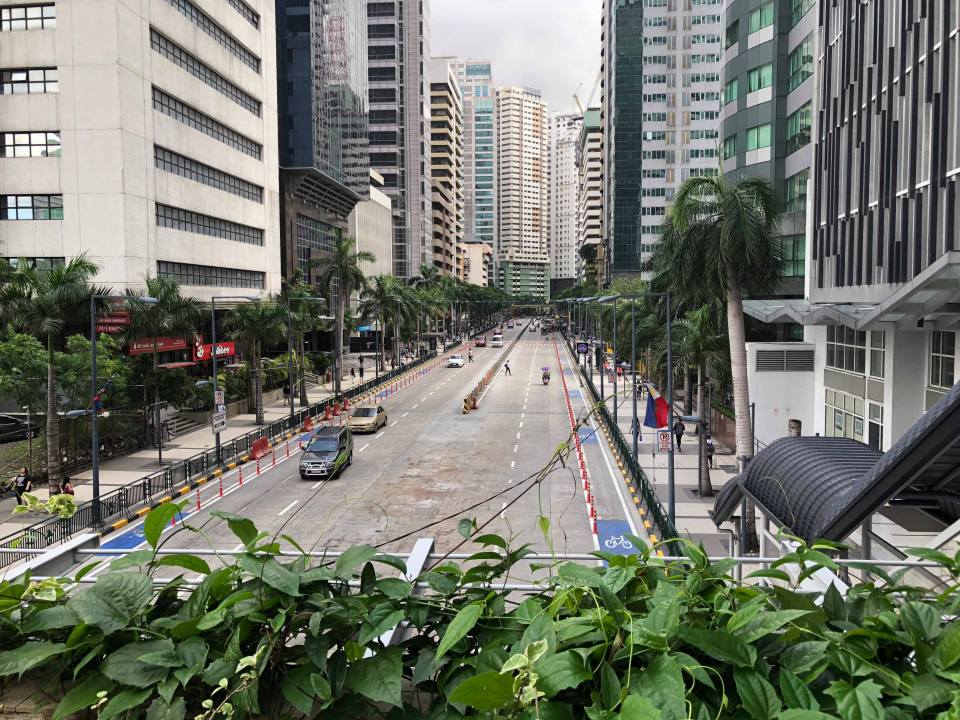 Protected bike lanes at either side of F. Ortigas Ave. at the Ortigas Center
We hope to see more of these re-designs in many other cities and towns in the Philippines. It is not a really difficult concept to apply or adopt as technically these are not complicated. However, there needs to be a change in the mindset of planners and engineers when they do these exercises considering how car-oriented our designs are. It is easy to say we want more people-oriented transportation facilities until it dawns on us how dependent we are on cars and resist the efforts to realise more sustainable designs.
–
Article on the “Boring Company” and the reinvention of transportation
Here’s another quick post where I share this interesting article on Elon Musk’s Boring Company. Central to the article is the notion that certain things related to transportation needs to be reinvented. This was written in March last year. To quote from the article:
“The Boring Company is emblematic of the Silicon Valley conviction that everything must be reinvented, literally: Airbnb is building a hotel, Uber is moving closer to operating like a bus service, and Elon Musk is slowly inventing the subway all over again…”
Here’s the article:
Marx, P. (2018) “Can we please let the Boring Company die already?,” http://www.medium.com , https://medium.com/radical-urbanist/can-we-please-let-the-boring-company-die-already-8562067adc1b [Last accessed: 01/11/2019]
–
Smoggy Metro Manila and a look forward to improving transport and air quality in 2019
I took the photo as we were driving up to Antipolo one morning this month when the opportunity presented itself for a quick photo of Metro Manila:

This serves as a reminder for those working to improving air quality in Metro Manila and elsewhere. It has already been established that much of the air pollution in Metro Manila and its adjacent areas can be attributed to mobile sources (i.e., motorised transport). A reduction of motor vehicle use, particularly cars, combined with more efficient engines and cleaner fuels should be lead to significant air quality improvements and, ultimately, an improvement in the quality of life. Of course, there should be parallel efforts to improve facilities for walking and cycling, and implementing the mass transit projects that will carry most people between the origins and destinations regardless of the distances.
Here’s to the approaching 2019 and the optimism that comes with the New Year!
Manigong Bagong Taon sa lahat!
–

