
Home » EST (Page 25)
Category Archives: EST
Wheel clamping in Antipolo
Earlier this year, Antipolo City implemented an aggressive campaign against illegal on-street parking. This policy was borne out of a new ordinance penalizing on-street parking that has been perceived as the cause of traffic congestion along many of the city’s roads. A more detailed description of the conditions or situations warranting wheel clamping may be found in the Antipolo City website.
The following photos were taken from the Antipolo City Government Facebook page:


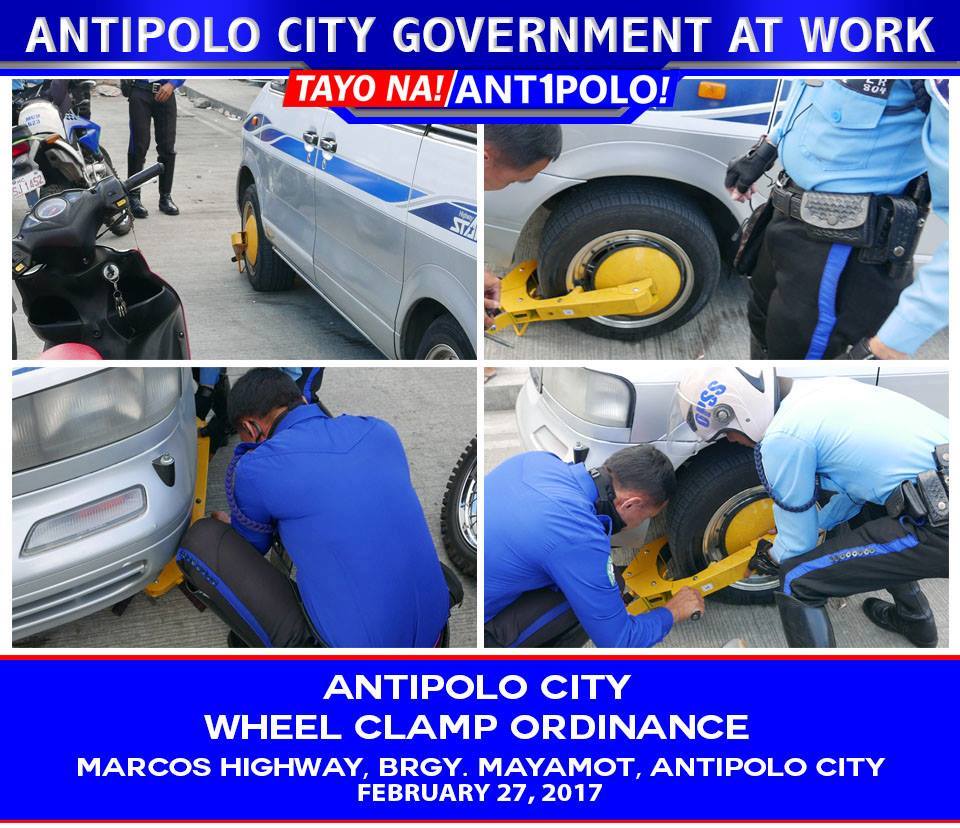
The ordinance and its implementation by the city is very timely (some may say overdue) considering that many streets particularly in the city center is already clogged with vehicles parked on-street. In certain cases, there’s double parking; severely constricting traffic flow even along one-way streets. There are (as always) evidence of resistance but hopefully, the city’s resolve will overcome and improve the situation.
I think another thing that should be in Antipolo’s agenda that’s very much related to the problem of on-street parking is the requirement for off-street parking spaces as stipulated in the National Building Code. The Code actually prescribes for the minimum number of slots per building or development but it is the local government that is tasked to implement or enforce the provisions in the NBC. Going around Antipolo, one can observe that there are many establishments clearly in violation of the Building Code provisions. One major university, for example, along Sumulong Highway does not have enough spaces considering the vehicle trips it generates. This situation is compounded by the expansion of the school to include a hospital and the adjacent commercial development that conspicuously also appears to not have enough parking spaces. An LGU can actually have a policy for stricter minimum parking slots. Quezon City and Makati City have ordinances stating so but have had mixed results compared to the outcomes they probably thought about as desirable.
Of course the topic of minimum parking spaces is currently the subject of discussions in other, more progressive cities and countries, and particularly those with better developed public transport and more disciplined land development. While relevant to us here in the Philippines, it is a topic that is not yet ripe for serious discussions given the many concerns (i.e., violations, non-compliance issues) that still need to be addressed by LGUs like Antipolo City at present.
–
List of infrastructure projects for the Philippines’ BuildBuildBuild initiative
I was looking for a list of projects said to be prioritized by the current administration in the Philippines and mentioned in the presentation made by government yesterday. Here’s one I found from GMA News:
Infrastructure projects lined up by the Duterte administration
Noticeable for me are the following:
1. No mention of major bridge projects that were heavily hyped both on mainstream and social media – these bridges include those that were proposed to connect the islands of Panay and Negros, Negros and Cebu, and Cebu and Bohol. It doesn’t mean, of course, that these have been abandoned but likely only sidelined for the moment.
2. Break-up of Clark Green City into several components – this seems to be a more realistic approach especially considering how big and complex this project is, and how many agencies or entities are and will be involved
3. Mass transit projects in Metro Manila – these include big ticket projects such as the proposed subway, BRT and the rehabilitation of PNR lines. These are all projects that should have been done a long time ago but for various reasons have been delayed. Say what you will about so much resources being poured into Metro (Mega?) Manila but it is the economic center of the country and efficient transport will go a long way in generating resources that can eventually be used in other parts of the country.
4. Emphasis on Clark Airport – it seems to me that the current administration is focused on developing Clark as the alternative (if not the main) gateway to the greater capital region. This is a departure from the hype we have received about a replacement for NAIA including one that was proposed at Sangley Point in Cavite.
5. Scaling down of Mindanao Railways – instead of pushing for a much grander (and unrealistic I think) railway project for the entire island, they identified a more realistic and perhaps practical line connecting Tagum, Davao and Digos. One colleague noted, however, that this corridor is already heavily serviced by buses and vans so rail ridership is at best threatened from the start.
What’s your take on the proposed projects and the list in general?
–
Incentives for not driving?
There’s a nice article on Wired that argues for giving an incentive to commuters to give up driving (i.e., using their cars to go to/from workplaces). My only comment here is that it might have better chances elsewhere but not in the Philippines where such incentives often are seen as dole-outs and, despite guidelines or rules for implementation, are likely to be abused or taken advantage of in many offices. This is especially true when cities do not have good quality public transportation and you have low priced motorcycles and cars on sale with the many dealerships. Sad to say but the Philippines is not ready (not mature enough?) for such schemes.
Want commuters to ditch driving? Try giving them cash money
The article is by Aarian Marshall and appeared on the online version Wired last March 26, 2017.
–
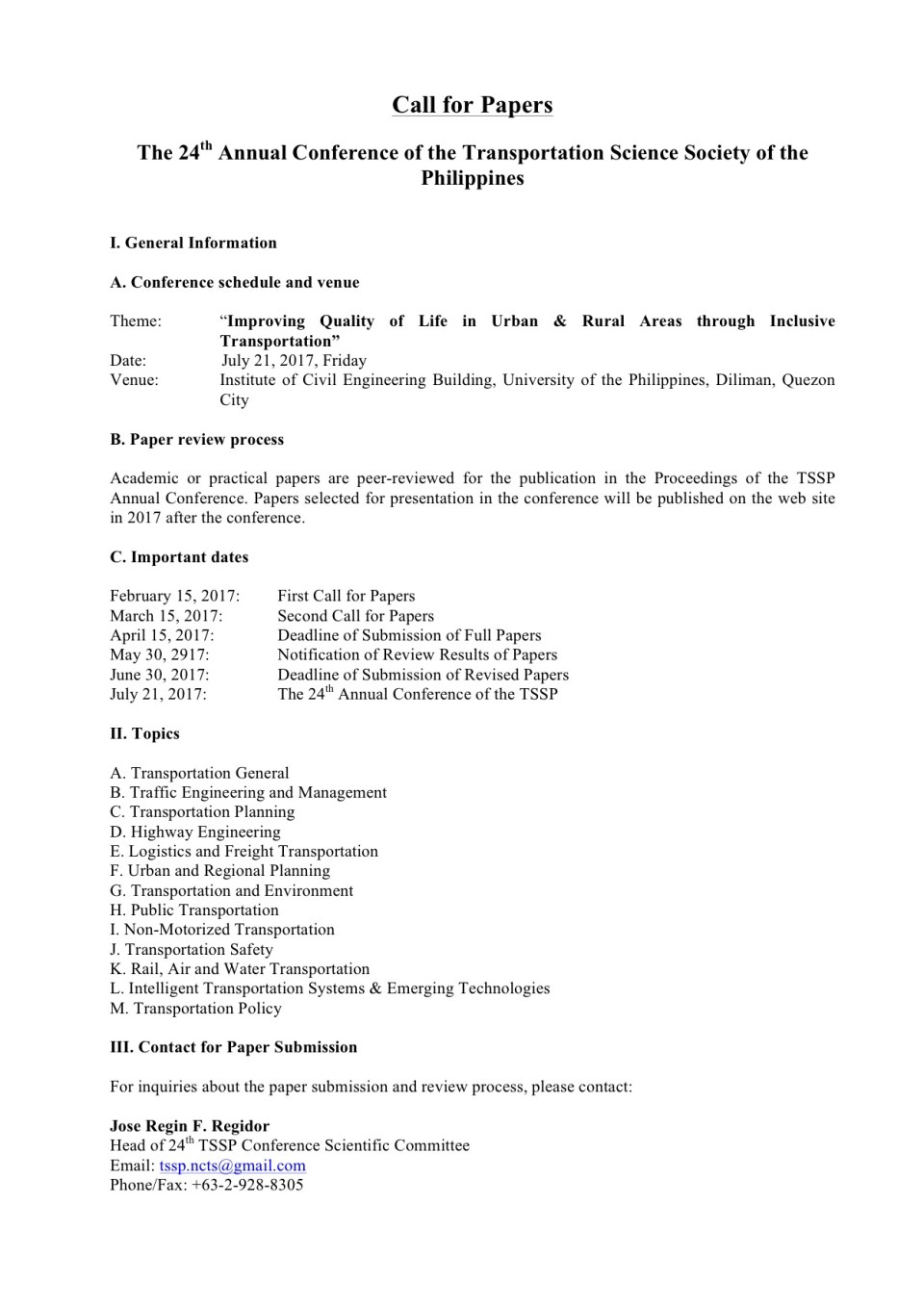
First call for papers for the TSSP 2017 conference
The first call for papers for the 24th Annual Conference of the Transportation Science Society of the Philippines came out last Wednesday, Feb. 15:
–
ITS Forum 2017 at DLSU
We are holding a forum on Intelligent Transport Systems (ITS) today at the De La Salle University (DLSU) along Taft Avenue, Manila. Following is the banner and the program as of February 16:

 In the workshops scheduled in the afternoon, the plan is to review the DOST roadmap and the ITS Master Plan. The DOST roadmap is basically on the research and development agenda of the agency. In the past, this has been associated mainly with the Engineering Research and Development for Technology (ERDT) program of which several major universities are a part of including UP Diliman, DLSU, Ateneo and Mapua Institute of Technology. Eventually, ITS became the theme for other R&D including those that were packaged as ITS but not necessarily falls under the category (i.e., projects like the AGT, hybrid bus and bike share are more sustainable transport than ITS).
The ITS Master Plan is actually something developed under a project implemented through the Department of Public Works and Highways (DPWH) more than 6 years ago and originally only for Metro Manila. This plan is being eyed as the foundation for a bigger one that hopefully would apply to the rest of the country.
–
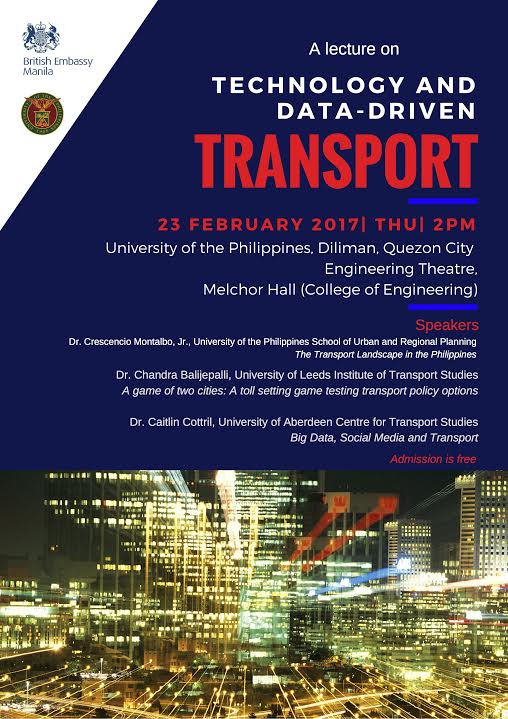
Special lectures on transport – February 23, 2017
I just wanted to share the following announcement from the University of the Philippines Diliman about special lectures on transport. The lectures will be delivered at the Melchor Hall theater at the UP Diliman campus and is open to the public.
–
Commuting and stress
Here is another quick post but on a topic that’s related to health and therefore is something that I think many should be interested in and perhaps take important note of.
Commuting: “The Stress that Doesn’t Pay”
There are many links to various medical articles within the article. At the last part, there is also a list of references that the reader may want to look at. I’m also posting this for future reference. This would contribute to the formulation of topics for research especially the inter-disciplinary or collaborative kind.
–
Bike share success?
There are two articles about bike sharing that got my attention today. These are both asked the question of weather bike sharing programs actually work or are successful. Following are links to the two articles available online:
Both articles draw upon the experiences in many cities in the United States where various bike share programs have sprouted. Many seem to have had some measure of success but most are not as successful when evaluated using criteria mentioned in the articles. I guess there’s much to be learned here but the experiences should not be limited to the US. There are better examples in Europe where bicycle use is quite popular compared to the US. Perhaps Asian examples, too, need to be assessed but then all need to be examined objectively and according to the unique situations and/or circumstances for how these bike shares came to be in the first place. In Metro Manila, the bike share program by the students at the sprawling University of the Philippines campus in Quezon City is a recent one but is very popular with students. Another, more endowed program in a more posh district in Taguig City is much less successful judging from the usually full racks of bicycles. There are also lessons to be learned here and perhaps things that can be shared with others looking to come up with their own bike share programs in their cities and towns.
–
Mobilizing sustainable transport for development
The United Nations (UN) has recently published a new report on “Mobilizing sustainable transport for development” authored by a High Level Advisory Group on Sustainable Transport formed by the UN. The report and other resources may be found at the following website:
Secretary General’s High Level Advisory Group on Sustainable Transport
This is under the UN’s Sustainable Development Knowledge Platform. You can check out the other materials at the website. The UN has many initiatives on sustainable transport and has been very active in promoting or advocating for sustainable transport for a long time now. It is through the UN Centre for Regional Development (UNCRD), for example, that the Philippines and other ASEAN countries were able to formulate their national EST strategies. The new report continues on the UN’s commitment to promote sustainable transport to improve people’s lives around the world.
–
Tutubi bike share at BGC
I had been curious about the ADB-supported bike share initiative they called Tutubi since it was launched at the University of Sto. Tomas (UST) in Manila and at Bonifacio Global City (BGC) in Taguig. These have sophisticated portals where one can rent a bicycle by simply swiping or tapping your card unto the terminal. I finally noticed the bike station at Bonifacio High Street in BGC. I don’t know how I missed it since we are there weekly but then there are usually events in that area and the bike share station may have been obscured. Following are a few photos I was able to take as I watched our toddler walking about curiously and excited of the fountains and others she found interesting at High Street.
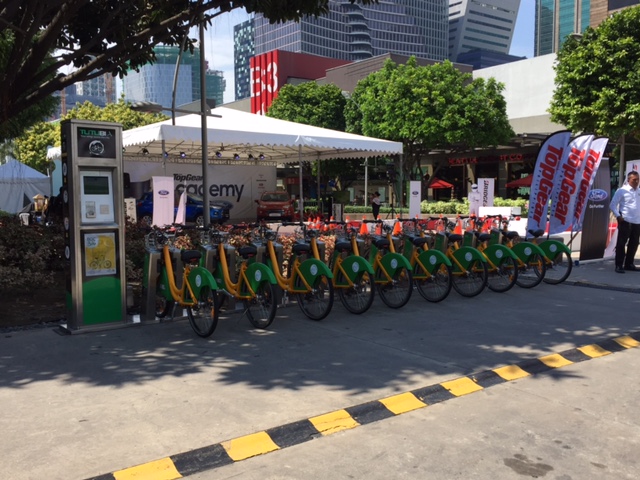 All the bikes seem to be here as not a slot was vacant.
 It seemed ironic to see not one bike in use against the backdrop banners of a popular motoring magazine.
 A closer look at the portal shows what looks like a new (unused?) facility.
It seems to me that there are few users of the Tutubi at least at Bonifacio High Street. I wonder if the bikes at UST are utilized more than the ones at BGC. I also wonder if UST is monitoring or studying bicycle use in its campus. Its use being limited within the premises of the campus sort of restricts users and diminishes utility. UST has a walkable campus and while its area is big (20+ ha) compared to other universities and colleges in the University Belt district, it is smaller beside Katipunan neighbors Ateneo De Manila University (80+ ha) and the University of the Philippines (493 ha). The latter two are also “walkable” with UP having more park-like features and open to the public.
UP Diliman has its own Bike Share program run by students and (I might come as biased) these seem to be popular on campus as I see many of the bikes used by students to go around from one building to another. UP Bike Share currently employs a more conventional system including subscriptions for frequent users. There is, however, a Department of Science and Technology (DOST)-funded project through the Electrical and Electronics Engineering Institute of UP Diliman that hopes to develop a more sophisticated system for managing and monitoring the bikes. That project has just started so we might wait 1 to 2 years to see its fruits.
–

