
Home » EST (Page 5)
Category Archives: EST
Planning for Accessibility: Proximity is More Important than Mobility
Here is a quick share of another very informative article that discusses the importance of proximity and more dense development in order to reduce car dependence.
Source: Planning for Accessibility: Proximity is More Important than Mobility
Here are some excerpts from the article:
“This shows that proximity is much more important than mobility in providing accessibility: location, location, location. For the last century, our transportation planning practices have contradicted this principle. Transportation agencies built urban highways that destroyed and degraded accessible and multimodal neighborhoods to benefit suburban motorists. This was racist and classist, but the mechanism was the way that transportation planners valued increased traffic speeds, measured as travel time savings, while ignoring the loss of accessibility imposed on urban neighborhood residents.
Of course, many other factors affect people’s transportation and neighborhood preferences. Some people need their cars for work or after-work activities, and not everybody can bicycle or use transit even if it is available. However, surveys such as the National Association of Realtor’s National Community Preference Survey indicate that many people would prefer living in more compact, walkable neighborhoods than they currently do but cannot due to a lack of supply.”
Such articles are a must read for those who want to understand why government needs to invest in land at or near the CBDs, and develop that land so people will not need to reside far from their workplaces and schools. Truly, there are many other factors affecting transport preferences or mode choice. Housing is one such factor that we continue to treat separately from transport. It is very (prohibitively) expensive to buy or rent in the city particularly in or near the CBDs. The result is people opting to purchase or rent homes in the suburbs. It doesn’t help that developers are also actively promoting subdivisions there and therefore are contributing to sprawl that puts so much pressure on transportation systems.
–
30th Conference of the Transportation Science Society of the Philippines
I am sharing here the First Call for Papers for the 30th Annual Conference of the Transportation Science Society of the Philippines (TSSP). The conference will be held in Iloilo City almost to the day of the last time it was held there in Sept. 12, 2014.

Information on past conferences may be found here: https://ncts.upd.edu.ph/tssp/conferences
–
Article share: The Benefits of Trees
Here is a quick sharing of this article on the benefits of trees. I thought such articles are always timely and relevant especially if you frame this in the context of road or highway development as well as the complete streets concept that is currently being promoted to improve transport conditions including road safety.
Source: The Benefits of Trees
Article share: on subsidies to public transportation
Here’s a nice article that presents arguments for subsidies to support transit or public transportation:
Wilson, K. (February 5, 2024) “Study: Subsidizing Transit Actually Makes It More Efficient,” Streets Blog USA, https://usa.streetsblog.org/2024/02/05/study-subsidizing-transit-actually-makes-it-more-efficient [Last accessed: 2/18/2024]
Subsidies to public transportation can be quite tricky and may require quite a balancing act. There seems to be few options outside of the straightforward subsidies national and local governments in the Philippines provide. Rail transit, for example, is heavily subsidized but these are rare for road-based public transportation. The concept of service contracting has been considered but it also has a few variations. While there seems to have been a proof of concept tested during the pandemic, it required so much funds that government apparently lost interest (i.e., the funds were also needed by other sectors). Local governments meanwhile, or at least those that had resources, decided to operate their own public transport (e.g., Quezon City bus).
To quote from the article:
“Newmark’s study doesn’t definitively determine why, exactly, high subsidies seem to correlate with better efficiency and transit agencies collecting more fares, but he has some theories. Some systems, he says, use subsidies to increase service frequency or install dedicated lanes to speed routes up along heavily-utilized corridors — and riders are responding, predictably, by showing up in droves. (Route expansion can help, too, he said, but only if agencies expand service to places “where there’s actual demand.”) Others use subsidies to keep ticket prices low, but not to eliminate fares outright, which Newmark argues is a smart move.
“People value stuff they pay for, and they pay for stuff they value,” Newmark added. “An underlying point in this paper is that transit offers something [valuable], and it’s worth trying to capture that value, whether through fares or in other ways.”
If transit networks and the taxpayers who support them can get that recipe right, it could create a virtuous cycle.
“If people see the benefits [of subsidies], that may make them more willing to invest [their taxpayer dollars],” he adds. “Good transit leads to a real social movement for more subsidies.” “
What do you think about subsidies to public transport in the Philippine setting? Of course, we are referring to ‘formal’ public transportation here. There are many ‘informal’ or paratransit modes like tricycles and non-motorized pedicabs. There are also motorcycle taxis providing services or filling in the gaps in transport services.
–
More than just painted lines – good practice examples of bike lanes
I’m sharing this article on the best bike lanes in the United States:
Holbrook, A. (February 12, 2024) “The 5 Principles That Make America’s Best Bike Lanes: A Lot More Than Painted Lines,” Velo, https://velo.outsideonline.com/urban/urban-gear/five-principles-the-best-bike-lanes/ [Last accessed: 2/15/2024]
This is a follow-up on an article on the best new bike lanes or bikeways that I shared earlier. This article features an interview of the author of the previous article about what features distinguish these bike lanes over others that have been implemented. Definitely, bike lanes should be designed beyond the usually painted lines that offer little protection to cyclists.
Here are examples of bike lanes in the Philippines:
 Painted bike lanes along Ortigas Avenue Extension, Cainta, Rizal
 Protected bike lane along Katipunan Avenue (C-5), Quezon City
–
On urban noise
We open February with an article share. The article is about noise in urban areas. Not surprisingly, most noise comes from transportation and the solutions mentioned in the article not only addresses transportation noise but at the same time addresses other concerns about transportation, including safety.
Durand-Wood, E. (January 25, 2024) “Why Are Cities So Noisy? And Can We Do Anything About It?“ Strong Towns, https://www.strongtowns.org/journal/2024/1/25/why-are-cities-so-noisy-and-can-we-do-anything-about-it [Last accessed: 2/2/2024]
To quote from the article:
“In 2011, the WHO set recommendations for daytime and nighttime environmental noise levels, and found the maximum safe noise level for daytime is 55db (somewhere between moderate rain and normal conversation) and at night, 40db (about the level of a quiet library). Beyond these levels, prolonged exposure to environmental noise has been shown to cause health problems, and not just hearing-related ones.”In 2011, the WHO set recommendations for daytime and nighttime environmental noise levels, and found the maximum safe noise level for daytime is 55db (somewhere between moderate rain and normal conversation) and at night, 40db (about the level of a quiet library). Beyond these levels, prolonged exposure to environmental noise has been shown to cause health problems, and not just hearing-related ones.
Until recently, most analysis related to urban noise has focused on noise as an annoyance or disruptor to humans. But with these new guidelines, there was an acknowledgement that too much environmental noise can actually have grave health consequences, noting that “at least one million healthy life years are lost every year from traffic-related noise in the western part of Europe.”
We now know that higher levels of environmental noise raise heart rate and blood pressure, cause harmful sleep interruptions, and are linked to cardiovascular disease, dementia, and cognitive impairment in children, among others. And as with environmental pollution, there are racial and socioeconomic disparities with noise pollution.
In a 2022 report, the United Nations identified urban noise pollution as a top environmental risk.”
Have you noticed how noisy it is in our cities? Many actually choose to live in the suburbs as the perception is its quieter especially during the night. The health risks due to noise are well-established as presented also in the article. However, there are ways to address this and reduce the noise, particularly the type attributed to transportation and traffic.
–
On the Pasig River esplanade project
My news feed was full of articles on the Pasig River esplanade, or at least the recently completed section at the Manila Central Post Office building. This is a proof of concept type of project that hopes to be expanded or extended to cover both sides of the river much like the Iloilo River Esplanade project. If you are wondering what the section looked like before the project, here are two posts I wrote in 2012 that features a lot of photos of the Muelle del Rio:
These were way before the fire that damaged the Post Office building. However, even at that time, there were already calls for the renovation, even repurposing of the Post Office building. Such projects or proposal draw inspiration from Singapore where old buildings have been preserved and many repurposed (e.g., how about the Post Office building transformed into a hotel?). Perhaps such will breathe life and lead to a revival of this part of Manila?
–
On bike lanes network development – examples in the US
I am sharing this article on the best new bike lanes in the United States:
Haggerty, M. (January 12, 2024) “The Best New U.S. Bike Lanes of 2023,” People for Bikes, https://www.peopleforbikes.org/news/the-best-new-u.s.-bike-lanes-of-2023 [Last accessed: 1/23/2024]
Quoting from the article:
“Even for the most ardent naysayers, it’s difficult to deny that the landscape of bicycling in America is transforming (although not as quickly as many of us would like to see). While we have yet to see any U.S. cities emerge with truly bold citywide plans for bike networks as we’ve seen in places like London, Paris, and Bogota, many are (slowly) beginning to envision a future where cycling takes center stage. Although there remains a substantial amount of work ahead of us to cultivate a safe and comfortable environment for people of all ages and abilities to ride bikes in the U.S., it’s well worth pausing to commemorate the significant infrastructure victories U.S. cities achieved in 2023.”
The quote above also applies to us in the Philippines where there are still few examples of safe and comfortable bike lanes. I shared the same article on my social media page asking aloud if there’s something like this in the Philippines. I am aware of the Mobility Awards but that’s supposed to cover everything on mobility and particularly walking and cycling. The list is about bike lanes and touches on the various designs (note that in the US, while there are federal guidelines, most if not all states and cities would have their own that they use for planning and design of bicycle facilities). It would be nice to have our cities develop guidelines while also referring to the minimum standards in the DPWH Guidelines. Of course, the challenge is to come up with good if not the best designs and not just comply with the minimum.
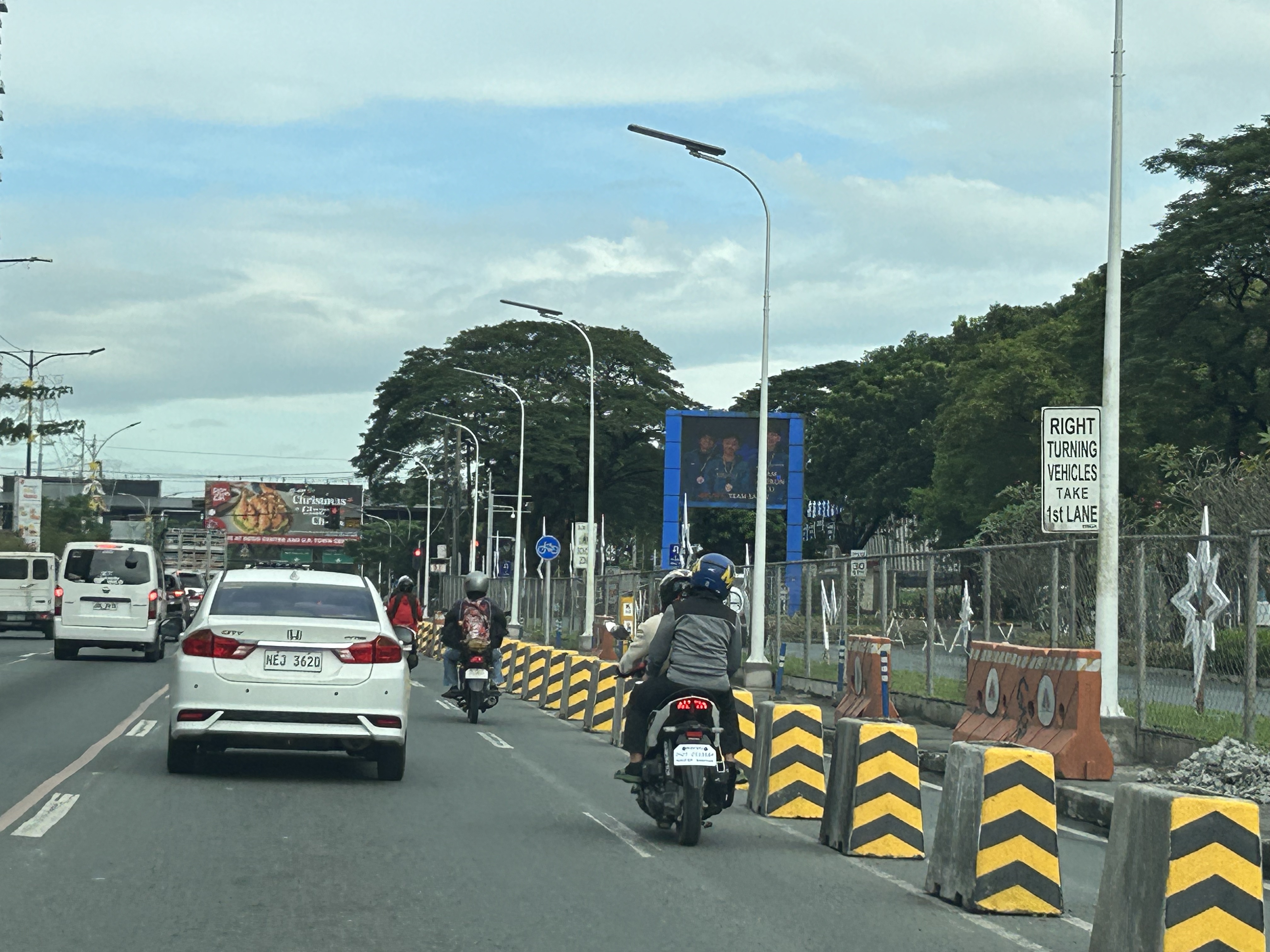 If there was an award for best new bike lanes in 2023, I think Quezon City will have several nominees and even win the award with one. Picture above is the bike lane along Katipunan Avenue/C5.
–
Solar road studs for Ortigas Avenue Extension bike lanes
The bike lanes along Ortigas Avenue Extension now have solar road studs for these to be more visible at night time or when it is dark. Following are photos of the bike lanes at night.
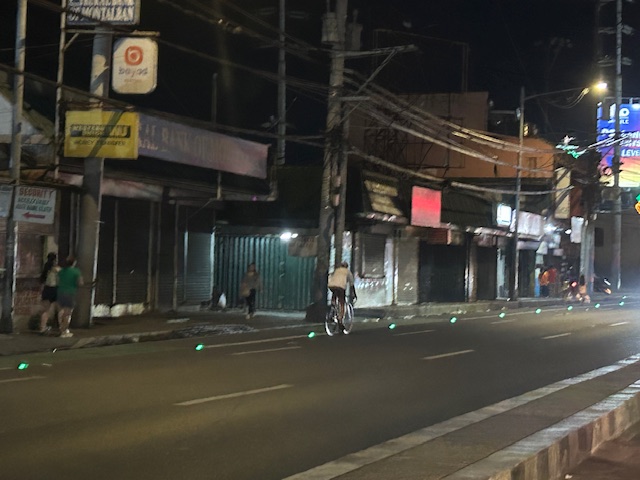
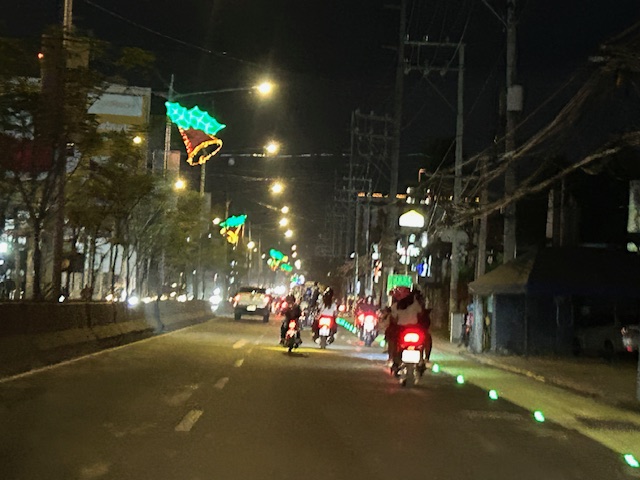

While the studs enhance the visibility of the bike lanes and perhaps also the safety of cyclists, the latter is not assured. The bike lanes are not protected and physical barriers like those installed along Quezon City roads are most effective in ensuring the safety of cyclists against motor vehicles. The solar studs do not deter motor vehicle drivers from encroaching on the bike lanes so they appear to have minimal impacts on safety.
–
Westbound bike lane along Ortigas Avenue Extension, Cainta, Rizal
I was not able to post these photos of the westbound bike lane along Ortigas Avenue Extension immediately after I shared photos of the eastbound bike lane. The bike lanes, as can be seen from the photos, are painted green.
 Bike lane past Valley Golf and STI
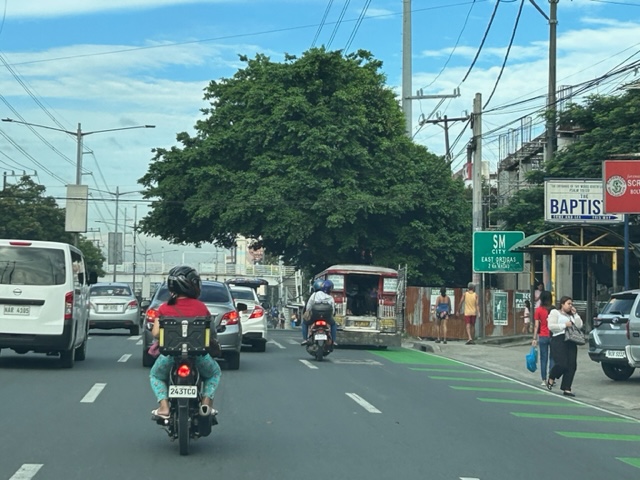 Bike lane approaching Brookside (Sunset Drive) with the CK Square as a landmark
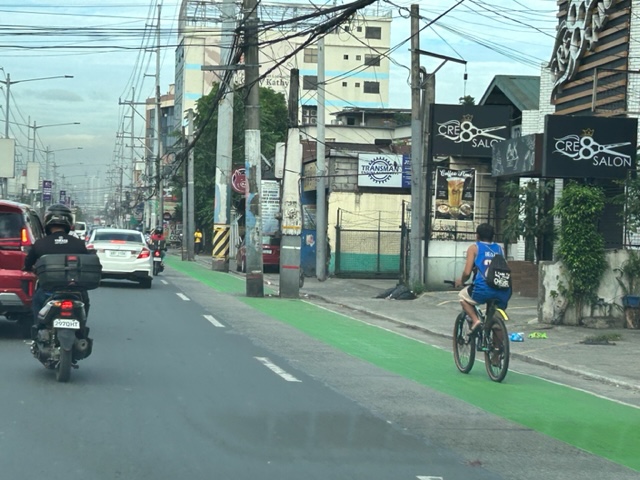 Still a big issue for bike lanes is the presence of electric and communication poles/posts that have not been relocated after so many years since Ortigas Avenue had been widened.
 Bike lane across from Tapsi ni Vivian
 These photos were taken before the solar studs were installed to delineate the bike lanes and make them more visible at night or when its dark.
 Also, challenges and concerns for cyclists are parked vehicles and those maneuvering from the various establishments along the road. This photo pretty much captures those two concerns – a parked UV Express van and a truck maneuvering out of a store occupying the bike lane.
 Cyclist pedaling along the bike lane approaching the Shell Gas Station (where there is also a McDonald’s)
 Bike lane in front of the Ortigas Hospital just outside the Brookside Gate 1 and near Cainta Junction
More photos of the bike lanes soon!
–
 Caught (up) in traffic