
Home » Governance (Page 26)
Category Archives: Governance
Politics: Fresh Faces at the Local Level?
A major factor in shaping our cities and municipalities is the leadership in the form of local politicians, most especially the Mayors, who are the decision-makers for many aspects of their constituencies. Mayors have a hand in most if not all policies pertaining to land use (e.g., zoning, planning, etc.) and transportation (e.g., schemes, policies, franchises, etc.).
The likes of Vico Sotto, Isko Moreno and Francis Zamora are currently being praised for what seems to be their fresh and aggressive approach to addressing problems and issues in their respective constituencies. The three’s ascendance to mayor of their respective cities have also exposed the alleged graft and corruption of their predecessors. The dominance of the latter in the form of dynasties have all but assured that whatever anomalies passed on from one term to another are internalised and made unknown to their constituencies who are to remain blind to these abnormalities. Instead, the people are made to believe that progress is achieved with some worthwhile projects here and there to show that taxpayers’ money are spent well.
Prior to these personalities, there were others who sort of broke the dynasties in their respective towns. I can name at least two cases that I am very familiar with; both with the Municipality of Cainta – Mon Ilagan and Kit Nieto. Both ended long reigns with Ilagan making Cainta history by finally upending the Felix dynasty there. Previous to him, the only one who almost upset the then reigning dynasty was a woman – Eunice Fermindoza. Ironically, Ilagan’s attempt at a dynasty by making his wife run after his 3 terms was up was nipped by Nieto, an erstwhile ally who has come to represent not just the emergence but the establishment of people who have settled in suburban town in the various subdivisions developed over the course of the last 50 years. These are the middle class comprised of professional and office workers and their families who decided to reside in Cainta because of the town’s proximity to Metro Manila and homes their being relatively affordable.
Even before Sotto, Moreno and Zamora have embarked on their own programs, Nieto has shown that the efficient use of resources coupled with transparency and a genuine feel for the requirements of his constituents will get one re-elected and gain attention. Cainta has transformed and blossomed under this current mayor. For one, he has been able to complete many infrastructure projects and strengthened social and medical programs in the municipality. It is a wonder how Cainta is not yet a city considering its income and continued growth. One only wishes this growth is not sustained by poorly planned land use development where the town basically relies on developers (i.e., Megaworld and Filinvest) for the plans instead of being involved in order to avoid exacerbating the enduring traffic and flooding issues that are still the bane of this town. Unfortunately, Nieto is on his last term and it is unclear for now who might be competent and progressive enough to replace him. Among the current councilors in the current administration is a Felix and an Ilagan, scions of the two previous families that lorded it over Cainta. Will one of them rise again to reclaim what they probably regard as their right place? Hopefully not…Kawawa naman ang Cainta.
–
Safety guides for pedestrians and cyclists
Here are a couple of references/resources for pedestrian and cycling safety. These are guidelines and countermeasure selection systems that were developed under the Federal Highway Administration of the US Department of Transportation:
- Pedestrian Safety Guide and Countermeasure Selection System
- Bicycle Safety Guide and Countermeasure Selection System
These guides are designed to be practical and should be helpful to practitioners/professionals, policymakers as well as researchers. These would be people looking for references to use in designing or revising (correcting?) existing conditions or situations in order to enhance safety for pedestrians and cyclists who are among the most vulnerable of road users.
–
On unlocking the potential of shared transportation
Here’s a quick share of a very nice article that’s very informative and therefore useful to people seeking to tap into the potential of shared transportation to help alleviate transport woes in their cities and towns:
Miller (2019) “9 Ways Cities Can Unlock the Potential of Shared Transportation”, Medium.com, https://medium.com/frontier-group/9-ways-cities-can-unlock-the-potential-of-shared-transportation-66a53b2c841 [Last accessed: May 3, 2019]
So far, we only have few examples of shared transportation in the Philippines. These include a few bike shares in Metro Manila and does not count ride-hailing/ridesharing, which we now know is not really a sustainable form of transport.
–
Bike patrol
Wouldn’t it be healthier and more effective for law enforcers to have bike patrols? Many of them seem to be detached from the communities they’re supposed to serve when they aren’t on foot or pedals but instead go around on motor vehicles. It also seems a waste that the motor vehicles assigned to these people are being used to train them for driving. Thus, you often see patrol cars (even motorcycles) that are supposed to be recent model vehicles but seem so battered already. Do they really use these for chases? Or are they damaged due to their being used as “training” vehicles?
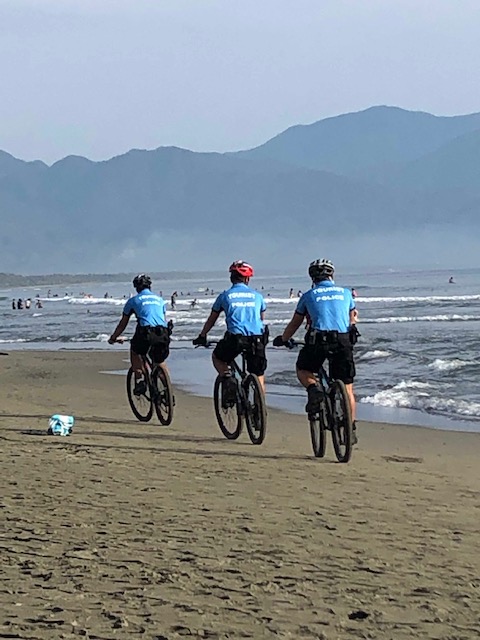 PNP officers on bike patrol along the beaches in Baler, Aurora
To be more effective, police officers should probably be roaming on foot or bicycles. They can be more in touch with the communities as there will be opportunities to mingle compared to if they were on cars or motorcycles. In one thread on social media, for example, there was a call for our local police to adopt the “Koban” style of the Japanese police where officers roam the communities mainly on foot and where many are recruited from the community for the latter and former to have some familiarity with the people and areas they are assigned to. Going around on foot or bicycle would also be a healthier option as surely they will be able to go more than the 10,000 steps (or equivalent) necessary to be classified as active.
–
Article on sustainable transport’s role in “saving the world”
Here is another quick post on another article I am sharing showing the importance of sustainable transport:
Milner, D. (2019) How sustainable transport can save the world, medium.com, https://medium.com/@djjmilner/how-sustainable-transport-can-save-the-world-f2f64517dc52 [Last accessed: 4/9/2019]
It goes without saying that sustainable transport has a lot of potential for helping mitigate climate change and other issues but much is expected of our leaders for policies and program & project development & implementation towards achieving sustainable transport in our cities and municipalities.
–
Reference on bike-focused street transformations
There’s an update to the “Rethinking Streets” guide with one that is focused on street transformation for bicycles. Here is the link to their site where they now have 2 guidebooks:
http://www.rethinkingstreets.com
You will have to click one of the guides to register (if you haven’t done so before) and download them.
–
Lessons to be learned from experiences on public transport abroad
There’s this “old” article that came out last year that is very much relevant as it is timeless for its topic. The title is intriguing as the many if not most US cities are known to be car-dependent. Few have good public transportation in terms of the efficiencies or qualities we see in Singapore, Hong Kong, Seoul or Tokyo (just to mention Asian examples). Clearly, quality of service is the main reason why people are apprehensive about using public transportation. In fact, the attraction of ride shares, for example, are precisely because people want to have what they perceive as safe, comfortable and convenient modes of transport for their regular commutes. Only, for many people, their choice is also limited by the affordability of such modes of transport. Perhaps the same is applicable if you extend the discussion to include active transport. Cities and municipalities would need to provide the right infrastructure and environment for people to opt out of cars, take public transport, walk or cycle.
English, J. (2018) Why did America give up on mass transit? , http://www.medium.com/citylab, https://medium.com/citylab/why-did-america-give-up-on-mass-transit-dont-blame-cars-d637536e9a95 [Last accessed: 08 March 2019]
–
References linking transportation and health
The Institute of Transportation Engineers (ITE) features several resources discussing the linkage between transportation and health. Here is the link to the page where they list references like reports from various sources as well as tools.
This is definitely a topic that needs more attention and studies in the Philippines in order to have local evidence (there are already strong evidence abroad) supporting active transportation and how it helps make citizens healthier. Of course, that goes without saying that active transport should be integrated with an efficient public transport system. That is so that the increasing share of private transport can be checked (no thanks to Grab and Uber) and we can either retain or increase public and active transport shares.
–
Simulating cities?
I found this nice article about some of the most popular simulation games; especially SimCity:
Baker, K.T. (201 ) Model Metropolis, Logic, https://logicmag.io/06-model-metropolis/?mbid=nl_021119_transportation_list_p [Last accessed: 2/13/2019]
While there are still those who dismiss these as merely games, they fail to appreciate the really complex algorithms and processes that could now mimic real world situations. That includes governance of cities that is a very important factor to its development. Land use planning or transport planning alone cannot provide the solutions for a city’s problems associated with, among others, its growth. The success reflects on the administration and leadership that should be able to anticipate and respond to issues while consolidating and rationalising resources, which are often limited.
–
On re-designing or re-imagining our transportation system for people
Here is another good read especially for those who advocate or even just beginning to appreciate the concept of people-oriented transportation:
VannPashak, J. (2018) “Design for humans as they are, not as you want them to be,” http://www.medium.com, https://medium.com/@jvannpashak/design-for-humans-as-they-are-not-as-you-want-them-to-be-ef95076c0988 [Last accessed: 11/23/2018].
In a recent symposium where I made a presentation about low carbon transport and visioning and re-imagining transport, I was asked how we can re-design our transportation to be more people-oriented than car-oriented. I replied that we have to do a lot of unlearning. That is, many planners and engineers would need to unlearn many things they’ve learned in school and those they got from their workplace. One convenient excuse for not coming up with a better design, for example, is that certain planners or engineers just followed what their offices or agencies have been doing. What if what their offices and agencies (and consequently their seniors at work) where wrong all these years and what was “ginagawa na” or “nakasanayan” have led to deficient outcomes? I even joked about whether these offices or agencies were “open minded” referring to a favourite by-line by networking companies. Being open-minded in the context of having people-oriented transport solutions would be difficult if everything was “nakakahon” because these were what you learned from school and/or the workplace. It is difficult to admit that something was and is wrong.
–
 Caught (up) in traffic