
Home » Governance (Page 29)
Category Archives: Governance
New ruralism, anyone?
I found this interesting article that tackles what to me is a new concept although it shouldn’t be. The concept of new ruralism to me is somewhat going back to the basics. While urbanization seems to be an unstoppable force, there is still the need to preserve rural areas and also the way of life as well as the industries that we need to sustain urban living. Food production, for example, is something that is being advocated or promoted in urban areas but hasn’t really caught on. Farming seems to have lost a lot of people as it is perceived as backward and yet it is essential.
New Ruralism: Solutions for Struggling Small Towns [by Jared Green in The Dirt, June 14, 2017]
What do you think about this concept of new ruralism? Is it something that’s also applicable to the Philippines or is will it be just a fad?
–
On the transportation aspects of Antipolo’s pitch for the senate to relocate there
I was browsing Facebook the other day and found an interesting post by the Antipolo City Government’s official account. They posted about the presentation made by the current mayor to the staff of the Philippine Senate, selling the idea for the Senate to relocate from its current location in Pasay City. There are currently two options known to us: Fort Bonifacio in Taguig City and Antipolo City in Rizal Province.
The Antipolo government’s post stated that it only takes 25 minutes between the the Batasan Complex and the proposed site, which is on land owned by the Antipolo City Government. This was probably based on travel time estimate using a tool such as Open Street Map. This though is inaccurate since travel times are affected by various factors and will vary according to time of day, day of the week and even month.
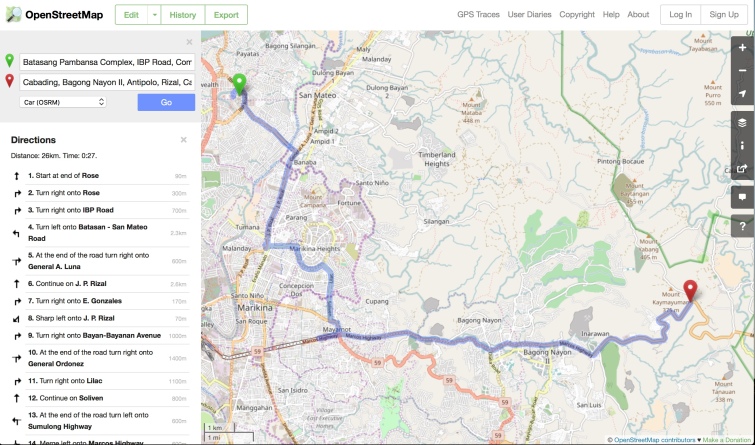 Open Street Map visualization of travel route and time between Batasan Complex and the proposed site for the Senate
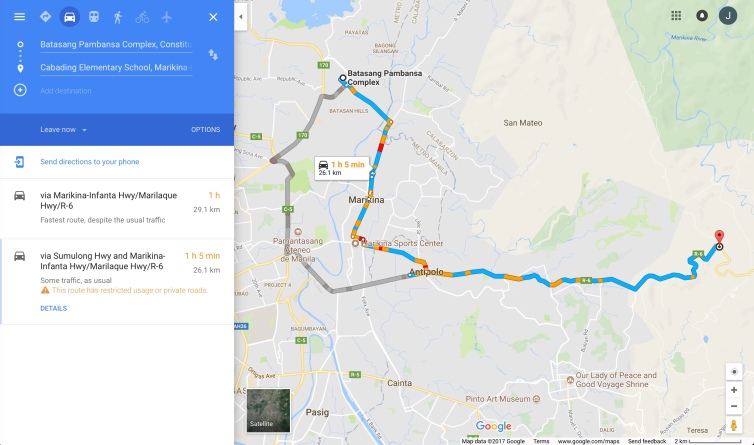 Google Maps visualization of alternative routes and typical travel times
I took the preceding screen captures at 10:00 AM on June 23, 2017 (Friday). Open Street Map’s version can be misleading because it states a travel time assuming practically no traffic (~26 km in 27 minutes or about 58 km/hr in terms of travel speed). Google Maps version is better as it accounts for typical traffic during a certain time of travel (i.e., 10AM). Thus, there’s the more realistic 1 hour travel time for the same distance (about 26 km/hr travel speed). Google’s is based on crowdsourced data and can be customized based on the day and time of travel (e.g., 8:00 AM on a Monday). And I wouldn’t even want to get into the discussion of the accuracy of the claimed 40-45 minutes to/from the airport (i.e., NAIA). Again, anyone with Waze or Google Maps can get more realistic travel time estimates for such trips.
What would be the transport impacts of such a relocation. For one, employees of the Senate (and I am not even considering the Senators and their closest staff here) would have to travel from their residences to the proposed site in Cabading, Antipolo City. Where do these staff live? If they were from Manila and they take public transport, that probably means they would have to take the LRT Line 2 to Masinag and then take a jeepney from Masinag to the site. Line 2 would present the most efficient option in terms of travel time and cost compared to taking a jeepney or van via Cubao. I am not aware of any direct transport services for them although we can speculate that perhaps new routes can be established. The Senate has shuttle buses so these would also be an option for those taking public transport. Car owners will have to travel and converge along Marcos Highway. It is uncertain when the extension to Cogeo will be decided and constructed, if at all.
There is also mention of the plans for Circumferential Road 6 (C-6). However, the reality is that government is taking its time in upgrading the existing sections in Taguig, Pasig and Taytay. The Taguig sections are in a very bad state now after the onset of the wet season. Dealing with the ROW acquisitions necessary for planned C-6 sections is already a big challenge as the areas are already built up or developed (mostly residential subdivisions).
Having the Senate complex in Antipolo will have repercussions on land use/development as well as land prices and rent. It will be located at a relatively undeveloped part of the city and will likely encourage urbanization there. Antipolo should be careful in regulating land development so that the area will not become another Batasan with all the informal settlements and the low density developments around it. There are many opportunities here to develop the area into a showcase government center and that should include planned development for residential, commercial and institutional uses. The housing options should include affordable walk-up apartments as well as medium rise buildings like those by DMCI and Filinvest. It is important to emphasize that options for affordable housing near the workplace cannot be provided in Fort Bonifacio since land and residential unit prices there are already very expensive; forcing most Senate staff to live outside and away from their offices. Such a situation necessitates long commutes and contributes to congestion.
To be fair, there is a good potential for congestion reduction if the Senate relocates to Antipolo. Perhaps the concept of a “New Town” in the proposed site can be developed in more detail. But questions arise: Will this attract major schools, for example, as well as offices such as BPOs? What is definite is that Antipolo will not be the only LGU that will benefit (economically) here but perhaps much of the Province of Rizal, too, as well as the nearby cities of Marikina and Pasig.
Decongestion can happen if:
a) Senate staff decide to move to Antipolo and environs (e.g., Marikina, Cainta, Tanay, etc.).
b) A significant number of staff reside at the proposed dormitories during much of the weekdays, and go home only for the weekends and holidays.
c) Efficient public transport is provided for them and Antipolo constituents along the corridor to be served.
d) Sustainable transport facilities like walkways and bikeways be developed to reduce dependence on motorized transport especially for short distance travel.
In the end, though, I think it will be the Senators who will be making the decision on this matter. Will they be more practical, pragmatic, or insensitive to the consideration of their staffs? Abangan!
–
Give way!
Road courtesy can be a scarce thing in many Philippine roads. In many road crash incidents, it can be quite obvious even to the casual observer that one of the problems we have is drivers and riders not practicing common courtesy. Hindi nagbibigayan. This is the case in most intersections where no traffic signals are installed and operational. Congestion occurs as drivers and riders try to impose their right of way over others. The absence of traffic personnel, even those who have limited capabilities managing traffic, further exacerbates the situation as motorists tend to ignore traffic personnel. Based on my observations, the most guilty of ignoring traffic rules and regulations including the enforcer on duty are motorcycle riders, followed by public utility vehicle drivers.
Below is a scene that greeted me one morning during my commute to my workplace. Maj. Dizon is a secondary national road passing through a residential area in Quezon City and Marikina; connecting C-5 with Marcos Highway.
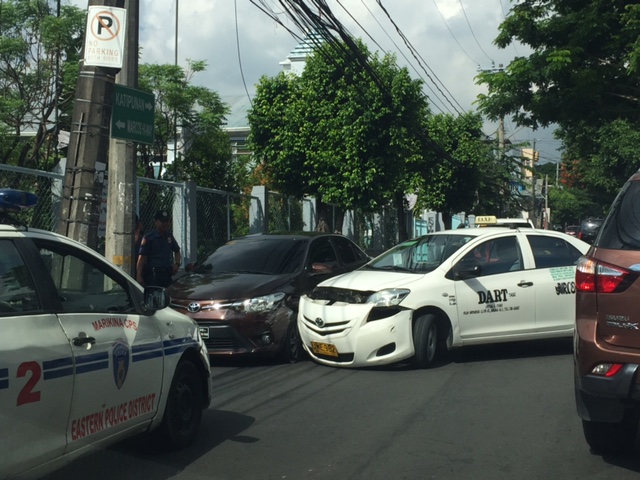
Who had the right of way here? Did the private car have the ROW and the taxi driver tried to impose himself (cut into the path of the private car) thinking that the private car driver will slow down to give way? Or did the taxi driver have the ROW but then the private driver decided to accelerate so as to prevent the taxi from completing the maneuver? Either are likely cases and are often the cause of crashes like this.
Other situations that are common are vehicles maneuvering (e.g., backing or turning) but tricycle drivers and motorcycle riders proceeding despite the clear ROW for the maneuvering vehicles. In certain cases, large vehicles like trucks have blind sides and have resulted in their inadvertently hitting motorcycles who riskily and recklessly maneuver with respect to the trucks.
How do we address such behavior? It likely is rooted from how drivers and riders learn to drive or ride so its starts with that stage. Many people learn to drive or ride from peers or their seniors (e.g., parent, uncle, family driver, company driver, etc.) while others learn via driving schools. Do they learn courtesy from their ‘teachers’? Are driving schools imparting this or just teaching people how to operate a vehicle? Then there is the licensing stage. The Land Transportation Office (LTO) is also responsible for assessing whether those applying for licenses are qualified. Both the written and practical exams should contain elements related to the practice of courtesy. And then there is the enforcement aspect, which has the burden of educating drivers and riders by accosting and reminding (lecturing?) motorists about proper driving and riding etiquette. Of course, you have to have capable enforcers in the field whether they be traffic aides or police officers.
–
On distracted driving vs. other, more urgent, traffic issues
Much has been written and said about the new law against distracted driving. The people who crafted the law, Senators and Congressmen, are in agreement that their intention was mainly to address the rampant use of gadgets including cell phones by motorists. Yet, when the agencies in-charge of implementation drew up the implementing rules and regulations (IRR), their interpretation was the subject of a lot of complaints. Many opined that the IRR didn’t take into consideration actual vehicle dashboard designs or that the definition of the term “line of sight” was open to interpretation. This necessitated another round of consultations with stakeholders leading to the infographic below:
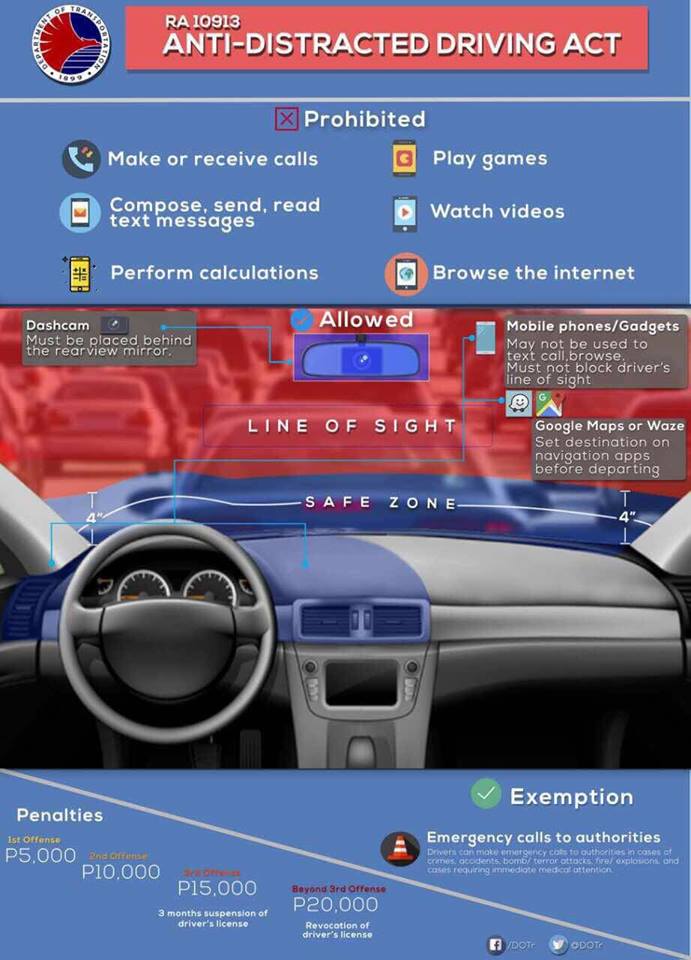
Frankly, I am more concerned about speeding, counter flowing and reckless weaving in traffic. These are equally if not more dangerous than many aspects of the distracted driving law. Quite serious would be the combination of distractions with any of the three behaviors mentioned. More disturbing would be the deliberate (definitely not distracted) or conscious acts of speeding, counter flowing and reckless weaving that are often the cases if one observes the incidence of these three driving behavior. We can only wonder about the likelihood of crashes due to these behaviors.
–
Back to school – concerns about congestion and safety
Many roads again are expected to become more congested as school resumes in most parts of the country especially in cities. But while congestion is usually the top issue along roads near many schools, one concern that usually takes a back seat to congestion is safety. Many public schools in the provinces are located along national highways. Many if not most of their students walk to and from school, usually on the carriageway when the shoulders are too rough, dusty or muddy. This situation for students increase the likelihood of their being hit by vehicles using the road. The risk increases because of their exposure to the dangers posed by motor vehicles. Following are a couple of photos showing typical cases at public schools along national roads. Both are in Antipolo City.
 Typical at-grade pedestrian crossing in front of a school. Students in most public schools often commute by walking or taking public transport like jeepneys or tricycles.
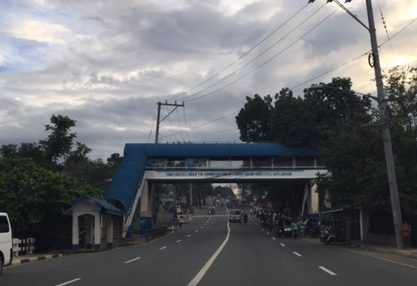 Despite this pedestrian overpass across a public school along Sumulong Highway, most students still prefer to cross on the road rather than go up and down the overpass.
Oftentimes, the seemingly obvious solution of constructing overpasses for safer crossings for students does not pan out as planned or intended. There are many underutilized pedestrian bridges since the natural way is still to cross at-grade. Then there is the issue of providing them safer walking paths or walkways. In both photos above, the sidewalks are only token (“puwede na iyan”) and insufficient for the pedestrian traffic supposed to use them. We need to plan, design and provide such facilities for our pedestrians, especially children, who are marginalized compared to those who have their own vehicles for travel.
–
Wheel “chaining” in Taytay, Rizal
Another municipality that has become somewhat aggressive in its campaign against illegally parked vehicles is Taytay also in Rizal province. In the case of Taytay, instead of wheel clamps, authorities have opted to employ what appears as more cost efficient (read: less expensive) tools in their campaign – chains and locks. Instead of the more sophisticated (and likely more expensive) wheel clamps in neighboring Antipolo, chains are wrapped around one of the front wheels of a vehicle and then secured by a lock. Examples are shown in the following photo:
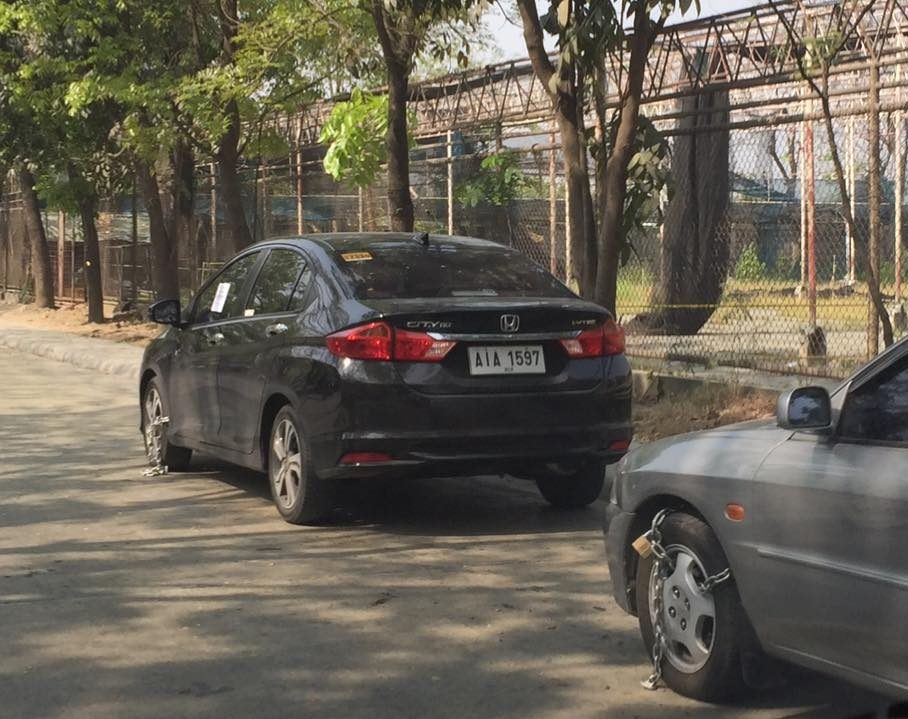 Car wheels chained and padlocked along Don Hilario Cruz in the Taytay Public Market area. The road connects the Manila East Road with the new Taytay municipal hall complex.
Anti-illegal parking enforcers also post a sheet of paper on the window of the vehicle to notify the driver about the violation. The enforcers are posted nearby; waiting for drivers to approach them. There’s supposed to be a fine similar to when a vehicle is towed and reclaimed by the driver or owner. This, campaign, however, seems to have been relaxed in the same area where I took the photo as there are again a lot of vehicles parked on either side of the street on the Saturdays that I pass by the area. I’m not yet sure if this is a case of ningas cogon on the part of the municipality or perhaps they are just exercising some flexibility considering the parking demand for the market and the numerous clothes shops there where wholesalers flock to for merchandise. I haven’t seen similar “chaining” activities in other parts of Taytay unlike Antipolo, which has been continuously and consistently conducting campaigns throughout the city.
–
Wheel clamping in Antipolo
Earlier this year, Antipolo City implemented an aggressive campaign against illegal on-street parking. This policy was borne out of a new ordinance penalizing on-street parking that has been perceived as the cause of traffic congestion along many of the city’s roads. A more detailed description of the conditions or situations warranting wheel clamping may be found in the Antipolo City website.
The following photos were taken from the Antipolo City Government Facebook page:


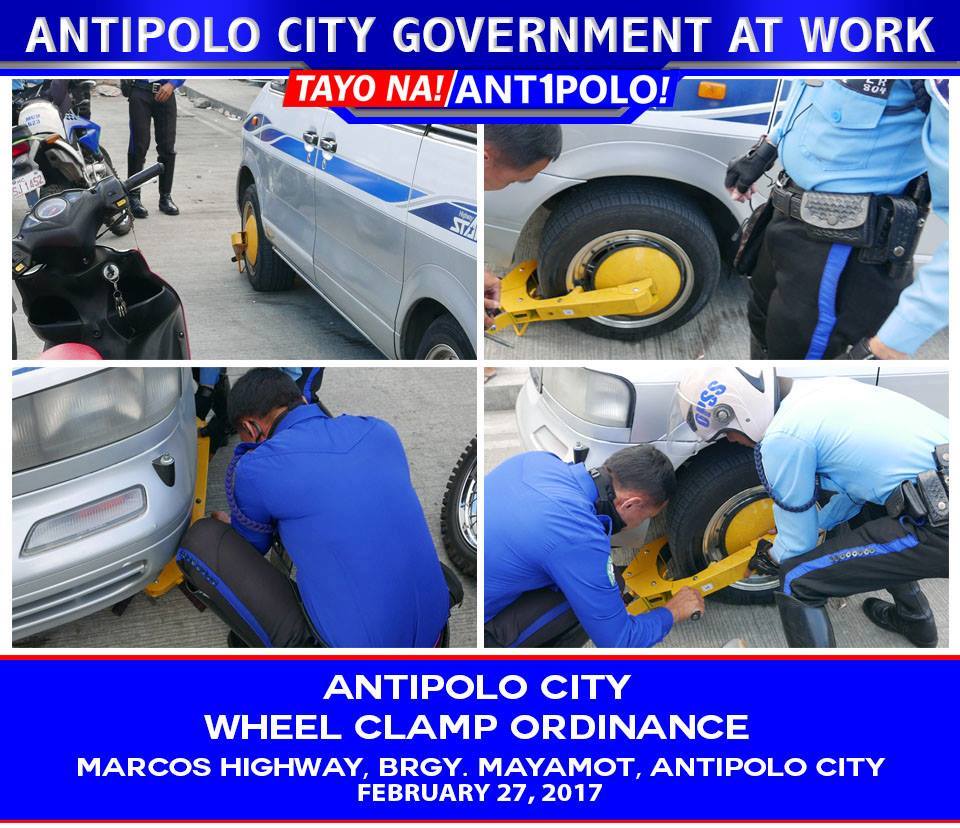
The ordinance and its implementation by the city is very timely (some may say overdue) considering that many streets particularly in the city center is already clogged with vehicles parked on-street. In certain cases, there’s double parking; severely constricting traffic flow even along one-way streets. There are (as always) evidence of resistance but hopefully, the city’s resolve will overcome and improve the situation.
I think another thing that should be in Antipolo’s agenda that’s very much related to the problem of on-street parking is the requirement for off-street parking spaces as stipulated in the National Building Code. The Code actually prescribes for the minimum number of slots per building or development but it is the local government that is tasked to implement or enforce the provisions in the NBC. Going around Antipolo, one can observe that there are many establishments clearly in violation of the Building Code provisions. One major university, for example, along Sumulong Highway does not have enough spaces considering the vehicle trips it generates. This situation is compounded by the expansion of the school to include a hospital and the adjacent commercial development that conspicuously also appears to not have enough parking spaces. An LGU can actually have a policy for stricter minimum parking slots. Quezon City and Makati City have ordinances stating so but have had mixed results compared to the outcomes they probably thought about as desirable.
Of course the topic of minimum parking spaces is currently the subject of discussions in other, more progressive cities and countries, and particularly those with better developed public transport and more disciplined land development. While relevant to us here in the Philippines, it is a topic that is not yet ripe for serious discussions given the many concerns (i.e., violations, non-compliance issues) that still need to be addressed by LGUs like Antipolo City at present.
–
Some issues abroad on car sharing/ride sharing companies
There are two articles recently that are worth reading for those who are into ride-sharing/car-sharing. And I am not necessarily referring to those who regularly take Uber or Grab, or those who opt to use these whenever they need a taxi ride. There are many who are already studying these services being provided not by your traditional or conventional taxi companies or rental vehicle companies but by supposedly private individuals who supposedly have the spare time and spare vehicle that they can use to provide transport for other people. I use the word “supposedly” here because this is a big assumption and the premise by which transport network companies like Uber, Grab and Lyft have been able to go around the bureaucratic processes that taxi and other companies have to go through as formal public transport (i.e., public utility vehicles). These articles are along the lines of the discussions in previous articles I have posted here about ride-sharing/car-sharing, and are mostly based on the experiences in countries who have more developed and presumably better transport than us in the Philippines.
Denton, J. (2017) Two Federal Lawsuits Could Spell Big Trouble for Uber, Pacific Standard, http://www.psmag.com, April 10, 2017.
McGraw, D.J. (2016) How Lyft and Uber are Ignoring the Poor, Pacific Standard, http://www.psmag.com, May 12, 2016.
I leave it up to my readers (any researchers out there?) to pick-up the main points and perhaps look at the issues from different perspectives. I have pointed out before that the situation in Metro Manila could be very different from the situations in other major cities like Cebu, Davao and Iloilo. And so transport network companies may not necessarily succeed in cities where taxi services, for example, are significantly better than what we have in Metro Manila.
–
List of infrastructure projects for the Philippines’ BuildBuildBuild initiative
I was looking for a list of projects said to be prioritized by the current administration in the Philippines and mentioned in the presentation made by government yesterday. Here’s one I found from GMA News:
Infrastructure projects lined up by the Duterte administration
Noticeable for me are the following:
1. No mention of major bridge projects that were heavily hyped both on mainstream and social media – these bridges include those that were proposed to connect the islands of Panay and Negros, Negros and Cebu, and Cebu and Bohol. It doesn’t mean, of course, that these have been abandoned but likely only sidelined for the moment.
2. Break-up of Clark Green City into several components – this seems to be a more realistic approach especially considering how big and complex this project is, and how many agencies or entities are and will be involved
3. Mass transit projects in Metro Manila – these include big ticket projects such as the proposed subway, BRT and the rehabilitation of PNR lines. These are all projects that should have been done a long time ago but for various reasons have been delayed. Say what you will about so much resources being poured into Metro (Mega?) Manila but it is the economic center of the country and efficient transport will go a long way in generating resources that can eventually be used in other parts of the country.
4. Emphasis on Clark Airport – it seems to me that the current administration is focused on developing Clark as the alternative (if not the main) gateway to the greater capital region. This is a departure from the hype we have received about a replacement for NAIA including one that was proposed at Sangley Point in Cavite.
5. Scaling down of Mindanao Railways – instead of pushing for a much grander (and unrealistic I think) railway project for the entire island, they identified a more realistic and perhaps practical line connecting Tagum, Davao and Digos. One colleague noted, however, that this corridor is already heavily serviced by buses and vans so rail ridership is at best threatened from the start.
What’s your take on the proposed projects and the list in general?
–
Resources on traffic calming and recalling statistics on road safety in the Philippines
As I usually post on some interesting and useful articles on transportation and so I just couldn’t resist sharing this find on resources for traffic calming. This is always a timely source of material on how we can improve road safety particularly in residential areas or where there are more pedestrians exposed to transport and traffic. Such exposure increases the likelihood that they may be involved in a crash.
I recall an article from 2015 that appeared on Rappler:
Francisco, K. (2015) Road deaths in PH: Most are motorcycle riders, pedestrians, Rappler, http://www.rappler.com, October 27, 2015.
The WHO Global Status Report on Road Safety 2015 is a good resource for statistics and the report can be easily downloaded along with other information, and in different languages. Here is the entry for the Philippines appearing in the report:

–
 Caught (up) in traffic