
Home » Governance (Page 43)
Category Archives: Governance
Too late?
A friend posted her disappointment over what she regularly observed through her condominium window overlooking EDSA Guadalupe. The traffic jams along EDSA seemed to be a 24-hour thing and she lamented about whether Metro Manila could solve this problem on congestion. She continues to be an active advocate for the environment and we have worked together on the electric jeepney that is now operating a 3rd route in the City of Makati and is also found operating elsewhere in other cities where its applications, to be fair, is still quite limited.
My response to her is something I have also mentioned in other venues including previous posts on this blog and interviews granted to major media networks that have asked me what’s wrong about transport and traffic in our country. It’s really simple – we have failed to build the necessary infrastructure when they needed to be constructed. And we continue to NOT build the infrastructure that could have saved us much in terms of fuel costs alone and perhaps contributed much more to our economy, and definitely outweighing the costs that have often been cited as if it were a deterrent to the realization of a mass transit network for Metro Manila.
Being one who has lived in both Tokyo and Singapore where they have good public transportation systems, I could not help but become excited when, returning from Japan before the turn of the century I came upon plans for Metro Manila’s rail network. I was excited because the decade before I was first exposed to similar plans for MM at a time when other capital cities in Southeast Asia like Bangkok, Jakarta and Kuala Lumpur where also planning for their own mass transit systems. In fact, they were also planning expressways in their respective metropolitan areas (i.e., Bangkok Metropolitan Area or BMA and Jakarta-Bogor-Depok-Tangerang-Bekasi or Jabodetabek/Greater Jakarta). Flash forward to the present, it is frustrating, if not depressing, to see that Bangkok and Jakarta were able to implement many of their plans that were critical for the growth of these metropolitan areas and definitely contributed to the overall sustainable development in those countries. Granted, Bangkok and Jakarta still experiences congestion like the legendary jams along urban highways in Bangkok. But which city around the world does not experience congestion? The key is to provide a viable and more efficient (also convenient and comfortable) alternative to taking one’s car. That should be in the form of a mass transport system that is comprehensive enough that it will allow for both mobility and accessibility to the traveler/commuter. The following figure from the 2005 World Transit Maps envisioned a network that is still now unrealized and, for the existing lines, have become the subject of controversy and other issues that include the absence of a single ticketing system similar to the smart and octopus cards found in other countries.

Can we imagine what could have been the experience of commuting in a Metro Manila where such a rail system would have been in place? My former students have related to me about how it was so convenient to move about in Singapore, Tokyo and Hongkong where the mass transit systems where comprehensive and integrated such that rail and bus systems could provide for the transport needs of commuters. I would like to believe that we have all the plans with us by this time and that the construction of transport infrastructure has long been delayed for our cities (not just Metro Manila but also other metros such as Cebu and Davao) so much so that we continue to suffer from the lack of critical systems that could definitely alleviate congestion and improve the plight of the general public. Perhaps people taking their cars and motorcycles will be convinced to shift to public transport if they see the benefits of doing so. For others who are still captives of our inefficient public transport systems, I am sure that the experience of having improved systems (and an expanded network) will be liberating considering their daily sacrifices just to make ends meet while losing much quality time, productive time stranded in traffic.
Enforceable?
Whenever laws and regulations are crafted, one basic question that needs to be considered pertains to whether there is capacity to enforce such laws or regulations. This is quite logical and appeals to common sense since laws and regulations are practically prints on paper that will not have any impacts if not enforced properly and fairly. I mention “fairly” here because laws and regulation may also be the subject of abusive enforcement. That is, there have been cases where motorists are flagged down and charged with violations that are taken out of the context given the traffic conditions, and where the number of apprehensions are related to quotas set by authorities.
Take the case of the unwarranted or illegal use of sirens (wangwang) in the past. There were laws and regulations for its use but for a long time these laws and regulations were not enforced properly, leading to the wangwang’s abuse by many unscrupulous people. Almost everyone have practically given up on this abuse of the siren when a newly elected President expressed his dismay and ordered the eradication of illegal sirens. Almost overnight, “wangwangs” were confiscated by authorities inspired by the Commander-in-Chief’s orders or removed by owners themselves for fear of the law bearing down on them. This was enforcement at its best. Unfortunately, it was not replicated for other traffic laws and regulations, wasting valuable momentum and the opportunity to make things right along our streets and highways.
Quezon City’s Green Building Ordinance is quite good and well-meaning. It is very timely and relevant, and even includes provisions for upgrading transport in that city. Among others, it requires that tricycles be transformed into cleaner vehicles by stipulating the replacement of 2-stroke and even 4-stroke motorcycles with LPG or electric models. To date, nothing significant has been achieved to address issues pertaining to the tens of thousands of tricycles in Quezon City. The construction of green buildings in Quezon City cannot be mainly attributed to the ordinance but rather to owners and designers who are now much more aware of climate change and its impacts, and are progressive enough to design buildings that are environment-friendly. Of course, there are those who take to the “green” bandwagon but do nothing towards this end. Are these subject to evaluations and inspections that are the equivalent of enforcement?
Now comes a bicycle ordinance from Pasig City that is formally the “Bicycle Transportation Promotion Ordinance of 2011.” It is also good and well-meaning but the jury will definitely be out there if this initiative will be a successful and sustainable one. I am quite hopeful that it would be and not just end up as an example of coming up with laws because anything about the environment is in these days. The provision in the ordinance designating bicycle lanes and requiring establishments to provide bicycle racks for parking are all good but we have seen this before in an even bigger scale in the City of Marikina. There they constructed bikeways practically connecting all parts of the city and they were quite aggressive even after foreign support had ended. Politics and shortcomings (I wouldn’t say failure.) in encouraging people to cycle have made much of the on-street bicycle lanes practically taken over by motorized transport. Bicycle racks there are also being used by motorcycles and scooters. Pasig should learn from these experiences and it is hoped that the city succeed and become another example of EST to be replicated in other Philippine cities.
Traffic Congestion in Metro Manila: Is the UVVRP Still Effective? -Conclusion
The MMDA always reports what it claims as improvements of travel speeds along EDSA that past years. They have pointed to this as evidence that traffic congestion is being addressed and that programs like the UVVRP are effective in curbing congestion. However, many traffic experts have cautioned against making sweeping generalizations pertaining to the effectiveness of schemes especially if the evidence put forward is limited and where data seems to have been collected under undesirable (read: unscientific) circumstances.
The MMDA also has been using and to some extent overextending its use of a micro-simulation software that is employs to demonstrate the potential effectiveness of its proposed traffic schemes. The software has an excellent animation feature that can make the untrained eye believe in what is being shown as The problem here is when one realizes that computer software will only show what the programmer/operator wants, and is perhaps an example where the term “garbage in, garbage out” is very much applicable. And this is especially true should the computer model be uncalibrated and unvalidated according to guidelines that are well established, and extensively discussed and deliberated in a wealth of academic references. The fallacy of employing advanced tools to demonstrate how one’s proposal is better than another was highlighted when the DPWH acquired the same tool and came up with an entirely different result for an analysis being made for the same project by that agency and the MMDA. Surely this resulted in confusion as the outcomes of the simulation efforts of both agencies practically negated each other.
It should be pointed out that such micro-simulation software is unsuitable for the task of determining whether metro-wide schemes such as the UVVRP is still effective given the actions of those affected by the scheme. What is required is a macroscopic model that would take into account the travel characteristics of populations in Metro Manila and its surrounding areas (cities and towns in the provinces of Rizal, Bulacan, Cavite, Laguna). There are quite a few of these models available but most if not all were derived from the one developed under the Metro Manila Urban Transport Integration Study (MMUTIS) that was completed in 1999. The main beneficiary from the outcomes of MMUTIS happens to be the MMDA but for some reason, that agency failed to build capacity for maintaining and updating/upgrading the model. As such, the agency missed a great opportunity to invest in something that they could have used to develop and evaluate traffic schemes to address congestion and other traffic issues in Metro Manila, as well as to assess the impacts of new developments.
Metro Manila has come to a point where its options for alleviating congestion are becoming more and more limited. The combination of a still increasing rate of motorization and private vehicle use have definitely contributed to congestion while there are also perceptions of a decline in public transport use in the metropolis. The share of public transport users in most Philippine cities and municipalities range from 80 – 90 %, while in many highly urbanized cities the tendency seems to be a decline for this share as more people are choosing to purchase motorcycles to enhance their mobility and as a substitute to cars. This trend towards motorcycle use cannot be denied based on the steep increase in ownership and the sheer number of motorcycles we observe in traffic everyday.
Metro Manila needs to retain the substantial public transport share while accepting that motorcycle ownership will continue to chip off commuters. The latter phenomenon can be slowed down should authorities strictly enforce traffic rules and regulations on motorcyclists, effectively erasing the notion that the latter group is “exempted” from such. The bigger and more urgent issue is how to put up long overdue mass transport infrastructure that is direly needed in order to create another opportunity for rationalization transport services. We seem to like that word “rationalization” without really understanding and acting on what is required to once and for all address transport problems in the metropolis. We are not lacking for examples of good practices that are both effective and sustainable including those in the capital cities of our ASEAN neighbors. However, we seem to be unable to deliver on the infrastructure part that we have tended to over-rely on a TDM scheme that has long lost much of its effectiveness. The evidence is quite strong for this conclusion and perhaps we should stop being in denial in as far as the UVVRP’s effectiveness is concerned. Efforts should be turned towards building the necessary infrastructure and making public transport attractive so that private car and motorcycle users will be left with no excuse to shift to public transport use. It is inevitable that at some time they will understand the cost of congestion and that they will have to pay for their part in congestion like what is being done along tollways or, in the more sophisticated and mature example, Singapore. But this cannot be realized if we continue to fail in putting up the infrastructure Metro Manila so direly requires.
Is it “Commonwealth” or “Commondeath” Avenue?
There is an excellent article appearing today in the Philippine Star written by Arch. Paulo Alcazaren aptly titled “‘Commondeath’ Avenue.” I stumbled on when it was shared by a friend, Dr. Dayo Montalbo, who is a faculty member of the UP School of Urban and Regional Planning. It provides a rare insight into the history of our highways and streets in Metro Manila. It is required reading for planners and engineers with backgrounds in civil engineering, architecture, urban planning, etc., and, I must say, for anyone who can appreciate history and how we seem to not have learned (or refused to learn) from it. It certainly should be required reading for students who want to become future planners and engineers.
When the MMDA “discovered” plans where it was indicated how wide the RROW for Commonwealth should be and started acquiring land left and right from those who were supposed to have been encroaching on the avenue, including UP Diliman, it apparently didn’t study the old plans and the context by which the capitol, Commonwealth, UP and other institutions where laid out back in the day. That interpretation translated into what we see now as probably the widest highway in the country.
I see the article as something that can be used by the DPWH and the MMDA as an input to whatever planning or engineering they plan along Commonwealth. The avenue is just too wide and definitely not friendly to people. Perhaps it should be transformed into the parkway it was meant to be in the first place.
Traffic congestion in Metro Manila: Is the UVVRP still effective? – Part 2
In the past decade, there has been a sharp rise in the motorcycle ownership around the country and especially in Metro Manila. From about 1 million motorcycles registered in 2000, the number has increased to 3.2 million in 2009, a 320% increase over a period of 10 years. Motorcycles have become associated with mobility, in this case the motorized kind, and have become the mode of choice for many who choose to have their own vehicles but cannot afford a four-wheeler. These people also choose not to take public transport for a variety of reasons but mainly as they perceive their mobility to be limited should they use public transport services that are available to them. This rise of the motorcycle is also a response to the restrictions brought about by UVVRP with the scheme not covering motorcycles. In fact, should motorcycles be included in the UVVRP, it would be a nightmare for traffic enforcers to apprehend riders considering how they maneuver in traffic. Add to this the perception and attitude of riders that motorcycles are practically exempt from traffic rules and regulations (and traffic schemes!). One only needs to observe their behavior to validate the argument.
To understand UVVRP, it must also be assessed in the context of its original implementation when Metro Manila had to contend with congestion due to infrastructure projects being constructed everywhere during the 1990’s. EDSA MRT was being constructed, interchanges were also being put up, and a number of bridges were being widened to accommodate the increasing travel demand. Road widening projects generally benefit private vehicle users more than public transport users. In the case of Metro Manila, many areas are already built-up and acquisition of right of way for widening is quite difficult for existing roads. As such, it is very difficult to increase road capacities to accommodate the steady increase in the number of vehicles.
In transportation engineering, when traffic/transport systems management (TEM) techniques are no longer effective or yield marginal improvements we turn to travel demand management (TDM) schemes to alleviate congestion. In the former, we try to address congestion by tweaking the system (i.e., infrastructure) through road widening, adjustment of traffic signal settings, etc. while in the latter, we go to the root of the problem and try to manage the trips emanating from the trip generation characteristics of various land uses interacting with each other. By addressing the trip generation characteristics through restrictions, we influence travel demand and hopefully lessen traffic during the peak periods while distributing these to others.
This is the essence of UVVRP where the coding scheme targets particular groups of private cars (according to the end number on the license plate) each weekday. Meanwhile, the scheme is not implemented during weekends due to the perception that, perhaps, travel demand is less or more spread out during Saturdays and Sundays. However, there is a problem with this approach as the traffic taken away from the peak hours are transferred to other times of the day, thereby causing in some cases the extension of what was originally a peak hour unto a longer period. What was before a morning peak of say 7:30 – 8:30 AM becomes spread out into a peak period of 7:00 – 9:00 AM. The problem here is when you have major traffic generators like central business districts (e.g., Makati and Ortigas) where congestion is experience for more than 2 hours (e.g., 7:00 – 10:00 AM or 4:00 – 7:00 PM).
The UVVRP is not implemented in all of Metro Manila. Several LGUs, particularly those in the outer areas like Marikina City and Pateros. This is simply due to the information and observations of these cities that their roads are not affected by the build-up of traffic since most traffic is bound for the CBDs located in Makati, Pasig, Mandaluyong, Quezon City and Manila. This is the case also for LGUs in the periphery of Metro Manila like the towns in the province of Rizal, which is to the east of the metropolis, where the typical behavior of traffic is outbound in the morning and inbound in the afternoon. The great disparity between inbound and outbound traffic is evident in the traffic along Ortigas Avenue where authorities have even implemented a counterflow scheme to increase westbound road capacity.
There have also been observations of traffic easing up during the mid-day. As such, the MMDA introduced a window from 10:00 AM to 3:00 PM to allow all vehicles to travel during that period while retaining the restrictions of the number coding scheme from 7:00 – 10:00 AM and 3:00 – 7:00 PM. However, while many LGUs applied the window, some and particularly those found in central part of the Metropolis like Makati, retained the 7:00 AM – 7:00 PM ban. This stems from their perspective that traffic does not ease up at all (e.g., try driving along Gil Puyat Ave. during lunchtime) along their streets during the window period.
Nowadays, there seems to be the general perception that one can no longer distinguish between traffic during the coding period and the window. Traffic congestion is everywhere and there are few opportunities for road widening. Traffic signal control adjustments are limited to those intersections where signals have been retained (mostly in Makati) since the MMDA replaced signalized intersections with U-turn slots during a past administration where the U-turn was hailed as the solution to the traffic mess.
Traffic congestion in Metro Manila: Is the UVVRP still effective? – Part 1
I was interviewed last week about the traffic congestion generally experienced along major roads in Metro Manila. I was asked whether I thought the Unified Vehicular Volume Reduction Program (UVVRP) more popularly known as the number coding scheme was still effective, and I replied that based on what we are experiencing it is obviously not effective anymore. The reasoning here can be traced from the fact that when the scheme was first formulated and implemented, the main assumption was that if the number of license plates on registered vehicles were equally distributed among the 10 digits (1 to 0), then by restricting 2 digits indicated as the end/last number on a plate we could automatically have a 20% reduction in the number vehicles. This rather simplistic assumption was sound at the time but apparently did not take into consideration that eventually, people owning vehicles will be able to adjust to the scheme one way or another.
One way to adjust when the number coding scheme was implemented was to change traveling times. Everyone knew that the scheme was enforced from 7:00 AM to 7:00 PM (i.e., there was no 10:00 AM to 3:00 PM window at the time) and so people only had to travel from the origins to their destinations before 7:00 AM. Similarly, they would travel back after 7:00 PM, which partly explains why after 7:00 PM there is usually traffic congestion due to “coding” vehicles coming out to travel. In effect, the “coding” vehicle is not absent from the streets that day. Instead, it is only used during the time outside of the “coding” or restricted period.
Another way that was actually a desired impact of the coding scheme was for people to shift to public transport, at least for the day when their vehicle was “coding.” That way, the vehicle is left at home and there is one less vehicle for every person who opted to take public transport. This, however, was not to be and people did not shift to public transport. Perhaps the quality of services available or provided to them were just not acceptable to most people and so they didn’t take public transport and a significant number instead opted for a third way.
That third way to adjust was one that was the least desirable of the consequences of number coding – people who could afford it bought another vehicle. This was actually a result that could have been expected or foreseen given the trends and direct relationship between increases in income associated with economic growth where people would eventually be able to afford to buy a vehicle. Actually, there is no problem with owning a car. The concern is when one uses it and when he opts to travel. Of course, this does not necessarily mean that people started buying new cars outright, making this something like an overnight phenomenon. It happened over several years and involved a cycle that starts when the wealthier people decide to purchase a new vehicle and discards their old ones. These used vehicles become available on the “second hand” market and are purchased by those with smaller budgets. Some of these may have even older vehicles that they will in turn discard, and eventually be owned by other people with even less budget. Note that in this cycle, very few vehicles are actually retired, if at all considering this country has no retirement policy for old vehicles. The end result? More cars on the roads and consequently, more severe and more frequent congestion.
Below is an excerpt from the news report on News TV Channel 11:
National EST Strategy Formal Launch
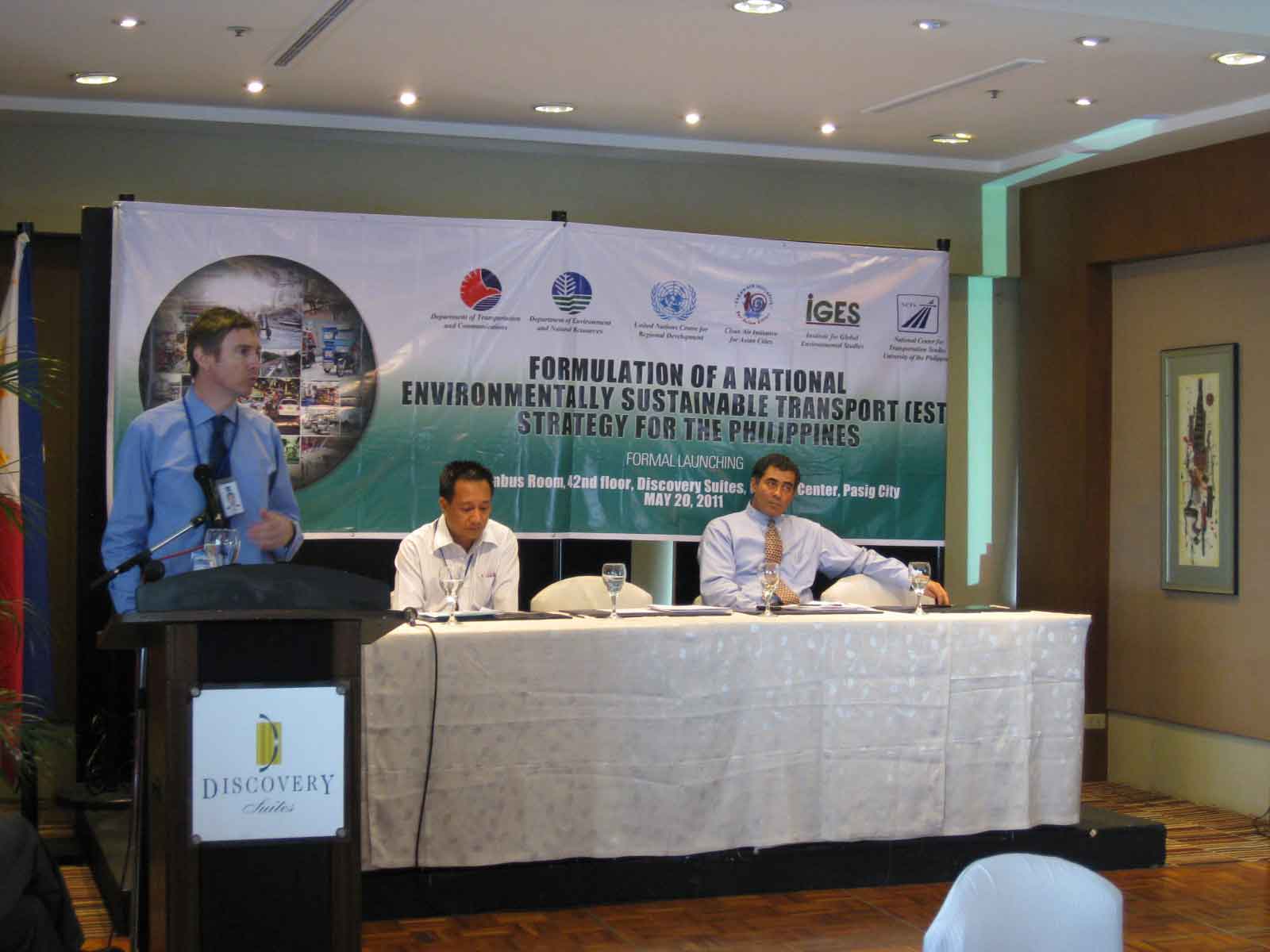
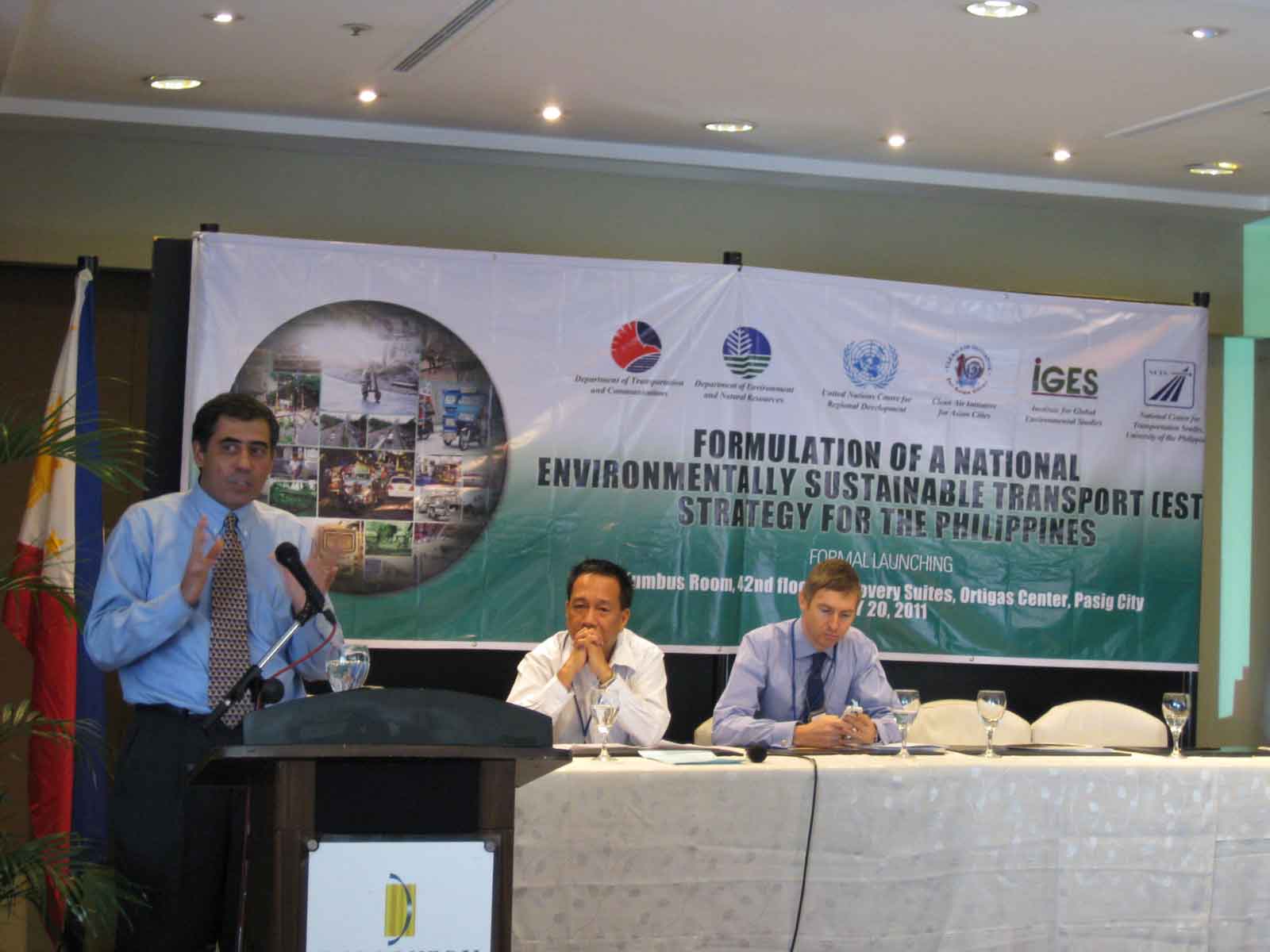
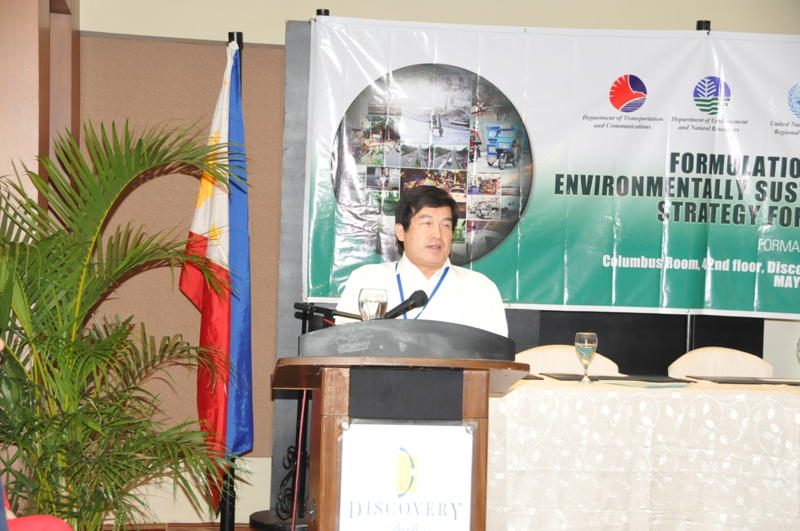
The National Environmentally Sustainable Transport (EST) Strategy of the Philippines was formally launched yesterday, May 20, 2011. The formal launch event was held at the Columbus Room of the Discovery Suites along ADB Avenue in Ortigas Center, Pasig City. It was graced by the presence of top government officials including Secretary Jose “Ping” P. De Jesus of the Department of Transportation and Communications (DOTC) and Presidential Assistant on Climate Change Elisea “Bebet” Gozun, who was a former Secretary of the Department of Environment and Natural Resources (DENR). The DOTC came full force with Undersecretary for Planning and Policy Ruben Reinoso, Assistant Secretary for Planning George D. Esguerra, Office of Transport Cooperatives Chair Leticia Z. Gorrospe, consultant and former Assistant Secretary Alberto Suansing, and senior technical staff of the DOTC and its line agencies including the Land Transportation Office (LTO) and the Land Transport Franchising and Regulatory Board (LTFRB). The DOTC and the DENR are the national focal agencies for the project and will be expected to lead in the operationalization of the national strategy.
The supporting agencies and organizations were represented by Mr. Choudhury Rudra Mohanty of the United Nations Centre for Regional Development (UNCRD), Ms. Sophie Punte of the Clean Air Initiative for Asian Cities (CAI-Asia), and Mr. Akio Isomata, Minister of the Embassy of Japan to the Philippines, who represented his country’s Ministry of Environment. Development agencies and banks were also present with representatives from the World Bank (WB), the Asian Development Bank (ADB) and the Japan International Cooperation Agency (JICA). Also present were stakeholders led by the Partnership for Clean Air (PCA), Philippines – Global Road Safety Partnership (PGRSP), and the Firefly Brigade, and participants from local government units led by Quezon City and Marikina City. The national collaborating center was well represented by the study team from the National Center for Transportation Studies (NCTS) of the University of the Philippines Diliman.
The formal launch even began with the Opening Remarks from the UNCRD delivered by Mr. Mohanty and was followed by a Message from DOTC Sec. De Jesus. The formal messages were followed by a presentation of the highlights of the national strategy by D. Jose Regin F. Regidor, NCTS Director. Afterwards, a panel discussion with the theme “Operationalization of EST in Support of Sustainable Development in the Philippines.” The discussion was facilitated by Ms. Punte and Mr. Herbert Fabian of CAI-Asia. Panel members included DOTC Asst. Sec. Esguerra, WB Lead Transport Economist Baher El-Hifnawi, ADB GEF focal person Bruce Dunn, and Mactan Cebu International Airport Manager Nigel Paul C. Villarete, who is also a former City Planning Coordinator of Cebu City and who is an advocate of Bus Rapid Transit (BRT) in the Philippines. The formal launch event concluded with congratulatory messages from the Government of Japan and the Presidential Assistant for Climate Change, followed by a photo op for all in attendance that day.
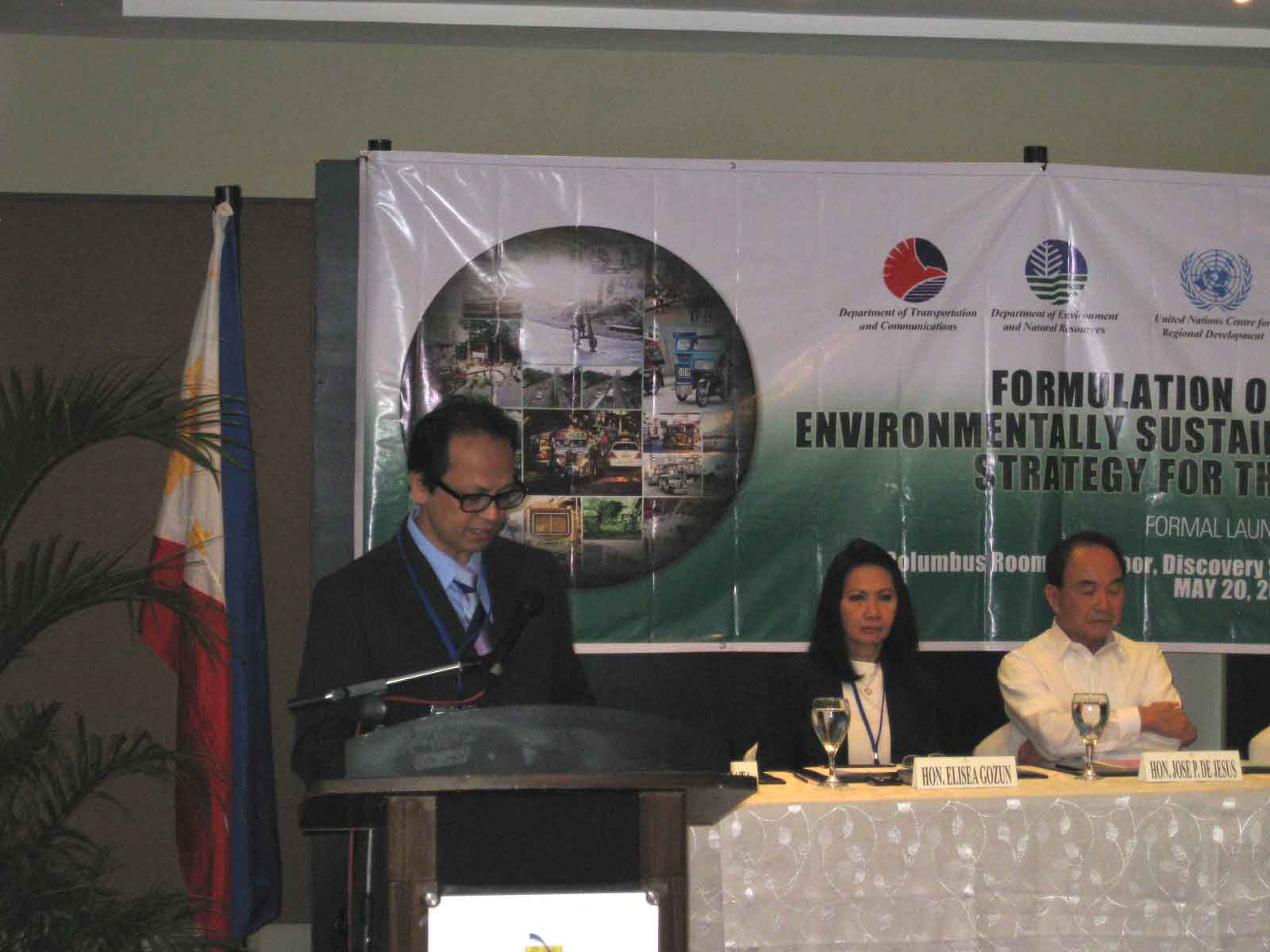 Mr. Mohanty of UNCRD delivering the Opening Remarks
 DOTC Sec. Ping De Jesus delivering a message from the Department
 NCTS Director Regidor presenting the highlights of the national EST strategy
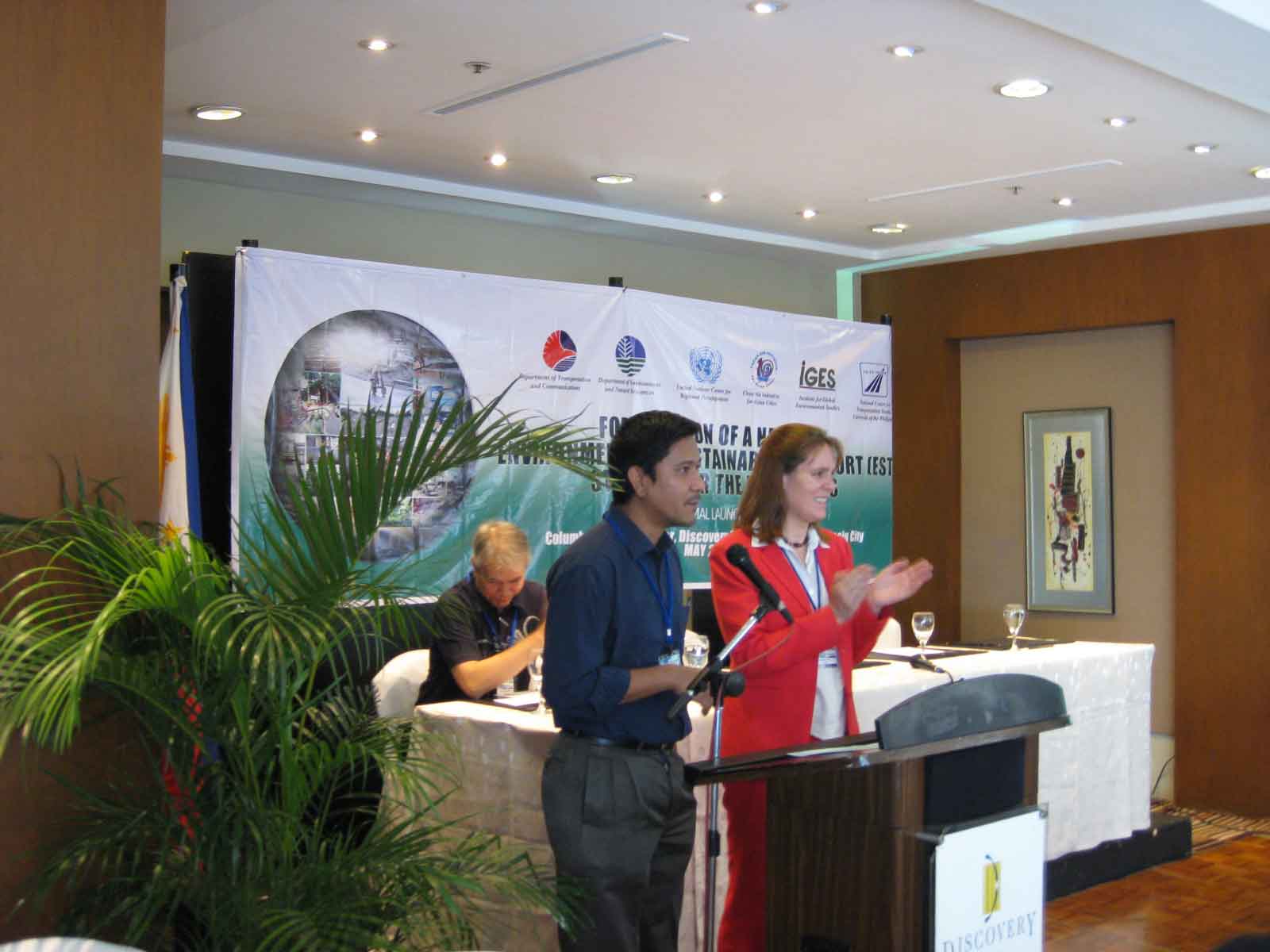 CAI-Asia’s Bert Fabian and Sophie Punte facilitated the panel discussion
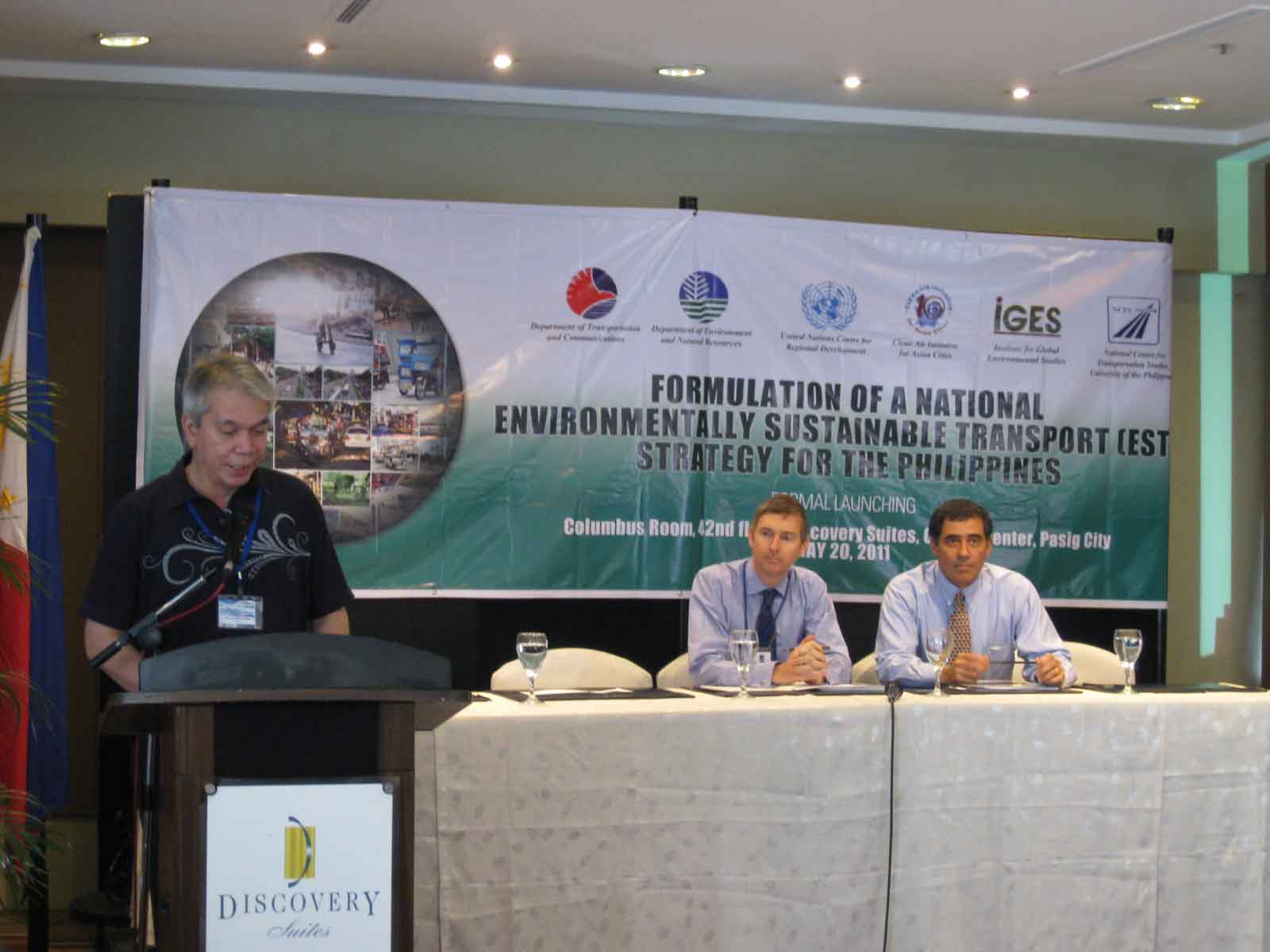 DOTC Asst. Sec. George D. Esguerra responding to the key questions during the panel discussion
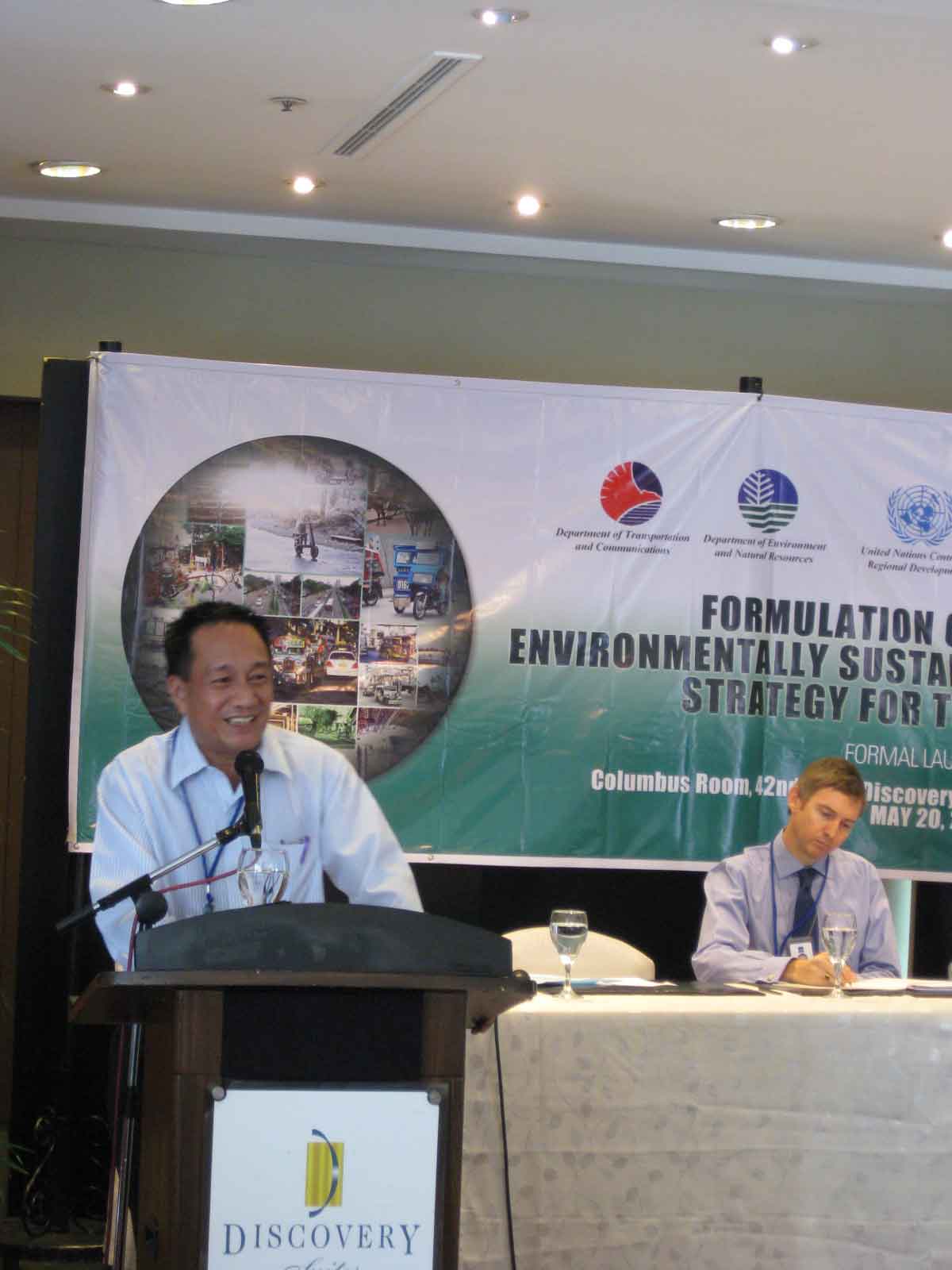 MCIAA’s Nigel Paul Villarete making his comments during the panel discussion
 Bruce Dunn explaining about the ADB’s initiatives
 The WB’s Baher El-Hifnawi stressing a point during the panel discussion
 Embassy of Japan Minister Isomata delivering a congratulatory message from the GOJ
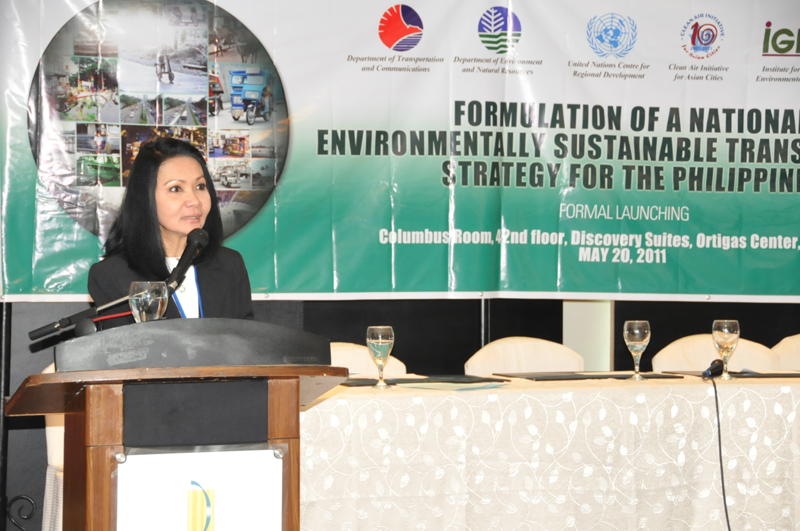 Presidential Asst. on Climate Change Bebet Gozun delivering the concluding message
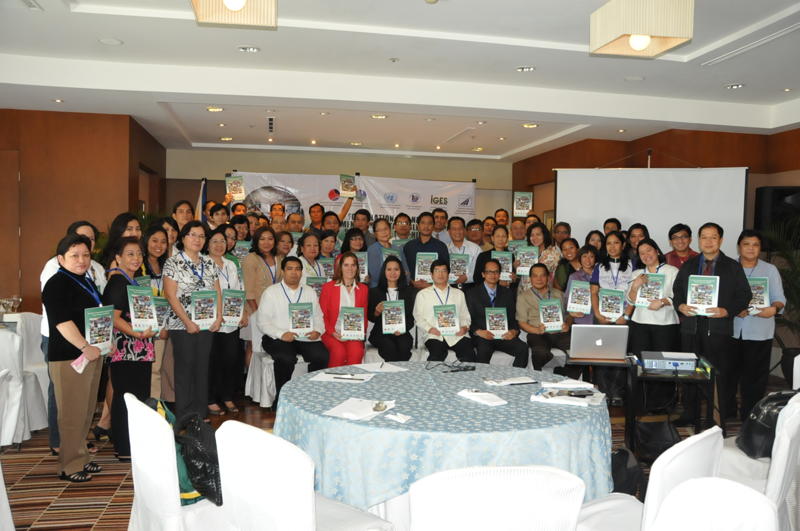 Group photo showing participants to the national EST strategy formal launch
The messages and the panel discussion were one in conveying a challenge to all stakeholders to use the framework provided by the national strategy to come up with action plans and implement these in order to realize sustainable transport in the country. It was also clear from the proceedings of the event that there should be a strong, collaborative effort among national agencies, local government units, NGOs, and development agencies if EST is to be operationalized and for programs and projects to succeed. Significant impacts would then be realized and perhaps lead to the alleviation of transport and traffic problems and their derivatives. It was emphasized that everyone should carefully consider the co-benefits that may be reaped from the implementation of EST.
For more on the national strategy including the reports and other resources, all these are available from the NESTS Web Portal hosted by the NCTS.
Moving about in Singapore
I’m back in Singapore and enjoying going around the city using its efficient public transportation system and pedestrian facilities. I am quite at home with the system considering I lived in Japan for quite some time and commuted daily using the rail and bus systems there. It was in Japan where I had a first hand experience of what an efficient public transport system should be whether for long distance commuting (i.e., I knew some supercommuters in Japan who used the shinkansen to go to the office or laboratory every weekday although using the Tokaido Line to commute between Kanagawa to Tokyo qualifies as supercommuting.) or for short distance trips.
I was able to appreciate mobility in Japan considering the interconnectivity of transport modes and the ease by which one can use the system. Even the payment of fares was efficient as one had many options for paying fares and could use various cards including using either the Pasmo card issued by private railway companies or the Suica card issued by Japan Railways (JR). One only needed to load the cards with enough credits to be able to use the cards for not only transport fares but even for paying for items such as food and drinks. One can even personalize the card and it can be reloaded after a period of not being able to use the card.
Singapore is not so much different from Japan in terms of transport systems and if one considers the electronic road pricing (ERP) being applied throughout the state, may even be more advanced in applications of Intelligent Transport Systems (ITS). Moving around in Singapore is so easy considering its rail and bus systems. There are even a number of bus types plying routes around the system including articulated buses much like those used by Bus Rapid Transit (BRT) systems and double deckers like the ones in Hongkong and London. I haven’t noticed and am not aware if there are paratransit systems outside the human powered rickshaws I found near Bugis but which appears only during night-time, considering the city-state being compact and there seems no need for paratransit like the jeepneys, multicabs and tricycles in the Philippines, or the tuktuks in Thailand. There should be no need considering the strategic placing of bus stops and train stations throughout the city and the well planned pedestrian facilities that complement these mass transit modes.
I have always looked forward to having such a system realized in the Philippines whether its going to be in Metro Manila or another city. It is still a vision that has often been derailed what with the systems that have been constructed so far and the weak handling of issues pertaining to bus, jeepney and tricycle services in the Philippines. And some people even argue that “service” shouldn’t be a word to be used to describe public transport in the Philippines. Rationalization of public transport systems back home seems a distant vision considering the chaos surrounding the matter. We can only hope that our efforts will not go to naught and that we can realize an efficient system within our lifespans. Perhaps that will be our legacy for the coming generations, for them to have system that they can be proud of and not drool over when they experience such in other countries such as Singapore.
Microcosm of society
As me and my colleagues crossed the street at the corner of the College of Engineering towards the Main Library grounds, we heard the distant sound of whistles of security guards posted along the Academic Oval. At first, we didn’t pay much attention even stating among ourselves that the guards may be trying to catch the attention of certain people. There are still many litterbugs on campus and there are street children often going around and trying to collect material they could sell at some junk shop. In some cases, they take whatever they find even those that are not supposed to be taken by them like scrap materials from buildings that are being constructed or renovated. These, after all, are not fair game in as far as the contractors and the university are concerned.
After we had crossed, however, the guards continued to whistle and the frequency and manner seemed to indicate urgency and not just as if they were not just trying to accost someone but were also in pursuit of someone or something. Another guard posted near the library stood up from where he was taking his lunch on a bench under the trees near the road and also started whistling. We soon saw the cause for the alarm – a black BMW 5 series was speeding counterflow along the bicycle lane.
We stopped near the Main Library kiosks to see where the BMW was heading and made our bets that it would be turning left towards the Asian Center and probably towards the exit along Magsaysay Avenue. We were not surprised when the car indeed took a left (and without signals) but towards the driveway in front of Malcolm Hall – the College of Law. I say we were not surprised because there have been many instances before this one when similar vehicles and even those with SUV escorts who have blatantly violated traffic rules and regulations inside the campus. Often, the excuse mentioned is that they were in a hurry. But then aren’t we all?
We did not see who alighted from the car (it was too far to see) but it was parked in front of Malcolm Hall so I assumed it must be a faculty member, a lecturer or a guest of that College who drove or owned the vehicle. It would also be likely that the occupant was a lawyer. This begs the question of what kinds of lawyers are teaching at the College of Law. I know this is quite a generalization and perhaps unfair to many whom I know from that college. But this simple act of violating the one-way scheme along the oval and using a lane dedicated to pedestrians and cyclists despite all the signs and the guards shouting at you, which some people (like lawyers for example) would dismiss as petty are manifestations of more serious things. And I will restrain myself from alleging what those serious things are.
If he or she was a student, then the obvious question is what kind of students do the college have these days? What kinds of lawyers are being bred by the college? And may I dare ask what kind of lawyers have been produced in the past as there are evidences (from the UP Police, the MMDA and other traffic enforcers) that the same professionals are the one most likely to argue with enforcers even when they are guilty of violating traffic rules and regulations.
It is the arrogance of such motorists that is among the common causes of road crashes and the major cause for anarchy and chaos in our roads. The example in UP only shows how far we are from the objective of instilling discipline among our motorists. That same arrogance shows, too, how we regard everyone else including the joggers, walkers, and cyclists who had to give way to a motor vehicle that intruded into their right of way and practically bulldozed its way towards its destination. For these people, it is no matter that they put the lives of people in danger by their actions. After all, they were in a hurry. I believe the pedestrians and cyclists were in no hurry. they were in no hurry to get injured or, God forbid, to die because a motorist in a luxury car had to run against the one-way flow and use road space that is dedicated for pedestrians and cyclists – most of whom happen to be students who have yet to fulfill their potentials, and hopefully for the good of this country.
Tools for traffic enforcement
The MMDA recently acquired speed guns to enable them to measure vehicle speeds and catch violators of speeding regulations. A case in point is the ongoing efforts to reduce road crashes along Commonwealth Avenue in Quezon City. Part of the effort is the enforcement of the 60 kilometer per hour speed limit that is applied to all vehicles. This, of course, is a simplification considering that ideally there are different speed limits for different types of vehicles if Philippine laws are to be reviewed. One problem with Commonwealth is that it is a very wide road with 8 to 10 lanes per direction depending on the section from Fairview to the Elliptical Road. All types of vehicles seem to be guilty of “over-speeding” but of particular concern were and are the buses that also have tended to change lanes quite frequently despite the maneuver being unnecessary.
Most private vehicles are also probably guilty of speeding at many points along the avenue. The wide road is indeed very tempting for cruising at high speeds much like what a driver may routinely do along expressways. The problem, of course, is that the avenue is not an expressway where access is restricted and there are practically no chance or instances of conflicts with pedestrians, vendors or typical public transport operations. And then there are also the ubiquitous median openings that have replaced at-grade intersections. These facilities have encouraged weaving and, arguably, aggressive driving in order to be able to maneuver to the nearest practical U-turn slot.
But going back to the speed guns; these are very handy tools for traffic enforcement. Based on what I saw on TV, the speed guns allow the operator to take a photograph of the guilty party’s vehicle and save this for downloading later at the office. The downloaded photos are then processed into a form (summons) that is sent to the owner of the vehicle who is assumed to be the driver of the vehicle caught by the speed gun’s camera. The person is given 7 days to pay the penalty/fine (PhP 7,500 accroding to the news reports) at the MMDA or at an accredited bank. If the person is unable to pay the fine, the MMDA will forward the violation to the LTO for flagging or tagging of the vehicle used. This tag will serve as an alarm for traffic law enforcers in case the vehicle is involved in another incident.
The speed gun is not an inexpensive tool and yet it is a very useful one if only to instill discipline to drivers in the form of speed management. Speeding is one manifestation of irresponsible or reckless driving, especially when combined with other maneuvers like frequent lane changing. It is also one of the most difficult to enforce since measurements are required and evidence must be strongly tied to a particular vehicle so that the match is “beyond reasonable doubt,” as lawyers may say.
Speed guns like the ones acquired by the MMDA will surely contribute to curbing speeding violations and reducing the incidence of crashes. However, this is currently limited to Commonwealth and there is definitely a need to acquire more instruments to enable the agency to enforce speed limits along other roads including perhaps EDSA and C5. At the very least, speed limits should be enforced along all the radial and circumferential roads. This is particularly important during the night time and probably the early mornings when many road crashes are associated with speeding violations that are obvious for the characteristic loss of control by the driver. The acquisition and proper use of additional units will go a long way into putting order to traffic along our roads and this order can be equated to ensuring that our travel ways will be safe for all users.
 Caught (up) in traffic