
Home » Governance (Page 43)
Category Archives: Governance
On license plates
More than 2 years ago, the current administration made an inspired move after the President mentioned in his inaugural speech that he was among those who didn’t like “wangwang” (sirens) and associated these with abusiveness, of feelings of entitlement among road users. The use of sirens and other similar devices tells people that the user is an “important” person whose time is more valuable than others.
Whatever happened to the drive against “wangwang” in all its forms? The proliferation of commemorative plates, for one, can be a form of “wangwang.” While the Land Transportation Office (LTO) came up with a memo a few years ago providing clear instructions on how the commemorative plate should be displayed (i.e., on top or above the legal plate), many have returned to the practice of replacing the license plate (hiding it) with the commemorative one. This is especially true for those plates bearing police, military, government, and other agencies or organizations that can be used to make traffic enforcers think twice about apprehending a motorist for legitimate traffic violations. One sees such plates everywhere screaming “PNP,” “CIDG,” “NBI,” “PMA,” “Prosecutor,” “Councilor,” etc. and you know these are statements that are meant to intimidate traffic enforcers, which is often denied by the guilty party.
Then there is also the abuse of special plates, particularly those supposedly assigned to lawmakers. How many people have “8” as their license plates? Do children or staff of senators and congressmen enjoy the same privileges as the elected official? In the past, plates bearing “8” also indicated the district represented by the person supposedly using the vehicle. And so you would know, for example, if the person happens to be from the 1st District of Iloilo or the 3rd District of Quezon City. The same goes for vehicles bearing “16” and other special plates indicating someone holding a high position in government. Nowadays, even family members and staff members of these officials use the special plates, thereby extending to them the courtesies usually given to elected or appointed officials like not being covered by the number coding scheme in Metro Manila. This should not be the case for such “extensions” if we are to enforce the law firmly and fairly.
In certain cases, worse are those who use neither license plates or authorized commemorative ones. There seems to be a proliferation of people using personalized, souvenir or replica plates from other countries. These are often used in lieu of the rear license plates. These are claimed to be harmless since traffic enforcers usually check only the front plates for registration and compliance to number coding. However, there are implications for when the driver and the vehicle are involved in incidents such as traffic violations or crashes (e.g., hit and run incidents). While witnesses would probably be able to describe the car, the license plate cannot be recorded. Therefore, it would be quite difficult to trace the vehicle’s ownership information that could be retrieved from the LTO’s computer records to identify the violator or suspect in an incident.
 The legal plate is deliberately obscured on this one as it is hidden in the rear bumper.
 The plate suggests one is driving in Europe rather than along C-5 somewhere in Pasig City
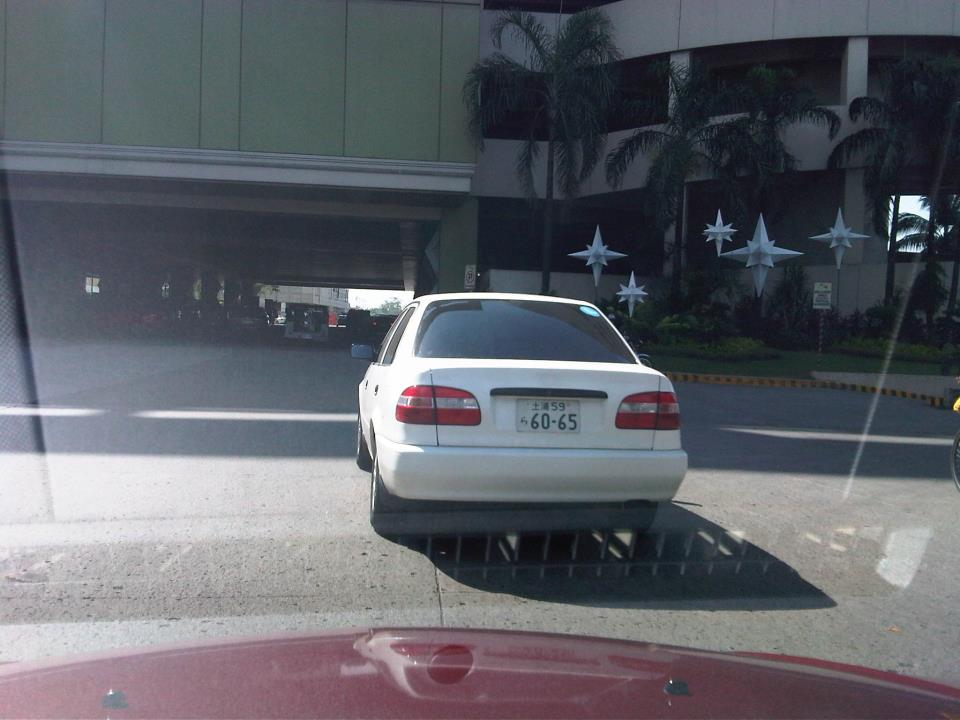 This one thinks he’s driving in Japan.
Perhaps the LTO and traffic enforcers who are deputized by the agency should also clamp down on these cases of violating RA 4136. The idea is to have a campaign similar to what was implemented to rid our roads of the annoying “wangwang” back in 2010. Such an initiative should help promote discipline on our roads in the sense that motorists would be more aware of traffic rules and regulations and that they cannot continue trying to circumvent basic laws.
–
Rationalizing public transport in the Philippines
I got a copy of the recent study “Development of a Mega Manila Public Transportation Planning Support System” conducted by UP Diliman’s National Center for Transportation Studies (NCTS) for the Department of Transportation and Communications (DOTC). The main outcome of the study was a planning support system that includes an updated database of bus, jeepney and UV Express routes for Metro Manila and its surrounding areas (collectively called Mega Manila), and a calibrated travel demand model for the region that is supposed to be used by the DOTC and the LTFRB in transport planning including the rationalization of public transport in the region. Among the notable recommendations for addressing public transport issues is the following on the classification of routes according to passenger demand, which I quote from the study:
“…routes and modes may be classified and prioritized as follows:
- Routes with Very High Passenger Demand [>160,000 passengers per day] – shall be served by high capacity modes such as rail-based transit or Bus Rapid Transit(BRT) with passing lanes.
- Routes with High Passenger Demand [100,000 to 160,000 passengers per day] – shall be served by high capacity vehicles such as Bus Rapid Transit System (BRT) without passing lanes;
- Routes with Medium Passenger Demand [10,000 to 100,000 passengers per day] – shall be served by PUVs with 60 or less passengers/seats but not less than 22 passengers (excluding driver) such as buses, CLRVs with more than 22 passengers/seats (including driver), or with 90 passengers/seats in the case of double decker or articulated buses;
- Routes with Low Passenger Demand [not exceeding 10,000 passengers per day] – shall be served by PUVs with less than 22 passengers/seats (including driver) such as jeepneys and other paratransit modes.
Under this principle, high capacity modes would have priority in terms of CPC allocation and transit right of way in a particular route over lower capacity modes with the exception of taxis. The latter, after all, operate as private cars rather than PUVs with fixed routes.
Applications to operate bus and/or minibus service in jeepney routes can be considered, but not the other way around. Similarly, bus service applications can be considered in minibus routes but not otherwise.
Based on the analysis of routes, the establishment of public transportation routes and the corresponding modes of services may be based on the following criteria:
• Passenger demand patterns and characteristics
• Road network configuration
• Corresponding road functions (road hierarchy)
• Traffic capacities and
• Reasonable profits for operation of at most 13% ROI.”
[Source: DOTC (2012) Development of a Mega Manila Public Transportation Planning Support System, Final Report.]
An interesting figure in the report is an illustration of how services can be simplified using buses and rail transport as an example. The following figure shows two maps: one showing the plotted EDSA bus routes (left) and another showing a more consolidated (and rational) route network for buses complementing existing and proposed rail mass transit systems.
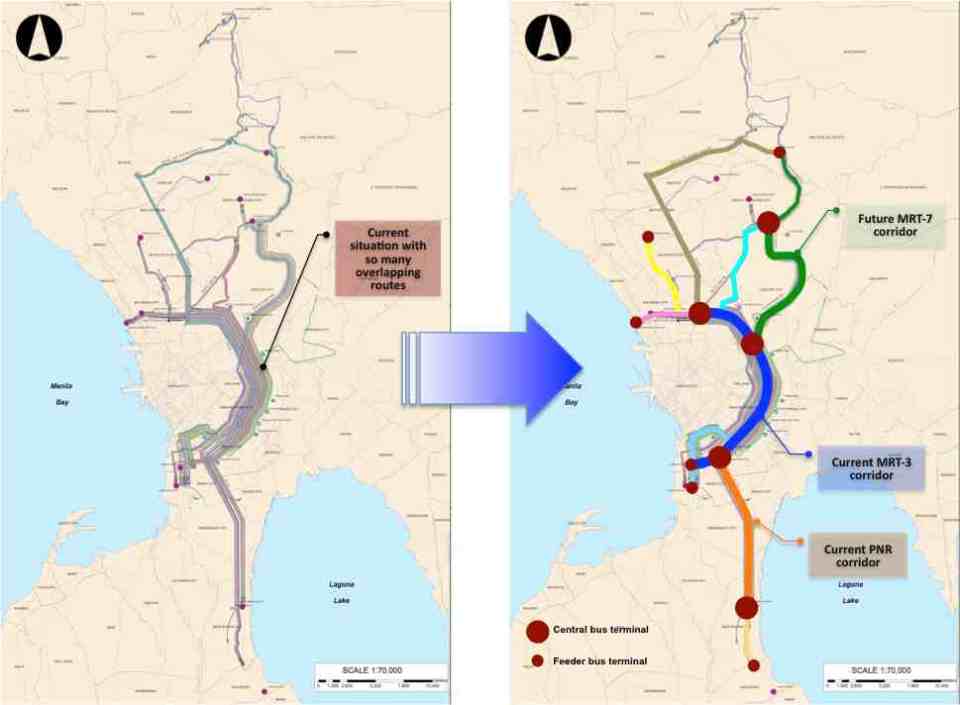 Simplifying bus transport services (source: DOTC, 2012)
What are not included in the figure above are the prospects for Bus Rapid Transit (BRT) systems for Metro Manila. Since the Final Report was submitted in mid 2012, there have been many discussions for BRT in the metropolis and current efforts are now focused on the assessment of a BRT line along Ortigas Avenue. The World Bank is supporting the evaluation of a route between Tikling Junction near the boundary of Antipolo and Taytay (Rizal Province) and Aurora Boulevard. There are also informal talks of a BRT line along Commonwealth Avenue but that would have implications on the proposed MRT-7 along the same corridor. Nevertheless, such mass transit systems have long been required for Metro Manila and their construction have been overdue. A more efficient public transport system will definitely have tremendous impacts on how we commute between our homes, workplaces, schools and other destinations. Long distances can easily be addressed by better transport options and could actually help solve issues pertaining to informal settlements, relocations and housing. That topic, of course, deserves an article devoted to this relationship between transport and housing. Abangan!
–
Loss of productivity due to congestion and inefficient public transport
I recently read two articles appearing in a major Philippine daily and a popular online site. The first one is an article that appeared in the Philippine Daily Inquirer – “PH economy losing $3.27B in human productivity due to traffic mess” – last September 25, 2012. The other article was posted on Rappler – “Traffic and infrastructure delays cost the Philippines” – last September 27, 2012. These were articles written after the authors’ attendance of what was an Energy and Infrastructure Forum last Sept. 25 where a transport official mentioned a recent study in his talk that estimates productivity losses of about 3.27B USD per year from Metro Manila traffic alone.
 Traffic congestion along Commonwealth Avenue
 Unusual traffic management scheme along Ortigas Avenue
The study from the National Center for Transportation Studies that was mentioned in both articles was actually first featured in a Yahoo! Philippines article – “Traffic congestion costs Metro Manila P137B per year” – that appeared a month earlier in Aug. 28, 2012. The study being referred to is actually a paper presented by Dr. Jose Regin F. Regidor in his Professorial Chair lecture at the University of the Philippines Diliman’s College of Engineering Colloquium in early August 2012. A copy of the paper may be found below:
Prof Chair 2012 JRFR 02July2012
The main reference for this paper is the study on congestion costs that was produced by the National Center for Transportation Studies back in 2000. Credits go to the core team of Dr. Ricardo Sigua (Institute of Civil Engineering of UP Diliman), Dr. Noriel Tiglao (now with the National College of Public Administration and Governance) and Dr. Val Teodoro (now in the US) for the study. The
Economic Impacts of Traffic Congestion in Metro Manila – Cover+Chap 1 and 2
Economic Impacts of Traffic Congestion in Metro Manila – Chap 3
Economic Impacts of Traffic Congestion in Metro Manila – Chap 4 and 5
Economic Impacts of Traffic Congestion in Metro Manila – Appendix
A much needed update may be possible in the next two years once the traffic model for Metro Manila is updated and calibrated using new data from Household Informations Surveys (HIS) and other transport and traffic surveys under the current MUCEP study that is supported by the Japan International Cooperation Agency (JICA). Hopefully, such a model can be updated and calibrated more often in order to assess losses due to congestion and our continuing inability to provide the necessary infrastructure to alleviate the situation. While the paper and the study mentioned above focus on productivity losses, it should be emphasized that there are other costs that should be highlighted including those related to health (respiratory diseases and road crash fatalities and injuries), energy (fuel consumption and inefficiencies), and emissions (carbon and other GHG).
–
Davao’s Traffic Management Center
I finally had the opportunity to visit Davao City’ Traffic Management Center, a modern facility that serves as a command center for traffic management as well as for disaster response for what is arguably the largest city in terms of land area in the Philippines. The city is able to monitor traffic via CCTVs installed throughout its road network, particularly at intersections. This allows the city to also respond to incidents like road crashes and to call in police or emergency personnel for various concerns. Traffic signals are also controlled from this facility. Our visit to Davao was upon the invitation of the City Mayor, Hon. Sara Duterte, and we had a meeting with the City Planning and Development Coordinator, Mr. Roby Alabado, who was a faculty member of UP Mindanao and a very active public servant. With me was Dr. Ric Sigua, Professor at UP Diliman’s Institute of Civil Engineering and the current head of the Road Safety Research Laboratory of National Center for Transportation Studies.
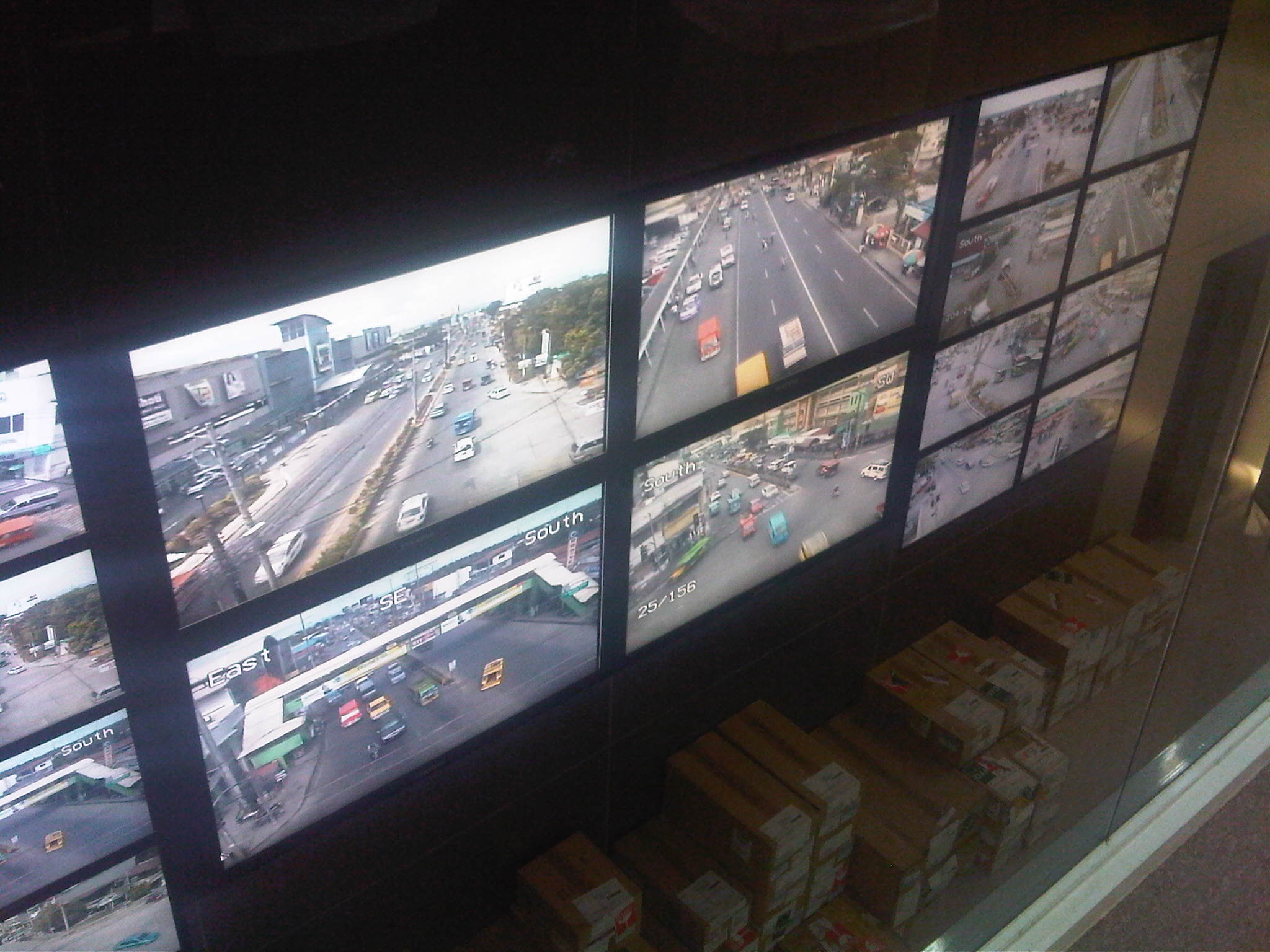 This is a view of the control center screen (actually comprised of several LCD screens) from the conference room of the TMC. Normally, there is a curtain screen covering the glass wall that they can raise in order to give people a view of the video screens.
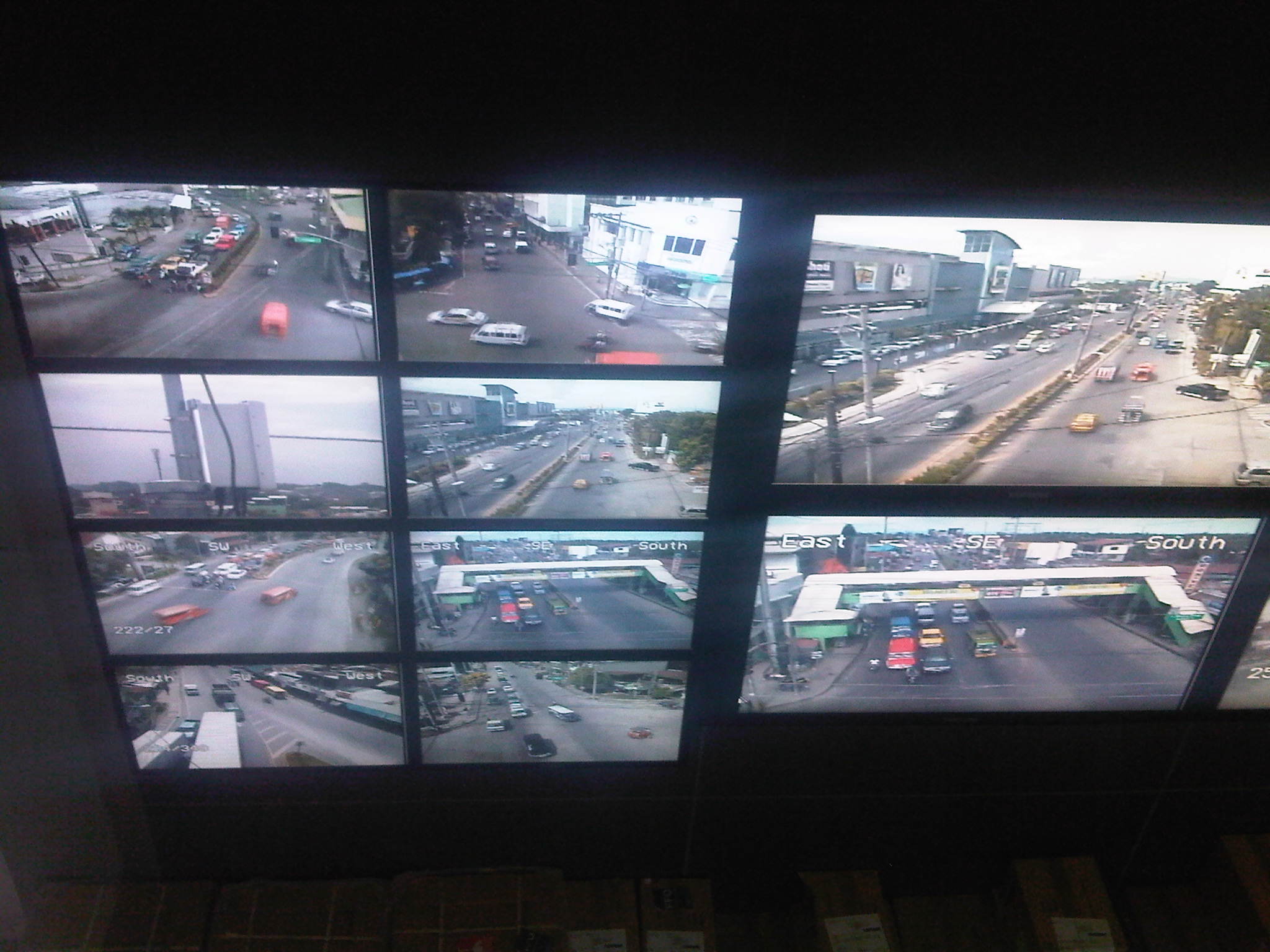 Each screen can be made to show conditions at different locations and staff can control the camera view from the command center. This control allows them to pan, zoom and just about see what goes about at different locations in the city.
 Cameras installed around the city are high definition and can focus and provide clear shots of license plates.
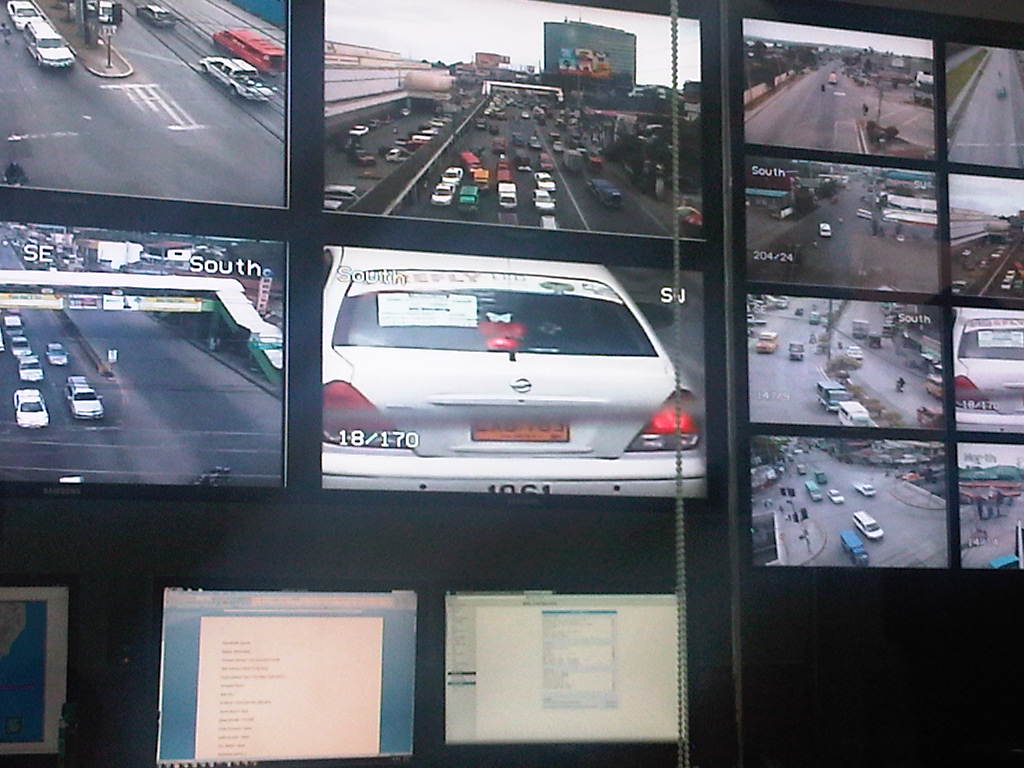 Close-up of a taxi among other videos of areas being monitored. Cameras can also focus on particular people such as a driver trying to bribe himself out of a traffic ticket.
 Videos, particularly those of incidents, are recorded and archived for future reference including reviews related to road crash investigations. Streets are well-lighted to allow for clear capture of incidents at night. In the photo, a truck is observed hitting a jeepney from the rear at an intersection with light traffic.
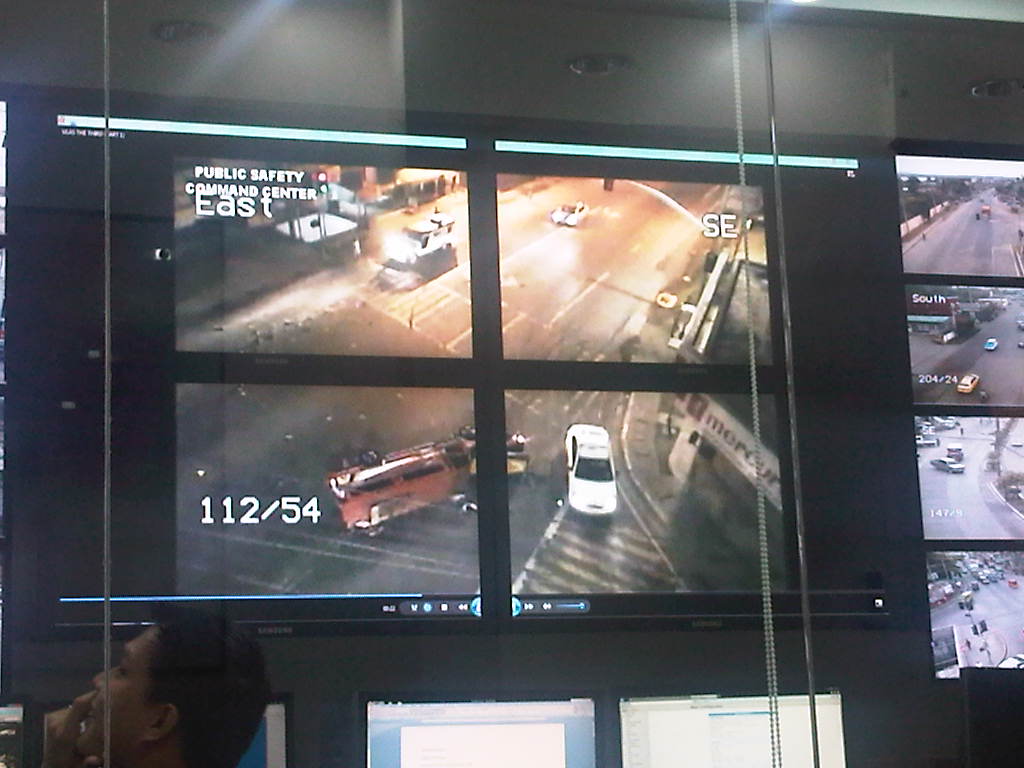 The aftermath of a road crash incident involving a truck and a jeepney shows the latter on its side.
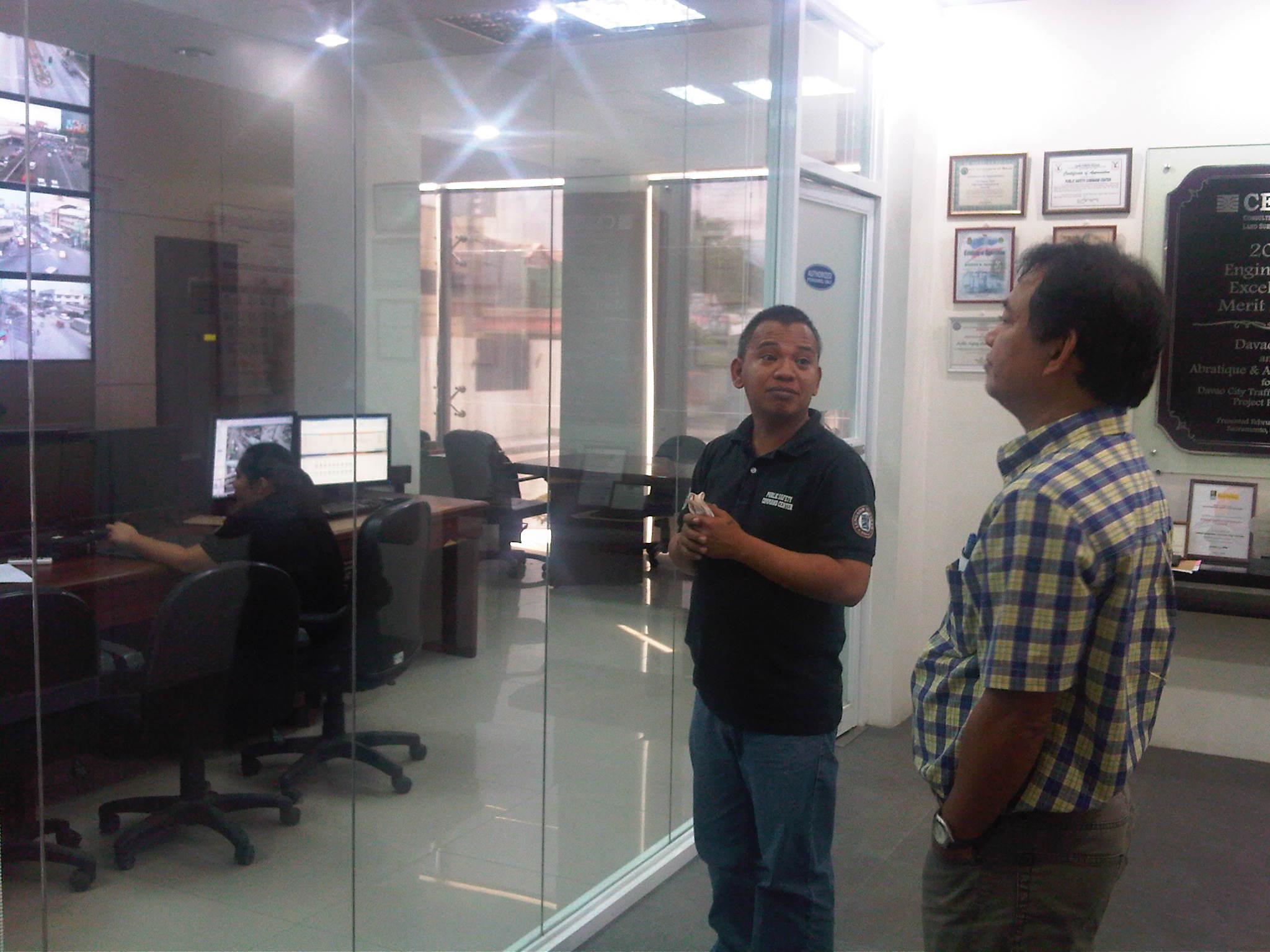 Dr. Sigua being briefed by TMC staff about their capabilities.
 Dr. Sigua with Davao’s Mr. Roby Alabado (City Planning and Development Coordinator) and Mr. Dick Coridel (OIC of Traffic Management Center).
Major cities in the Philippines should have similar facilities for traffic monitoring and management that could also be employed for other purposes as well. The latter may include incident detection, response and management such as emergency response for medical, fire or even security-related incidents. So far, I do know that Metro Manila has two such centers – one with the MMDA and another with Makati City. Cebu has one but it badly needs upgrading including the acquisition of CCTV cameras as they prepare to also upgrade their traffic signal system that was once the most sophisticated in the country.
–
Transportation-related lectures at the UP College of Engineering 2012 Professorial Chair Colloquium
The College of Engineering of the University of the Philippines Diliman will be holding its Professorial Chair Colloquium for 2012 on July 30, 2012 at the Melchor Hall and the UP Alumni Engineers Centennial Hall at the UP Diliman campus. Among the topics under many disciplines of engineering are several lectures on transportation. These are the following and mainly under three departments of the college.
Institute of Civil Engineering [P & G Room, Melchor Hall]
- “Investigation of Road Crash Causes in Metro Manila,” Dr. Hilario Sean O. Palmiano, DMCI Developers Professorial Chair [8:30 – 8:50 am]
- “Design of Traffic Signal Timing and Traffic Impacts of the Re-introduction of Traffic Signal Control at the Intersection of the University Avenue and Commonwealth Avenue,” Dr. Karl B.N. Vergel, Maynilad Professorial Chair [8:50 – 9:10 am]
- “Microscopic Simulation: A Tool for Evaluation of Traffic Schemes,” Dr. Ricardo G. Sigua, Prof. Emeritus Norbert S. Vila Professorial Chair [9:10 – 9:30 am]
- “Revisiting the Costs of Traffic Congestion in Metro Manila and Their Implications,” Dr. Jose Regin F. Regidor, Pozzolanic Philippines, Inc. Professorial Chair [9:30 – 9:50 am]
Department of Mechanical Engineering [Maynilad Room, Melchor Hall]
- “Performance And Emission Characteristics of a Direct Injection Diesel Vehicle with Different Blends of CME Biodiesel,” Dr. Edwin N. Quiros, Emerson Professorial Chair in Mechanical Engineering [9:30- 9:50 am]
- “Design and Local Fabrication of an Energy- Efficient Electric Vehicle,” Asst. Prof. Joseph Gerard T. Reyes, Emerson Professorial Chair in Engineering [10:30 – 10:50 am]
Department of Chemical Engineering [Maynilad Room, Melchor Hall]
- “Co-Production of Alternative Fuels for the Philippines,” Dr. Rizalinda L. De Leon, Semirara Professorial Chair in Engineering [10:50 – 11:10 am]
The lectures are all open to the public and will be held from 8:30 AM to 12:30 PM. There are 8 lecture groups that are assigned to 8 venues at Melchor Hall and UPAE Centennial Hall. Melchor Hall is located at the university core along the Academic Oval while the UPAE Hall is located along Velasquez Street beside the EEE Institute Building and across from the National Institute of Geological Sciences (NIGS).
–
The Panay-Guimaras-Negros bridge: nice to have but is it necessary now?
An article came out of the Philippine Daily Inquirer about 19 congressmen backing a proposed 53-Billion Peso bridge project. The bridge is supposed to connect the main islands comprising Western Visayas namely Panay (which has 4 provinces – Iloilo, Capiz, Aklan and Antique), Guimaras and Negros (divided into two provinces – Negros Occidental and Oriental). The claim is that the bridge will generate traffic between the islands, leading to more economic activity. While this preliminary assessment is generally true, it is the magnitude of the traffic and the resulting benefits that is difficult to determine. In fact, it is very difficult to establish a likelihood for what are expected to be tremendous benefits given also the tremendous cost of the bridge. The price tag will require quite a stretch should the usual economic analysis of NPV, IRR and B/C Ration be applied to justify the project, even factoring in employment opportunities (after the project, what then becomes of the workers?)
Meanwhile, it is interesting to make a reality check about the constituencies of these same congressmen. Do they have health centers to serve their people? If so, are there medicines and other essential equipment or staff in these centers? These are just examples of what needs much and immediate attention other than constructing what may likely become a monument to folly. First things first! There are many other things that need to be prioritized other than sinking funds into this project.
From a purely civil engineering or architectural viewpoint, the bridge would definitely be a great project. It could be a showcase project for an emerging economy, a statement for a country wanting to be recognized among its more progressive neighbors like Thailand and Malaysia. Yet, considering many other things like recovery from the disasters that visit the nation every year (think Ondoy and Sendong) it is another one of those projects that I believe is nice to have but is unnecessary at this time. In fact, the cities in the islands of Panay and Negros would probably benefit more if their traffic and public transport systems are upgraded. But that’s just one opinion…
The article is reproduced below:
19 solons back P53-B bridge project
By Nestor P. Burgos Jr.
Inquirer Visayas12:03 am | Sunday, March 25th, 2012ILOILO CITY—Crossing party lines, 19 Visayas congressmen have asked President Aquino to prioritize the construction of a bridge network linking the islands of Panay, Negros and Guimaras.
The legislators, in a resolution, called on Mr. Aquino, the Public-Private Partnership (PPP) Center, the Department of Public Works and Highways (DPWH) and the National Economic Development Authority to prioritize the construction of bridges connecting the islands in the government’s PPP program.
“The construction of trans-link bridges will open new economic opportunities, reduce transportation and business transaction costs, increase access to social services and boost tourism in the entire Western Visayas region,” according to the resolution.
The resolution was initiated by Iloilo City Rep. Jerry Treñas and was signed by 19 of the 21 legislators from Western Visayas and Negros Oriental.
Aside from Treñas, those who signed the resolution include Representatives Janette Garin (Iloilo), Augusto Syjuco (Iloilo), Arthur Defensor Jr. (Iloilo), Ferjenel Biron (Iloilo), Niel Tupas Jr. (Iloilo), Florencio Miraflores (Aklan), Paolo Javier (Antique) , Antonio Del Rosario (Capiz), Jane Castro (Capiz), JC Rahman Nava (Guimaras), Anthony Rolando Golez Jr. (Negros Occidental), Aflredo Marañon III (Negros Occidental), Alfredo Benitez (Negros Occidental), Jeffrey Ferrer (Negros Occidental), Mercedes Alvarez (Negros Occidental), Jocelyn Limkaichong (Negros Oriental), George Arnaiz (Negros Oriental) and Pryde Henry Teves (Negros Oriental).
Only the late Rep. Ignacio “Iggy” Arroyo and Rep. Julio Ledesma IV, both of Negros Occidental, were not among the resolution’s coauthors.
House Resolution No. 2018 was read on Jan. 16 and was referred to the House committee on public works and highways.
Steel bridges
There have been various proposals and studies to construct the bridges over the years but none has led to an actual project because of the high estimated cost. In the past, however, the government used modular steel bridges for its various projects. The bridges, unlike concrete ones, are easier to build and less expensive.
A study of Japan International Cooperation Agency conducted in 1999 pegged the cost of the project at P53.661 billion with a total span of 23.19 kilometers.
This includes P14.173 billion for the construction of the 2.59-km Panay-Guimaras bridge and P39.488 billion for a 20.6-km bridge linking Guimaras and Negros islands.
In a separate DPWH study in 2010, the project cost was estimated at P28.496 billion covering 13.16 kilometers. This include 3.6 km for the Panay-Guimaras bridge at P9.438 billion and a 9.56-km bridge to connect Guimaras and Negros costing P19.08 billion.
The 13.16-km span is the shortest among the target areas for bridge construction.
Based on this projected length, a bridge will be constructed to connect Leganes town in Iloilo to Buenavista town in Guimaras. Another bridge will link San Lorenzo town in Guimaras to Pulupandan town in Negros Occidental.
‘More realizable’
Treñas said the projected cost in the DPWH study “makes the dream more realizable.”
The Visayan legislators pointed out in the resolution that the promotion of the project under the PPP is an integral part of the President’s socioeconomic program.
They said infrastructure and economic development projects should also be implemented beyond the capital.
“The National Capital Region receives the lion’s share of the national budget despite the Visayas islands having a population greater than that of Metro Manila,” said the resolution.
They said the archipelagic nature of the country “requires the development of a unified well-integrated economy which allows people and goods to be transported swiftly and efficiently.”
Treñas said they hoped that the national government could release funds for a comprehensive feasibility study that would pave the way for the approval and implementation of the project.
–
A tale of transport costs for a commuter
When I was in high school, the minimum fare was 1 peso and my daily afternoon commute from school cost me an average of 3 pesos per day. If we didn’t have to go to school for extra-curricular activities on a Saturday, that meant I usually spend 15 pesos per week or about 60 pesos per month. I remember that my parents paid 200 pesos for the school service, which only covered the morning trips from home to school. This brought my monthly transport cost total to 260 pesos and this was back in the 1980’s. At the time my weekly allowance was 100 pesos (~400/month); more than enough for my lunch and snacks, and which allowed me to save some money that I usually deposited in my savings account. Of course, my actual total allowance was 600 pesos per month factoring in the amount my parents paid for the school service. These figures meant transport accounted for 43.33% of what was my income back then (15% if the school service component was not included).
At university in the early 1990’s, my allowance was up to 300 pesos per week. Transport fares, however, increased with a minimum fare of 2 pesos (for the first 4 kilometers) and my two rides one way to the university cost me a total of 5 pesos per trip. This could easily be multiplied by two if I was able to get an easy ride home from Katipunan but traffic was already worsening at the time and I, together with a few friends who had similar commutes, often found myself going to Cubao where the terminal was so I could get a sure ride home. This meant I had to shell out an additional 6 pesos on certain days. I estimate that my weekly total could average around 80 pesos, bringing my monthly average up to 320 pesos. That translates to 26.67% of what can be considered as my monthly income at the time.
By the time I was in graduate school in the mid 1990s, commuting in Metro Manila was a whole different animal with congestion along my route really becoming terrible. It was so terrible that the conditions then resulted in the birth of what was called FX services. The then newly introduced Asian Utility Vehicles (AUV), particularly the Toyota Tamaraw FX’s, that originally were registered as regular taxis started contracting passengers (illegally) in order to maximize their fares. It was actually the other way around as passengers who were exasperated at the very long queues in Cubao decided to contract FX taxis as groups and offering the drivers fares they just couldn’t refuse given that their being taxis allowed for flexible travel routes bypassing congested roads. By the time, the going rate was 10 pesos per passenger for an FX taxi starting from Cubao and ending at Cainta Junction. I was among the people willing to pay for this luxury, considering it saved me a lot of time and the ride then was comfortable due to the airconditioning on these vehicles. Perhaps it was also my way of applying what I understood from my transport economics lessons from my Japanese professor back then.
My daily commute during my grad school days cost me around 30 pesos for a total of about 200 pesos per week counting Saturdays and other side trips during the week. This to me was quite acceptable considering I had a scholarship grant at the time that gave me 3,000 pesos per month excluding other allowances that covered research expenses. The significant increase in my income was actually just enough to retain the percentage I spend for transport. Due to the corresponding increase in my transport costs, the percentage I spent for transport remained at 26.67%!
Taking post grad studies in Japan a few years later, I estimate that my average monthly transport costs amounted to around 20,000 yen (I traveled practically everyday using trains and buses.) This didn’t include the very occasional taxi on late nights when trains and buses were no longer available from the city center to the dormitory. My monthly allowance though was a very generous 185,000 yen so transport only accounted for 10.81% of my monthly income. This meant I had money available for a comfortable life abroad after accounting for my needs (e.g., food and shelter) and factoring in savings towards my estimated disposable income at the time.
The above examples are illustrations of how much transport costs become significant considerations in our typical expenses. Transport costs like the fares I paid when I was a student ate up a significant part of what was considered my income at different times. My case can probably be considered as fortunate since my parents were able to provide for me during my high school and university days, and I was able to get generous scholarships during my grad and post grad schooling. It is not the same for may others who would have to shell out more to be able to travel between home and school and do not have the choice, given limited resources (i.e., allowances), to select transport with a higher level or quality of service. There are those who have to walk (and even swim) to and from school simply because they have no other means.
I relate my personal experiences as I try to understand the plight of many commuters who have to bear the provisional fare hikes that the LTFRB approved today. This is in part a reaction to the clamor of public transport groups for transport fare increase in relation to the alarming increase in fuel costs. Unfortunately, there is little difference between transport during my time as a student and transport today. In fact, we still are very dependent on tricycles and jeepneys where buses and perhaps rail transport is the more appropriate modes for travel.
Perhaps our continued dependence on transport that is too dependent on fossil fuels whose prices are susceptible to many factors makes us quite vulnerable not just to price changes but also to the whims of a public transport system that has been proven to be inefficient and ineffective. It goes without saying that we need to have the necessary public transport infrastructure built in order for commuters to once and for all be relieved of the constant threats of oil price hikes and fare increases. Too long have been the delays for rail lines and BRTs, and it is costing us billions of pesos that could have instead already paid for these systems that we are hesitant to put up. Only then will we be liberated from those who claim to be concerned about the welfare of commuters but fail to deliver safe and efficient transport services as they put revenue first contrary to their commitments when they got their franchises.
–
Decoupling transport and fossil fuels in the Philippines
An article appearing in the Business World today caught my attention as it provided, to me, a very good argument to support initiatives to wean transport away from its dependence on fossil fuels. Being a supporter of the initiatives for alternative energy to power public transport, especially the electric jeepneys, I can appreciate the discussions pertaining to urban transport. The DOTC, LGUs and the current dispensation should take heed of the main points in the article and focus attention and resources to building the transport infrastructure that our cities so badly need and that have been delayed for so long that we are often forced into short term (and short sighted) remedies (the FX or UV Express services come to mind).
The author is a former Dean of the School of Economics of the University of the Philippines Diliman and is well respected for his articulate views on practically everything connected to his field of expertise. His piece on urban transport in the Philippines includes mention of what many of our leaders already know but are afraid to touch due probably to its socio-political, and therefore painful, implications. I reproduce below the entire article as it appeared on the March 19, 2012 issue of Business World’s online edition. My sincere apologies for any copyright infringements that I might have committed.
The right thing is doing nothing
The clamor from public transport groups, mass organizations, a few politicians, media columnists, and — surprisingly — even some academics to reduce the VAT on oil products has now become so insistent that the government may just be tempted to cave in.
Doing so would be a big mistake.
It is hard to justify on first principles just why or how a solution to high oil prices should involve a reduction of the VAT on fuel. The VAT, after all, is based on the idea that all consumption must be uniformly taxed — that is, taxed at the same rate. Without good reason, the tax system should not itself be responsible for making some goods more or less expensive than others. Hence, if without taxes the price of a can of corned beef was, say,twice that of a bar of bath soap, then it should still be worth twice as much after a 12% tax is imposed on each. (Note that the ratio of X to Y is the same as the ratio of X(1.12)to Y(1.12).) That relationship is unchanged whether the uniform VAT is set at 5, 10, or 12%, as long as the rate is the same across all goods. (My colleague Ben Diokno has even seriously proposed that the VAT rate be raised to 15 percent in lieu of high income taxes — although he has curiously been reported as supporting a cut in the VAT on fuel.)
To argue that the VAT rate should be reduced for some products but not for others is to privilege the consumption of those products. But why should gasoline and diesel in themselves be more vital to consume than other goods? Why is a peso spent on fuel socially more important than, say, the peso a family spends on electricity or water? Or the toll paid by a bus using the NLEx? Or what a student pays for a cheap sandwich? Or a professional’s hard-won savings to purchase a laptop? Or more meritorious than a farmer’s purchase of fertiliser, pesticides, and farm tools? What entitles petroleum products to this special treatment?
If the answer given is that petroleum products are “consumed by the poor,” that’s not exactly true either. It is vehicle owners, both private and commercial, who consume petroleum-based fuel — and few of them are poor. Indeed, if the government were to cut the VAT on fuel, it would help not only jeepney — and bus — operators but also owners of BMWs, Benzes, Pajeros, and Fortuners. The effect would be to privilege heavier users of auto fuel — poor or not.
Tax-tinkering is fraught with danger, and its deleterious effects should by now be evident in our experience with an already existing fuel subsidy (which everyone seems to have forgotten), namely, the decades-old privilege given to diesel fuel. For starters, note that there is no inherent physical reason that diesel should be cheaper than gasoline. Indeed, from a pure cost perspective, diesel is more costly to refine, so that before any taxes, it is likely to be more expensive than gasoline. In the US and the UK, for example, where the two fuels are taxed uniformly, diesel is more expensive than gasoline; in Germany and Canada they cost virtually the same. So if only the 12% VAT were applied to both — say, at landed cost — gasoline would probably still be cheaper than diesel.
It is not the VAT but the lower specific tax on diesel — at only one-third of that applied to gasoline — that makes the latter more expensive by more than 20%. This low tax, which has been in place since time out of mind, was always meant as a concession to public transport, the predominant user of auto diesel.
And where has this discriminatory policy taken us? First, it has only deepened the country’s reliance on diesel fuel. It has discouraged any search for or shift to alternative fuels on the part of public transport. On the contrary, it has enticed an increasing number of private vehicle owners to shift to diesel fuel themselves. The latter, of course, is a completely unforeseen consequence and embarrassingly gives the same “pro-poor” diesel tax privilege to a jeepney driver and a Mercedes Benz owner. It’s basic Slutsky: cheapen something in relative terms and you divert consumption towards that thing. Similarly, lowering the VAT on fuel will do nothing but deepen the country’s dependence on all petroleum fuels.
The second effect is more pernicious. Cheap diesel — combined with the lax franchising of everything from buses to jeeps to pedicabs — has created an overcrowded and über-fragmented urban transport sector. A 2007 World Bank volume reports that Manila had 13,375 public transport vehicles per million people, compared to only 1,890 for Bangkok and 1,807 for Hong Kong. (Guess where the public is better served.) Philippine public transport today is dominated by numerous and fragmented small operators kept alive only by artificially cheap fuel.
Transport groups routinely blame high fuel prices for their woes. Under-appreciated is the fact that their own uncontrolled proliferation — which leads to cutthroat competition, congestion, and dangerous road rage and warfare — is the main reason for their low incomes. This proliferation of bit-players has itself been unwittingly brought about by the policy of subsidized fuel (diesel). Ultimately, however, this kind-hearted approach has only hurt the poor by depriving them of cheap, clean, and efficient transport. For just as large developers will be discouraged by squatters occupying a property, the transport sector’s preemption by an inefficient and fragmented small sector precludes the entry of firms with larger capacities and more efficient technologies, all of which could have led to better service.
Lowering the VAT on fuel addresses none of these problems. On the contrary, it would only perpetuate them. The country is better served by confronting the real problems of urban transport. Government time, imagination, and effort are better directed at encouraging higher capitalization in the transport sector, larger capacities, more fuel-efficient technologies, and less reliance on imported fuels whose prices are volatile. The initiative to field large numbers of natural gas-powered and electric buses is a promising start. Unlike the transport sector, the power industry weaned itself from imported oil many decades ago, and electric power now is largely sourced domestically and therefore largely immune to the price-gyrations of world oil markets. Using more electricity for transport is the more effective way to insulate the country from the speculative activity that characterizes world oil markets. The same goes for natural gas, which is something the country itself produces.
The sooner the petroleum dependency of public transport can be reduced, the better it will be for the country-including its poor. For that, the most urgent and bold actions are clearly warranted. But as for the demand to reduce the VAT rate on petroleum products-effectively undermining and distorting hard-won legislation for the sake of a temporary exigency-the best response is clearly inaction. And if there are those who choose to call this indolence, indifference, or “Noynoying” (the latest meme), if some critics cannot see the difference between a placebo and real medicine, between palliatives and real reforms-then the president would do well to pay them no heed.
He should simply-igNoy them.
Emmanuel S. de Dios is the treasurer of the Institute for Development and Econometric Analysis and a Professor at the UP School of Economics. For comments and inquiries, please email us at idea.introspective@gmail.com.
–
Indeed, Filipinos deserve better transport services. In most cases, the proliferation of informal modes where they are no longer suitable (e.g., tricycles dominating urban transport in many cities, jeepneys plying long distance routes, etc.) is actually a disservice with many operators no longer committed to providing safe and efficient service. For most, the livelihood aspect of transport has become so deeply rooted in the sector that our leaders have tended to turn a blind eye to the excesses and abuses such operators impose upon the riding public. The result? Filipinos will continue to aspire for their own vehicles (these days this vehicle would be the affordable motorcycle) because of the low quality of service of our public transport modes, eventually contributing to the worsening congestion we experience in our daily commutes. Meanwhile, we continue to envy the transport systems in the major cities of our neighbors like those in Bangkok, Kuala Lumpur and Jakarta. We are eons behind Singapore but soon, even Vietnam will probably overtake us in terms of public transport systems once they start building what they are currently planning for Hanoi and Ho Chi Minh. How long must we all suffer before our leaders are moved to finally address this problem head-on and not be satisfied with remedies.
–
Single ticketing at last?
Among the big news on transport and traffic in Metro Manila this weekend is the resolution by the Metro Manila Council (MMC) to adopt a single ticketing system for traffic violations in Metro Manila. It took some time for this to be realized and such a system should be favorable to motorists and LGUs alike. The biggest issue in the past was how to divide the revenues derived from the penalties imposed on erring motorists (though some quarters will deny this). Many MM LGUs balked at the original proposal of the MMDA that the agency should get the bulk of the revenues. The MMDA explained that their enforcers were and are deployed along most roads and manage traffic in most of Metro Manila. Perhaps they were right in proposing for a substantial cut of the total revenues as many LGUs were dependent on the MMDA for traffic management.
Following is the news article from the Philippine Star:
MANILA, Philippines – Metro Manila mayors have approved the resolution for the adoption of a uniform or single ticketing system for traffic violations in the metropolis.
Metropolitan Manila Development Authority (MMDA) chairman Francis Tolentino said the resolution was approved after a dialogue between Metro Manila mayors and Interior and Local Government Secretary Jesse Robredo at the Pasay City Hall last Thursday.
Representatives of transport groups – the Federation of Jeepney Operators and Drivers, Pangkalahatang Sanggunian Manila and Suburbs Drivers Association, and Pagkakaisa ng mga Samahan ng Tsuper at Opereytor Nationwide – also joined the dialogue.
Tolentino said Robredo would present the resolution to President Aquino for approval.
“Without the single ticketing system, Metro Manila local government units (LGUs) and the MMDA use their respective traffic violation tickets. This runs counter to the 1995 MMDA Charter, mandating the MMDA to install and administer a single ticketing system,” said Tolentino.
He said the resolution paves the way for the implementation of a uniform traffic violation ticket bearing the MMDA logo and that of the 17 LGUs of Metro Manila.
“The uniform ticket will be issued by all traffic operatives within Metro Manila and shall be recognized metrowide,” he said.
Tolentino said a technical working group composed of the traffic heads of the 17 LGUs of Metro Manila, representatives of the Department of Transportation and Communications, Land Transportation Office, Land Transportation Franchising and Regulatory Board and the MMDA would be created to resolve the issues concerning the implementation of the unified ticket system.
The transport sector and the LGUs have until Feb. 2 to submit their comments and proposals on the matter, the MMDA said. – By Mike Frialde (Philstar News Service, http://www.philstar.com)
–
We look forward to the implementation of the single ticketing system for traffic violations in Metro Manila. Perhaps after the usual confusions and misunderstandings at the start of the integration, we will see a more systematic (and maybe stricter?) way of handling violations. This should, however, translate to better behavior among motorists as the system should influence how people drive. Otherwise, all the hype for single ticketing would have been to naught.
Perhaps the next single ticketing project should be for public transport fares?
–
Memorandum Order No. 25, Series 2011
MALACAÑAN PALACE
MANILA
BY THE PRESIDENT OF THE PHILIPPINES
MEMORANDUM ORDER NO. 25
RECONSTITUTING THE INTER-AGENCY TECHNICAL COMMITTEE ON TRANSPORT PLANNING (IATCTP)
WHEREAS, transportation infrastructure has the biggest share in the country’s infrastructure investment program and will continue to be among the critical drivers of the country’s economic growth;
WHEREAS, a number of government agencies are involved in transport planning activities within their respective areas of jurisdiction;
WHEREAS, the Department of Transportation and Communications (DOTC) is the primary policy, planning, programming, coordinating, implementing, regulating and administrative entity of the government in the promotion, development and regulation of dependable and coordinated transportation network in the country;
WHEREAS, the Department of Public Works and Highways (DPWH) is the lead agency for the planning, design, construction and maintenance of the national road network, which continues to dominate the country’s transport system;
WHEREAS, the Philippine Ports Authority (PPA) is mandated to facilitate the implementation of an integrated program for the planning, development, financing, operation and maintenance of ports or port districts in the country;
WHEREAS, the Maritime Industry Authority (MARINA) is tasked to integrate the development, promotion and regulation of the maritime industry in the country;
WHEREAS, the Philippine National Railways (PNR) is the first instrumentality of the government mandated to provide railway system and services within the integrated national transport system;
WHEREAS, the Light Rail Transit Authority (LRTA), by virtue of Executive Order (EO) 603, is responsible for the construction, operation, maintenance and/or lease of light rail transit systems in the country, which are recommended and envisioned to alleviate traffic and transportation situation in a congested metropolitan area within the context of rational land use planning;
WHEREAS, the Metropolitan Manila Development Authority (MMDA) is tasked, among others, to coordinate development planning, transportation and traffic management, urban renewal and land use planning, urban protection, pollution control and public safety in Metro Manila which is the country’s premier economic and financial capital;
WHEREAS, the Civil Aviation Authority of the Philippines (CAAP), created on 04 March 2008 by virtue of Republic Act (RA) 9497, is mandated to be the technical regulator of air transport;
WHEREAS, the University of the Philippines-National Center for Transportation Studies (UP-NCTS) aims to, among others, conduct research activities on transportation, provide extension services to various government agencies and the private sector, and provide information services on transportation; and,
WHEREAS, transportation affects the country’s economic development and therefore there is a need to effectively coordinate its planning and policy formulation process led by the National Economic and Development Authority (NEDA) in order to achieve the objectives of sustainable economic growth in the country.
NOW, THEREFORE, in consideration of the foregoing premises, the IATCTP is hereby reconstituted in view of the important roles of the other transport agencies in achieving a comprehensive and integrated coordination function in transport planning. The Committee shall now be composed of the following:
| Deputy Director-General, NEDA-National Development Office | – Chairperson |
| Assistant Director-General, NEDA-National Development Office | – Member |
| Director, NEDA-Infrastructure Staff | – Member |
| Director, NEDA-National Planning and Policy Staff | – Member |
| Director, NEDA-Project Monitoring Staff | – Member |
| Director, UP-NCTS | – Member |
| Head of Planning Service/Unit, DOTC | – Member |
| Head of Planning Service/Unit, DPWH | – Member |
| Head of Planning Service/Unit, PPA | – Member |
| Head of Planning Service/Unit, MARINA | – Member |
| Head of Planning Service/Unit, PNR | – Member |
| Head of Planning Service/Unit, LRTA | – Member |
| Head of Planning Service/Unit, MMDA | – Member |
| Head of Planning Service/Unit, CAAP | – Member |
The Committee shall continue to perform the following duties and functions:
a. Formulate and recommend to the NEDA Board Committee on Infrastructure (INFRACOM) comprehensive and integrated transport plans;
b. Formulate standards and guidelines for the preparation of agency plans for transport development;
c. Develop a transport information system that shall serve the information needs of all transport planning and other relevant agencies;
d. Coordinate the conduct of studies, researches and data-gathering on various aspects of the transport sector;
e. Formulate areas of cooperation and coordination among the various agencies and instrumentalities of the government involved in transport programs and projects to avoid duplication of efforts;
f. Provide the NEDA Board with up-to-date information needed in the review and evaluation of transport plans and projects; and
g. Serve as a forum for the resolution of operational problems of transport agencies.
The Committee shall submit to the NEDA Board INFRACOM any issues/concerns that require adoption/resolution by the latter.
The Committee shall meet for the purpose of discharging its functions and may create sub-committees as may be necessary. Other relevant transport agencies and organizations may also be invited to attend meetings when warranted.
The NEDA Infrastructure Staff shall provide secretariat services to the Committee.
All heads of departments, bureaus, offices and instrumentalities of the government are hereby requested to extend full cooperation and assistance to the Committee to ensure the successful execution of its tasks.
This Memorandum Order (MO) shall take effect immediately and shall supersede MO 473 (1974).
DONE, in the City of Manila, this 26th day of October in the year of our Lord Two Thousand and Eleven.
(Sgd.) BENIGNO S. AQUINO III
By the President:
(Sgd.) PAQUITO N. OCHOA, JR.
Executive Secretary
 Caught (up) in traffic