
Home » Governance (Page 45)
Category Archives: Governance
Traffic congestion in Metro Manila: Is the UVVRP still effective? – Part 1
I was interviewed last week about the traffic congestion generally experienced along major roads in Metro Manila. I was asked whether I thought the Unified Vehicular Volume Reduction Program (UVVRP) more popularly known as the number coding scheme was still effective, and I replied that based on what we are experiencing it is obviously not effective anymore. The reasoning here can be traced from the fact that when the scheme was first formulated and implemented, the main assumption was that if the number of license plates on registered vehicles were equally distributed among the 10 digits (1 to 0), then by restricting 2 digits indicated as the end/last number on a plate we could automatically have a 20% reduction in the number vehicles. This rather simplistic assumption was sound at the time but apparently did not take into consideration that eventually, people owning vehicles will be able to adjust to the scheme one way or another.
One way to adjust when the number coding scheme was implemented was to change traveling times. Everyone knew that the scheme was enforced from 7:00 AM to 7:00 PM (i.e., there was no 10:00 AM to 3:00 PM window at the time) and so people only had to travel from the origins to their destinations before 7:00 AM. Similarly, they would travel back after 7:00 PM, which partly explains why after 7:00 PM there is usually traffic congestion due to “coding” vehicles coming out to travel. In effect, the “coding” vehicle is not absent from the streets that day. Instead, it is only used during the time outside of the “coding” or restricted period.
Another way that was actually a desired impact of the coding scheme was for people to shift to public transport, at least for the day when their vehicle was “coding.” That way, the vehicle is left at home and there is one less vehicle for every person who opted to take public transport. This, however, was not to be and people did not shift to public transport. Perhaps the quality of services available or provided to them were just not acceptable to most people and so they didn’t take public transport and a significant number instead opted for a third way.
That third way to adjust was one that was the least desirable of the consequences of number coding – people who could afford it bought another vehicle. This was actually a result that could have been expected or foreseen given the trends and direct relationship between increases in income associated with economic growth where people would eventually be able to afford to buy a vehicle. Actually, there is no problem with owning a car. The concern is when one uses it and when he opts to travel. Of course, this does not necessarily mean that people started buying new cars outright, making this something like an overnight phenomenon. It happened over several years and involved a cycle that starts when the wealthier people decide to purchase a new vehicle and discards their old ones. These used vehicles become available on the “second hand” market and are purchased by those with smaller budgets. Some of these may have even older vehicles that they will in turn discard, and eventually be owned by other people with even less budget. Note that in this cycle, very few vehicles are actually retired, if at all considering this country has no retirement policy for old vehicles. The end result? More cars on the roads and consequently, more severe and more frequent congestion.
Below is an excerpt from the news report on News TV Channel 11:
National EST Strategy Formal Launch
The National Environmentally Sustainable Transport (EST) Strategy of the Philippines was formally launched yesterday, May 20, 2011. The formal launch event was held at the Columbus Room of the Discovery Suites along ADB Avenue in Ortigas Center, Pasig City. It was graced by the presence of top government officials including Secretary Jose “Ping” P. De Jesus of the Department of Transportation and Communications (DOTC) and Presidential Assistant on Climate Change Elisea “Bebet” Gozun, who was a former Secretary of the Department of Environment and Natural Resources (DENR). The DOTC came full force with Undersecretary for Planning and Policy Ruben Reinoso, Assistant Secretary for Planning George D. Esguerra, Office of Transport Cooperatives Chair Leticia Z. Gorrospe, consultant and former Assistant Secretary Alberto Suansing, and senior technical staff of the DOTC and its line agencies including the Land Transportation Office (LTO) and the Land Transport Franchising and Regulatory Board (LTFRB). The DOTC and the DENR are the national focal agencies for the project and will be expected to lead in the operationalization of the national strategy.
The supporting agencies and organizations were represented by Mr. Choudhury Rudra Mohanty of the United Nations Centre for Regional Development (UNCRD), Ms. Sophie Punte of the Clean Air Initiative for Asian Cities (CAI-Asia), and Mr. Akio Isomata, Minister of the Embassy of Japan to the Philippines, who represented his country’s Ministry of Environment. Development agencies and banks were also present with representatives from the World Bank (WB), the Asian Development Bank (ADB) and the Japan International Cooperation Agency (JICA). Also present were stakeholders led by the Partnership for Clean Air (PCA), Philippines – Global Road Safety Partnership (PGRSP), and the Firefly Brigade, and participants from local government units led by Quezon City and Marikina City. The national collaborating center was well represented by the study team from the National Center for Transportation Studies (NCTS) of the University of the Philippines Diliman.
The formal launch even began with the Opening Remarks from the UNCRD delivered by Mr. Mohanty and was followed by a Message from DOTC Sec. De Jesus. The formal messages were followed by a presentation of the highlights of the national strategy by D. Jose Regin F. Regidor, NCTS Director. Afterwards, a panel discussion with the theme “Operationalization of EST in Support of Sustainable Development in the Philippines.” The discussion was facilitated by Ms. Punte and Mr. Herbert Fabian of CAI-Asia. Panel members included DOTC Asst. Sec. Esguerra, WB Lead Transport Economist Baher El-Hifnawi, ADB GEF focal person Bruce Dunn, and Mactan Cebu International Airport Manager Nigel Paul C. Villarete, who is also a former City Planning Coordinator of Cebu City and who is an advocate of Bus Rapid Transit (BRT) in the Philippines. The formal launch event concluded with congratulatory messages from the Government of Japan and the Presidential Assistant for Climate Change, followed by a photo op for all in attendance that day.
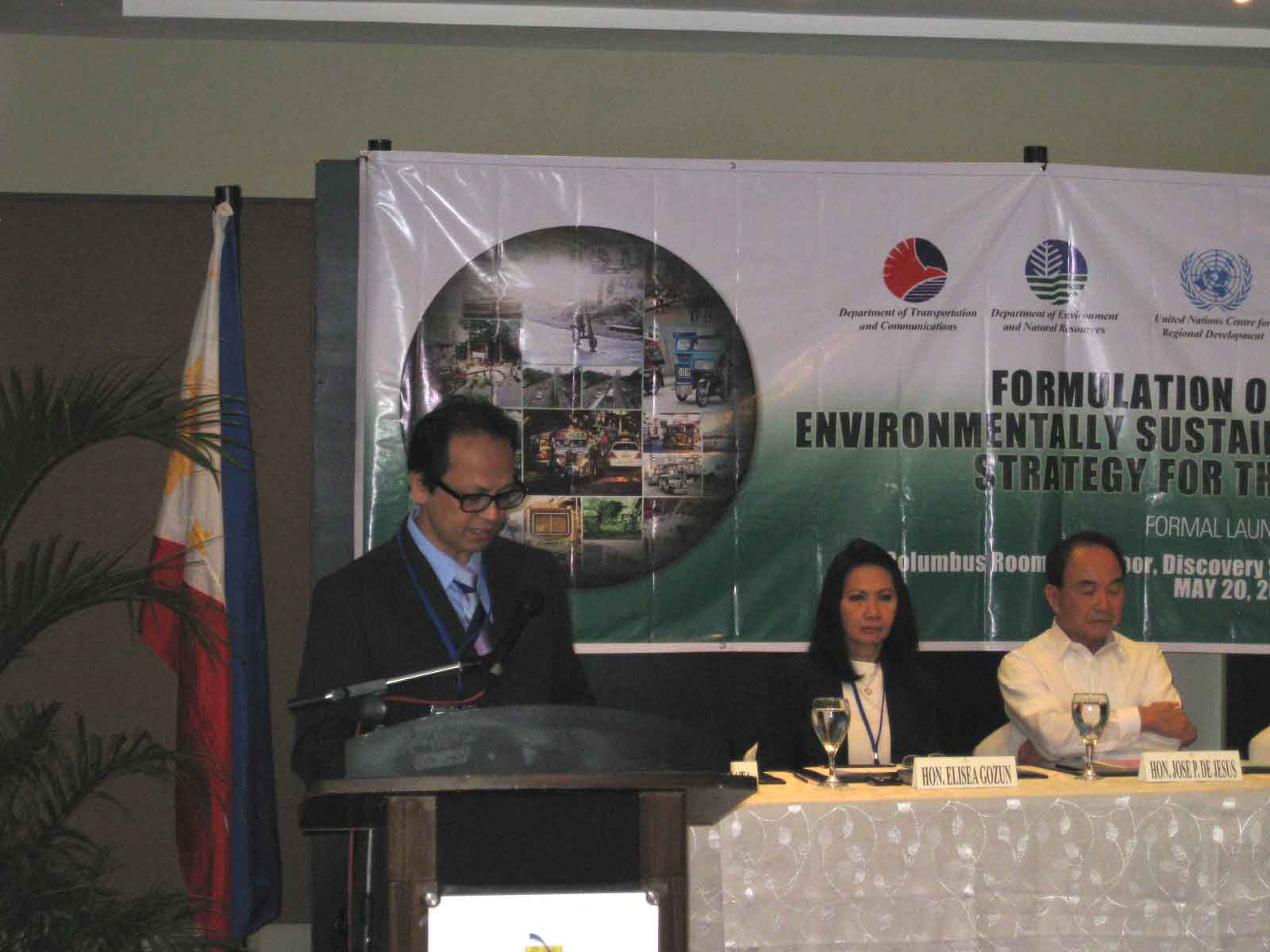 Mr. Mohanty of UNCRD delivering the Opening Remarks
 DOTC Sec. Ping De Jesus delivering a message from the Department
 NCTS Director Regidor presenting the highlights of the national EST strategy
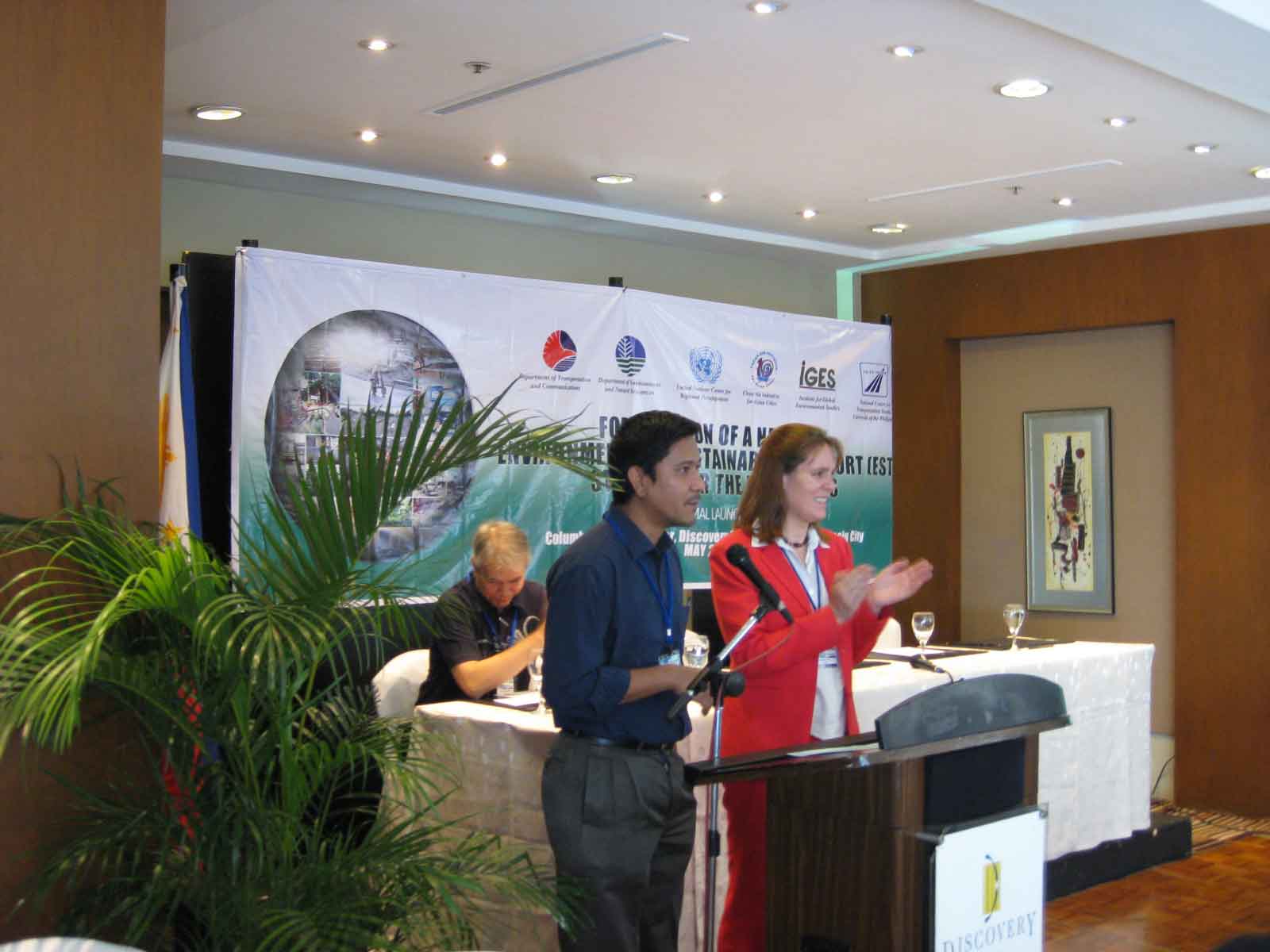 CAI-Asia’s Bert Fabian and Sophie Punte facilitated the panel discussion
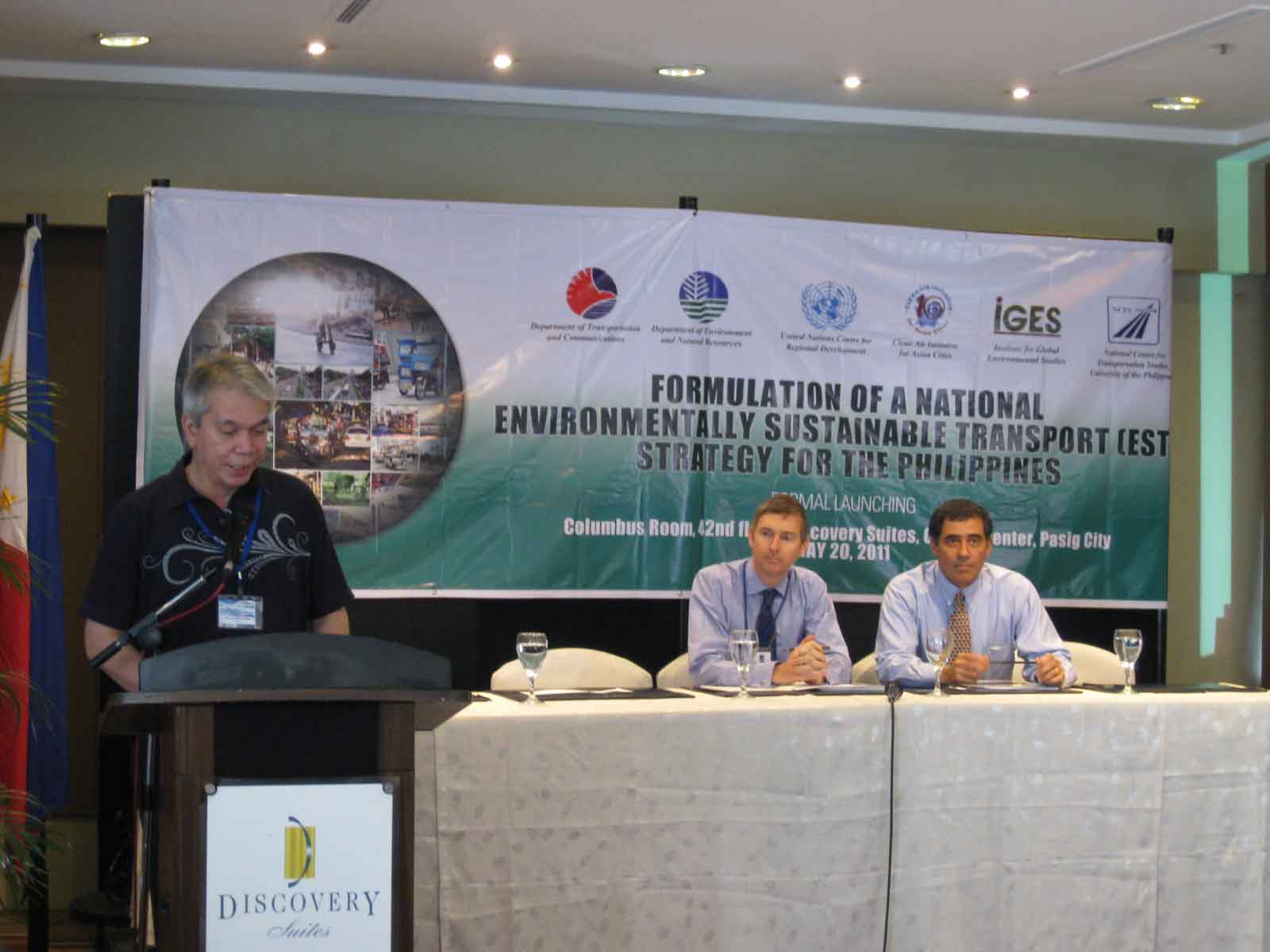 DOTC Asst. Sec. George D. Esguerra responding to the key questions during the panel discussion
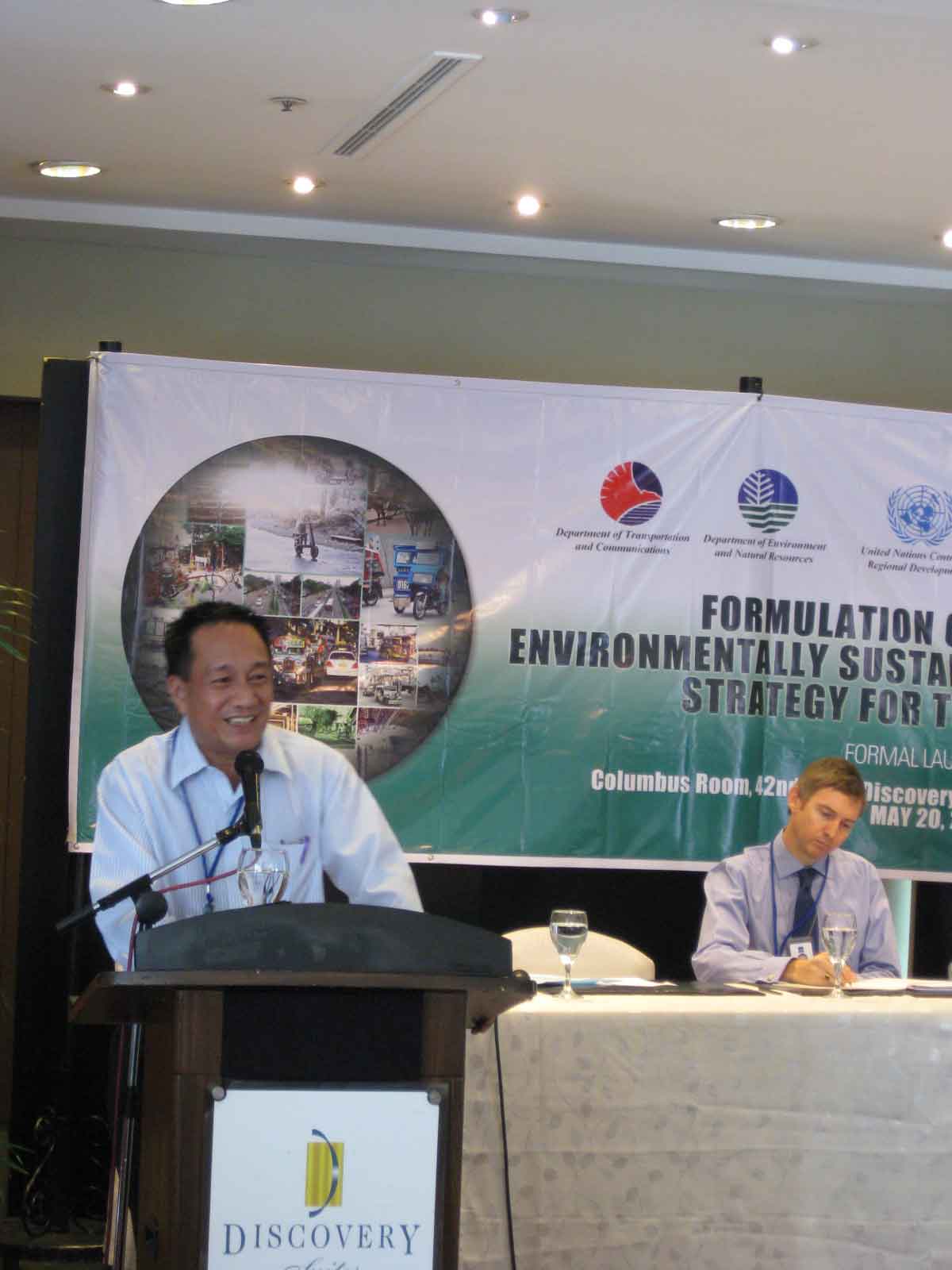 MCIAA’s Nigel Paul Villarete making his comments during the panel discussion
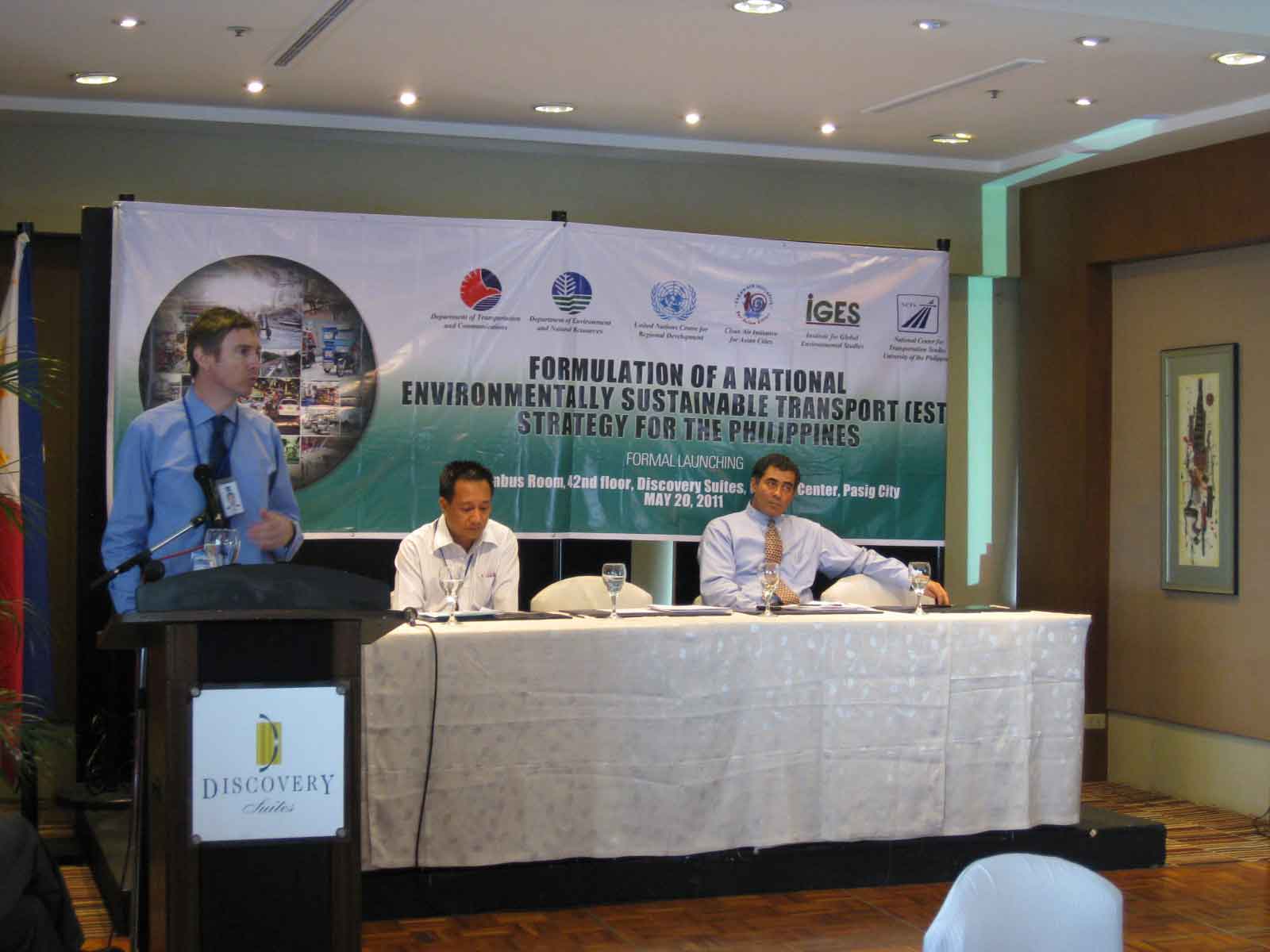 Bruce Dunn explaining about the ADB’s initiatives
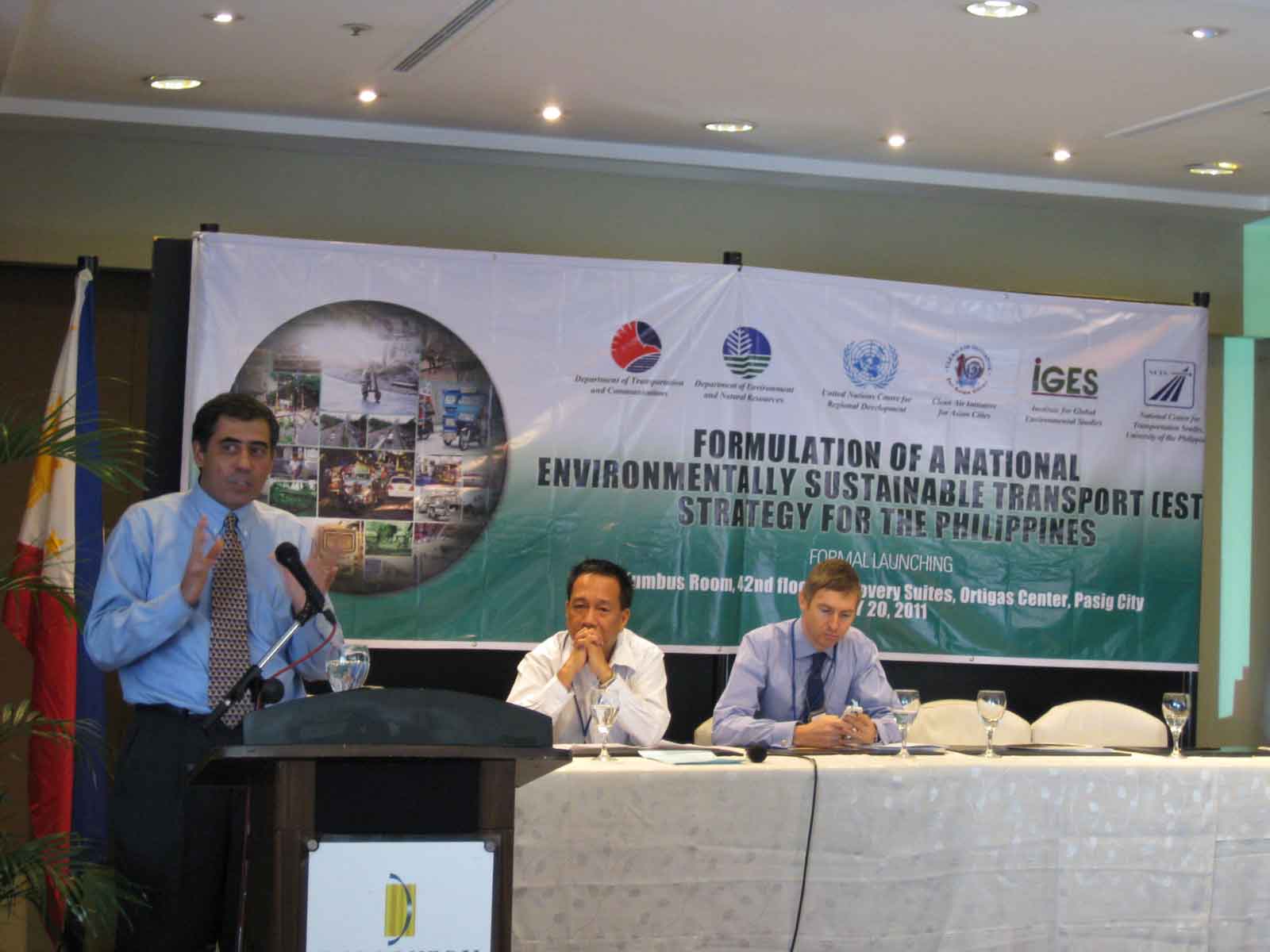 The WB’s Baher El-Hifnawi stressing a point during the panel discussion
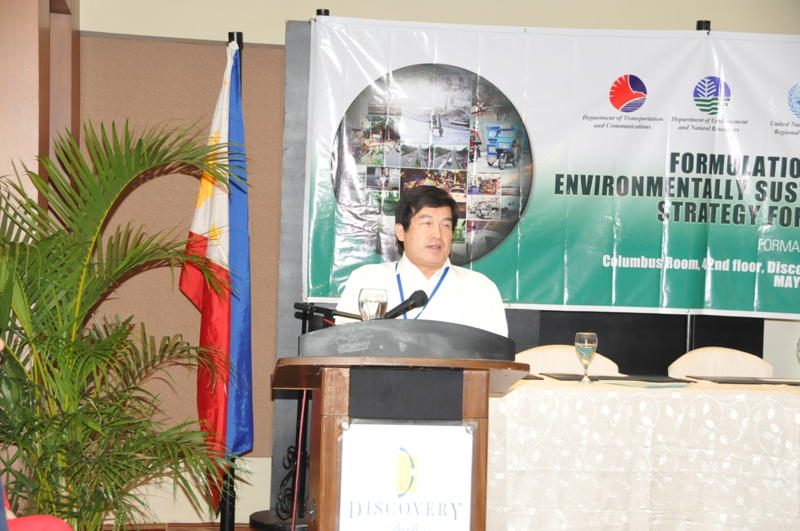 Embassy of Japan Minister Isomata delivering a congratulatory message from the GOJ
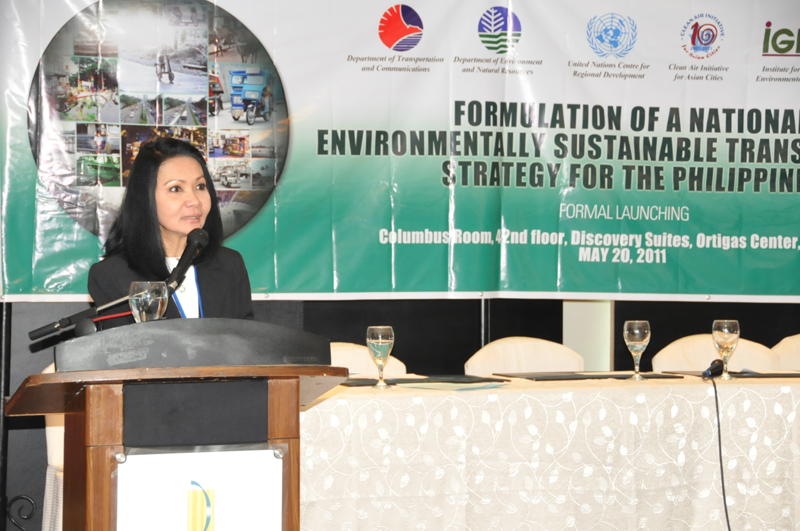 Presidential Asst. on Climate Change Bebet Gozun delivering the concluding message
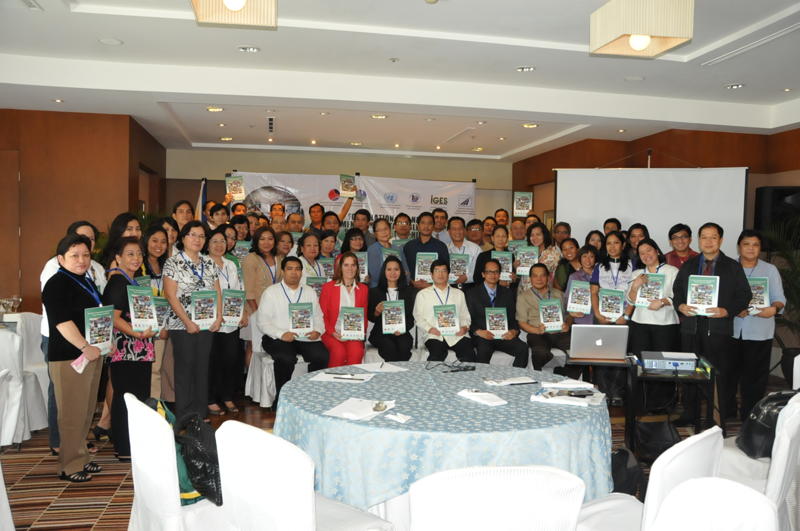 Group photo showing participants to the national EST strategy formal launch
The messages and the panel discussion were one in conveying a challenge to all stakeholders to use the framework provided by the national strategy to come up with action plans and implement these in order to realize sustainable transport in the country. It was also clear from the proceedings of the event that there should be a strong, collaborative effort among national agencies, local government units, NGOs, and development agencies if EST is to be operationalized and for programs and projects to succeed. Significant impacts would then be realized and perhaps lead to the alleviation of transport and traffic problems and their derivatives. It was emphasized that everyone should carefully consider the co-benefits that may be reaped from the implementation of EST.
For more on the national strategy including the reports and other resources, all these are available from the NESTS Web Portal hosted by the NCTS.
Moving about in Singapore
I’m back in Singapore and enjoying going around the city using its efficient public transportation system and pedestrian facilities. I am quite at home with the system considering I lived in Japan for quite some time and commuted daily using the rail and bus systems there. It was in Japan where I had a first hand experience of what an efficient public transport system should be whether for long distance commuting (i.e., I knew some supercommuters in Japan who used the shinkansen to go to the office or laboratory every weekday although using the Tokaido Line to commute between Kanagawa to Tokyo qualifies as supercommuting.) or for short distance trips.
I was able to appreciate mobility in Japan considering the interconnectivity of transport modes and the ease by which one can use the system. Even the payment of fares was efficient as one had many options for paying fares and could use various cards including using either the Pasmo card issued by private railway companies or the Suica card issued by Japan Railways (JR). One only needed to load the cards with enough credits to be able to use the cards for not only transport fares but even for paying for items such as food and drinks. One can even personalize the card and it can be reloaded after a period of not being able to use the card.
Singapore is not so much different from Japan in terms of transport systems and if one considers the electronic road pricing (ERP) being applied throughout the state, may even be more advanced in applications of Intelligent Transport Systems (ITS). Moving around in Singapore is so easy considering its rail and bus systems. There are even a number of bus types plying routes around the system including articulated buses much like those used by Bus Rapid Transit (BRT) systems and double deckers like the ones in Hongkong and London. I haven’t noticed and am not aware if there are paratransit systems outside the human powered rickshaws I found near Bugis but which appears only during night-time, considering the city-state being compact and there seems no need for paratransit like the jeepneys, multicabs and tricycles in the Philippines, or the tuktuks in Thailand. There should be no need considering the strategic placing of bus stops and train stations throughout the city and the well planned pedestrian facilities that complement these mass transit modes.
I have always looked forward to having such a system realized in the Philippines whether its going to be in Metro Manila or another city. It is still a vision that has often been derailed what with the systems that have been constructed so far and the weak handling of issues pertaining to bus, jeepney and tricycle services in the Philippines. And some people even argue that “service” shouldn’t be a word to be used to describe public transport in the Philippines. Rationalization of public transport systems back home seems a distant vision considering the chaos surrounding the matter. We can only hope that our efforts will not go to naught and that we can realize an efficient system within our lifespans. Perhaps that will be our legacy for the coming generations, for them to have system that they can be proud of and not drool over when they experience such in other countries such as Singapore.
Microcosm of society
As me and my colleagues crossed the street at the corner of the College of Engineering towards the Main Library grounds, we heard the distant sound of whistles of security guards posted along the Academic Oval. At first, we didn’t pay much attention even stating among ourselves that the guards may be trying to catch the attention of certain people. There are still many litterbugs on campus and there are street children often going around and trying to collect material they could sell at some junk shop. In some cases, they take whatever they find even those that are not supposed to be taken by them like scrap materials from buildings that are being constructed or renovated. These, after all, are not fair game in as far as the contractors and the university are concerned.
After we had crossed, however, the guards continued to whistle and the frequency and manner seemed to indicate urgency and not just as if they were not just trying to accost someone but were also in pursuit of someone or something. Another guard posted near the library stood up from where he was taking his lunch on a bench under the trees near the road and also started whistling. We soon saw the cause for the alarm – a black BMW 5 series was speeding counterflow along the bicycle lane.
We stopped near the Main Library kiosks to see where the BMW was heading and made our bets that it would be turning left towards the Asian Center and probably towards the exit along Magsaysay Avenue. We were not surprised when the car indeed took a left (and without signals) but towards the driveway in front of Malcolm Hall – the College of Law. I say we were not surprised because there have been many instances before this one when similar vehicles and even those with SUV escorts who have blatantly violated traffic rules and regulations inside the campus. Often, the excuse mentioned is that they were in a hurry. But then aren’t we all?
We did not see who alighted from the car (it was too far to see) but it was parked in front of Malcolm Hall so I assumed it must be a faculty member, a lecturer or a guest of that College who drove or owned the vehicle. It would also be likely that the occupant was a lawyer. This begs the question of what kinds of lawyers are teaching at the College of Law. I know this is quite a generalization and perhaps unfair to many whom I know from that college. But this simple act of violating the one-way scheme along the oval and using a lane dedicated to pedestrians and cyclists despite all the signs and the guards shouting at you, which some people (like lawyers for example) would dismiss as petty are manifestations of more serious things. And I will restrain myself from alleging what those serious things are.
If he or she was a student, then the obvious question is what kind of students do the college have these days? What kinds of lawyers are being bred by the college? And may I dare ask what kind of lawyers have been produced in the past as there are evidences (from the UP Police, the MMDA and other traffic enforcers) that the same professionals are the one most likely to argue with enforcers even when they are guilty of violating traffic rules and regulations.
It is the arrogance of such motorists that is among the common causes of road crashes and the major cause for anarchy and chaos in our roads. The example in UP only shows how far we are from the objective of instilling discipline among our motorists. That same arrogance shows, too, how we regard everyone else including the joggers, walkers, and cyclists who had to give way to a motor vehicle that intruded into their right of way and practically bulldozed its way towards its destination. For these people, it is no matter that they put the lives of people in danger by their actions. After all, they were in a hurry. I believe the pedestrians and cyclists were in no hurry. they were in no hurry to get injured or, God forbid, to die because a motorist in a luxury car had to run against the one-way flow and use road space that is dedicated for pedestrians and cyclists – most of whom happen to be students who have yet to fulfill their potentials, and hopefully for the good of this country.
Tools for traffic enforcement
The MMDA recently acquired speed guns to enable them to measure vehicle speeds and catch violators of speeding regulations. A case in point is the ongoing efforts to reduce road crashes along Commonwealth Avenue in Quezon City. Part of the effort is the enforcement of the 60 kilometer per hour speed limit that is applied to all vehicles. This, of course, is a simplification considering that ideally there are different speed limits for different types of vehicles if Philippine laws are to be reviewed. One problem with Commonwealth is that it is a very wide road with 8 to 10 lanes per direction depending on the section from Fairview to the Elliptical Road. All types of vehicles seem to be guilty of “over-speeding” but of particular concern were and are the buses that also have tended to change lanes quite frequently despite the maneuver being unnecessary.
Most private vehicles are also probably guilty of speeding at many points along the avenue. The wide road is indeed very tempting for cruising at high speeds much like what a driver may routinely do along expressways. The problem, of course, is that the avenue is not an expressway where access is restricted and there are practically no chance or instances of conflicts with pedestrians, vendors or typical public transport operations. And then there are also the ubiquitous median openings that have replaced at-grade intersections. These facilities have encouraged weaving and, arguably, aggressive driving in order to be able to maneuver to the nearest practical U-turn slot.
But going back to the speed guns; these are very handy tools for traffic enforcement. Based on what I saw on TV, the speed guns allow the operator to take a photograph of the guilty party’s vehicle and save this for downloading later at the office. The downloaded photos are then processed into a form (summons) that is sent to the owner of the vehicle who is assumed to be the driver of the vehicle caught by the speed gun’s camera. The person is given 7 days to pay the penalty/fine (PhP 7,500 accroding to the news reports) at the MMDA or at an accredited bank. If the person is unable to pay the fine, the MMDA will forward the violation to the LTO for flagging or tagging of the vehicle used. This tag will serve as an alarm for traffic law enforcers in case the vehicle is involved in another incident.
The speed gun is not an inexpensive tool and yet it is a very useful one if only to instill discipline to drivers in the form of speed management. Speeding is one manifestation of irresponsible or reckless driving, especially when combined with other maneuvers like frequent lane changing. It is also one of the most difficult to enforce since measurements are required and evidence must be strongly tied to a particular vehicle so that the match is “beyond reasonable doubt,” as lawyers may say.
Speed guns like the ones acquired by the MMDA will surely contribute to curbing speeding violations and reducing the incidence of crashes. However, this is currently limited to Commonwealth and there is definitely a need to acquire more instruments to enable the agency to enforce speed limits along other roads including perhaps EDSA and C5. At the very least, speed limits should be enforced along all the radial and circumferential roads. This is particularly important during the night time and probably the early mornings when many road crashes are associated with speeding violations that are obvious for the characteristic loss of control by the driver. The acquisition and proper use of additional units will go a long way into putting order to traffic along our roads and this order can be equated to ensuring that our travel ways will be safe for all users.
Upgrades: the Ayala BRT
The Ayala Land Inc. (ALI) has been issuing press releases about their plan to put up a Bus Rapid Transit (BRT) system for the Makati CBD and the Bonifacio Global City. The system will serve both the old financial center in Makati and the rapidly emerging one in Taguig, connecting the two via Ayala Avenue-McKinley Road and Gil Puyat (Buendia) Avenue-Kalayaan Avenue corridors. It is a project that is long overdue although the buses serving the Fort have shown us at least what a higher capacity mode of transport can do if managed properly.
The Fort Buses load and unload passengers at designated stops. They follow traffic rules and regulations enforced more strictly inside the Global City. Many of the newer bus units also happen to have layouts that are more appropriate for city operations. The Mercedes Benz coaches are designed such that they can accommodate more passengers as they have ample standing space and there are only enough seats for passengers who may actually need them like the elderly, pregnant women, persons with disabilities, and perhaps those who are burdened with heavy bags or packages. The doors of these units are also designed for more efficient fare collection and discharging of passengers, with the narrower front door accommodating boarding commuters who are already queued at bus stops and the wide two door rear egress allowing for efficient alighting. Surely, an automated fare collection system such as those using smart cards or other machines will be in place in the near future and greatly improve the operations of these buses. But the most significant feature, it seems, of the Fort Bus is the compensation scheme for its employees, particularly its drivers. Unlike most bus companies, Fort Bus drivers are given a regular monthly salary and reportedly enjoy benefits much like regular employees in typical companies or offices. This feature, I believe, is what makes it work in the first place and what is required for a transformation in public transport services as it does away with the rabid competition that is the derivative of a commission-based or “boundary” system compensation scheme that is used for both buses and jeepneys.
Considering the calls for more efficient as well as more safer public transport systems, let this Ayala BRT be a test case for what to do with transport systems that should have been phased out a long time ago (jeepneys) along corridors or routes that demand higher capacity vehicles. Public utility vehicles with low capacities and perhaps low quality of service should be replaced by more efficient modes especially along arterials. Also, all the elements are there for a potentially successful PPP in transport. You have a major player from the private sector (Ayala) offering to put up a system that it has studied and designed over the past few years. You have two CBDs in Makati and Taguig that currently serve as the present and future financial centers. And you have the challenge of doing away with an inefficient transport system. Though there sure will be compromises that are not necessarily palatable (e.g., re-routing PUJ and PUB lines) the government should start realizing that it should be more deliberate and even unforgiving when it deals with the issue on PUJ and PUB franchises here.
The local governments of Makati and Taguig should cooperate with Ayala to make this work for these LGUS should put aside certain interests including those pertaining to PUJ and PUB operators and drivers, many of whom may be their constituents and comprise a significant part of their voting populations. The LGUs should facilitate discussions including those dealing with livelihood and othe social issues that are the province of local governments. The Land Transport Franchising and Regulatory Board (LTFRB) should get out of its shell and make a stand now considering the opportunity for public transport transformation. And its mother agency, the Department of Transportation and Communications (DOTC) should support this stand, all out, if only to show that it is indeed committed to reforming and modernizing public transport systems in this country.
A BRT finally being realized for Makati and Global City will indeed be a showcase. We just hope that it will be a showcase of an efficient transformation of a public transport system from an outdated to a modern and efficient one rather than a showcase of futility and ineptness on the side of those in government. As they say, something has to start somewhere. A modern, efficient public transport system that is deserved by Filipinos may just start in Makati and Taguig, and with a BRT that may actually mean “better rapid transit.”
Ortigas traffic
Ortigas Avenue traffic is very familiar to me. For one, I have used the road since childhood because it was the most direct route to and from school. We lived in Cainta and I went to school for 11 years in Mandaluyong. Before that, I even have memories of the section of Ortigas Avenue where Valle Verde phases are now located being carved quite literally from the adobe mountain that it was back in the mid 1970’s. Ortigas was the only access for those living in the east, particularly the Antipolo-Cainta-Taytay-Binangonan-Angono towsn of Rizal Province, for quite some time. Marcos Highway was still a dirt road and Marikina and Cogeo were somewhat out of the way. Meanwhile, Ortigas was already an important corridor as it led to Antipolo, an important religious and popular recreational site.
As the populations of the Rizal towns I mentioned increased, mostly due to their proximity to Metro Manila and being popular for residential developments then as now, Ortigas became congested. The avenue itself was widened but as any traffic engineering textbook will tell us, the bottlenecks were really the bridges. And I also remember the Rosario Bridge across the Pasig River being widened twice, both before the Manggahan Floodway was constructed. I experienced the impacts of both widening endeavors and did not enjoy having to wake up earlier than when I usually did because of the horrific traffic. It was worse, I guess, when the Manggahan Floodway was being constructed and there were too few options as to alternative routes. In fact, there were too few bridges across the floodway and Pasig River.
Nowadays, traffic congestion along Ortigas Avenue seem much worse than before. This I get from my siblings who still use the corridor as part of their routes to their workplaces. I trust in their assessment considering that my brother went to the same Mandaluyong school I attended and my sister attended another exclusive school in Pasig. My sister’s husband attests to the worsening traffic as he’s also lived at a residential area along Ortigas. From firsthand observation, I can also validate that Ortigas is worse these days than say 10 and 20 years ago.
The counterflow scheme along Ortigas is not new. In fact, my father and our school service drivers knew about this and would often time their trips to coincide with the scheme so that they can drive almost continuously to their destinations in the morning. Back then, I remember that the counterflow scheme was in effect for 10 to 15 minutes at the 0630, 0700, 0730 and 0800 times. It was also actually a regulated one-way scheme and was called thus since it benefited vehicles traveling along the outbound (from Rizal) direction. Inbound traffic were stopped at strategic points along the avenue including Rosario Bridge.
Such schemes are possible only when there is a dominant direction during the peak hours. In the case of Ortigas the directional distribution before was practically 90% outbound in the morning peak. A one-way, counterflow scheme was possible and practical for an undivided road. There were no medians or island to prevent vehicles from moving over to the opposing lane and back. That was then and at a time when I suppose that there were less friction along the avenue. Road friction, particularly those caused by public utility vehicles stopping for passengers, is more serious these days as the number of PUVs have also dramatically increased to address the demand for travel. Only now, there seem to be more informal terminals and longer dwell times at strategic points along Ortigas. These cause the bottlenecks that are also complicated by Ortigas now having median barriers along its length.
I believe congestion can be significantly alleviated by developing and implementing a simple dispatching system for PUVs along strategic points like the designated loading and unloading zones at either ends of the Manggahan and Rosario bridges. The dispatching system should be implemented along with a strict enforcement regime to ensure quick boarding and alighting times and prohibiting PUVs from spilling over and occupying other lanes, that often results in blockage of general traffic. Perhaps, a counter-flow scheme may be re-evaluated and become unnecessary. This recommendation comes in the heels of a survey we conducted along Ortigas only yesterday, February 10 in Manila, where I personally experienced PUVs making a terminal out of the outbound lanes before the Manggahan bridge and effectively blocking outbound traffic along the avenue. I can imagine the frustration of those caught in traffic along Ortigas and its implications along the extension and the Imelda and Bonifacio Avenues from Cainta Junction. The result of that blockage and the implementation of a counterflow around 0715 is shown in the following two photos I took.
 Figure A: Image downstream along Ortigas Avenue (to Rosario Bridge and C5)
 Figure B: Image upstream along Ortigas Avenue (from Cainta Junction)
It is clear from the photos that private vehicles were the ones who benefited from the counterflow. However, it is interesting to see that the outbound lanes were practically empty especially along the Manggahan Bridge. This clearly shows that there is actually enough road capacity but that it is not utilized (and counterflows were required) because of the blockage caused by PUVs upstream of our position. This is another strong case for going back to the basics in as far as traffic engineering and management is concerned. It does not take a PhD degree to see what’s wrong in the photos and certainly an advanced degree is not required for a solution to the problem.
Ningas Cogon
After focusing on one negative trait, I didn’t expect to be writing immediately about another. Again, I do this in the context of transport and traffic, and to drive home the point that we really need to go back to the basics in as far as solving transport and traffic problems in this country is concerned. Ningas cogon refers to how a type of grass burns when set on fire. There is initially an intense burning of the grass but after a short time it dies out. This behavior of the burning is often alluded to when describing efforts that are not sustained and especially those that showed enthusiasm (and therefore promise) only at the start. It is also associated with an initial show of interest that eventually and shortly wanes for one reason or another.
Only two weeks back I was writing about Commonwealth Avenue and how it was called a killer highway. At the time, I was hopeful that the renewed effort to impose discipline among motorists and especially public utility vehicle drivers and pedestrians would result in a significant improvement of safety along the highway. The initial results seemed to be encouraging, with a dramatic decrease in the number of road crashes and deaths in the first few days. I even had several opportunities to observe the efforts of enforcers, the combination of MMDA, PNP and QC personnel, to keep PUVs along their designated lanes and remind motorists and pedestrians to follow rules and regulations. I was pleasantly surprised, for example, to see vehicles “slow down” to 60 kph instead of the expressway speeds they usually attain along Commonwealth. At the Philcoa area near Commonwealth’s junction with the Elliptical Road, PUVs were being guided through the loading and unloading area and violators were quickly apprehended by MMDA and PNP personnel closely watching the traffic.
Meanwhile, I read a few newspaper columns giving mixed reviews about the program. One column in particular from a major daily mentioned that the effort lasted only a few days and that traffic reverted back to pre-discipline zone times. My reaction was one of disappointment, not for the government but for the columnist whom I thought came up with a premature conclusion, given that changing motorist and pedestrian behavior and attitudes along a major thoroughfare would take time. I did mention though in my previous post that enforcement should be firm and sustained in order for it to be successful and enduring. Also, I was already wary of the tendency for such programs to go the way of others before it – ningas cogon.
Last Sunday, I drove along Commonwealth on my way to visit my in-laws in Novaliches. I decided to do an experiment using a simple method that I learned when I was a student at University and which I also teach my students in undergrad civil engineering. In what is called a floating car technique, I attempted to travel according to the speed limit of 60 kph. I also tried my best to keep my lane, only changing when it was necessary. I also tried to count how many vehicles would pass me, indicating how many traveling my way were faster than me and therefore over-speeding.
The first thing I noticed when I entered Commonwealth from University Avenue was that buses and cars were again zipping by me and so I didn’t bother anymore to count those passing me. I did maintain my speed so I could have a reference as to how fast the other vehicles were relative to mine. Approaching the Fairview Market area, I also observed that people were crossing almost anywhere and that some barriers have been moved to allow jaywalkers to cross the median. Meanwhile, the pedestrian overpasses were all crowded and I could see the entire length also occupied by vendors. Not an enforcer was around to bring order in what was a chaotic marketplace scene – along a major highway.
I repeated the experiment in the afternoon when I drove from my in-laws home to my parents’ home. Taking the opposite direction, Commonwealth was even more congested when I approached the Fairview Market area. Buses, jeepneys and tricycles practically took up 3 lanes, stalls, hawkers and pedestrians took up 2 lanes and there was only 1 left for all other vehicles to pass through. No one among those who clogged the highway seemed to care and I again saw no enforcers to mahage traffic. If there were, I’m sure they were somewhere else and definitely not doing their jobs.
It is both disappointing and frustrating that the traffic discipline program along Commonwealth went the way of ningas cogon. In fact, the MMDA seemed to have celebrated what they thought was success prematurely, even stating that they were to apply similar strategies to other major roads in the Metro. By the looks of the outcomes along Commonwealth, such efforts along other roads will eventually go the way of ningas cogon. Such results send the wrong message to motorists and pedestrians and reinforce the perception that the authorities don’t really mean business and that such programs are just for show. So far, it seems that this perception will continue to pervade along Metro roads unless the MMDA, the PNP and the respective local government units get their acts together. Again, it shows that going back to the basics remain the main challenge and overcoming the ningas cogon tendency the main obstacle for our authorities.
Suwapang
The Filipino or Tagalog translation of the words greedy or selfish seems much more appropriate to use as a term to describe what is arguably the most basic reason why our country is in a rut. It can also be used to describe why our transport systems and traffic is what it is at present. The term suwapang easily and comprehensively defines the way we drive vehicles, ride motorcycles, commute, operate transport services, and enforce or manage traffic. It is also applicable to the way we plan and build infrastructure.
Public utility vehicle drivers are suwapang when they cheat on fares for students and senior citizens, refusing to give the discounts mandated by law. The are suwapang when they race to overtake fellow drivers in order to get to passengers waiting along the roadside. They never mind the safety of their passengers or those in other vehicles around them. To them, the most important thing is to get ahead of everyone else even if in the end those waiting along the roadside or the stop weren’t even heading their way. PUV drivers are suwapang, too, when they cut trips, making it difficult for passengers to get a ride home, to school or to their workplace. Suwapang is also the word appropriate for those refusing passengers for one reason or another. Public transport is, after all and definitely above its business aspect, a service.
Motorcycle riders are suwapang when they disregard traffic rules and regulations and weave in traffic, placing themselves and others at risk of getting involved in a road crash. They are suwapang when they carry more than one other rider (angkas) as what we commonly observe along many roads and with children sandwiched between their parents who seem to not understand the risk they are exposing their children and themselves to.
Tricycle drivers are suwapang when they travel along national roads or highways, fully aware that they are prohibited from doing so. They are suwapang when they charge exorbitant fare for “special” rides. The word also applies when they clog streets due to their numbers, many probably even illegal or colorum units. There are actually too many of them in many areas but they are still steadily increasing as newer tricycles are accommodated or tolerated by the ones supposed to be regulating them.
Transport operators are suwapang when they cheat on vehicle maintenance and place passengers at risk of being involved in a road crash. Poorly maintained vehicles also lead to higher fuel consumption and would definitely have a significant impact on operational costs that is part of the basis for setting fare rates. Suwapang is the word for those who operate gas guzzlers while claiming that it is wholly the rising fuel prices that are to blame for their rising fuel costs. These operators unfairly lobby for increasing fare rates while not doing their part on maintaining their vehicles, effectively imposing the fuel inefficiencies of the vehicles on the riding public.
Commuters are suwapang when they pressure drivers to stop where public transport are restricted from loading and unloading passengers. They do not care about the driver being apprehended and probably paying up for the violation. Commuters are also suwapang when cheating the driver for fares like when they choose or insist to hang on to jeepneys and not pay fares or pretend that they have paid when they have not. They are also suwapang for waiting on the road rather than the road side. They cause congestion because they occupy space intended for vehicles and in effect reduce the capacity of these roads.
Private vehicle drivers are suwapang when they overspeed and weave aggressively in traffic. They do not care about the safety of others nor about rules and regulations that are in place for everyone’s well-being. They are suwapang for demanding more road space when the collective volume of private vehicles are the real cause of congestion, especially when one realizes most vehicles carry only 1 or 2 passengers including the driver. It is inefficient use of road space at best aside from being a waste of fuel and unfriendly to the environment due to the emissions they produce. They are also suwapang when they do not have off-street parking where they reside and leave their vehicles to occupy precious road space, reducing capacity and contributing to traffic congestion in the process. One is also suwapang if they still have sirens (wang-wang) installed on their vehicles for their convenient use, despite the no wang-wang policy being implemented.
Traffic enforcers are suwapang when they extort money from drivers instead of issuing them the traffic ticket for legitimate violations of traffic rules. They are more suwapang when they unscrupulously apprehend motorists for what the former claim were violations by the latter but are actually not, in order to eventually extort money from them. These are quite awkward situations since either or both parties may not even be knowledgeable of the rule or rules that were violated in the first place, if any. Enforcers are also suwapang for extorting money or tong from drivers of goods or freight vehicles. Their activities only lead to an increase in the prices of commodities such as rice and vegetables.
Our government leaders, planners and engineers are suwapang for poorly planned, designed and prioritized infrastructure. Perhaps some are more concerned with their cuts in the budget for transport infrastructure than the quality of a project and its overall benefit to the public. They are suwapang because they choose to benefit themselves (sarili) over the good of their country (bayan), securing their pockets and their own futures when they should be securing the future of the nation as is required of those in public service. They are suwapang because they hinder the nation’s development and deprive people of an efficient transport system for both mobility and accessibility.
Some in the private sector are considered suwapang for collaborating with politicians, planners and engineers described previously. They can also be considered suwapang for pushing for projects that should not be prioritized but are assessed to be so due to their connections with people in power. They, too, hinder this country’s development and deprive people of the efficient system they deserve.
So the inevitable question is – Are you swapang?
Discipline along a killer highway
Commonwealth Avenue in Quezon City was given a tag as a killer highway due to the frequent occurrence of road crashes along the road, many of them resulting in fatalities. Only last December, a retired judge was about to cross the highway on his vehicle, his wife (a retired teacher from a prestigious science high school) with him as they were heading to church. It was very early in the morning since they were going to the Simbang Gabi or night mass – a tradition in the Philippines during the Advent Season leading up to Christmas Day. Despite probably signalling and their being cautious enough, their vehicle was hit by a speeding bus. The driver of the bus was to claim later that he used his lights and horns to warn the judge against crossing. There was no mention if the bus driver attempted to slow down, the safest thing to do when driving at night and knowing that there are many crossings along the road he is traversing. In fact, this should be the first thing on the mind of anyone aware and conscious about safe driving.
There are many incidents like the one above and not just along Commonwealth or other Metro Manila road. Road crashes occur along many of our national and local roads everyday and the casualties just pile up, and many are often just treated as statistics especially when nothing is done to address the issue. Such road crashes occur due to many factors that are usually categorized into human, vehicle or environment-related. Most often, as findings in the Philippines indicate, it is the human factor that results in a road crash.
Driver error, poor maintenance of vehicles, and ill-designed roads can all be traced to human shortcomings. Environmental factors are also ultimately rooted on the human element. Speeding is one thing and aggressive driving is probably another but altogether general driver behavior along Philippine roads are clearly a manifestation of a lack of discipline and not necessarily the lack of skill, although the latter is also a significant factor if one is to focus on public transport and trucks.
There are few exceptions and it seems “few” is a relative term often leading to the example of Subic. At Subic, we always wonder how and why drivers seem to be disciplined. Some say it is because of the fines or penalties for traffic violations. Others say it is psychological and a legacy of the base being previously under the US military. I would say it is more of the traffic rules and regulations being enforced firmly and fairly in the free port area. I would add that motorists and pedestrians have embedded this in their consciousness such that there is something like an invisible switch turning on when they drive in Subic and turning off once they are out of the free port.
For a corridor like Commonwealth, perhaps the best example to emulate would be the North Luzon Expressway (NLEX). Along that highway, its operators the Tollways Management Corporation (TMC) have established a strict regimen of enforcement and have applied state of the art tools for both monitoring and apprehension. These tools include high speed cameras equipped with speed radars that detect speeds and capture on photo cases of overspeeding. Photos are used as evidence upon the apprehension of the guilty party at the exit of the expressway.
The current campaign along Commonwealth is premised on the strict enforcement of a 60 kph speed limit along the arterial and the designation of PUV lanes (e.g., yellow lanes) along the length of the corridor. The initiative would be manpower intensive and features novel tools such as the use of placards, loudspeakers and public relations in order to encourage motorists and pedestrians to follow traffic rules and regulations. The results as of today look promising and there has been a significant reduction in speeds and general compliance for PUVs serving the corridor. The numbers might be misleading if we attempt to conclude about the success of the program now. Perhaps the more reliable statistics would come out after the campaign has been implemented and the effort sustained over a month’s time. Nevertheless, it gives us a nice feeling to see less speeding and less weaving among vehicles that were once observed as though they were driven along a race track. It would be nice to once and for all kill the “killer highway” tag and make Commonwealth an example of how traffic management should be implemented. We are always searching for examples of good if not best practices that can be replicated elsewhere. If we succeed in the “Battle of Commonwealth” then perhaps we could eventually win the “War Against Irresponsible Driving and Jaywalking.”
 Caught (up) in traffic
