
Home » Governance (Page 7)
Category Archives: Governance
On the idea of congestion pricing
I purposely titled this post to include the word ‘idea’ as congestion pricing is still very much like that in the Philippines. It is a reality in some part of the world particularly in Singapore where its Electronic Road Pricing (ERP) has evolved and improved over the years. Its success though seems to be an exceptional case that has not been replicated elsewhere where conditions are not exactly like the city state’s.
Here is an article that recently came out from The Washington Post about the New York Governor’s decision to backtrack on the proposed congestion pricing initiative in New York City:
McArdle, M. (June 12, 2024) “People hate traffic. They also hate this great idea to clear it,” The Washington Post, https://www.washingtonpost.com/opinions/2024/06/12/congestion-pricing-great-idea-people-hate/ [Last accessed: 6/14/2024]
To quote from the article:
“Roads are a scarce good; you can fit only so many cars on a road at one time, and fewer if you would like those cars to go somewhere. When roads are “free,” we are forced to fall back on a more costly and inefficient strategy: sitting in traffic. This wastes valuable human time and inflicts noise and pollution on everyone nearby. Far better to charge a modest price that inspires some drivers to carpool and others to take public transit or shop nearer to home, until supply and demand are balanced and traffic flows easily…
In political disputes, a discrete group facing highly concentrated costs often defeats a larger public interest that conveys a small individual benefit to everybody — such as being able to move around the city faster when you really need to. This is particularly true in the American system, which is designed to empower angry minorities. And it’s especially true when they’re abetted by status quo bias and a sympathetic majority, as in this case.
Complain all you want about selfish suburban drivers or the Metropolitan Transit Authority’s bloated cost structure or Hochul’s cowardice; the biggest obstacle to congestion pricing is that almost two-thirds of New York City residents have told pollsters they oppose it — in a city where less than half of all households even own a car. A more technocratic, less democratically responsive government might have been able to ram it through, and perhaps in time everyone would have come to like it. But in fractious America, with all its political veto points, congestion pricing is doomed by the reality that people hate slapping prices on things — especially if they have to pay them.”
There is a congestion pricing proposal in Baguio City and we don’t know yet how this will go. I don’t have the details yet except that a private company whose core business is tollways is involved. Will this be a model or a proof of concept? Or will it just go the way of a typical tollway where users are those who are willing to pay and which would eventually congest if most of the current users pay and use it anyway? Will the funds generated be used to develop a more efficient transport system for Baguio, eventually leading and contributing to less congested streets? That would also mean eventually less revenues from the congestion pricing scheme and probably lead to it being unnecessary.
–
On the impact of bike lanes on motor vehicle traffic
With the news that bike lanes will be removed along major roads including, most recently, I share some findings from the US about a decrease in traffic speeds when there are protected bike lanes. The decrease in speeds are associated with a reduction in road crashes, ergo safer streets.
McPherson, K. (June 3, 2024) “Traffic Speeds Decrease When Bike Lane is Present,” Rutgers.edu, https://www.rutgers.edu/news/traffic-speeds-decrease-when-bike-lane-present [Last accessed: 6/8/2024]
To quote from the article:
“They found that the presence of the delineated bike lane made a difference: a 28 percent reduction in average maximum speeds and a 21 percent decrease in average speeds for vehicles turning right. For those heading straight and not turning, a smaller speed reduction of 8 percent was observed. In addition, drivers moving at a perpendicular angle to the bike lane did not slow down.
Marking the bike lanes with cones as a clearly delineated space was more effective at reducing speed than a painted-only bike lane. The painted-only bike lane was associated with a smaller speed reduction of between 11 percent and 15 percent, but only for drivers turning right.
Younes hypothesized that drivers slow down when they see a bike lane marked with the cones because the driving lane is narrower and requires more concentration, and it’s easier to notice cones or planters or some other space delineator than it is to spot painted lines on the road surface.”
Of course, one major element that was probably not considered in their studies is the presence and behavior of motorcycle riders. Motorcycles here frequently enter and use bike lanes whether protected or not. Often they crowd out bicycle users leading to situations where riders of motorized and non-motorized 2-wheelers come into conflict. Still, it would be nice to have a study to determine not just whether there are similar outcomes here but to what extent as well as how motorcycles figure in the study.
–
Safety or speed?
We start June by sharing a video on why safety and vehicle speed are incompatible:
I saw this video while browsing an article on “Dangerous by Design”. The article discusses a new publication where road designs are evaluated from the perspective of safety. Most of our roads have been designed with speed in mind. That is, how to facilitate the movement of motor vehicles to ensure they travel faster. Forgotten or, even worse, disregarded is the most important element of safety. Why do we widen roads or insist on higher speeds in populated areas or school zones? Such questions are not addressed directly or not answered at all by agencies in charge of planning, designing, constructing and maintaining roads and bridges. The same is true for agencies or units in charge of traffic regulations or management. The result not surprisingly is an increase in the number of road crashes, fatalities and injuries due to our roads being ‘dangerous by design’.
–
Article share: Picking it up as we go: how transportation agencies can learn from university research
Here’s a quick share of an article on the JTA Research Lab. This is a good example of how transportation agencies can learn from university research and also how they can collaborate or cooperate with academe to formulate solutions to various transport problems or issues.
JTA Research Lab has been created to identify critical transportation policy questions, and get academics to help solve them. Pencils sharpened? Nathaniel P. Ford explains…
Source: Picking it up as we go: how transportation agencies can learn from university research
Another roadblock for active transport?
The Metro Manila Development Authority (MMDA) recently released what they claim to be their counts of bicycle traffic along major roads in Metro Manila from 2020 to 2023.
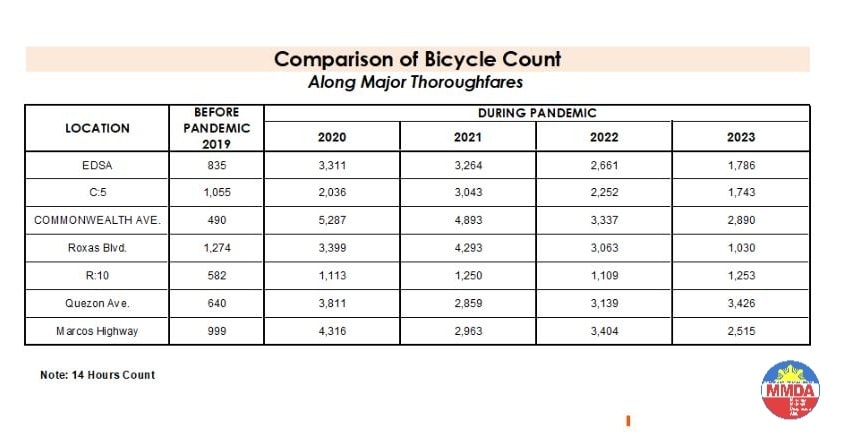
These are supposed to be official data as it is issued by the government agency in-charge of traffic management for Metro Manila roads (aside from its other functions and roles). What are not stated, and are actually very important details, are the locations of the counts and when the counts were conducted. The Traffic Engineering Center (TEC) that was under the DPWH and currently with the MMDA used to publish traffic volume maps for major roads in Metro Manila. So along EDSA, for example, the volume per section are shown on the map. The same for other major roads like Commonwealth, Quezon Avenue and SLEX. The thicker lines mean higher volumes along those sections, and vice versa. However, they did not consciously count bicycles (only motor vehicles) and perhaps MMDA only started counting during the pandemic (i.e., 2020). So there is no one value to represent a road. And counts vary over time of day, day of the week and even throughout the year (i.e., monthly variations).
There were many reactions to the MMDA’s posting of the data and most were critical and even derided the agency for what to them appeared to be inaccurate data. The problem is that it seems there are no other counts that can validate and perhaps refute the MMDA data. Previous bike counts were not conducted according to how the MMDA and DPWH count vehicles. That is, counts are typically done over a 14 or 16-hour period and ideally on several days in a year. Expansion and conversion factors are applied based on established stations along major roads that are supposed to have more frequent if not continuous counts. This methodology is how Annual Average Daily Traffic (AADT) is computed. Call it car-centric if you like but the methodology is very much applicable to bicycles as well. Peak hour counts for bikes are not enough and the peak hour factor for motor vehicles does not apply to bicycles (if this is to be used to expand/convert peak volumes to daily values). In fact, if you go into the math, there should be a peak hour factor for each type of vehicle considering each vehicle’s volume will vary differently over time. So yes, the solution here is to conduct bicycle counts according to how MMDA or DPWH counts vehicles and these should be done along several stations along major roads (e.g., those in the table above) to validate the MMDA counts.
More on this topic in the next post!
–
Article share: on making more affordable neighborhoods
I’ve been commenting about how transportation cannot be isolated and the need to relate it to other factors such as housing or home location choice. The latter though is also affected by other factors as well that affect the affordability of homes near the city centers or CBDs where workplaces and schools are located. The result of course is sprawl or the encouragement of sprawl. Private companies take advantage of this or contribute to this ‘encouragement’ by developing land farther away from the center. Thus, for Metro Manila’s case, many people reside in the peripheral provinces of Bulacan, Rizal, Laguna and Cavite. There are even those who choose to reside in Pampanga, Bataan and Batangas.
Kayatekin, C.S. and Sanmiguel, L.U. (April 16, 2024) ” ‘Urban form’ and the housing crisis: can streets and buildings make a neighborhood more affordable?” The Conversation, https://theconversation.com/urban-form-and-the-housing-crisis-can-streets-and-buildings-make-a-neighbourhood-more-affordable-224108 [Last accessed: 4/23/2024]
Quoting from the article:
“Our main finding was that the bottom-up districts we looked at had, overall, more small-scale apartments. The reason is simple: they had more small-scale buildings, built on small-scale plots. Once divided into apartments, this produces small apartments – homes in the bottom-up areas were 10% to 23.1% smaller than their top-down counterparts. This also made their real estate markets for small homes more competitive, and therefore more affordable.
However, our study showed there is nothing inherently magical about bottom-up areas. Their more intricate housing stock has little to do with the layout of streets and blocks, and a lot to do with how that land is built upon.
Plot size appears to be the deciding factor: the districts with greater numbers of small buildings built on small plots supported a denser and more affordable housing stock, regardless of whether they were top-down or bottom-up.
Older bottom-up areas seem to naturally lend themselves to having more small-scale plots. This is likely due to the incremental development of these areas, and the complex land ownership patterns that developed as a result. However, there is no reason why a top-down area cannot be designed to replicate these characteristics.”
–
Planning for Accessibility: Proximity is More Important than Mobility
Here is a quick share of another very informative article that discusses the importance of proximity and more dense development in order to reduce car dependence.
Source: Planning for Accessibility: Proximity is More Important than Mobility
Here are some excerpts from the article:
“This shows that proximity is much more important than mobility in providing accessibility: location, location, location. For the last century, our transportation planning practices have contradicted this principle. Transportation agencies built urban highways that destroyed and degraded accessible and multimodal neighborhoods to benefit suburban motorists. This was racist and classist, but the mechanism was the way that transportation planners valued increased traffic speeds, measured as travel time savings, while ignoring the loss of accessibility imposed on urban neighborhood residents.
Of course, many other factors affect people’s transportation and neighborhood preferences. Some people need their cars for work or after-work activities, and not everybody can bicycle or use transit even if it is available. However, surveys such as the National Association of Realtor’s National Community Preference Survey indicate that many people would prefer living in more compact, walkable neighborhoods than they currently do but cannot due to a lack of supply.”
Such articles are a must read for those who want to understand why government needs to invest in land at or near the CBDs, and develop that land so people will not need to reside far from their workplaces and schools. Truly, there are many other factors affecting transport preferences or mode choice. Housing is one such factor that we continue to treat separately from transport. It is very (prohibitively) expensive to buy or rent in the city particularly in or near the CBDs. The result is people opting to purchase or rent homes in the suburbs. It doesn’t help that developers are also actively promoting subdivisions there and therefore are contributing to sprawl that puts so much pressure on transportation systems.
–
On kamote riders
Much has been written and reported about the so-called ‘kamote’ riders. These are motorcyclists who have the propensity for risky behavior including reckless maneuvers on the road. Such often places them in harm’s way whether they are conscious about the actions or not. I see them everyday during my commutes including but not limited to those who counterflow, speed, race, zig-zag through moving traffic, and use the bicycle lanes or pedestrian sidewalks.
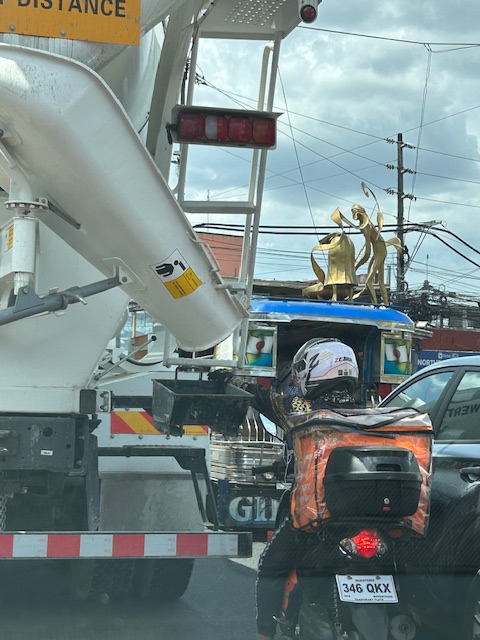 The not so obvious kamote rider positioning himself at the downspout of a concrete mixer.
Not all motorcycle riders are kamote. However, there is a significant number of them out there that put other road users in risky situations. They also contribute to a lot of damage to property as evidenced by a lot of vehicles, especially cars, that have the signature scratches, dinks and dents after being sideswiped or bumped by motorcycles. Such behavior can actually be corrected if the Land Transportation Office (LTO) would be stricter with licensing – requiring more in terms of rider training and certification as well as testing. Traffic law enforcement is also critical here because behavior change can only be done and effective if enforcers are firm. A friend made the observation that law enforcers themselves are the first to violate rules and regulations or bend them in their favor. That sends a wrong signal and would only encourage more ‘pasaway’ and ‘kamote’ riders.
Of course, there are also kamote drivers and cyclists. But those are the topics for future posts.
–
Lower speed limits may not slow drivers, a before-and-after study shows
I am sharing this article on drivers not reducing their speeds after speed limits have been lowered along certain roads. My first reaction after reading the article is that it is that perhaps in the US case, the after study was conducted quite early and before people have become aware, understood and adjusted to the lower speed limits. The responses or reactions to lower speed limits (particularly those posted or on signs) may vary among cities and countries. In the Philippines, where drivers and riders appear to be oblivious to speed limits, other interventions may be required including some types of traffic calming devices. This is very much a concern particularly in school zones where children are exposed to the risks of being run over by motor vehicles speeding along the roads and not minding the speed limits in the area.
Here is the Research report:
Source: Lower speed limits may not slow drivers, a before-and-after study shows
On the current issue about 2 and 3-wheeled electric vehicles
Electric vehicles are again in the news due to the proposed policies regarding them that the government is planning to implement. These include banning them from national roads and requiring their registration as well as their drivers having licenses. While it seems simple enough to many, there are complexities involved here due to the provisions of a law incentivizing the e-vehicle adoption and use.
Most recently, the Electric Vehicle Association of the Philippines or eVAP released a statement regarding the proposed policies on electric vehicle use. Here is their press release, which is available from their official Facebook page:
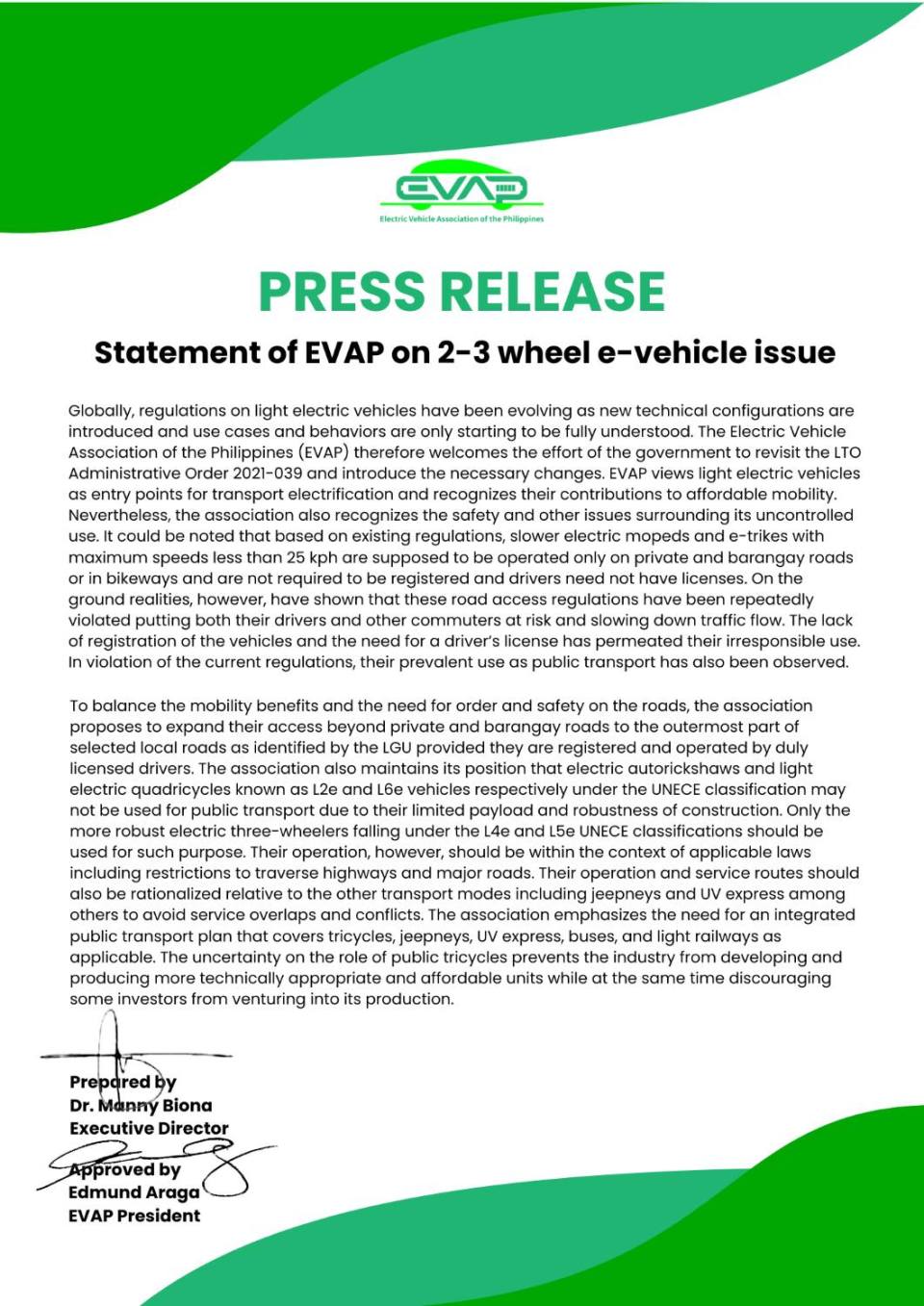
I tend to agree with the eVAP statement more than the stand of other organizations or entities. Perhaps its because I know many people behind eVAP (at one time I was one of their advisers) and trust that their statement is based on informed discussions not just among themselves but their partners and cooperators among different sectors including the government.
–
 Caught (up) in traffic