
Home » Health (Page 10)
Category Archives: Health
Traveling abroad soon?
I miss traveling, particularly overseas. My last travels abroad were to Sri Lanka in September 2019 and to Singapore in December 2019. My long travels within the Philippines was to Zamboanga in January 2020 and Cebu in February the same year. We were supposed to go back to Zamboanga to do some field work in March 2020 but the trip was canceled when the first lockdowns were enforced. I was supposed to travel to Hiroshima last September 2021 for a conference that we highly anticipated partly because of the opportunity to go to Japan again and do another sentimental trip to certain places in that country, including taking the Shinkansen and other trains to go around.
Recently, the US reopened to international travelers and friends have already crossed the Pacific to be with family/relatives there. Here is an article from The New York Times about what you need to know when traveling to the US; including vaccinations:
On the key transformations needed to achieve sustainable, low carbon transport
Also related to COP26, I am sharing material from the Sustainable Low Carbon Transport (SLOCAT) partnership, of which our center is part of. SLOCAT recently released the 11 key transformations for sustainable low carbon land transport urgently needed to meet the climate targets. Here’s a link to their site:
SLOCAT also has the following Wheel of Transport and the Sustainable Development Goals (SDG’s) on the same site. The Wheel illustrates the four cross-cutting themes: equitable, healthy, resilient and green.
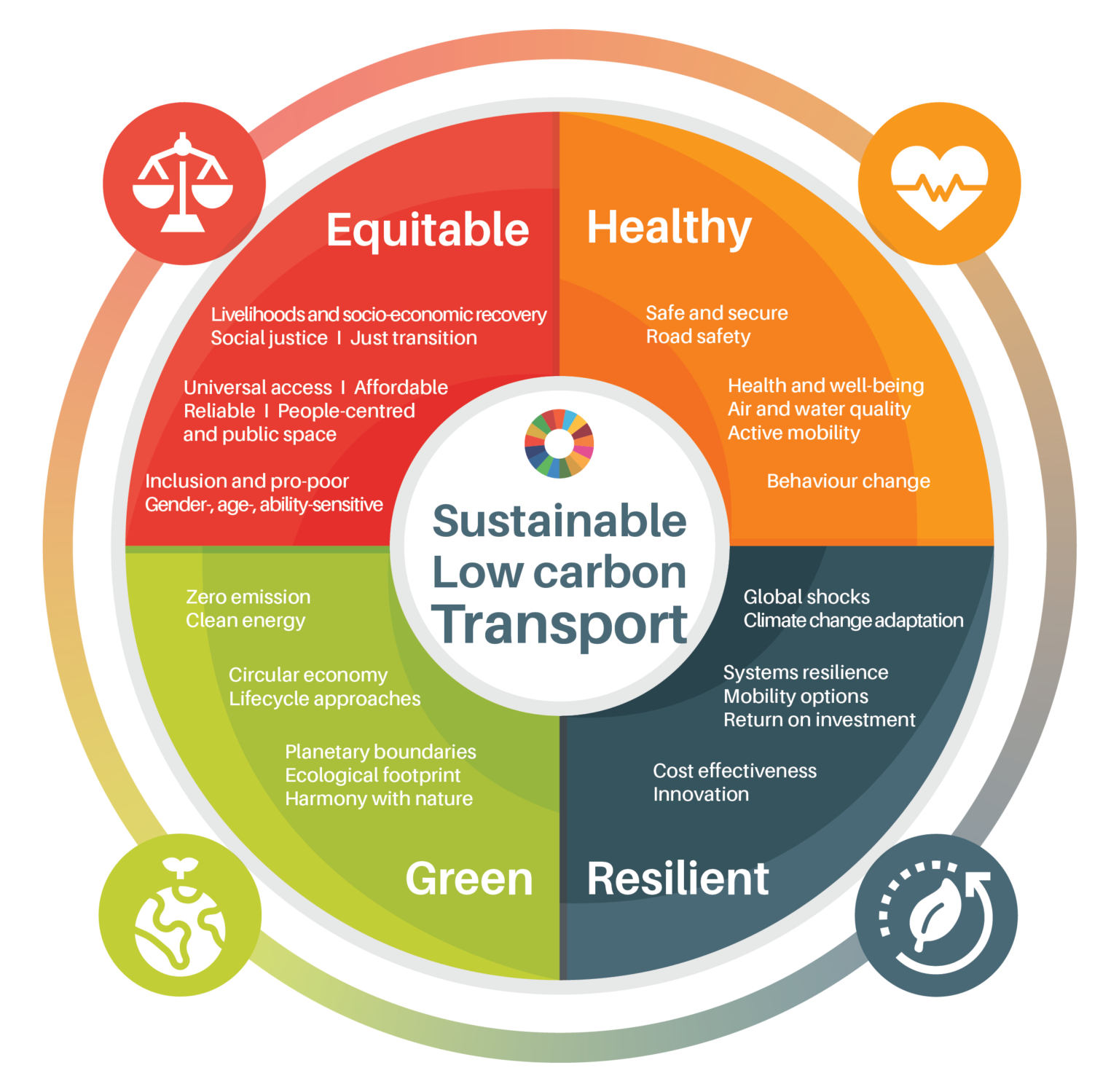
In the SLOCAT site, they list the following to support the transformations:
Overarching approaches to apply across transport modes and sub-sectors overtime
- Put people first, not vehicles and technology
- Co-create and communicate a compelling vision and targets
- Guide short- and medium-term action with clear, coherent political messages
- Combine push and pull measures: Regulate and incentivise
- Link policies within and beyond transport for synergies
- Prioritise resources by social and sustainable value for money
- Engage, empower and coordinate stakeholders across government levels and sectors
- Build capacity and improve data
- Implement pilots to learn and share, then roll out at scale
–
On the 12 global road safety performance targets
The UN recently released the Global Plan for Road Safety. I’m just sharing their graphic on the global road safety performance targets:

I will try to discuss each one in future posts especially as I am involved one way or another in trying to realize these targets. Note, too, that these targets are further categorized among the five pillars mentioned at the foot of the graphic. These are (1) Road safety management; (2) Safer roads and mobility; (3) Safe vehicles; (4) Safe road users; and (5) Post-crash response.
–
We need to do more to reduce transport emissions
I did some work on long term action plans on low carbon transport for the ASEAN region before. We were able identify many of interventions that were being implemented as well as those that can be done to reduce transport emissions. Such reductions for the region would ultimately contribute to alleviating global warming. Unfortunately, while ASEAN is a significant contributor to emissions, it pales in comparison to emissions by individual countries like China and the US. If these two and others in the industrialized world do not commit to reducing their emissions, all work will come to naught. Here is an article that serves as a pre-event write-up for COP26, a major climate summit that will be held in Glasgow in the coming days.
–
Safe streets for children
We have been working with UNICEF and several partner organizations on a project on Child Road Traffic Injury Prevention (CRTIP). The Final Reports for the two pilot cities, Valenzuela City and Zamboanga City, have been submitted and represents over 2 years work including during the lockdowns due to the Covid-19 pandemic. The latter part of project implementation indeed became a challenge as we couldn’t travel and engage face-to-face or conduct field surveys like how we did in the first part of the project. Still, I believe we were able to accomplish much and most of what we initially set out to do. Here are the covers of the Final Reports we submitted to UNICEF and we understand will be officially or formally transmitted to the two cities.


The reports narrate the surveys conducted for 25 schools in Zamboanga and 41 schools in Valenzuela. Each initially had selected 25 schools but Valenzuela pushed for an additional 16 schools midway into the project. The SR4S tool developed by iRAP was used for the assessments of critical areas around the schools. The initial assessments were used to identify interventions to improve safety in these areas and recommendations were submitted for consideration of the cities as well as the DPWH where applicable (i.e., the DPWH has jurisdiction over national roads and improvements proposed along these). While some interventions were implemented, others and many were delayed mainly due to Covid-19.
We also conducted a survey to determine the commuting characteristics of schoolchildren in both cities. Since most schools were public schools, it was no surprise that most children lived near the schools or within the school district (which is basically the catchment area for these schools). Thus, it also came as no surprise that most schoolchildren came by foot (walking), motorcycles (riding with a parent) or motor tricycle. There’s a lot of information and takeaways from the data but unfortunately, we could get the bigger, more complete picture of Valenzuela City because they selected only elementary schools covering students from Grades 1 to 6. Zamboanga had a more robust data set with both elementary and high schools, covering Grades 1 to 12. The information derived from these surveys were also analyzed and related to the SR4S assessments. The commuting survey results and SR4S assessment are subject of two technical papers presented in the recent EASTS 2021 conference hosted by Hiroshima University.
What’s next? We are now drafting a proposal for a Phase 2 of the project. We hope to continue and reinforce and follow-up on the recommended interventions from Phase 1. We also hope to be able to work on the CRTIP data hub that was only partly completed due to the many constraints faced by that part of the project. I will post here from time to time about some of the outcomes from the surveys and assessments.
–
On current health protocols applied to public transport
The current surge of infections attributed to the Delta variant of Covid-19 has been alarming. The recent quarantine issuances by national government have not been effective as there was basically lax enforcement or implementation. Granted, there were just a lot of loopholes designed to allow so-called “economic frontliners” to go to work and under conditions that made their commutes risky in the context of the pandemic. The same laxity and loopholes apply too, to people who have no business roaming around and yet travel with their motor vehicles (especially motorcycles) and bicycles across cities, towns and provinces in the guise of exercise or essential travel.
Meanwhile, the practice and enforcement of public health protocols in the country has been lax and misguided (e.g., do we really need to wear face shields?). In public utility vehicles, people are now crowding inside with usually only a sheet of plastic separating one from another. This is not exactly reassuring in as far as spreading the virus is concerned. And we shouldn’t pretend that we are not aware that there are asymptomatic people going around and infecting others whether knowingly or not. It’s no wonder, really, why people who have the private vehicle or active transport option use these instead of public transport.


Much has been said about government failing to address the Covid-19 pandemic from the start. And it continues to bumble through this health crisis (if you don’t want to call it one then either you don’t understand the gravity of the problem or just refuse to do so – the latter is worse). Tagging workers as ‘economic frontliners’ is probably at least as bad as calling BPO workers ‘Bagong bayani’, adding them to the Overseas Foreign Workers (OFWs) who had been branded as so in the past. This becomes a convenient excuse to ease health-related restrictions for people to travel/commute to work. It is a form of gaslighting the very same workers to believe they need to go out and work. Meanwhile, precious funds are being diverted elsewhere including the dolomite beach at Manila Bay and money spirited away in preparation for next year’s elections.
I got it from recent surveys that people give a higher priority to employment and earning income over Covid-19. Perhaps most have not had direct experiences with the frightening cases of Covid-19 (i.e., they’re asymptomatic or have encountered only asymptomatic cases with friends and families). I hate to say it but it seems like the same thinking pertaining to extra judicial killings (EJK). I can already imagine hearing the usual comments: “Malayo sa bituka.” “Wala akong pakialam diyan.” “Okay lang yan. Hindi naman kami apektado niyan.” These comments reflect an absence of empathy. Empathy I think is very much needed today in order for people to understand what’s going about. And that’s not just about us but businesses as well that definitely, likely lost a lot during this pandemic but still need to empathize if not call out those who are really responsible about the mess we are in. Do your employees really need to go to the office? Or can they continue working from home? The answer to these questions affect commuting in the time of Covid-19 and relates strongly to the protocols applied to public transport.
–
On defining the 15-minute city
I have shared articles and briefly written about the concept of the 15-minute city on this blog. Here is another discussing how a 15-minute city is defined:
(February 8, 2021) “Defining the 15-minute city,” Public Square, https://www.cnu.org/publicsquare/2021/02/08/defining-15-minute-city [Last accessed: 8/10/2021]
Here is an image from the article:
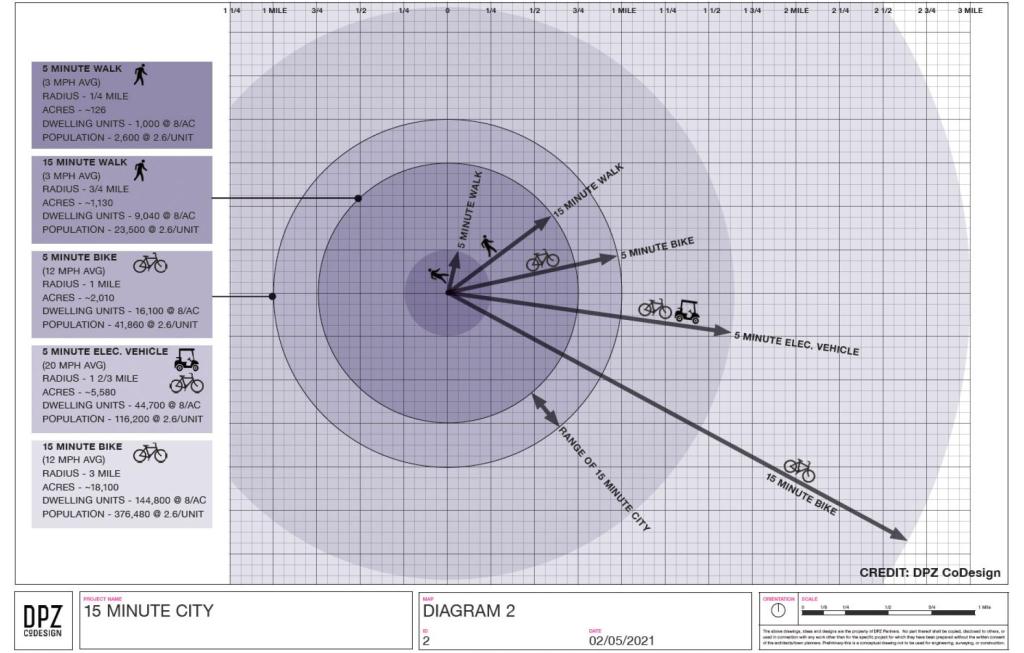
Again, it is important to contextualize these concepts. I share these as references and topics for discussion. Of course, I have my own opinions about this and I have written about those in previous posts. I guess in the Philippine context, we can include the pedicab or non-motorized three-wheelers in the discussion. These are also very popular modes in many cities and municipalities despite their being also prohibited along national roads like their motorized counterparts. It would be nice to have more visuals in the form of maps that show travel times for essential destinations or places like hospitals, markets, grocery stores, workplaces and, of course, homes. I assume there is at least someone, somewhere who perhaps have made multi-layer maps of this sort and attempted to related them along the lines of this concept of a 15-minute city (or perhaps the even older “compact cities”).
–
On quantifying the benefits of bike share
I’m sharing another article that presents a quantification of Such articles and studies are gaining interest as cycling or biking becomes a popular choice for many seeking an alternative to their usual or former modes of transport. It helps that there are many initiatives promoting active transport in general and cycling/biking in particular.
Wilson, K. (July 23, 2021) “Study: Bike Share Saves the U.S. $36 Million Public Health Dollars Every Year,” StreetsBlog USA, https://usa.streetsblog.org/2021/07/23/study-bike-share-saves-the-u-s-36-million-public-health-dollars-every-year/ [Last accessed: 8/6/2021]
While the article is about bike share, the conclusions can be extended to cycling/biking in general. The article points to at least 3 major areas where benefits can be derived: safety, air pollution (reduction) and physical activity. To quote:
“I think the message to cities is that bike share — and biking in general, though that’s harder to quantify in the way we do in this study — can contribute a lot to their long term goals,… Most cities want to improve quality of life, the economy, the climate, and their public health outcomes. Bike share does all those things.”
–
On riders’ perception of safety
The Federal Highway Administration (FHWA) of the US Department of Transportation released some infographics recently to highlight road safety. One very timely and relevant graphic image asks about which facilities make bicycle riders feel safer:

There were some initial reactions when I shared this on social media with one immediately criticizing share-use paths and citing the one along Marcos Highway (stretch under Pasig, Marikina, Cainta and Antipolo) as an example. I quickly explained that the graphic assumes good designs instead of the flawed one along Marcos Highway. In fact, the shared use path is also quite popular in Europe and particularly in the Netherlands where they have many examples of these paths stretching for kilometers that are exclusive to active transport (pedestrians and cyclists). The good designs need to be shared and circulated so people will know about what they look like and learn about their features. These can be adopted and adapted to local situations.
Did you notice the images of cyclists/riders at the top of the graphic? These are important, too, because they provide context in terms of the type of riders who are the targets for infrastructure and campaigns that support and promote cycling across different types of people. Cycling shouldn’t just be for the most fit or the weekend warriors but rather for everyone who could take it up and not just for recreation but for everyday, utilitarian use (e.g., commuting, shopping, etc.).
Another look at the ‘avoid, shift and improve’ framework
The transport and traffic situation during this pandemic has revealed a lot about what can be done and what needs to be done about transportation. Discussions about what and how people visualize their ideal or acceptable transportation system reminded me of the backcasting concepts and the tools. The following diagram is sourced from the SLoCaT homepage: https://tcc-gsr.com/global-overview/global-transport-and-climate-change/
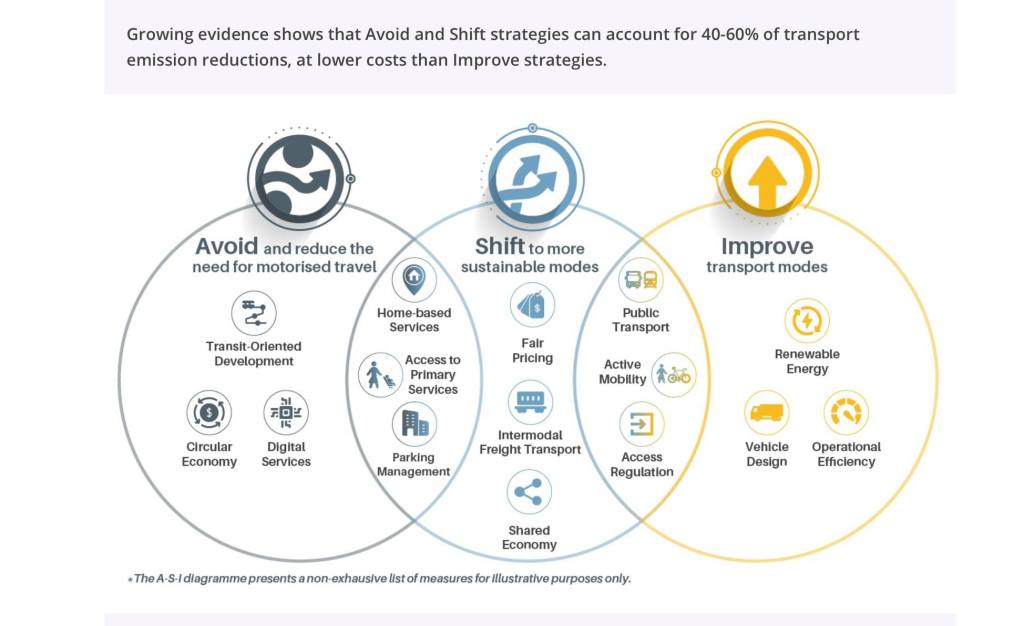
Note the overlaps among the three? Do you think its possible to have a measure that’s avoid, shift and improve at the same time?
Note, too, that if we contextualize this according to the Covid-19 pandemic, these measures even make more sense rather than appear like typical, ordinary measures we have about transportation. The pandemic revealed many weaknesses or vulnerabilities of our transportation system. We are presented with the opportunity to address these and implement certain measures that would have met with a lot of opposition before but can probably be rolled out now such as public transport priority schemes and protected bike lanes. “Work from home” is not really new since the concept has been proposed and implemented before but not as widely as was required by the pandemic situation. So perhaps we should take advantage of this forced reboot of sorts for our transportation system to be able to implement this A-S-I framework.
–
 Caught (up) in traffic