
Home » Health (Page 12)
Category Archives: Health
If you build the bike lanes, will people use them?
The obvious answer to this question is yes. It is not so clear, however, how many will really be using these bike lanes over time. That needs data. That requires counting. And such data will be useful in order to understand, among other things, why people choose to bike or why they don’t. The latter is important to determine what factors are being considered by people who can switch to cycling particularly for commuting. Of course, there are many references for this from other cities and countries but these still need to be contextualized from our (Philippine) perspective. Case in point is Marikina, which has the most comprehensive network of bike lanes in the country. What are the numbers and what are the constraints and misconceptions? Did the city do its part to promote and sustain cycling?
Here is an article discussing the experience in the US:
Penney, V. (April 1, 2021) “If You Build It, They Will Bike: Pop-Up Lanes Increased Cycling During Pandemic,” The New York Times, https://www.nytimes.com/2021/04/01/climate/bikes-climate-change.html?smid=url-share [Last accessed: 4/9/2021]
 Bike lane along Katipunan Avenue (C5) in Quezon City
Here is the link to the paper mentioned in the article:
https://www.pnas.org/content/118/15/e2024399118
–
On the importance of trees along streets
I’ve written before about the importance of having parks around a city or town. Here’s an article I recently read about the positive impacts of trees along streets:
Stimpson, A. (March 12, 2021) “Green health: a tree-filled street can positively influence depression, study finds,” The Guardian, https://www.theguardian.com/us-news/2021/mar/12/baltimore-study-trees-mental-health-study [Last accessed: 3/29/2021]
 Tree-lined street somewhere in Antipolo City, Rizal
We often refer to cities as the urban jungle. Why not really, literally make cities as urban jungles by planting more trees and other plants where its possible to grow and nurture them. Gardens may be grown not just for flowers or aesthetics but for food. Perhaps architecture should deliberately be oriented for greens? Orchard Road in Singapore is much admired for its trees. Surely, similar streets in our country can be landscaped accordingly.
–
On a different view of the ’15-minute city’ concept
Here is an article discussing the downside(s) of the 15-minute city; particularly its adoption without understanding first and setting the context for the concept:
O’Sullivan, F. (March 3, 2021) “The Downside of a 15-Minute City,” Bloomber CityLab, https://www.bloomberg.com/news/articles/2021-03-02/the-downsides-of-a-15-minute-city [Last accessed: 3/20/21]
Some people are pushing very much the same concept for quick adoption in the Philippines without again contextualizing it. I feel these people are detached or choose to be so perhaps as they seek shortcuts to achieve what they believe should be the way cities and municipalities are laid out in the country. But wait…don’t we already have 15-minute cities in the Philippines? I will be writing about that soon…
–
On planning communities for children
I am currently involved in a project concerning child road traffic injury prevention (CRTIP). The topic of road safety is also close to my heart since a beloved aunt died due to injuries sustained after being hit by a jeepney. She was in great health and walked almost daily between our home in Iloilo and the church to hear Mass. Children and senior citizens are among the most vulnerable road users and so I believe we must address their needs more than able-bodied adults. That would probably make our communities safer and friendlier to most people. Here is an article that tackles planning for communities from the perspective of children and families:
Litman, T. (March 9, 2021) “Planning communities for children and families,” Planetizen.com, https://www.planetizen.com/node/112498?utm_source=newswire&utm_medium=email&utm_campaign=news-03112021&mc_cid=5a75b816a6&mc_eid=9ccfe464b1 [Last accessed: 3/14/2021]
To quote from the article:
“Here is a summary of child-oriented urban design features:
-
Children need opportunities to join a loose social group of other children without a formal—or prearranged—invitation to play.
-
Children need access to safe, uninhibited outdoor play to support their physical and mental health. Outdoor play should include opportunities to interact with the natural environment—finding bugs, smelling flowers, playing in puddles, or collecting objects—without the need for excessive rules, oversight, or segregation.
-
Children need environments that are safe from traffic, pollution, and undue physical or social hazards, including safe routes to and from school and local playgrounds, allowing them to travel throughout their neighbourhoods safely in order to develop confidence, resilience, and independence.
-
Children need private spaces for themselves and their friends, including tree houses, forts, or clubhouses that are close to home yet away from public view. 5.
-
Children need stable, appropriate, and affordable housing that provides them with private space to rest, study, and play.
-
Children need local access to appropriate early childhood education, child care, and community schools.
-
Children benefit from the opportunity for their parents to work locally.
-
Children benefit from walkable communities, with infrastructure for safe walking, cycling, and recreation.
-
Children benefit from diverse, multi-generational communities, where they can interact with—and learn from—children, adults, and seniors of all races, religions, cultures, and incomes.
-
Children should be given an opportunity to effectively and productively participate in decision-making processes.”
–
Vaccine passports anyone?
As the Philippines, relaxes protocols to contain the Covid-19 pandemic, it is interesting to note that other countries have not let down their guard. And the latter includes nations that have been quite successful in dealing with the pandemic. Many countries have also received the vaccines and have started inoculating their populations. These received the doses ahead of the Philippines and have now vaccinated a significant % of their population according to their respective prioritization schemes.
But even as countries have started vaccinations, the question remains whether a vaccinated individual can now move around or travel as if it were pre-pandemic conditions (the old normal). Here’s a nice article to read as the topic of unrestricted (or restricted, depending on your take) comes up in discussions including those leading to certain policies to be formulated by governments:
Fisher, M. (March 2, 2021) “Vaccine passports, Covid’s next political flashpoint,” The New York Times, https://www.nytimes.com/2021/03/02/world/europe/passports-covid-vaccine.html [Last accessed: 3/4/2021]
–
On leaders and decision-makers taking public transport or bikes to commute
There has been clamor for our leaders and decision-makers, especially those in the transport and highway agencies, to take public transportation. This is for them to experience how most commuters fare for their daily grinds. And no, having an entourage including bodyguards or reserving your own train car does not count. Dapat pumila o maghintay sa kalye. Makipagsisikan o makipag-habulan sa bus, jeepney o van para makasakay. Many if not most of these officials have their own vehicles or are even driven (may tsuper o driver) to and from work. One even had the gall to transfer his department to where he comfortably resides so he won’t commute but that’s another story.
You see articles and posts about Dutch politicians and even royalty riding the bicycle to work.
 The Dutch Prime Minister bikes to work
Then there are politicians regularly taking public transport while in office. Here is an article about the newly inaugurated POTUS, Joe Biden, who took the train for his regular commutes:
Igoe, K.J. (May 4,2020) “Where Did “Amtrak Joe,” Joe Biden’s Nickname, Come From?”, Marie Claire, https://www.marieclaire.com/politics/a32363173/joe-biden-amtrak-joe-meaning/ [Last accessed 2/14/2021]
Do we have someone close to such an example? Commuting by private plane between your home in the Southern Philippines and your office in Manila surely won’t let one have an appreciation of the commuting experiences of typical Filipinos.
–
On the need for more public spaces
Here’s a quick share of an article discussing the pandemic’s exposing the need for more public spaces:
Ionescu, D. (February 5, 2021) “The Pandemic Revealed Public Space as ‘Essential Infrastructure'”, Planetizen.com, https://www.planetizen.com/node/112044?utm_source=newswire&utm_medium=email&utm_campaign=news-02082021&mc_cid=4fac9821d0&mc_eid=9ccfe464b1 [Last accessed: 2/9/2021]
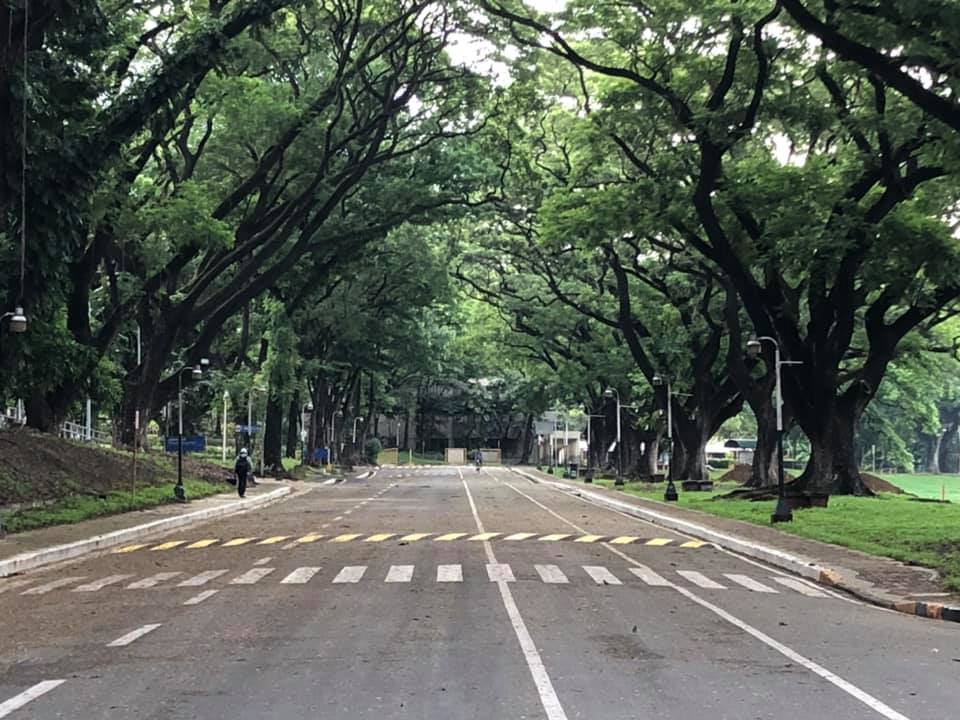 Quezon City is lucky to have the Quezon Memorial Circle, Parks and Wildlife and the University of the Philippines Diliman campus but it needs more public spaces given its size. UP should not technically be regarded as a public space as it is a school first and just happens to be blessed with a spacious campus. Pictured above is its academic oval with the Sunken Garden to the right.
Public spaces include parks and other open spaces that serve as breathing spaces or lungs for our cities and municipalities. A lot of people complained about being cramped up during the lockdowns and are now going out (others quite recklessly) even with the specter of Covid-19 still about us. In many old towns around the country, there are plazas and of course fields where people can go to while maintaining safe physical distancing. We certainly lack for these especially in highly urbanized cities. Rizal Park and its surrounding areas including Intramuros are not sufficient for dense Manila. In Taguig, you see a lot of people taking walks or exercising along the C5 service road. Its good that they actually have a linear park in Lower Bicutan and maybe parts of BGC where people can “decompress” from their cramped conditions where they reside but again, these may not be enough. Cities and municipalities need to allocate or build more public spaces. These should be deliberate developments to create such spaces (even small playgrounds scattered around a city would be a good start) for everyone’s well-being.
–
What type of seat is appropriate for your child?
I wrote yesterday about the new law requiring child seats for children 12 and under or under 4’11” in height in the Philippines. The implementation has been postponed after government received a lot of flak about it. To be fair, the info campaign started months ago but it seemed to be limited to social media and not really disseminated as widely as is ideal. The material while catchy at first glance, is not as clear in the info or message as already evidenced from the flak about the law and its provisions.
Here is a graphic from the US National Highway Traffic Safety Administration (NHTSA) that is quite easy to understand:
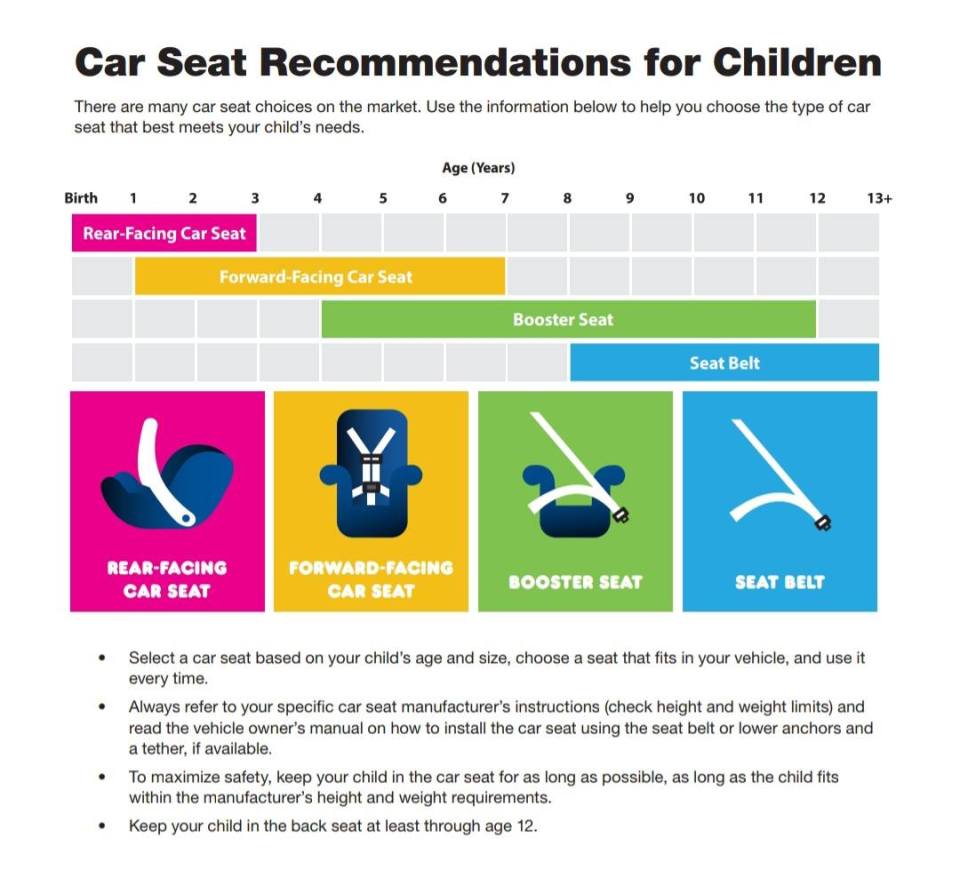
Based on the information from the NHTSA, the CDC came up with the following graphic:

It would have been clearer and more effective in communications if the agencies-in-charge came up with similar material rather than the one I shared in yesterday’s post. There are also many designs for child seats and so far there are no specifics about these that people could refer to. Ultimately, I believe there should be a list of what are allowed or not allowed including brands. Perhaps its better to have a list of what are not allowed with the reasons for these, and then let the manufacturers challenge these. Having a list of allowed products might come off as advertising or favoring certain manufacturers. Of course, it will be up to the Bureau of Product Standards (BPS) of the Department of Trade and Industry (DTI) to determine which seats will be allowed based on their specs and the standards they conform to. European and US standards are among the most stringent so perhaps these can be reviewed and determine whether they can be adopted in the Philippines.
–
On R.A. 11229 and the requirement of Child Seats
There seems to be a lot of feedback (mostly negative) on the new law and its implementing rules. RA 11229 is the “Child Safety in Motor Vehicles Act” that requires the use of child car seats. There seems to be a confusion about who are supposed to be using child seats particularly about the age and height limits mentioned. In one “controversial” interview, a government transport official was recorded replying to a question about tall children that the parents would have to get a bigger vehicle. That was obviously uncalled for but also probably what can be considered as a “snappy answer to a stupid question[see note below]” type of situation. What is clear now is that a lot of people are not aware of the provisions and implications of the new law (for various reasons including their choosing to ignore it) and there needs to be a more comprehensive and effective info campaign on this topic. Not yet mentioned in discussions are the models of car seats that are approved or certified for use.
 Screenshot of a graphic explaining who are required to use child car seats
Here are examples of the opinions and comments in one of the group discussions I am part of [I will just leave these without specific attribution or anonymous.]:
- “RA#11229 was badly written. Authored by Sen JV Ejercito, trying to copy laws in the USA. In California, the Child Safety Seat is only required for child 2 years old and below, 4 years old in NY, and 3 years old in Europe. Additional parameters: height limit of 40″ (101 cm) and weight limit of 40lbs. They differentiate rules for children up to 8 years in NY & CA.”
- “The Philippine version lumps all kids into one group below 12 years old, requiring child restraint system. Additional parameter is 150 cm height, none on weight. Two wrong premises of our law: 1) that Filipinos children are taller than Europeans and Americans of same age, and 2) Filipino children mature later at 12.”
- “They lumped it into one class because its the simplest and easiest thing to do, without going into a lot of uncertainty. Na controversial na nga yung 12 yr. old catch-all, ano pa kaya kung they broke it down into numerous classifications.”
[Note: To those who are not familiar with the term “snappy answers to stupid questions”, google it together with Mad Magazine.]
–
On using a car for transport in the time of COVID-19
We start the month of February with a very informative articles from the New York Times about car use and the spread of Covid-19. There have been a lot of discussions or discourse, even arguments, about private car use or shared vehicles (e.g., Grab) as people have apparently chosen these over public transport in many parts of the Philippines. For one, there is still a limited supply of public transport as government tries to take advantage of the situation to implement their rationalization and modernization programs.
The following article is from the US but the principles presented particularly about air flow and the potential spread of the virus inside a car are factual and apply in a general manner to other situations including ours. It is important to have an appreciation of the science behind air circulation and how it relates to the potential infections.
Anthes, E. (January 16, 2021) “How to (Literally) Drive the Coronavirus Away,” New York Times, https://www.nytimes.com/2021/01/16/health/coronavirus-transmission-cars.html [Last accessed: 2/2/2021]
The common misconception appears to be that using private vehicles automatically helps spread the coronavirus. The science tells us it is not as simple as that (i.e., using your own vehicle will lead to your and your family being infected). While private vehicles are not the proverbial suit of armor vs. Covid-19, their proper use might give better chances compared to crowded and/or poorly ventilated public utility vehicles. Walking and bicycles, of course, are most preferred but that’s a topic for another article.
–
 Caught (up) in traffic