
Home » Health (Page 19)
Category Archives: Health
Article on sustainable transport’s role in “saving the world”
Here is another quick post on another article I am sharing showing the importance of sustainable transport:
Milner, D. (2019) How sustainable transport can save the world, medium.com, https://medium.com/@djjmilner/how-sustainable-transport-can-save-the-world-f2f64517dc52 [Last accessed: 4/9/2019]
It goes without saying that sustainable transport has a lot of potential for helping mitigate climate change and other issues but much is expected of our leaders for policies and program & project development & implementation towards achieving sustainable transport in our cities and municipalities.
–
References linking transportation and health
The Institute of Transportation Engineers (ITE) features several resources discussing the linkage between transportation and health. Here is the link to the page where they list references like reports from various sources as well as tools.
This is definitely a topic that needs more attention and studies in the Philippines in order to have local evidence (there are already strong evidence abroad) supporting active transportation and how it helps make citizens healthier. Of course, that goes without saying that active transport should be integrated with an efficient public transport system. That is so that the increasing share of private transport can be checked (no thanks to Grab and Uber) and we can either retain or increase public and active transport shares.
–
On re-designing or re-imagining our transportation system for people
Here is another good read especially for those who advocate or even just beginning to appreciate the concept of people-oriented transportation:
VannPashak, J. (2018) “Design for humans as they are, not as you want them to be,” http://www.medium.com, https://medium.com/@jvannpashak/design-for-humans-as-they-are-not-as-you-want-them-to-be-ef95076c0988 [Last accessed: 11/23/2018].
In a recent symposium where I made a presentation about low carbon transport and visioning and re-imagining transport, I was asked how we can re-design our transportation to be more people-oriented than car-oriented. I replied that we have to do a lot of unlearning. That is, many planners and engineers would need to unlearn many things they’ve learned in school and those they got from their workplace. One convenient excuse for not coming up with a better design, for example, is that certain planners or engineers just followed what their offices or agencies have been doing. What if what their offices and agencies (and consequently their seniors at work) where wrong all these years and what was “ginagawa na” or “nakasanayan” have led to deficient outcomes? I even joked about whether these offices or agencies were “open minded” referring to a favourite by-line by networking companies. Being open-minded in the context of having people-oriented transport solutions would be difficult if everything was “nakakahon” because these were what you learned from school and/or the workplace. It is difficult to admit that something was and is wrong.
–
On the need to increase NMT and public transport use
A recent report reinforces what many of us already probably know or are aware of – that we need to shift away from dependence on car use to more sustainable modes of transport in the form of non-motorised transport (NMT) and public transportation. Here is the article from the AASHTO Journal:
Global Climate Report Calls For Expansion Of ‘Non-Motorized’ Transport And Public Transit (2018)
There is a link to the report in the journal article. The report is conveniently available in PDF form and is very readable (i.e., not overly technical).
Incidentally, I was involved some time ago in a project led by the group Clean Air Asia (CAA), which involved several experts from across ASEAN as well as Japan that attempted to determine the necessary transport programs and projects in the region to stave off the projected increase in global temperatures. In all the scenarios evaluated, non-motorised transport (NMT) and a rationalised public transportation system By the term ‘rationalised’ I am referring to the use of higher capacity vehicles as against the taxis and tricycles that typically carry few if not one passenger. Here is a link to the final symposium for that study that has links to the materials presented:
The Final Symposium on the “Study on Long Term Transport Action Plan for ASEAN”
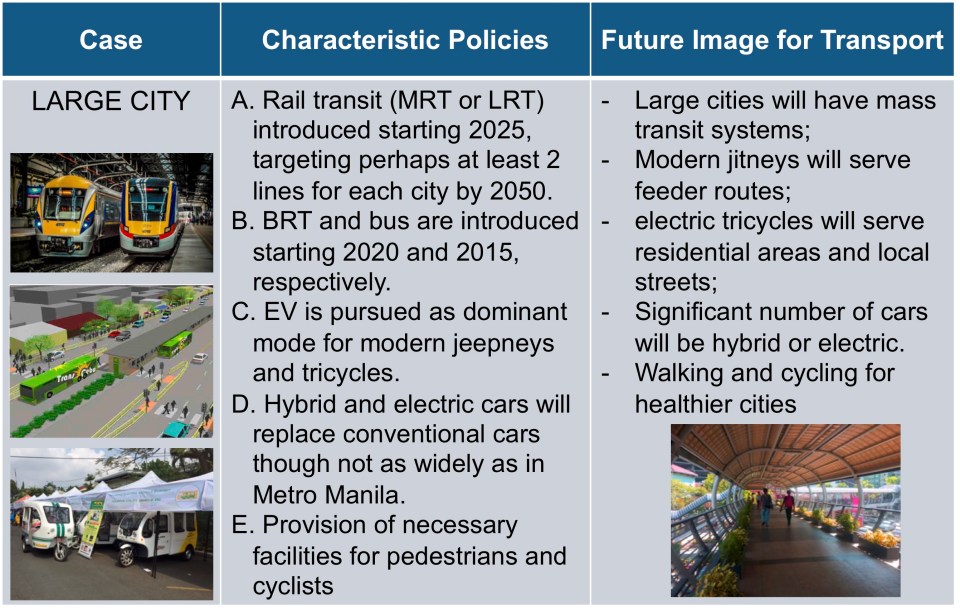
Here’s a slightly updated slide on the future image for a large city in the Philippines:
–
School is back and so are safety issues for schoolchildren
It’s school time once again in most parts of the Philippines. Public and private schools including most colleges and universities have resumed classes this month of June while others start this July and August. But with the resumption of classes, there is also the re-emergence of issues pertaining to the safety of these children. Students are exposed to the hazards of commuting. These include the likelihood of being injured or killed by vehicles running along the roads the students use to get to school.
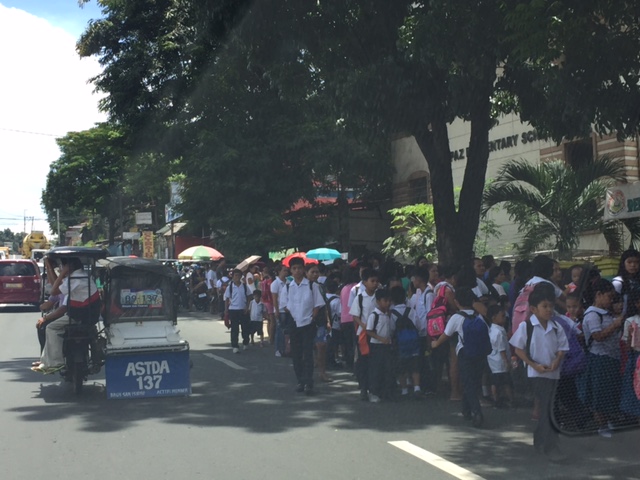 The photo above is a typical scene in front and around many public schools in the country. Schools are located along national roads and often lack spaces for students and their guardians. Many end up occupying the roads and causing congestion. Of course, that congestion is secondary to the safety of these children. Nevertheless, such issues need to be addressed in a more holistic manner rather than attempt to solve one as if they could be isolated.
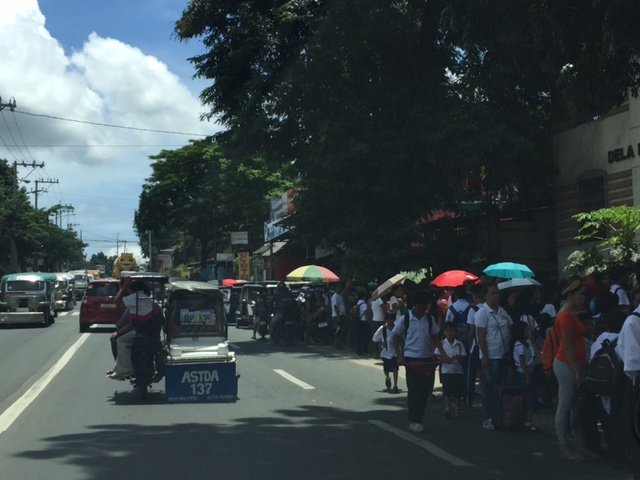 Most students of grade schools and high schools around the country either walk or take public transportation in their commutes. They are exposed almost daily to motor vehicle traffic along the roads and risk being sideswiped or run over by vehicles. In certain cases, small children walk significant distances thereby increasing the likelihood and risk of being harmed by traffic.
Traffic is particularly bad along most roads leading to schools mainly during the morning, mid-day and afternoon periods when students arrive or leave their schools. In Metro Manila, for example, the worst congestion are experienced along major roads like Katipunan Avenue (due to traffic generated by Ateneo, Miriam and UP) and Ortigas Avenue (due to La Salle Greenhills). That means a lot of time and fuel are wasted and more emissions are released into the air that we breathe. However, one can argue that in terms of road safety, this is better since gridlocks mean slow moving vehicles that make it safer for walking or cycling. This is not the same in the provinces or rural areas where there is less congestion and vehicles travel at faster speeds.
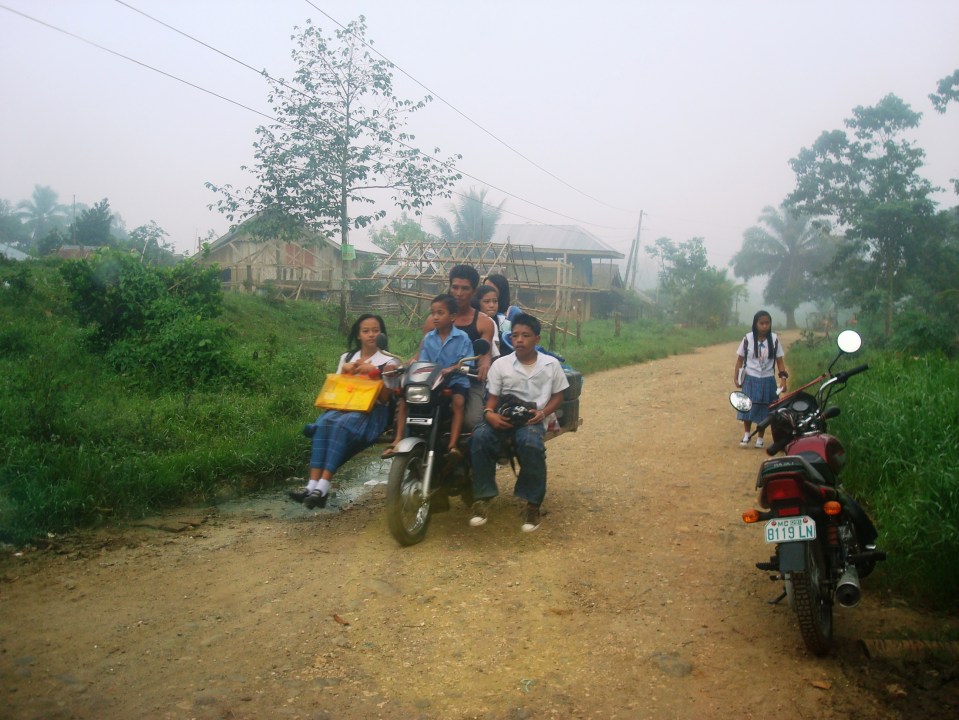 Children heading to school on a ‘skylab’ version of the motorcycle taxi
While there are initiatives pertaining to revisions in speed limits, such are limited (pun not intended) by how much action can be done in order to enforce these regulations. Add to this the requirement of having the instruments to measure and record speeds in aid of enforcement. This was what MMDA did along Commonwealth Ave. and Macapagal Blvd. with the acquisition of two speed guns. I don’t see them using these anymore and wonder if the instruments are still working. Meanwhile, expressway authorities are using these as they continue their enforcement of speed limits along tollways. [I am aware of NLEX and SCTEX enforcement units employing speed guns along those tollways.]
The DPWH is also doing its part by doing road safety audits and identifying measures to reduce the likelihood of crashes involving these students. Among these are rumbles strips and, in some cases, the construction of sidewalks but these are not enough. There were recommendations from an iRAP project many years ago but the agency was resistant to what they thought were new and innovative ideas that were actually already being implemented in other countries. Perhaps these recommendations and that iRAP study could be revisited and solutions drawn from there?
–
On the opposition to “complete streets”
I recently read an article about the opposition to road diets in California, USA:
Tinoco, M. (2018) “How to Kill a Bike Lane”, http://www.citylab.com, https://www.citylab.com/transportation/2018/05/how-to-kill-a-bike-lane/559934/?utm_source=SFTwitter [Last accessed: 5/20/2018]
So far, we know that at least three cities are progressive enough to implement road diets including Marikina City, Pasig City and Quezon City. Iloilo doesn’t count yet since their bike lane was constructed along the very wide Diversion Road. Our recommendations for Tacloban, if implemented by the city, will probably result in the second most comprehensive application of road diets/complete streets in the Philippines after Marikina, which implemented their bikeways network almost 2 decades ago. There are sure to be many who would be opposed to such schemes as many still have the view that streets are for motor vehicles. This car-oriented thinking is something that will be a challenge to advocates of people-oriented transportation systems. Hopefully, many can learn from experiences here and abroad on how to reclaim space for people leading to safer and more inclusive transport for all.
–
On child-friendly cities
Here’s another article that I want to share. This time it is about child-friendly cities. Here is an article that present many good practice examples in other cities. Many are easily replicable in our towns and cities, and should be considered by local governments in order to enhance safety and health aspects in their jurisdictions.
Laker, L. (2018) “What would the ultimate child-friendly city look like?”, theguardian.com, https://www.theguardian.com/cities/2018/feb/28/child-friendly-city-indoors-playing-healthy-sociable-outdoors [Last accessed 3/9/2018]
–
On prioritising pedestrians and promoting walking
We begin March with an excellent article that came out from curbed.com:
Walker, A. (2018) The case against sidewalks and how cities can create new avenues for pedestrians, curbed.com, https://www.curbed.com/2018/2/7/16980682/city-sidewalk-repair-future-walking-neighborhood [Last accessed 2/23/2018].
How do we improve the environment (i.e., facilities) to encourage people to walk? Do we simply clear up sidewalks? Widen them? Build overpasses and underpasses? What should be the context for improving pedestrian facilities for our cities and municipalities? What are the implications to planning and design?
–
Another walkability tool: Pedestrians First
The ITDP recently came out with a new walkability tool called Pedestrians First. Here’s the link to their site where you can download the tool. The tool was released in the recently concluded World Urban Forum held in Malaysia.
https://www.itdp.org/publication/walkability-tool/
Of course, there are other tools out there including one developed by Clean Air Asia, material on which may be found through the following links:
http://cleanairasia.org/walkability-study-in-asian-cities-4/
Our technical staff and my students are currently using the methodology developed by Clean Air Asia and have covered several major thoroughfares in Metro Manila and a highly urbanized city in studies that have been undertaken in the last 6 years. I already asked them to take a look at the new tool and see how this compares with the ones we are using.
–
On riding bicycles slowly
I saw this interesting article on cycling/biking that I thought was quite relevant to the situation we have on campus. The University of the Philippines Diliman campus has a bike lane along the inner side of its Academic Oval that has been used by various cyclist types. There are those who use their bikes for commuting or going around campus (e.g., students traveling between buildings for their classes, messengers bringing documents, etc.). There are those biking in a more relaxed manner (i.e., for recreation). And then there are those who bike for fitness including those racing around the oval. It is from the latter that UP Diliman has received complaints about conflicts with joggers, motor vehicles and fellow cyclists. But then UP has maintained that the bike lane is not for racing or taking laps around the oval. It was created to have a segregated (and in the future maybe protected) lane to enhance mobility more than any other purpose.
Babin, T. (2018) “How to ride a bike slowly (and why you would want to),” Medium.com, https://medium.com/shifter/how-to-ride-a-bike-slowly-and-why-you-would-want-to-b544ec869846 [Last accessed: 2/4/2018].
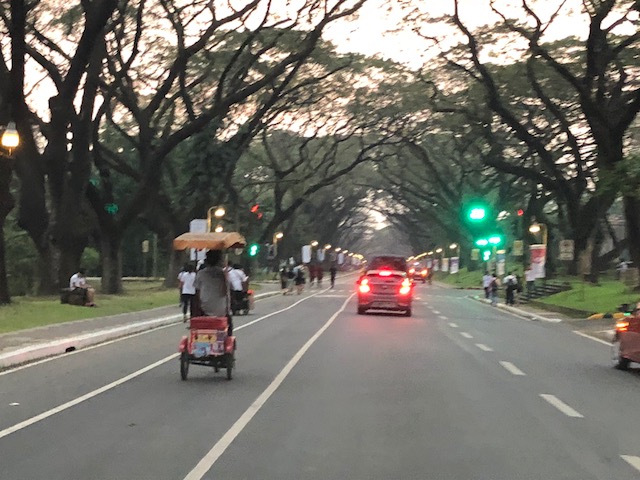 UP Diliman’s Academic Oval now features a bike lane between a jogging/walking lane and the lanes assigned for motorised traffic. The ice cream vendor on a NMT 3-wheeler is running on the bike lane.
–

