
Home » Health (Page 3)
Category Archives: Health
How the Built Environment Affects Your Mood
Here’s a nice read as we do our storm watch, and probably explains why when we reminisce about college or university as “the best years of our lives”.
Source: How the Built Environment Affects Your Mood
To quote from the article:
“It is not for nothing that older adults often regard college as “the best years of your life” because in some cases it truly is. College years serve as a gateway drug to all the amenities and benefits of urban-core living — until you graduate that is. Then you have to return to your parents’ suburban home (as many Americans do) and suddenly all the amenities you had disappear. Your newfound college friends might make up for the lack of a diverse built environment. Nope, they all have moved back to their sprawling neighborhoods too, probably dozens of miles if not hundreds of miles away from your town. You might get a new car to celebrate your graduation and your new 9 to 5 corporate job. Work will keep you busy! But you know what else? Driving. No more waking up 10 minutes before class and arriving just on time. You might now have to wake up a few hours early to drive to your job through rush hour morning traffic, and do it all again in the afternoon.
You might also gain weight — not because you are eating more, but because you are walking less. Various studies demonstrate the link between car usage and obesity, showing “greater levels of obesity in communities where the private automobile is the dominant means of transportation.” And let’s not forget that obesity leads to other health issues such as diabetes and hypertension, among others. Mental health conditions such as depression are more prevalent in adults with obesity. Hence once college ends, graduates stop socializing, stop enjoying public amenities every day, start driving everywhere, stop walking and hence gain a little more weight in the process. Then it is no surprise that young graduates feel unfulfilled, and sometimes even depressed after college — for them, it feels they were robbed of an integral part of their new lives.
Our surroundings impact our mental and physical health. Living in neighborhoods with negative qualities can increase the risk of mental health conditions such as depression. At the same time, the pandemic made us appreciate diversity in our lives and what happens when we are deprived of it. Walkable cities are not “just a preference”; they develop happiness by fostering community trust, promoting physical activity, and offering nearby amenities. As learned, these spaces encourage healthy behaviors, reduce car dependency, and create opportunities for social interaction — all things that are crucial for our well-being.”
Based on this, no wonder I love to stay at the University of the Philippines campus in Diliman. I’m sure my colleagues in UP Los Banos feel similarly.
–
On bike lanes contributing to safer roads
Do bike lanes make roads safer? There are obviously mixed reaction to this question especially if you look as social media. If we are level headed about this topic and look at the evidence out there, the answer is yes. But there can be caveats as we try to contextualize in the local setting. The formal studies so far are in countries where the drivers arguably more disciplined than ours here in the Philippines. Driver behavior, after all, is a major factor for road traffic safety. Here is a good article for reference in the discussions and arguments for bike lanes:
Tu, Maylin (November 5, 2024) “How Bike Lanes Slow Drivers and Save Lives,” Next City, https://nextcity.org/urbanist-news/how-bike-lanes-slow-drivers-and-save-lives [Last accessed: 11/10/2024]
To quote from the article:
“Bike lanes with physical delineators (cones or bollards) were more effective than paint-only lanes at calming traffic, echoing a popular mantra for bike activists: “Paint is not protection.” (The lanes were not protected, however, because drivers could drive over the delineators.) For vehicles turning right, top speeds were reduced by 28% and average speeds by 21%. Paint-only bike lanes slowed driver speeds by up to 14% and drivers going straight slowed down by up to 8%…
The study adds that pop-up bike lanes are a cost-effective solution for studying the effects of more permanent solutions — after all, you could just borrow the traffic cones. A city could quickly implement pop-up or temporary infrastructure. Then, armed with data and community feedback, they could invest in making the changes permanent.”
The article also points to a technical paper or scientific article on the traffic calming effect of bike lanes. Here is the link to the article published in the Journal of Urban Mobility: https://doi.org/10.1016/j.urbmob.2024.100071
–
On whether bike lanes cause more traffic congestion
I previously share articles on whether bike lanes cause more traffic. This question has been asked so often as we have returned to the “old normal” levels of traffic and bike lanes that were put up during the pandemic have been neglected or removed in favor of motor vehicle traffic. The perception for those in-charge of traffic and transportation in local government units is that the space occupied by bike lanes take up the space demanded by motor vehicle use. Thus, the view that bike lanes cause congestion. Here is another article share in support of bike lanes:
Mortillaro, N. (October, 2024) “Do bike lanes really cause more traffic congestion? Here’s what the research says,” cbc.ca, https://www.cbc.ca/news/science/bike-lanes-impacts-1.7358319 [Last accessed: 01/11/2024]
To quote from the article:
“One would think that building more roads with more lanes for cars would reduce congestion, but research shows that’s not the case, thanks to something called induced demand. The more traffic lanes that are put in, the more it appeals to people who may not otherwise have chosen to drive, thereby putting more cars on the roads and increasing congestion.
“So for a short period of time, there might be a slightly improved [reduction], but within a year or two, or perhaps three, traffic is as bad or worse than it was before the lanes were added in the first place,” said David Beitel, data services lead at Eco-Counter, a Montreal company that collects and analyzes pedestrian and bicycle traffic data.
Conversely, if you put in more dedicated bike lanes, people tend to feel safer and demand for use increases, said Shoshanna Saxe, an associate professor at the University of Toronto’s department of civil and mineral engineering and Canada Research Chair in sustainable infrastructure.
“As soon as you build a bike lane, within a year, two years, the latent demand shows up,” she said.
Bike Share Toronto statistics show that ridership on its network of shared bikes has increased dramatically since 2015, when 665,000 bike trips were made annually. In 2023, that shot up to 5.7 million trips.”
I think many people here are already aware of the concept of induced demand. However, this is usually shrugged aside as realities in their situations (e.g., commuting options, locations of residences and workplaces, etc.) lead them to choosing private vehicles (i.e., cars and motorcycles) over public or active transport. The last paragraph there is significant though as there never was and so far a decent estimate of bike trips in any city in the Philippines. Granted that there are attempts to measure bike trips but the volumes published so far are not as reliable as we want them to be in order to be convincing decision-makers to put up more bike lanes. Of course, the convincing part is always challenging if decision-makers have already made up their minds in favor of the car.
–
On the need for helmet laws and their implementation to reduce fatal road crashes involving motorcycles
I found this article reporting on findings of their study on helmet laws and their impacts on road safety:
Insurance Institute for Highway Safety (October 20, 2024) Lax helmet laws have killed more than 20,000 motorcyclists, study shows, https://www.iihs.org/news/detail/lax-helmet-laws-have-killed-more-than-20-000-motorcyclists-study-shows [Last accessed: 10/23/2024]
To quote from the article:
“Wearing a helmet is one of the biggest things riders can do to protect themselves from death and traumatic brain injury,” said Eric Teoh, IIHS director of statistical services and the author of the paper. “We understand that requiring helmets for all riders everywhere would be unpopular with some motorcyclists, but this could save hundreds of lives each year. Those aren’t just numbers. They’re friends, parents and children.”
There’s a link to the study report in the article for those who want to have a copy of the report.
–
Sharing the road with persons with disabilities
The wife took this photo as we were turning at the roundabout at Tikling Junction in Taytay, Rizal. I just wanted to share this here for everyone’s awareness that there are those of us traveling who have certain disabilities that may not be so obvious. We probably see people on wheelchairs or special vehicles like those you’d find along Cainta roads especially near or in the vicinity of Tahanang Walang Hagdanan. And then there are those with PWD stickers on their motor vehicles. But are we aware and sensitive to the needs of others like this deaf cyclist? There should be policies to ensure their safety as they should be able to travel for whatever purpose they may have similar to our senior citizens and children who are among the most vulnerable road users. And drivers and riders should have the training and the empathy to share the road with them.
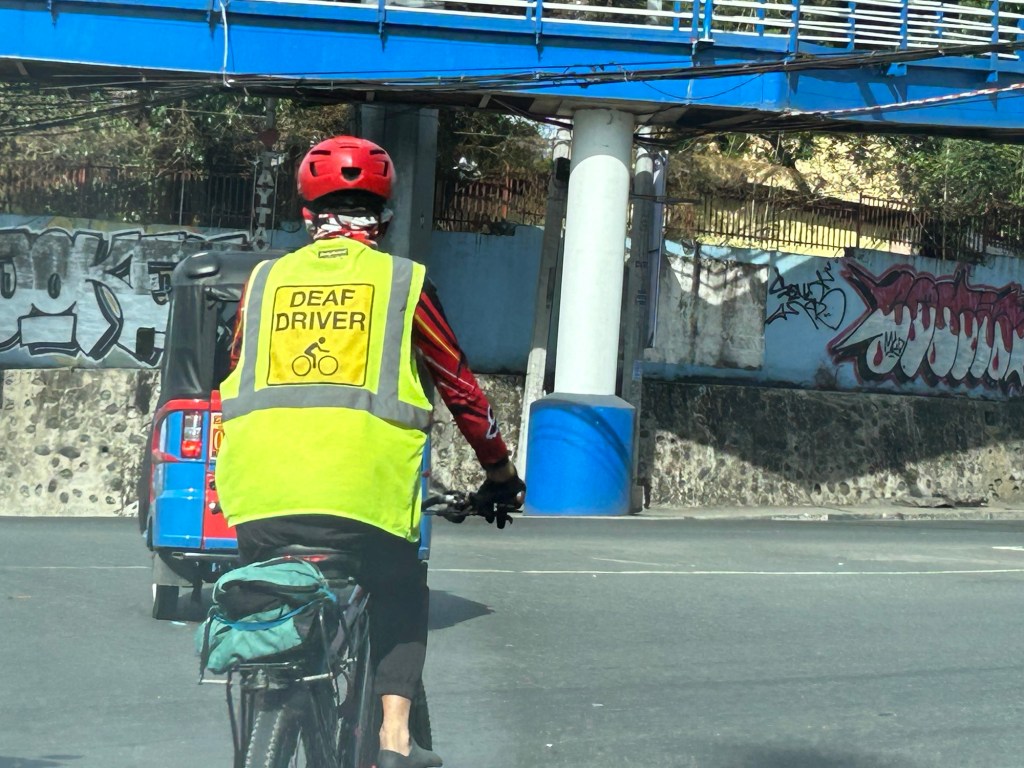 Deaf rider along Tikling Junction, Taytay, Rizal – not all would probably have a vest like this and motorists likely would be oblivious to their situation. There will also be pedestrians with similar circumstances who have natural disabilities. Irresponsible would those who are “deafened” by their gadgets like those wearing earphones or headphones while riding or walking.
 –
On transportation and global health – article share
I was supposed to write about the keynote lecture delivered during the 30th Annual Conference of the Transportation Science Society of the Philippines (TSSP). I am sharing instead an article written by Dr. Renzo Guinto who is an Associate Professor at the SingHealth Duke-NUS Global Health Institute based at the National University of Singapore.
Here is the link to his article on the Philippine Daily Inquirer: Health at the center of transport and mobility
I will not quote from the article and leave it to my readers to read and appreciate the articles content.
–
Designing a “Runnable” City
I’m sure you’ve read or heard about walkable cities. But have you read or heard about “runnable” ones? Here’s a quick share of an article about cities where you can run, jog or walk.
Source: Designing a “Runnable” City
To quote from the article:
“Several urban design principles can enhance the runnability of a city:
Connectivity and accessibility: This means developing a network of interconnected running paths and trails that are easily accessed from various parts of the city (especially neighborhoods). Even better if can be green corridors that connect to other parks and open spaces, and support continuous movement.
Safety and security: Ensuring running paths are well-lit and separated from vehicle traffic is crucial. Traffic calming measures such as vehicle lane narrowing, wider footpaths, and appropriate landscaping enhance runner safety. Street trees also help reduce car speeds, as they alter our perception of how wide the road is and provide a psychological cue that we’re in a residential area. Redesigning urban infrastructure to include dedicated running paths alongside walking paths and bicycle lanes, is a great idea.
Inclusive design: City design should encourage active mobility, which means including benches, water fountains, and restrooms along running routes. It means building footpaths that enables running, and avoiding uneven, slippery or unfavorable surfaces such as cobblestones. It also means making it easy to find your way around — even in unfamiliar environments.”
–
Technical sessions at the TSSP 2024 Conference
I am sharing here the latest draft of the technical sessions for the 30th Annual Conference of the Transportation Science Society of the Philippines (TSSP). The conference will be held in Iloilo City this coming September 13, 2024.
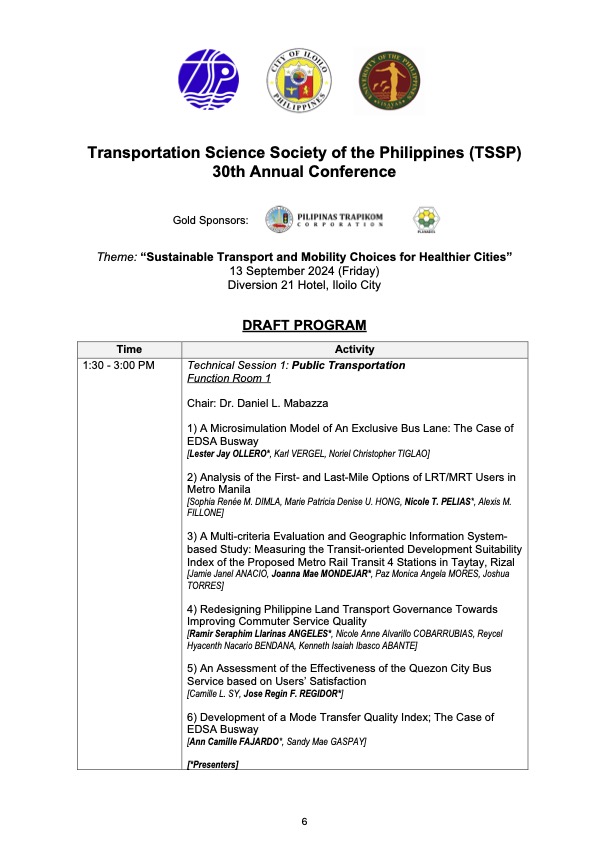
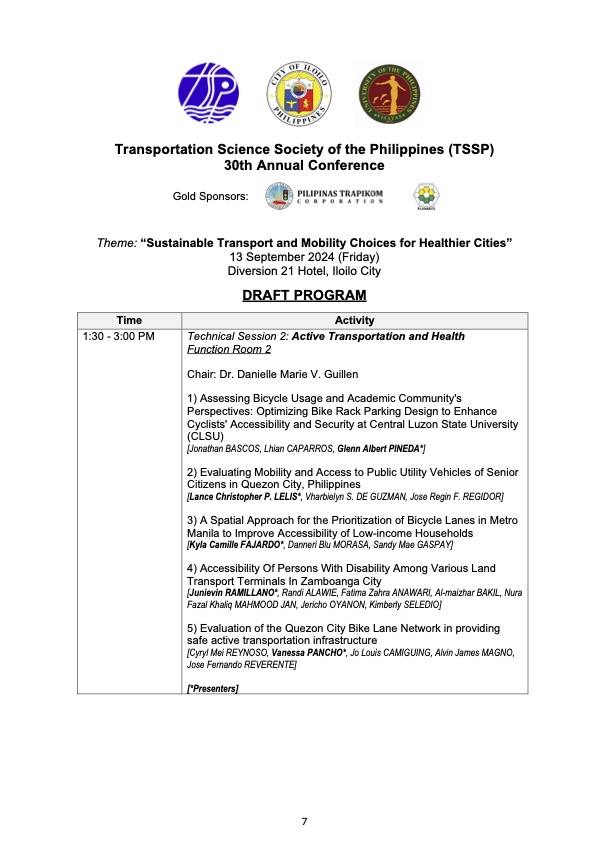
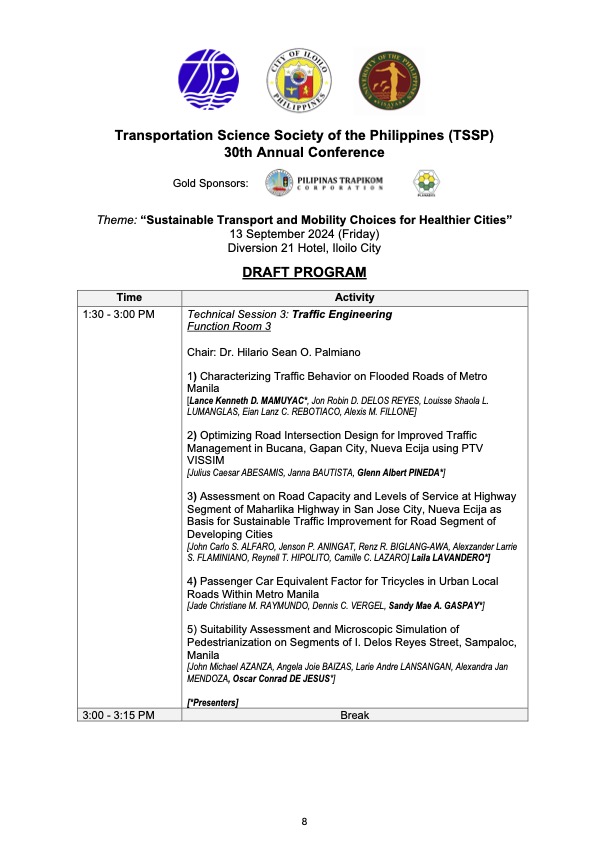
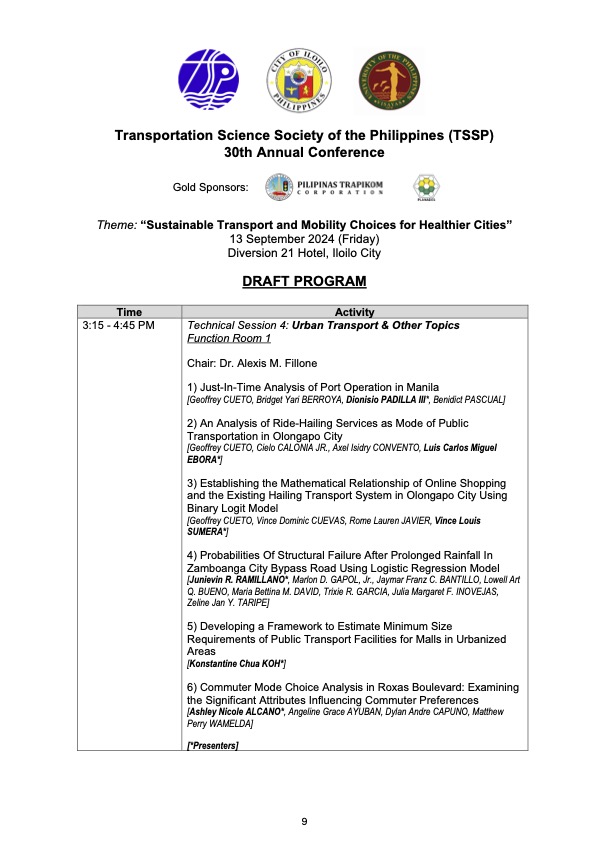
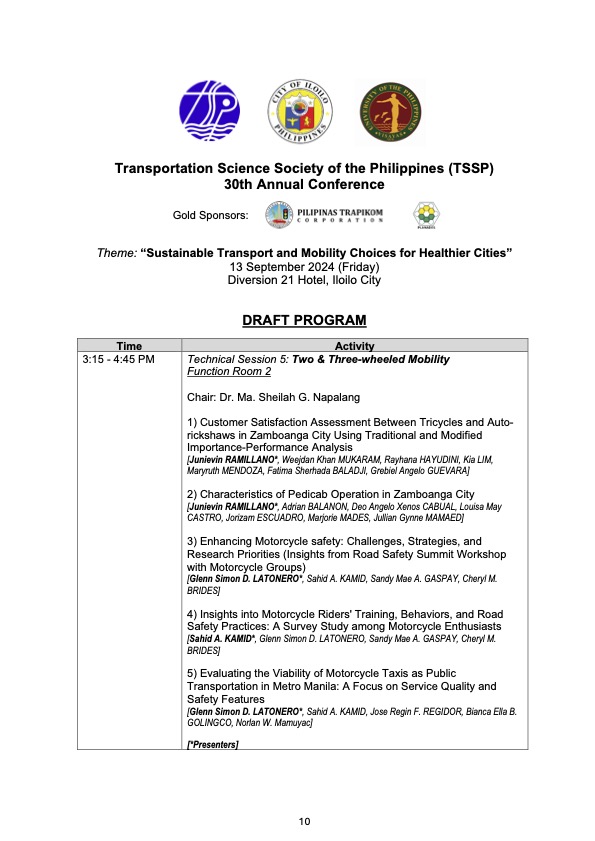
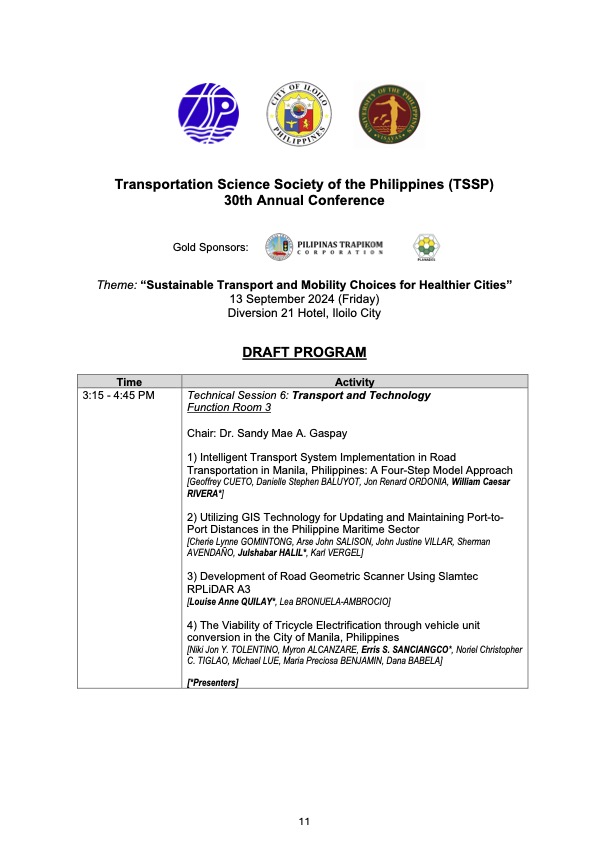
I will share the draft program for the morning plenary session in the next post.
–
On trees as solution to many of our urban problems
I am sharing this nice article on trees being the solution to many of our urban problems. I think many people have come to notice the importance of trees and the role they play with the increasing temperatures (i.e., heat) we’ve experienced the past years. The science on this state much more and covers not just temperatures but flooding, energy and infrastructure as well. Discussions and examples on these are in the article:
Durand-Wood, E. (August 8, 2024) “The Multi-Tasking Marvel: How Street Trees Can Solve Many Municipal Problems,” Strong Towns, https://www.strongtowns.org/journal/2024/8/8/the-multitasking-marvel-how-street-trees-can-solve-many-municipal-problems [Last accessed: 8/28/2024]
To quote from the article:
“Planting and maintaining street trees is an investment, but it’s one that pays for itself over and over again. Cities around the world are starting to calculate the economic value of their urban forests, a task made feasible with tools like i-Tree.
And more research is finding that trees pay for themselves many times over. A U.S. Forest Service study “conducted in five U.S. cities found that every dollar invested in the management of urban trees [ …] yields annual benefits of $1.37 to $3.09.
Trees are also the perfect example of a small bet. They cost relatively little, but the many varied returns are so high.”
–
Pedestrian-Friendly Cities: The Impact of Walkability Grants
Here is a quick share of an article on how to encourage cities to be more pedestrian-friendly:
Source: Pedestrian-Friendly Cities: The Impact of Walkability Grants
Many of our cities, particularly the highly urbanized ones, are not as walkable as we want them to be. Lacking are the most basic facilities such as sidewalks and safe crossings. Walkability Grants such as those in the US can encourage cities to build and/or enhance pedestrian infrastructure. Many designs such as those footbridges along EDSA and Commonwealth Avenue, for example, are anti-walking. Grants may be used to come up with better designs for walkways and footbridges.
To quote from the article:
“Walkability grants are awards for programs and projects creating innovative pedestrian infrastructure, such as new sidewalks, crosswalks, plazas, street lights and green spaces. For example, in February 2023, the Biden-Harris Administration announced the Safe Streets and Roads for All Grant Program, delivering $800 million in monetary awards for 511 projects addressing public safety and road improvements…
Reshaping the built environment into a walkable haven helps boost the local economy and sustainability. By changing the urban landscape, citizens are more inclined to walk instead of drive, allowing cities to reduce emissions, improve air quality and create healthier neighborhoods. This is critical, considering air pollution is responsible for 7 million early deaths yearly.”
Perhaps we can have similar grants coming from national government via the Department of Interior and Local Government (DILG) in cooperation with the Department of Transportation (DOTr) and the Department of Public Works and Highways (DPWH)? There was some funding for bikeways during the pandemic but this new one should put more emphasis on walkability.
–
 Caught (up) in traffic