
Home » Health (Page 7)
Category Archives: Health
Signs of the times? A COVID-19 test vending machine at the airport
I just wanted to share this photo that I took of a vending machine dispensing COVID-19 antigen self-test kits at NAIA Terminal 3. I took this photo as we exited the baggage claim area and headed for the multi-level parking of the terminal.
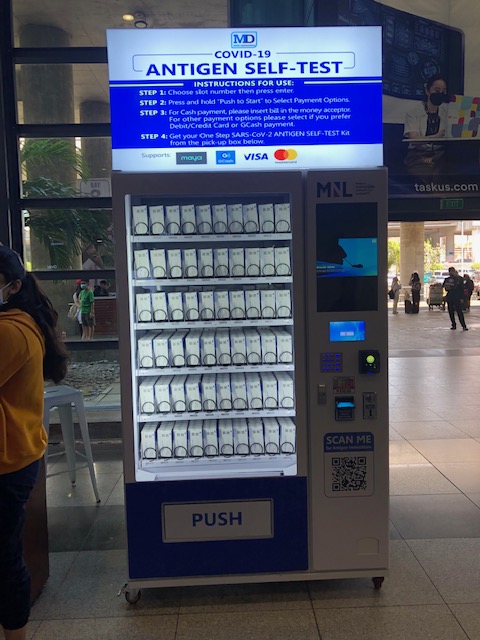
There are many vending machines at airports including the most typical ones for drinks and food. Some dispense souvenirs and even electronics. This was the first time I encountered this type of machine. I didn’t see one while in Changi or in NAIA Terminal 2, and even in Panglao, Mactan, Zamboanga or Laguindingan airports where I have been recently. Perhaps there are machines like this there or in there airports but I just didn’t see them. I guess these are here to stay considering COVID-19 is not yet completely out of the picture so to speak.
–
Article share: on pedestrian facilities and climate change
Here is an article that articulates the importance of walking and pedestrian facilities in sustainability and ultimately fighting climate change. It argues that if we had the infrastructure and facilities to make it easier for people to walk, they will and are likely to walk rather than use their cars. This is not limited to short trips as walking can be in combination with public transportation, making it an integral part of trips where public transportation covers the main commute and walking is the proverbial last mile travel.
To quote from the article:
“Walking, biking, and transit need to be prioritized, and treated as legitimate forms of transportation. This means stepping up efforts to collect data on sidewalks the way we do for roads, investing in complete walking networks before engaging in expensive new road projects and making sidewalk construction and maintenance a municipal responsibility rather than an individual one.”
Child’s perspective of road safety
As adults, many of us seem to have forgotten how it was to be a child and to see things from a child’s perspective. This perspective is important in many cases, situations or scenarios. One area where we can use this perspective to improve how things are is in road safety. As they say, streets that are safe for children are safe for everyone else. I am sharing this guide that also includes a project involving coming up with a reverse periscope. The reverse periscope is intended for an adult to have the view of a child.
How Do Kids Experience Streets? The Reverse Periscope Companion Guide
This guide would be something that can be used in road safety seminars or workshops that include some field activities. Participants can use the reverse periscope to simulate being a child as they walk and cross streets. An activity can be designed for transport and highway officials, even local government staff involved in planning, design and assessment of streets.
–
Push and Pull: The Link Between Walkability and Affordability
Here is a quick share of an article about the link between walkability and affordable housing.
To quote:
“While early pandemic pundits predicted the ‘death’ of urban areas, recent trends show that people—perhaps more than ever—value the benefits of compact development and easily accessible amenities and services. But “Demand drives up costs and can reduce low- and moderate-income households’ opportunity to live in highly walkable areas,” the report warns.”
Source: Push and Pull: The Link Between Walkability and Affordability
Some people seem to be baffled why people choose to purchase homes and reside in the suburbs or away from the city centers. It is actually simpler than what many tend to overthink and attribute purely to the condition of our transportation system. It takes two (or more apparently) to tango and housing affordability is critical for the Philippines’ case.
–
On the need to change mindsets about bike lanes
Public acceptance of bike lanes has grown during the pandemic. Prior to the pandemic, there were few supporters especially among local government units and national agencies that seem to be comfortable with the status quo. Few like Iloilo and Marikina had any bike facilities worth mentioning. The pandemic was supposed to change that and it did for many. However, the acceptance and the gains seem to be eroding as we return to face-to-face activities and the ‘old’ normal situation.
I’m sharing below an article on the need to change mindsets about bike lanes and cycling in general:
Thompson, C. (January 24, 2023) “The Battle Over Bike Lanes Needs a Mindset Shift,” Wired, https://www.wired.com/story/the-battle-over-bike-lanes-needs-a-mindset-shift/ [Last accessed: 1/27/2023]
To quote from the article:
“Maybe bike lanes will always be fraught, until enough of the public is finally in a true lather about climate change—and it seems reckless to not have them.
Crises, after all, have a way of opening people’s eyes to possibilities. During Covid, restaurants and cafés lost so much business that cities nationwide began allowing them to build curbside seating areas where people could sit, safely, in the open air. It greatly reduced parking—but because, well, crisis, shop owners didn’t see any way around it. Patrons loved the outdoor seating so much that cities are making it permanent: A New York City study of several streets closed during Covid found storeowners making more than before, and diners digging the al fresco lifestyle. If data won’t change minds, customers might.”
There are two opposing sides on this matter. On one side are advocates who naturally will push for bike lanes and will promote them as The solution (emphasis mine) rather than one of a cocktail to address the transport mess we are in. On the other side are conservative, status quo types (or car-lovers as bike advocates will call them) who believe cars should have the roads to themselves. Unfortunately, many in government and particularly in transport agencies are with the latter. Perhaps they should be the first ones that need to be converted to favor active transport?
–
On getting started on bike commuting
Here is another article on bike commuting. It really is a challenge to get people into bike commuting even if their workplaces or schools are close to their homes. What more for people who have to travel longer distances between their homes and workplaces or schools?
Bassett, E. (December 1, 2022) “The No B.S. Guide to Getting Started Bike Commuting,” Medium, https://erikbassett.medium.com/the-no-b-s-guide-to-getting-started-bike-commuting-5dd0cbb87e5b [Last accessed:
To quote from the article:
“Assume you’re invisible until proven otherwise.
Like every city I’ve lived or ridden in, yours probably paints pictures on the ground and calls them “bicycle infrastructure.” Road designs encourage excess speed; vehicles aren’t meaningfully separated from cyclists and pedestrians; there are conflicting rights-of-way at intersections, driveways, and so forth.
And that is not right. It’s a sad commentary on urban “planning” in most places that anything but car use requires this degree of paranoia. It points to a profound dysfunction that few (with any serious influence) are willing or even interested to change…yet.
But unless or until it improves, the only viable response is to assume you don’t exist in the eyes of whoever’s driving nearby. “If I weren’t here, would they gun it to make a right turn on red?” Well, assume they will. “If I weren’t here, would they merge up there?” You guessed it: assume they will.
This is unquestionably the worst aspect of bike commuting, and if it’s too stressful in your situation, that’s perfectly fine. But in the spirit of a “no-B.S.” guide, I’d be remiss not to drive home a life-saving lesson that all these years of cycling have so deeply ingrained in me.”
The author also states the difference between bike commuting and sports biking including noting the differences in the objectives or goals for each.
–
Why do we keep widening roads?
I’m just going to share this article here. The article from The NY Times asks a question that has been bugging planners and engineers, particularly those who are in government and perhaps under the agencies like the DPWH, DOTr and NEDA. This also applies to planners, engineers and those from other disciplines involved in transportation infrastructure development and particularly roads or highways.
–
Safest airlines in 2022/2023?
One magazine published an article recently about the safest airlines in the world. This is very relevant as people have returned to traveling during this period despite the pandemic and the new strains coming out. It is useful especially for people who are traveling overseas since airline choices might be very limited for domestic routes. Here is the article:
Puckett, J. (January 5, 2023) “This is the safest airline in the world,” Condé Nast Traveler, https://www.cntraveler.com/story/the-safest-airlines-in-the-world?utm_source=nl&utm_brand=spotlight-nl&utm_campaign=aud-dev&utm_mailing=thematic_spotlight_010623_2&utm_medium=email&bxid=5bd6761b3f92a41245dde413&cndid=37243643&hasha=cf6c402001bc473063a8744033fe9be3&hashb=ec2bb753c2e6299f5107823241955221da67bd1f&hashc=09f65c608bfb62050199733de500e3cd82827631b36d537ce8386d41a3bd1ff7&esrc=FYL_SEG_APR18&sourcecode=thematic_spotlight&utm_term=Thematic_Spotlight_Afternoon [Last accessed: 1/7/2023]
To quote from the article, the basis for the ranking is as follows:
“The site’s staff analyzes each airline’s records for crashes over the last five years, serious incidents over two years, audits from aviation’s governing bodies and associations; fleet age, expert analysis of pilot training, and COVID protocols. In addition to these criteria, each airline that makes the list is also at the top of the industry in terms of safety innovations and have added cutting-edge aircraft to their fleets, like the Airbus A350 and the Boeing 787…”
There are not so many Asian airlines in the list especially if you don’t include the Middle Eastern airlines. Only Singapore Airlines, EVA Air and Cathay Pacific are in the list. I was expecting at least one Japanese airline and perhaps Thai Airways to be in the list. I was not surprised Philippine Airlines was not on the list considering the criteria.
There’s a separate list for low-cost carriers in the article and Air Asia is one though there are actually several Air Asia companies operating out of Southeast Asian countries. It would be nice to see how Air Asia Philippines compares with the mother company based in Malaysia. Cebu Pacific is categorized under LCC’s but with so many of these companies around the world, it won’t be a surprise they didn’t rank among the Top 20 either.
–
Shared article: Active and Micro Mobility Modes Can Provide Cost-Effective Emission Reductions–If We Let Them
I’m sharing this article on active and micro mobility modes from Todd Litman, published in Planetizen.com:
Source: Active and Micro Mobility Modes Can Provide Cost-Effective Emission Reductions–If We Let Them
From the article:
“Common Active Transportation Leverage Effects:
–Shorter trips. Shorter active trips often substitutes for longer motorized trips, such as when people choose a local store rather than driving to more distant shops.
–Reduced chauffeuring. Better walking and bicycling conditions reduces the need to chauffeur non-drivers (special trips to transport a passenger). These often require empty backhauls (miles driven with no passenger). As a result, each mile of avoided chauffeuring often reduces two vehicle-miles.
-Increased public transit travel. Since most transit trips include walking and bicycling links, improving these modes supports public transit travel and transit-oriented development.
-Vehicle ownership reductions. Active mode improvements allow some households to reduce their vehicle ownership, which reduces vehicle trip generation, and therefore total vehicle-miles.
-Lower traffic speeds. Active travel improvements often involve traffic speed reductions. This makes non-auto travel more time-competitive with driving and reduces total automobile travel.
-More compact development. Walking and bicycling support more compact, multimodal communities by reducing the amount of land devoted to roadways and parking, and creating more attractive streets.
-Social norms. As active travel increases, these modes become more socially acceptable.
The article is a must read if we are to understand how important active transport and micro mobilities are in the context of today’s transport conundrum. Of course, part of the contextualization and perhaps ‘localization’ on these modes will be related to land use or development. The latter is a big challenge especially for the likes of Metro Manila and other rapidly developing cities in the Philippines where housing in the cities (related to compact development) has become quite expensive and has driven more and more people to live in the suburbs. As I’ve mentioned in previous posts, this has resulted in more pressure to develop transportation systems but infrastructure development cannot play the catch up game given the limited resources for their construction. Meanwhile, services are also behind in terms of quality and requires reforms and rationalizations.
–
On reducing driving and its inherent risks
Ever since the automobile was invented and eventually mass-produced, there has been an increasing risk associated with motor vehicle traffic. Laws, policies and regulations have also been influenced to favor the car rather than people. And so we now have what is termed as a car-oriented and dependent transportation system that seems so difficult to undo as most people appear to be enamored by the car. Owning a car (or even a motorcycle if you want to extend this idea of individual ownership) remains an aspiration to a lot of people.
Here is a link to the compact version of a comprehensive report by Todd Litman that presents and argues for a new paradigm where driving is considered a risk factor. There are data and a table comparing old and new traffic paradigms to help us understand the situation and what needs to be redefined or re-framed in order to achieve our safety targets or vision.
Litman, T. (October 20, 2022) “Driving as a Risk Factor: A New Paradigm,” Planetizen, https://www.planetizen.com/blogs/119287-driving-risk-factor-new-paradigm?utm_source=newswire&utm_medium=email&utm_campaign=news-10202022&mc_cid=beacdc2a04&mc_eid=9ccfe464b1 [Last accessed: 10/28/2022]
To quote from the article:
“Safer vehicles, roads, and driving may reduce crashes but achieve few other goals, and sometimes contradict them. Transportation demand management and smart growth policies increase safety in addition to helping to achieve other planning goals, and so can be considered win-win solutions.
More comprehensive safety analysis tends to support social equity goals. Many conventional safety strategies, such as larger vehicles with more passenger protection, and wider roads with fewer intersections, tend to increase walking and bicycling risks. In contrast, lower traffic speeds, TDM, and Smart Growth tend to improve safety, mobility, and accessibility for people who cannot, should not, or prefer not to drive.”
The key takeaway here should be that people should have the option of not driving at all in order to reduce the risks associated with driving as well as reduce congestion. A more comprehensive
–
 Caught (up) in traffic