
Home » Health (Page 7)
Category Archives: Health
On bicycles as a preferred mode of transport
Sharing this article on bicycles being the perfect mode of transportation. It is framed with respect to the concept of the 15-minute city. Here is the article:
Johnson, R. (April 19, 2023) “Embracing the 15-Minute City: 7 Reasons why Bicycles Are the Perfect Mode of Transportation,” Momentum Mag, https://momentummag.com/embracing-the-15-minute-city-7-reasons-why-bicycles-are-the-perfect-mode-of-transportation/ [Last accessed: 4/29/2023]
To quote from the article:
“Bicycles are aligned with the goals of sustainability and climate action, as they contribute to reducing greenhouse gas emissions, air pollution, and congestion. In a 15-Minute City, where the focus is on creating sustainable and climate-friendly communities, bicycles can be a powerful tool to achieve these objectives. By promoting cycling as a viable transportation option, cities can reduce their carbon footprint, mitigate climate change impacts, and promote a greener and healthier way of living.”
–
On air quality in subways
I saw this article on Wired and immediately read it as the topic to me was interesting. I have been using when I lived in Japan in the 1990s and in Singapore in 2010-2o12. I have used the transit system in many other cities including in the US and Europe. And so the topic of air quality in subways (particularly the stations and inside the trains) got my attention. I guess this is not entirely an issue for ground-level and overhead systems like what most of Lines 1, 2 and 3 and the PNR are. Only Line 2 has one underground station (Katipunan Station) and perhaps has that issue. Here is the article about the air in subways:
Baraniuk (April 24, 2023) “The Filthy Truth About Subway Air,” Wired, https://www.wired.com/story/subway-air-health/ [Last accessed: 4/25/2023]
To quote from the article:
“The big unknown is whether all of this particulate matter is actually causing health problems for people. Millions of commuters use metro systems, in many cases for multiple hours a day, five days a week, for years on end. And thousands of transport workers spend even longer in the tunnels. But there are no widespread signs of severe or acute health problems among these populations, even if pollution levels in subways exceed recommended limits. Could there be more subtle, chronic effects, however—impacts on lung, brain, or heart function?”
Indeed, metros or subway systems have been operating for over a century and so far there is limited that we know about the health risks concerning their use by passengers. But this is something to keep in mind as the Philippines builds its first subway line in Metro Manila. The depots and the situation of workers thought may be a different matter. I recall one of my colleagues at the university doing a quick study of the Line 3 depot, which is underground (i.e., underneath the Trinoma Mall), and measurements showed the air quality to be quite bad. Imagine working there and being exposed to that everyday. Those conditions merit further study but require immediate action to improve working conditions considering the impact to health.
–
On sleepy drivers
I am sharing this article on sleep-deprived driving as there appears to be low awareness of the dangers of this behavior as opposed to the typical drunk driving or driving under the influence (DUI) cases that we often hear or read about in the news (mainstream or social media).
Britt, R.B. (April 18, 2023) “Sleep-Deprived Drivers Might as Well be Drunk,” Medium.com, https://robertroybritt.medium.com/sleep-deprived-drivers-might-as-well-be-drunk-887aab48c1c [Last accessed: 4/21/2023]
To quote from the article:
“A 2016 study by AAA linked lack of sleep in the past 24 hours to dramatically higher crash risk, in hour-by-hour increments:
6–7 hours sleep: 1.3 times the risk
5–6 hours: 1.9 times the risk
4–5 hours: 4.3 times the risk
<4 hours: 11.5 times the risk
The risk of a crash drops to zero if you simply stay off the road, of course. Otherwise, the bottom line is pretty clear:
“You cannot miss sleep and still expect to be able to safely function behind the wheel,” said David Yang, executive director for the AAA Foundation for Traffic Safety.”
So make sure you get your sleep because it is really important for you to function not just as a driver or rider. It also applies to other activities or tasks as well whether you’re working, studying or playing.
–
On bicycles and first responders
I am sharing this article on the use of bicycles by first responders, particularly the police for their work:
International Police Mountain Bike Association (April 11, 2023) “Why Bicycles are Great for Police and First Responders,” Policemag.com, https://www.policemag.com/patrol/news/15382905/why-bicycles-are-great-for-police-and-first-responders [Last accessed: 4/15/2023]
To quote from the article:
“The advantages of using bicycles in public safety include:
• Bicycles can easily penetrate crowds – in highly congested areas police, EMS, and security personnel on bikes can move around more easily than patrol cars and ambulances.
• Response time in heavy traffic is improved – during their trial period in Orlando, bike medics responded in less than one minute 55% of the time; less than two minutes 83% of the time; and less than three minutes 95% of the time; contrasted with an average of four minutes for motorized rescue units.
• Stealth advantage – bicycles give officers the “stealth advantage” – because they are silent. Cops on bikes can ride right up to the scene of a crime before they are noticed.
• Police, EMS, and security cyclists lead by example – promoting helmet use and bike safety to the community and its children.
• Bicycles are great for public relations – an officer or a medic on a bike is much more approachable than one in a patrol car or ambulance.
• Bicycle use promotes good health – and departments benefit from decreased healthcare costs.
• Bicycles are enjoyable – even occasional bike duty improves morale.
• Bicycles are cost-effective – the average cost per bike is approximately $1200, a fraction of the cost of a cruiser, an ambulance, or any other motorized vehicle – and the annual maintenance costs are low.
• Bicycles are environmentally-friendly – no fossil fuels or emissions, and less parking surface is needed.”
While there are no disadvantages mentioned in the article, the advantages are clear and can be assumed to outweigh the cons of using bicycles. This is especially true in an urban setting where the items mentioned above are applicable and surely gives police and other first responders an advantage. In the Philippines, where the image of a bad or corrupt police officer is one who has bulging tummy, more physically fit and approachable officers on bicycles will surely improve the image of the PNP and other traffic enforcers as well.
 Quezon City’s Green Transport Office Bike Patrol
–
Back to ‘old’ normal for air travel in the Philippines
Before we embark on another trip this week, I just wanted to share that it seems all is back to the old normal in as far as air travel is concerned in the Philippines. There are few, if any, exceptions based on what I and colleagues have experienced while traveling domestically. The only difference now from pre-COVID-19 air travel is that people are required to wear face masks inside the aircraft. Inside the airports, masks appear to be optional though most people wear them.
 The March-April 2023 issue of Cebu Pacific’s Smile Magazine features places to go while in Tokyo, Japan, a popular destination these days as foreign travel restrictions have eased.
Cebu Pacific provides passengers with their Smile magazine on-board their aircraft. Philippine Airlines domestic flights don’t have magazines (unless they do on Business or First Class) for Economy passengers. I noticed also that PAL did not have duty free items on-board their aircraft (at least for the MNL-SIN-MNL trips we had recently). I know that other airlines have resumed duty free sales on-board so perhaps this is just a cost-cutting thing for PAL. Meanwhile, Cebu Pacific’s inflight shop is open and selling souvenir items on their domestic flights.
–
Noise, air pollution and your health
Here is another quick share of an article relating transportation and health:
Hunter, M. (March 27, 2023) “Road Noise Might Be One Reason Why Your Blood Pressure is High,” Medium.com, https://medium.com/beingwell/road-noise-might-be-one-reason-your-blood-pressure-is-high-5f6c7bd69ad8 [Last accessed: 3/29/2023]
To quote from the article:
“After a median of 8.1 years, the researchers discovered a dose-response relationship: The higher the noise exposure, the greater the risk of having a diagnosis of hypertension.
For every 10 decibel increase (in average 24-hour road traffic noise level), there was a 1.07 times rise in the chances of having high blood pressure. The researchers adjusted the data for fine particles (PM2.5) and nitrogen dioxide (NO2) exposure.
Exposure to air pollution and traffic noise exposure led to the highest high blood pressure risk.”
Both air pollution and noise are mentioned as issues to be addressed by implementing programs for sustainable transport. Sustainable transport includes low carbon transport as well as the reduction of noise generated by traffic.
–
Signs of the times? A COVID-19 test vending machine at the airport
I just wanted to share this photo that I took of a vending machine dispensing COVID-19 antigen self-test kits at NAIA Terminal 3. I took this photo as we exited the baggage claim area and headed for the multi-level parking of the terminal.
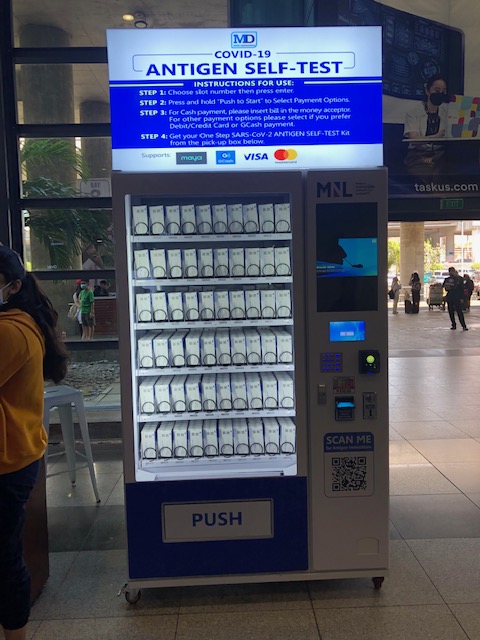
There are many vending machines at airports including the most typical ones for drinks and food. Some dispense souvenirs and even electronics. This was the first time I encountered this type of machine. I didn’t see one while in Changi or in NAIA Terminal 2, and even in Panglao, Mactan, Zamboanga or Laguindingan airports where I have been recently. Perhaps there are machines like this there or in there airports but I just didn’t see them. I guess these are here to stay considering COVID-19 is not yet completely out of the picture so to speak.
–
Article share: on pedestrian facilities and climate change
Here is an article that articulates the importance of walking and pedestrian facilities in sustainability and ultimately fighting climate change. It argues that if we had the infrastructure and facilities to make it easier for people to walk, they will and are likely to walk rather than use their cars. This is not limited to short trips as walking can be in combination with public transportation, making it an integral part of trips where public transportation covers the main commute and walking is the proverbial last mile travel.
To quote from the article:
“Walking, biking, and transit need to be prioritized, and treated as legitimate forms of transportation. This means stepping up efforts to collect data on sidewalks the way we do for roads, investing in complete walking networks before engaging in expensive new road projects and making sidewalk construction and maintenance a municipal responsibility rather than an individual one.”
Child’s perspective of road safety
As adults, many of us seem to have forgotten how it was to be a child and to see things from a child’s perspective. This perspective is important in many cases, situations or scenarios. One area where we can use this perspective to improve how things are is in road safety. As they say, streets that are safe for children are safe for everyone else. I am sharing this guide that also includes a project involving coming up with a reverse periscope. The reverse periscope is intended for an adult to have the view of a child.
How Do Kids Experience Streets? The Reverse Periscope Companion Guide
This guide would be something that can be used in road safety seminars or workshops that include some field activities. Participants can use the reverse periscope to simulate being a child as they walk and cross streets. An activity can be designed for transport and highway officials, even local government staff involved in planning, design and assessment of streets.
–
Push and Pull: The Link Between Walkability and Affordability
Here is a quick share of an article about the link between walkability and affordable housing.
To quote:
“While early pandemic pundits predicted the ‘death’ of urban areas, recent trends show that people—perhaps more than ever—value the benefits of compact development and easily accessible amenities and services. But “Demand drives up costs and can reduce low- and moderate-income households’ opportunity to live in highly walkable areas,” the report warns.”
Source: Push and Pull: The Link Between Walkability and Affordability
Some people seem to be baffled why people choose to purchase homes and reside in the suburbs or away from the city centers. It is actually simpler than what many tend to overthink and attribute purely to the condition of our transportation system. It takes two (or more apparently) to tango and housing affordability is critical for the Philippines’ case.
–

