
Home » Infrastructure (Page 10)
Category Archives: Infrastructure
On roadway expansions and induced demand
We start December with another shared article. Here is another excellent article from Todd Litman about roadway expansions and induced demand:
Litman, T. (November 28, 2021) “The Roadway Expansion Paradox,” Planetizen.com, https://www.planetizen.com/blogs/115395-roadway-expansion-paradox?utm_source=newswire&utm_medium=email&utm_campaign=news-12022021&mc_cid=89cc0b2638&mc_eid=9ccfe464b1 [Last accessed: 12/3/2021]
Note the list of references at the end of the article for further reading.
–
On preserving railways – an example in Bulgaria
Here’s a quick share of an article about saving Bulgaria’s last narrow gauge railroad:
The article is relevant as it discusses the plight of railways amidst shrinking ridership and escalating costs of operations and maintenance. The railways in the article is not a isolated case. It is quite common for many railway systems. The difference of this example from another similar service like those in Japan is that Japan Railways or private companies can probably absorb the costs and maintain the line not just as a service but to show their commitment. Historically, there are many railway lines, branches if you prefer, of the Manila Rail Road Company (later the Philippine National Railways) that had to be discontinued due in part to a combination of diminished ridership and escalating O&M costs. The Main Line South, for example, had several branches including an extension from Albay to Sorsogon that had to be discontinued. Nowadays though, the topic should also be considered as the railways in the country is being expanded again. There is still the issue of ridership and this will always be in competition with road-based transport as well as aviation.
–
Is it really a golden age for railways in the Philippines? Or is it just a great catch-up?
The government and many railway fans in the Philippines have dubbed the construction and rehabilitation of railway lines as a “golden age of railways in the Philippines.” Many, especially those who have aspired for railway development in the country agree with this monicker.
But is it really a golden age or are we just playing catch-up due to the backlog of railway projects in the country? Rehabilitation, after all, means there was a period of deterioration, even neglect by the government (i.e., across several administrations starting from Marcos) that led to poor or discontinued services.
A “golden age” is defined as “a period in a field of endeavor when great tasks were accomplished.” Indeed, by definition we can qualify the current one as such but let me point out the facts from history that railways development in the country (both long distance and urban transit) started in the late 1800s before the revolution that led to declaration of Philippine independence from Spain in 1898, and while many of our revolutionary leaders were abroad, mainly in Europe where I’m sure they took the trains and trams to move about. Here’s a link to the website developed by a research program in the University of the Philippines that focused on mass transit development in what is now the Metro Manila area:
Since railway development in the late 1800s started from scratch, perhaps the current development is more of a “second” golden age for railways, and not ‘The’ golden age for railways. This wouldn’t have happened or won’t be necessary if we rehabilitated the tranvia after WW2 or allocated resources to preserve and maintain the PNR and other lines like how our Southeast Asian neighbors did to their own railways. Indonesia, Malaysia, Thailand and Vietnam have enviable railways including preserved, operational steam locomotives that are now practically moving museum pieces. But since we are into catching-up and there’s been significant progress on this end, perhaps the right term shouldn’t be “Golden Age” but “Renaissance”. It’s actually quite a catchy phrase “Railway Renaissance,” if you bother to consider it.
–
PAREX or PARES?
Much has already been written and said about the proposal by San Miguel Corporation (SMC) to build an elevated expressway atop (or along the banks) of the Pasig River. The project is called the Pasig River Expressway or PAREX. Although it has caught the attention of the public quite recently, the idea or concept is something that was already brought up and studies even before SMC took it up. I recall seeing this concept and even discussing about this with a close friend who was involved in modeling the traffic for an elevated highway along the Pasig River during the PNoy administration for the Metro Manila Development Authority (MMDA). The MMDA then was chaired by someone who is now a senator of the country. There was apparently no opposition then for this project that probably was dismissed or shelved as it had no takers at the time. Fast forward to the present and the concept was picked up or somehow fell into SMC. The latter did some work on it, pitched it to government and, one way or another, got it approved. Being a major project under a high profile company pitched to a government that went by its “build, build, build” slogan, it wasn’t so difficult to get this hyped.
Opposition to the PAREX comes from a broad mix of professionals, environmentalists and civil society groups who questioned not just the idea or concept but the process that led to government practically giving the green light for this project. Some have countered that perhaps, instead of PAREX there should be PARES. PARES would be a Pasig River Esplanade, inspired by the Iloilo River Esplanade. Maybe this is a better option. Maybe we could even have a tramline along the river if the ROW permits it. Or, perhaps instead of an elevated expressway (with the BRT and bike lane add-ons that were obviously included to soften the image of the tollway) there can be a elevated monorail along the Pasig River. This can be designed to have a minimal footprint and could certainly have branches such as one along the Marikina River. These two options alone provide alternatives that SMC should at least consider and study very well. The options might give the company a way to save face (literally and figuratively).
–
Is it difficult to understand the phenomena of induced demand?
I’m sharing a recent article that laments about how transport departments in the US seemingly don’t understand the concept and phenomena of induced demand. Is it really difficult to understand or are transport officials including highway planners and engineers deliberately ignoring what’s staring them in the face?
Zipper, D. (September 28, 2021) “The Unstoppable Appeal of Highway Expansion,” Bloomberg City Lab, https://www.bloomberg.com/news/features/2021-09-28/why-widening-highways-doesn-t-bring-traffic-relief [Last accessed: 10/10/2021]

The topic in the article is very much applicable to our own Department of Public Works and Highways (DPWH). The DPWH’s key performance indicators (KPIs) need to change from the typical “kilometers of road constructed” or “lane-kilometers of roads widened” to something like “travel time between points A and B”. Agencies like the DPWH always like to claim they are for solving traffic congestion but we already know widening roads just won’t cut it. It has to be more comprehensive than that and involve the entire transport system rather than just a part (i.e., the road). And it has to be a collaborative effort with various other agencies like the Department of Transportation (DOTr) and local government units. Unfortunately, too, these agencies like the DOTr and those under it, and many (not all) LGUs also like to go at it solo so we end up with piecemeal solutions that are also often out of context.
–
On the other benefits of cycling – pavements
Here is a very interesting article that tackles a not so obvious benefit of switching to cycling:
Dion, R. (July 12, 2021) “Biking’s Billion-Dollar Value, Right Under Our Wheels,” Planetizen, https://www.planetizen.com/features/113986-bikings-billion-dollar-value-right-under-our-wheels?utm_source=newswire&utm_medium=email&utm_campaign=news-07262021&mc_cid=51555c9a39&mc_eid=9ccfe464b1 [Last accessed: 8/4/2021]
To quote: “A strategic switch to biking would dramatically reduce the depth of roads, saving untold billions over the next generation.”
This is relevant from the perspective of highway engineering particularly concerning pavement design, construction and maintenance. It is intriguing, too, since pavement design (and consequently pavement thickness) is not necessarily correspondent to light vehicle traffic volumes. In the Philippines, for example, only heavy vehicles are considered for the pavement load estimation. It is assumed that light vehicle traffic, which compose most of the traffic along roads contribute mainly to pavement weathering rather than structural aspects.
–
On riders’ perception of safety
The Federal Highway Administration (FHWA) of the US Department of Transportation released some infographics recently to highlight road safety. One very timely and relevant graphic image asks about which facilities make bicycle riders feel safer:

There were some initial reactions when I shared this on social media with one immediately criticizing share-use paths and citing the one along Marcos Highway (stretch under Pasig, Marikina, Cainta and Antipolo) as an example. I quickly explained that the graphic assumes good designs instead of the flawed one along Marcos Highway. In fact, the shared use path is also quite popular in Europe and particularly in the Netherlands where they have many examples of these paths stretching for kilometers that are exclusive to active transport (pedestrians and cyclists). The good designs need to be shared and circulated so people will know about what they look like and learn about their features. These can be adopted and adapted to local situations.
Did you notice the images of cyclists/riders at the top of the graphic? These are important, too, because they provide context in terms of the type of riders who are the targets for infrastructure and campaigns that support and promote cycling across different types of people. Cycling shouldn’t just be for the most fit or the weekend warriors but rather for everyone who could take it up and not just for recreation but for everyday, utilitarian use (e.g., commuting, shopping, etc.).
Another look at the ‘avoid, shift and improve’ framework
The transport and traffic situation during this pandemic has revealed a lot about what can be done and what needs to be done about transportation. Discussions about what and how people visualize their ideal or acceptable transportation system reminded me of the backcasting concepts and the tools. The following diagram is sourced from the SLoCaT homepage: https://tcc-gsr.com/global-overview/global-transport-and-climate-change/
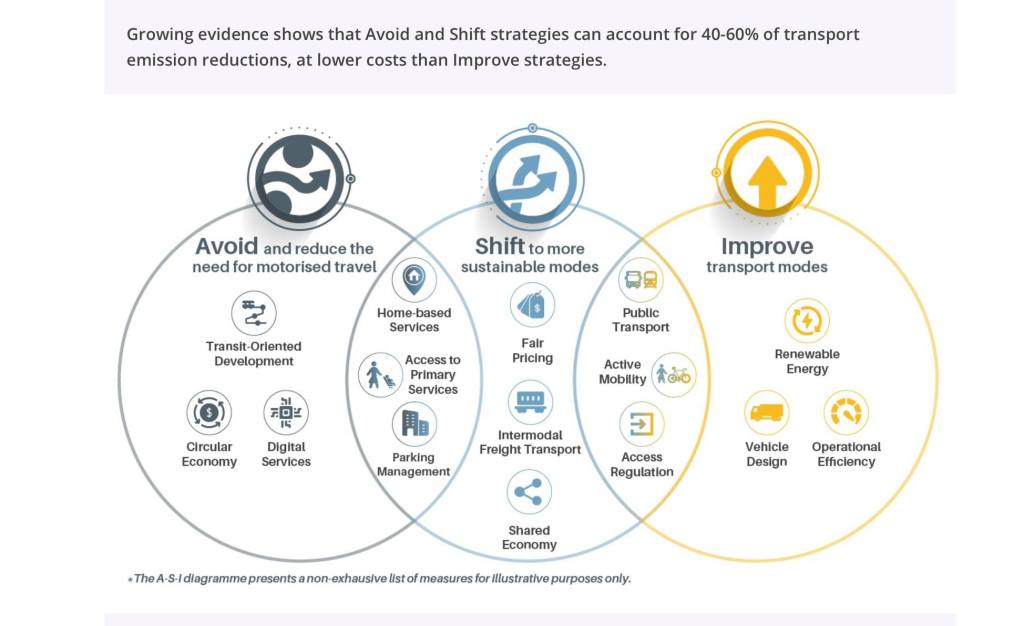
Note the overlaps among the three? Do you think its possible to have a measure that’s avoid, shift and improve at the same time?
Note, too, that if we contextualize this according to the Covid-19 pandemic, these measures even make more sense rather than appear like typical, ordinary measures we have about transportation. The pandemic revealed many weaknesses or vulnerabilities of our transportation system. We are presented with the opportunity to address these and implement certain measures that would have met with a lot of opposition before but can probably be rolled out now such as public transport priority schemes and protected bike lanes. “Work from home” is not really new since the concept has been proposed and implemented before but not as widely as was required by the pandemic situation. So perhaps we should take advantage of this forced reboot of sorts for our transportation system to be able to implement this A-S-I framework.
–
On car ownership and car use vs. public transport use
Here is another quick share of an article regarding car ownership and car use vs. public transport use. It is written in the first person as a the author relates her experience and what contradictory feelings she’s had with the decision to acquire and use a car.
Noor, D (June 21, 2021) “Buying a Car Improved My Life. It Shouldn’t Have.” Gizmodo, https://gizmodo.com/buying-a-car-improved-my-life-it-shouldnt-have-1847106068 [Last accessed: 7/10/2021]
I think many people in the Philippines (not just Metro Manila or other highly urbanized cities in the country) have similar experiences. They really don’t want to get a car or a motorcycle but their circumstances and the conveniences have outweighed their initial stand. Why do we need to have our own private vehicle anyway? Is it because its difficult to get a ride using public transport? Is it because of the quality of the ride? Is it due to health or safety-related reasons? In that last question, perhaps the fears of getting infected by Covid-19 present a overwhelming justification for car use and not just car ownership.
We also have to distinguish between vehicle ownership, car ownership and car use. ‘Vehicle ownership’ is a more general term that should include both motorized and non-motorized vehicles. Thus, if you have don’t have a car but instead have a bicycle, you are still a vehicle owner. Of course the term is more widely applied to motor vehicle owners but we need to expand this and distinguish between motor and non-motor vehicle ownership. Otherwise, let’s just be specific about the vehicle. ‘Car ownership’ is not equal to or does not correspond with car use. It is possible that one owns one or more cars or vehicles but does not use them at least for his/her regular commute. People in Singapore, for example, have cars. The same for people in Japan. However, most of these car owners choose to take public transportation most days. In their case, owning a car may not have improved their lives considering the excellent public transport services they have and requirements for people wanting to own cars in those places. Elsewhere, such as the Philippines, owning and using a car may provide better transport options depending not the circumstances of the person(s), even considering the costs of ownership and operations.
–
On how animals can safely cross highways
Here is a quick share of an article regarding animal crossings and roads/highways:
I thought the article was interesting not just because it featured animal crossings but because the very same ideas and design interventions may be adopted for humans as well. Indeed, there will be cost implications but that is only because we have been accustomed to designs that favor car use more than the movement of people. Perhaps we should rethink how we design infrastructure such as our roadways for them to be favoring active transport and employing more nature or environment-friendly features.
 Caught (up) in traffic