
Home » Infrastructure (Page 24)
Category Archives: Infrastructure
Some thoughts on the EDSA MRT 3 problem
A lot of people reacted when the current Philippine President practically absolved the Department of Transportation and Communications (DOTC) from any fault regarding the issues on the EDSA MRT Line 3 during his recent State of the Nation Address (SONA). The main message in some articles appearing on mainstream and social media is that the President should blame DOTC for the mess. I have the opinion that both DOTC and the private entities involved (MRT Corporation, MRT Holdings) are responsible for the problem and its being continuously unresolved.
A week ago, I got the following question in my email:
Who is it that we could blame for the current state of the rail system? What do you suggest that the government or the private partner do in order for them to improve the line?
Quite frankly, I thought the first question was too direct and blunt as to ask who we can blame for the MRT3 mess. It is also very awkward to answer the second question because it assumes that I am an expert on the legal issues on this matter. I am NOT a legal expert nor would I want to pretend to be one. Here was my reply:
That’s actually a very tricky question. We can’t really blame a specific person or persons but perhaps entire organizations that are supposed to be responsible for the mess that is MRT3. The main or root issue seems to be legal and not at all technical. The technical problems experienced are manifestations of a contract that is a textbook case for how NOT to do a PPP. I am not privy to the details of the discussions between the government and the people involved and behind MRTC so it is awkward to make comments specific to this matter of the contract and all its complexities. Perhaps the DOTC wants to follow “Daang Matuwid” by not budging to the terms laid out by MRTC? Perhaps MRTC is aware of the stakes (plight of the riding public) and is using this to force DOTC into a deal that is not favorable to government? We can only speculate on this without firsthand knowledge of their discussions.
However, from the perspective of transport as a service and as a public good, I would say that MRTC indeed is aware of the public’s clamor for improvement. This is all over the news and social media in the form of commentaries, images and even videos of the undesirable experiences of those taking the MRT3. In the end, DOTC must decide whether it is all worth it to maintain the stalemate with MRTC considering that the public interest is at stake here and things will just become worse with inaction. Perhaps the government should move towards the best compromise they can live with considering the urgency of addressing the problem at hand.
I would like to think that my reply was quite cautious. There have been many allegations and claims from both sides of the table regarding how to resolve the impasse and the conflicts that seem to be interwoven with the contract on the MRT3. Perhaps such cases test the limits of “Daang Matuwid”? Much was and is expected from DOTC considering its battery of lawyers including top officials of the department. Aren’t they supposed to have been involved in discussions and negotiations aside from strategic planning for our transportation in this country? I guess the general public especially those who take the MRT3 for their commutes already know who to blame for their plight…
–
State of the nation’s transport – 2015
The National Center for Transportation Studies (NCTS) of the University of the Philippines Diliman received a few letters from media the past week or so asking for resource persons on transport for today’s State of the Nation Address (SONA) by the Philippines President. It is something like a routine for media to come up with commentaries or reports assessing the performance of the government. This year is a bit special because today’s is the final SONA to be delivered by the current administration. The presidential elections will be in May next year and the next SONA will be delivered by whoever wins in that election. There is already a long list of aspirants, declared or expressing interest, for the top government post in the country, and this includes many who are perceived to be critical if not hostile to the current administration.
I was invited to give an assessment by a major media network back in 2010 and I remember giving that previous administration a grade (using the UP grading system) of 2.0. I explained that I could not give a very high grade because a lot of transport infrastructure remained unimplemented. These included airports, ports, highways and bridges, and, most notably, mass transit systems. I had knowledge though that many of the infrastructure projects were at the end of the project development or already have their feasibility studies and were ready for implementation by the succeeding administration. These were the so-called “low hanging fruits” that were “ripe for the picking” the following years. Sadly, many of the notable low-hanging fruits remain unimplemented. These include the LRT 2 Extension to Masinag in Antipolo City, the expansion of Clark Airport, the rehabilitation of the PNR, and the BRT in Cebu City.
 Traffic congestion along Commonwealth Avenue – whatever happened to the proposed MRT 7? [Photo courtesy of Rodel Velasco]
I recall a short exchange in social media with a government official whose favourite tagline was something like “We can do it!” He is fond of applying the tagline to a lot of things but especially with certain advocacies and politicians that he wanted to promote. When I asked him about transport and traffic at a CBD his office was involved in developing, the tagline immediately vanished in mention. He was quick to express what seemed to be his resignation that transport and traffic could not be improved in that rapidly developing CBD. This may be partly because they could not influence certain government agencies to expedite the implementation of urgent transport projects that would benefit the CBD. Clearly, to me, the tagline had a limit in terms of its applicability.
It seems the more appropriate tagline should be “Just do it!” as the Nike commercial goes and as adopted by a great senator who recently passed away (one who could have been a good president). It took the current administration a long time to evaluate projects and much of the delay appears to be related to the government’s fascination for PPP (Public Private Partnerships) to the point that their mention of projects being planned for implementation became another type of PPP – PowerPoint Presentation. It has been a frustrating last 5 years for transport infrastructure development especially public transportation and it is partly due t the insistence of the government to almost exclusively depend on the private sector for mass transport infrastructure. One opinion by a colleague that I also share in is for government to put its money (actually the people’s money) where its mouth is (in a manner of speaking) and invest in the construction of mass transit systems for major cities and then look to the private sector to operate/manage these systems. The government doesn’t have a good track record for managing transit systems (e.g., Metro Manila Transit Corporation, Pasig River Ferry Ferry, LRT Lines 1 and 2, etc.) but it has shown that it can build these (again LRT 1 and 2) and others (SCTEX, Iloilo and Bacolod Airports, etc.) if it wanted to. Perhaps we should again reflect on the real state of the nation’s transport come 2016 but do this very quickly so that we could finally alleviate the daily suffering experienced by most commuters.
Rains, floods and traffic
The wet season is here and with it the now typically heavy rains in the afternoons. Last week, the heavy rains brought upon flash floods in Metro Manila and adjacent towns. There have been no typhoons yet so these are mainly monsoon rains (Habagat), which we expect to be daily occurrences. Many of these floods are along major roads including EDSA, C5, Espana, and Quezon Ave. that transformed these roads into parking lots as most light vehicles are unable to traverse flooded streets.
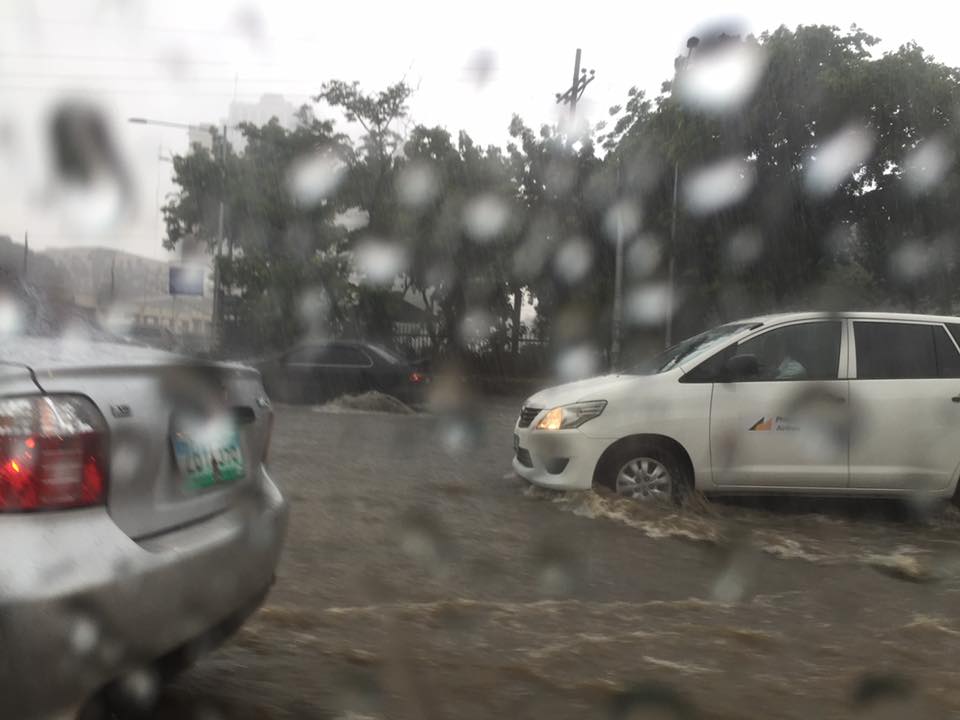 Vehicles run along the flooded Elliptical Road in Quezon City
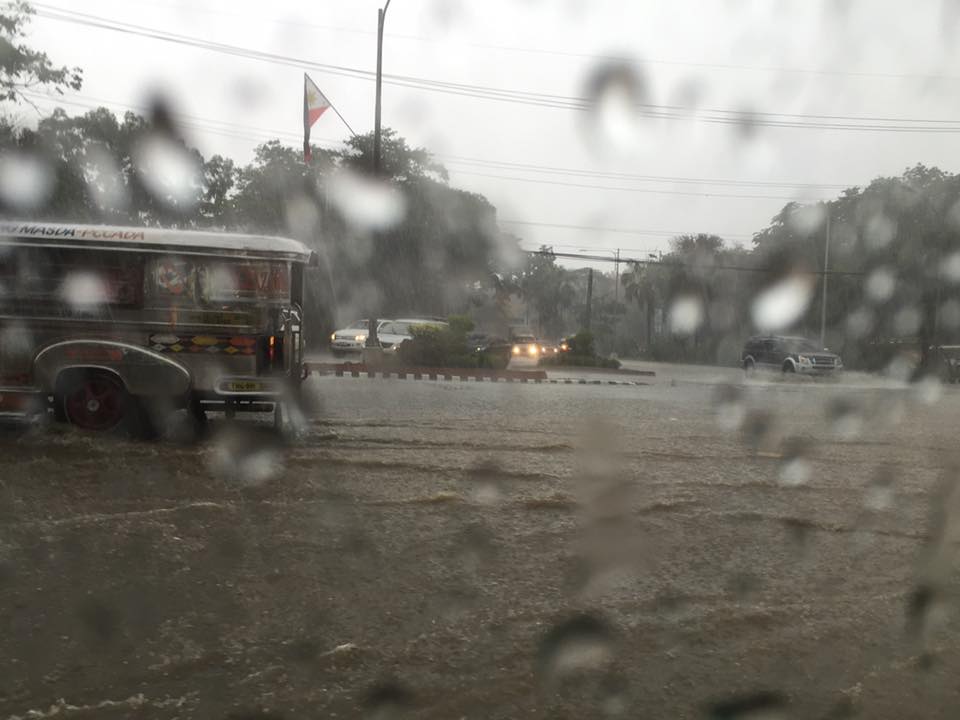 Jeepneys and SUVs (at right in the photo) take on the flooded Elliptical Road-Quezon Avenue intersection
Due to the traffic congestion resulting from the floods, many public utility vehicles especially jeepneys and UV Express vehicles were not able to go back and make their round trips.
 Cars risk the floods along Elliptical Road – the deepest waters are, ironically and curiously, along the section fronting Quezon City Hall where there is a pedestrian underpass connecting city hall with the Quezon Memorial Circle. Since the underpass is not flooded then it can be concluded that there’s something wrong with the drainage for Elliptical Road.
The weather is a very significant consideration for transport planning for cities in the Philippines. For Metro Manila it is almost everyone’s concern about how they can travel between their homes, offices, schools and other destinations without them and their things getting wet. This is what a lot of people advocating for road sharing seem to forget or choose to forget in their arguments for walking and cycling. A person residing in Fairview in Quezon City and working in Makati City will most likely not walk or cycle between his home and office because of the weather. This is a reality that could be solved by good public transportation, which, unfortunately, we also don’t have (yet) so people are ‘forced’ to do what they can to improve their plight. Unfortunately, too, what they are forced to do is purchase a car (or more). The proposal to build infrastructure to enable walking and cycling especially over medium to long distance is in the same dilemma as those for mass transit. And the latter is the more urgent matter needing action for the sheer volume of people they can carry and therefore benefit.
–
Transport Planning in the Philippines (WB, 1976)
[Important note: I have noticed that the material on this blog site has been used by certain people to further misinformation including revisionism to credit the Marcos dictatorship and put the blame on subsequent administrations (not that these also had failures of their own). This and other posts on past projects present the facts about the projects and contain minimal opinions, if any on the politics or political economy at the time and afterwards. Do your research and refrain from using the material on this page and others to promote misinformation. I suggest you go to the The Mass Transit System in Metro Manila site for more facts about railway development and history. I do not consent to the use of my articles for the purposes of misinformation and historical revisionism. 10/13/2019]
I know its been a long while since the posts on UTSMMA (1973), MMETROPLAN (1978) and other studies – past studies and plans concerning transport in Metro Manila. It seems apt that I finally was able to finish this piece in time for the Philippines Independence Day. Sinasadya talaga. I left a question hanging about what caused the changes in mindset reflected in MMETROPLAN that practically did away with the proposed mass transit network in UTSMMA. Browsing other materials at the NCTS Library, I came upon a report that I thought would have likely influenced the MMETROPLAN study team as well as government officials at the time. This is the report that I think would be the vital link between UTSMMA and MMETROPLAN – for what happened between these two studies and why the “about face” when feasibility studies were already underway for what could have been the country’s first subway line. The World Bank published a report entitled “Transport Planning in the Philippines” in 1976. The report had recommendations that were not favorable to rail transport whether for long distance or urban applications. Some excerpts are shown in the succeeding photos of pages of the document:
 Cover of the report indicating some disclaimers and restrictions to circulation. I assume that since a copy is found in a public library then it is already declassified. It is definitely a historical document and a valuable one if we are to understand transport in the Philippines and Metro Manila.
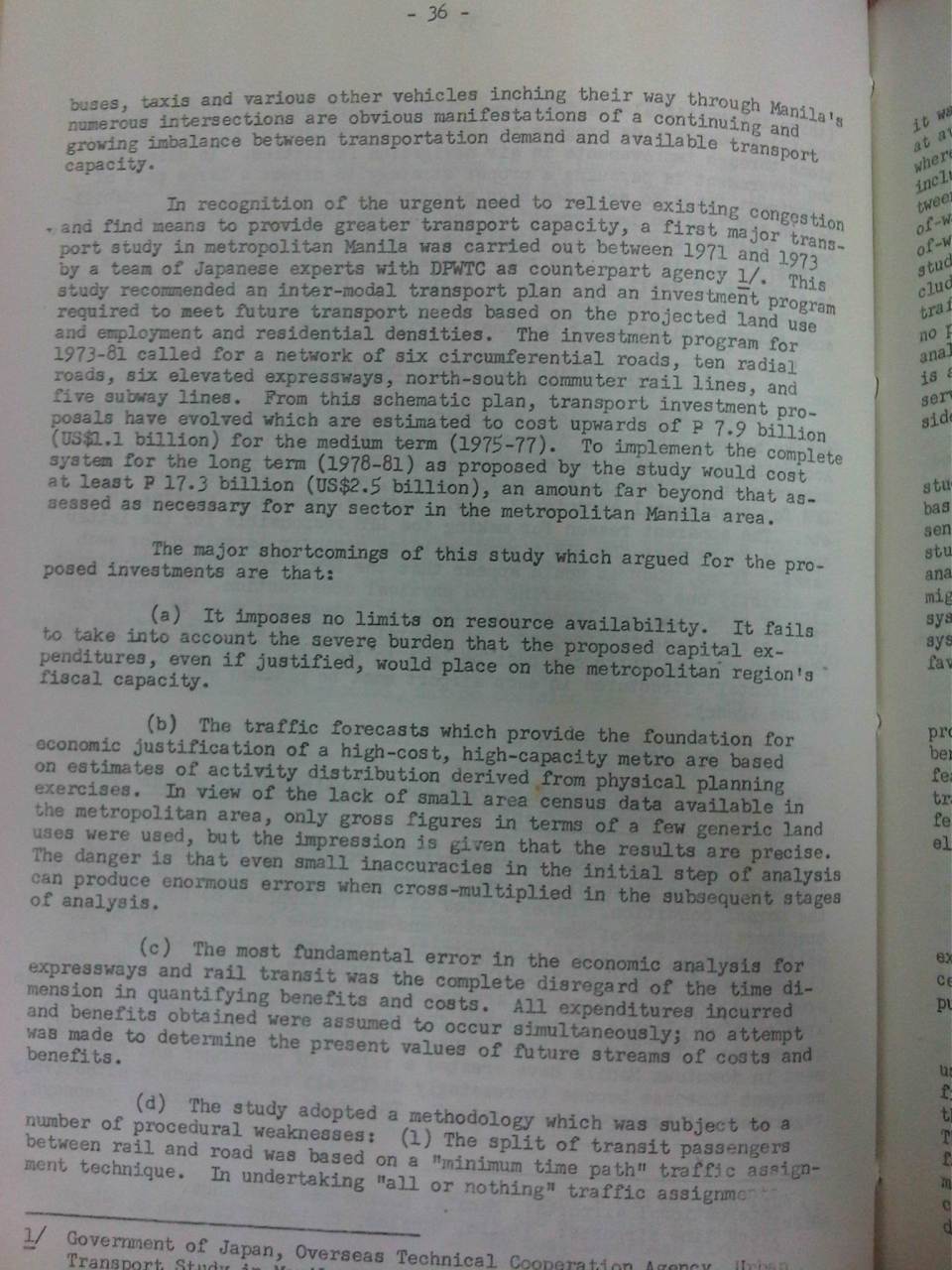 Scan of page 36 showing the WB’s assessment of UTSMMA
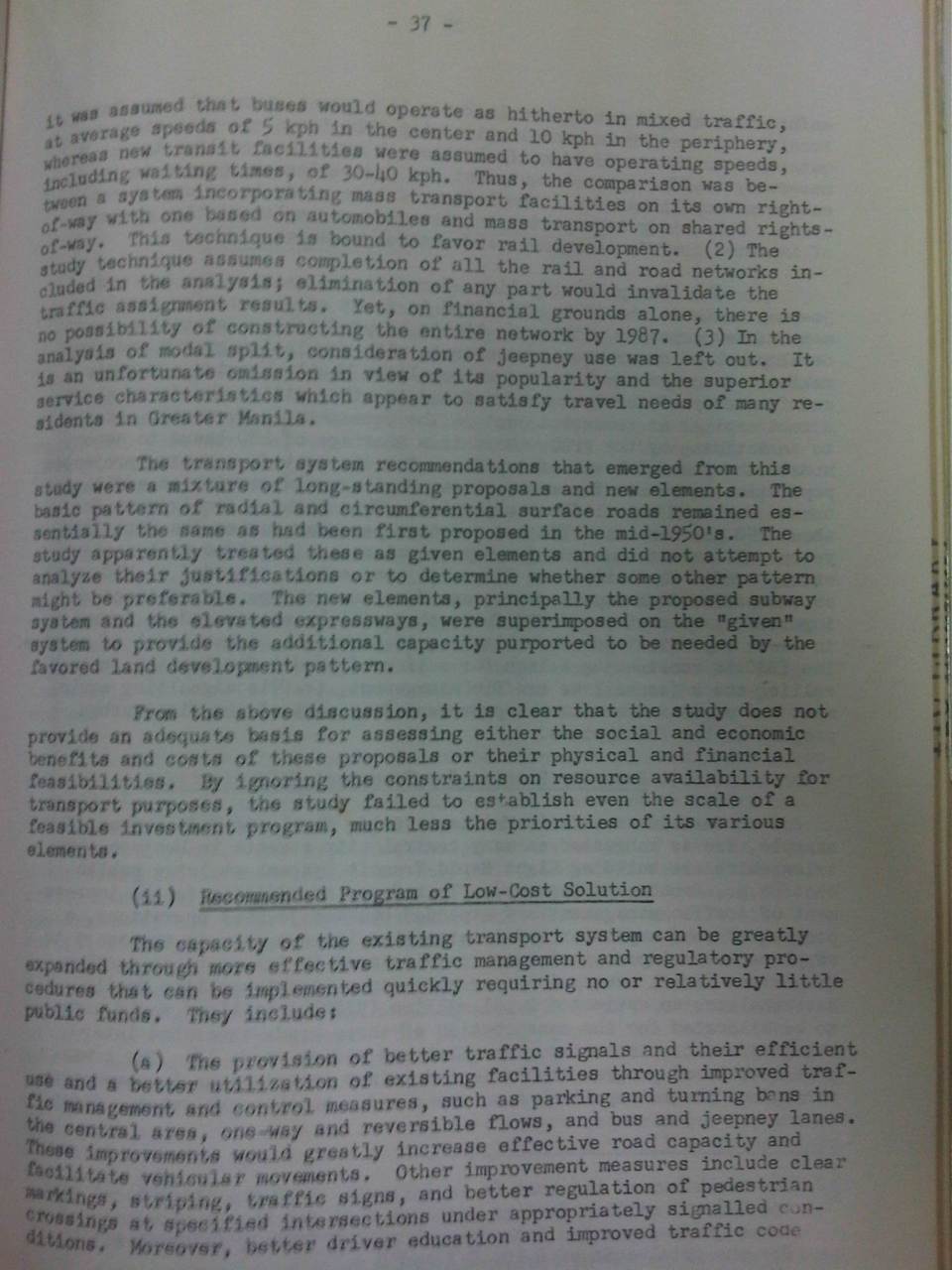 Page 37 states the conclusion of the WB report regarding UTSMMA.
I leave it up to the reader how he/she will interpret this but I think it is also important to contextualize this contents of this report to the situation of the Philippines at the time. In my opinion, too, it is basically one consultant’s word against another. From what I’ve learned, the recommended plan in UTSMMA came from a team led by a very senior and well-respected professor of the University of Tokyo’s Department of Urban Engineering. Looking back now, it seems that their work was visionary and its refuting by this WB report was a critical point in the (non)development of Metro Manila’s transport.
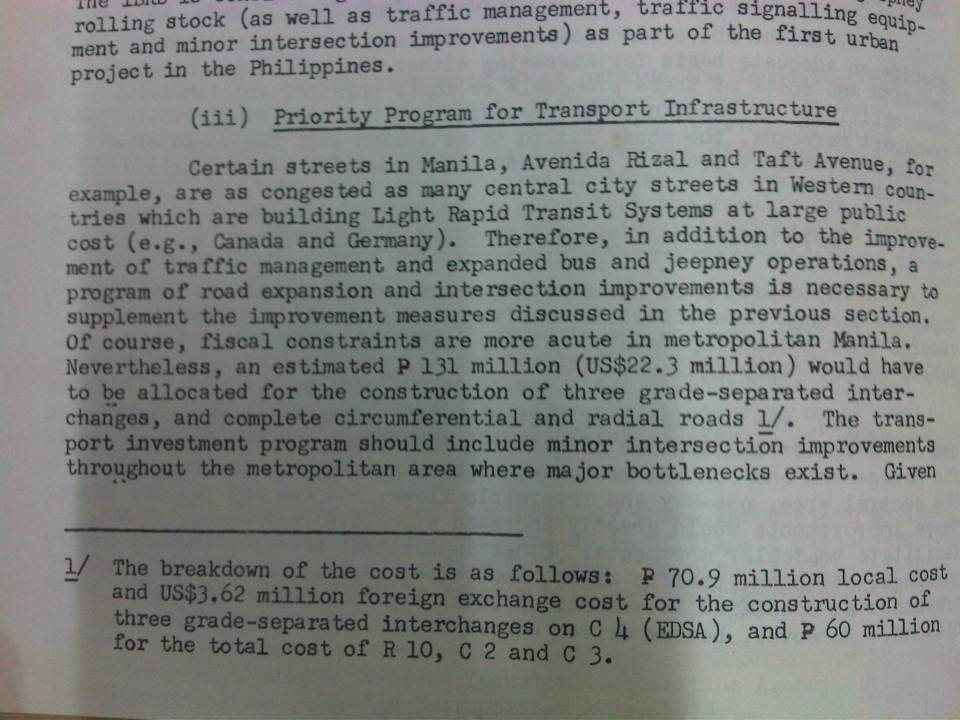 A reference to LRT systems, which to some will seem like a counter-recommendation to UTSMMA
The same report suggested taking a look at LRT instead of the heavy rail recommendations of UTSMMA. This eventually led to subsequent studies seemingly having bias towards LRTs and distancing from much needed resources to improve the plight of the PNR.
 Recommendations for the long term were explicit about the importance of having a sound spatial strategy for Philippine cities.
One could only speculate what went on in the background that were off the record or not documented. Did the WB exert its influence and ‘convince’ the Philippines to shelve ambitious plans for a heavy rail network in favor of what we now know as ill-planned light rail lines? It is this same WB report that recommended for the reorganization of the then DPWTC and DPH into the DOTC and DPWH that we know today. Thus, it is not only transport policy and infrastructure influenced by this report but also institutions dealing with transport. One person’s guess is as good as another in terms of the thinking back then as there are very few people who were directly involved in planning and decision-making then who survive now and are likely willing to divulge anything that will lead us to the truth and some closure regarding what went wrong at this critical time for transport development in the Philippines.
The data and evidence points to something Marcos loyalists would cringe to admit, that the former President ultimately failed in bringing a modern public transport system to this country and its capital. [No, the LRT wasn’t as modern and progressive as they thought it to be back then. We know now that Lee Kwan Yew got it right by investing in heavy rail urban transit at that same time.] We can only speculate that perhaps the WB and those behind the scenes knew Marcos and his ilk would probably steal much of the funds that could have been allocated for the rail rapid transit system and so did their best to come up with the conclusion that it was too expensive and the Philippines couldn’t afford it. I hope my economist friends would correct me but I am leaning towards thinking that “Uutang ka na din lang, umutang ka na para sa imprastraktura na magagamit di lamang ng mga anak mo kundi pati na rin ng mga apo mo at nila.” This seems to be the basic philosophy applied by other nations that have invested much on their transportation infrastructure. Such infrastructure has already paid off many times more and are part of the backbone of strong and resilient economies.
One colleague offered the analogy that the new JICA Dream Plan for Mega Manila is actually an updated version of UTSMMA. I also believe so and it is an updated and much more validated version of what we had back in the 1970s that was at best only partly realized (the recommendations for roads were mostly implemented). However, the price for such infrastructure will not be cheap and it will only become more expensive while we procrastinate in building them. Perhaps this should be an election issue come 2016 and something that we should strongly advocate for from our leaders.
–
Finally, the LRT Line 2 Extension begins construction
The groundbreaking ceremony for the extension of the LRT Line 2 from Santolan, Pasig City to Masinag Junction in Antipolo City was held last June 9, 2015. This marks the beginning of the construction of the much anticipated and much delayed extension of the line to what was supposed to be part of the first phase of Line 2. I say supposed because most experts believe the current line should have terminated at Masinag from the start instead of at Santolan where the depot is located. Masinag had much more sense many years ago as it was a good staging point for possible extensions to Cogeo, Antipolo City proper or Marikina City. The areas along the Marcos Highway corridor beyond Masinag alone have experienced tremendous growth especially after the floods of Ondoy (Typhoon Ketsana), which submerged much of the Marikina Valley including Pasig, Cainta and lower Antipolo.
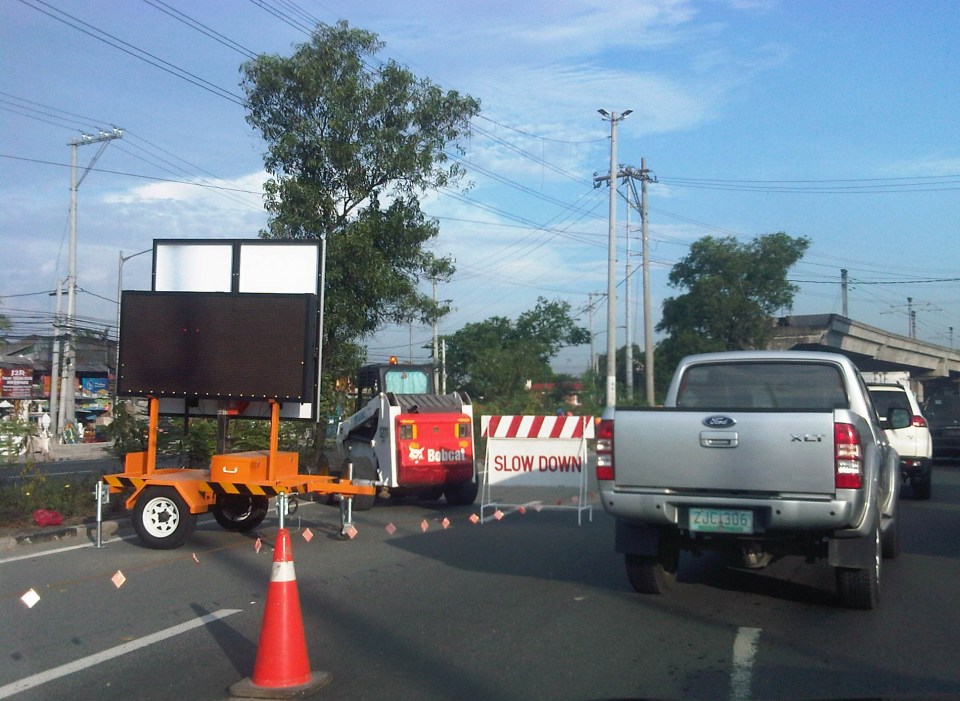 Traffic cones and signs guide motorists away from the inner lanes of Marcos Highway.
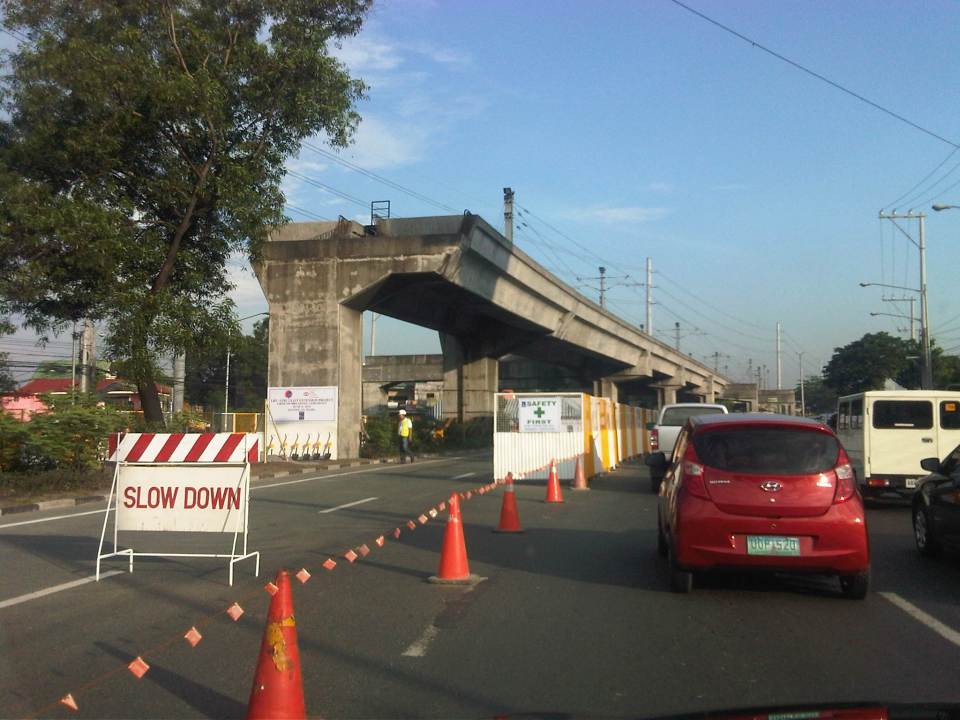 Two lanes from each side of Marcos Highway at the current end of the Line 2 were appropriated in addition to the median for the groundbreaking ceremony.
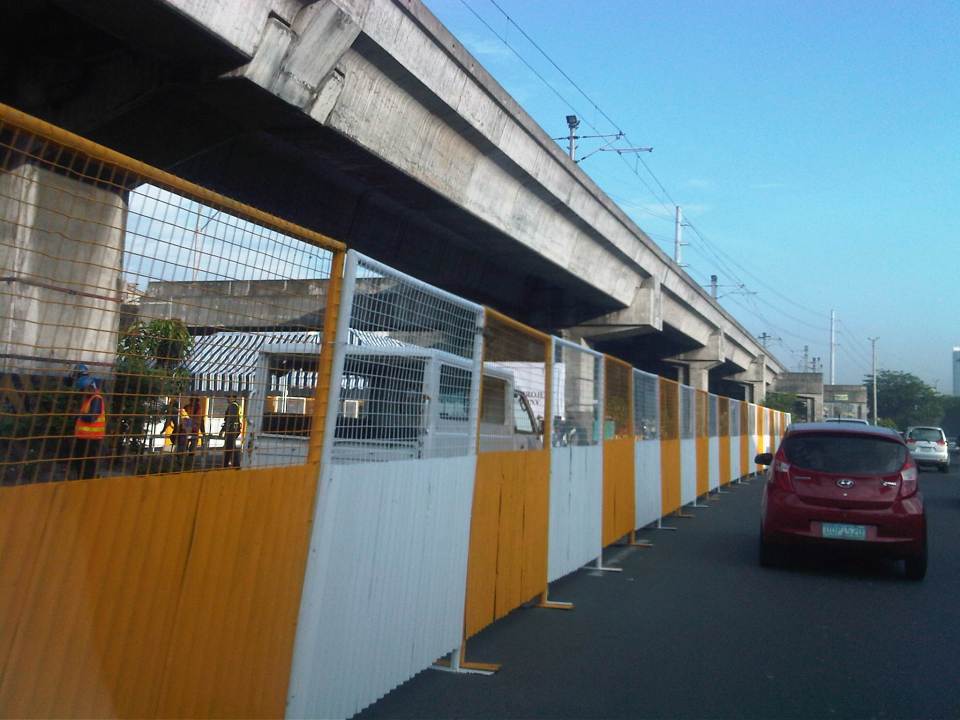 The stage is set – the stage for the ceremony is set under the viaduct with these barriers practically shielding the participants from curious passers-by (usyoso). Regardless, the event cause congestion along the highway.
Of course, that was the groundbreaking ceremony. As of today, there’s no sign yet of the contractor, DMCI, fully mobilizing and already reserving the inner lanes of Marcos Highway for the construction of the viaduct and stations. If the current works for the NAIA Expressway in the airport area is to be a reference, then severe traffic congestion is to be expected along the highway and this will extend beyond the actual construction site from Santolan to Masinag. As such, the public will experience inconvenience for the next so many months or perhaps couple of years (or more if there were delays). However, I believe that once the line is operating all the way to Masinag, it will help to ultimately decongest Marcos Highway and Aurora Boulevard and a lot of people will benefit from the improved travel times.
Incidentally, the term LRT is actually a misnomer here because among the 3 operational rail mass transit lines (I am excepting the PNR Commuter Line here.) in Metro Manila, Line 2 is actually a heavy rail system. Perhaps the government should already correct this by simply referring to Line 2 as ‘LRTA Line 2’ or renaming LRTA to reflect its nature as a transit authority that should not be limited to light rail only.
–
Community road works
There have been a lot of roadworks recently at the subdivision where we reside. This is a good thing for the residents as many roads have deteriorated after so many years of non-maintenance. The rehabilitation of the main roads, I understand, were and are funded by public money through the City Government and the DPWH. This is made possible by the subdivision’s roads being already turned over to the city government and with the subdivision being also a barangay. In fact, the subdivision is the smallest of the city. Following are some photos of roadworks in our village.
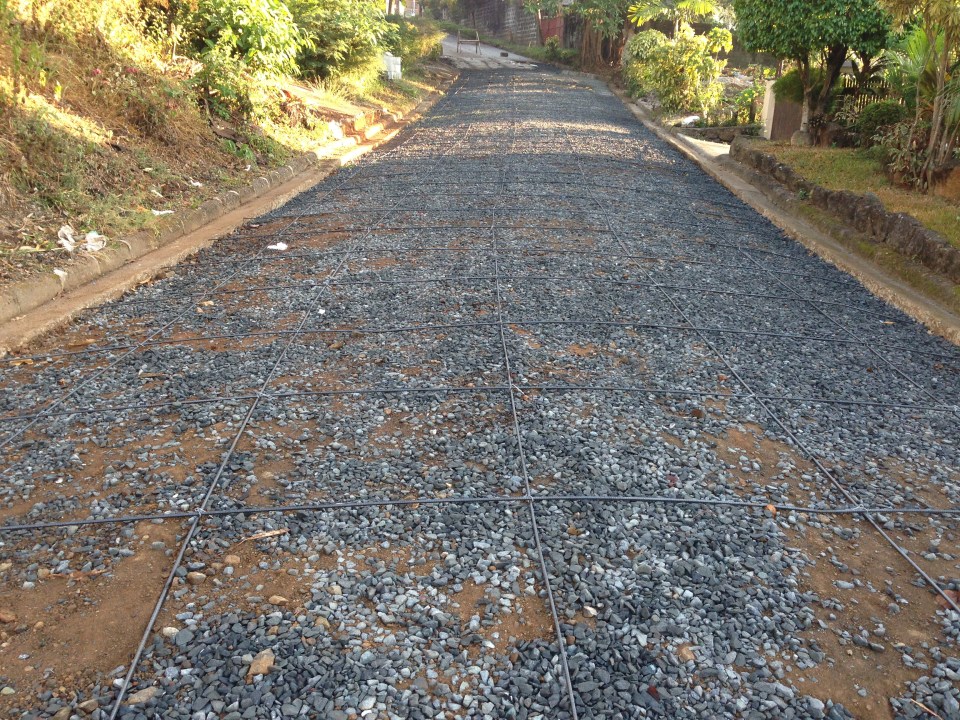 Base layer and steel reinforcement
 A close-up of the “ties that bind” the steel bars together
 Section for concreting
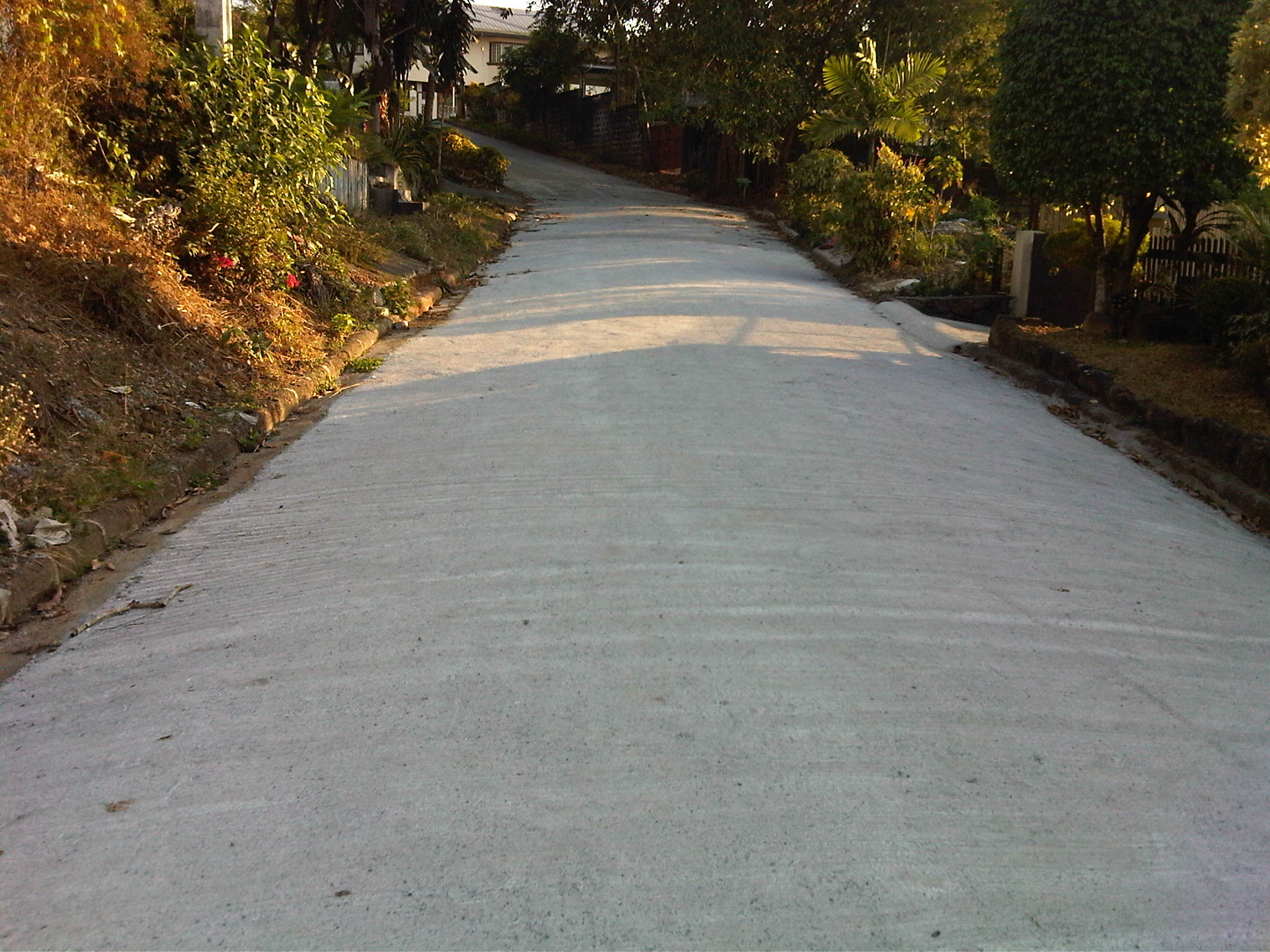 The finished product
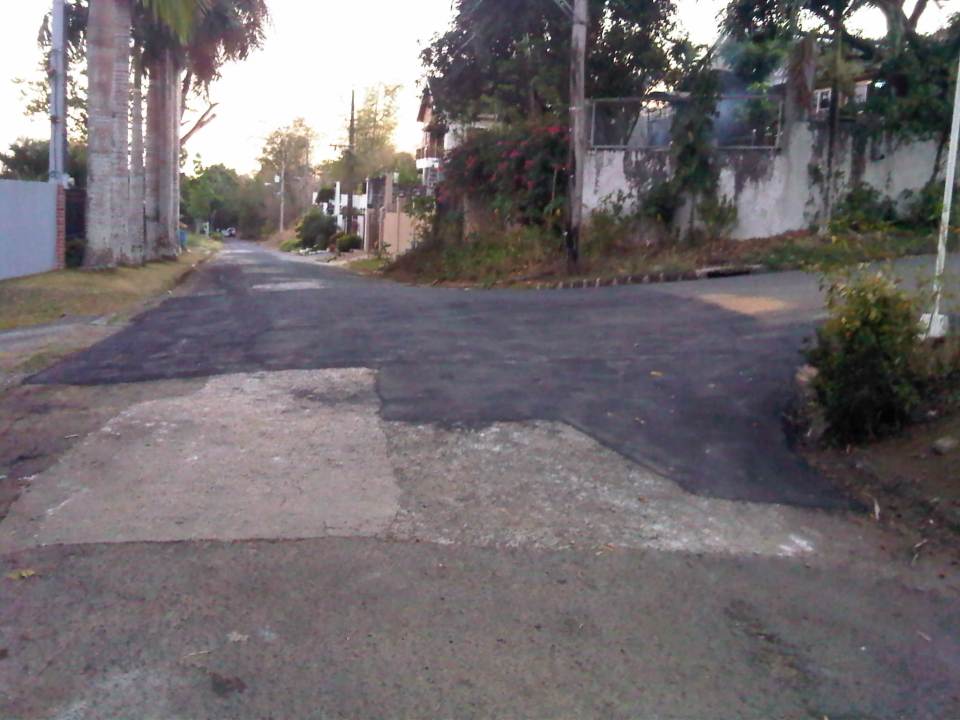 Asphalted pavement at an intersection near the homeowners’ association office
We are very appreciative of the efforts of our village homeowners association in improving the infrastructure in the subdivision. The current policy calls for the prioritization of road sections where residents are up to date in paying their dues. I think this is a fair approach to prioritizing community road works. In fact, there are more road works being implemented now. This is good timing considering it is the dry season. The only drawbacks of such projects are temporary road closures and re-routing of traffic.
–
End game: flyover frenzy
The Manila Bulletin featured news on the Japanese government extending a loan to the Philippines for road projects in Metro Manila that include the construction of several major interchanges. An excerpt from the article is as follows:
The Japanese government will be providing some P4 billion to the Philippines for road projects aimed at decongesting monstrous traffic jams in Metro Manila.
Noriaki Niwa, chief representative of the Japan International Cooperation Agency (JICA), said the loan will cover major interchanges to address traffic congestion in Metro Manila, including flyovers, and road links.
Among them are the interchanges on EDSA/Roosevelt/Congressional, EDSA/West/North, and C-5/Green Meadows and North/Mindanao Avenue.
“This is to help Metro Manila sustain growth and develop it as an attractive investment destination,” said Niwa.
While these interchanges have been recommended many years ago and are also reiterated in the recent transport roadmap for Mega Manila, one cannot help but make the observation that these projects will not alleviate congestion over the long term. Instead, it will likely encourage more vehicle traffic (with the availability of more road space – part of a vicious cycle).
Other major projects that are ongoing in Metro Manila include the NAIA Expressway, which is an elevated tollway connecting to the Skyway. A friend commented that this is basically a glorified flyover project as I will explain later in this post.
 NAIA Expressway construction in full swing – a column rises near NAIA Terminal 3
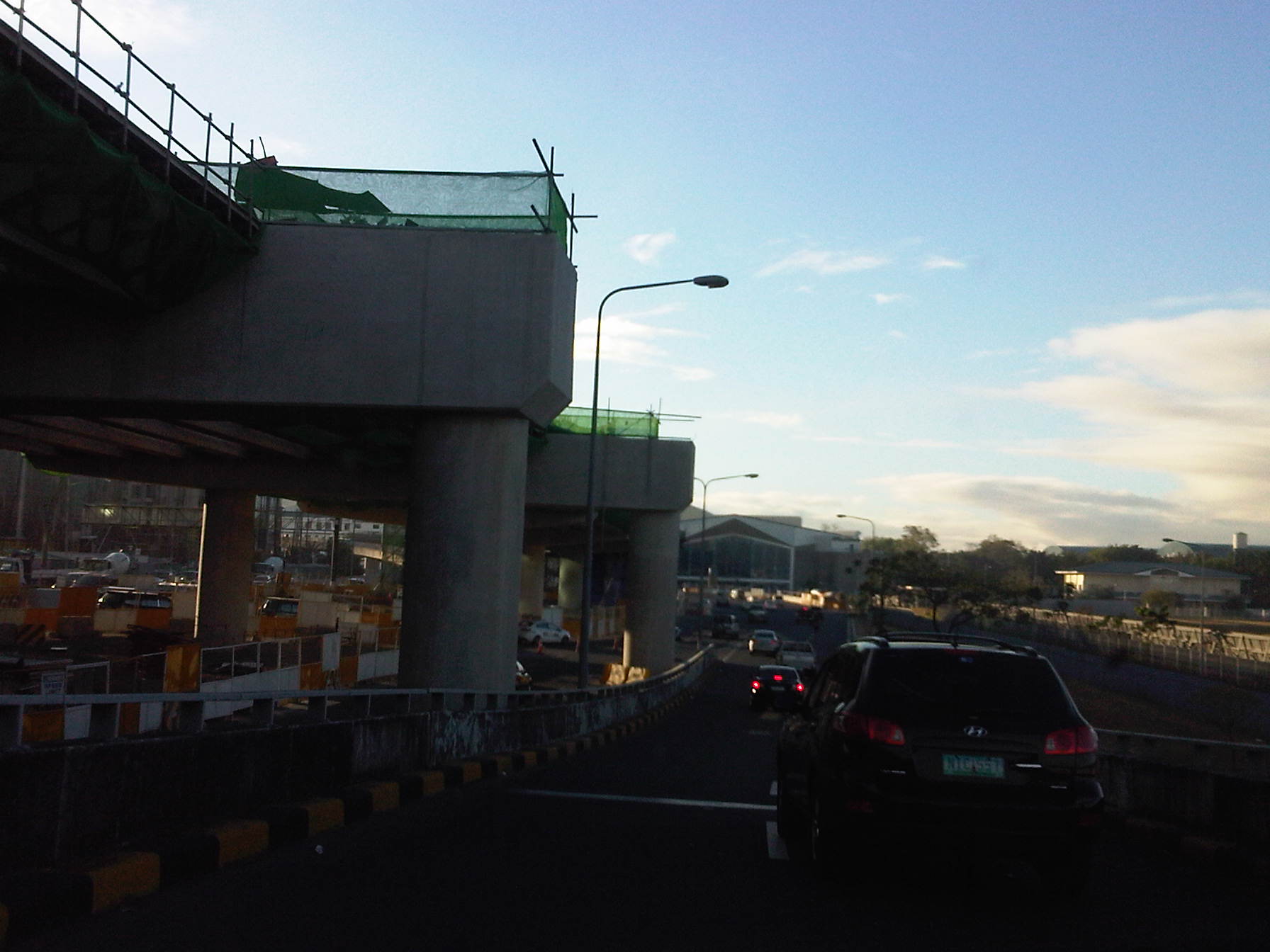 NAIA Expressway elevated sections nearing completion across from Terminal 3
The term of the current administration concludes next year (2016) and so we are almost in the endgame, to borrow a term from chess. What seems to be a frantic move for the government to build all these flyovers (and elevated tollways) can be interpreted as a way to compensate for the underspending and underachieving ways of the government in putting up the necessary infrastructure to address transport and traffic problems in urban areas. Unfortunately, all the funding (public and private) seems to be going to road projects instead of to mass public transport systems like rail and BRT that should be the priority because these could provide the positive impacts over a longer term than what road projects could deliver in terms of mobility and sustainability.
A friend reminded me of a similar situation back in 1991/92 when government embarked on a slew of flyover projects in an effort to leave a legacy in transport. That administration’s excuse for failing to deliver any mass transit project was that it was transitioning from a dictatorship. However, it also failed to deliver on power projects, which led to the energy crisis that had to be solved quickly (but with costly PPP power plant projects). There is a looming energy crisis now but more worrying is a transport crisis as we continue to procrastinate about public transport infrastructure. Should we be hopeful of transport with the next administration? That is still a big question as of now.
–
If you build it, will they come?
There seems to be a belief among the more zealous advocates of sustainable transport that if “you build it, they will come.” It seems cliche but this saying is not necessarily applicable to many things especially when referring to transport infrastructure. There are examples of roads, terminals and other transport facilities that have been built but sadly are underutilized mainly due to the demand just not being there and taking much time to attain. The last is usually due to the fact that certain conditions or prerequisites have not been satisfied. One such example of this is the case of the Subic-Clark-Tarlac Expressway (SCTEX), whose payment for the loan that covered the construction costs was premised on a very high traffic demand forecast. It took some time for more people to use the expressway as the traffic from the major developments (Clark, Subic, Tarlac and Bataan industrial and commercial developments) just didn’t happen as immediately as assumed in the forecast. Still, there is a strategic value to such major infrastructure considering it as an investment and something that will cost a lot more in the future if not built today.
In Metro Manila, the MMDA has allocated or designated lanes for cycling along several major roads. These included the lanes they created out of painting existing pedestrian sidewalks and marking these as bikeways. One section is between Magallanes and Ayala while another is from Ortigas to White Plains. These are poorly designed, “pwede na yan” types of bikeways that people on bicycles would find very difficult to use because the course is full of obstacles. And how about the plight of pedestrians who would have to share these narrow paths with cyclists? Such mixed signals on providing for the needs of pedestrians and cyclists are not necessary unless of course the main objective of this exercise is just to get the attention of a wider audience that is the general public, which I would strongly agree is needed to advocate for sustainable transport. Focus on the ultimate goal, however, should not be lost for what appears as small victories. Perhaps an even stronger initiative should be towards having the DPWH revise road design guidelines to incorporate walking and cycling requirement especially for national roads.
 Bicycle lane along Julia Vargas Ave. in Pasig City
Cebu City enacted an ordinance essentially promoting cycling through the planning and implementation of bikeways, bike lanes or shared lanes. However, initial efforts seem to be following the MMDA’s “pwede na yan” approach. I think Cebu could do better and come up with a better plan for integrating and mainstreaming bikeways into the transport network. But of course, a lot still needs to be done for pedestrian facilities.
In conclusion, building transport infrastructure is not an assurance that it will generate its intended benefits at once. However, some infrastructure are more strategic than others as perhaps they form part of a network. Expressways in Luzon are among these strategic investments. High standard highways in Mindanao are also essential. Rail rehab and building in Luzon is strategic. The same in Mindanao perhaps is not. Mass transit systems in highly urbanized cities are required but perhaps many should start with buses rather than rail. Bridges across islands are not urgent. International-standard airports in major cities are necessary but not all provinces require such airports. Its not a simple task to determine what will work and what wouldn’t. While it is easy to attribute so many benefits in order to justify a project, such practice would usually result in white elephants that few people benefit from.
–
The need for basic transport infrastructure
The need for basic transport infrastructure cannot be emphasized more when we see photos or reports on makeshift bridges and very rough roads that many people use for travel between their homes and the places where they work, attend school or to go to markets to sell or purchase items like food. Many people living in rural areas continue to be in poverty because they lack the infrastructure required for them to be productive. Nevermind that most wealth and productivity is in urban areas. Are we encouraging people who don’t have to be in cities to flock to the cities? And who will be left in the farms? To fish? To produce the food that is so vital for everyone? This is actually a delicate system that hangs in the balance if we cannot support rural development as well as we have urban development.
 A hanging bridge in Tarlac is basically the only way for people to travel across this river, which swells during the wet season. The span is suspended from two columns at either ends of the bridge where there are makeshift stairs for people to climb unto and off the bridge.
 Another view, this time from one end of the hanging bridge shows a crude structure made out of steel cable, reinforcing bars and whatever wood they could use as planks and hand rails. It looks flimsy but they make do with it out of need. We learned that in times when the bridge was destroyed by typhoons, they would rebuild it with little help from the government.
The term “buwis buhay” comes to mind every time I look at these photos and others I have taken of rural roads in Tarlac and other parts of the country. People, especially children and those working hard to care for their families, should not have to risk lives or limbs just so they could go to work or school. Farmers and fishermen should be provided efficient access to markets so as to encourage them to continue in their contribution to food production. And perhaps we should think twice about building expensive white elephants for vainglorious attempts at mega structures especially when we still have a lot to accomplish in basic transport infrastructure.
–
Bridges too far (from being practical)
I am always amused whenever I read or hear news about big bridge projects being proposed by politicians in the Philippines. There is no lack of interest in these types of projects considering the many islands comprising the country. However, at this time and with the urgent demand for other transport infrastructure like access roads (farm to market, tourism, etc.), public transport systems, airports and ports, bridge projects of the “mega”-scale can be considered more as follies than smart investments.
Among the projects I have heard or read about are bridges connecting:
- Cebu and Bohol
- Cebu and Negros (Negros Oriental)
- Panay (Iloilo) and Negros (Negros Occidental)
- Panay (Iloilo), Guimaras and Negros (Negros Occidental)
- Batangas and Mindoro
There is also a bridge proposed to cross the Pangil Bay in Mindanao that has been part of many conversations pertaining to development in Northern Mindanao. These bridges are entirely different in terms of scale and traffic from, say, the proposed third bridge connecting Cebu and Mactan Islands or even the more basic bridges that should have been built many years ago in order for people in rural areas to have direct and safe access to schools, hospitals and workplaces. We see so many images and viral videos of children crossing swollen rivers using make-shift foot bridges, boating or even just walking or swimming across the rivers. Shouldn’t our leaders prioritize these instead of mega bridge projects?
I still have the same questions as before for the proponents of these bridges:
- Are these bridges economically and financially viable?
- What would be the traffic for these bridges?
- Would the money spent for any of these bridges be better allocated for other infrastructure projects in their constituencies?
The first and second questions are often easily answered but it can be argued that traffic forecasts and estimated benefits can be drastically and dramatically increased just so a project is justified. The third one is usually the testy question that, when combined with the first two could be very difficult to answer and explain. Many cities and provinces in the country lack basic transport infrastructure as well as infra for social services (e.g., schools, health centers, hospitals, etc.). And even with health centers, hospitals and schools being built, their facilities and human resources are often less than satisfactory or adequate for the people they are supposed to serve and benefit. These should be on the top of priorities rather than mega bridge projects whose potential benefits will take years, if ever, to actually realize.
–

