
Home » ITS
Category Archives: ITS
Still towards a car-oriented future?
Saw this photo being circulated on social media.
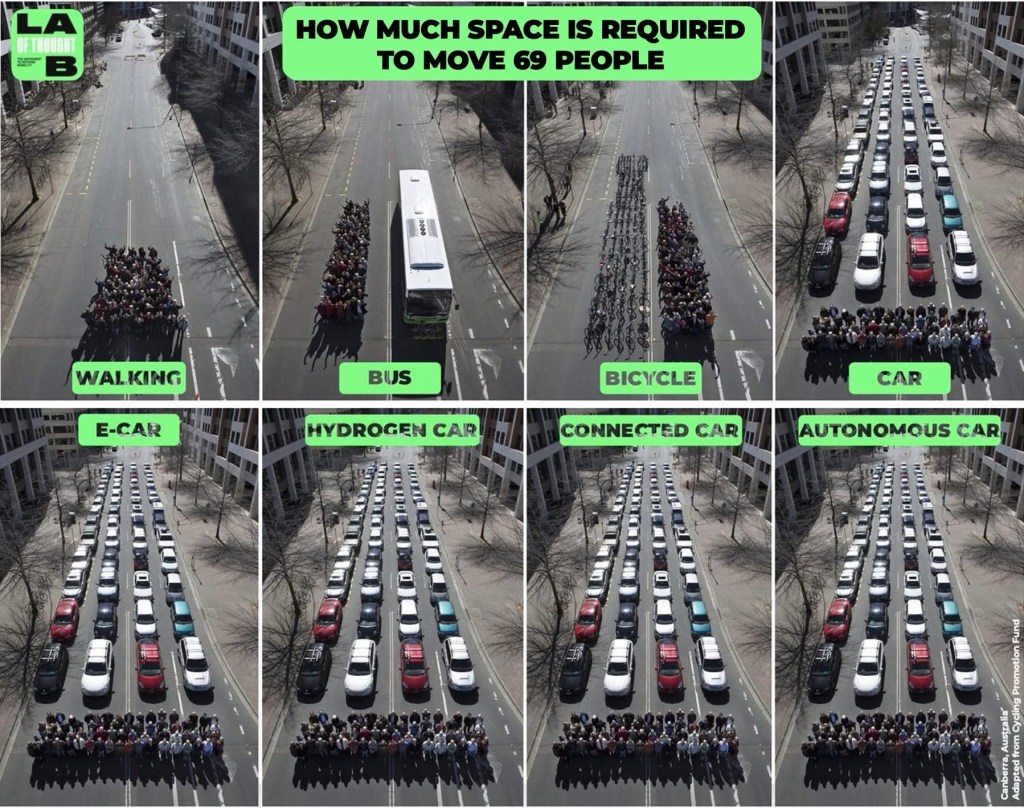
Again, there are many versions of this including the original from a town in Germany that compared 50 people on cars, a bus and on bicycles. The bottom line in the latest images (do these qualify as memes?) is that all these efforts in developing the car, whether regarding the engine or fuel, or perhaps autonomy or connectivity related, ends up being still car-oriented or car-centric. I
t doesn’t really solve our transport problems despite what is being packaged as environmentally friendly. The discussions about this is timely and relevant as electric and hybrid cars are now quickly replacing conventional ones. And there’s a kicker for those driving in Metro Manila, hybrid and electric vehicles are exempted from the travel demand management scheme that is number coding.
How do we veer away from this temptation from technology? How do we keep mode shares in favor of active and public transportation? How do we influence mode choice for the latter options?
–
Article share: On AI as a tool for urban planning
Here is a quick share of an article on AI and its application to urban planning. I haven’t written about artificial intelligence here except maybe mentioning it along the lines of intelligent transport systems (ITS). There were what were termed as Expert Systems but AI now (including its potentials) is much more than the expert systems developed in the past.
Sanchez, T. (June 20, 2025) “In Urban Planning, AI Prompting Could be the New Design Thinking,” Planetizen, https://www.planetizen.com/blogs/135418-urban-planning-ai-prompting-could-be-new-design-thinking [Last accessed: 7/17/2025]
To quote from the article:
“Working across disciplines is essential. Collaborating with architects, landscape architects, engineers, artists, and technologists brings in diverse perspectives that can help spark new ideas. AI integrates knowledge and techniques from each of these fields. Contributing to a culture where planners feel free to experiment, where trying something new is encouraged rather than being frowned upon, is key to real innovation. Whether engaging with colleagues or prompting an AI model, creativity thrives in conversation and collaboration…
Cities should be shaped by creative thinking, and today’s challenges demand more of it than ever. Planners are in a unique position to combine deep local knowledge with new technologies, such as AI, to imagine, design, plan, and implement. AI should be seen not as a shortcut, but it has incredible potential as a partner or assistant with encyclopedic knowledge that helps planners stretch their creativity even further. As Wright advises, planners should challenge themselves with constraints to spark creativity: For instance, “What would you do if you had to write an entire zoning ordinance with 10 rules or less to make a sustainable built environment?” Such exercises encourage us to set clearer goals and find better solutions.
By combining traditional tools with emerging technologies, planners can design places that are not only functional but also vibrant, equitable, and resilient.”
What do you think about AI and its applications to urban planning including transportation and traffic?
–
On transportation problems being treated like diseases
I am sharing this relatively old article on transportation problems needing treatments as if these were diseases. I say it’s ‘old’ because it’s from last year, and these days when much content is being pushed everywhere including mainstream and social media, things get old, quickly. Rewind to more than a decade ago and Intelligent Transportation Systems (ITS) wasn’t as popularly applied as today and Artificial Intelligence (AI) seems to be everywhere now including in transportation systems.
Menard, T. (September 1, 2024) “Transportation Rx: Treating Traffic Glut Like Doctors Treat Sinus Congestion,” Planetizen, https://www.planetizen.com/features/131478-transportation-rx-treating-traffic-glut-doctors-treat-sinus-congestion [Last accessed: 4/21/2025]
To quote from the article:
“Traffic congestion is not unlike congestion that builds up in the human airways. When we see a doctor, we are prescribed a treatment that clears the backup. Similarly for roads, rather than setting up road signs and cones to redirect traffic, cities can take a more prescribed treatment approach through methods such as congestion pricing and other road pricing strategies, as well as technologies like edge computing, navigation-enabled Mobility-as-a-Service (MaaS) modeling, and transit signal prioritization. “
This is not the first article to allude to medicine when the topic is traffic congestion. There are others that use terminology from the human body’s circulatory system. When an artery gets blocked, a bypass can be a solution. But perhaps we don’t need bypasses and look at other. more effective ways of dealing with transportation problems.
–
Initial thoughts on driverless cars
The wife is currently in San Francisco in the US. She sent me some photos and videos of the driverless car ahead of booked to get to their office there.
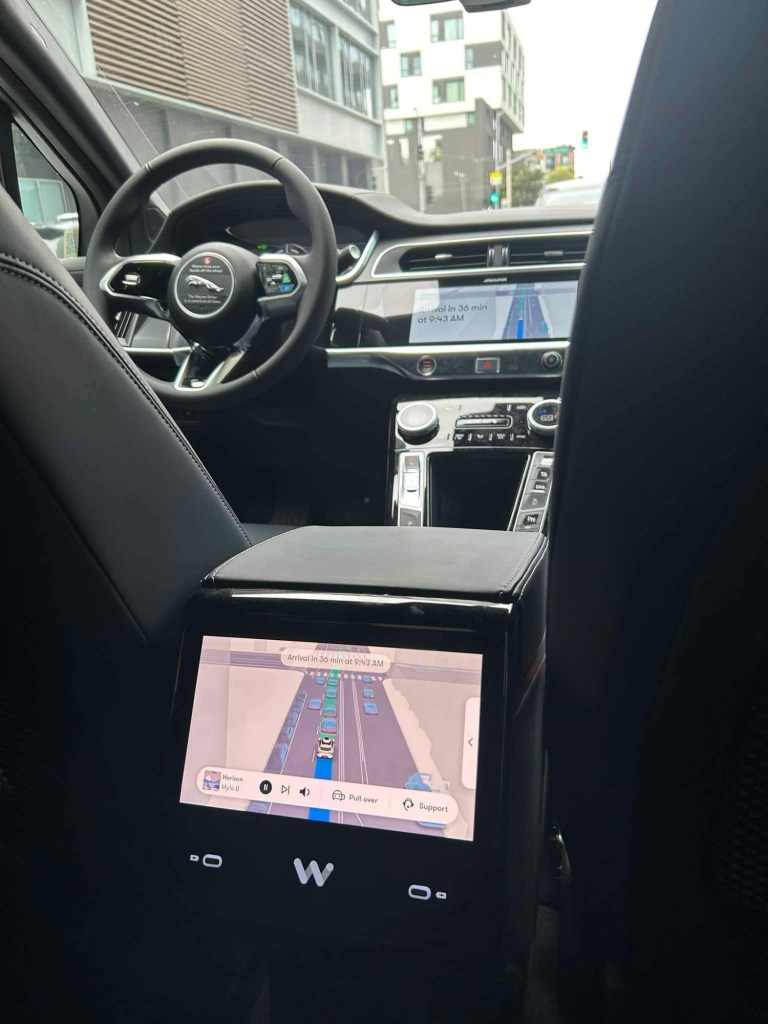
The first thing that came to mind seeing the photos and videos is “It’s cool!” Their creation and operation are indeed wonders from an engineering and technology standpoint. Unfortunately, these are not the solution to our transport problems. These will just replace the cars we already have and causing congestion and other concerns.
–
Article on the new mobilities
Here’s a quick share of an article on what is described as the new mobilities:
Litman, T. [June 30, 2021] “Planning for New Mobilities: Preparing for Innovative Transportation Technologies and Services,” Planetizen.com, https://bit.ly/2U99Hlw [Last accessed: 7/3/2021]
What exactly are these new mobilities? To quote from the article:
“New Mobilities
- Active Travel and Micromobilities. Walking, bicycling, and variations, including small, lower-speed motorized vehicles such as electric scooters, bikes, and cargo bikes.
- Vehicle Sharing. Convenient and affordable bicycle, scooter, and automobile rental services.
- Ridehailing and Microtransit. Mobility services that transport individuals and small groups.
- Electric Vehicles. Battery-powered scooters, bikes, cars, trucks, and buses.
- Autonomous Vehicles. Vehicles that can operate without a human driver.
- Public Transport Innovations. Innovations that improve transit travel convenience, comfort, safety, and speed.
- Mobility as a Service (MaaS). Navigation and transport payment apps that integrate multiple modes.
- Telework. Telecommunications that substitutes for physical travel.
- Tunnel Roads and Pneumatic Tube Transport. New high-speed transport networks.
- Aviation Innovation. Air taxis, drones, and supersonic jets.
- Mobility Prioritization. Pricing systems and incentives that favor higher-value trips and more efficient modes.
- Logistics Management. Integrated freight delivery services.”

–
The future of walking?
Here’s another nice article on the most basic of all modes of transport for people – walking.
Levinson, D. (2018) “What will the footpath of the future look like?”, foreground.com.au, https://www.foreground.com.au/transport/future-footpath/?platform=hootsuite [Last accessed: 7/18/2018]
My only comment about this article is that perhaps the matters mentioned here pertaining to technology that is often associated with the mention of the word “future” is something that the more advanced countries might be concerned with. They are not necessarily applicable to many if not most cases in the developing world much like the talk about autonomous vehicles being exciting in developed countries but not so in others. So yes, the future of walking should still be for people to walk and for authorities to provide the facilities for this activity. Active transport, after all, is not about moving machines but for people to be on the move.
–
A new transport planning process?
December’s already “Chrismassy” in our part of the world and so in keeping with the spirit of Christmas, here is another article I am sharing:
Polzin, S. (2017) “All I Want for Christmas is a New Transport Planning Process,” Planetizen.com, https://www.planetizen.com/node/96036?utm_source=newswire&utm_medium=email&utm_campaign=news-12042017&mc_cid=e64f0c0c60&mc_eid=9ccfe464b1 (Last accessed: 12/6/2017)
In school, we’ve been taught and are still teaching many of the old concepts of transportation planning. I believe these are still important and relevant especially since the fundamentals, or the basics if I may say, are still needed in many situations around the country (i.e., the Philippines). The article above is relevant to our case because it helps build awareness of what is now being discussed and what the future will bring to us. That future for transport is not necessarily immediate although there are already pressures coming from various sectors and technology has been key to the disruptions and the leapfrogging we are experiencing. I like what a friend opines overtime he gets the chance. That is, that the technology-push is not the solution to a lot of our problems because we cannot ignore the basic deficiencies in our transportation system that technology alone cannot overcome.
–
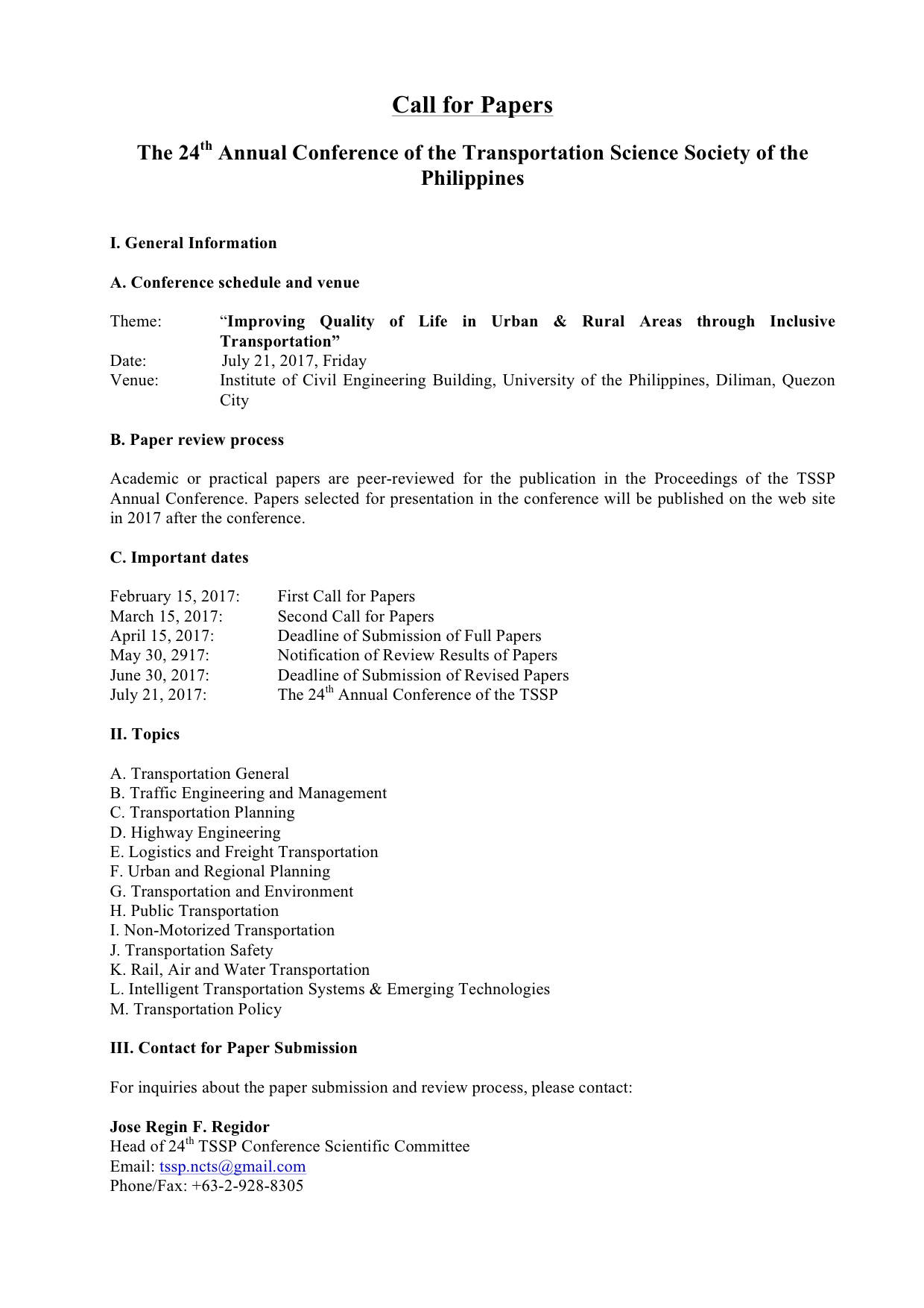
First call for papers for the TSSP 2017 conference
The first call for papers for the 24th Annual Conference of the Transportation Science Society of the Philippines came out last Wednesday, Feb. 15:
–
ITS Forum 2017 at DLSU
We are holding a forum on Intelligent Transport Systems (ITS) today at the De La Salle University (DLSU) along Taft Avenue, Manila. Following is the banner and the program as of February 16:

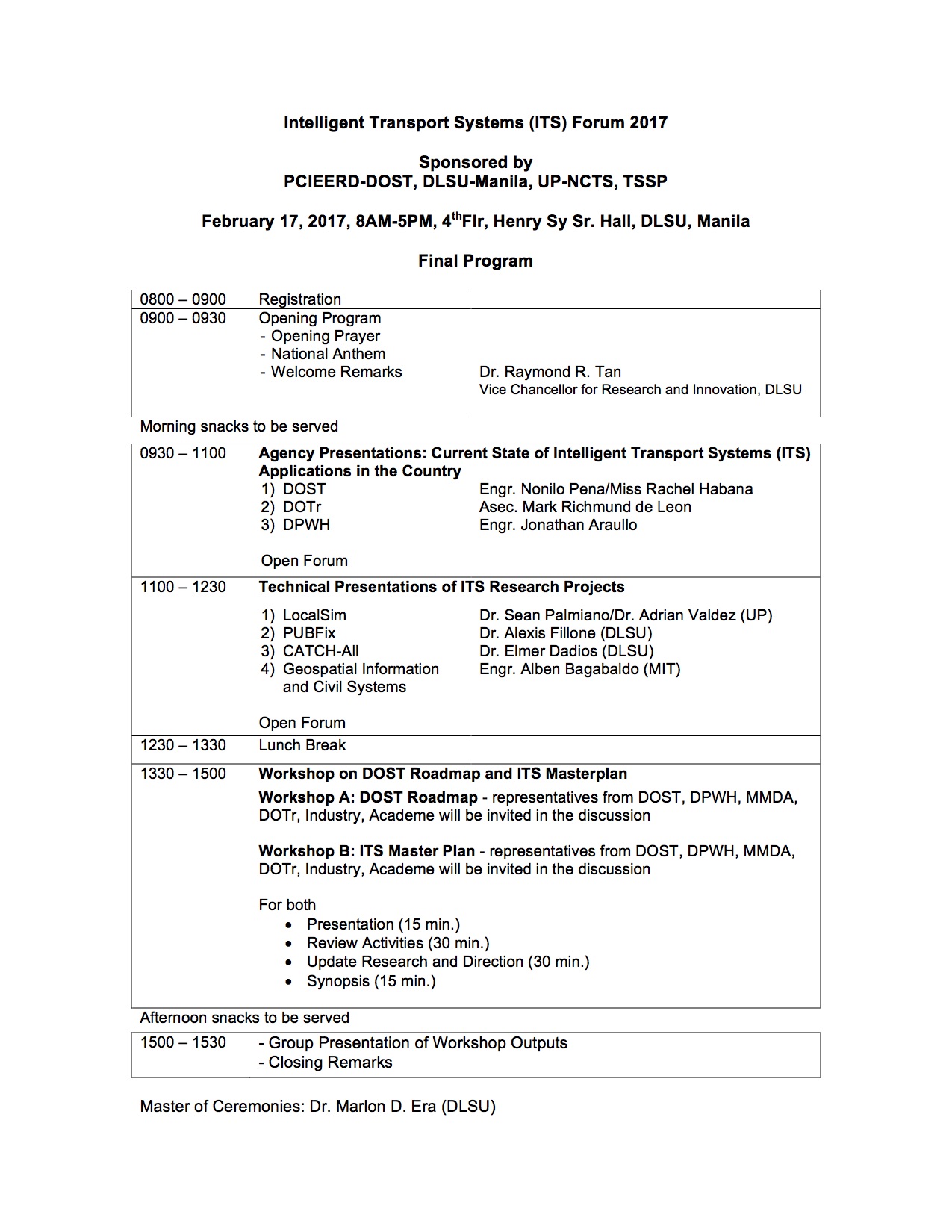 In the workshops scheduled in the afternoon, the plan is to review the DOST roadmap and the ITS Master Plan. The DOST roadmap is basically on the research and development agenda of the agency. In the past, this has been associated mainly with the Engineering Research and Development for Technology (ERDT) program of which several major universities are a part of including UP Diliman, DLSU, Ateneo and Mapua Institute of Technology. Eventually, ITS became the theme for other R&D including those that were packaged as ITS but not necessarily falls under the category (i.e., projects like the AGT, hybrid bus and bike share are more sustainable transport than ITS).
The ITS Master Plan is actually something developed under a project implemented through the Department of Public Works and Highways (DPWH) more than 6 years ago and originally only for Metro Manila. This plan is being eyed as the foundation for a bigger one that hopefully would apply to the rest of the country.
–
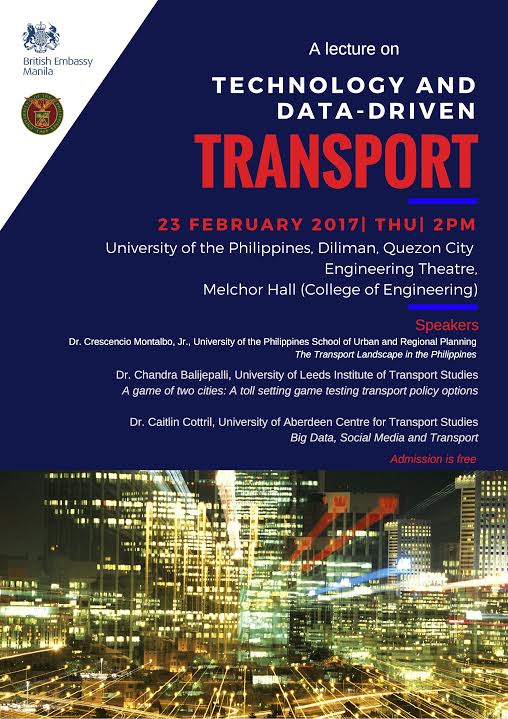
Special lectures on transport – February 23, 2017
I just wanted to share the following announcement from the University of the Philippines Diliman about special lectures on transport. The lectures will be delivered at the Melchor Hall theater at the UP Diliman campus and is open to the public.
–
 Caught (up) in traffic