
Home » Laws
Category Archives: Laws
Senseless road crashes
My staff shared the following cctv footage of a recent road crash along C.P. Garcia Avenue just across the College of Science Complex in UP Diliman. The videos show two vehicles colliding along the road at nighttime. This is usually a busy road with traffic to and from Katipunan, mostly comprised of travelers associated with the schools I the area.
https://www.facebook.com/share/v/17MPeJnrCk/
The black SUV appears to be speeding and suddenly veered towards the opposing lane where it collided with another vehicle. It is unclear if the driver lost control of the vehicle or was aware of what he was doing. That cost 2 lives as both drivers reportedly died from the crash.
This is among those crashes that can be regarded as senseless incidents. This could have been avoided if the driver was not speeding in the first place or perhaps was not influenced by any factor like alcohol or drugs. Perhaps it’s really about the behavior of certain motorists who shouldn’t have licenses to drive in the first place? We commonly refer to them as kamote drivers or riders. The LTO should do their part in ridding the roads of these menaces.
–
Quick comments on the NCAP
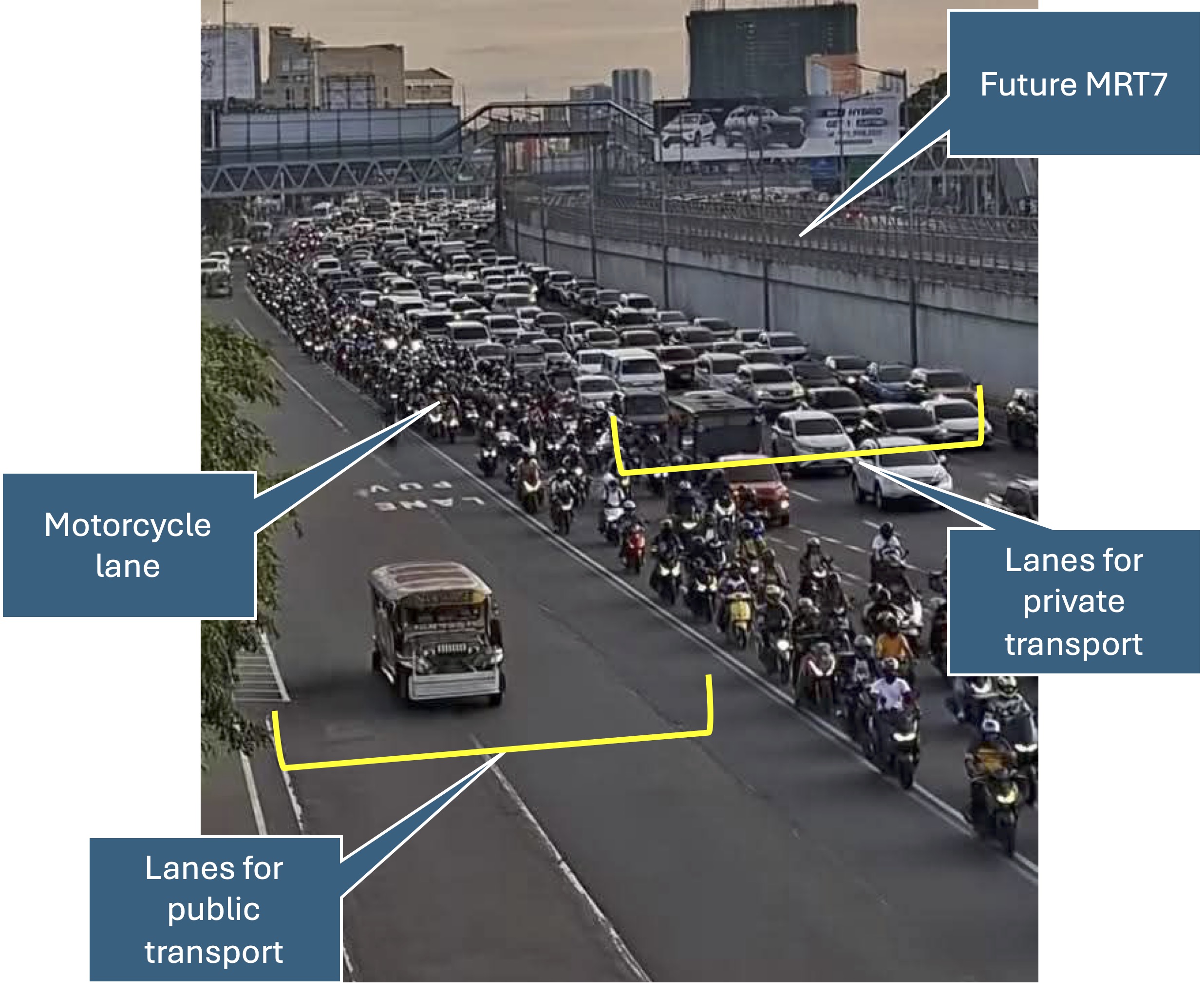
The No Contact Apprehension Policy (NCAP) is finally being implemented in Metro Manila. The results so far has been dramatic in terms of the number of violations recorded and the images being shared so far about how motorists are behaving. Below is one of those photos being shared on social media to which I added some annotations. I will use this later to comment on the NCAP and how we can use the outcomes to assess the transportation situation and determine what interventions can be done. Some are already obvious from the photo – the lack of public transport options lead to people depending on private motor vehicles like cars and motorcycles for their commutes. MRT7 is yet to be operational and road public transport has not been rationalized.
More on this topic soon!
–
Are transportation issues election issues in the Philippines?
Are transportation issues in the Philippines? Or are these issues at the local level? Here is an article about how transportation issues were brought to light and were actual topics in the ballot in Los Angele, California in the US:
Tu, M. (November 25, 2024 ) “Bike, Bus and Pedestrian Improvements Won the Vote in L.A. How Did Advocates Pull It Off? “ Next City, https://nextcity.org/urbanist-news/bike-bus-pedestrian-improvements-healthy-streets-los-angeles-ballot?utm_source=Next+City+Newsletter&utm_campaign=532838ef65-DailyNL_2024_11_18_COPY_01&utm_medium=email&utm_term=0_fcee5bf7a0-532838ef65-44383929 [Last accessed: 11/26/2024]
The three lessons in the article are:
- Build a coalition – “In the lead-up to the election in March, Streets For All successfully secured endorsements from unions, climate organizations and business groups that saw the vision for safer streets.”
- Safety wins – “We could make climate arguments, we could make equity arguments, but the thing that felt the most bulletproof to us and the most empathetic to the general Angeleno was just road safety,”
- Keep it simple – “…simple messages were the most effective. Vredevoogd fought for one billboard on Vermont Avenue that read “In 2022, more pedestrians died on Vermont Avenue than in the state of Vermont.”
Los Angeles or LA as many people fondly call the city is well known for being car-centric (as opposed to San Francisco to the north, which is more transit-oriented). Perhaps we can learn from this experience though I know there are already groups and coalitions lobbying for better transportation in the Philippines. Are they successful and to what extent are they succeeding? Granted there are different situations and conditions, even modalities, to engage politicians, there are also so-called party list groups claiming to represent the transport sector but none appear to be really standing up for issues like improving public transport or road safety. And so the challenge is still there for people to make transportation issues election issues in the country.
–
On bike lanes contributing to safer roads
Do bike lanes make roads safer? There are obviously mixed reaction to this question especially if you look as social media. If we are level headed about this topic and look at the evidence out there, the answer is yes. But there can be caveats as we try to contextualize in the local setting. The formal studies so far are in countries where the drivers arguably more disciplined than ours here in the Philippines. Driver behavior, after all, is a major factor for road traffic safety. Here is a good article for reference in the discussions and arguments for bike lanes:
Tu, Maylin (November 5, 2024) “How Bike Lanes Slow Drivers and Save Lives,” Next City, https://nextcity.org/urbanist-news/how-bike-lanes-slow-drivers-and-save-lives [Last accessed: 11/10/2024]
To quote from the article:
“Bike lanes with physical delineators (cones or bollards) were more effective than paint-only lanes at calming traffic, echoing a popular mantra for bike activists: “Paint is not protection.” (The lanes were not protected, however, because drivers could drive over the delineators.) For vehicles turning right, top speeds were reduced by 28% and average speeds by 21%. Paint-only bike lanes slowed driver speeds by up to 14% and drivers going straight slowed down by up to 8%…
The study adds that pop-up bike lanes are a cost-effective solution for studying the effects of more permanent solutions — after all, you could just borrow the traffic cones. A city could quickly implement pop-up or temporary infrastructure. Then, armed with data and community feedback, they could invest in making the changes permanent.”
The article also points to a technical paper or scientific article on the traffic calming effect of bike lanes. Here is the link to the article published in the Journal of Urban Mobility: https://doi.org/10.1016/j.urbmob.2024.100071
–
Safety or speed?
We start June by sharing a video on why safety and vehicle speed are incompatible:
I saw this video while browsing an article on “Dangerous by Design”. The article discusses a new publication where road designs are evaluated from the perspective of safety. Most of our roads have been designed with speed in mind. That is, how to facilitate the movement of motor vehicles to ensure they travel faster. Forgotten or, even worse, disregarded is the most important element of safety. Why do we widen roads or insist on higher speeds in populated areas or school zones? Such questions are not addressed directly or not answered at all by agencies in charge of planning, designing, constructing and maintaining roads and bridges. The same is true for agencies or units in charge of traffic regulations or management. The result not surprisingly is an increase in the number of road crashes, fatalities and injuries due to our roads being ‘dangerous by design’.
–
Article share: on making more affordable neighborhoods
I’ve been commenting about how transportation cannot be isolated and the need to relate it to other factors such as housing or home location choice. The latter though is also affected by other factors as well that affect the affordability of homes near the city centers or CBDs where workplaces and schools are located. The result of course is sprawl or the encouragement of sprawl. Private companies take advantage of this or contribute to this ‘encouragement’ by developing land farther away from the center. Thus, for Metro Manila’s case, many people reside in the peripheral provinces of Bulacan, Rizal, Laguna and Cavite. There are even those who choose to reside in Pampanga, Bataan and Batangas.
Kayatekin, C.S. and Sanmiguel, L.U. (April 16, 2024) ” ‘Urban form’ and the housing crisis: can streets and buildings make a neighborhood more affordable?” The Conversation, https://theconversation.com/urban-form-and-the-housing-crisis-can-streets-and-buildings-make-a-neighbourhood-more-affordable-224108 [Last accessed: 4/23/2024]
Quoting from the article:
“Our main finding was that the bottom-up districts we looked at had, overall, more small-scale apartments. The reason is simple: they had more small-scale buildings, built on small-scale plots. Once divided into apartments, this produces small apartments – homes in the bottom-up areas were 10% to 23.1% smaller than their top-down counterparts. This also made their real estate markets for small homes more competitive, and therefore more affordable.
However, our study showed there is nothing inherently magical about bottom-up areas. Their more intricate housing stock has little to do with the layout of streets and blocks, and a lot to do with how that land is built upon.
Plot size appears to be the deciding factor: the districts with greater numbers of small buildings built on small plots supported a denser and more affordable housing stock, regardless of whether they were top-down or bottom-up.
Older bottom-up areas seem to naturally lend themselves to having more small-scale plots. This is likely due to the incremental development of these areas, and the complex land ownership patterns that developed as a result. However, there is no reason why a top-down area cannot be designed to replicate these characteristics.”
–
On kamote riders
Much has been written and reported about the so-called ‘kamote’ riders. These are motorcyclists who have the propensity for risky behavior including reckless maneuvers on the road. Such often places them in harm’s way whether they are conscious about the actions or not. I see them everyday during my commutes including but not limited to those who counterflow, speed, race, zig-zag through moving traffic, and use the bicycle lanes or pedestrian sidewalks.
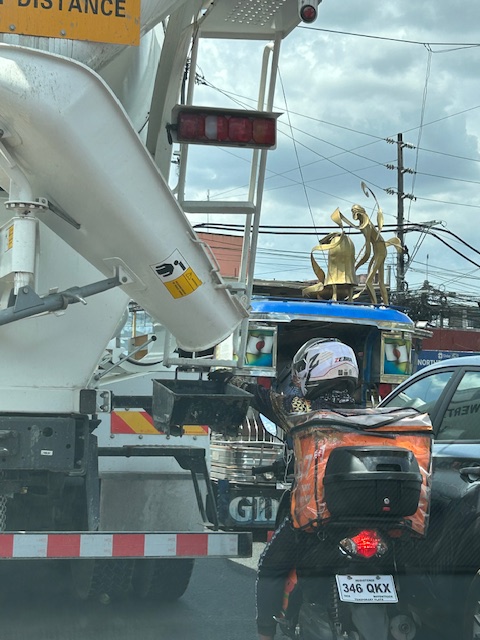 The not so obvious kamote rider positioning himself at the downspout of a concrete mixer.
Not all motorcycle riders are kamote. However, there is a significant number of them out there that put other road users in risky situations. They also contribute to a lot of damage to property as evidenced by a lot of vehicles, especially cars, that have the signature scratches, dinks and dents after being sideswiped or bumped by motorcycles. Such behavior can actually be corrected if the Land Transportation Office (LTO) would be stricter with licensing – requiring more in terms of rider training and certification as well as testing. Traffic law enforcement is also critical here because behavior change can only be done and effective if enforcers are firm. A friend made the observation that law enforcers themselves are the first to violate rules and regulations or bend them in their favor. That sends a wrong signal and would only encourage more ‘pasaway’ and ‘kamote’ riders.
Of course, there are also kamote drivers and cyclists. But those are the topics for future posts.
–
Lower speed limits may not slow drivers, a before-and-after study shows
I am sharing this article on drivers not reducing their speeds after speed limits have been lowered along certain roads. My first reaction after reading the article is that it is that perhaps in the US case, the after study was conducted quite early and before people have become aware, understood and adjusted to the lower speed limits. The responses or reactions to lower speed limits (particularly those posted or on signs) may vary among cities and countries. In the Philippines, where drivers and riders appear to be oblivious to speed limits, other interventions may be required including some types of traffic calming devices. This is very much a concern particularly in school zones where children are exposed to the risks of being run over by motor vehicles speeding along the roads and not minding the speed limits in the area.
Here is the Research report:
Source: Lower speed limits may not slow drivers, a before-and-after study shows
Speeding, road crashes and nuts behind the wheel
A recent road crash involving a car slamming into a truck along Marcos Highway in Antipolo City highlights one of the main concerns affecting road safety in the Philippines – speeding. Video from a CCTV camera installed at an establishment near the crash site showed a truck making a U-turn and doing it correctly (i.e., the maneuver) and safely. What followed was a car that was obviously speeding but seemingly not out of control. The car slammed the back of the truck in what was a fatal and tragic crash.
Are the roads to blame? While roads and bridges are static, design elements are the main culprits for why these facilities can be unsafe to users. Straight, level and wide sections of roads invite speeding among drivers and riders alike. The so-called ‘ideal’ sections of roads encourage drivers and riders to speed up, regardless of the speed limits. Thus, roads like Commonwealth Avenue in Quezon City and Marcos Highway in Antipolo, Cainta, Marikina and Pasig have many speeding vehicles. The design speeds for these roads are definitely above the speed limits. I still maintain though that it takes two to tango. That is, even with the above conditions, disciplined, experienced drivers and riders should not have been speeding or doing any other risky maneuver. That could have reduced the likelihood of such crashes. I think that’s pretty plain and common sense.
–
 Caught (up) in traffic