
Home » Laws (Page 5)
Category Archives: Laws
On motorcycle taxis becoming the “new king of the road” (cont.)
This is a continuation of the yesterday’s post on motorcycle taxis. The feature appearing in Sunstar Philippines also focuses on the case of Cebu City where there is a rising demand for motorcycles and issues on public transport have given rise to a motorcycle taxi use despite their being basically illegal under current laws/guidelines. Habal-habal as these motorized 2-wheeler taxis are known have been in service in many cities and municipalities but are mostly tolerated in rural areas where conventional public transport services are scarce.
Part II of the feature by Sunstar:
New King of the Road – Part II
There are three articles in Part II:
Ramirez, J.A.C. (2017) Motorcycles on the rise, Sunstar Philippines, Retrieved from: http://www.sunstar.com.ph, April 4.
Ramirez, J.A.C. (2017) Habal-habal drivers form group to ‘professionalize’ services, Sunstar Philippines, Retrieved from http://www.sunstar.com.ph, April 4.
Ilano, M.V. (2017) Hailing a motorcycle taxi with your smartphone, Sunstar Philippines, Retrieved from http://www.sunstar.com.ph, April 4.
Part III of the feature by Sunstar:
New King of the Road – Part III
Ilano, M.V. (2017) Even with BRT, motorbikes still needed in Cebu City, Sunstar Philippines, Retrieved from www. sunstar.com.ph, April 4.
Ilano, M.V. (2017) Will Cebu City lead the way?, Sunstar Philippines, Retrieved from http://www.sunstar.com.ph, April 4.
I hope these articles on motorcycles and motorcycle taxis will generate meaningful discussions pertaining to their applications and perhaps their regulation. One issue, of course, that should definitely be on the table is safety. That is non-negotiable and assurances by motorcycle taxi transport providers should not be enough to persuade their becoming formalized as a public transport mode. The basis for mainstreaming these should be evidence-based including assessments based on crash (accident) data. Here is something that can be studied by the various schools around the country especially universities that have the capacities and capabilities to conduct such studies in aid of policy formulation at the national and local levels.
–
The Tagaytay transportation predicament
The title of this article is actually a bit tame and on the diplomatic side of trying to describe transportation and traffic in this city that was once relaxed a retreat for many. I had wanted to end February on a good note and so I decided to defer posting this until March.
We used to frequent Tagaytay and liked spending some rest and recreation time there to the tune of being there almost once a month at one time. Needless to say, at the time travel to Tagaytay from our home in Antipolo took us only about 2 to 2.5 hours excluding our usual stop at Paseo in Sta. Rosa, Laguna. We liked the city so much that we even considered making it a second home; even inquiring and looking at properties there.
Fast forward to the present and it has become an excruciating travel with the highways leading to the city already congested. It didn’t help that when you got there, you also had to deal with serious traffic congestion. This started not a few years ago when the city approved developments by major players including Robinsons, SM and Ayala. The developments by SM and Ayala proved to be the backbreakers with Ayala coming up with the first mall in the city and SM operating an amusement park beside its prime acquisition that is the Taal Vista Hotel. Now, there is another mall under construction by Filinvest and right at the corner of the rotonda where the Aguinaldo Highway terminates.
 Vehicles queue along the Tagaytay – Nasugbu Highway towards the Rotonda where Tagaytay traffic enforcers attempt to manage traffic but appear to create more congestion instead.
More on Tagaytay soon…
–
Uber as a Ponzi scheme?
I came upon this article posted by an acquaintance on his social media account. The article appears to be click-bait given its title but reading through it, the author leads you to other articles of what seems to be a series about Uber’s operations. I won’t give any assessment here as we are also doing research on ridesharing (although for now its mostly about the passengers perspective and characteristics). I will let my readers digest the content and context of the following article:
Excellent, deep series on Uber’s Ponzi-scheme economics
–
Mobilizing sustainable transport for development
The United Nations (UN) has recently published a new report on “Mobilizing sustainable transport for development” authored by a High Level Advisory Group on Sustainable Transport formed by the UN. The report and other resources may be found at the following website:
Secretary General’s High Level Advisory Group on Sustainable Transport
This is under the UN’s Sustainable Development Knowledge Platform. You can check out the other materials at the website. The UN has many initiatives on sustainable transport and has been very active in promoting or advocating for sustainable transport for a long time now. It is through the UN Centre for Regional Development (UNCRD), for example, that the Philippines and other ASEAN countries were able to formulate their national EST strategies. The new report continues on the UN’s commitment to promote sustainable transport to improve people’s lives around the world.
–
Emergency powers to solve PH transport problems? – A long list of projects
I am sharing the long list of projects submitted by the Department of Transportation (DoTr) to the Senate Committee on Public Services chaired by Sen. Grace Poe. This is a public document and I think should be circulated for transparency and so people will know what projects are proposed to be covered
List of sectoral projects that the Department of Transportation intends to implement and draft bill for emergency powers: dotr-list-of-projects-and-draft-bill
I leave it up to my readers to determine which among the projects listed really require emergency powers. Many I think do not require emergency powers especially since the period requested for such powers is 2 years and not the duration of the current administration’s term. Perhaps those requiring emergency powers would be programs and projects aiming to overhaul our public transport system, which is currently much dependent on road-based modes. Public transportation services do not follow the suitable hierarchy as seen along major corridors served by low capacity modes. An overhaul (i.e., rationalisation) will touch the very sensitive nerves of bus, jeepney, UV express and tricycle operators and drivers and could trigger an avalanche of TROs to prevent or discourage government from doing what should have been done decades ago to bring order to our chaotic transport. I believe emergency powers coupled with the current admin’s political capital (and the “action man” image of Pres. Duterte) can help bring about genuine reform (and change!) to transport in our cities.
–
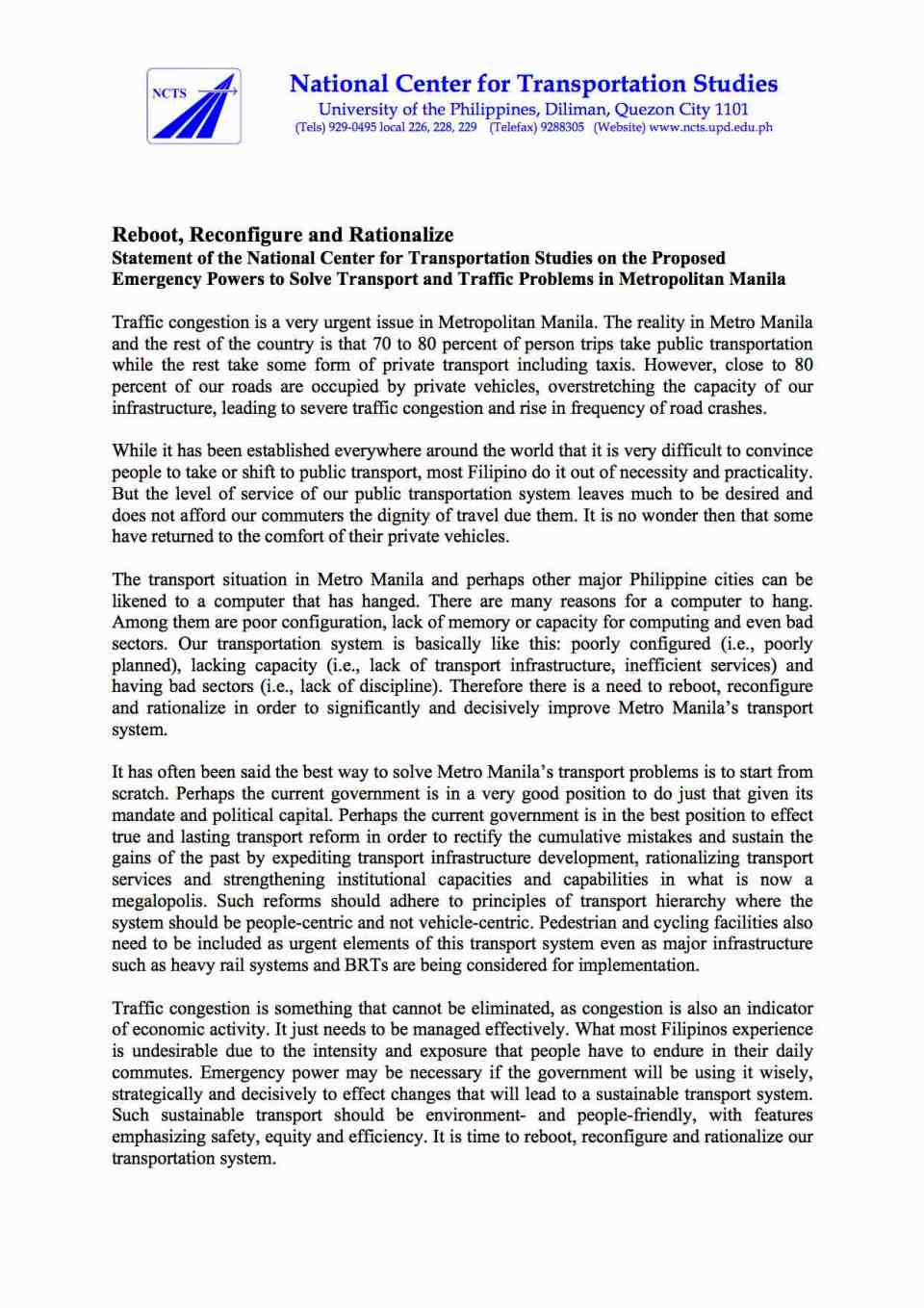
Statement on the proposed emergency powers to solve transport and traffic problems
The National Center for Transportation Studies (NCTS) of UP Diliman submitted a statement to the joint Senate committees evaluating the proposal to grant emergency powers to the Philippines President in order to solve the transport and traffic problems in the country and especially in Metro Manila. Following is a copy of the one-page statement:
–
Better indicators than GDP
A friend shared this article on social media:
Five measures of growth that are better than GDP
The article explains in clear and simple terms five better indicators of growth and development than what is regarded as the conventional and traditional measure that is gross domestic product (GDP). There is an analogy in the article using speed, a parameter in traffic, to explain how GDP is insufficient in describing growth in a more complete manner. For example, in the Philippines, the significant increase in GDP over the last 6 years has been mentioned as proof of economic growth. While this is true, many people could not appreciate this growth since there is the perception is that it is not inclusive. That is, economic development is not felt by many who are in the lower income classes.
Speed, indeed, is not enough to describe the transport situation along a road considering that there are other metrics needed to have a more complete picture of transport and traffic conditions. I will talk about this in another posting soon.
–
A new Department of Information
The big news today is the creation of a new Department by virtue of a new law signed by the outgoing President. The news article describing this new Department may be found in the following link:
Department of Information and Communications Technology created
This is a significant development as the next President of the Philippines already named his man for the Department of Transportation and Communications (DOTC) and now he has to deal with a new Department and more appointments.
With the DOTC (or DOT?) now reduced to dealing only with transportation, perhaps it can be more focused on the issues it needs to address immediately, over the next 6 years and beyond (i.e., from a strategic perspective). Also, perhaps the next administration can take a look at the possibility of having a merger of the transportation department and DPWH. Of course, such a merger would require a really good person on top to lead. This person should not only be an excellent manager but also a master strategist, with a clear and progressive vision for a modern, efficient transportation system for this country.
–
Helmet or no helmet when biking?
We were at the Department of Science and Technology – Philippine Council for Industry, Energy and Emerging Technology Research and Development (DOST-PCIEERD) this morning to help defend our proposal for a bike sharing system. UP Bike Share is an initiative coming out of a group of students from various programs in their respective colleges at the University of the Philippines Diliman.
One question that was raised among the technical panel to whom the proposal was presented for evaluation was concerning safety of people participating in the bike share. One panelist asked if cyclists were required to wear helmets. We replied that those participating in the bike share were not required to wear helmets and that despite helmets being available few, if any, borrowed the available helmets. I mentioned that there was an article I came upon before that stated the requiring people to wear helmets discourage biking. It seems a coincidence that as I browsed my Facebook just now, I found a link to that very same article I mentioned in a meeting earlier today:
To encourage biking, cities lose the helmets [by Elisabeth Rosenthal from The New York Times, Sunday Review, September 29, 2012]
The article makes a lot of sense especially the observation that requiring helmets seem to send the message that it is dangerous to bike. People associating danger with biking with helmets tend to opt out of biking. I recall that in Japan before, I didn’t have a problem biking in urban areas and helmets were not required. Of course, drivers of vehicles in are very admirable by the way they drive safely and respecting other road users’ right to the road. Instead of having a campaign to require helmets for bikers perhaps efforts should be focused on how to make our roads safer for all users including bikers and pedestrians.
–
Towards safer roads: design, respect and education
Fatal crashes involving cyclists have been posted in social media including a recent one involving a mother of two who was run over by a garbage truck that encroached on the on-street/painted bike lane in, of all places, Marikina City. Emphasis on Marikina is made here because it is a city well-known for its comprehensive bikeways network. The network is comprised of segregated and on-street bikeways.
Following are some photos showing examples of good and bad practices pertaining to bikeways design in the Philippines:

Example of segregated bikeway at the University of the Philippines Diliman campus. Cyclists actually share the carriageway lane allocated from the Academic Oval with pedestrians and joggers. They are not physically protected from motor vehicles that can encroach on the bike lane.

Example of segregated and protected bikeway along Marcos Highway in Pasig City (similar design for the sections in Marikina, Cainta and Antipolo) – bikeway is on the sidewalk and cyclists essentially share space with pedestrians despite delineations.

Example of segregated and protected bikeway/walkway along EDSA in Makati City – note that space to be shared by pedestrians and cyclists is very constricted.

Example of poor design along White Plain Avenue – the MMDA seems to have designated the entire sidewalk space for cyclists.
Three examples from Marikina’s bikeways are shown below:
 Painted, segregated bikeways on the carriageway on either side of a two-way road [Note: This is basically the design along the street where the crash in Marikina occurred.]
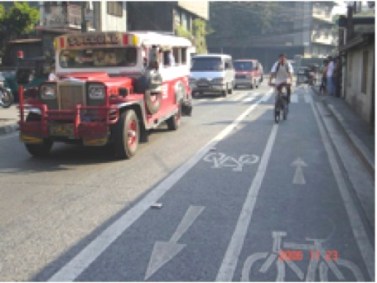 Painted, segregated bikeways on the carriageway along a one way road
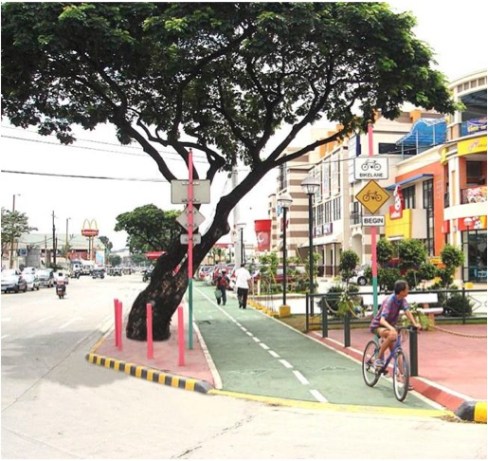 Segregated and protected bikeway off the carriageway along Sumulong Highway
Granted that the ideal set-up would have segregated or protected bikeways that are designed properly, we take a look at two other very important elements that are not at all as technical as design and planning of bikeways – respect and education.
Education is an important aspect of driving. Many Filipino drivers are poorly educated in terms of traffic rules and regulations, road design as well as local policies pertaining to transport and traffic. As such, there is a tendency for many drivers to disregard rules and drive/ride aggressively and recklessly. This must change and it starts with reforms in the way licenses are issued to all types of drivers including perhaps stricter certification systems for truck drivers and public utility vehicle drivers. Traffic education should also be integrated into the academic curricula of schools starting at a very young age. Road safety parks are one way to promote traffic education for kids.
Respect is partly derived from education but is also related to attitude. No matter how much driver or road user education or skill you get if you have a bad attitude, you will still have the tendency to be reckless or irresponsible with your actions on the road. One way to curb bad attitudes on the road and to educate road users (particularly errant drivers and riders) is strict traffic enforcement. Many cities already have CCTVs installed at major intersections that allow law enforcement units to be able to monitor traffic behavior and perhaps zoom in to determine driver and vehicle information including license plate numbers.
The crash that killed the single parent in Marikina is not so much as an issue one whether we need segregated and protected bikeways but is more an urgent need to assess the state of traffic education and enforcement in this country.
–
Articles on the crash and calls for reforms may be found in this link.
 Caught (up) in traffic