
Home » Logistics
Category Archives: Logistics
On how delivery culture is influencing policy and urban design
While discussing on-street parking policies and schemes with Naga City LGU officials, one comment was on providing parking space for delivery riders. Truly, delivery riders have become a significant consideration especially where they have no parking spaces to wait or sort their items. The following articles expounds on how the rise of delivery culture is influencing policy and urban design:
Franco, A. (November 14, 2025) “From edge to epicenter: How the curb became a key piece in modern cities,” Public Square, https://www.cnu.org/publicsquare/2025/11/05/edge-epicenter [Last accessed: 11/14/2025]
To quote from the article:
“Urban designers need to recognize that while our streets were once built exclusively for car movement and storage, they are inherently adaptable. The opportunity now is to make these spaces more equitable, accessible, and efficient for everyone, not just car owners with parking privileges. After all, the street and the curb are public spaces and should serve the diverse needs of all citizens.”
The mobile stores of my childhood days
I took a photo of this animal (cow) drawn cart as we passed it in Taytay en route to Makati via C-6. These used to be larger and wagons drawn by one or even two animals (usually cows or bulls). Families lived in those wagons and were somewhat nomadic in a sense that they traveled while selling products like walis tambo (brooms for indoor use like those in the photo), walis tingting (brooms made of coconut stems also in the photo to the rear of the cart), baskets, and other handicrafts. I have memories of their regular if not frequent visits to our village in Cainta in the 1970s and early 1980s. Eventually, they vanished. I see some from time to time but only like the one in the photo below. I have not seen the larger wagons.
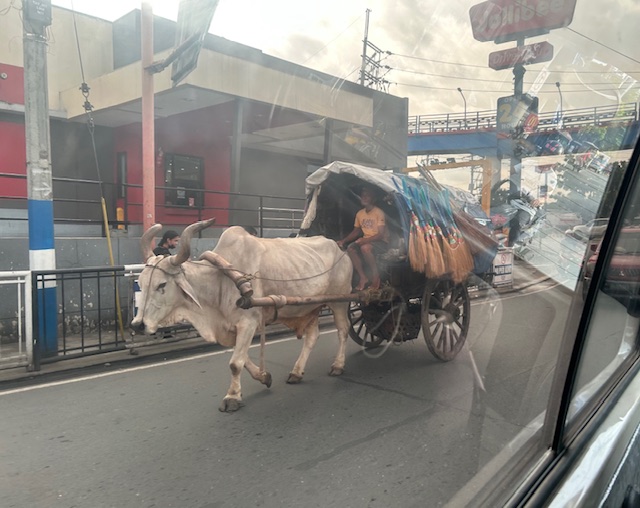 The cart was pulled by a bull that looked emaciated to me. I hope they’re able to feed this animal and care for it considering this is probably their most valuable asset.
While this seems like a spectacle these days, they were the mobile stores of the past; often traveling in groups. I wonder how long there will be animal-drawn carts like this.
–
On the fatal Katipunan road crash
The vehicles involved in a recent road crash that killed at least 4 people are still there and parked under the Aurora Flyover. A truck apparently lost its brakes and control and the driver ended up plowing into other motor vehicles, likely trying to gain some control in order to stop the truck. It was reported in news articles that there were 4 immediate fatalities and many suffered serious injuries. We probably won’t know the final fatality count unless someone reports on those hospitalized for injuries.


The crash highlighted again the need for vehicles, especially trucks, to be roadworthy. This time of year, most of these trucks run busy schedules with the logistics requirements. But maintenance is just one part of the problem here as the truck was reported to be speeding. So driver behavior is also a factor and apparently there was no monitoring (having those CCTVs don’t count if they are only used in a passive manner such as for evidence after a road crash had already occurred) or enforcement versus speeding for these large vehicles. Also, was the truck overloaded? This practice may also lead to the deterioration of the truck’s brakes and the vehicle’s mass contributes to the severity of the crash including the damage to other vehicles. The MMDA and LGUs have their work cut out for them to address these road safety concerns.
–
Technical sessions at the TSSP 2024 Conference
I am sharing here the latest draft of the technical sessions for the 30th Annual Conference of the Transportation Science Society of the Philippines (TSSP). The conference will be held in Iloilo City this coming September 13, 2024.
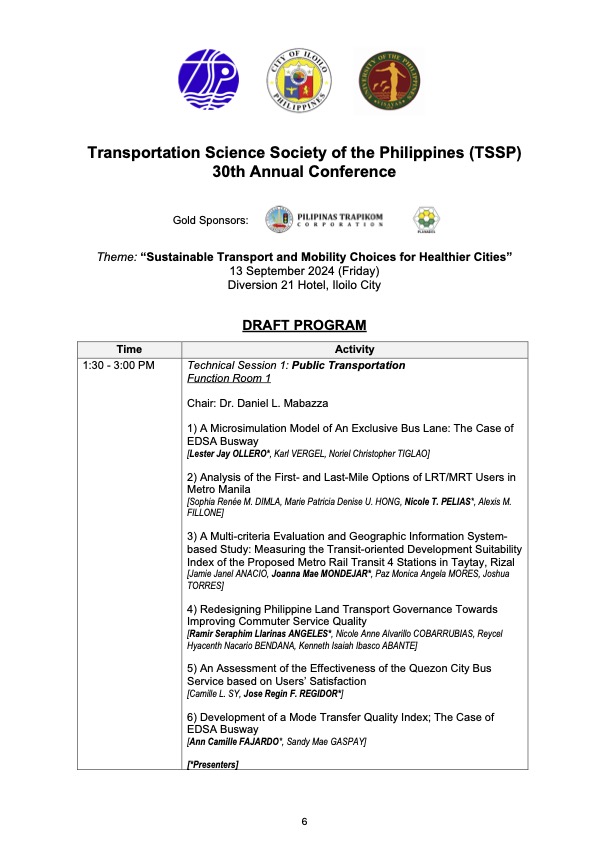
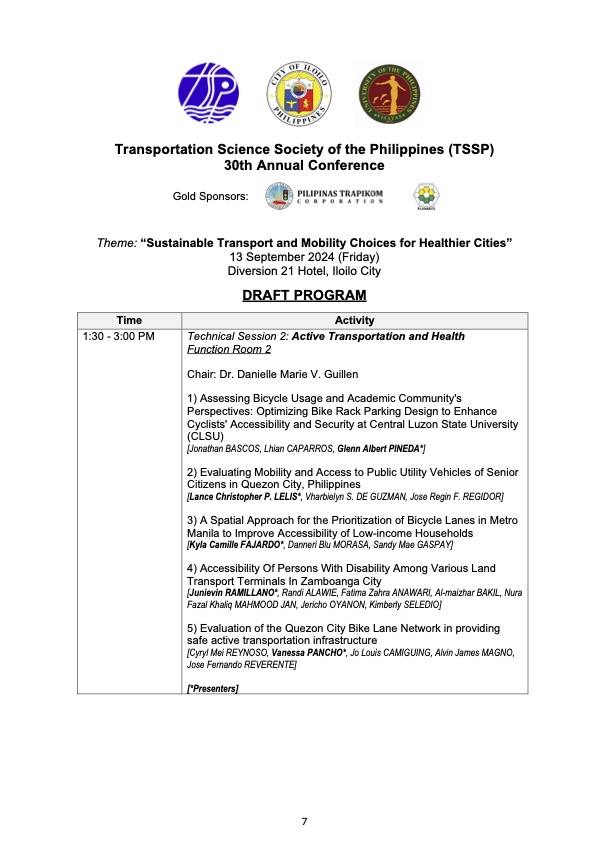
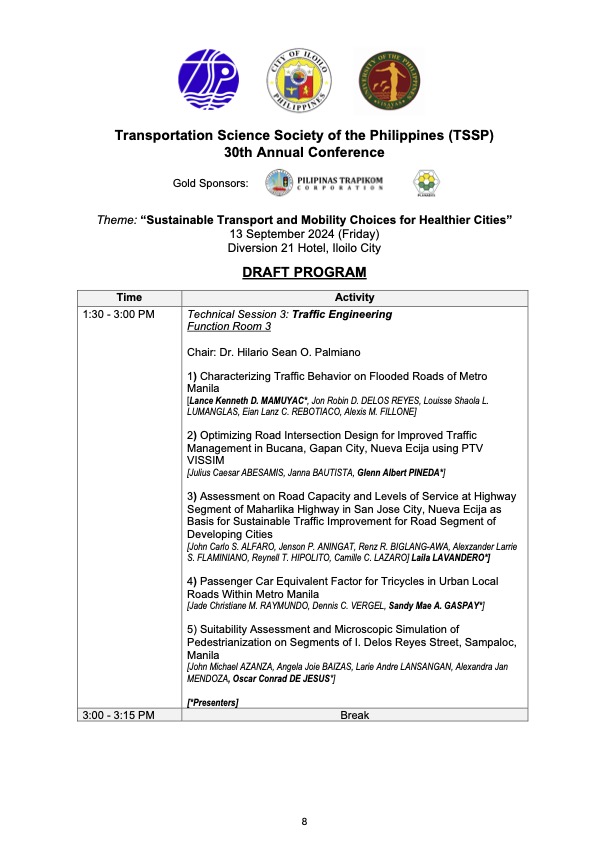
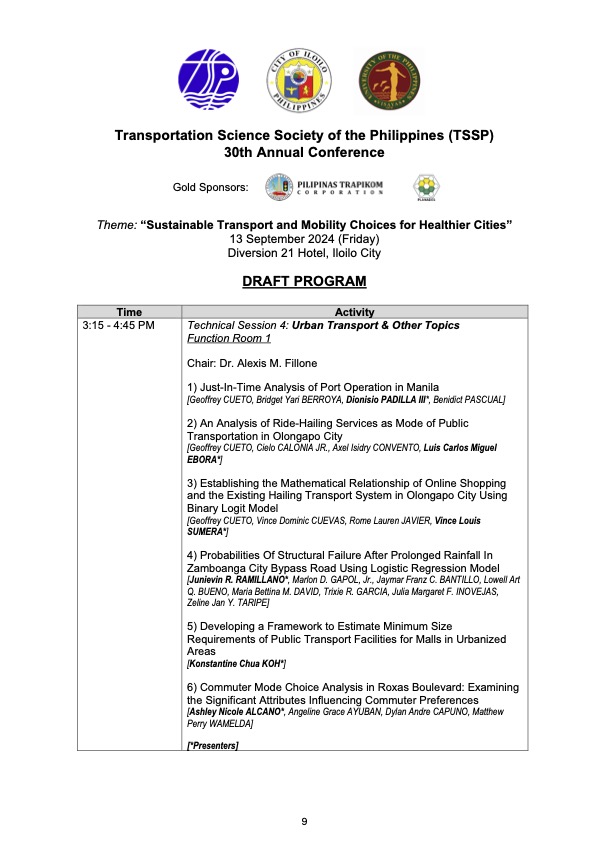
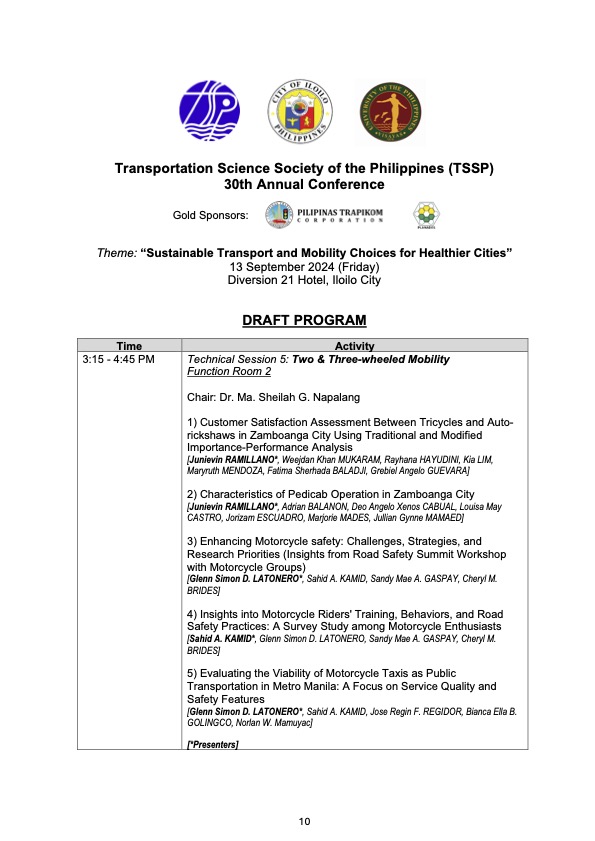
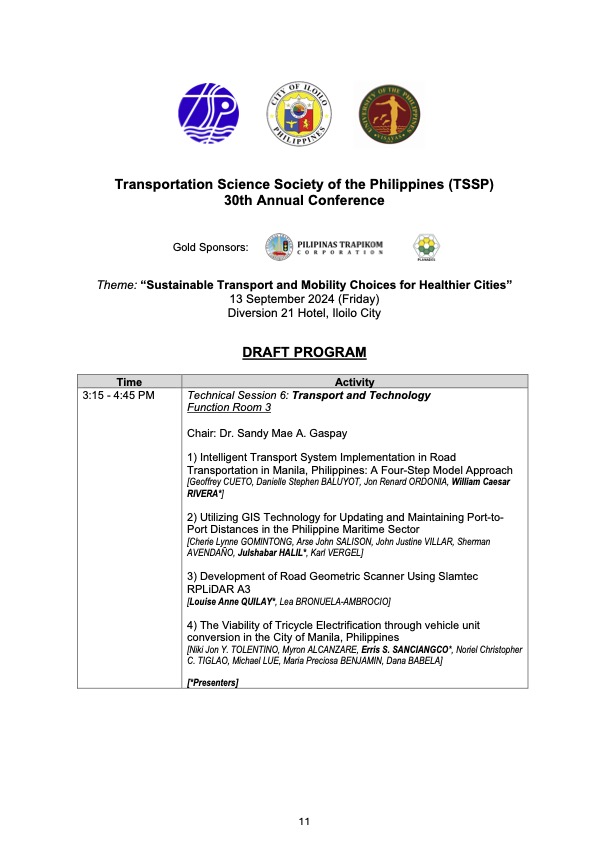
I will share the draft program for the morning plenary session in the next post.
–
Speed limits and danger zones for trucks
Saw these signs at the back of a long truck as we were stopped before an intersection. One states the speed limits for these vehicles along different roads while the other is a warning sign for other road users especially those who might be less visible when the truck maneuvers (e.g., motorcycle riders, cyclists).
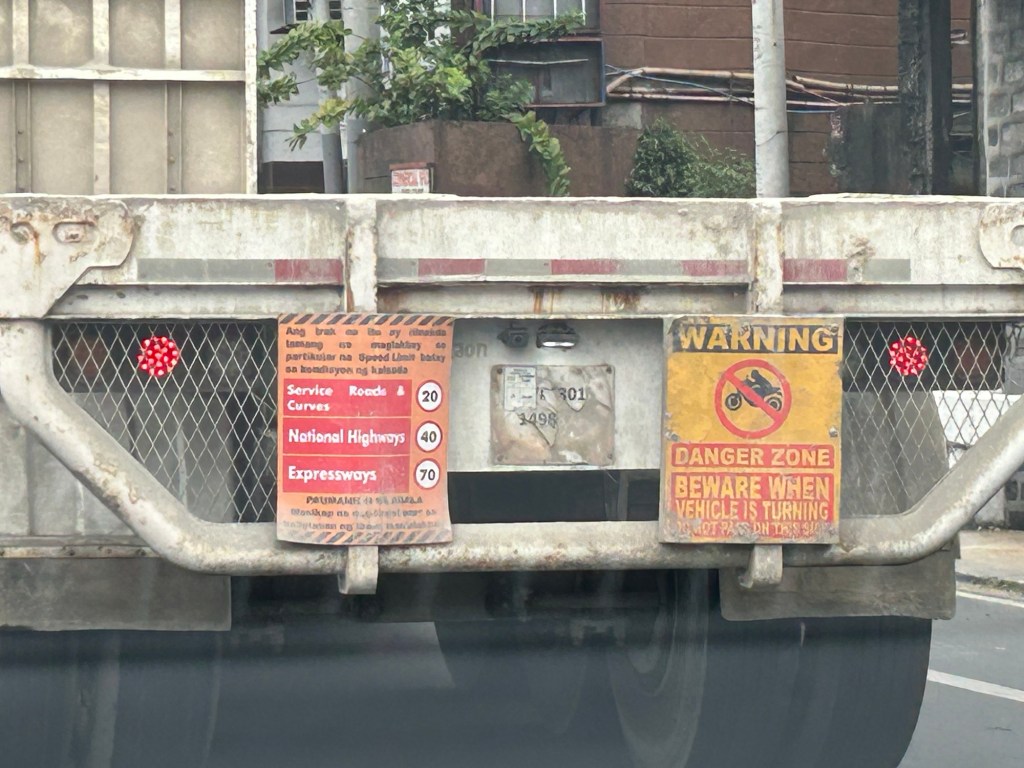
These are important information and fair warning to other road users. However, I think the signs should be bigger to be more visible or conspicuous. You have to be close to the truck for one to read and understand what the signs were. It might be too late by the time one figures out what the warning was about. I’ve read somewhere about people trying to debunk or play down these danger zones for trucks. That is bad opinion and puts drivers and riders heeding it in harm’s way. I think we should always go for what is on the safe side rather than risk being hit by these trucks.
Such information should be part of driver and rider education and perhaps education in general. While these large vehicles pose risks to other road users, they also play an important role particularly for logistics.
–
Article share: Drought and the Panama Canal
Here’s a quick share of an article on how a drought is affecting operations of the Panama Canal:
Eavis, P. (November 1, 2023) “Drought Saps the Panama Canal, Disrupting Global Trade,” Wired, https://www.nytimes.com/2023/11/01/business/economy/panama-canal-drought-shipping.html?unlocked_article_code=1.7kw.9CNJ.NKhQS8RCMh9h&smid=url-share [Last accessed: 11/3/2023]
From the article:
“But a drought has left the canal without enough water, which is used to raise and lower ships, forcing officials to slash the number of vessels they allow through. That has created expensive headaches for shipping companies and raised difficult questions about water use in Panama. The passage of one ship is estimated to consume as much water as half a million Panamanians use in one day…
Without a new water source, the canal could lose significant amounts of business. Other ocean routes are, of course, longer and more expensive, but they are less likely to have unpredictable delays. One alternative is to transport goods between Asia and United States through the Suez Canal to the East Coast and Gulf Coast. Another is to ship goods from Asia to the West Coast ports — and then transport them overland by train or truck…”
I suddenly remembered the current work along the Marikina River. The government is supposed to be working towards making the river navigable for the Pasig River Ferry to extend operations there. However, the depth of the river prevents regular, reliable operations. I wonder if the current project that includes flood control, riverside roads and erosion control components also will lead to a navigable depth for the river for most if not the whole year.
–
Article share: On the busiest shipping routes
Here is an article on maritime transportation. I don’t get to feature similar topics here as mostly I have written about land and air transport. I thought this article is interesting because it describes maritime transport traffic volume. Statistics like these appear to be trivial but are important especially from the perspective of logistics as well as, if you delve in to it, maritime security.
Piper, G. (July 11, 2023) “The busiest shipping routes in the world by the numbers,” Medium, https://grantpiperwriting.medium.com/the-busiest-shipping-routes-in-the-world-by-the-numbers-c09571ad5af6 [Last accessed: 8/2/2023]
To quote from the article:
“The vast majority of world trade sees Asia as the focal point. Both Europe and North America do heavy volumes of trade with Asia, mostly imports. But three of the five busiest shipping routes in the world are all internal routes. Europe-Europe, North America-North America, and Asia-Asia. That means that vast amounts of global trade are still relatively local.
Large importers like the United States and England drive massive amounts of trade. Large exporters, like China, Korea, and Japan, also drive massive amounts of trade. The areas where these terminuses link up are the busiest hotspots for global trade.”
A while back in 2004-2005, I was involved in an inter-regional passenger and freight flow study in the Philippines. We gathered data on maritime transport and were able to derive the OD tables for inter-regional and inter-island passenger and freight flow. Unfortunately, those studies and surveys had no follow-up or updating afterwards. There is a saying that “you can’t manage what you can’t measure.” This applies to transport as well so perhaps there are data somewhere and someone’s using them. We hope government agencies are able to collect the data required to analyze and improve maritime transport in the country.
–
Flashback: Transport Infrastructure Framework Plan for the Philippines
I was reading an article yesterday about the outgoing NEDA Director General stating that Philippines needing a long term strategy for infrastructure development that will address the shortcomings or gaps due to unsolicited proposals. There was already something like this drafted almost a decade ago and under the auspices of the returning NEDA DG. Unfortunately, while NEDA accepted the Final Report of the study, they never adopted it as a policy that could also be imposed on agencies like the DOTr (still DOTC back then) and the DPWH. So for a sort of Throwback Thursday and on the last day of the Duterte Administration, I am sharing the promotional video produced for the framework plan that was supported by The World Bank.
The study was conducted by Cambridge Systematics (not related to Cambridge Analytics as far as I know) and was implemented at the same time as the JICA Dream Plan study for Mega Manila. I recall there is also a video on the latter and it listed all the infrastructure projects needed to address the transport problems of the Greater Capital Region. The Infra Framework Plan for the country mentions the various infrastructure projects ongoing and proposed for the Philippines but focuses on the soft side (i.e., strategies) including the reforms and institutional set-up that need to be in place for everything to come together and produce the desired outcomes in the long term. Sadly, strategies and plans are not well appreciated despite their being essential as foundations. While the Build, Build, Build mantra of the outgoing administration is worth praising for attempting to do the catch-up needed in as far as certain transport infrastructure is concerned, it falls short of what are necessary and to be prioritized. Instead, it ended up accommodating projects that are “nice to have” but should not be prioritized considering our limited resources and the undesirable foreign debt racked up by government. Hopefully, the returning NEDA DG and other officials will be able to steer the country clear of the current and future crises that may end up bringing more hardships on Filipinos.
–
On trucks and road safety again
The past days saw many trucks being involved in crashes along my commuting route. My social media feed also gives me updates on the traffic situation in my home city. And there are many reports of the same – trucks involved in road crashes or stalled due to a variety of reasons (engine problems, flat tires, etc.) . It is not an understatement to say that such incidents are a matter of concern especially since these may have been fatal (i.e., deaths due to road crashes). Here are a couple of photos we took as we passed a truck on its side along Ortigas Avenue Extension along one of my usual commuting routes.
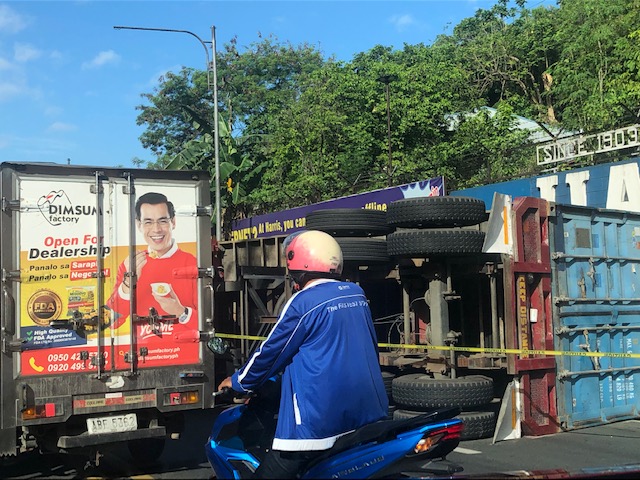
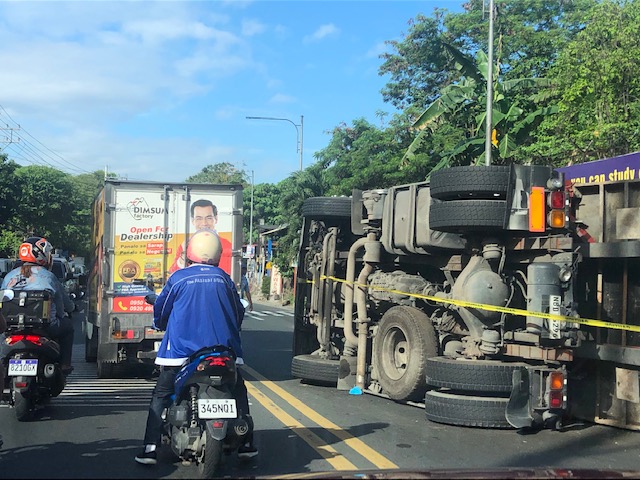
It is fortunate that this did not result in any fatality but from the photos one can surmise the potential or likelihood of serious injuries if not death/s. Such underlines the importance of both proper maintenance and operations of these vehicles including how they are loaded. Shifting or unbalanced loads on moving trucks negotiating turns or maneuvering, for example, will result in loss of control and overturning that also leads to traffic congestion. Are the drivers competent, awake, alert? Or are they sleep or perhaps driving under the influence of alcohol or other substances?
–
Where do trucks fit in complete streets?
The complete streets concept usually involve transforming streets to favor active and public transport. The typical discussions and presentations on complete streets are often focused on taking away road space from cars to allocate to pedestrians (e.g., wider sidewalks), cyclists (e.g., bike lanes) and public transport (e.g., transit lanes). Seldom do we read about trucks, deliveries and related items even in guides and manuals and are often just implied to be addressed in street transformation examples.
Evans, T. (March 24, 2022) “”Complete Streets” and Goods Delivery: What are Streets For?” New Jersey Future, https://www.njfuture.org/2022/03/24/complete-streets-and-goods-delivery-what-is-a-street-for/ [Last accessed: 4/5/2022]
To quote from the article:
“Not every final destination for a package needs to be accessible to large trucks. Rather than proposing truck-focused modifications (wider lanes, bigger turning radii, etc.) to local streets in order to accommodate truck deliveries, transportation planners and logistics industry professionals should focus instead on matching the type of delivery vehicle to the environment in which the destination is located.”
I recall the mainly pedestrianized shopping streets (shotengai) in Japan when I try to make sense of how delivery vehicles can be included in the discussion. The Japanese use small trucks or vans for deliveries and mostly these are confined to the side streets. However, during certain times of the day, usually early mornings or after business hours, they are allowed inside the shopping street for quick deliveries or pick-ups. This show what kind of goods vehicles and operations may be permitted.
–
 Caught (up) in traffic