
Home » Media
Category Archives: Media
Sins of omission at DPWH
I’ve been quite busy the past weeks due to various commitments including deadlines. Nevertheless, I have tried to be updated on the current events pertaining to the flood control scandal many government officials are now being linked to. These include the personalities involved, the projects and the amounts that are now the basis for a lot of people being horrified enough to be called into action. Apparently, many people have not been convinced enough of past misdeeds that have been reported; including the ones pertaining to abuses of uses of confidential funds.
I have hesitated to post on my thoughts about the mess at DPWH as I have many friend including past and present students who are with the Department. Some if not all I know to be sensitive to the corruption issues around the flood control projects. The latter apparently blew up in the faces of the officials of the agency and exposed them and their staff to a lot of ridicule (both warranted and not) and even harassment. Recently, I’ve been seeing a lot of posts from people who are supposedly with the DPWH. These posts are obviously apologists for certain officials considering the content of their writing. These are basically attempts to absolve those who claim to be clean among the DPWH staff and officials, and yet they have not done anything to correct these wrongdoings. This is what is called commiting ‘sins of omission’. By not doing anything for whatever reasons including being afraid to be a whistleblower (considering the consequences) means one is enabling or even encouraging the acts of corruption. In essence, they are being complicit by turning their blind eyes to the rotten eggs. This applies anywhere and not just to DPWH employees. And perhaps so many in government agencies are guilty of this.
–
On a ride-hailing apps algorithm and surge pricing
I am sharing this very informative article on ride-hailing based on an investigation conducted by investigative journalists:
Ilagan, K. and Rainis, F.A. (December 10, 2024) “How we investigated the algorithm behind the Philippines’ largest ride-hailing app,” ijnet.org, https://ijnet.org/en/story/how-we-investigated-algorithm-behind-philippines-largest-ride-hailing-app?fbclid=IwZXh0bgNhZW0CMTEAAR2azviuNxdh5gSbrJKl8lsViL5YRO5k33QHFc24EAFkIi4HTo-Ew4H7LO4_aem_NnVHOD8B1PERNOQYSjVHdg [Last accessed: 12/27/2024]
To quote from the article:
“Once all the fares were broken down, we found that a surge fee was always present. With the help of statisticians from two local universities, we conducted a statistical analysis to scientifically determine whether the waiting time for a ride decreases when the surge fee is higher.
The results didn’t show a significant correlation between the surge rate and waiting times. This contradicts the assumption that a higher rate attracts more cars to the street and lowers waiting times.”
I leave it up to my readers to make their own assessment of what the conclusions to this report state or imply. The bottomline is that the ride-hailing company is making a lot of profit from their surge pricing scheme that really doesn’t make it easier for people to get a ride from their app.
–
Are transportation issues election issues in the Philippines?
Are transportation issues in the Philippines? Or are these issues at the local level? Here is an article about how transportation issues were brought to light and were actual topics in the ballot in Los Angele, California in the US:
Tu, M. (November 25, 2024 ) “Bike, Bus and Pedestrian Improvements Won the Vote in L.A. How Did Advocates Pull It Off? “ Next City, https://nextcity.org/urbanist-news/bike-bus-pedestrian-improvements-healthy-streets-los-angeles-ballot?utm_source=Next+City+Newsletter&utm_campaign=532838ef65-DailyNL_2024_11_18_COPY_01&utm_medium=email&utm_term=0_fcee5bf7a0-532838ef65-44383929 [Last accessed: 11/26/2024]
The three lessons in the article are:
- Build a coalition – “In the lead-up to the election in March, Streets For All successfully secured endorsements from unions, climate organizations and business groups that saw the vision for safer streets.”
- Safety wins – “We could make climate arguments, we could make equity arguments, but the thing that felt the most bulletproof to us and the most empathetic to the general Angeleno was just road safety,”
- Keep it simple – “…simple messages were the most effective. Vredevoogd fought for one billboard on Vermont Avenue that read “In 2022, more pedestrians died on Vermont Avenue than in the state of Vermont.”
Los Angeles or LA as many people fondly call the city is well known for being car-centric (as opposed to San Francisco to the north, which is more transit-oriented). Perhaps we can learn from this experience though I know there are already groups and coalitions lobbying for better transportation in the Philippines. Are they successful and to what extent are they succeeding? Granted there are different situations and conditions, even modalities, to engage politicians, there are also so-called party list groups claiming to represent the transport sector but none appear to be really standing up for issues like improving public transport or road safety. And so the challenge is still there for people to make transportation issues election issues in the country.
–
The wrong message for electric and hybrid vehicles
There are two billboards along Katipunan Avenue, each displayed to face either the northbound or southbound traffic along the busy thoroughfare. The ad by a major Japanese automaker is a sales pitch for one of its electric vehicle models. The ad states one of the incentives or come-ons for electric and hybrid vehicles granted by government (in this case the Metro Manila Development Authority) to encourage people to buy electric or hybrid vehicles; ideally to replace their fossil fuel-powered vehicles.
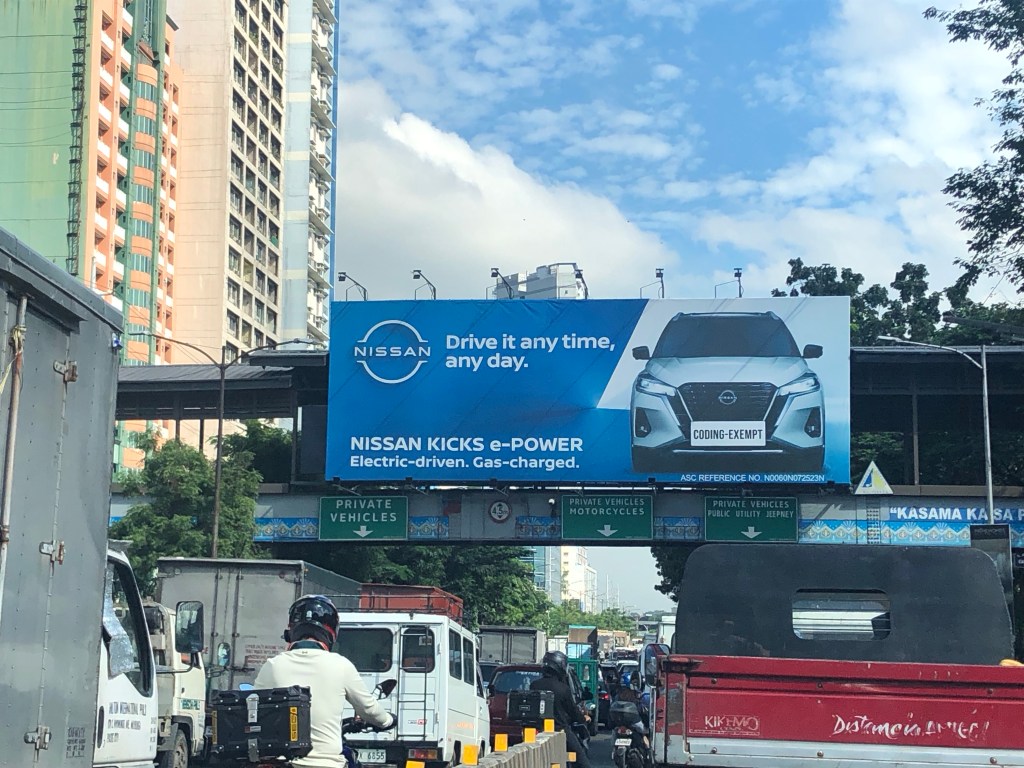 Electric and hybrid vehicles in Metro Manila are exempt from the MMDA’s number coding scheme. The ad is clear about that especially as a selling point for the vehicle featured.
At this point, more electric and hybrid vehicles would probably translate to more traffic congestion. They will just be replacing the conventional vehicles if not adding to them. The incentive will actually backfire vs. the MMDA since the number coding scheme will eventually be rendered ineffective (di pa ba?) with the addition of these coding-exempt vehicles.
–
A brief history of transport strikes – Part 3: advocacy and bandwagon
You see a lot of posts on social media stating people supporting the current transport strike. There are cartoons and memes that dramatize if not romanticize the plight of drivers. One cartoon I saw has a girl asking her driver-father if he will join the strike. The father replies he is unsure as they won’t have any income to cover their needs. One panel shows the driver’s cash box with graduation photos of what appear to be his other children. Of course, this suggests that the jeepney driver was able to support his children in their education while also suggesting about the uncertainties for the other child (who is in the comic). The comic obviously appeals to the emotions of the reader. It is a fallacy but one that is very close to and appeals to the psyche of the Filipino.
Another cartoon appears to be comparing modernization with replacing office computers. It states that the government’s modernization program is like an office requiring its employees to replace their old notebooks with high end ones. Only, the office is not paying for the new units and will have these charged to the employees’ salaries. I thought that was an oversimplification. Jeepneys are public utility vehicles and not private. There are rules and regulations governing PUV acquisition, franchising and operations, unlike your typical office computer.
I think we should draw the line between advocacy and simply jumping onto the bandwagon that is supporting a transport strike without knowing and understanding the details about it. Otherwise, we end up giving unconditional support to what others will refer to as a backward public transportation system. There are always two sides to a coin and while there are good stories about the jeepney and how it has supported many families, there are also bad ones that have allowed them to remain practically unchanged over so many decades. The same applies to the opposition – those who call for a phase-out or outright modernization without understanding the terms given to drivers and operators and the overall context and situation regarding the modernization program. It is easy to take sides. The question is if you are aware and understand the details about the issues here.
–
A brief history of transport strikes – Part 1: introduction
A nationwide week-long transport strike by jeepney operators and drivers From a CNN news report yesterday, it was stated that an estimated 4 out of 10 or 40% of jeepney drivers will be going on strike and halting operations for a week. These are supposedly members of the group Manibela, which claims to have over 100,000 members nationwide (Aren’t you curious how many jeepneys there actually are nationwide? There are supposedly more than 250,000 public utility jeepneys operating across the country with about 55,000 in Metro Manila.). The other 40% are certain that they will not be going on strike and these include members of the more established groups like PISTON, ACTO and Pasang Masda as well as those who belong to the many transport cooperatives that were formed the last so many years in part for the purposes of modernization. The remaining ones are undecided and include those also affiliated with those groups and those who claim to not have any affiliations.
If media companies like GMA, the defunct ABS CBN and even government station PTV have archives dating back to the 1970s, they will probably see that similar interviews have been conducted of jeepney drivers. Libraries like the National Library or perhaps those of leading universities like the University of the Philippines and Ateneo de Manila University would likely have archives of newspapers from way back. I remember UP Diliman having microfiche facilities but I am unsure to what year they have archives. You will likely read similar reports and interviews about jeepney operations during those times. The idea and initiatives for phasing out the conventional jeepneys is not a new thing or topic. It has been out there for quite some time but in different forms and contexts.
For example, there was a proposal to phase out jeepneys along the corridor of the LRT Line 1 in the Feasibility Study for the railway line as well as in the Metro Manila-wide studies that were conducted in the late 1970s and early 1980s. Jeepneys plying the Monumento-Baclaran and Monumento-Harrison Plaza routes were among those identified for phasing out. Careful reading of the reports though will also show that ‘phase out’ actually meant ‘rationalizing’ or ‘rerouting’ the jeepney services so they will complement the mass transit line. That never happened and the jeepneys still operate today (probably many are still the same jeepneys from the 1970s and 1980s!). Do passengers ride them from Monumento to Harrison (or vice versa)? Probably not as the travel will be too long compared to riding the train. They survive because of the short trips, usually less than 4 kilometers, by passengers who probably should be walking or cycling instead if we were in a Japanese, Korean, Singaporean or European city.
Fast forward today, the call apparently is for a phase-out in favor of the “modern” jeepneys (many are actually mini-buses). Jeepney operators and drivers are also being called to join or form cooperatives under which they can be part of programs that will replace their conventional jeepneys with a ‘modern’ unit. One issue here are the terms for the replacement or the acquisition of a new vehicle. The cost of a new vehicle varies and can be more expensive than a new SUV (e.g., more expensive if not as expensive as a new Montero, Fortuner or Everest) depending on the model and the size of the vehicle. This is apparently the most significant concern among others that is being cited by those opposing or resisting modernization, which they equate to a ‘phase out’.
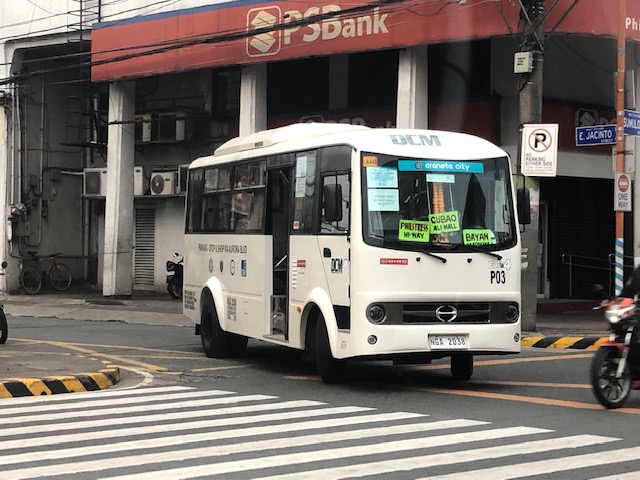 One of the ‘modern’ jeepney models currently operating in Metro Manila
More in the next article for this series…
–
Opinions on the current transportation situation?
Some people were asking me about what I thought about certain issues and reports on transportation. To be honest, while I am involved in some projects including one on road safety, I have been busy (or swamped is probably a more suitable term) with administrative duties at the university. While I take a peek from time to time, as is my habit, to see what’s happening, I have much less time to really engage or get involved in discussions. Whereas before, I easily get myself into typing comments and engaging in some discussions about transport issues particularly in social media, I now quite easily turn away and let it be. There are, after all, a lot of people experts, pundits, advocates, even trolls who are “slugging it out” with their opinions on just about anything on transport.
While I am amused at many discussions or posts, I now find myself not at all wanting to get involved unlike before. I think perhaps I have done my part and continue to do so in ways and avenues where I am more effective and where my time and effort is not wasted and more appreciated. I have never been the loud person in a room and have always tried to have my work speak for myself.
The indifference is the product of many factors and circumstances including becoming tired of doing interviews with conventional media. Nowadays especially, when media seems engrossed on having content by the minute; never mind the substance. Basta may ma-report or ma-post (As long as their is something to report or post).
Well, here’s a few thoughts about what seem to be trending these days:
- There is still a lack of public transportation supply considering the increasing demand (more people are back to their workplaces and schools are already reopening!). Government agencies still seem to be clueless or perhaps just want to push the original rationalization and modernization programs despite the pandemic changing the game for commuting demand. Due to the lack of public transport, more people are taking to private vehicles but certain observers apparently see only cars (which they automatically equate to ‘private vehicles’). Motorcycles are also increasing in numbers and allowing motorcycle taxis will mean people will turn to these for commuting/transport needs.
- Cable cars won’t solve Metro Manila transport or traffic woes. Even if one will consider where they will fit or may be suitable, this is still a band aid solution considering all the solutions including the ones that are obvious or staring us in our faces (yes, allow the conventional jeepneys and buses back for now) that are available but government stubbornly rejects. As for the senator who broached the idea, I think he did so mainly for media mileage (and the mainstream media quickly snapped it up!) – para mapag-usapan. As they say – it’s so showbiz!
- I still believe that the experiences from the pandemic strongly provide us with the evidence to support a continuation and sustaining work-from-home or remote work set-ups. This actually ‘solved’ traffic during the heights of the pandemic and yet we choose to revert to the old normal set-up. People are languishing, suffering as they spend long travel times in their commutes. These are unproductive time that people could have spent more efficiently and productively (not to mention more meaningful) at home.
- I support children going back to school but not for 100% of their times. We definitely know that a 100% study-at-home set-up is not for everyone and the last two years have affected our children including their need for face-to-face interaction with other children (classmates) and adults (teachers). Still, we can have a blended set-up where perhaps we can have children come to school 2 to 3 days in a week rather than the old normal of 5 to 6 (even 7 in some schools) days. Other tasks and learning activities can be done effectively at home. This also could help ease traffic and travel demand especially in urbanized areas.
More opinions in future posts!
–
On experiments and crowd-sourcing for solutions
If you didn’t notice, the government (national agencies and local government units) has implemented and successfully employed experimentation and crowd-sourcing to find solutions for transport and traffic problems. In the case of experimentation with traffic, this has been going for a while now but not at the level of those conducted during Bayani Fernando’s stint at the MMDA. At the time, full scale experiments were undertaken as the agency dabbled with the U-turn scheme. The ultimate product of that time are the twin U-turn flyovers at C5-Kalayaan. I say ultimate because it involved both experimentations and traffic simulation, where the latter was used to justify the U-turn flyovers over what was originally proposed as an underpass along C-5. As I recall, the model was not calibrated or validate contrary to the agency’s claims. I say so because I personally saw how the model ran and the presentations were more like demonstration of the software used. Meanwhile, the DPWH at the time made their own simulation models and did the necessary calibration and validation to come up with sound models for other projects including the Quezon Avenue-Araneta Avenue underpass.
Crowd-sourcing, mainly through social media is a more recent approach. It is not an entirely new animal because prior to social media, there were a lot of inter-agency committees that included people from various stakeholders (some invited, some not) who were the primary “sources”. The crown now is larger and perhaps more diverse. Whether this is a conscious or unconscious effort is uncertain. And this can easily be denied or shrugged-off. But in this age of social media, there are just so many enablers or influencers for crowd-sourcing each of whom have their own agenda. Some mainly to promote or prop up the current administration. Some to mainly criticize without offering solutions. And others to invite constructive scrutiny or assessment while also providing options to address problems and issues. It is the latter group whose opinions and recommendations should carry more weight if indeed the administration is fishing for solutions from the so-called crowd.
Consider the following recent examples (not in any order):
a) Closing U-turn slots along EDSA
b) Requiring face masks for all who are outdoors including cyclists
c) EDSA carousel
d) Resumption of public transport with mostly air-conditioned vehicles
e) Bike lanes along major roads
f) Public transport reform (in general)
There are others but the six listed above have been discussed a lot on social media after government picked up an idea or two about them, and implemented each seemingly without conducting due diligence or paying attention to the details including potential glitches. They ended up with mixed results, many very costly (I wouldn’t say disastrous at this point). However, in all cases, they seem to welcome (though at times begrudgingly or feigning resistance) crowd-sourced solutions particularly those from organized groups who are only too happy for themselves to be in the limelight.*
One thing is for sure and that is that there is still a lack of capabilities among government agencies and LGUs when it comes to transportation. Don’t get me wrong. National government and many LGUs have the resources and capacity to address transport problems. However, their capabilities are in question here because they seem to be unable to harness their capacities and resources to come up with sound and suitable solutions. In the end, they appear to buckle under the pressure of their own crowd-sourced schemes only to emerge as manipulators after they are able get what they want with the willing assistance of the naive.
–
*Some of these are true advocates who have worked hard to make transport better for all while others are the bandwagon types (nakikisakay lang) who are content dropping key words that now sound cliche at every opportunity. I leave it up to my readers to determine which are which. 🙂
NCR checkpoint map
I just wanted to share the checkpoint map developed by a good friend from UP. Here is the text and link provided by UP Resilience Institute head Mahar Lagmay on his FB page:
Metro Manila quarrantine checkpoint map now available. It is already linked with the Google Traffic Map. Sana makatulong. You can check the traffic status if you zoom in on the interactive map.
Many thanks to Prof. Noriel Christopher Tiglao of UP NCPAG. He is a civil engineer by profession and has conducted research on transportation management and policy with the National Center for Transportation Studies (NCTS).
Copy paste to your web browser this URL http://35.185.190.69/
and continue to accept. Walang pong virus iyan.
I hope this is good info to many!
–
On fact-checking articles in this blog site
Last month, I received an interesting and intriguing comment that was actually an inquiry about an article I posted that contained a photo of a section of the Marikina Bikeways. A news agency was fact-checking something circulated by trolls praising Davao City for putting up bikeways. The problem is that they used my article and photo taken some years ago:
https://d0ctrine.com/2014/09/30/lets-revisit-the-marikina-bikeways/

The photo was taken by me one time I was driving along Sumulong Highway in Marikina City’s downtown area. I take similar snapshots whenever the opportunity presented itself and I thought this one was perfect because it showed bicycle infrastructure and a cyclist using it. I don’t put any watermarks or other identifiers on my photos but routinely advise those using or intending to use them to do the proper attribution or citation.
Credit is due to the people of Marikina and their leaders for making their bikeway network a reality. Of course, there are issues here and there but the important thing was that they were able to construct it and show that it can be done given the resources in support of active transportation modes. I am not sure if Davao has initiated a program to plan and construct a bikeway network for their city. Perhaps there is and perhaps there’s none. But perhaps, too, they should take the cue from Marikina and develop one that can also be emulated or replicated in other LGUs as well. It is better to come up with something real and tangible rather than being credit for something inexistent.
–
 Caught (up) in traffic