
Home » Mode Share (Page 17)
Category Archives: Mode Share
References linking transportation and health
The Institute of Transportation Engineers (ITE) features several resources discussing the linkage between transportation and health. Here is the link to the page where they list references like reports from various sources as well as tools.
This is definitely a topic that needs more attention and studies in the Philippines in order to have local evidence (there are already strong evidence abroad) supporting active transportation and how it helps make citizens healthier. Of course, that goes without saying that active transport should be integrated with an efficient public transport system. That is so that the increasing share of private transport can be checked (no thanks to Grab and Uber) and we can either retain or increase public and active transport shares.
–
Marikina’s Bike and Parking Lanes
I had to navigate through Marikina’s streets in order to reach the Feliz Mall from the city’s downtown. Normally, I would have taken the more straightforward route that would have involved traveling along Marcos Highway. However, I couldn’t because it was my number coding day and the U-turn slots in the area are usually “swarming” with MMDA and Pasig City traffic enforcers. Marikina’s streets though were not part of the coding scheme and you only need to be familiar with their road network including which streets are one-way in order to navigate the streets properly.
 The bike lane is on the left side of the one-way road and to the right of the on-street parking spaces. The parking lane is the left-most and curb-side.
 This actually qualifies as an example of a road diet application. These could have easily been 2-way streets before but effectively 2 lanes have been allocated for traffic flow while the others are for parking and cycling. [Of course, hard-core cyclist will say only one lane was taken away from motor vehicles.]
These bike and parking lanes were implemented in connection with the Marikina Bikeways project that was initiated during the time of then Marikina Mayor Bayani Fernando in the late 1990s. The project was continued and maintained by succeeding administrations of the city and contribute to the city’s being more liveable compared to other LGUs. The reconfiguration of the streets make them safer and saner in terms of traffic flow where “traffic” is referred to as inclusive of all users.
–
More concerns about ride-hailing/ride-sharing
Here are two interesting (to me at least) articles about the negative aspects of ride hailing or ride sharing. The first is quite a curious one for me as I teach at UP Diliman, which has a sprawling campus in Quezon City. Students can have one class at a building on one end of the campus and have the next class at another end of the campus. I now wonder if there’s a significant number of Grab or Angkas trips within campus.
Kidambi, M. (2019) “Popularity of brief Uber, Lyft rides on campus raises environmental concerns,” Daily Bruin, http://dailybruin.com/2019/01/29/popularity-of-brief-uber-lyft-rides-on-campus-raises-environmental-concerns/ [Last accessed: 2/8/2019]
The second article relates on the a more general context of what’s bad about ride hailing/ride sharing. The author presents not just a list but evidence of each item mentioned.
Schmitt, A. (2019) “All the Bad Things About Uber and Lyft In One Simple List,” Streetsblog USA, https://usa.streetsblog.org/2019/02/04/all-the-bad-things-about-uber-and-lyft-in-one-simple-list/ [Last accessed: 2/8/2019]
As I’ve mentioned in previous articles here, there are still a lot we need to learn about ridehailing in this country and especially in our cities. I guess Angkas’ case can be different because motorcycle taxis were already operating in many areas even before the app-based service. But of course, we also need to understand about his enhanced ‘habal-habal’.
–
About the habal-habal again
There’s a nice article written by the current City Administrator of Cebu City, Nigel Paul Villarete. Paul has a regular column in a major daily and one that is always a good read. The article is a consolidation of previous articles he has written about the habal-habal or motorcycle taxi.
Villarete, N.P. (2018) “Habal-habal: the Two-Wheeler “Public” Transport in the Philippines,” http://www.streetlife.com, http://streetlife.villarete.com/habal-habal-the-two-wheeler-public-transport-in-the-philippines/?fbclid=IwAR06y9lrH-j6YtXRLf6rDL_JssnewNhR0b49dJ4Muc2PKyCzxeK50X6Ul6Y [Last accessed: 12/21/2018].
The article is relevant and current in its take on the motorcycle taxi and why it is important to consider this mode of transport as a form of public transportation. For one, it obviously gives people another choice for travel that is supposed to be able to cut down travel times compared to when they use conventional public transport or private vehicles. The question and perhaps the challenge to those operating such services is to prove that they are a safe mode of transport. Also, not to forget, is the question of fares and how to set the proper structure in order to protect people against abusive or excessive fares charged by the service providers.
There is news recently that the DOTr is convening a technical working group (TWG) to look into what they perceive as an issue on habal-habal. I wish the TWG well and hope that this will lead to something constructive including regulations that everyone can agree to. That said, I also believe that service providers, especially transport network company (TNC) Angkas, should exert more effort to prove they are a safe mode of transport rather than resorting to what appears to be more a fallacy of appealing to the emotions of people while trying to evade the legal constraints imposed on them. There is definitely a difference in motorcycle taxi operations in rural areas compared to those in the urban setting including the fact that they would have to deal with more vehicular traffic along urban roads. This means more interactions with other vehicles that may lead to an increased likelihood of road crashes involving motorcycle taxis if the latter don’t exercise safe driving practices.
–
On payment schemes for public transport services
Here is a nice article about paying for your fares:
Weinstein, Z. (2018) “Why do so many public transit agencies make it so difficult to… pay for public transit,” http://www.medium.com, https://medium.com/@z_75510/why-do-so-many-public-transit-agencies-make-it-so-difficult-to-pay-for-public-transit-c5ae98ae2571 [Last accessed: 11/28/2018].
This is interesting for us as we are just starting to come up with more efficient and innovative ways for paying for public transport services. This is in the form of the Beep card that is now being used for rail transit services as well as for some buses and jeepneys (electric?). Still, we have a lot of catching up to do in the Philippines compared to, for example, Japan and Singapore where it’s possible to go cashless in paying for public transport. We don’t even have a pass (e.g., there’s a monthly, quarterly and even annual pass that Japanese railway companies sell to students and employees that gives them a substantial discount for travels between their home station and work or school station) for regular transit users. Hopefully, the use of Beep will expand and perhaps other modes of payment may be introduced for the convenience of public transport users.
–
On the war vs. cars and the need to engage in discussions on this topic
There is an increasing awareness for the problems brought about by car-oriented transportation in many cities and towns. These include needless widening of roads, road crashes, and traffic congestion. Then, there are also what we seem to take for granted like air pollution, noise and fuel consumption that are also attributable to the over-dependence on cars. Here’s a nice article about the arguments for more people-oriented transport and how having the latter will benefit us:
Marx, P. (2018) The war against cars will ultimately be won – and that’s good for everyone, https://medium.com/@parismarx/the-war-against-cars-will-ultimately-be-won-and-thats-good-for-everyone-a57b2983c81d [Last accessed: 12/7/2018]
Don’t get me wrong. Though the wording or title seems to stating that cars are “evil” we should still be grounded in the fact that there should be a balance among transport modes. There is still a need to determine which are most suitable for different people with different trip purposes and other characteristics. It is always easy to state (or shout out?) slogans or mantras for sustainable transport when in reality it is challenging to implement these given the various factors in play. That includes changing mindsets especially among the decision-makers. I like to recall what a good friend always asks/says when a discussion on this topic arises: “What mode do you use to travel between your home and office? If you’re dependent on a car, then perhaps its difficult to have the perspective of a public transport user or a cyclist or a pedestrian.” But then that statement also works the other way if you’re open-minded enough to understand why people are dependent on cars in the first place. Likely, the discussions will expand to include housing even the selection of schools for your children. And these types of discussions are exactly what we need to indulge in, and engage our leaders and those coming forward as candidates for elective posts next year.
–
Article on induced demand and why more roads mean more traffic
Here is a nice article about induced demand, which is simply the additional traffic you get on top of the current and estimated traffic from “normal” growth based on the current transportation system and infrastructure once you introduce additional services and/or infrastructure. That is, there is additional trips/traffic generated for when you widen roads or construct a new transit system.
VannPashak, J. (2018) “More roads, same congestion,” http://www.medium.com, https://medium.com/@jvannpashak/more-roads-same-congestion-b2b437ecaa94 [Last accessed: 11/22/2018]
I think the more interesting part of the article is its mention of the work of Redmond and Mokhtarian, which the author provides in a link. Clicking this link brings you to a wealth of articles attributed to the two that are definitely worth reading especially for people seeking understanding for issues related to commuting. Many of the researches and the methodologies in the articles may be replicated for application in the Philippines, and should be taken on as research topics in what can be inter-disciplinary programs or projects.
–
On school trip generation
I chanced upon the changing of the shifts for a national high school. This was the time of day when the morning shift students were dismissed (i.e., coming out of school) and the afternoon shift students were coming in.
 Students come out of the school to mainly either walk or take public transport (mostly tricycles) to their homes.
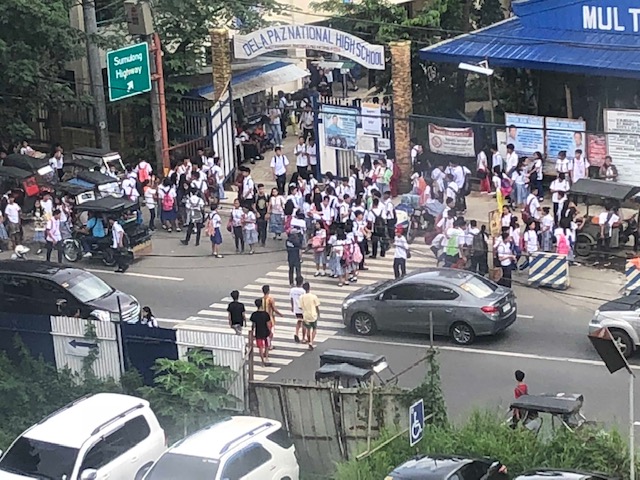 Most vehicles give way to people, especially students, crossing the busy street. There are usually traffic aides in the area who help manage traffic and to ensure pedestrians may safely cross or move about.
There are no severe traffic congestion here unlike those generated by many exclusive or private schools. There is actually a private school just beside this public high school that also generates significant private vehicle traffic but somehow manages not to congest this major road that’s part of the L. Sumulong Memorial Circle the way another private school congests Sumulong Highway in the mornings.
Is this simply because of the school being a public school as compared with private schools? Perhaps it is, given the perceived disparity in income classes concerning those going to typical public schools and those going to typical exclusive schools. But income disparity aside, wouldn’t it be possible for most students to just walk or take public transport to school? I actually envy the public school students in the photos above as they can walk to school. And that is because they likely live near the school, which is something that is a desirable situation if public schools are at least at par in quality with the more established private schools (especially the sectarian ones where many parents likely prefer their children to go to). This disparity in quality leads to people residing in relatively long distances away for the preferred schools to travel (often with their private vehicles) to and from the exclusive schools. The point here is that it really is more complicated than what it seems in terms of trip generation.
–
On the need to increase NMT and public transport use
A recent report reinforces what many of us already probably know or are aware of – that we need to shift away from dependence on car use to more sustainable modes of transport in the form of non-motorised transport (NMT) and public transportation. Here is the article from the AASHTO Journal:
Global Climate Report Calls For Expansion Of ‘Non-Motorized’ Transport And Public Transit (2018)
There is a link to the report in the journal article. The report is conveniently available in PDF form and is very readable (i.e., not overly technical).
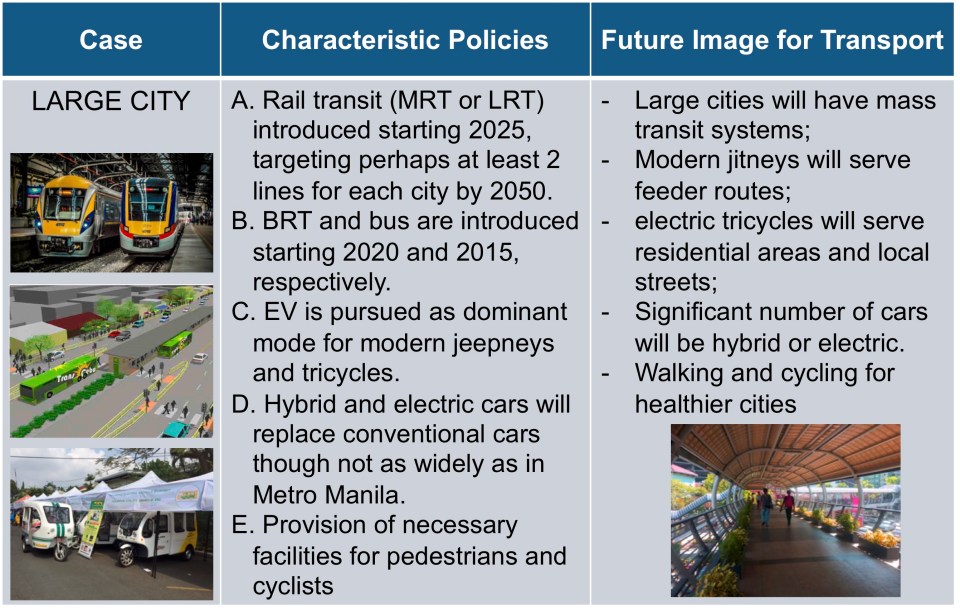
Incidentally, I was involved some time ago in a project led by the group Clean Air Asia (CAA), which involved several experts from across ASEAN as well as Japan that attempted to determine the necessary transport programs and projects in the region to stave off the projected increase in global temperatures. In all the scenarios evaluated, non-motorised transport (NMT) and a rationalised public transportation system By the term ‘rationalised’ I am referring to the use of higher capacity vehicles as against the taxis and tricycles that typically carry few if not one passenger. Here is a link to the final symposium for that study that has links to the materials presented:
The Final Symposium on the “Study on Long Term Transport Action Plan for ASEAN”
Here’s a slightly updated slide on the future image for a large city in the Philippines:
–
On EDSA transport and traffic, again
There’s a recent decision by the Metro Manila Council (MMC) comprised of the mayors of the cities and municipality of Metro Manila and chaired by the Metro Manila Development Authority (MMDA) Chair that vehicles bearing only one passenger (the driver) will be banned from travelling along EDSA. The problem with this is that by banning cars with one passenger from EDSA, you only succeed in making other roads like C5 more congested. It’s a simple case of transferring traffic and worsening it elsewhere since you’re not doing anything to alleviate congestion along those roads. Did MMDA run this and other scenarios using analytical or simulation tools at their disposal? If so, can these be shown and used to explain the soundness of this policy approved by the MMC? I suspect they didn’t and likely depended more on gut feel based on the data they have including what is often reported as 70% of vehicles traveling along EDSA having only one passenger. Meanwhile, the state of mass transit along EDSA still sucks.
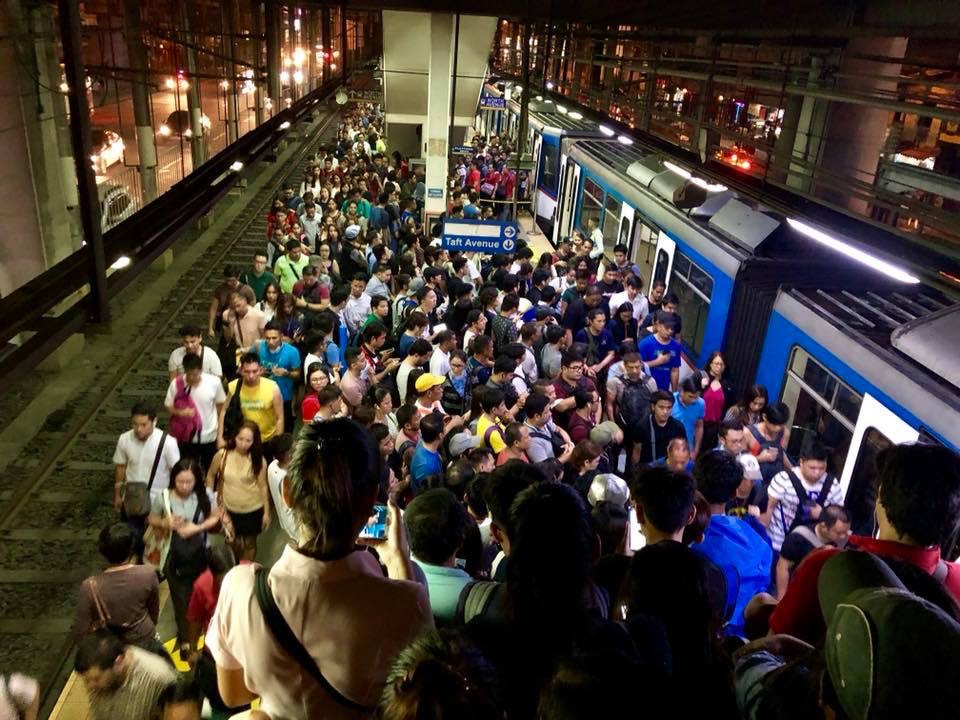 A very crowded Boni Avenue Station platform (photo courtesy of Mr. Raul Vibal)
Of course, the pronouncement from the MMDA launched quite a lot of memes on social media. Some people shared the typical quotes on planning (you know, like the ones about planning for people vs. planning for cars). Some offered their own ideas about how to “solve” traffic along EDSA. And so on…that only succeeded in showing how everyone had an opinion about transport and traffic. Everyone is an expert, so it seems.
Some thoughts and not in any order:
- The government can initially dedicate a lane each for express buses (a la Bus Rapid Transit or BRT). This idea has been circulating for quite some time now and has a good chance of succeeding. The DOTr is already deploying buses that they say are supplementing the MRT 3 trains (i.e., there aren’t enough trains running so passengers have the option of taking a bus instead). Running along the inner lanes of EDSA would mean, however, that they would have to find a way for passengers to cross the road and one idea would be for the stations to be retrofitted for this purpose.
- Those cars along EDSA are not necessarily for short trips so walking and cycling while needing space may have less impact in the immediate term for such a corridor. In the meantime, serious consideration should be made for bike lanes whether on the ground or elevated and improvements to walking spaces.
- But these efforts to improve passenger (and freight) flows should be a network-wide thing and not just along EDSA.
- It’s time to have serious discussions and perhaps simulations (even a dry run) of congestion pricing in Metro Manila. Congestion pricing for all major roads and not just one or two. Funds collected goes to mass transit, walkways and bikeways development. DOTr was supposed to have already discussed an Electronic Road Pricing (ERP) system like Singapore’s with the company and people behind the same in the city-state. That doesn’t seem to be moving along.
- Working and studying from home might work in terms of reducing vehicular traffic but then we generally have lousy internet services so that’s a barrier that needs to be broken down.
- How about legalizing, once and for all, motorcycle taxis? Many are opposed to this citing safety concerns but then we are running out of options outside the usual motherhood statements pertaining to building transport infrastructure. Think about it. Give it a chance. These motorcycles might just surprise us in a nice way; that is, helping alleviate congestion.
- Carpooling and lanes dedicated to High Occupancy Vehicles (HOV) would be good but the LTFRB made a pronouncement about these being illegal as they would be considered ‘colorum’. Such statements do not make the situation any easier and sends mixed signals as to the government’s being serious in considering all possible angles to improve transport and traffic particularly for commuting.
Do you have other ideas to share?
–

