
Home » Mode Share (Page 9)
Category Archives: Mode Share
Flashback: Transport Infrastructure Framework Plan for the Philippines
I was reading an article yesterday about the outgoing NEDA Director General stating that Philippines needing a long term strategy for infrastructure development that will address the shortcomings or gaps due to unsolicited proposals. There was already something like this drafted almost a decade ago and under the auspices of the returning NEDA DG. Unfortunately, while NEDA accepted the Final Report of the study, they never adopted it as a policy that could also be imposed on agencies like the DOTr (still DOTC back then) and the DPWH. So for a sort of Throwback Thursday and on the last day of the Duterte Administration, I am sharing the promotional video produced for the framework plan that was supported by The World Bank.
The study was conducted by Cambridge Systematics (not related to Cambridge Analytics as far as I know) and was implemented at the same time as the JICA Dream Plan study for Mega Manila. I recall there is also a video on the latter and it listed all the infrastructure projects needed to address the transport problems of the Greater Capital Region. The Infra Framework Plan for the country mentions the various infrastructure projects ongoing and proposed for the Philippines but focuses on the soft side (i.e., strategies) including the reforms and institutional set-up that need to be in place for everything to come together and produce the desired outcomes in the long term. Sadly, strategies and plans are not well appreciated despite their being essential as foundations. While the Build, Build, Build mantra of the outgoing administration is worth praising for attempting to do the catch-up needed in as far as certain transport infrastructure is concerned, it falls short of what are necessary and to be prioritized. Instead, it ended up accommodating projects that are “nice to have” but should not be prioritized considering our limited resources and the undesirable foreign debt racked up by government. Hopefully, the returning NEDA DG and other officials will be able to steer the country clear of the current and future crises that may end up bringing more hardships on Filipinos.
–
Bike lanes at Bonifacio Global City
After settling down at our new ‘tambayan’ at BGC, I decided to take my regular morning walk around the area to familiarize myself with the environs and to establish a route that I and the wife would likely be taking for our constitutionals whenever we are staying at BGC. I took the following photos of the bike lanes along 38th Street where most of the locators are international schools.


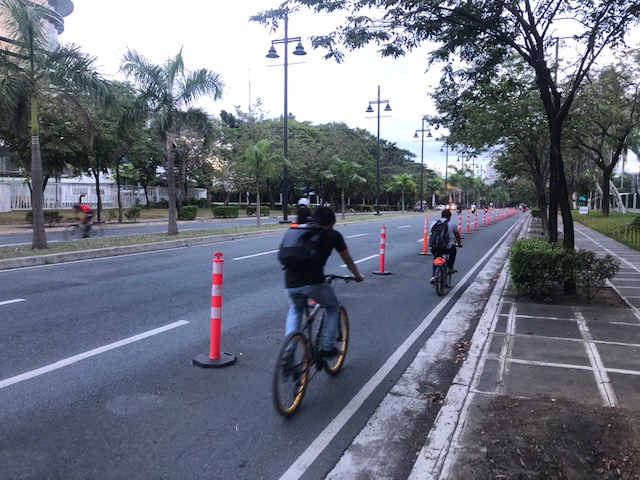


During Saturday and Sunday mornings, the bollards are moved to the sidewalk as many cyclists use 38th Street for laps. I wonder if the bike lanes will be retained once the schools resume face-to-face classes. That would mean a tremendous number of private vehicles generated by the international schools and colleges here. My opinion is that the bike lanes need to be retained as it is a step in the right direction for transport and encourages people to cycle or take PMDs to work and perhaps to school. These and others like it in Metro Manila and around the country need to be sustained and further developed to be attractive and viable to many seeking another option for mobility and their regular commutes.
–
How can e-scooters become a safer way to travel?
I’ve shared some articles and opinions about electric scooters. Here is another one that delves into the safety about these vehicles that have become quite popular in the US. Here in the Philippines, they still seem to be in infancy in terms of popularity and to some, are seen as more a novelty and touristy rather than a mode of transport for the typical work trips.
Donahue, B (June 11, 2022) “How to Make Electric Scooters Become a Safer Way to Travel,” Bloomberg, https://www.bloomberg.com/news/features/2022-06-11/how-to-make-electric-scooters-safer [Last accessed: 6/18/2022]
To quote from the article:
“Dediu believes that in time micromobility will attain critical mass, as other modes of transit have already done, and that infrastructure will come as the user base grows. “We didn’t build airports and then have airplanes show up,” he’s said. “I’m confident, given the history, that we’ll see things like more safe roadways for micromobility vehicles.” “
 Scoot-to-work at BGC, Taguig, Metro Manila
It is not really about the vehicle but the environment in which it is being used. One can say a lot about walking, for example, being dangerous but without touching on the why and the how its become a dangerous or risky mode of travel. It’s the lack of infrastructure or facilities as well as the car-oriented environment (that includes archaic laws and other regulations) that make active mobility and micro mobility modes dangerous or risky. If we can address these basic issues, then perhaps we can entice more people to use these modes more often and for the most trips we make everyday.
And don’t forget that these modes are the most fuel efficient! Saves you from the every increasing prices of fuel!
–
Suffering and salvation for transport and traffic
I shared the following photo on social media with the label “Kalbaryo at Kaligtasan”:
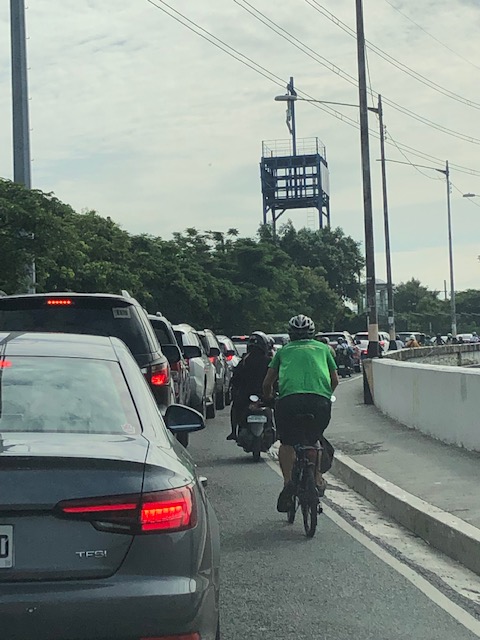 Cyclist pedaling ahead of cars queueing along the C5 ramp towards BGC
The label or title has double meaning. Conspicuous in the photo is the image of the Crucifixion atop what is a small shrine along Circumferential Road 5 across and facing SM Aura. The image appears to be a reminder or symbol of suffering but with the superimposed image of traffic congestion, alludes to the suffering endured by motorists on a daily basis. The “kaligtasan” or salvation part of the photo is in the form of the cyclist or the bicycle (I really have to explain that, right?) that offers an alternative or even hope for those who seek it. One thing the pandemic has taught us is that active transport in the form of walking or cycling is part of the solution to the transport problems we are experiencing. Public transport, of course, is touted as an ultimate solution but the reforms and infrastructure required are and will take time to implement, and these are already encountering problems leading to further delays or ineffectiveness.
–
On phasing out cars in cities
I’m sharing another article on reducing car dependence. The article was referred to by the previous series that I shared recently.
Nicholas, K. (April 14, 2022) “12 best ways to get cars out of cities – ranked by new research,” The Conversation, https://theconversation.com/12-best-ways-to-get-cars-out-of-cities-ranked-by-new-research-180642 [Last accessed: 5/20/2022]
Here are a few excerpts from the article:
“Question: what do the following statistics have in common?
The second-largest (and growing) source of climate pollution in Europe.
The leading killer of children in both the US and Europe.
A principal cause of stress-inducing noise pollution and life-shortening air pollution in European cities.
A leading driver of the widening gap between rich and poor urban residents.Answer: the vehicles on our streets, primarily the not-so-humble passenger car.”
also this:
“The research is clear: to improve health outcomes, meet climate targets and create more liveable cities, reducing car use should be an urgent priority.”
and this:
“To meet the planet’s health and climate goals, city governments need to make the necessary transitions for sustainable mobility by, first, avoiding the need for mobility (see Paris’s 15-minute city); second, shifting remaining mobility needs from cars to active and public transport wherever possible; and finally, improving the cars that remain to be zero-emission.”
You can also listen instead of reading it as it is a narrated article.
–
Articles on examining the role of the planning profession in both perpetuating and solving traffic congestion
Planetizen recently published a three-part series of articles examining the role of the planning profession in both perpetuating and solving traffic congestion:
Part 1: Brasuell, J. (April 13, 2022) “Planning and the Complicated Causes and Effects of Congestion,” Planetizen, https://www.planetizen.com/features/116834-planning-and-complicated-causes-and-effects-congestion [Last accessed: 5/17/2022]
Part 2: Brasuell, J. (April 20, 2022) “How Planning Fails to Solve Congestion,” Planetizen, https://www.planetizen.com/features/116914-how-planning-fails-solve-congestion%5BLast accessed: 5/17/2022]
Part 3: Brasuell, J. (May 12, 2022) “Planning for Congestion Relief,” Planetizen, https://www.planetizen.com/features/117153-planning-congestion-relief?utm_source=newswire&utm_medium=email&utm_campaign=news-05162022&mc_cid=34b0612d40&mc_eid=9ccfe464b1 [Last accessed: 5/17/2022]
I think these articles are a must read especially for students (and not just practitioners or professionals) and is sort of a crash course on transportation engineering and planning. It covers many concepts and learnings from so many decades and touches on certain programs that are most effective in reducing car trips. To quote from the article, the top 12 programs based on case studies in Europe are:
- Congestion Pricing (12-33% reduction in city-center cars)
- Parking and Traffic Controls (11-19% reduction in city-center cars)
- Limited Traffic Zones (10-20% reduction in city-center cars)
- Workplace Mobility Services (37% drop in car commuters)
- Workplace Parking Charges (8-25% reduction in car commuters)
- Workplace Travel Planning (3-18% drop in car use by commuters)
- University Travel Planning (7-27% reduction in car use by university commuters)
- University Mobility Services (24% drop in students commuting by car)
- Car Sharing (12-15 private cars replaced by each shared car)
- School Travel Planning (5-11% reduction in car use for school trips)
- Personalized Travel Planning (6-12% drop in car use share among residents)
- App-Based Incentives (73% – proportion of app users declaring reduced car use)
Are we ready to confront congestion and at the least start discussing these car trip reduction programs? Or are we content with the current discourse, which remains car-centric?
–
On bicycle economics in the Philippines
I am sharing this link to a newly minted reference that should be useful to policy or decision-makers (yes, that includes politicians) in justifying bicycle facilities including bike lanes around the country.
https://www.freiheit.org/philippines/bikenomics-assessing-value-cycling-philippines
There’s been a dearth in local references and this should suffice for now pending more in-depth studies on the benefits of cycling and related-facilities and programs in the Philippines. Note that while the reference mentions certain calculations and unit costs, it would be better to have the actual numbers from the various LGUs that have constructed bike lanes and facilities, and implementing bike programs and projects. Quezon City and Mandaue City, for example, should have the numbers that can serve as initial data for compiling and eventual publication of unit costs per type or design of bike lanes or bikeways. LGUs and national government should gather, process and make use of such data in aid of bike facilities and infrastructure development that will attract people away from private motor vehicle use while reinforcing both active and public transport mode shares.
–
On development density and transportation
The term ‘density’ here does not refer to transport or traffic density in the traffic engineering sense but to density of development such as urban density or building density. Here is an interesting article about building during a climate crisis. While it is very much applicable to any situation, the need to revisit plans and designs has become more urgent with the current pandemic.
Alter, L. (November 19, 2021) “What’s the Right Way to Build in a Climate Crisis?” Tree Hugger, https://www.treehugger.com/what-is-right-way-to-build-in-climate-crisis-5210156 [Last accessed: 2/23/2022]
There are mentions to various references throughout the article so it is not entirely an opinion piece but supported by evidence or studies. There is also a note that the article has been fact-checked. Quoting from the article:
“Adding gentle density can help ensure there are enough people in a neighborhood to support local schools, health, and community services and keep shops and restaurants open. It can provide a range of housing types and tenures that support the needs of individuals and families throughout all stages of life and allow for aging in place. It can also support public transit services, providing residents with efficient and affordable transportation options without relying on private automobiles.”
What do you think is the ‘right’ density for Philippine cities and municipalities?
–
Article on how cities can rapidly expand bike networks
With the increasing popularity of bicycles for utilitarian use (e.g., bike to work, bike to school, etc.), the need for strategies, programs and projects to support cycling has become more urgent. This is mainly to sustain the increase of bicycle use and partly to enhance the safety of cyclists. Here is an article that discusses how cities can rapidly expand bike networks:
https://www.urban.org/urban-wire/how-can-cities-rapidly-expand-access-cycling-infrastructure
To quote from the article:
“Our research points to several key recommendations for other cities hoping to expand their cycling infrastructure and encourage a more rapid shift toward biking and away from cars.
– Local governments can lead the implementation of a large-scale expansion of cycling infrastructure if local leaders can commit to ambitious, quantified mileage goals that will help structure how capital dollars are spent.
– Local implementation goals should include metrics related to increasing equity, particularly for people of color and those with low incomes. Although the Final Mile program increased the number of miles of cycling infrastructure, it did not directly prioritize the people who could benefit most from improvements.
– Philanthropic funders interested in supporting climate-friendly infrastructure should ensure their funds help hold local policymakers accountable to achieving their commitments instead of funding infrastructure projects directly. They can also encourage collaboration between cities and nonprofit advocates while working to fill local capacity gaps, such as through engineering consultants.”

Article on evaluating transport equity
Here is another quick share of an article on transportation equity:
Litman, T. (February 2, 2022) “Evaluating Transportation Equity: ITE Quickbite,” Planetizen, https://www.planetizen.com/news/2022/02/116058-evaluating-transportation-equity-ite-quickbite [Last accessed: 2/4/2022]
Transportation equity is a very relevant, very timely topic as people in the Philippines are just beginning to understand and weigh the advantages of having more efficient transport in the forms of active and public transport over private vehicles.
–

