
Home » Motorcycles
Category Archives: Motorcycles
On the rideshare competition among 4 and 2-wheeler companies.
Grab is the current market leader for rideshare or TNVS involving cars or 4-wheeled vehicles. Others like Joyride and Angkas went the way of legalizing motorcycle taxis. Grab applied for the same as they were already operating motorcycles for food and deliveries; competing with another company, Lalamove, which focuses on deliveries. Disallowed by the LTFRB to deploy MC taxis under their brand, they acquired Move It to circumvent the decision.
Meanwhile, as Grab continued their dominance of the rideshare market, the other players decided to offer some competition. I say ‘some’ because the perception is that they have not really gained much vs. Grab. You don’t see many Joyride taxis though a couple of companies appear to be making some impact – In Drive and Green GSM. The latter though is a taxi company that looks to attract people back to the conventional but app-enhanced taxi services
Last week, we saw this car with a familiar brand on its side. Sporting the colors and logo of MC taxi leader Angkas, they coined a brand for their cars – Angcars.
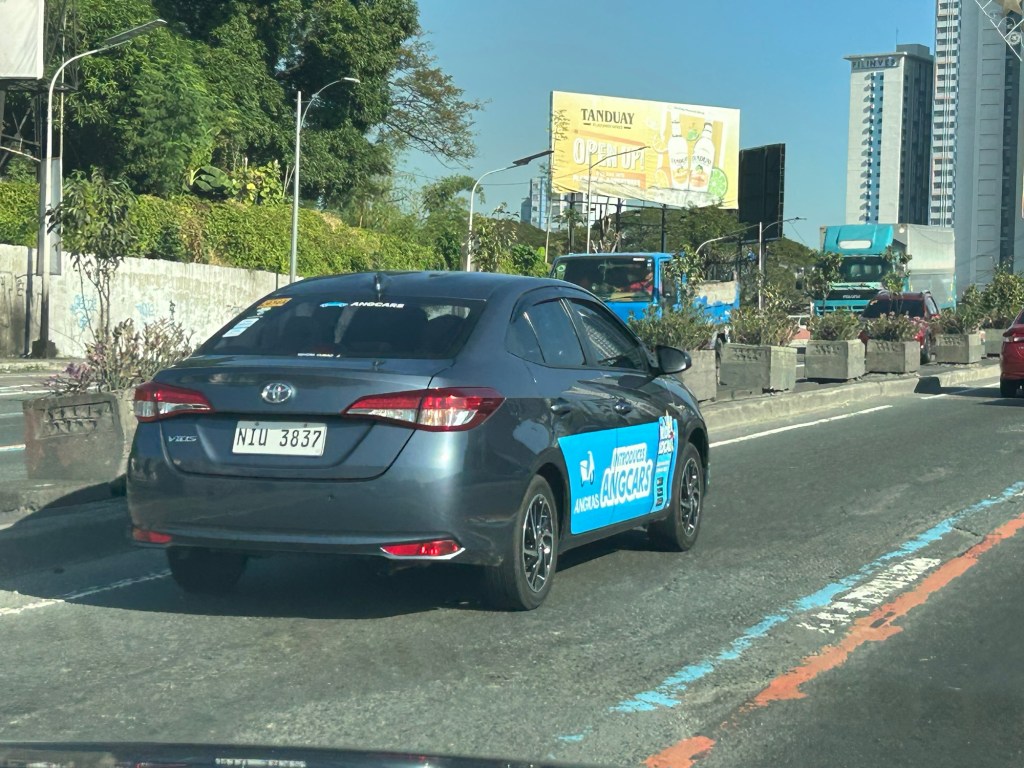
Whether people will take to these competitors for 4 or 2-wheelers so there is not an imbalance of market shares depends on public perception based on the cost and convenience, among other factors, of availing the services of these companies. Conditions may also vary depending on the cities. That is, situations may be different elsewhere like Cebu, Davao or Iloilo.
These modes, however, are still cars and motorcycles, and are regarded as private vehicles in terms of operational characteristics. Even if they are also public utility vehicles (they are for hire with fare rates), these represent a segment of private mode share. There is really a need to improve and improve and expand public transport services in order to retain or increase transit mode shares. Unfortunately, it takes a lot of time and resources to build railways so road-based public transport is still the main option where improvements need to be realized.
–
Street legal vehicle?
I saw this motorcycle being driven along the main road to the Shrine in Antipolo. It seems more like a toy than a mode of transport. Say what you will about people’s right to transportation but it is a risky mode to use as the user can be invisible to most motorists. And I’m talking about jeepneys, buses and trucks. Huwag na lang mga SUVs and cars since the mere mention of these trigger the “car-centric” reactions.
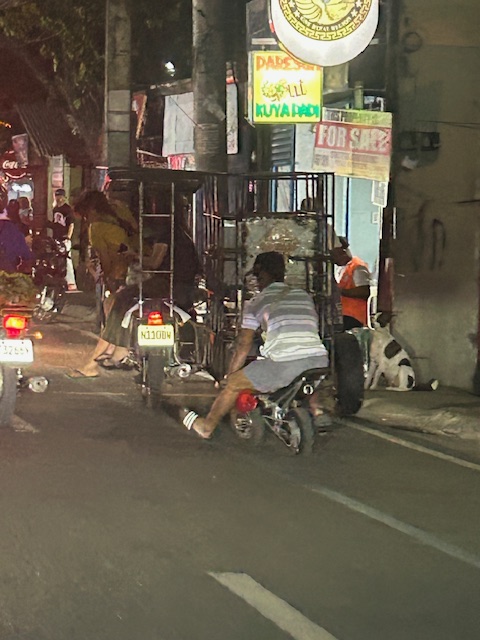 Rider seemed to be struggling with balancing on this “toy” transport. You can compare the rider to the trike in front of him.
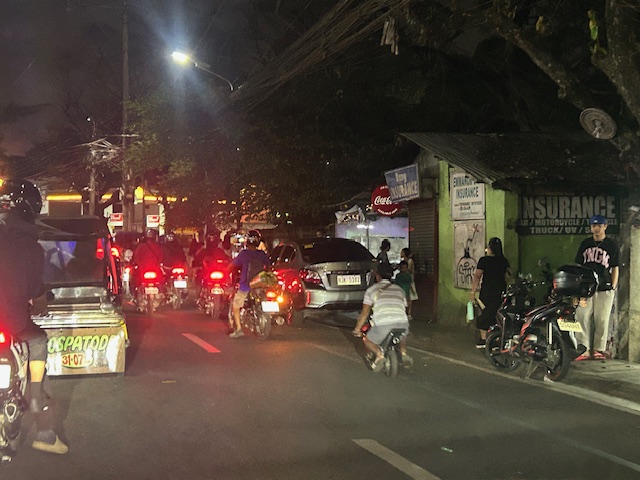 The rider and the vehicle in mixed traffic
I don’t think these can be classified as micromobilty. It would be a stretch. A colleague says these mini motorcycles are actually used for racing. We should draw the line between what is safe and unsafe given the conditions and situation along our streets rather than what is declared as the desired conditions. It is better to err on the side of safety rather than push for advocacy that will lead to road crashes involving these vehicles and their riders.
–
On how delivery culture is influencing policy and urban design
While discussing on-street parking policies and schemes with Naga City LGU officials, one comment was on providing parking space for delivery riders. Truly, delivery riders have become a significant consideration especially where they have no parking spaces to wait or sort their items. The following articles expounds on how the rise of delivery culture is influencing policy and urban design:
Franco, A. (November 14, 2025) “From edge to epicenter: How the curb became a key piece in modern cities,” Public Square, https://www.cnu.org/publicsquare/2025/11/05/edge-epicenter [Last accessed: 11/14/2025]
To quote from the article:
“Urban designers need to recognize that while our streets were once built exclusively for car movement and storage, they are inherently adaptable. The opportunity now is to make these spaces more equitable, accessible, and efficient for everyone, not just car owners with parking privileges. After all, the street and the curb are public spaces and should serve the diverse needs of all citizens.”
Traffic congestion along EDSA
I’ve taken some photos of EDSA traffic as well as the EDSA Carousel buses. Here are the more recent EDSA photos I took as I traveled from Makati to Quezon City after serving as a panelist in the Energy Transitions Dialogue last Wednesday.
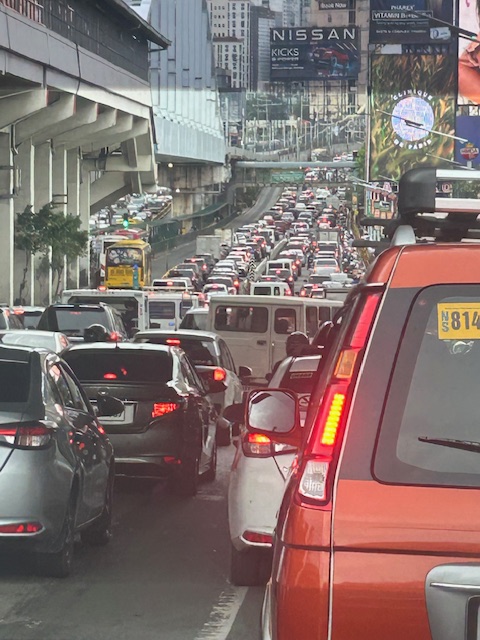 I took this photo as we passed Guadalupe. I like this in the sense that it shows the clear ROW for the EDSA Carousel buses. One wonders why most of these motorists would prefer to drive their vehicles rather than take the bus or the MRT.
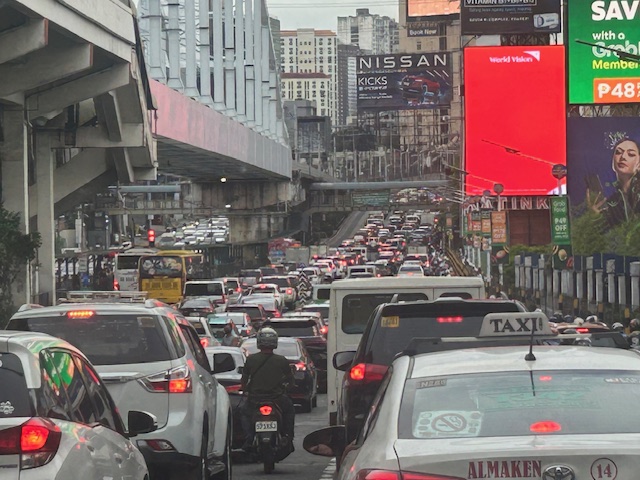 You can see in the photo that EDSA’s northbound side is clogged as far as the eye could see. If you check the image under the MRT bridge, it shows the southbound side was also congested. These photos were taken around 4 PM so this was still an hour before most people would be going home from work.
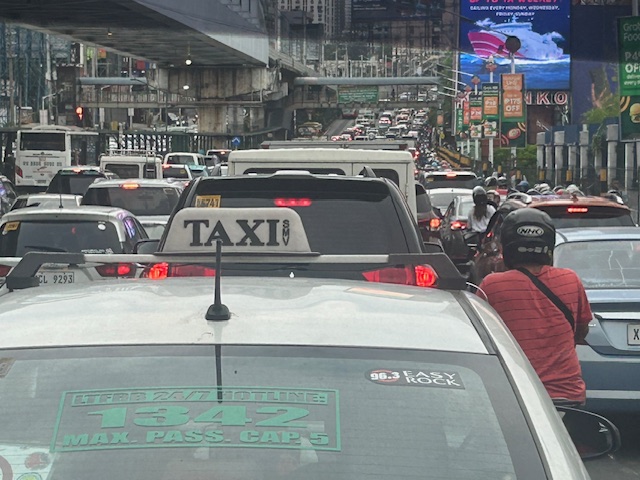 I mentioned in my comments at the panel that one consequence of giving number coding exemption to electric and hybrid vehicles is that this further diminishes the effectiveness (is it still effective?) of the MMDA’s number coding scheme. I don’t have the stats of how many EV’s and hybrids are registered and running in Metro Manila. Those numbers combined with actual counts will tell us how they are impacting traffic. That would be a nice topic for a paper. 🙂
The photos pretty much describe the transport situation in Metro Manila. Many of our major cities will be heading this way unless they improve their public transportation fast. If they do, then public transport mode share will be sustained if not increased. Metro Manila’s is already being eroded by inefficient public transport, motorcycles (including taxis) and perhaps unintentionally, electric and hybrid vehicles.
–
Quick comments on the NCAP
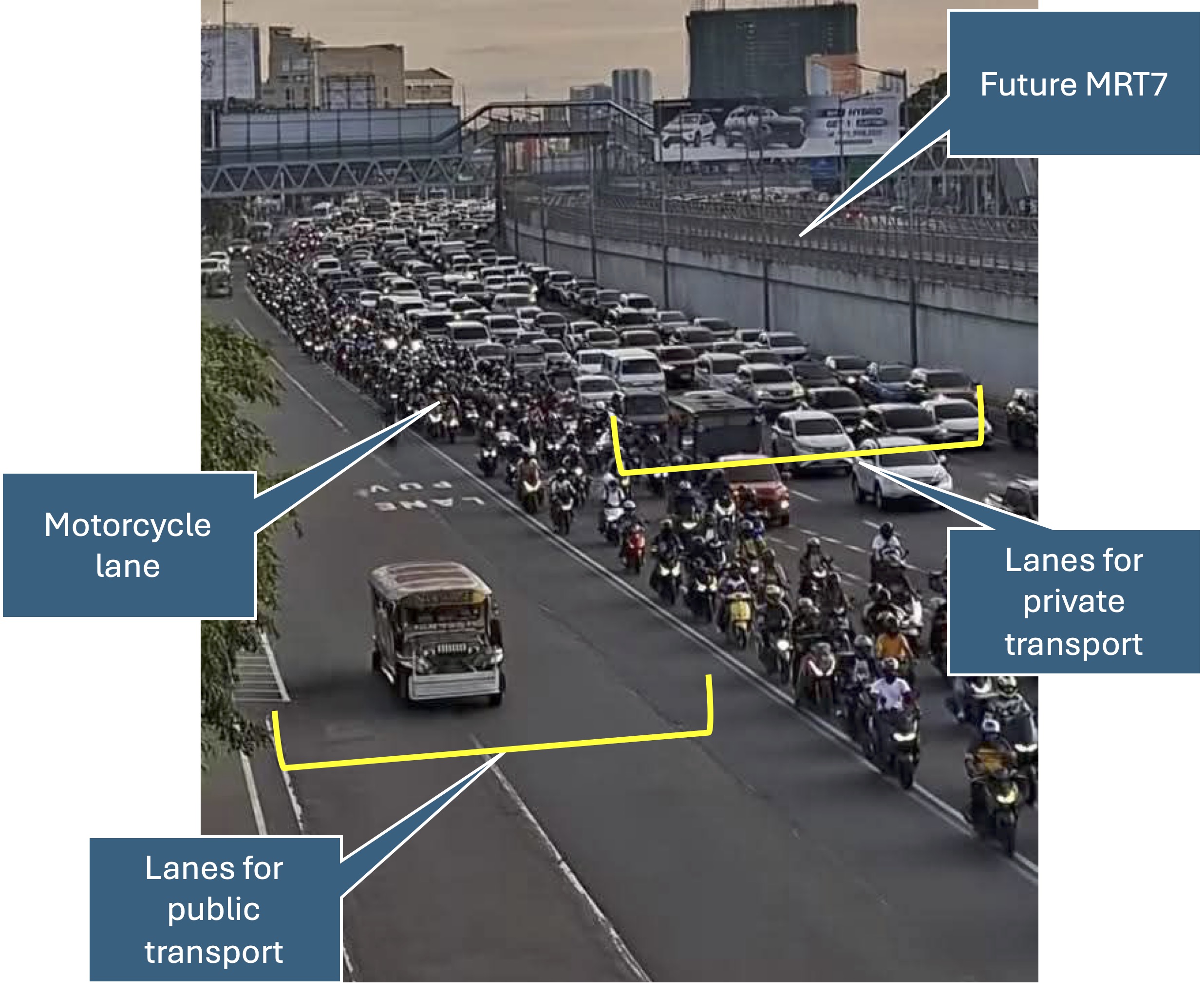
The No Contact Apprehension Policy (NCAP) is finally being implemented in Metro Manila. The results so far has been dramatic in terms of the number of violations recorded and the images being shared so far about how motorists are behaving. Below is one of those photos being shared on social media to which I added some annotations. I will use this later to comment on the NCAP and how we can use the outcomes to assess the transportation situation and determine what interventions can be done. Some are already obvious from the photo – the lack of public transport options lead to people depending on private motor vehicles like cars and motorcycles for their commutes. MRT7 is yet to be operational and road public transport has not been rationalized.
More on this topic soon!
–
Shared article on shared mobility
Here’s is a nice short read on a Sunday about shared mobility. The article is of particular interest to me because it tackles the needs of persons with disabilities, senior citizens and those in low income households.
Seruga, K. (April 14, 2025) “Shared mobility: Making travel easier for all,” Knowable Magazine, https://knowablemagazine.org/content/article/society/2025/increasing-access-to-shared-transportation [Last accessed: 27/04/2025]
“But if you’re disabled or elderly, living in a low-income area or — imagine! — without a smartphone or credit card, using these shared mobility services becomes a lot more difficult. They tend to cluster in more affluent urban areas, and are often inaccessible to people with reduced mobility or those traveling with young children needing child seats. In part because of these factors, users are disproportionately younger, wealthier, able-bodied, white and male.
Shared mobility could be a key part of a more sustainable transportation system. But to be most effective, it needs to include everyone. For-profit shared mobility providers have largely failed to deliver on this, but various initiatives and projects are finding creative solutions to reach underserved communities.
The potential benefits are large. On-demand shared mobility that feeds into well-developed public transportation systems could reduce the number of vehicles in some cities by 90 percent and cut transportation emissions by 50 percent — but only if it largely replaces private car use. “The car has to be a guest, not the main actor,” says Luis Martinez, lead modeler at the International Transport Forum, who coauthored a paper on shared mobility and sustainability in the 2024 Annual Review of Environment and Resources.”
There is a cautionary tale on ‘for-profit’ shared mobility here but a major difference in countries like the Philippines from those in western countries is the presence motorcycle taxis and the surge in the ownership of electric three-wheelers. These have changed the way people travel though their impacts are only now being assessed.
–
On reckless driving and riding, road rage, and kamotes
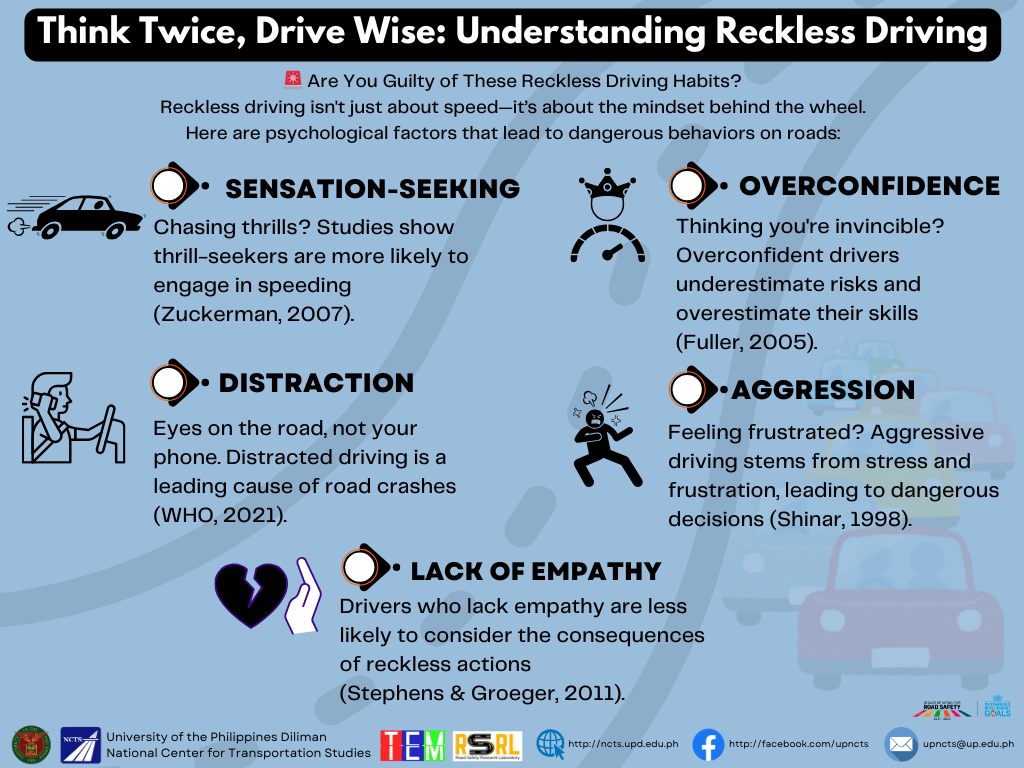
A story went viral a couple of weeks ago about a motorcycle rider getting shot by a driver. Many discussions and videos have been shared with some sympathetic to the driver and others to the riders. One thing is definite from the videos shared when you filter the commentaries and biased opinions – both the driver and the riders are guilty of reckless driving or riding. With all due respect to the root crop often invoked and associated with these kinds of motorists, kamotes as they are called seem to have increased no thanks to many of these learning to operate motor vehicles without being properly trained, oriented, evaluated and tested if they deserve having licenses. The increase and documentation of incidents of road rage should be taken very seriously by the LTO and serve as reference for improving the licensing system.
Here’s an informative material on reckless driving from the National Center for Transportation Studies’ Road Safety Research Laboratory:
This Holy Week, there are many who are using the roads whether for long distance travel (e.g., spending the holidays in their hometowns away from the metro) or for the typical religious trips (e.g., pilgrimages, Visita Iglesia, etc.). Motorists should exercise caution as they drive or ride. We should be more mindful of the impacts of our behavior to other travelers whom we share the roads with.
Safe travels to all!
–
Is the MMDA’s coding scheme still effective?
That’s actually a title of a paper or article I co-wrote before. At the time, which was over a decade ago, we were revisiting certain travel demand management (TDM) measures being implemented in Metro Manila. We already concluded that the effectiveness of the number coding scheme has been reduced mainly as people bought a second, third or more vehicles to be able to use any vehicle on coding days.
Since then, coding’s effectiveness continued to be eroded by a combination of increasing vehicle ownership (including more vehicles operating as ride hails) and the rapid increase of motorcycles.
More recently, government decided to give push for electric and hybrid vehicles. The MMDA made these coding exempt, which perhaps is an example of instituting a policy with unintended consequences. I say unintended here because the agency seems oblivious to the fact that people will likely get that second, third or more vehicle. And that will be an EV or hybrid. Manufacturers are already marketing these as ‘coding exempt’ and they are making a good sales pitch here.
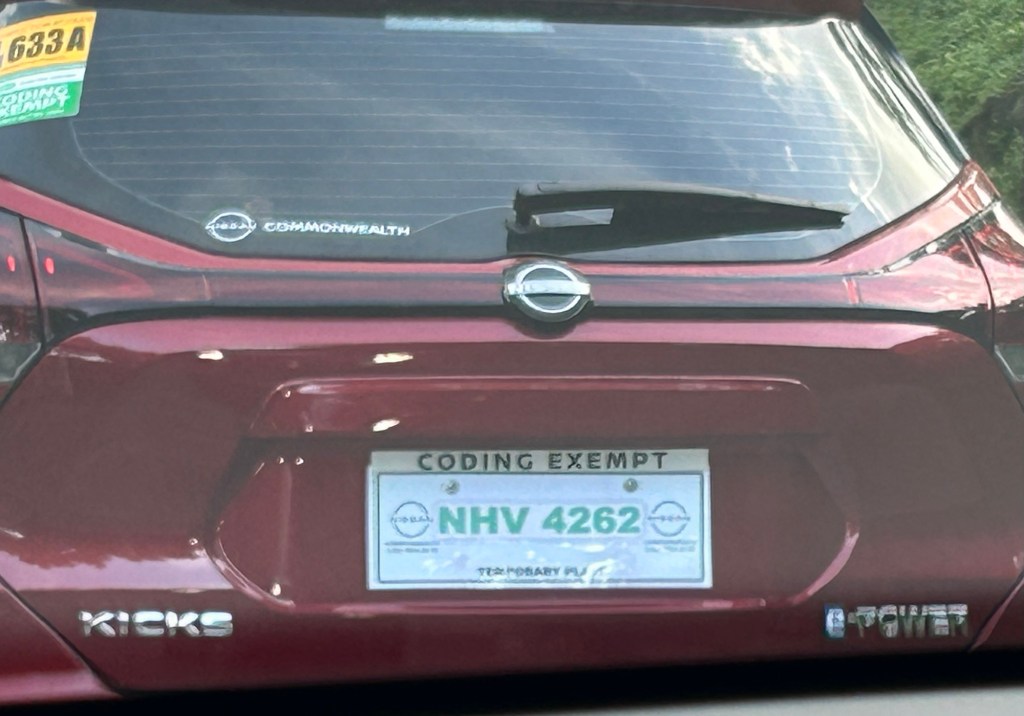
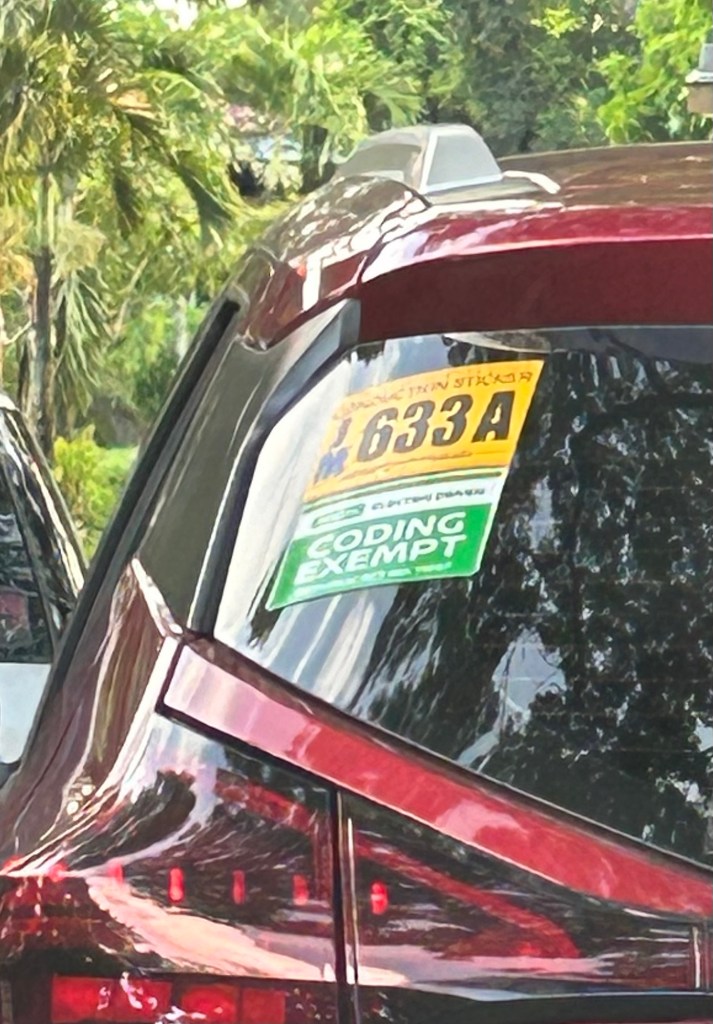
Maybe it’s time to revisit coding and re formulate it? But then coding wasn’t supposed to be sustained as long as it has. Government should be more aggressive and decisive for public transport in order to retain and increase mode shares that have also been reduced by more private vehicle and motorcycle use.
–
On ride hailing replacing more sustainable options for transport
We’ve long suspected that ride hailing or ride sharing is not as sustainable as their proponents and companies would project them to be. Here is more evidence showing how ride hailing has diminished other more sustainable transport options.
Kerlin, K. (August 28, 2024) “Half of Uber, Lyft Trips Replace More Sustainable Options,” UC Davis News, https://www.ucdavis.edu/news/half-uber-lyft-trips-replace-more-sustainable-options [Last accessed: 9/8/2024]
Quoting from the article:
“About 47% of the trips replaced a public transit, carpool, walking or cycling trip. An additional 5.8% of trips represented “induced travel,” meaning the person would not have made the trip were an Uber or Lyft unavailable. This suggests ride-hailing often tends to replace most sustainable transportation modes and leads to additional vehicle miles traveled. “
The article and the study by UC Davis is limited to their experiences with Uber and Lyft and perhaps others that employ cars. In our case, we have in addition motorcycle taxis or habal-habal that further takes away passengers from public and active transportation. Motorcycle taxis provide a very attractive alternative to conventional public transport modes as these are perceived to reduce travel times among other advantages they provide to users.
I will share some information later about the current mode shares in Metro Manila and how drastically public transport mode shares have been eroded post pandemic.
–
Technical sessions at the TSSP 2024 Conference
I am sharing here the latest draft of the technical sessions for the 30th Annual Conference of the Transportation Science Society of the Philippines (TSSP). The conference will be held in Iloilo City this coming September 13, 2024.
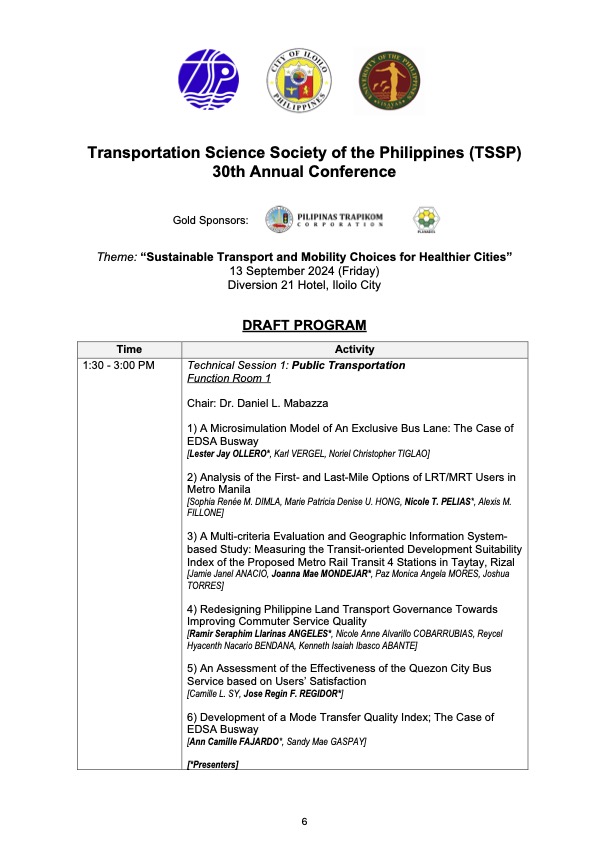
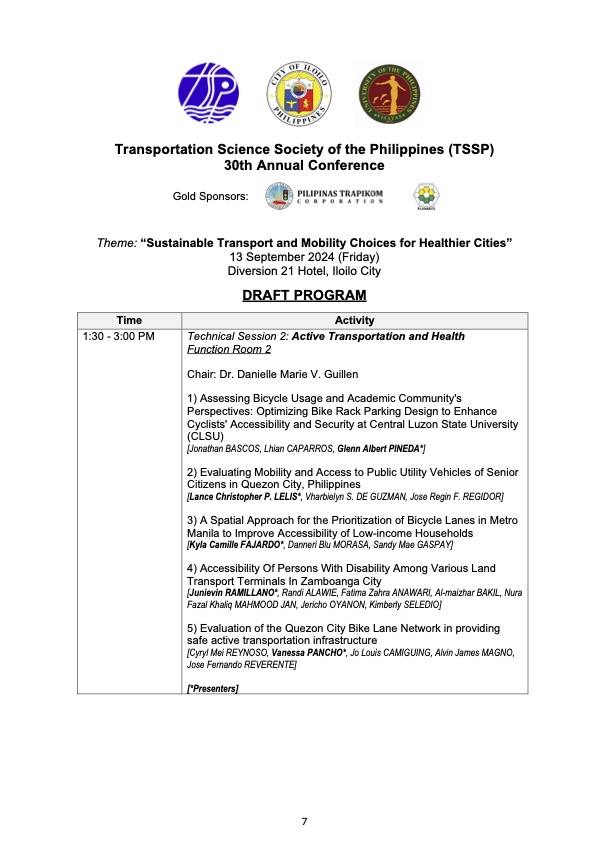
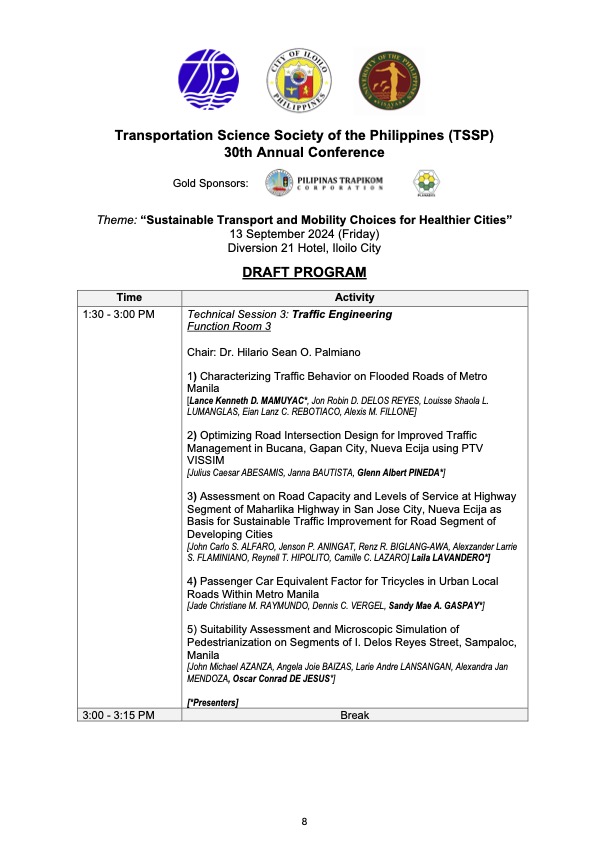
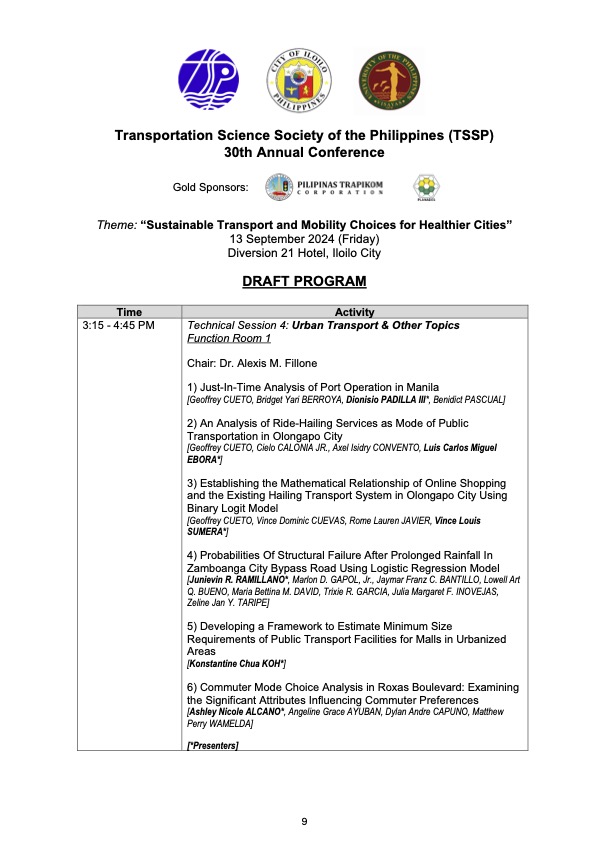
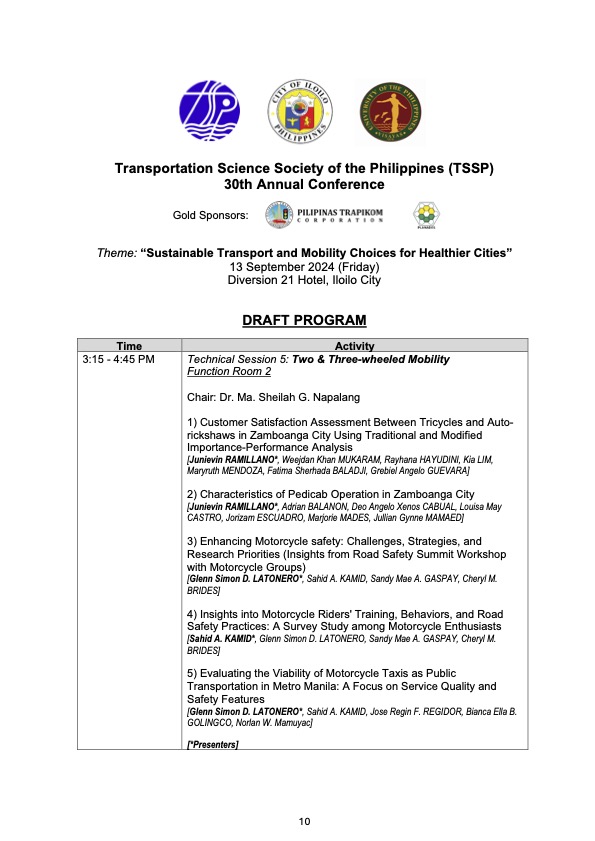
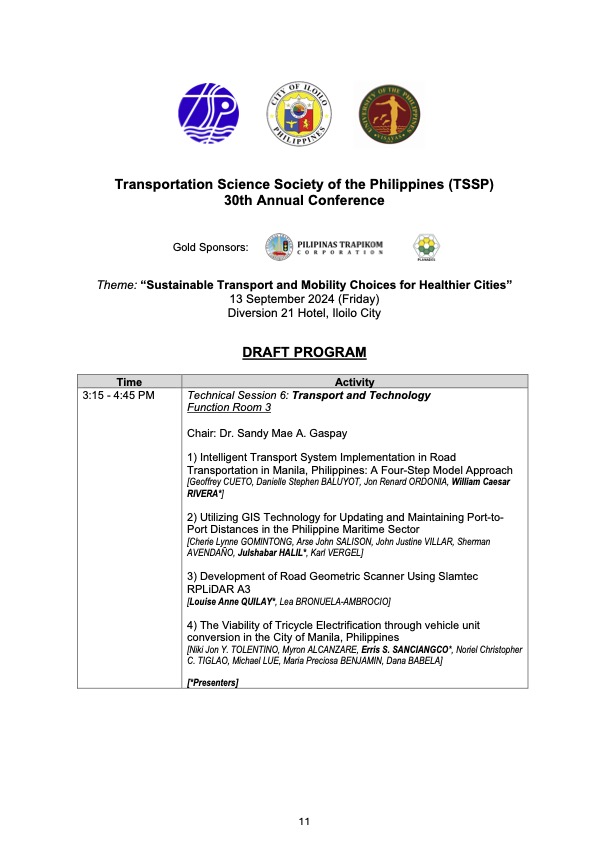
I will share the draft program for the morning plenary session in the next post.
–
 Caught (up) in traffic