
Home » NMT (Page 14)
Category Archives: NMT
On the future of city streets
Here is another article, this time on the future of city streets. I had been sharing many of the ideas related in the article in the Transportation Engineering courses that I handle including those pertaining to the Complete Streets concept and road diets. The article is good reading material for my students who need to get out of the box (so to speak) of traditional civil engineering thinking regarding highways and streets. That is, we need to do more people-centred rather than car-centric designs.
Davidson, J. (2018) “What Is a City Street? And What Will It Become?”. New York Magazine. http://nymag.com/daily/intelligencer/2018/01/what-is-a-city-street-and-what-will-it-become.html [Last accessed: 2/2/2018].
Here is a photo I took in Iloilo City a couple of years ago showing the bikeway along the Diversion Road. The facility then was underutilized but was supposed to represent, along with the Promenade along the river and the redevelopment of the old airport site in Mandurriao, the revitalisation of the city. Meanwhile, there have been little done for the downtown streets.

Iloilo City provides a good example of the need to have a more holistic transformation rather than have some exhibition or demonstration pieces for inclusive transport here and there.
–
Tacloban downtown in the early mornings
Mobilizing surveyors for traffic data collection in Tacloban City’s downtown, I took the opportunity to take some photos before 6:00AM. This was before most people were at work or school on the first good weather day in the city after a week of heavy rains that brought floods and landslides to parts of the city. Schools at all levels had been suspended earlier this week with government offices also closed last Monday.
 Zamora Street towards southeast and M.H. Del Pilar Street
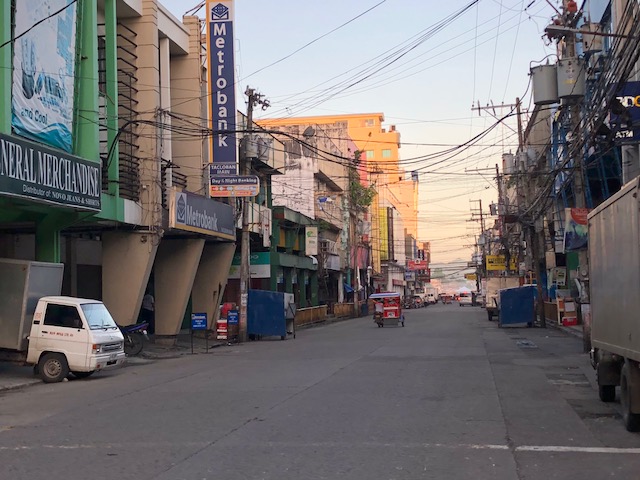 Zamora Street towards northwest and Salazar Street
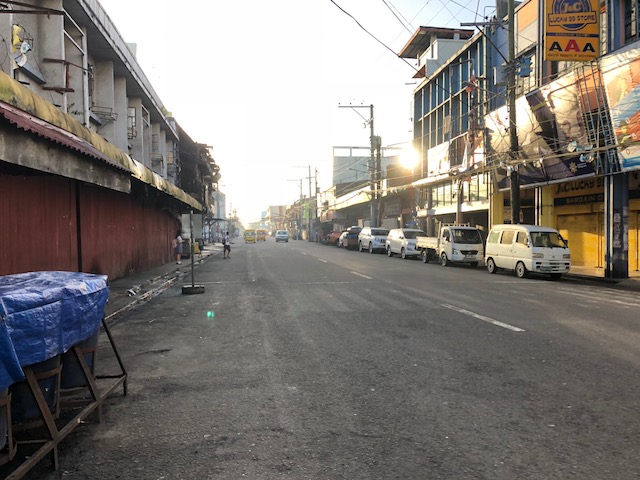 Justice Romualdez Street to southwest and M.H. Del Pilar Street
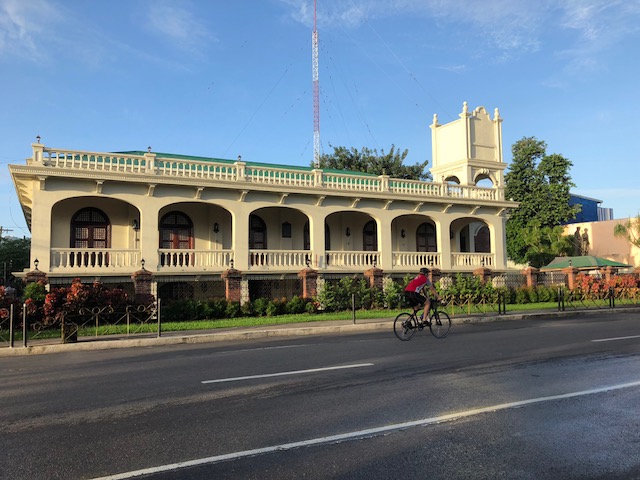 A lone cyclist along Justice Romualdez Street
There’s something about coming out to walk in the early morning in cities like Tacloban. You catch a city at a time before all the action happens, when everything seems so peaceful and calm when you see more people walking and cycling than motor vehicles dominating road space. That serenity should serve as an inspiration for what should be the vision for a city in order for it to retain its soul rather than lose it in what can be nightmarish traffic and transport conditions. Tacloban’s downtown holds so much promise for revitalisation but among the issues that need to be addressed is traffic-related. The city needs to recover spaces for pedestrians and cyclists while ensuring efficient traffic circulation for motor vehicles, particularly public transport. There seems to be spaces available for road diets and the creation of safe paths for people, and such design challenges need to be taken on in order to transform the downtown area into an example of sustainable transport.
–
New guidelines for bikeways
I want to share an article discussing new guidelines for bikeways released in the US.
Andersen, M. (2017) “Which Bike Lanes Should Be Protected? New Guide Offers Specifics,” Streets Blog USA, https://usa.streetsblog.org/2017/11/01/which-bike-lanes-should-be-protected-new-guide-offers-specifics/ (Last accessed 11/16/2017)
This is useful not only for practitioners or planners but also for academic purposes such as in transportation planning or engineering courses where future planners and engineers are molded.
–
Article on building support for walking and cycling infrastructure
There is another recent article on non-motorized transport (NMT). This is a good read and something that I think should be required for those who are little too serious or staunch about their advocacies.
Doyon, S. (2017) “Building support for walking and bicycling infrastructure” Public Square, A CNU Journal, https://www.cnu.org/publicsquare/2017/11/11/building-support-walking-and-bicycling-infrastructure (Last accessed 11/11/2017)
I believe that if you want to convince people to appreciate and support your cause, you should not take the hardline. Instead, there should be a more persuasive process for wooing people. This is especially true in transportation and the advocacies for walking and cycling. You will not get a lot of support, for example, by condemning car users and telling everyone they should bike instead.
–
Some recommended references for sustainable transportation design
We conclude the month of October with the following recommended readings:
- Designing Walkable Urban Thoroughfares: A Context Sensitive Approach, An ITE Recommended Practice, 2010
- Model Design Manual for Living Streets, 2011
- Smart Transportation Guidebook, Planning and Designing Highways and Streets that Support Sustainable and Livable Communities, 2008
While these are guidelines and manuals developed and published in the United States, the principles and much of the content and context are very much applicable here.
As an additional reference, here is the latest version of functional classifications for streets that is supposed to be context-sensitive:
- Stamatiadis, N., A. Kirk, D. Hartman, J. Jasper, S. Wright, M. King, and R. Chellman. 2017. An Expanded Functional Classification System for Highways and Streets. Pre- publication draft of NCHRP Research Report 855. Transportation Research Board, Washington, D.C.
–
TSSP 2017 Conference
The Transportation Science Society of the Philippines (TSSP) holds its 24th Annual Conference tomorrow, July 21, 2017. It will be held at the National Center for Transportation Studies at the University of the Philippines Diliman, Quezon City. More than a hundred participants are expected to attend this 1-day affair.
The final program for the conference may be found in the following link:
http://ncts.upd.edu.ph/tssp/index.php/2017/07/17/tssp-conference-program/
The theme for this year’s conference is “Improving Quality of Life in Urban and Rural Areas Through Inclusive Transportation.” This is also the theme for the panel discussion in the morning. The afternoon will feature four parallel technical sessions where 18 papers will be presented.
The keynote lecture will be delivered at the start of the conference by Prof. Tetsuo Yai of the Tokyo Institute of Technology, who is also the current President of the Eastern Asia Society for Transportation Studies (EASTS) under whose umbrella the TSSP is part of. TSSP is a founding member of EASTS and actually preceded EASTS by a year.
–
Ortigas Center walkways under construction
Currently under construction at the Ortigas Center are elevated walkways that are part of the Ortigas Greenways Project. Following are some photos I took a few weeks back (they’re old!), and so the current state should show significant progress from what is in the photos.
 Elevated walkways are currently under construction at the Ortigas Center. This part can be seen along Julia Vargas Ave. at the intersection with Garnet St.
 Structure at F. Ortigas, Jr.
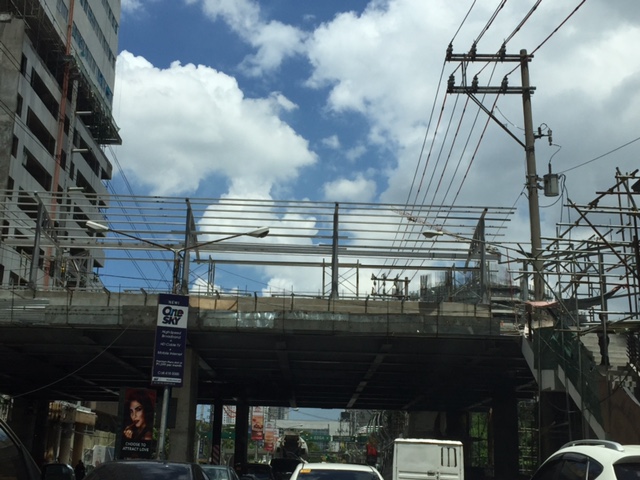 Close-up of the F. Ortigas part of the elevated walkways
 Walkway section under construction along the approach of ADB Ave./San Miguel Ave.
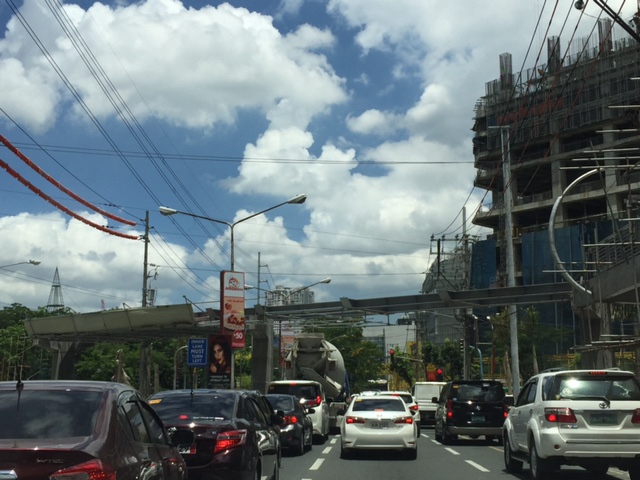 Crossing under construction at the intersection of Julia Vargas with San Miguel Ave. (to the left) and ADB Ave. (to the right).

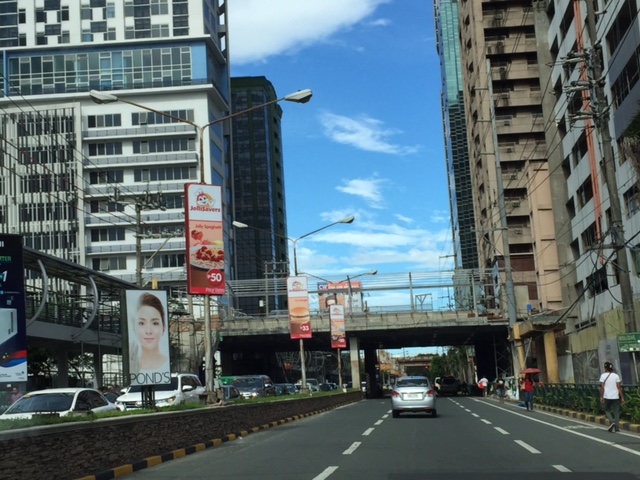 View of the F. Ortigas crossing walkway along the eastbound direction of Julia Vargas Ave.
This project is perhaps one of the most hyped pedestrian facilities in Metro Manila and if I recall right, the concept for this can be traced to workshops conducted during one of the Transport Forums organized by the Asian Development Bank (ADB), whose headquarters are located in Ortigas Center. It took a while to be realized but should be completed soon. This won’t be the first of its kind in Metro Manila as Makati already has one connecting office and residential buildings to Greenbelt and Glorietta. I really do hope it is able to reduce congestion in the area but this would require studies after the facilities are opened for public use. We need more of these around Metro Manila as well as other major cities. We direly need facilities to encourage walking as a preferred mode over motorized transport.
–
Challenges for students commuting to/from schools
Its our first day of school for our daughter today. But unlike her, I recall that I had to wake up early when I was in grade school and high school because the ‘service’ providing transport to and from school had to pick me up and then others. That usually meant a 5:30 AM wake up, a quick shower, dress-up (we wore uniforms) and breakfast before the ‘service’, an AUV, picked me up at home. School started at 7:30 AM and it took something like 45 minutes (depending on traffic) from our last pick-up to get to school at exactly 7:30. If our vehicle is able to finish pick-ups earlier, that meant we were assured of not being late for homeroom period. If the other kids (and there are many) are running late and we end up waiting longer for each, then we would likely be late. In many cases, our driver would have to resort to being reckless in order to make the time.
Nowadays, I think its much more difficult for kids due to the worsening traffic congestion. What was a 30 to 45-minute travel time between our home in Cainta to Pasig/Mandaluyong is now easily twice or longer that. And I am only referring to a direct trip. Even with Waze available, one can only have few options for routes between home and school.
While there are still many school ‘service’ vehicles (and not so many actually buses), many parents seem to have opted to Ateneo, for example, used to have a fleet of buses transporting students. These were replaced by AUVs and vans accredited by the school, and the many (too many?) private vehicles ferrying mostly individual students to and from their Quezon City campus.
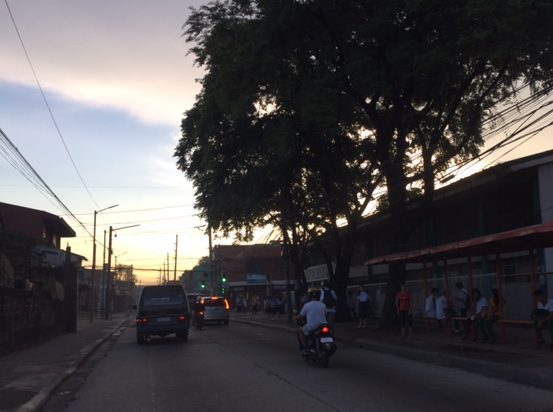 School children have to wake up early to go to school. Some probably take their breakfasts as baon in order to save time for traveling. Some take their breakfasts at nearby eateries or fast-food restaurants.
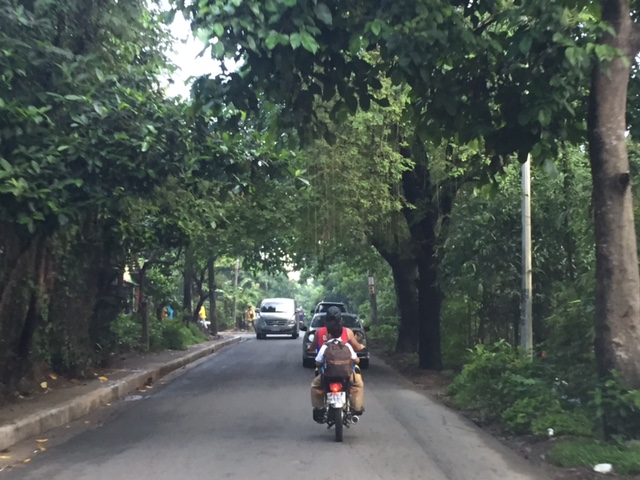 Many children may be at risk as they are ferried to school via motorcycles and usually without helmets. In other cases, there are tricycles acting as school service vehicles. Often these are overloaded with children and their school bags.
Pedestrian facilities are also lacking in many cases and particularly in rural areas where public schools are located along highways that have no sidewalks or cities where pedestrian walkways are not built to standards for one reason or another. These are issues that need to be addressed and would be nice topics for research, especially those with practical and safety applications.
–
Some articles on walking, biking and transit for wellness
Here are a couple of recent articles on walking, biking and transit:
Walk, bike, and transit benefits boost people of all incomes [McAnaney, P. in Greater Greater Washington, June 13, 2017]
“Bikes are happiness machines.” Behind the Handlebars with cyclist extraordinaire Joe Flood [Maisler, R. in Greater Greater Washington, June 7, 2017]
I posted these partly for future reference but also to promote walking, biking and public transport. These are essential elements for mobility anywhere and governments should ensure that people have these as options for traveling about and not be dependent on automobiles for transport.
–
On low income cyclists
There are two articles that I want to share here. These are quite interesting for me as they tackle something not usually written about when it comes to cycling. The “invisible biker” referred to in one of the articles is the typical low-income cyclist. These are those who can be seen regularly using their bicycles to commute to and from their workplaces; likely to save hard-earned money for more important items such as food and shelter (rent?). They do not use fancy bicycles like those nice, branded mountain, road or fat bikes that you see being used by recreational bikers or weekend cyclists. They most likely use second-hand bikes like those surplus bicycles from Japan, or perhaps old BMX’s that have been modified to make it a bit more comfortable for the long commutes.
Quednau, R. (2017) The Invisible Bike Riders, Strong Towns, http://www.strongtowns.org, May 2.
Koeppel, D. (2015) How Low-Income Cyclists Go Unnoticed, Bicycling, http://www.bicycling.com, November 9.
I think these are the bike riders that we should be providing safe bikeways for. They are the ones who most often use bicycles for their trips and are at risk of being hit by motor vehicles.
–

